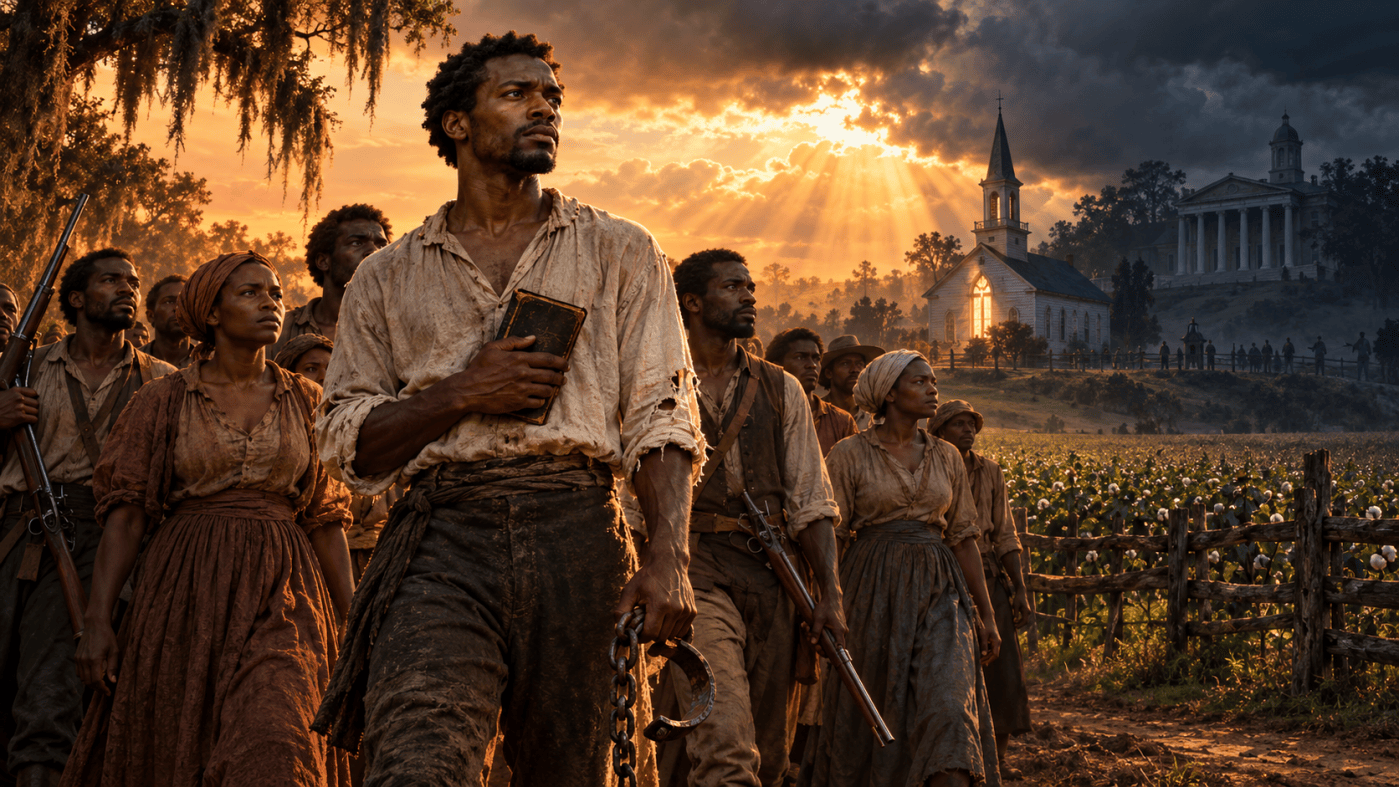
The slaveholding republic offered Nat Turner salvation while keeping the deed to his body. Reading Anthony E. Kaye’s Nat Turner, Black Prophet, completed by Gregory P. Downs, this review follows the faith that became a command to fight, the people who made that command a collective struggle, and the machinery of property, church, and state mobilized to crush it. It takes the book’s recovery of Turner’s religious world seriously while challenging interpretations that separate prophetic conviction from stolen labor, organized resistance, and the material demands of war. The masters could hang the prophet; their victory could never make them rightful owners of another human being.
By Prince Kapone | Weaponized Information | Weaponized Intellects Book Review | October 18, 2026
I. The Prophet Inside the Slaveholding Republic
The slaveholding republic had a place for Nat Turner: somebody’s property. He could work its fields, fill its citizens’ pockets, and listen while its preachers dressed obedience in the robes of Christian virtue. His labor belonged to a master; his future could pass from one hand to another in a dead man’s will. Then the man this republic claimed to own declared that God had commissioned him to wage war against it. In Southampton County, Virginia, in August 1831, people expected to bow their heads took up arms. The masters discovered that the Christianity they handed down to the enslaved carried a judgment against the very world they owned.
Anthony E. Kaye’s Nat Turner, Black Prophet: A Visionary History, completed by Gregory P. Downs and published in 2024, enters this conflict through Turner’s life as a believer and insurgent. The Introduction follows “his life as a Methodist, as a prophet, and as a man his followers called General.” The book moves through these connected roles. Turner learned his faith among Christians who recognized his soul while somebody held title to his body. He came to understand himself as a prophet answerable to a command no master could revoke. Carrying out that command meant gathering comrades who could confront the armed power that kept them enslaved.
The authors take his prophecy seriously: “a prophet literally heard the voice of God and acted upon it” (Introduction). Turner wasn’t presenting himself as a sharp observer with something useful to say about his people’s suffering. He believed he had received a commission. Through that conviction, an order that seemed immovable became a world that could be judged and overthrown. A master could wave a deed, recite the law, or call for men with guns. Turner believed a higher authority had ordered him to act. The republic could produce all the paperwork it pleased; it couldn’t make that command disappear.
The book roots this challenge in the history of the country that claimed to own him. “The newly formed United States expelled Native people and protected the expansion of slavery into the backcountry,” the authors write in Chapter 1. The land was seized from Indigenous peoples; the wealth was wrung from enslaved labor. Government, law, and armed force guarded the proceeds. Here was the class content of the republic’s freedom: the owners enjoyed rights over the people whose work kept them wealthy. For those forced to do that work, emancipation meant breaking the chains the nation had stamped with the seal of law.
Black people in Turner’s region had already fought to break those chains. Chapter 1 follows enslaved Virginians who escaped toward British forces during the Revolutionary War and the War of 1812, seeking openings to fight their enslavers and win their freedom. Some understood deliverance through Exodus. Moses Wilkinson, an enslaved Methodist preacher, joined biblical hope to the possibilities war had opened. The Crown had its purposes; the enslaved had their own. Their actions tear through the fraud that passes off the American slaveholder’s independence as everybody’s liberation. From the fields, the patriotic festivities could look like a master throwing himself a party because nobody stood over him anymore.
This history gives Turner predecessors without reducing his calling to somebody else’s script. He grew up in a countryside where armed Black struggle remained within living memory, where the language of scripture could give voice to the destruction of bondage. His own appeal to divine authority took shape inside the republic those earlier wars had helped establish. By 1831, slaveholders had dug themselves deep into political power. Turner’s commission declared an authority they neither owned nor controlled. At stake was the power to command the lives and labor of the enslaved, and the power of the enslaved to rise together and destroy that command.
The authors make a decisive choice when they declare that “this work treats rebellion not as a crime but as an act of war” (Introduction). An account of crime takes its seat in the slaveholder’s courthouse and asks what got into his property. A history of war follows people fighting to end their subjection: choosing comrades, securing food and weapons, moving across the countryside, and confronting an organized enemy. Turner and his company enter history as people making their own struggle for emancipation. The slaveholder’s law cannot make owning another human being just, however solemnly its judges pronounce the sentence. Nor can it turn resistance to that ownership into a sickness for respectable people to diagnose.
The book’s greatest strength is that it brings prophetic conviction into the practical work of struggle. Its evidence follows religious understanding through teaching, ownership, kinship, and community, until belief gathers force in collective action. Its interpretation falters where it pulls religion away from the very relations through which it lived and acted. A revolutionary reading carries the book’s strongest history further: Turner’s faith helped sanction a struggle that the enslaved had to organize against masters with property, connections, and guns. The Gospel of the Oppressed became dangerous when the enslaved claimed the right to put it into practice. That conflict began close to home, among Christians willing to welcome Turner into their fellowship while keeping him in their chains.
II. The Church That Taught Him Christ and Kept Him Enslaved
“The white Turner family would lead him to Christ but not to freedom,” the authors write in Chapter 2. Salvation reached the plantation; emancipation stopped at the gate. The people who helped introduce Turner to Christianity kept the power to command his labor and dispose of his body. They could welcome him as a believer and keep him on the books as an asset. His conversion cost them nothing in property. Equality before God was an agreeable doctrine so long as God left the ownership papers alone.
Christian fellowship grew inside this machinery of domination. The household that helped cultivate Turner’s faith also decided where he worked and whether he could leave. Religious teaching passed between people whom the law divided into owner and owned. Turner could learn that his life had sacred worth while his freedom remained hostage to somebody else’s investment. The master could call him brother on Sunday and put him back to work on Monday. The church found room for both, and the enslaved paid for the arrangement.
Kaye with Downs trace how Methodism made this bargain easier to keep. The denomination moved toward “making slavery a question of individual conscience, encouraging but not requiring manumission” (Chapter 2). Encouragement asked nothing the owner couldn’t refuse. A binding rule would have made Christian membership answerable for the human beings a member claimed to own. Retreat into individual conscience let the church condemn slavery in principle while sheltering slaveholders in practice. Freedom became a charitable gift requiring the thief’s consent. The person whose stolen labor enriched him was left to wait for a generous mood.
This retreat took shape through fights over church policy, concessions to regional slaveholding power, and restrictions weakened by exceptions. Lewis Marshall Hagood’s Black denominational history reproduces proceedings in which proposals to restrict slaveholding could be defeated while conditional rules survived. The church was bargaining over how much its opposition to slavery would actually require its members to do. Christian profession had reached the question of cost. Slaveholders stood to lose valuable property through emancipation, so the institution made room for them and sent the bill to the people they owned.
Nathan Bangs’s account of suspension lays the bargain bare. The church could suspend a rule against slavery and keep its formal abhorrence intact. Bangs defended the retreat as institutional prudence: preserving the church’s ability to carry on its work justified easing the demand on slaveholding members. The owners kept the people whose labor and sale sustained their wealth. The church kept its freedom of action. A splendid division of Christian sacrifice: the institution supplied the explanation, and the enslaved supplied everything else.
The bargain even reached the printed page. Abel Stevens’s later denominational history describes a separately printed spiritual portion of the Methodist Discipline for enslaved readers that left out the slavery rules. The separation of heavenly instruction from earthly bondage had become a publishing policy. Enslaved Christians could read what the church prescribed for their souls while being denied its rules about their captivity. Those who controlled the teaching also controlled which obligations of the institution the enslaved were allowed to know.
This accommodation helped keep stolen labor flowing into slaveholders’ hands. Condemnation remained available for sermons; ownership remained protected in practice. An enslaved person appealing to Christian duty faced a church increasingly prepared to leave freedom to the conscience of the person profiting from its denial. The moral question could wait indefinitely. The property claim could be enforced at once. Owners were granted all the time they needed to search their souls while the people they owned kept working.
The book follows the survival of that power through changes in Turner’s ownership and control. Death, inheritance, trusts, and hiring could change the person giving orders without ending anyone’s right to give them. An owner’s death could bind Turner’s future to provisions made for surviving relatives. Hiring could send him to work for one person while another retained the claim to his body. Bondage renewed itself through the ordinary business of managing family wealth. Other people planned their futures with his life.
“Several people could have freed him; none did,” the authors conclude (Chapter 2). One person after another had the chance to surrender control and chose to keep it. Some knew Turner well enough to recognize his abilities and the seriousness of his faith. Knowing the man didn’t make them relinquish the property. His freedom demanded that somebody give up an asset, abandon a claim, or break with an arrangement backed by law. The obstacle had names, signatures, and legal instruments. It could hardly be removed by a warm feeling in a Christian heart.
Within these conditions, the authors suggest that Turner’s family “appears to have opened a subtle high-stakes negotiation” (Chapter 2). This is their reconstruction: relatives may have used religious intimacy to press the owning family toward freedom. Such an effort would show captive people working whatever opening they could find. But the power to decide remained with the owner. Turner’s family could build trust, invoke Christian duty, and appeal to promises; the person holding title could still say no. Fellowship gave their demand a moral claim while leaving the means of enforcing it in the enemy’s hands.
Frederick Douglass later turned Christian language against slaveholding religion in the appendix to his Narrative. His distinction between Christ’s Christianity and its slaveholding American practice challenged the enslaver’s claim to speak for the faith. The people crushed beneath that authority could bring its pretensions before the teachings it professed to uphold. Douglass spoke from his own experience. His argument also reveals a weapon within Black Christian thought: the master’s profession of faith could be entered as evidence against him.
Turner’s faith developed on this contested ground. The church taught him to recognize divine authority while accommodating men and women who claimed authority over his body. Its own teachings supplied grounds for judging their command intolerable. A religion owners expected to secure obedience could become an indictment of ownership. That judgment grew through people measuring what they were taught against what they lived: labor stolen, movement controlled, freedom deferred, families left at the mercy of somebody else’s decision.
The book digs beneath the hypocrisy to show how the institution worked. The church preserved fellowship by easing the demands it placed on slaveholders. Owners kept the fruits of exploitation; emancipation waited on their goodwill. For Turner, the people who spoke of salvation still dictated the terms of captivity. A command from God carried an authority they could neither grant nor withdraw. The church had helped teach him that earthly masters could be judged. Now the question was what carrying out that judgment would demand.
III. A Calling No Master Could Authorize
“Nat understood the call to war because he was enslaved and because he was a Methodist,” the authors write in Chapter 3. In that conjunction, the book gets to the roots of revolutionary consciousness. Turner learned his faith under bondage and came to understand it as a command to rise against bondage. Slavery gave that calling an enemy he knew through the daily theft of his own life. Methodism gave him teachings, practices, and expectations through which he could recognize a divine commission. The masters’ lawful authority now stood before a judgment they couldn’t issue, revoke, or appeal.
The road to that conviction ran through retreat and struggle. Turner escaped, then returned. The book understands his return through his effort to distinguish the freedom he wanted immediately from the duty he believed God had laid upon him. “Nat had to discern the distinction between being enslaved to a man and accepting submission to God,” the authors argue (Chapter 3). In their reconstruction, the master got Turner back without winning his allegiance. The man returned to work carrying a purpose that threatened the very power putting him to work.
For the enslaver, obedience meant labor delivered and orders carried out. Turner’s account placed obedience under an authority the master couldn’t command. Answering God might require endurance, preparation, or action whose purpose no inspection of the fields could reveal. Beneath the familiar appearance of plantation work, a dangerous conviction could grow: the person whose labor was being stolen understood himself as preparing to answer a command against the theft. The owner could force his body into the field. He couldn’t force that body’s presence to mean consent.
Other enslaved people challenged Turner’s return. Had they possessed his intelligence, they reportedly told him, “they would not serve any master in the world” (Chapter 3). Their criticism belongs to the struggle for freedom as surely as his calling does. They measured his decision against the opening his escape had given him. They could recognize his abilities and still think he was wrong; they had minds of their own before the prophet spoke. These were captive people arguing over how to get free when a bad decision could cost a life. Turner would have to build his authority among people whose judgment no declaration of prophecy could simply overrule.
The authors turn inward to explain why revelation didn’t bring immediate action. “The plausible explanation is that he lacked faith even if he could not quite admit it,” they propose (Chapter 3). A man who believed himself commanded to confront slaveholding power had plenty to fear. But a delay cannot tell us, by itself, what he secretly believed. Organizing took time; danger was real; signs had to be interpreted; other people had to decide whether they would act. The book gives us a prophet who could be frightened. When it claims to know what he couldn’t admit, it asks the evidence to confess more than it contains.
The struggle over religious authority comes into sharper view in Turner’s account of baptism with the white believer Etheldred Brantley. “The white people would not let us,” he reportedly said (Chapter 4). An enslaved Black man acting upon his faith alongside a white convert ran into people accustomed to deciding what Black people could do. Their control reached into a rite proclaimed sacred. Christianity became ground over which authority had to be fought. In Virginia, even a command from heaven was expected to clear the white man’s desk.
Turner’s reported commission carried the conflict beyond the policing of a religious rite. The Spirit told him that Christ had laid down the yoke borne for human sins, and “that I should take it on and fight against the Serpent” (Chapter 4). Here was a burden to shoulder and an enemy to fight. Turner understood himself as called to act within the sacred history he had learned. Fighting formed part of the duty itself. The master might claim to own his life, but that claim couldn’t extinguish the obligations Turner believed his life now carried.
The approaching moment would bring a world in which “the first should be last and the last should be first” (Chapter 4). First and last were no abstractions in Turner’s Virginia. The first commanded labor and passed human beings down through their wills. The last could be sold to settle somebody else’s debts. Reversal struck at the foundations of that order, at its claim to endure because law and custom said it should. From below, divine judgment could announce the sentence against a world built on bondage. Those ordered to accept their place could hear a summons to overturn it.
Kaye with Downs read the commission through Revelation and the anticipated return of Christ. “At stake was not only the end of slavery but also the end of the world,” they write (Chapter 4). In their interpretation, Turner’s war would help usher in a new sacred age. Biblical history remained unfinished, and the enslaved could become actors in its unfolding. Turner’s attributed words establish the command to fight and the promise of an approaching reversal. The fuller account of his place in the apocalypse belongs to the authors’ reconstruction; its claims must stand on the evidence they can bring to it.
The revolutionary force of the calling is already there. Turner needed no constitutional blueprint to place the slaveholding republic under judgment. His commission subjected the master to an authority that could condemn and destroy his command. The promise of a transformed world meant that this world could end. For people taught that bondage was their permanent condition, that conviction opened a breach in the walls. Slaveholders arranged tomorrow through debts, wills, and inheritance. The prophet saw a tomorrow in which their arrangements could be swept away.
David Walker’s Appeal to the Coloured Citizens brings divine judgment down upon the wealth wrung from Black labor. His Christian indictment confronts those fattened by oppression and calls the oppressed to act. There’s no evidence that Turner read the Appeal. Walker nevertheless shows a Black political language alive in the same period, joining sacred obligation to a clear understanding of exploitation. Belief in God required no blindness about who had stolen the fruits of one’s work. The stolen labor itself demanded judgment.
Amílcar Cabral’s account of culture and liberation helps us understand how ideas inherited under domination can become weapons against it. People learn to understand the world within definite historical relationships, then act through that understanding to change the world they inhabit. Turner’s Methodist formation remained living material in his thought. He could turn its teachings against the authority of those who had taught him. The faith brought into the slaveholding household could return as an indictment of its owners. The man instructed to obey could discover an obligation to fight.
Here was the danger growing inside Turner’s calling: a duty beyond the master’s permission that had to be carried out on the ground the master ruled. Fulfilling it meant finding people prepared to risk their lives beside him. Revelation could tell Turner what he must do. Building a company demanded trust, persuasion, food, knowledge, and the independent decisions of other enslaved people. The burden he believed God had placed upon him was becoming a collective struggle. Its strength would depend on the hands willing to take it up.
Rewrite this to sound more human and proletarian, in the poetic and militant eloquence of Vijay Prashad, with the political clarity and intellectual precision of Michael Parenti, the scathing sarcasm of Karl Marx, and the guerilla intellectual grounding of Walter Rondey. Remove the liberal framing and bourgeois nuances. Do not change anything else.
V. Surprise Met the Power of Property
Turner’s calling brought him onto ground where “his prophecy would require generalship” (Chapter 6). The company needed recruits, weapons, routes, and decisions that would keep its people alive to fight again. In the authors’ account, Turner maneuvered, refusing to spend his remaining strength against every obstacle in his path. He searched for scattered fighters, worked to rebuild his numbers, and changed direction when armed white resistance blocked the way. His divine commission gave the struggle its purpose. Waging it demanded a hard reckoning with the people, weapons, and possibilities before him.
After the fighting at Parker’s, Turner tried to gather enough people to advance toward Jerusalem. Former members of the company had scattered. His efforts along a private way failed to bring sufficient numbers together, and white men held Cypress Bridge. He changed course. Here was a commander responding to a shifting balance of force. The road to his objective ran through Virginia, where the enemy could seize a crossing and close it with guns. Faith supplied no passage around that fact.
The authors put their finger on the pressure bearing down upon him: “Perhaps Nat’s recruiting was doomed by the very thing that fueled his early success: surprise” (Chapter 6). Secrecy had kept the preparations from the masters. It had also kept most enslaved people outside the plan. The company reached people who hadn’t yet heard its intentions, judged its leadership, or decided whether to join. The secrecy that protected the first blow made it harder to gather the force needed for the next.
People confronted the uprising with decisions still before them. The book records signs that some were willing to join if the company arrived at a plantation in force, rather than set out alone to find it. Numbers and proximity mattered. Joining an armed company at hand offered a different prospect from crossing hostile ground alone while slaveholders gathered their weapons. The insurgents had to show strength to win the people who could make them stronger. Their “rebellion depended on success to attract new people” (Chapter 6).
Time tightened the trap. A larger company could give others confidence to join, but gathering recruits gave white reinforcements time to assemble. By Tuesday morning, the book reports, cavalry from neighboring Greensville County had reached the Cross Keys area. Turner was struggling to rebuild his force while the enemy enlarged its own. Every encounter had to yield enough confidence and fighting strength to keep the uprising moving before the defenders of slavery could mass the arms to crush it.
The defenders entered this struggle with advantages built long before the alarm sounded. Enslaved people forged and sustained relationships, but “they could not prevent enslavers from selling away their family members” (Chapter 7). The continuity of their lives lay at another person’s disposal. A debt to settle, a better price to collect, and an owner could tear apart the daily contact through which people learned to trust one another. The damage reached into the foundations of resistance. Those forced to rebuild their ties had to organize against a class whose ordinary property rights included the power to scatter them.
Against that imposed insecurity, the authors set the white networks built through “long-standing, cultivated property ownership” (Chapter 7). Land, inheritance, and legally protected marriage bound white households across generations and distances. John Vick, for example, received forty-two acres through his marriage to Patience Jordan. Intermarriage joined neighboring families; property helped anchor those connections. Enslaved people built profound bonds of kinship under conditions that denied them control over the people and places sustaining those bonds. The law stood ready to defend the man who broke their families apart.
Churches carried white connections beyond the household. The authors describe congregations formed around interrelated families and the ties they extended among wider kin groups. Institutions that policed behavior also kept people acquainted, renewed obligations, and gave them places to recognize one another as members of the same social world. Armed white men could draw upon relationships sustained by protected households, property, and public authority. Turner’s company had to widen its circle of trust in the middle of a war. Its enemies could call upon connections cultivated over years.
Property furnished the masters with more than a reason to fight. It helped give them the means. The same ownership that secured their command over labor strengthened the relationships through which they defended that command. Enslaved people built communities under the permanent threat of sale and forced separation. When war came, these accumulated inequalities entered the field with them. The masters hadn’t needed to devise every obstacle Turner encountered. The ordinary business of owning human beings had already helped prepare the ground against him.
Here was the class power behind the campaign’s unequal reach. The defenders summoned resources from an order already standing. The insurgents had to build a force capable of breaking it while fighting their way through it. Courage couldn’t conjure reinforcements. Knowing a neighborhood couldn’t instantly produce trusted comrades across a county. The book gives defeat a history deeper than a commander’s shortcomings. Domination builds the means of its own defense while attacking the relationships through which the dominated might organize to destroy it.
Comparison brings Southampton’s particular conditions into sharper view. Christian Høgsbjerg’s history of Demerara places religious organization alongside plantation labor, grievances over work, and communication among the enslaved. It also records efforts to restrain killing. Nigel Westmaas’s Guyanese retrospective puts enslaved people’s initiative at the center of the conflict between labor and capital. Christian conviction entered a different arrangement of work, organization, and tactical decisions. Calling a rebellion religious tells us too little about how its people came together or why they fought as they did.
The Jamaican account of Sam Sharpe brings another difference into view: a planned refusal to work preceded the conflict’s wider development. The labor the owners compelled could become a weapon when the laborers withheld it. Set beside Southampton, this raises questions the label of religious rebellion cannot answer. How were people connected? What could they organize together? What demands could they enforce, and how could they break the owners’ command? Belief entered struggles whose possibilities were shaped by these material relations.
These comparisons offer no ready-made plan Turner could have lifted from another struggle and carried to victory. They show why the organization of labor, the reach of trusted relationships, and the enemy’s resources belong at the heart of the explanation. In Southampton, surprise opened a breach before wider preparation had become possible. Keeping it open demanded a growing company. Meanwhile, the slaveholding order mobilized through relationships the insurgents were still struggling to build. Turner made his decisions inside this contest over time and strength.
Kaye with Downs recover the intelligence of a commander working to meet those demands. Their account also lays bare the material weight of the power arrayed against him. The masters won through people, weapons, property, and institutions. Heaven had supplied no certificate of approval. Breaking the armed company still left them with the task of forcing obedience from the living. Behind the militia and mounted men came magistrates, testimony, sentences, and restrictions on who could gather or preach. The class that claimed the labor of the enslaved now claimed the right to sit in judgment over their war for freedom.
VI. The Court Preserved Slavery; the Archive Preserved a Voice
Breaking the armed company wasn’t enough. The slaveholders had to force their command back into the lives of those who survived. Kaye with Downs describe “a shift from extralegal terror to legal hegemony” (Chapter 7): repression moved into courtrooms, where magistrates sorted accusations, handed down punishments, and secured property. Curbing uncontrolled killing served the same purpose. Owners had no wish to let armed white men destroy the human beings they counted among their assets. A life could be spared so its owner could keep consuming it through forced labor.
“The law was sufficient to protect slavery,” the authors write in Chapter 9. There goes the comforting fiction that legality stood above the struggle. A slaveholding court could observe its procedures faithfully and carry out the work of counterrevolution. Judges chose whom to hang, whose testimony to believe, and which accusations to stamp with the authority of a verdict. The order that made a human being saleable now sat in judgment over his resistance. Justice arrived in court with the master’s title already in its pocket.
Turner’s November 5 trial record compresses that arrangement into a few terrible entries: a plea of not guilty, a conviction, a sentence of hanging, and a valuation of $375. He was a person when the court needed someone to punish and property when it came time to reckon the owner’s loss. His fight for freedom became a crime before an institution charged with defending his captivity. The court’s orderly accounting laid the barbarism bare.
Virginia’s lawmakers carried the counterattack beyond those accused of taking up arms. The March 1832 statute restricted Black preaching and leadership of meetings, punished attendance at Black-led instruction, and restricted arms. Specified forms of white-controlled worship remained permissible. Christianity could carry on with the master watching; independent Black religious authority had to be suppressed. A person allowed to hear the Gospel could be forbidden to lead others in understanding it. The lawmakers knew that a congregation might become something more dangerous than an obedient audience.
These measures struck at the means by which people learned to think and act together. Preaching could establish authority. Meetings brought people into contact. Instruction carried knowledge beyond the reach of a single household’s command. Restricting them helped secure the owners’ grip on labor and movement. Faced with a rebellion voiced through religion, the state attacked the gatherings, teaching, and relationships that could turn conviction into collective power. The self-appointed guardians of civilization were frightened of what the people working their fields might say when no white man was listening.
The machinery of punishment also shaped the record left behind. Accusations and testimony were collected to establish guilt, dispose of defendants, and restore obedience. The authorities’ questions helped decide which relationships would become visible to history. A woman might appear only through somebody else’s description of an encounter. A child’s words might reach the page through an adult’s account. Silence could protect people while leaving an absence whose meaning we cannot securely recover. The power that punished the rebellion also helped manufacture the documents through which we struggle to understand it.
Thomas R. Gray’s publication gave that power an enduring place on the printed page. “Some words attributed to Nat were certainly Gray’s,” the authors acknowledge (Chapter 8). Turner speaks in the first person through a text another man assembled and framed. In his preface to the Confessions, Gray calls for enforcement of the laws controlling Black people and presents the uprising as local. He offered the slaveholding public an account of a danger its order had defeated. The prisoner’s voice entered print inside an argument for tightening the rule he had fought to overthrow.
Yet “Gray did not invent crucial aspects of Nat’s story,” the book insists (Chapter 8). David Allmendinger’s argument for substantial authenticity points to Turner telling his story before Gray’s interviews and to evidence supporting particular details. Christopher Tomlins’s analysis of the pamphlet examines the work done by its framing and composition. These arguments send us back to the text: what is attributed to Turner, what Gray supplies, and what another source can establish. Gray’s politics cannot, by themselves, erase Turner’s testimony. They make recovering it a struggle over how the publication was built.
One attribution needs correcting. A September newspaper dispatch long assigned to Gray is identified by the documentary project as the work of an unknown correspondent. It cannot securely show how Gray’s own interpretation changed before the November pamphlet. Its reports of prophetic signs establish that such claims circulated before Turner’s capture. Whether they establish particular visions is a separate question. A story repeated from newspaper to newspaper and book to book may still have only one witness behind it. Repetition cannot manufacture corroboration.
The dispatch also reports papers obtained through whipping from a woman identified as Turner’s wife. Here the lash enters the making of the archive. A claim about prophetic knowledge reached the public through a report of violence against someone close to the accused. Her precise identity and the reported papers still require examination. The relation of power is plain: white investigators could beat disclosure out of people whose bodies they controlled. Whatever its disputed details, the surviving account bears the marks of that domination.
Throwing out Turner’s words because an enemy helped preserve them would hand his voice back to his captors. Treating Gray as a faithful recording instrument would let the captor dictate every term on which we hear it. The book does its strongest work where it separates editorial intervention from testimony supported elsewhere. This is partisan historical work in the fullest sense: recovering an enslaved revolutionary’s thought means confronting the power through which his words survived. The captor’s custody of the record gives him no title to its meaning.
The published book adds another layer, which Downs names plainly: “his arguments and research but my words” (Introduction). Kaye died before he could finish the work. Downs reconstructed and developed the manuscript, deciding how its research and arguments would reach readers. His postscript acknowledges “guesses that I think are persuasive but that can never be factually proved.” That admission matters especially where the narrative reconstructs private intentions and religious identifications. A documented transfer of ownership and an inferred struggle inside Turner’s mind do not acquire the same standing because both are told with conviction.
“This book is an act of multiple ventriloquisms,” Downs writes (Postscript). Turner, Gray, Kaye, and Downs stand at different places in that chain. Gray published in the aftermath of suppression. Kaye worked to recover the rebel’s world. Downs completed the unfinished work of a dead colleague. Their purposes and circumstances require us to judge each intervention on its own evidence. The disclosure strengthens the book when it helps readers see where documentation ends and reconstruction begins. It also binds the narrative to its own admitted limits. An eloquent account of what Turner might have thought remains an interpretation, however neatly it fits a passage of scripture.
Enough survives to challenge the victors on their own ground. Turner’s attributed religious claims can be read alongside the company’s movements, the records of ownership, and the institutions brought against the rebellion. Together they reveal a struggle larger than the defeated local conspiracy Gray sought to contain within his pamphlet. The publication intended to explain the danger also preserved the words of a man who claimed the authority to overthrow his owners. Once printed, those words could reach people the publisher had no power to command.
The court could hang Turner. The legislature could suppress Black preaching. Gray could fence the prisoner’s testimony with reassurances to the slaveholding public. None of it could make human ownership just. Nor could it stop later readers from finding an indictment of the judges inside their record of punishment. The republic had restored its power to force obedience. Whether it had defeated the calling was another matter. The condemned man’s reported answer would place his victorious masters beneath the judgment of a crucified Christ.
VII. What Defeat Could Not Settle
“Was not Christ crucified?” Turner reportedly answered when challenged over the failure of his calling (Chapter 8). The condemned man threw the question back at his captors. They had won possession of his body, not proof of their righteousness. Within the faith he professed, an execution could condemn the people who ordered it. The slaveholding republic faced a prisoner who could look toward the scaffold through a sacred history in which the authorities put to death the very person they should have recognized.
The authors’ observation that faith promised neither survival nor success gives that answer its weight (Chapter 4). Turner had acted without a guarantee of victory. Ruling classes prefer another measure: their power to crush people becomes evidence that those people were wrong to resist. They put down a rebellion, then parade its defeat as proof of the rebels’ madness. By that reasoning, the wisest man in any prison is the one holding the keys. Turner refused to let the masters’ victory become the final judgment upon his struggle.
James Cone’s Black Theology and Black Power understands revolt as an affirmation of humanity whose meaning reaches beyond the immediate chance of winning. Cone explicitly invokes Turner in making that argument. The enslaved person rises against the master’s definition of him: property to be worked, sold, punished, and replaced. Revolt lays claim to a life the institution is consuming. Cone’s later interpretation brings that political content into view without pretending to read Turner’s private thoughts. The person held as an object acts to destroy the relation that makes him one.
Kaye with Downs describe Turner appealing to “the only counter-sovereignty he could discern, the power of God” (Chapter 9). Earlier Black fighters in the region had used wars between British forces and American slaveholders to strike for freedom. Turner confronted an established republic whose institutions secured the masters’ command. His divine commission claimed an authority beyond their jurisdiction. This tells us what authority he could discern, without supplying a finished constitution for the world after slavery. The challenge was already immense: the master’s right to rule stood beneath a judgment no master could control.
The restoration of slaveholding rule delivered a bitter lesson about the limits of religious fellowship. In 1835, the book reports, Nathaniel Francis hired Etheldred Brantley as an overseer—the white man Turner had baptized (Conclusions). That baptism had challenged white control over Black religious authority. Brantley’s later employment put him to work supervising enslaved labor. The record of his occupation cannot tell us his private reasons. It tells us plainly which work he performed. The man who had shared the baptismal waters with Turner went on to serve the institution that held Turner captive.
Here the class question rises inside the religious history: what did faith require a person to do about another human being’s bondage? The answer took flesh in conduct. One person surrendered ownership; another supervised forced labor; another helped an uprising; another defended the masters. Turner’s commission became revolutionary through the action he believed it demanded against slavery. Brantley’s later role shows why fellowship cannot answer that practical question in advance. People could enter the same sacred waters and emerge to serve opposing earthly powers.
Even proposals for change could carry the work of domination forward. “This was a plan to whiten Virginia, not a plan to weaken slavery in the United States,” the authors write of a gradual emancipation proposal tied to removal (Chapter 9). Owners could evade the proposed change by moving or selling people into states where slavery remained, breaking families in the process. The authors also argue that a Virginia eventually without slavery might have weakened slaveholding power nationally. That possible consequence doesn’t erase the demand placed upon Black people: white legislators made their departure the price of the future under discussion. The enslaved sought freedom where they lived. The lawmakers considered how Virginia might eventually be rid of them.
The book’s Conclusions follow another historical current through those who carried Turner’s name into later struggles. Henry Highland Garnet’s printed address to the enslaved invokes him directly in a call for resistance. Turner’s example became part of an argument urging enslaved people to act, to consider what they could demand of themselves and what they owed those who claimed to own them. Memory did political work because someone put it before a living audience for a definite purpose. It entered the struggle through an appeal people could take up.
“Nat was admired, but often by people wary of acknowledging their admiration,” the authors observe (Conclusions). Respectability could salute his courage while backing away from the revolt that gave that courage its meaning. C. L. R. James’s argument about Black history carries us beyond the honoring of heroes toward the building of movements. That gives Turner’s inheritance a practical test: what does invoking him help people understand, organize, and undertake? His company’s defeat belongs to the history of its campaign. The later force of his example belongs to the arguments, organizations, and struggles that put it to work.
The same question reaches into the book’s method. “Nat’s religion does not serve to communicate the real story; it is the real story,” Downs writes (Postscript). The sentence strikes rightly at those who treat Turner’s faith as an embarrassment to be translated into more respectable language. But religion loses its historical force when lifted out of the relations through which it lived. Teaching, ownership, family, food, recruitment, and armed struggle carry this book forward. Through them we can understand how the calling formed, how it gathered people, and what stood ready to crush it.
The Black radical tradition has already done substantial work on this ground. Cedric Robinson’s account of sacred consciousness recognizes spiritual understanding as a force in Black resistance and discusses Turner directly. Vincent Harding’s history of Turner roots religious struggle in the world of enslavement. Their readings differ from this book’s Methodist reconstruction. Together they establish that sacred conviction and emancipation have long been thought through within Black revolutionary history. Kaye with Downs enter that intellectual struggle. They haven’t unearthed a religious dimension the tradition somehow failed to notice.
Cone’s engagement with Marxism presses the inquiry forward, demanding an examination of the structures of oppression while insisting on what Black religion brings to the struggle. Marx’s discussion of religious protest likewise recognizes rebellion within the religious expression of suffering. For Turner, the materialist question is how people held as property developed convictions that moved them to fight ownership. Those convictions entered history through the people they gathered, the duties they undertook, and the institutions they attacked. Faith belongs in the explanation because it helped move human beings into action.
Nat Turner, Black Prophet gives us powerful material for that work. Its history of Turner’s formation binds faith to captivity. Its account of the campaign brings prophecy face to face with the demands of command. The argument weakens where a plausible biblical pattern becomes a claim to know Turner’s inner purpose, or where religion appears to float above the conditions in which people acted upon it. Developing the book’s achievement means pursuing its strongest connections. A divine commission became a material threat when people organized to break the masters’ ownership. The masters crushed that force with advantages their property order had spent years building.
Defeat could not undo the challenge Turner and his comrades had made. A man the republic claimed as property declared a duty to overthrow its command, and others committed their labor, knowledge, and lives to the struggle. The Gospel of the Oppressed gained its force as judgment became organized action. The masters could hang the prophet and put their accounts back in order. They couldn’t make the wealth wrung from captivity rightfully theirs. Nor could they erase the fact that people they claimed to own had organized a war to be free.


Leave a Reply