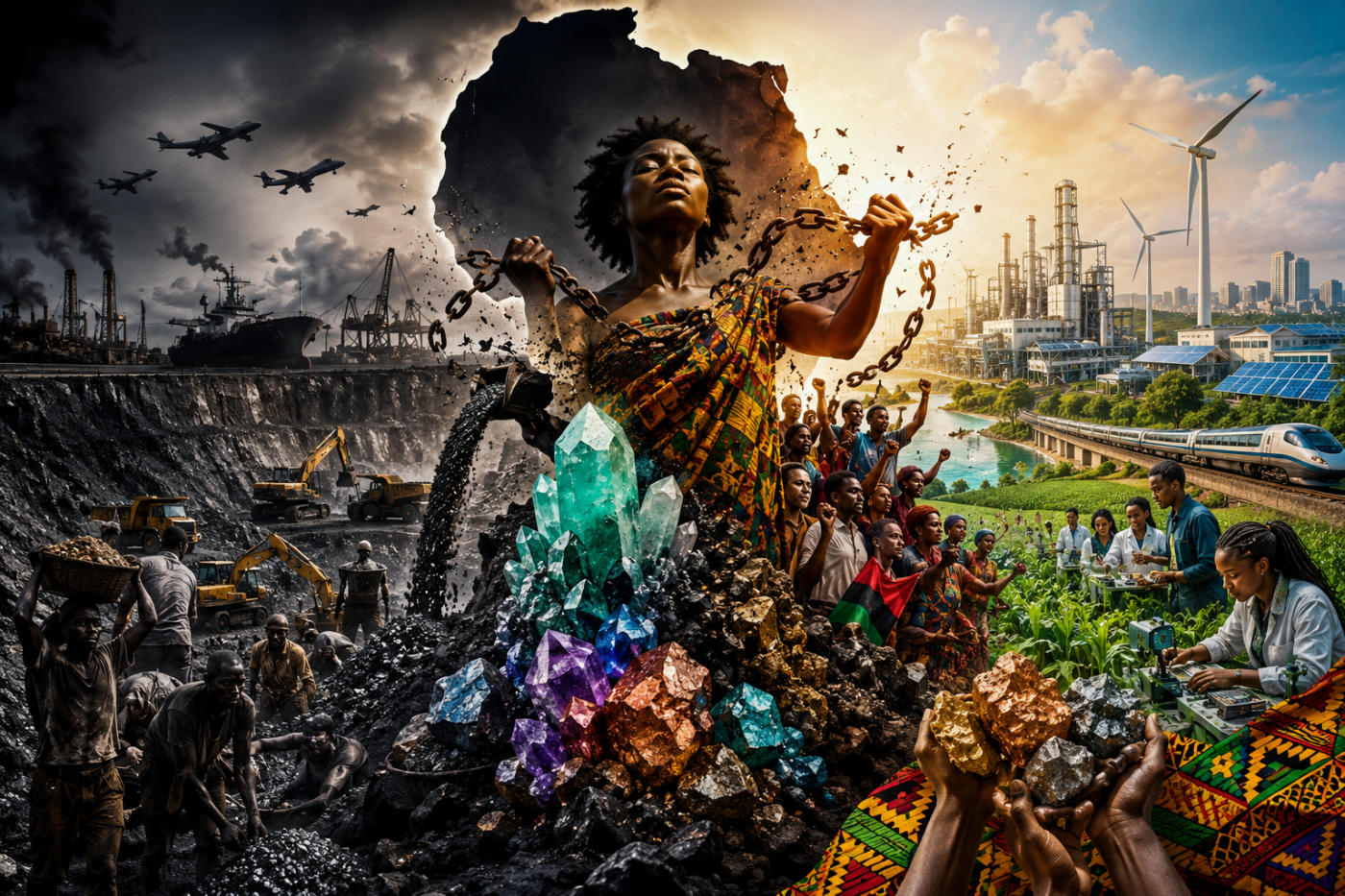
Business Insider Africa frames the continent’s critical-minerals wealth as an investment problem, transforming a struggle over sovereignty into a question of market efficiency. Beneath that narrative lies a different reality: Africa possesses the material foundation of the next industrial revolution, yet the capitalist-imperialist world system continues to organize those resources for external accumulation rather than continental development. The growing assertion of mineral sovereignty—from beneficiation strategies to the emerging Sahel alliance—reveals that parts of Africa are already pushing against the limits of the colonial division of labor and searching for new paths through multipolar realignment and regional integration. The task before workers, organizers, and anti-imperialist forces is to transform that opening into a broader struggle for African unity, mineral sovereignty, and liberation from the structures of extraction that have defined the continent’s place in the world economy for centuries.
Prince Kapone | Weaponized Information | July 3, 2026
McKinsey Finds the Minerals, Africa Becomes the Problem
Business Insider Africa’s July 3, 2026 article by Ayodeji Adegboyega begins with a true enough observation: Africa holds a massive share of the critical minerals now feeding artificial intelligence, electric vehicles, renewable energy, advanced manufacturing, and military technology, yet most African mining projects are not moving quickly into production. On the surface, this looks like ordinary business reporting. The continent has the minerals. The world has the demand. Investors have the money. Something must be blocking the machine. The article then tells the reader what that something is supposed to be: weak infrastructure, uncertain policy, slow permitting, high financing costs, unreliable power, and insufficient technological modernization.
That is the trick. The article does not need to lie about Africa’s mineral wealth in order to discipline the reader’s imagination. It only has to arrange the facts inside the logic of capital. The main interpreter is not an African miners’ union, not a peasant movement living beside poisoned water, not a state planning institution trying to build sovereign industry, and not a regional body struggling over beneficiation and value addition. The main priest at the altar is McKinsey, whose report claims Africa could unlock $40 billion in additional mining value if the continent fixes the “ecosystem” around the mine. In plain English: the minerals are there, but Africa must be rearranged so capital can reach them faster.
The propaganda device is not cartoonish. Nobody screams empire. Nobody says loot. Nobody waves the old colonial flag. Instead, the article speaks in the clean managerial language of “opportunity,” “clusters,” “investment,” “AI,” “jobs,” and “GDP.” This is how modern extraction dresses itself for polite company. The old plantation ledger has learned to say “supply chain resilience.” The old mine concession has learned to say “critical minerals strategy.” The old colonial railway, built to drag wealth from the interior to the port, now returns under the name of logistics efficiency.
What disappears is the political question: who will own, process, finance, transport, insure, price, and profit from these minerals? The article treats production itself as victory. But production under foreign ownership, foreign finance, foreign technology, foreign logistics, and foreign market command can reproduce the same dependency in a cleaner shirt. Africa is not presented as a continent of peoples fighting over sovereignty, labor, land, water, and industrialization. It is presented as a sleeping mineral platform waiting to be properly activated.
That is the ideological function of the piece. It converts a world-historic sovereignty struggle into a business problem. It teaches the reader to worry that Africa may “miss” the mining boom, while avoiding the more dangerous question: whether the boom itself is being organized to make sure Africa remains the mine while others remain the factory, the bank, the laboratory, the weapons contractor, and the final market. That is not analysis. That is the empire’s investment memo with better lighting.
The Facts Beneath the Investment Memo
Africa’s mineral position is not marginal. The article’s own factual spine admits that the continent holds more than a quarter of the world’s known critical mineral reserves, including major deposits of copper, manganese, bauxite, and lithium. It reports that fewer than one in ten critical mineral projects has secured financing or advanced beyond the feasibility stage. The McKinsey report underneath the article places Africa at the center of the next industrial cycle because these minerals now feed defense supply chains, artificial intelligence, energy systems, and advanced manufacturing. This is not a minor mining story. This is the material base of the next wave of global accumulation.
The numbers sharpen the contradiction. Africa contains more than 60 percent of the world’s platinum group metals, tantalum, cobalt, and chromium reserves, along with significant shares of manganese, graphite, and copper. Yet the continent receives only about $1.2 billion in annual exploration spending, roughly half the level attracted by either Australia or Canada. The explanation offered is familiar: ageing rail networks, limited port capacity, unreliable electricity, permitting delays, regulatory uncertainty, community disputes, and high financing costs. Those facts are real. But by themselves, they explain the wound by describing the scar.
Africa has already named this contradiction for itself. The African Union’s Africa Mining Vision was adopted as Africa’s own response to the paradox of great mineral wealth existing beside pervasive poverty. Its objective is not to make African mines more convenient for foreign balance sheets, but to build a mining sector that is transparent, equitable, and integrated into broad-based socio-economic development. The Africa Mining Vision places mineral extraction inside a wider program of infrastructure, skills, technology, local inputs, worker and community benefit, research, industrial linkages, and regional integration. That is the terrain the investment memo tries to narrow.
The African Green Minerals Strategy pushes the same line into the age of batteries, electric vehicles, data centers, renewable energy, and high-tech war. It calls for Africa’s mineral wealth to drive value addition at source, regional industrialization, and climate resilience. It does not treat lithium, cobalt, copper, manganese, graphite, and rare earths as rocks waiting to be exported. It treats them as a foundation for processing capacity, manufacturing capability, energy systems, transport integration, technological learning, and continental markets. The issue is not whether minerals can leave Africa quickly enough. The issue is whether the mineral economy can be forced to build Africa while feeding the world.
This is why the DRC-Zambia battery-precursor initiative matters. The Democratic Republic of Congo and Zambia sit on strategic copper and cobalt reserves, and their battery plan is an attempt to move beyond raw mineral exports into higher-value industrial activity. Afreximbank and the UN Economic Commission for Africa moved toward special economic zones for battery precursors, batteries, and electric vehicles in the DRC and Zambia. But the contradiction sits inside the project itself. The initiative still faces unresolved questions around location, mineral sourcing, outside actors, transparency, public consultation, and community benefit. A battery plant can become a step toward regional industrialization, or it can become a showroom for the same old extraction model if ownership, planning, financing, and accountability remain outside popular control.
The same contradiction runs through the Lobito Corridor. The corridor is a 1,300-kilometer railway connecting the mineral-rich Copperbelt of the DRC and Zambia to Angola’s Port of Lobito. Its foundational infrastructure, the Benguela Railway, was first developed in 1902 as a colonial trade corridor to move raw minerals from Africa’s interior to international markets. Today, the same route returns as a flagship critical-minerals corridor backed by the United States and Europe. The U.S. International Development Finance Corporation describes the project as the rehabilitation, operation, and maintenance of a 1,289-kilometer railway and mineral port to facilitate Atlantic exports of copper and cobalt from the DRC. The old export artery has been modernized, refinanced, and rebranded.
A railway can serve development, but only if development commands the railway. The Lobito route can reduce transport costs and connect regional markets, but it can also accelerate the removal of unprocessed minerals unless it is subordinated to binding value-addition, processing, energy, manufacturing, and local procurement strategy. That is why the corridor is not neutral infrastructure. It is contested infrastructure. It can become a tool of regional industrialization, or it can become weaponized infrastructure: a logistics system built around the needs of foreign supply chains while African communities carry the displacement, dust, policing, and debt.
The community cost is already visible. A Global Witness investigation found that up to 6,500 people could be at risk of eviction in the DRC because of the EU-backed Lobito Corridor railway. In the cobalt and copper mining zones themselves, the price of “clean energy” has already been paid in dirty forms. Industrial-scale mining in the DRC has produced forced evictions, sexual assault, arson, beatings, and the destruction of homes and farmland. The battery does not become clean because the suffering is hidden upstream. A green transition built on eviction, underpayment, poisoned land, and militarized extraction is not a just transition. It is extractivism with a better public relations department.
The DRC’s cobalt policy shows that African states are not merely passive “risk environments” waiting for capital’s approval. The DRC produces about 70 percent of the world’s cobalt, and it has tightened control through export suspensions, quotas, and national-interest allocations. Recent measures withdraw unused export quotas and reassign them to a state-controlled entity supporting local processing and economic value addition. That does not solve every contradiction inside the Congolese mining sector. It does show that the state is fighting over price, supply, and value capture in a market where corporations are accustomed to treating African sovereignty as paperwork.
Revenue leakage belongs at the center of this reconstruction. A mineral economy cannot become sovereign when the state cannot fully see, tax, discipline, and plan around the value leaving its soil. African countries generate only about 40 percent of the revenue they could potentially collect from these resources. In the DRC, a state audit found that mining companies underreported $16.8 billion in revenue between 2018 and 2023. That fact belongs beside every polite phrase about investor confidence. Confidence for whom? Confidence that companies can extract without full public accounting? Confidence that states will build roads, power lines, ports, and rail corridors while corporations dispute taxes, externalize costs, and capture the higher-value stages of the chain?
The deepest bottleneck is not geology. It is the value chain. The IEA’s critical minerals outlook shows that demand for key energy minerals continues to grow, with lithium demand rising nearly 30 percent in 2024 and demand for nickel, cobalt, graphite, and rare earths rising 6 to 8 percent in 2024. But mining is only one part of mineral power. The refining and processing stages remain far more concentrated than extraction, and China dominates much of the midstream for lithium, cobalt, graphite, and rare earths. This is why raw mineral possession does not automatically become sovereignty. Whoever controls refining, processing, patents, battery chemistry, standards, financing, shipping, insurance, and final manufacturing controls the social meaning of the mine.
The deeper historical fact is that African infrastructure was never neutral. Colonial transport systems were overwhelmingly designed to connect mines, plantations, and export zones to ports, while leaving African domestic markets fragmented. Rail lines ran from interior extraction zones to coastal outlets, with weak links between African regions themselves. That inherited geography still shapes the cost structure that McKinsey describes as a technical bottleneck. Africa is not behind because Africans failed to understand infrastructure. Africa was forced into an infrastructure pattern built for extraction, then told generations later that the resulting dependency proves it is not yet ready for development.
The Sahel adds another decisive fact the article’s investment frame cannot metabolize. Niger, Mali, and Burkina Faso are not merely waiting for foreign capital to decide whether Africa is investable. They are moving, unevenly but materially, to increase state control over strategic resources. Niger moved to nationalize the Somaïr uranium mine operated by France’s Orano after removing Orano’s operational control over major uranium assets. Mali’s 2023 mining code increased royalties and expanded state and local ownership in mining projects to at least 35 percent, while Mali has also begun building a Russia-backed gold refinery and created a state body to regulate artisanal gold trade. Burkina Faso adopted local-content provisions in the mineral sector, suspended some small-scale gold export permits, and nationalized gold assets as part of a wider resource-sovereignty push. These measures sit inside the wider AES process, where Mali, Burkina Faso, and Niger established the Confederation of Sahel States around security, economic cooperation, resource pooling, infrastructure, industrialization, agriculture, mines, and energy.
This is the factual ground the article does not reconstruct. Africa has the minerals. African institutions have already articulated a program for beneficiation, regional value chains, fairer rents, local processing, and industrial development. Strategic corridors are being built and contested. The DRC is testing state control over cobalt flows. Regional battery plans are trying to pull value addition closer to the mine. Mining communities are facing eviction, abuse, and dispossession in the name of the “green” future. The world’s AI, clean-energy, and defense sectors are hungry for what Africa holds. The decisive question is whether Africa’s mineral wealth will be converted into sovereign industrial power, or whether the continent will once again be praised for its “potential” while the real value leaves by rail, ship, contract, patent, algorithm, and bank transfer.
The Limit Has Been Reached
The Business Insider article wants the reader to see Africa’s critical-minerals contradiction as a problem of insufficient investment readiness. Africa has the minerals. The world has the demand. The investors are interested. The projects are stalled. Therefore, Africa must fix the bottlenecks so the machine can move. That is the story capital tells whenever it finds wealth it does not yet fully command.
The real story is sharper. Africa has reached the ceiling of development permitted by the capitalist-imperialist world system. The continent possesses the mineral base required for the next industrial cycle, but the existing order does not organize those minerals for African sovereignty. It organizes them for extraction, transit, refinement elsewhere, technological capture elsewhere, profit elsewhere, and final use elsewhere. Africa is allowed to be rich in resources so long as that richness does not become African power.
This is the colonial contradiction in its modern form. The old empire built the mine, the rail line, and the port to move wealth outward. The new empire arrives with feasibility studies, public-private partnerships, risk assessments, critical-minerals strategies, and green-transition language to preserve the same direction of motion. The uniform changed. The route did not.
That is why “more investment” cannot answer the contradiction by itself. Investment into what? Under whose ownership? Along what corridor? Toward which processing chain? With what labor regime? Under what tax discipline? For which market? A dollar that builds sovereign productive capacity is not the same as a dollar that accelerates raw export dependency. A railway commanded by regional industrial planning is not the same as a railway commanded by foreign supply chains. A battery plant rooted in African control is not the same as a fenced-off enclave where Africa supplies the minerals while others command the technology, standards, finance, and final market.
The article treats the stalled projects as Africa’s failure to move fast enough. But those stalled projects expose something deeper: the mode of production has become a fetter on African development. Africa cannot fully advance while locked into the role of mine, corridor, labor reserve, sacrifice zone, and revenue stream. The contradiction is not under-integration. The contradiction is the form of integration itself.
That is why the community question matters. Evictions, beatings, destroyed homes, lost farmland, and poisoned land are not side issues. They are the local form of the global relation. The clean battery appears clean because the violence has been pushed upstream. The AI system appears weightless because the minerals, water, land, labor, electricity, and displacement that sustain it have been hidden from view. The future is being dug out of African soil, but the people living on that soil are told to wait for development later.
The African Mining Vision and African Green Minerals Strategy already point beyond this trap. They do not simply ask the world to mine Africa more efficiently. They insist that minerals must be tied to beneficiation, regional value chains, industrial policy, local processing, infrastructure, technology, labor, and community benefit. That is not a technical adjustment. It is a challenge to Africa’s assigned position inside the world economy.
But even that program runs into the wall of the world system. Beneficiation cannot be reduced to adding one processing plant while finance remains foreign, patents remain foreign, logistics remain foreign, energy systems remain subordinate to export corridors, and domestic elites take commissions from the same structure. Regional industrialization cannot be built through isolated national competition for investor approval. Mineral sovereignty cannot survive if every state bargains alone against mining houses, commodity traders, banks, insurers, and imperial governments.
This is where continental unity becomes material necessity. Africa’s minerals are dispersed across national borders, but the value chain that exploits them is international. No single African state can fully break that chain alone. The answer has to be regional and continental: shared infrastructure under African command, coordinated processing strategy, common bargaining positions, public ownership where necessary, transparent contracts, labor protections, community control, technology transfer, and industrial planning across borders. The continent cannot remain balkanized while capital operates as one system.
The crisis of imperialism gives this struggle new urgency and new room to maneuver. The old Western monopoly over finance, logistics, markets, and political command is being contested. China, BRICS+, South-South finance, and the wider multipolar architecture create openings that did not exist under unipolar domination. Those openings matter. They give African states more room to bargain, more partners to choose from, and more space to reject the old colonial instruction: export raw materials, import finished goods, obey the creditor, protect the investor.
The Sahel enters this story not as another example, but as a warning flare. It shows that the mineral question has already begun to move from policy debate into sovereignty struggle. The empire’s preferred Africa is a continent of compliant concession zones, disciplined export corridors, and governments competing for investor approval. The emerging counter-motion is something else: states trying to turn resources from objects of extraction into instruments of national and regional command.
That is the meaning of partial delinking. Not withdrawal from the world, not autarky, not romantic isolation, but rupture with the colonial assignment. Africa cannot negotiate liberation as fifty-four isolated mineral depots begging for better terms. The continent has to become a political and productive force. Regional sovereignty is not decorative Pan-Africanism. It is the organizational form required to confront a world market that already operates as a unified imperial machine.
But multipolarity is not magic. It is terrain. It can widen the road toward sovereignty, but it does not walk that road for Africa. China-centered infrastructure, BRICS finance, and new South-South partnerships can support African industrialization only if African peoples and states command the terms. Otherwise, new partners can be pulled into old patterns, and the continent can remain the mine while the names on the contracts change.
Rupture, then, does not mean isolation from the world. It means breaking with the colonial function imposed on Africa inside the world system. It means refusing to remain the raw-material base of other people’s industrial revolutions. It means using every contradiction in the crisis of imperialism to build African productive power, continental coordination, worker and community authority, and sovereign control over the chain of value.
The real danger is not that Africa will miss the critical-minerals boom. The real danger is that Africa will be dragged into the boom on the same terms that produced underdevelopment in the first place. The article worries that too few projects are moving ahead. The people must ask a harder question: moving ahead toward what?
If the mine feeds the port, the port feeds the trader, the trader feeds the refinery, the refinery feeds the battery firm, the battery feeds the car company, the data center, the weapons contractor, and the imperial military machine, while African communities are displaced and African states collect fragments, then nothing has been solved. That is not development. That is colonial continuity with a green mask.
The truth is that Africa is not sitting on a missed opportunity. Africa is sitting on the material basis for a rupture. The minerals beneath the soil can either deepen dependency or help build continental liberation. The difference will not be decided by geology. It will be decided by power.
From Mineral Sovereignty to Organized Struggle
The answer is not ethical branding for dirty supply chains. The answer is organized pressure against the structures that turn African land, labor, and minerals into inputs for imperial technology, green capitalism, and war. That means supporting African-led struggles for mineral sovereignty, labor power, community defense, public control, regional beneficiation, and demilitarization of the supply chain.
In the United States, that begins with confronting the military arm of the extraction system. The Black Alliance for Peace’s U.S. Out of Africa / Shut Down AFRICOM campaign identifies AFRICOM as an instrument of U.S. imperial policy on the continent and organizes political education, coordinated days of action, and anti-war pressure against the militarization of Africa. Critical minerals do not move through a neutral world market. They move through corridors protected by diplomacy, debt, bases, intelligence networks, security partnerships, and military doctrine. Any serious solidarity with African mineral sovereignty must oppose the armed architecture that keeps the continent open for extraction.
On the continent, formations such as the Pamoja Critical Minerals Alliance are already organizing around the contradictions exposed by the DRC-Zambia battery-precursor initiative. Pamoja brings together mining communities, Indigenous people, labor, media, faith formations, and civil society actors to demand transparency, community voice, value-chain accountability, and protection against another “green resource curse.” That terrain matters because the battery economy can either become a step toward African industrial power or another polished enclosure where the people supply the minerals while corporations and outside states command the chain.
In the DRC, AFREWATCH works on natural-resource governance, mining-community rights, corporate accountability, and protection for human-rights defenders. Its work is useful where communities confront mining abuses, corridor displacement, state opacity, and corporate impunity. But solidarity must remain politically clear. Watchdog work is not enough by itself. Documentation must feed organization. Investigation must feed pressure. Exposure must feed struggle.
The labor front is decisive. Congolese cobalt workers have challenged mining companies through legal action in DRC courts over labor abuses, while union-linked campaigns have exposed unsafe conditions, unequal treatment, and corporate violations in major cobalt operations. These fights should be amplified by workers, unions, students, journalists, and anti-imperialist organizations abroad. The worker who digs the mineral is not a footnote to the battery. The worker is the living force without whom the entire “green” and “AI” future collapses.
The practical tasks are clear. Track the Lobito Corridor and every similar project: who finances it, who owns the concessions, who is displaced, who is compensated, what security forces are deployed, and whether the corridor moves raw minerals outward or supports processing, manufacturing, power access, and regional development. Expose every attempt to sell forced evictions, destroyed homes, poisoned land, and broken communities as “clean energy.” Support African demands for beneficiation, transparent contracts, community consent, enforceable labor rights, public revenue, and regional industrial planning. Build teach-ins, union resolutions, campus forums, church discussions, social-media explainers, and local anti-war actions that connect critical minerals to AFRICOM, debt, corporate power, and the crisis of imperialism.
The warning is just as clear. Do not let the NGO-industrial complex turn mineral sovereignty into ESG paperwork. Do not let imperial governments that helped build the extraction order present themselves as Africa’s development partners because they now need cobalt for batteries, copper for grids, graphite for storage, and rare earths for weapons. Do not reduce the struggle to consumer guilt over “ethical sourcing.” The issue is not whether empire can buy cleaner minerals. The issue is whether Africa can break the colonial function assigned to it inside the world system.
Solidarity means taking sides in that rupture. Against AFRICOM. Against mineral corridors built for imperial supply chains. Against corporate theft, labor abuse, and community displacement. For African unity. For beneficiation. For worker power. For community defense. For continental planning. For a world where the minerals beneath African soil no longer feed the machinery of African underdevelopment, but help build the material basis of African liberation.


Leave a comment