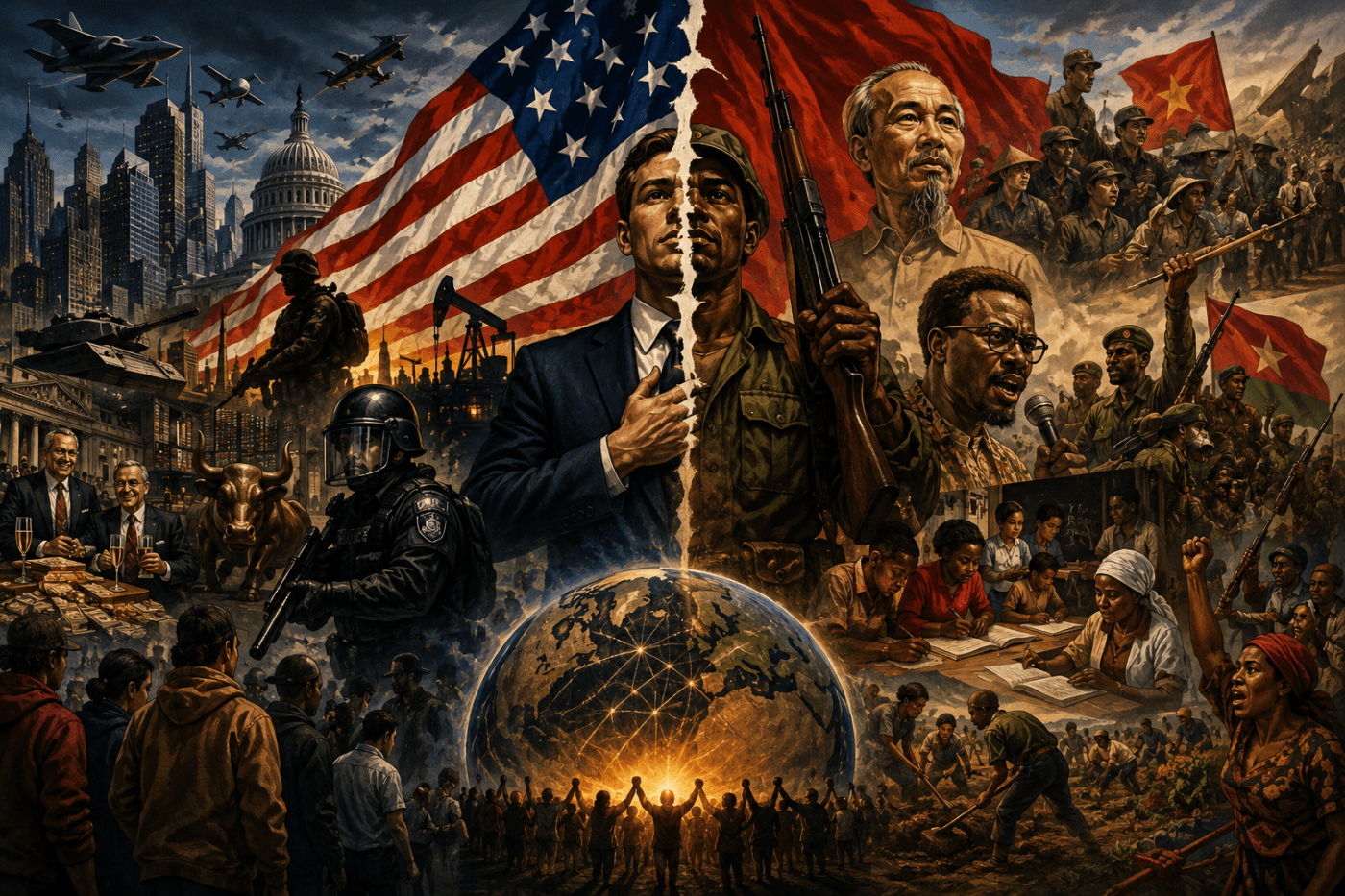
The modern nation was built by capital, not God, and its patriotism has always carried the class contradictions of the forces that made it. Imperialism split nationalism in two: in oppressed nations, it could become a weapon of liberation, while in oppressor nations it became a weapon of ruling-class consent. From China to Vietnam, Guinea-Bissau, Mozambique, and Angola, communists fought for the nation all the way down because real independence required sovereignty over land, labor, resources, education, defense, and development. In the United States, patriotism was born through slavery, settler property, Indigenous dispossession, and empire, which is why the first duty of revolutionary love is betrayal of the ruling class.
Prince Kapone | Weaponized Information | July 5, 2026
The False Choice They Wrapped in the Flag
On the Fourth of July, Donald Trump gave the ruling class version of a birthday prayer. He told the country that it must choose between communism and patriotism, between Marx and America, between loyalty to the nation and loyalty to the revolutionary tradition that has armed the oppressed across the world. The line was not profound. It was not original. It was the old anti-communist catechism reheated for a decaying empire that can no longer offer its people bread, housing, peace, health, or dignity, and so must offer them enemies instead.
But the remark is useful because it exposes the contradiction more clearly than Trump understands. He wants patriotism to mean loyalty to the United States as it exists: loyalty to its property relations, its ruling class, its military power, its settler mythology, its police order, its private accumulation, and its right to command the world. In that sense, he is correct that communism and American patriotism are opposed. Communism does not reconcile itself with a nation founded on enslaved labor, Indigenous dispossession, capitalist property, and imperial expansion. It does not bow before a flag when that flag has been planted over plantations, reservations, prisons, sweatshops, oil fields, military bases, and mass graves.
But Trump’s formulation depends on a trick. He treats patriotism as if it has one meaning in all places and all historical conditions. It does not. Patriotism in an imperialist country is not the same as patriotism in a colonized country. The nationalism of the jailer is not the nationalism of the prisoner. The flag raised by an army of occupation does not mean the same thing as the flag raised by a people breaking colonial rule. A ruling class defending domination and an oppressed people struggling for sovereignty may both use the language of the nation, but history does not judge words by their uniforms. It judges them by the class forces they serve.
This is the contradiction at the heart of the question. In oppressed nations, revolutionary nationalism has often become one of the concrete forms of proletarian internationalism, because the struggle to liberate the nation from imperialism weakens the whole imperial system. In imperialist nations, nationalism usually performs the opposite function. It binds workers to their own ruling class, trains them to mistake empire for community, and turns the suffering produced by capitalism into resentment against migrants, communists, Black rebellion, Indigenous sovereignty, China, the Global South, and every other target except the owners of the country itself.
So the issue is not whether communists can be patriots in the abstract. Abstractions are cheap, which is why politicians buy them in bulk. The real question is: patriotism for which nation, under which class leadership, against which enemy, and toward what historical project? Once that question is asked scientifically, Trump’s slogan collapses. The history of national liberation shows that communists were often the truest patriots of the oppressed world, while the imperial ruling classes who screamed loudest about love of country were busy selling the people, poisoning the land, looting the public treasury, and turning the nation into a machine for private profit and global domination.
The Nation Was Built by Capital, Not God
The nation is usually presented to the people as a sacred inheritance. We are told it is ancient, natural, almost biological, as if every border were drawn by the hand of God and every flag were stitched into the human soul before history began. But the modern nation did not fall from heaven. It was built on earth, through struggle, production, trade, war, taxation, language, schooling, administration, and class power. The nation is not a family. It is not a mystical bloodline. It is a historical product, and like every historical product, it carries the fingerprints of the class forces that made it.
This is why any serious discussion of patriotism must begin with the material history of the nation itself. The modern nation emerged alongside capitalism, not outside it. As feudal relations fractured and local economies were pulled into wider markets, the rising bourgeoisie needed larger spaces in which commodities could circulate, labor could be disciplined, laws could be standardized, taxes could be collected, and property could be defended. The old patchwork of local privileges, dynastic jurisdictions, tolls, guild restrictions, and inherited rights became an obstacle to the movement of capital. The bourgeoisie did not abolish these barriers because it had suddenly discovered universal brotherhood. It abolished them because capital does not like being stopped at every village gate and asked to explain itself.
Marx and Engels saw this process clearly. In describing the bourgeoisie as the class that created the world market, tore apart older local relations, and gave production and consumption a cosmopolitan character, they were not praising capitalism as liberation in the sentimental sense. They were identifying its revolutionary destruction of the old world. Capitalism smashed feudal fragmentation, uprooted inherited relations, dissolved local isolation, and created national and eventually world markets. But this progress came with a little invoice attached, as it always does under class rule. The bourgeoisie broke the chains of feudalism only to fasten society to the cash nexus, wage labor, private property, and the rule of capital.
The nation-state became the political shell of this new order. It unified territory, standardized law, expanded bureaucracy, built armies, regulated currency, constructed roads, disciplined populations, and gave the market a political body. The people were now invited to imagine themselves as one nation, while their lives remained divided by property. The landlord and the tenant, the factory owner and the worker, the banker and the debtor, the officer and the conscript were told they belonged to a single national community. This was the genius of bourgeois nationalism. It spoke in the name of “the people” while organizing society for the class that owned the means of production.
This national consciousness did not arise from slogans alone. It required material instruments. Benedict Anderson’s famous formulation that the nation is an “imagined political community” is useful precisely because it reminds us that people had to be taught to imagine themselves as part of a community larger than their village, estate, parish, clan, or region. The spread of print culture, vernacular languages, newspapers, schools, maps, censuses, and state administration helped produce a shared national horizon among people who would never meet one another. Capitalism sold the printed word, the state standardized the language, and gradually the people learned to recognize themselves in a national mirror polished by forces they did not control.
There was, therefore, a historically progressive side to bourgeois nationalism in its rising phase. It challenged dynastic rule, clerical authority, feudal privilege, and the fragmentation of social life into inherited local hierarchies. It helped create the modern political language of citizenship, popular sovereignty, constitutional rights, and national self-government. Against kings who claimed to rule by divine right, the bourgeoisie announced the nation. Against aristocrats who claimed privilege by birth, it announced equality before the law. Against feudal immobility, it announced movement. Against the old order, it announced history.
But the bourgeoisie never meant equality all the way down. Its revolution stopped at property. It could proclaim the citizen while preserving the worker. It could abolish noble privilege while defending capitalist exploitation. It could condemn hereditary rule while building wage slavery. It could speak of the nation as a common home while turning that home into a market and charging rent at the door. This is why bourgeois patriotism was contradictory from birth. It contained a real democratic impulse against feudalism, but it also concealed a new class dictatorship beneath the language of national unity.
That contradiction is the beginning of the whole problem. Nationalism did not begin as pure reaction, and it did not begin as pure liberation. It began as a historical weapon in the hands of rising classes, shaped by the conflicts of its time. Under early capitalism, the nation could be used to break the old feudal order. But because the bourgeoisie led that process, the nation was built around private property, commodity production, class discipline, and the needs of accumulation. The flag entered history already carrying two faces: one promising the people a collective future, the other quietly registering the deed in the name of capital.
Once this is understood, patriotism can no longer be treated as an innocent feeling. It becomes a political question. The nation is not a neutral container floating above class struggle. It is a terrain of struggle, a historical formation shaped by production and power. To ask whether communists can be patriots without first asking what kind of nation, which class rules it, and what historical task confronts it is to confuse poetry with analysis. The modern nation was built by capital, but it did not abolish the struggle over who the nation belongs to. It only created a new battlefield on which that struggle would unfold.
Imperialism Split the Nation in Two
The contradiction inside bourgeois nationalism did not remain frozen in its early form. Capitalism developed. It concentrated production, swallowed smaller capitals, fused banks with industry, exported capital across the world, and transformed the national market into a base of operations for global accumulation. The nation-state that had helped organize capitalism in its rising phase became too narrow for capitalism in its imperialist phase. Capital still needed the flag, the army, the border, the court, the prison, and the schoolhouse, but it no longer confined itself to the national community it claimed to represent.
This is the great turn Lenin identified. In the imperialist epoch, capitalism in the advanced countries had “outgrown the framework of national states”. That sentence cuts through a century of patriotic fog. The bourgeoisie continues to dress itself in national colors, kiss the flag on camera, and speak tenderly about the homeland whenever taxes, wars, or police budgets need public approval. But its real loyalty is not to the people of the nation. Its loyalty is to accumulation. It is national in costume and international in operation.
Imperialism is not merely an aggressive foreign policy, a bad attitude, or a regrettable excess committed by otherwise decent statesmen after too much brandy. It is a stage of capitalism. Lenin defined it through the concentration of production into monopoly, the fusion of bank capital with industrial capital into finance capital, the export of capital, the formation of international capitalist associations, and the territorial division of the world among the major powers. In other words, imperialism is monopoly capitalism organized on a world scale. It is capital no longer satisfied with exploiting labor at home when it can command labor, land, minerals, ports, debt, currencies, and governments across the planet.
Once capitalism reaches this stage, nationalism itself splits. It no longer carries one historical meaning. The nation of the colonizer and the nation of the colonized stand on opposite sides of the same world system. Lenin insisted that communists must distinguish between oppressor nations and oppressed nations, because the same slogan can serve opposite historical purposes depending on who raises it and against whom. This distinction is not decorative theory. It is the key to the whole question. Patriotism in an imperialist country cannot be judged by the same standard as patriotism in a country fighting colonial rule, occupation, blockade, debt domination, or military encirclement.
In the imperialist nation, nationalism usually becomes a weapon of ruling-class consent. It teaches workers to identify their own future with the very class that exploits them. It tells them that the profits of corporations are “national prosperity,” that military expansion is “security,” that sanctions are “defending democracy,” that foreign bases are “stability,” that cheap minerals and cheap labor from the Global South are simply the natural reward for living in the greatest country on earth. The worker is asked to celebrate the empire as if the empire were his household. He is handed a flag so he does not notice the eviction notice.
This is why imperial nationalism is not innocent. It does not merely express love for one’s neighbors, landscape, music, food, language, or ordinary people. Those affections are real, but the ruling class does not spend billions manufacturing patriotism so workers can love their grandmother’s cooking. It manufactures patriotism so workers will mistake ruling-class interests for national interests. It needs them to believe that the enemy is somewhere outside the class relation: the migrant, the communist, the foreign competitor, the colonized rebel, the sanctioned country, the worker abroad who earns less because imperialism made sure of it. Imperial nationalism turns the exploited into emotional shareholders of the empire.
But the national question appears differently in the oppressed world. There the nation is not primarily the mask of domination. It can become the terrain on which domination is challenged. For colonized and semi-colonized peoples, the struggle over the nation is a struggle over land, food, language, culture, minerals, ports, banks, schools, armies, borders, and the right to choose a path of development without a foreign master standing over the map. The question is not whether people are allowed to wave a flag. The question is whether the people control the material foundations of national life.
This is why nationalism has no fixed political content. It is not automatically revolutionary, and it is not automatically reactionary. Its meaning depends on class leadership, historical position, and practical direction. Does it defend an oppressor nation’s right to dominate others, or does it organize an oppressed nation’s struggle to break domination? Does it bind workers to their own bourgeoisie, or does it mobilize workers and peasants against imperialism and comprador rule? Does it deepen capitalist dependency, or does it open the road toward sovereignty over land, labor, production, and planning?
Under imperialism, then, the word “nation” begins to carry two opposed possibilities. In the mouth of the imperial ruling class, it is a command: obey, enlist, sacrifice, consume, hate the enemy we name for you. In the hands of an oppressed people, it can become a weapon: reclaim the land, break the colonial chain, nationalize the resources, educate the masses, defend the revolution, and build a future no longer licensed by empire. The same word survives, but history has split it open.
This is the ground on which Trump’s slogan collapses. He speaks as if communism and patriotism confront each other in a vacuum. But there is no vacuum in history. There is only the world system, divided by power, property, and violence. Once imperialism divides humanity into oppressor and oppressed nations, patriotism itself becomes a class question on a world scale. In the imperialist country, patriotism usually means loyalty to domination. In the oppressed nation, revolutionary patriotism can become the struggle to abolish domination. That is why the next question is not whether communists can love the nation. The real question is why, in so much of the colonized world, communists became the only ones willing to fight for the nation all the way down.
The Communists Fought for the Nation All the Way Down
Mao’s answer to Trump was written before Trump’s empire had fully inherited the world. In the middle of China’s war against Japanese aggression, Mao asked whether a communist internationalist could also be a patriot. His answer was not defensive, confused, or embarrassed. He said the communist in an oppressed nation “not only can be but must be” patriotic, because the defense of the nation against imperialist aggression was inseparable from the struggle of the world’s oppressed against the imperial system. His formulation was exact: in wars of national liberation, “patriotism is applied internationalism”. That sentence does not turn Marxism into flag-waving. It turns the national question right-side up.
The reason is material. Colonialism was never merely a foreign flag above a government building. It was a whole system of domination over land, labor, minerals, ports, schools, armies, language, law, credit, culture, and the future itself. A colonized people could remove the governor and still remain chained to the plantation, the mine, the bank, the export crop, the foreign officer, the missionary school, and the comprador politician trained to speak the empire’s language with a local accent. Formal independence without economic sovereignty was independence with a leash. The communists became the most consistent patriots in so many oppressed nations because they understood that the nation could not be free while the people remained dispossessed.
Vietnam makes the point with the force of a rifle butt on a colonial desk. Ho Chi Minh and the Vietnamese revolution did not counterpose communism to the nation. They built the organized force through which the nation could finally become real. Vietnam’s declaration of independence came after French colonial rule and Japanese wartime occupation, and the struggle that followed was not a seminar on abstract ideology. It was a people’s war over whether Vietnam would belong to the Vietnamese people or remain a rice field, labor pool, military outpost, and humiliation chamber for foreign power. The French called their domination civilization. The Americans later called their intervention freedom. The Vietnamese called it what it was and fought it until the empire discovered, once again, that peasants with history on their side are very difficult to pacify.
China reached the same truth through its own century of humiliation, invasion, partition, warlordism, landlord domination, and foreign encroachment. Mao’s patriotism was not the patriotism of an aggressor nation demanding the right to dominate others. It was the patriotism of a people resisting dismemberment. That is why his distinction mattered. The patriotism of Japan’s imperial army was reactionary because it defended conquest. The patriotism of the Chinese people was revolutionary because it resisted conquest. The same word could not carry the same class meaning in both camps. One was the nationalism of the sword over another people’s neck. The other was the nationalism of a people trying to remove the sword.
Guinea-Bissau sharpened this lesson through the work of Amílcar Cabral and the PAIGC. Cabral did not treat national liberation as a flag ceremony scheduled for the end of armed struggle. The struggle itself had to begin creating the social basis of a new nation. In the liberated zones, the PAIGC built schools, political education, health structures, people’s organization, and forms of administration rooted in the masses, because colonialism had not merely occupied the territory; it had distorted the people’s capacity to govern their own lives. Tricontinental’s study of the PAIGC shows how the movement treated education and political formation as central tasks of national liberation, not decorative reforms to be postponed until after victory. Cabral understood that the oppressed do not inherit a ready-made nation from colonialism. They have to reconstruct it through struggle.
Mozambique followed the same road under different conditions. FRELIMO was formed to unite the struggle against Portuguese colonial rule, and its armed struggle began in 1964 before Mozambique won independence in 1975. The movement’s history cannot be reduced to a diplomatic transition from Lisbon to Maputo. It was a mass anti-colonial war against a European empire that had no intention of surrendering land, labor, and power because somebody asked politely. FRELIMO’s development out of the struggle against Portuguese rule, and Mozambique’s eventual independence in 1975, show that national liberation had to be fought through organized revolutionary force. The polite world calls this instability. The colonized call it breathing.
Angola, too, exposed the fraud of colonial patriotism. The MPLA fought Portuguese rule in a country whose land and resources were bound to colonial extraction and whose future was treated as property of empire. The liberation struggle did not unfold in isolation. It became part of a larger confrontation involving Portugal, apartheid South Africa, the United States, Cuba, and the socialist camp. The MPLA’s emergence from the anti-colonial struggle and its role in Angola’s independence placed the national question directly inside the global balance of forces. The point is not that every contradiction inside these movements disappeared because they raised socialist banners. The point is that the struggle for the nation could not avoid the struggle against imperialism, because imperialism was the system that had stolen the nation’s sovereignty in the first place.
Across these struggles, the pattern is unmistakable. The communists did not love the nation as a museum piece. They fought for the nation as land to be returned, labor to be liberated, children to be educated, women to be organized, peasants to be armed with power, workers to be brought into history, resources to be reclaimed, and development to be planned according to human need rather than imperial profit. Their patriotism was not the sentimental patriotism of parades and speeches. It was the practical patriotism of irrigation, literacy, land reform, clinics, people’s defense, and the destruction of colonial authority. A flag without bread is a decoration. A nation without sovereignty over production is a rented room.
This is why Trump’s claim collapses under the weight of the twentieth century. If communists cannot be patriots, then who were the patriots in Vietnam: the Viet Minh or the French colonial administrators? Who were the patriots in China: the communists resisting Japanese invasion or the collaborators and compradors who made peace with national humiliation? Who were the patriots in Guinea-Bissau and Mozambique: the liberation fighters building schools in the bush or the Portuguese empire holding African land at gunpoint? The answer is obvious to everyone except those paid not to understand it.
Revolutionary nationalism in the oppressed world became internationalism because every blow against colonial domination weakened the entire imperial chain. The liberation of Vietnam was not only Vietnamese. The liberation of Guinea-Bissau was not only Guinean. The liberation of Angola and Mozambique was not only Angolan and Mozambican. Each struggle taught the world’s oppressed that empire could be fought, bled, and beaten. Each victory widened the imagination of humanity. Each defeated colonial army made another people stand a little taller. That is what Mao meant. Patriotism, under conditions of national liberation, is not the negation of proletarian internationalism. It is one of the forms through which internationalism enters history with mud on its boots and a rifle in its hands.
The Empire Hands the Worker a Flag
In the oppressed nation, revolutionary nationalism can become a weapon against domination. Inside the imperialist nation, nationalism usually performs the opposite function. It does not summon the worker to overthrow the system that exploits him. It summons him to identify with it. It teaches him to see the world through the eyes of his own ruling class, to mistake the empire’s enemies for his enemies, and to believe that the power which robs him at home is somehow defending him abroad. The trick is old, but it still works often enough to keep the generals employed and the poor divided.
Lenin was ruthless on this point because he understood that internationalism cannot survive as a slogan while workers defend their own empire in practice. The proletariat of an oppressor nation, he argued, must demand the freedom of oppressed nations to separate from the state that dominates them; otherwise its internationalism is reduced to a pleasant phrase with no revolutionary content. In Lenin’s formulation, socialists in oppressor nations had a specific duty to fight the domination of colonies and oppressed nations by “their own” imperial state. That is the test. Not how loudly one sings about humanity, but whether one breaks with the empire that claims to act in one’s name.
Imperial patriotism exists to prevent that break. It turns the ruling class into the nation and then turns the nation into a moral obligation. The worker is told that corporate profits are “our economy,” that military expansion is “our security,” that sanctions are “defending democracy,” that foreign bases are “stability,” and that competition with China explains the ruins produced by Wall Street. The language is designed to make theft sound communal. A corporation closes a plant, destroys a town, moves production, pockets subsidies, and then returns wrapped in the flag to warn the unemployed worker about foreign threats. Capital burns down the house and sells the ashes as patriotism.
Michael Parenti described the imperial function without romance: empires enrich dominant economic interests while imposing violence, poverty, and dependency on the people subjected to them. Empire is not a charity project with aircraft carriers. It is a system for extracting wealth, securing markets, controlling labor, commanding resources, and disciplining governments that refuse to obey. The ruling class cannot sell this project honestly, so it sells it through fear, virtue, and national mythology. It must persuade the people that what benefits investors, contractors, banks, oil companies, weapons firms, and strategic planners is somehow the common interest of the nation. That is why every empire arrives as a humanitarian and leaves behind a balance sheet.
This persuasion does not happen by accident. Herman and Chomsky’s propaganda model explains how concentrated wealth and power shape the flow of information, filtering news, marginalizing dissent, and allowing dominant state and private interests to transmit their messages to the public. Their point was not that every journalist receives a phone call from a secret villain in a smoke-filled room, though one suspects some would wait by the phone with enthusiasm. The point is structural: corporate media operate inside institutions whose ownership, advertising, sourcing, flak, and ideological pressures narrow the range of acceptable thought. Through this machinery, empire becomes common sense before the worker ever has a chance to ask who benefits.
Imperial nationalism also works through material insecurity. The empire does not merely wave flags at the poor; it offers them escape routes from the conditions it helped create. Military service is sold as discipline, purpose, education, employment, health care, travel, citizenship, and masculine restoration. The reality is more complex than the lazy claim that only the poorest enlist, but the class pressure is real. Research on military recruitment notes that recruits from lower socioeconomic backgrounds have stronger incentives to join for employment and education, even as the modern military also recruits heavily from broader working- and middle-class layers. That is how class discipline works in an empire: first narrow the future, then call enlistment opportunity.
The ideological function is displacement. The worker suffers under debt, rent, medical bills, stagnant wages, gutted unions, poisoned towns, police violence, and the slow humiliation of being told to work harder in a country where the rich get rescued before breakfast. But imperial nationalism trains him to look away from the owners. His anger is redirected toward migrants, communists, Muslims, China, Black rebellion, Indigenous sovereignty, the Global South, and whatever new enemy the empire’s priests discover on television this week. The ruling class breaks his back, points overseas, and says: there is your problem.
This is why the phrase “national interest” must always be interrogated in an imperialist country. The ruling class says “America” when it means its markets, its investments, its supply chains, its military corridors, its reserve currency, its sanctions regime, its debt instruments, and its right to dominate. It says “security” when it means strategic control. It says “freedom” when it means access for capital. It says “democracy” when it means governments obedient enough to privatize, liberalize, and open their veins. The people are permitted to enter this national interest only as taxpayers, soldiers, consumers, prisoners, workers, and mourners.
So imperial patriotism is not the love of ordinary people for the places that formed them. It is not the tenderness one feels for a neighborhood, a language, a song, a family table, a river, or the graves of ancestors. The ruling class did not invent those feelings. It hijacks them. It takes the real human attachment people have to one another and transfers it upward onto the state, the military, the market, and the empire. Then it declares every act of resistance a betrayal, as if the worker owes loyalty to the very machinery that degrades his life.
This is the opposite of revolutionary nationalism in the oppressed world. There, the struggle for the nation can become a struggle to reclaim the material basis of life from imperial domination. Here, inside the imperialist core, nationalism usually asks the worker to defend domination as if it were his own liberation. That is why the imperial worker who wants to become free must first learn to separate the people from the empire, the country from the ruling class, and love of home from obedience to power. Until that separation is made, the flag remains what the empire needs it to be: a blindfold with better colors.
The American Nation Was Born as Property
If imperial nationalism trains workers to confuse the ruling class with the nation, American patriotism was born already fluent in that language. The United States did not become a settler empire by accident, by corruption, or by tragic deviation from its founding soul. Its founding soul was already organized around property. The republic announced liberty while building its material life from land theft, enslaved labor, racialized citizenship, and capitalist expansion. This is why American nationalism so easily becomes imperial nationalism: it was never built on the sovereignty of all people who lived here. It was built on the sovereignty of those recognized as owners.
The contradiction was present at birth. The Declaration of Independence could proclaim that “all men are created equal” while describing Indigenous peoples as “merciless Indian Savages”. That was not a stray phrase. It revealed the border of the founding imagination. The “people” of the new republic were being defined against the Native nations whose land the settler project intended to occupy. American freedom was not imagined on empty soil. It was imagined through conquest, with Indigenous existence cast as an obstacle to the expansion of settler property. The republic did not merely forget the Native. It needed the Native turned into an enemy so theft could appear as destiny.
The Constitution carried the same class logic in more polished language. It avoided the word slavery while protecting slavery through representation, commerce, and police power. The Three-Fifths Clause increased the political power of slaveholding states by counting the enslaved for representation while denying them personhood in political life. The Constitution also protected the transatlantic slave trade until 1808 and required the return of those who escaped bondage through the Fugitive Slave Clause. The founders knew how to speak softly while writing chains into law. The plantation did not sit outside the republic. It helped design the republic.
Settler expansion then became federal policy. The Indian Removal Act authorized the president to pursue the removal of Native nations west of the Mississippi, dressing dispossession in the language of exchange and administration. The State Department’s own historical account acknowledges that the United States used treaties and removal policy to displace Native peoples and that federal authorities sometimes violated treaties and Supreme Court rulings to facilitate westward expansion. The empire came with signatures, seals, maps, and clerks. Robbery is much easier to respect when it arrives on government stationery.
This is why the American Revolution has to be understood dialectically. It was a real break from monarchy and British imperial authority, but it was not a social revolution for the enslaved, the dispossessed, women, workers, or Indigenous nations. It overthrew one form of external rule while consolidating an internal order of class, race, property, and settler power. In relation to Britain, the United States could present itself as anti-colonial. In relation to Indigenous nations and enslaved Africans, it was colonial to the bone. That double character sits at the center of American patriotism like a loaded pistol under the hymn book.
The “nation” produced by this history was never a neutral community of equals. It was structured by who could own land, who could command labor, who could vote, who could inherit, who could settle, who could be protected by courts, and who could be hunted by law. Citizenship was not simply a legal status. It was a social relation organized through property and racial power. The flag promised unity, but the material order divided the country between master and slave, settler and Native, owner and worker, creditor and debtor, citizen and excluded subject. American patriotism learned to call this hierarchy freedom because the ruling class needed a beautiful word for its own domination.
Communism threatens this patriotism because it asks the forbidden questions. Who owns the land? Who controls labor? Who commands production? Who benefits from the state? Who is asked to die for the country, and who profits from the war? Who is told to love the nation, and who is allowed to own it? These questions cut through the incense of patriotic mythology and expose the altar beneath it: private property backed by organized violence. Communism does not threaten the ordinary person’s love of home, language, memory, neighborhood, or people. It threatens the ruling class’s claim that its property is the nation and its power is freedom.
That is why Trump’s anti-communist patriotism sounds so natural in the American political tradition. He is not inventing a new ideology. He is speaking the old settler-capitalist language in its vulgar late-imperial accent. When he says communism and patriotism cannot coexist, he means communism cannot coexist with a patriotism built around the sanctity of capitalist property, racial hierarchy, police power, military domination, and settler innocence. On that point, history grants him a small and accidental honesty. Communism cannot reconcile itself with the America of the slaveholder, the speculator, the settler fort, the prison, the landlord, the weapons contractor, and the billionaire wrapped in bunting.
But that America is not the only reality contained inside this land. There has always been another history: the rebellion of the enslaved, the resistance of Indigenous nations, the strikes of workers, the struggles of Black reconstruction, the organizing of migrants, the refusal of soldiers, the movements of women, the poor, the incarcerated, and the colonized inside the belly of the beast. The ruling class calls itself America because every ruling class enjoys mistaking its mirror for the world. But the people have never been identical with their rulers. The country is not the empire. The nation is not the bourgeoisie. The flag is not the land. And love of the people requires hatred for the system that has used their name to dominate the world.
Patriotism After Empire
Trump says a person can be a communist or a patriot, but not both. History answers with a sharper question: patriotism for whom, under which class, against what enemy, and toward what future? Once the nation is taken down from the altar and placed back into history, the slogan loses its magic. The nation is not eternal. It is made. It is fought over. It is shaped by production, property, conquest, resistance, class struggle, and the world system in which it stands.
Under rising capitalism, the nation helped break feudal fragmentation and build the modern political world, but it did so under bourgeois leadership and therefore carried the contradiction of bourgeois property from birth. Under imperialism, that contradiction split open on a world scale. The nationalism of oppressed nations could become a weapon against foreign domination, while the nationalism of imperialist nations became a weapon for binding workers to their own ruling class. One raised the question of sovereignty. The other buried the question of class.
This is why Mao’s formulation remains decisive. In wars of national liberation, patriotism is applied internationalism. Not because the flag is holy. Not because the nation is above class. But because the oppressed nation’s struggle against imperial domination weakens the whole imperial chain. The communist fighting for Vietnam, China, Guinea-Bissau, Mozambique, Angola, Cuba, or any other oppressed nation was not betraying internationalism. They were giving it territory, organization, discipline, and breath.
Inside the imperialist nation, the task is different. The American worker cannot become free by loving the empire that exploits him at home and dominates the world in his name. His patriotism becomes revolutionary only when it breaks from the ruling class, breaks from imperial chauvinism, breaks from settler innocence, and joins the struggles of the oppressed here and everywhere. The first act of proletarian internationalism in the belly of the beast is not hatred of the people. It is betrayal of the empire.
So Trump is right only in the narrowest and most accidental sense. Communism cannot be patriotic toward the America of the slaveholder, the settler, the landlord, the prison, the corporation, the drone base, and the billionaire wrapped in a flag. But communism can be faithful to the people buried beneath that America: the workers, the poor, the dispossessed, the colonized, the incarcerated, the migrants, the Indigenous nations, the Black masses, and all those whose labor and suffering built a country they were never allowed to own.
The real contradiction is not communism versus patriotism. It is imperial patriotism versus the liberation of the people. It is the patriotism of property versus the patriotism of life. It is the nation as empire versus the people as history. And once that contradiction is named, the task becomes clear: not to bow before America as it was founded, but to fight for the people against the empire that has always claimed to speak in their name.


Leave a comment