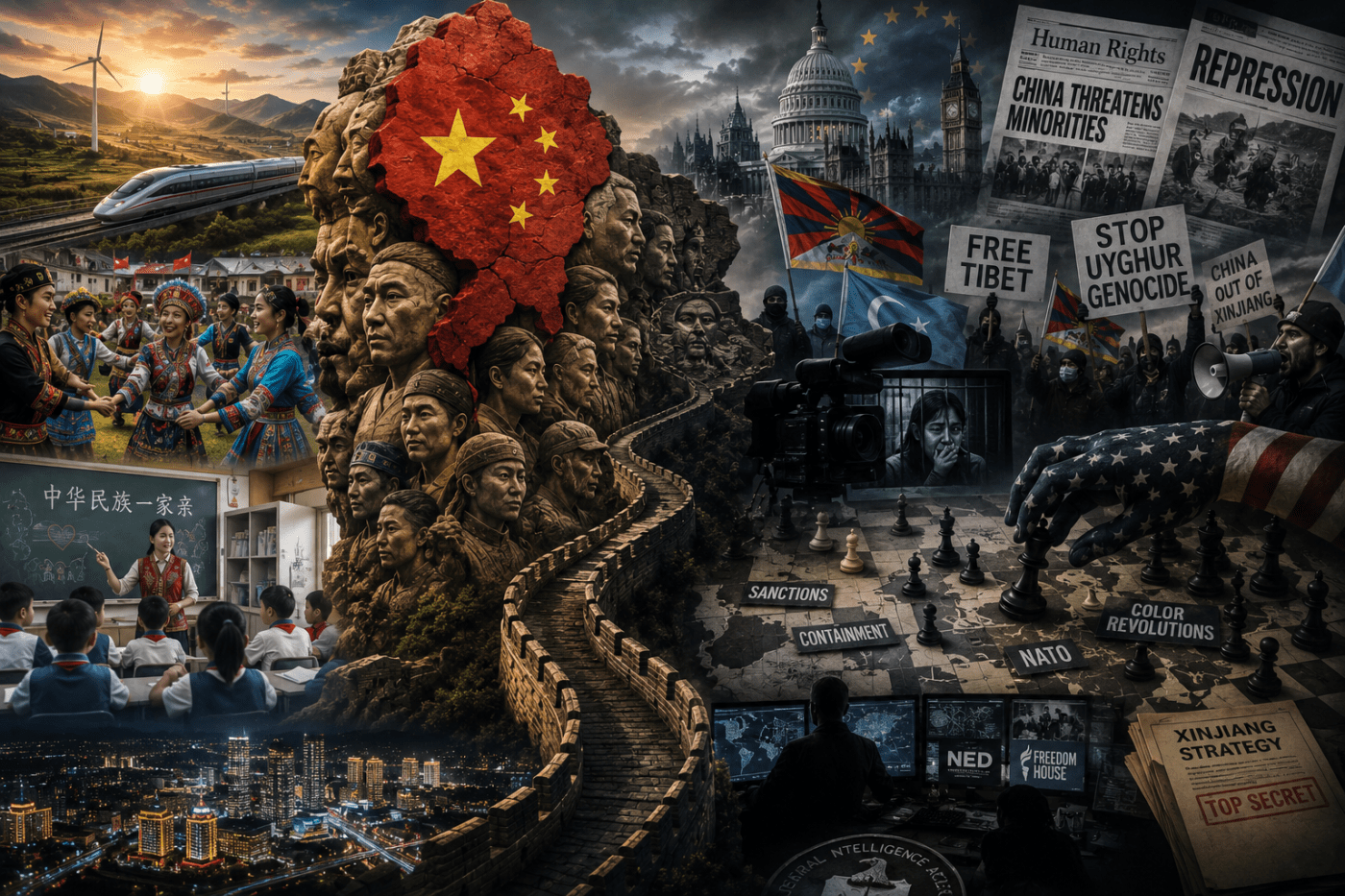
The New York Times presents China’s new ethnic unity law as another chapter in an authoritarian assault on minority peoples, but in doing so it transforms a complex historical and political contradiction into a familiar Cold War morality play. Beneath the headlines lies a much deeper terrain: a multinational socialist state grappling with the legacy of imperial dismemberment, the realities of separatism, and the renewed use of ethnic and religious contradictions as instruments of strategic containment against China. The central question is therefore not whether contradictions exist—they do—but who seeks to exploit them, toward what political end, and how a socialist project can defend national sovereignty without allowing unity to harden into bureaucratic assimilation. Understanding that contradiction is indispensable for anyone committed to anti-imperialism, international solidarity, and the liberation of oppressed peoples from both imperial domination and administrative distortion.
Prince Kapone | Weaponized Information | July 3, 2026
When the Empire Puts China in the Dock
The New York Times article under excavation, “China Defends Widely Criticized ‘Ethnic Unity’ Law,” by Lily Kuo, published July 3, 2026, presents China’s new ethnic unity law as another exhibit in the familiar imperial case file: authoritarian Beijing versus endangered minorities. The article reports real provisions in the law, including its overseas reach, its emphasis on Mandarin, and its insistence on political education around the Communist Party, the motherland, the people, and the Chinese nation. But it arranges those facts inside a courtroom built by the West. China is the accused. The U.S., the European Union, exile organizations, rights groups, and corporate media are the witnesses. The verdict is drafted before the evidence appears.
This is how imperial journalism works when it wants to look sober. It does not need to lie about everything. It selects, sequences, and moralizes. Chinese public education becomes “propaganda.” Western state messaging becomes “concern.” Chinese law becomes “transnational repression.” U.S. and EU pressure becomes “human rights.” Minority fear is foregrounded, but imperial strategy is erased. The reader is shown a state defending unity, but not the long history of empire using ethnicity, religion, separatism, sanctions, exile politics, and information warfare to pry open countries that refuse submission.
The article’s source hierarchy tells the story before the prose does. Western officials, U.S. lawmakers, human rights organizations, Tibetan and Uyghur activists abroad, and Taiwan’s leadership define the moral frame. Chinese officials appear mostly as defensive functionaries insisting the law is misunderstood. The Chinese historical argument—semi-colonial dismemberment, national humiliation, anti-fragmentation, socialist state-building, and the constitutional structure of a unified multiethnic republic—is treated as background noise, if it appears at all. The article therefore does not simply report criticism of the law. It naturalizes the empire’s right to prosecute China’s national question.
That is the ideological function of the piece. It converts a difficult contradiction inside a socialist-rooted multinational state into a simple liberal morality play. It asks the reader to believe that the same imperial bloc that sanctions nations, surrounds China militarily, polices “foreign influence,” arms settler colonies, and launders regime-change politics through “civil society” has suddenly become the guardian of minority liberation. The trick is old. First empire finds a contradiction. Then it names itself the doctor. Then the patient wakes up missing a country.
A serious excavation cannot let the Times define the battlefield. The question is not whether China’s law contains coercive and disciplinary provisions. It does. The question is what those provisions mean inside the real historical terrain: a post-revolutionary socialist state born from anti-colonial rupture, still confronting the unresolved national question under conditions of New Cold War pressure. The propaganda wants China on trial before the empire. The real task is to put the empire’s whole courtroom on trial.
The National Question Is Not a Liberal Charge Sheet
China’s Law on Promoting Ethnic Unity and Progress was adopted by the National People’s Congress on March 12, 2026, and took effect on July 1, 2026. It is presented by China as a fundamental law on ethnic affairs, national cohesion, common prosperity, and the modernization of governance in a unified multiethnic socialist state. The law does not begin from the liberal premise that “diversity” is a private lifestyle question managed by courts, NGOs, and media outrage. It begins from China’s historical experience: after 1840, China was reduced to a semi-colonial and semi-feudal country, and the peoples of China struggled against foreign aggression, territorial fragmentation, national chaos, and civilizational rupture. National unity, in that framework, is not decorative language. It is the political form through which China survived dismemberment.
The law codifies the Xi-era line of “forging a strong sense of community for the Chinese nation”, but this must be read inside the PRC’s constitutional structure. China’s Constitution defines the country as a unified multiethnic state founded by the people of all ethnic groups. It recognizes equality among nationalities, prohibits discrimination and oppression, protects the freedom of all nationalities to use and develop their own spoken and written languages, upholds regional ethnic autonomy, and explicitly opposes both Han chauvinism and local ethnic chauvinism. That is the legal baseline the Times has no interest in foregrounding, because it complicates the preferred courtroom drama of China versus “minorities.”
The law’s language policy is one of its sharpest contradictions. Article 15 establishes the national common spoken and written language as the basic language of education, teaching, and official state organs, while also stating that the state respects and protects the learning and use of minority languages and scripts. The contradiction is not the cartoon of “Han assimilation” alone. It is the socialist state’s effort to build a common national communicative infrastructure while formally preserving minority linguistic rights. That tension is real. A common language can expand mobility, administration, education, and participation across a vast country. It can also become a pressure mechanism if minority languages are pushed from living public life into ceremonial preservation. Serious analysis begins there, not with the NYT’s imperial gasp.
Article 20 places family education inside the broader project of socialist citizenship by requiring parents and guardians to educate minors to love the Communist Party of China, the motherland, the people, and the Chinese nation. In liberal hands, this becomes “indoctrination,” as though capitalist states do not discipline children every day into flags, police, property, militarism, consumer citizenship, settler myths, and the holiness of the market. In revolutionary analysis, the point is clearer: China is openly declaring that national unity, socialist legitimacy, and historical consciousness are not neutral matters under conditions of imperial siege. The political question is not whether any state educates its young into a social order. Every state does. The question is what class project, what historical memory, and what national future that education serves.
Article 63 allows legal responsibility for organizations and individuals outside mainland China who act against the PRC by undermining ethnic unity or creating ethnic division. This is not some uniquely Chinese abnormality descended from the moon. It belongs to the same terrain as extraterritorial law, sanctions regimes, foreign influence policing, espionage prosecutions, and security legislation used constantly by Western states. The outrage appears because China is asserting sovereign defense against imperial fragmentation. U.S. and EU objections must therefore be recorded as hostile state reactions, not neutral moral standards. Western officials denounce China’s overseas reach through the language of “human rights” and “transnational repression,” while the same imperial bloc maintains its own vast machinery of sanctions, extradition pressure, foreign-agent policing, and global legal command.
The buried political core of the law appears in Article 10, which directly names foreign forces using ethnicity, religion, or human rights to suppress, infiltrate, or undermine the PRC. The NYT frame treats this as authoritarian suspicion. History says otherwise. Xinjiang has already been treated by U.S. policy as a pressure point against Chinese sovereignty. Jie Li and Shu Yang’s study, “Exploiting Ethnic and Religious Separatism as a Tool: U.S. Policy in Xinjiang during the Early Cold War,” shows that early Cold War U.S. strategy sought to use ethnic and religious separatism in Xinjiang against the newly founded People’s Republic. That matters because Beijing’s concern about foreign-backed separatism is not mystical paranoia. It is a state memory rooted in the actual record of imperial policy.
The law also includes the development terrain that the liberal frame has every incentive to minimize. Chinese reporting presents the measure as part of a broader effort to promote common prosperity, strengthen infrastructure, improve public services, support industrial development, and protect the environment in ethnic regions. China’s official reporting places ethnic unity inside the material record of poverty alleviation and regional development, including the claim that all 420 poverty-stricken counties in ethnic autonomous areas and all 28 ethnic groups with relatively small populations shook off poverty during the anti-poverty campaign. Implementation can and should be interrogated. Contradictions can and should be studied. But the material terrain cannot be erased and replaced with a pure cultural-repression script cooked in the kitchen of empire and served by the corporate press as humanitarian cuisine.
This is the larger context: the law codifies a specific stage of China’s socialist-rooted state consolidation. It attempts to fuse national modernization, common prosperity, socialist legitimacy, borderland stability, ethnic unity, and anti-imperialist sovereignty into one governing framework. That does not make China “neoliberal” or “imperialist.” It confirms the opposite. The PRC remains a post-revolutionary socialist-rooted state using law, planning, education, development policy, and national mobilization to manage contradictions inherited from semi-colonial dismemberment and intensified by the New Cold War.
The Western frame reverses the whole picture. Every Chinese effort at national cohesion becomes “authoritarian assimilation,” while U.S. and EU foreign policy, sanctions, military encirclement, separatist patronage, exile networks, and information warfare are washed clean as “human rights concern.” The proper comparison is not China against an imaginary liberal West that never existed. The proper comparison is China against every formerly colonized or semi-colonized state that faced imperial fragmentation through ethnicity, religion, border politics, separatist proxies, sanctions, covert influence, and “civil society” infrastructure. China’s internal nationality contradiction is real, but it cannot be analyzed through imperial vocabulary. The revolutionary question is whether socialist unity is deepened through common prosperity, anti-Han-chauvinism, regional autonomy, language protection, cadre accountability, mass participation, and mutual development—or weakened by bureaucratic methods that give imperial propaganda new material to weaponize.
Empire Wants Fracture, Socialism Must Build Unity
The principal contradiction is not “China versus minority rights.” That is the imperial headline, the courtroom frame, the moral little costume the New Cold War puts on before it reaches for the knife. The real contradiction is China’s socialist-rooted multinational state defending anti-imperialist sovereignty against imperial fragmentation, while internally struggling to ensure that national unity is built through common prosperity, equality, autonomy, language protection, and mass participation rather than reduced to administrative command.
The New York Times sees ethnic unity as repression because imperial journalism cannot recognize socialist multinational state-building as legitimate. In its worldview, Western-backed fragmentation becomes “rights advocacy,” exile politics becomes “civil society,” sanctions become “accountability,” and every Chinese attempt to defend national cohesion becomes “authoritarian control.” That is not analysis. That is empire translating its own strategic desires into the language of moral concern. The wolf does not stop being a wolf because it learned to pronounce “human rights” with a trembling voice.
China’s position does not emerge from paranoia or cultural chauvinism in the abstract. It emerges from the historical memory of semi-colonial dismemberment, foreign invasion, borderland vulnerability, separatist pressure, and the living reality of U.S.-led containment. A country that was carved open by empire does not treat unity as a greeting-card phrase. It treats unity as the condition of survival. The law’s preamble is not ornamental. It is the state’s historical argument for why national cohesion cannot be surrendered to those who have already shown what they do when China is weak.
The United States and the European Union are not neutral defenders of Tibetans, Uyghurs, Mongols, Taiwanese people, or anybody else’s liberation. They are imperial powers that have repeatedly converted the vocabulary of rights into sanctions, separatist patronage, diplomatic coercion, media warfare, and regime-change infrastructure. They do not approach China’s nationalities as peoples with full historical lives. They approach them as openings in the wall. One day it is “religious freedom.” The next day it is sanctions. The next day it is hearings, exile platforms, intelligence-friendly NGOs, military encirclement, and another sermon from the arsonist about fire safety.
That does not mean every Chinese policy is automatically correct because Washington opposes it. Only fools and opportunists think anti-imperialism means turning the brain off and saluting whatever the state prints. The law’s coercive and disciplinary provisions must be analyzed dialectically, not sensationalized through NYT moral panic and not buried under empty applause. A socialist state under siege has the right to defend territorial integrity, social stability, and national unity against foreign-backed fragmentation. But socialist unity must be superior to capitalist nation-building. It must defeat chauvinism, protect minority languages and cultures, expand real participation, and resolve uneven development materially.
The danger inside China is not the liberal fantasy that “authoritarianism” naturally hates diversity. That is children’s-book politics for adults who read the State Department as scripture. The danger is bureaucratic handling of the national question: the tendency to flatten contradiction instead of resolving it, to mistake administrative obedience for political unity, to confuse a shared national project with a single official tone. When that happens, unity becomes thinner, not stronger. A multinational socialist state does not become more secure by making minority nationality feel like a file to be managed. It becomes more secure when the people experience unity as their own historic construction.
This is why the contradiction is two-sided but not equal. Imperialism is the principal danger because it seeks to weaken, fragment, encircle, and delegitimize China. It has the motive, the machinery, the money, the media, the sanctions architecture, the military footprint, and the long habit of turning internal contradictions into external weapons. Internal bureaucratic overreach is a secondary contradiction, but it matters because mishandling the national question can create openings for the principal enemy. Empire loves nothing more than a real grievance it can dress in its own uniform.
The revolutionary answer is not separatism. Separatism under imperial sponsorship is not liberation; it is the old colonial mapmaker returning with a nonprofit badge. But the revolutionary answer is also not assimilation. A socialist multinational state cannot answer every contradiction by tightening the administrative belt and calling the resulting silence harmony. The national question under socialism has to be solved at a higher level than bourgeois nationalism. It must join anti-Han-chauvinism and anti-separatism as linked tasks: defend the common state against imperial rupture, while making the common state worthy of defense by every nationality inside it.
That is the story the NYT cannot tell because it would indict the whole imperial order. The article needs the reader to believe China is on trial before civilization. In reality, empire is the guilty party pretending to be the judge. It wants China’s national question placed under Western management, not because it loves oppressed peoples, but because it hates sovereign development outside its command. It wants every contradiction inside China translated into a weapon against China. It wants minority pain made useful, minority fear made strategic, minority identity made available for containment.
The WI position is neither liberal China-bashing nor empty state worship. We defend China against imperial aggression. We reject the U.S.-EU human-rights racket. We expose the NYT’s propaganda function. And we insist that socialist multinational unity must be proven in practice through common prosperity, anti-chauvinism, minority cultural flourishing, language protection, regional autonomy, cadre accountability, and mass-line governance. China is not on trial before the empire. The empire is on trial before history. And history has already seen what it does when it gets its hands on a country’s national question.
Do Not Let Empire Borrow the Language of Liberation
The task now is not to let the empire borrow the language of liberation and march it back into the arsenal. The Times wants its readers to feel morally clean while standing inside the New Cold War machine. Our job is to break that machine. That begins with political education rooted in law, history, and anti-imperialist discipline: read the ethnic unity law itself, study China’s constitutional structure as a unified multiethnic socialist state, study the historical use of Xinjiang as a pressure point against the People’s Republic, and refuse every media script that turns Tibet, Xinjiang, Taiwan, or any other national question into a ready-made weapon for Washington and Brussels.
There are already formations doing pieces of this work. The Veterans For Peace China Working Group organizes against U.S. confrontation with China and calls for peace, dialogue, and cooperation instead of militarized encirclement. Veterans For Peace identifies itself as a global organization of military veterans and allies working to abolish war, which makes it a useful anti-war anchor for people trying to move this question out of liberal outrage and into organized opposition to empire. Qiao Collective describes itself as a diaspora Chinese media collective challenging U.S. aggression on China, and its materials are especially useful for breaking the monopoly of corporate media narratives in teach-ins, reading groups, classrooms, union halls, and social media work. No Cold War provides an international campaign frame against the U.S.-led confrontation with China, useful for connecting this struggle to the wider global fight against militarism, sanctions, and imperial bloc discipline.
Black radical anti-war work also belongs in this struggle. The Black Alliance for Peace connects U.S. militarism abroad to repression at home, and its anti-imperialist framework helps expose the fraud of a government that claims to defend minority peoples in China while occupying, sanctioning, policing, imprisoning, and starving oppressed peoples across the world. The movement must make that contradiction visible everywhere. A state that arms settler colonies, surrounds China with bases, funds opposition networks, polices “foreign influence” at home, and sanctions nations abroad has no standing to lecture the world about freedom.
The concrete work is clear. Build teach-ins on the national question under socialism. Compare the law’s actual text against the NYT frame. Circulate the history of U.S. exploitation of ethnic and religious separatism in Xinjiang. Challenge anti-China propaganda inside unions, churches, campuses, community groups, anti-war coalitions, and local media. Push peace organizations to name Tibet, Xinjiang, Taiwan, sanctions, bases, chips, and military encirclement as parts of one New Cold War strategy. Defend Chinese, Asian, Muslim, immigrant, and international student communities from the domestic blowback that always follows imperial demonization abroad.
The political line must stay sharp. Defend China against imperial fragmentation. Reject the U.S.-EU human-rights racket. Refuse NGO moralism that turns oppressed peoples into props for containment. At the same time, insist that socialist unity must be stronger than administrative uniformity: common prosperity, anti-chauvinism, minority language protection, cultural dignity, regional autonomy, cadre accountability, and mass participation. That is how we keep the national question out of the hands of the Pentagon without surrendering it to bureaucracy. Empire wants fracture. Socialism must build unity worthy of defense.


Leave a comment