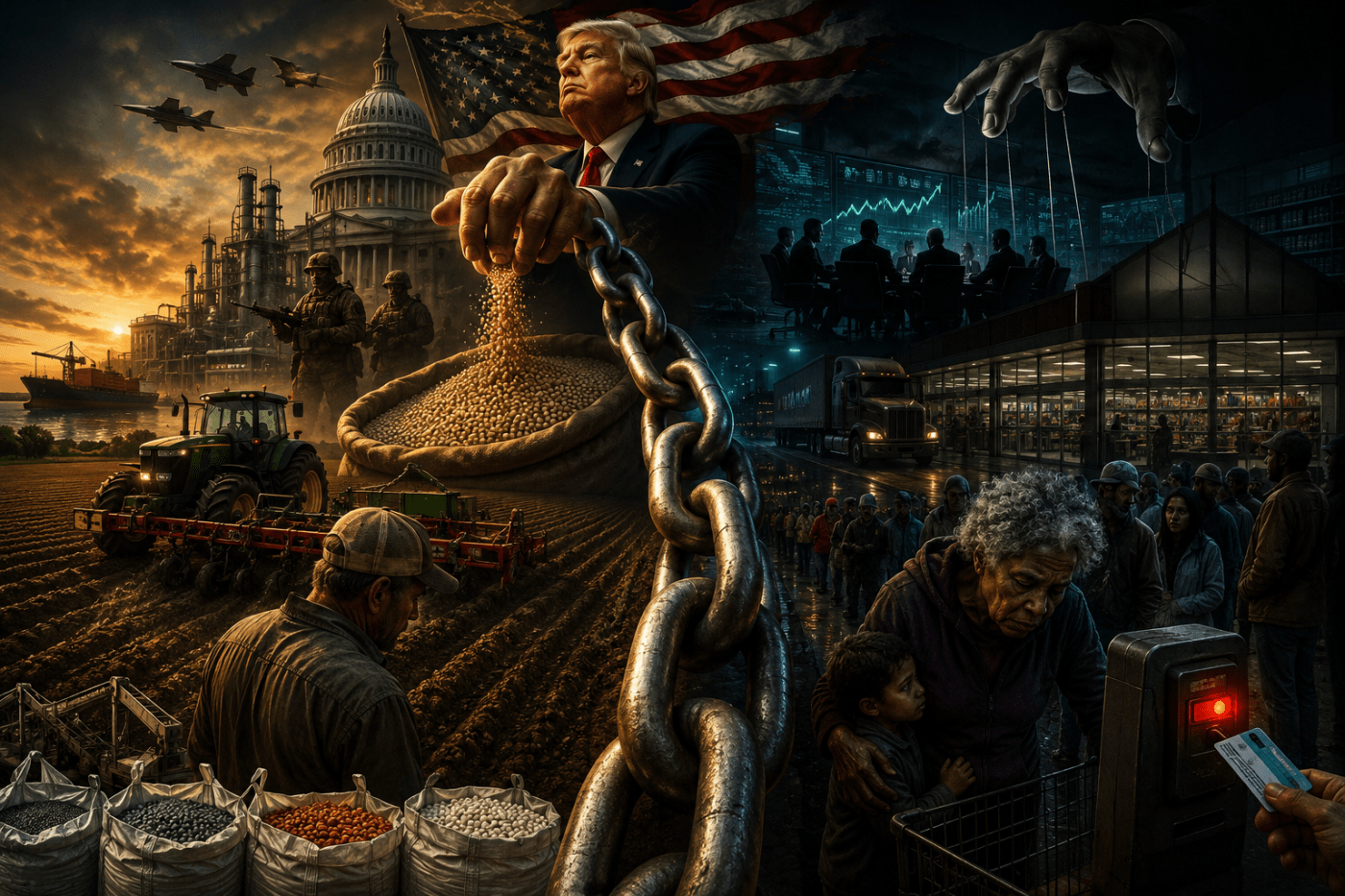
Fox celebrates Trump’s fertilizer emergency as farmer relief, but the article quietly admits that the food system depends on state intervention when production is threatened. The factual record shows that the emergency sits inside a U.S.-built tariff regime, a concentrated fertilizer market, global input dependency, and a food chain where most value is captured after the farm gate. The real story is Trump 2.0’s technofascist food regime: relief upward for capital, discipline downward for workers and oppressed internal nationalities. The answer is not charity politics or liberal welfare defense alone, but food power: defend SNAP, organize the food chain, build mutual aid, strengthen Black and Indigenous food sovereignty, and fight toward decommodified food as a social guarantee.
Prince Kapone | Weaponized Information | June 29, 2026
The Emergency Is Only an Emergency When Capital Needs Feeding
Fox Business reports that President Donald Trump has declared a food supply emergency and temporarily suspended tariffs on Moroccan phosphate fertilizer imports, presenting the move as a decisive act to protect American farmers, stabilize food production, and lower pressure on working families. The article follows the rhythm of the White House almost step for step: there is an emergency, fertilizer is needed, farmers must be protected, and Trump has acted. The reader is not invited to ask why the food system is so fragile that a tariff fight over phosphate fertilizer must be elevated into an emergency proclamation. The reader is not invited to ask who controls the inputs, who captures the profits, who pays the prices, and who gets disciplined when the food crisis reaches the household refrigerator instead of the farm ledger.
The first trick is benevolence. Fox gives us Trump the protector, standing guard over the farmer and the consumer, as if the capitalist food system were a family farm wrapped in a flag and not a dense machinery of land monopoly, fertilizer dependence, agribusiness concentration, retail power, debt, transport, speculation, and state management. The article repeats the administration’s claim that tariff suspension is needed so farmers can access phosphate fertilizer in time to protect the domestic food supply, while leaving untouched the political economy underneath that sentence. “Farmers” become the innocent face of the policy. Behind that word sit input giants, trade lawyers, tariff regimes, grain markets, food processors, grocery chains, banks, landlords, and the old patriotic scarecrow named national security.
The second trick is national security laundering. Once the administration declares fertilizer “vital” to feeding the nation, state intervention becomes common sense. Tariffs can be suspended. Emergency authority can be invoked. Trade policy can bend. The state can move with speed and confidence because agricultural production must not be interrupted. But this is where the article exposes more than it intends. Fox is not defending the free market here. It is celebrating state intervention into the food system. The question is not whether the state intervenes. The question is where, for whom, and with what class purpose.
That is the omission sitting in the middle of the article like a bone in the throat. The piece treats intervention at the input level as responsible government, while the broader Trump 2.0 food regime treats intervention at the household level as dependency, fraud, and moral failure. When fertilizer supply threatens production, there is an emergency. When hunger threatens the worker, there is suspicion. When agribusiness needs stability, the state becomes generous. When poor and working people need groceries, the state becomes a caseworker, a cop, an accountant, and a scold. Fox does not need to mention SNAP for this contradiction to matter. The article’s own logic opens the door: food is strategic when capital needs inputs, but food is conditional when workers need to eat.
So the ideological function of the article is not simply to praise Trump. It is to discipline how the reader understands food security. Food security is made to mean fertilizer access, tariff relief, farmer margins, and national supply. It is not made to mean the right of every person to eat. The emergency is real, but it is framed from the commanding heights of production, trade, and capital, not from the kitchen table of the working class and the oppressed internal nationalities who live every day under the permanent emergency of prices, wages, rent, debt, and hunger. That is the excavation. Fox says Trump saved the food supply. What it really shows is that the capitalist state knows food is too important to leave to the market, but only admits it when the stomach being protected belongs to capital.
The Tariff Was Suspended Because the Market Had Already Failed
The emergency Fox presents as presidential common sense is, in its own legal form, state intervention into the agricultural input chain. Trump’s June 29 proclamation declared an emergency and authorized the temporary duty-free importation of phosphate fertilizer from Morocco, using presidential authority to interrupt the normal tariff regime because fertilizer supply had become a food-supply problem. The White House stated that phosphate fertilizer is “vital to feeding the Nation” and that the suspension was meant to give farmers “sufficient and timely” access to a key input needed for domestic agricultural production. This was not a free-market correction. It was executive intervention because the food system could not stabilize itself.
The Moroccan phosphate order followed Trump’s earlier move to place agricultural inputs directly inside the machinery of national security. In February, the administration issued an order mobilizing Defense Production Act authority around elemental phosphorus and glyphosate-based herbicides, connecting crop production, military supply chains, and national defense. By June, the same logic had reached Moroccan phosphate. Fertilizer was no longer treated merely as a farm expense. It was treated as strategic infrastructure.
Fox does not explain that this emergency partially reverses a tariff regime Washington itself built. The Department of Commerce issued countervailing-duty orders on phosphate fertilizers from Morocco and Russia in April 2021 after Commerce and the International Trade Commission found subsidized imports had injured U.S. industry. Those orders remained part of the trade battlefield into 2026, with the ITC conducting five-year reviews of the Morocco and Russia phosphate fertilizer duties to determine whether ending them would likely bring back injury. The emergency suspension was the state loosening one arm of its own protectionist apparatus because another arm of the food system needed relief.
The input crisis was already mature before Trump signed the proclamation. USDA’s Economic Research Service found that fertilizer costs per acre for corn and wheat in 2022 rose to more than double their 2020 levels, placing the June 2026 emergency inside a longer spiral of price shocks and supply stress. Texas A&M’s Agricultural and Food Policy Center found that U.S.-based fertilizer concentration reached CR4 levels as high as 100 percent for phosphate and potash and 77 percent for nitrogen, exposing the class structure hidden beneath Fox’s soft-focus word “farmers.” In this system, the farmer is squeezed by the input monopolist before the seed touches the soil, then squeezed again by the post-farmgate machinery after the crop leaves the field.
Moroccan phosphate sits directly inside that dependency. Texas A&M’s study of the countervailing-duty fight found that Morocco was a major source of U.S. phosphate fertilizer imports before the tariff battle, which means the emergency was not about some marginal foreign supplier. It was about an exposed artery in the U.S. food-production system. The same state that sells “America First” had to suspend duties on Moroccan fertilizer because American agriculture depends on global mineral extraction, international shipping, foreign producers, trade policy, and concentrated input markets.
The contradiction sharpens when the food chain is followed from the field to the household. Five days before the fertilizer proclamation, USDA announced that the national SNAP payment error rate for fiscal year 2025 was 10.62 percent, immediately placing the number inside Congress’s new 6 percent threshold for state penalties. But the same USDA release states that SNAP payment error rates measure how accurately states determine eligibility and benefit amounts, and USDA’s own payment-error page states that payment errors include both underpayments and overpayments. In other words, the administration’s fraud narrative turns administrative error, changing household income, paperwork burden, state capacity, and benefit-calculation complexity into a weapon against the people who need food assistance.
The administration’s definition of a food emergency changes the moment the crisis leaves the fertilizer plant and arrives at the kitchen table. Just five days before Trump declared an emergency to protect phosphate fertilizer imports, the USDA announced that the national SNAP payment error rate for fiscal year 2025 had reached 10.62 percent, placing most states above Congress’s newly established 6 percent threshold that now triggers financial penalties. The number was immediately absorbed into the administration’s campaign against the food stamp program, reinforcing the narrative that SNAP had become a system plagued by fraud, waste, and abuse. Yet the administration’s own documentation tells a different story. The same USDA release explains that payment error rates measure how accurately states determine eligibility and benefit amounts, while USDA’s payment quality guidance states that payment errors include both underpayments and overpayments. What is presented politically as evidence of criminality is, in reality, a statistical measure of administrative accuracy shaped by changing household income, reporting requirements, bureaucratic complexity, and state administration.
The administration has transformed that bureaucratic measurement into an instrument of class discipline. Trump’s tax-and-spending law authorizes the federal government to require states with payment error rates above 6 percent to begin paying a share of SNAP benefit costs for the first time, while simultaneously increasing the share of administrative expenses borne by the states themselves. The Congressional Budget Office projects that these changes will reduce direct federal SNAP spending by approximately $41 billion between 2028 and 2034, largely by shifting financial responsibility downward and encouraging states to restrict participation. The consequences are already visible. Millions of people have already begun losing access to SNAP benefits under Trump’s restructuring of the program as states confront new fiscal pressures and recipients face tightening eligibility rules and administrative barriers.
This is precisely why the SNAP offensive belongs inside the same excavation as the Moroccan fertilizer emergency. Both are expressions of the same food regime viewed from opposite ends of the food chain. When fertilizer prices threaten agricultural production, the state invokes emergency powers, suspends tariffs, and mobilizes its institutional machinery to stabilize the conditions under which capital produces food. When the contradiction appears at the level of the working-class household—when wages fail to purchase groceries, when children go hungry, when workers require assistance to reproduce life itself—the language changes completely. Emergency becomes fraud. Relief becomes dependency. Administration becomes punishment. The state intervenes decisively at both ends of the food system. The only difference is whose crisis it recognizes as worthy of rescue.
The deeper political economy is food commodification. John Bellamy Foster’s Monthly Review essay places food, nutrition, agriculture, class, and capitalist social relations inside Marx’s critique of capitalism. Benjamin Selwyn’s Socialist Register essay states the strategic problem directly: food commodification reproduces laboring-class market dependence because access to food through the market requires money, wages, and submission to prices. Weaponized Information has already excavated this terrain from several angles: the struggle over SNAP as a class war over food, the family-farm mythology that hides agribusiness monopoly power, the attack on hunger measurement as part of technofascist perceptual management, and the use of food-stamp rollbacks as one weapon in Trump’s wider class offensive.
The Food Chain as Class Command
The Fox article says Trump moved to protect the food supply. The facts show something sharper: the Trump 2.0 regime knows the food system is too fragile, too concentrated, too dependent, and too strategic to be left to the mythology of the market. When fertilizer inputs are threatened, the state does not fold its arms and preach personal responsibility to the soil. It declares an emergency. It suspends duties. It places agricultural inputs inside the same vocabulary as national defense. It moves because production must continue, prices must be managed, and the machinery that feeds the country must not seize up in public view.
That is the first admission. Food is not a private matter when capital needs the conditions of production secured. Fertilizer is not a plate of food, but the state understands that it sits near the beginning of the chain. If that link breaks, the break travels forward: into planting, yields, prices, farm income, supply contracts, processing, distribution, retail shelves, and political stability. The state knows this. Fox knows it enough to celebrate the intervention. The White House knows it enough to speak the language of emergency. Nobody in power tells the fertilizer market to tighten its belt, find a second job, or prove that it is poor enough to deserve relief.
But when the same food crisis appears at the other end of the chain, inside the household, the vocabulary changes. The emergency disappears. The worker’s refrigerator is not treated as national infrastructure. The child’s dinner is not treated as strategic supply. The elder’s grocery card is not surrounded with the patriotic music reserved for fertilizer imports. At the household level, food access becomes an object of suspicion, paperwork, error rates, penalties, work discipline, and moral interrogation. The system that can see hunger coming through the phosphate market suddenly goes blind when hunger appears in the kitchen.
This is not contradiction in the sense of confusion. It is contradiction in the Marxist sense: one social relation appearing in opposite forms depending on class position. At the production end, food is national security because agricultural capital, input monopolies, and supply chains require protection. At the consumption end, food is discipline because working people must remain dependent on wages, prices, bosses, landlords, and state-administered relief. The regime does not hate dependency. It organizes dependency. It hates any form of survival that weakens the whip of the market.
That is why SNAP is not socialism, and the right knows it even when it screams otherwise. A socialist food system would confront private ownership, monopoly control, land concentration, commodity production, and the rule of profit over life. SNAP does none of that. It helps workers buy food inside the private market. It moves public money through private retailers. It keeps people alive while leaving the food system in capitalist hands. But even that limited survival mechanism becomes intolerable to the ruling class when it gives the poor and working class any breathing room outside immediate hunger discipline. Welfare capitalism is acceptable only when it reproduces labor quietly. It becomes a scandal when the worker is seen eating without sufficient humiliation.
The Fox article therefore opens a larger map of the Trump 2.0 food regime. At the input level, the state intervenes to protect fertilizer access. At the farm level, it wraps policy in the sentimental language of “farmers,” while hiding the concentration of power that squeezes actual producers from above and below. At the distribution level, the supply chain is dominated by large firms with the scale to protect themselves through disruption. At the retail and post-farmgate level, most of the food dollar travels away from the farm and into the machinery that processes, transports, packages, finances, markets, and sells food back to the people. At the household level, the same state that rescues the chain disciplines the people chained to it.
This is technofascist consolidation through the food system: not merely hunger, not merely high prices, not merely tariffs, not merely benefit cuts, but the fusion of emergency power, market concentration, administrative surveillance, national-security language, and class punishment. The regime does not need to nationalize the grocery store to command the stomach. It can command the stomach through the fertilizer input, the tariff schedule, the benefit portal, the eligibility rule, the work requirement, the error-rate regime, the data system, the checkout counter, and the price tag. The old breadline becomes a digital queue. The ration card becomes an EBT card under suspicion. The food chain becomes a chain of command.
Oppressed internal nationalities feel this command with particular force because the food system in the United States has never been a neutral marketplace. The same capitalist order that concentrates land, wages, housing, credit, policing, and healthcare also concentrates hunger. The Black household, the Indigenous family, the migrant worker, the colonized neighborhood, the disabled worker, the unemployed worker, and the poor rural family do not encounter the food system as consumers floating freely through choice. They encounter it as a terrain already shaped by dispossession, low wages, redlined markets, carceral discipline, poisoned land, hollowed-out stores, predatory prices, and state suspicion. When Trump declares an emergency for fertilizer but not for hunger, he is not forgetting these communities. He is governing them.
Fox wants the reader to stop at the patriotic surface: Trump protects the food supply. The real story begins there but does not end there. The food supply is being protected as a system of capitalist accumulation, not as a human right. Production must be secured because capital must circulate. Distribution must be stabilized because firms must sell. Consumption must be disciplined because workers must remain dependent. The farmer is invoked, the corporation is hidden, the worker is blamed, and the state stands in the middle pretending to be a neutral referee while handing relief upward and discipline downward.
The emergency proclamation is therefore not an exception to Trump’s war on the working class. It is one of its clearest expressions. The regime is not anti-state. It is not anti-intervention. It is not even anti-dependency. It is building a food order where capital can depend on the state, while workers must depend on capital. It protects the conditions that allow food to be produced as a commodity and attacks the conditions that allow people to survive when they cannot afford that commodity. This is the hidden law of the article Fox published by accident: food is sacred when it feeds accumulation, conditional when it feeds people, and criminal when the hungry dare to demand it as a right.
From Food Relief to Food Power
The answer to this food regime cannot be charity politics, donor spectacle, or another liberal sermon about compassion from people who will not confront power. Hungry people need food now. Workers need benefits defended now. Farmworkers need rights now. Black and Indigenous communities need land, seed, water, and self-determining food systems now. The task is to defend every survival mechanism the working class needs under capitalism while building the forms of dual and contending food power that can break dependence on the very system producing hunger.
That work already exists in embryo. Food Not Bombs describes itself as an autonomous, consensus-based movement that recovers food and shares free meals as a protest against war, poverty, and hunger. That is not a substitute for revolution, but it is a living answer to the obscene arithmetic of empire: food is wasted while people starve, and bombs are funded while groceries are rationed. Every city where people can organize should have free food shares tied to political education, SNAP defense, antiwar work, and local campaigns against grocery profiteering.
The struggle also has to move through the oppressed internal nationalities whose communities are hit hardest by the food regime’s combined violence of price, poverty, dispossession, policing, and administrative discipline. The Detroit Black Community Food Sovereignty Network frames its work around Black food sovereignty, environmental justice, and Black liberation, while the National Black Food & Justice Alliance organizes around Black food sovereignty, land justice, and self-determining food economies. These formations point beyond begging the state for a softer cage. They point toward community-controlled land, cooperative groceries, urban farms, resource commons, political education, and food institutions accountable to the people who eat, work, and live there.
Indigenous food sovereignty is not a lifestyle niche. It is a front of anti-colonial struggle. The Native American Food Sovereignty Alliance works to restore, affirm, and reclaim Indigenous food systems, and the Indigenous Seed Keepers Network supports seed sovereignty projects across Turtle Island. Any serious food politics in the settler colony has to begin there: with land, water, seeds, traditional foodways, treaty rights, ecological repair, and Indigenous governance against the colonial food order that poisoned the soil, enclosed the land, attacked the buffalo, disciplined the reservation, and then sold “choice” back to the people through a checkout machine.
The food chain also has to be organized as a labor chain. Food Chain Workers Alliance represents workers across farming, warehousing, meatpacking, distribution, restaurants, retail, and other food sectors, making visible the labor hidden behind the sacred phrase “food supply.” Migrant Justice organizes immigrant farmworkers for economic justice and human rights, and its Milk With Dignity campaign targets corporate dairy supply chains through worker-led pressure. That is the direction: not consumer guilt, but worker power; not polite concern, but organized pressure at the choke points where profit depends on exploited labor.
Concretely, this means defending SNAP recipients from the fraud frame; sharing USDA’s own language showing that payment errors are not the same thing as recipient fraud; supporting local food shares, community kitchens, and community fridges; joining food-worker and farmworker campaigns; refusing to cross worker-led picket lines; building Black and Indigenous food-sovereignty institutions; pressuring retailers that profit from abusive supply chains; and turning every discussion about groceries, tariffs, fertilizer, and hunger into political education about class power. The point is not to romanticize survival work. The point is to organize survival so it becomes a school of struggle.
The warning is simple. Do not let liberals shrink this into “SNAP works,” and do not let conservatives reduce it to “fraud.” SNAP helps people eat, and that must be defended without apology. But the horizon is not a more polite welfare capitalism where the poor are processed more efficiently through the same market cage. The horizon is food as a human right, food as social guarantee, food as collective power, food as decommodified life. The Fox article showed us the state will move when the food system serving capital is threatened. Our task is to build enough organized power that the hunger of the people becomes an emergency the ruling class can no longer manage, ignore, or discipline away.


Leave a comment