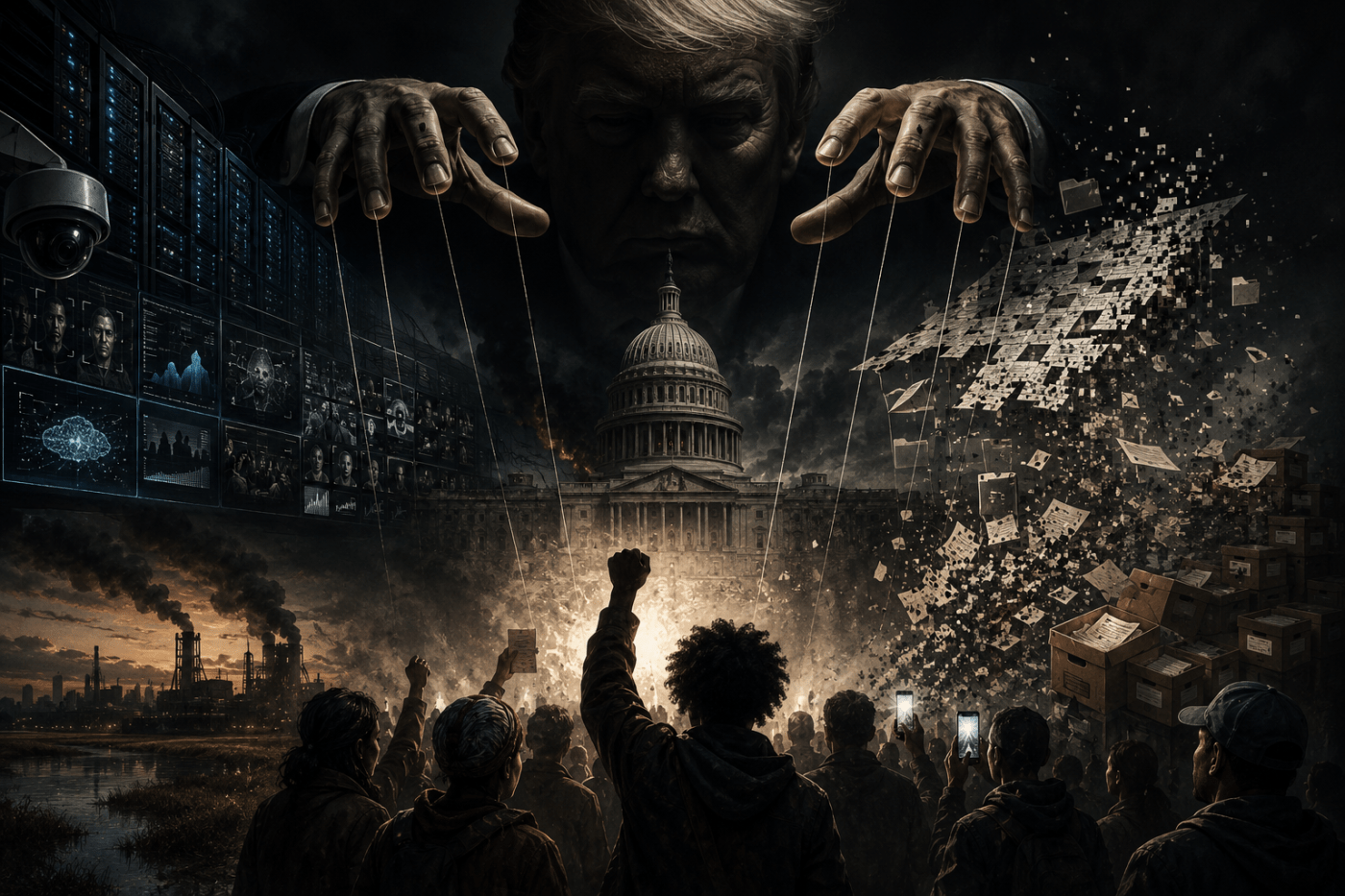
The Guardian exposes how the Trump regime is systematically dismantling federal datasets tied to hunger, pollution, maternal death, climate catastrophe, and social vulnerability, revealing an escalating assault on the public record itself. Beneath the liberal language of “transparency” lies a deeper crisis: a ruling class attempting to blind the population before the social wreckage of imperial decline becomes impossible to hide. As the empire expands surveillance, AI policing, and informational control while erasing the statistics that expose suffering, the struggle over data becomes a struggle over who gets to define reality itself. Across the country, archivists, anti-colonial organizers, environmental justice movements, librarians, and grassroots preservation networks are beginning to fight back against a collapsing system terrified of its own numbers.
By Prince Kapone | Weaponized Information | May 7, 2026
The State Takes a Knife to the Public Record
In “The Trump administration is deleting government data. From infant deaths to hunger, here are 5 ways it’s hurting Americans”, published by The Guardian on May 7, 2026, Amy Qin reports on the Trump administration’s systematic alteration, removal, and destruction of federal datasets and public information tools. The article focuses on five areas where deleted or disabled data systems are already producing concrete harm: hazardous chemical exposure, maternal and infant health, hunger, LGBTQ youth vulnerability, and climate disasters. Qin’s basic argument is straightforward: federal data is not a decorative ornament sitting in some bureaucrat’s filing cabinet; it is part of the infrastructure through which public agencies, researchers, communities, and ordinary people identify social problems, fight for resources, and hold power accountable. When that information disappears, the people most exposed to danger are made more vulnerable, while the institutions responsible for protecting them become conveniently blind.
The Guardian approaches this crisis from the standpoint of liberal public-interest journalism. Its institutional posture is that of a professional media outlet defending transparency, expertise, democratic norms, and public access to information against dictatorial vandalism. That gives the piece a real usefulness. It names harm. It gathers testimony. It shows how the deletion of government data will make life harder for people already living under the boot heel of poverty, pollution, medical neglect, climate disaster, and state-backed social erasure. But it also carries the limits of its own class location. The article can tell us that the house is burning, and it can interview several credentialed people who smell the smoke, but it does not quite tell us who built the house, who owns the matches, and why the landlords always seem to have fire insurance while the tenants are left coughing in the stairwell.
Qin’s reporting relies heavily on the authority of experts: former federal data officials, public health scholars, environmental advocates, insurance analysts, legal researchers, and nonprofit policy workers. This is not a weakness in itself. Expert testimony matters, especially when the Trump regime is attacking the very infrastructure that allows the public to verify reality. But this appeal to authority also narrows the social field. The poor, the hungry, the poisoned, the pregnant, the trans, the uninsured, and the climate-displaced appear mostly as populations affected by data loss, not as political subjects engaged in struggle. The article lets professional knowledge speak clearly. It does not yet fully let the people speak as a class.
The piece also uses appeal to emotion, and rightly so. Babies dying without adequate maternal health data. Families facing hunger while the government stops measuring food insecurity. Trans youth placed at greater risk while the state removes the categories that make their suffering visible. Communities living near chemical facilities suddenly forced back into the paper-record darkness, as if this were 1926 and not 2026. Homeowners facing a climate insurance crisis while the government stops updating the very disaster archive used to understand risk. These examples hit hard because they should hit hard. They are not sentimental decorations. They are social wounds. Still, the article keeps these wounds largely within the frame of administrative cruelty, rather than identifying them as symptoms of a ruling-class project.
The dominant propaganda mechanism inside the article is narrative framing. The Trump administration is presented as destroying data because it is hostile to “woke programs,” “racial equity,” “gender ideology,” and “climate extremism.” That is true as far as it goes. But the deeper class logic remains underdeveloped. The article frames the purge as an attack on public knowledge and democratic governance, but it does not fully excavate how the ruling class benefits when the public loses the ability to independently measure social breakdown. This is where omission does its quiet little dance in polished shoes. The reader is shown the disappearance of the data, but not yet the political economy of disappearance.
There is also card stacking. The article piles up five powerful examples, each one damning, each one morally urgent, each one backed by concrete consequences. Chemical danger. Infant mortality. Hunger. Queer and trans youth vulnerability. Climate disaster. Together they create a devastating picture of administrative destruction. But the structure also fragments the crisis into separate policy arenas, when the more dangerous truth is that these are not separate fires. They are connected burn marks from the same ruling-class machine. The same regime that wants to erase hunger data wants to erase climate data, maternal health data, LGBTQ data, and environmental risk data because all of them help the people prove what capitalism and empire are doing to their lives.
The article’s source hierarchy reinforces this limitation. The Guardian’s sources are credible, useful, and often necessary, but the political center of gravity remains with experts and institutions rather than organized communities and revolutionary movements. The people appear as victims of informational destruction more than as potential makers of counter-power. This is liberal journalism’s old habit: it discovers the crime scene, photographs the blood, interviews the coroner, and then gets nervous when someone asks who owns the knife factory.
Still, the article gives us valuable raw material. It confirms that the Trump 2.0 regime is not merely attacking agencies, budgets, programs, or personnel. It is attacking the public record itself. It is taking a knife to the instruments through which society can see its own injuries. That is where a Weaponized Propaganda Excavation must begin: not by dismissing the Guardian’s reporting, but by pushing through its limits. The liberal press can tell us that data is disappearing. Our task is to ask the harder question: why would a ruling class preparing economic, ecological, and social disaster want the people to lose access to the statistics that could prove the disaster is real?
When the Empire Stops Counting Its Dead
The Trump regime’s attack on federal data systems is not just about a few missing webpages or broken government tools. What is unfolding is bigger, meaner, and far more dangerous than bureaucratic vandalism. This is a campaign against the people’s ability to measure social collapse itself. The federal government has frozen, erased, restricted, abandoned, or quietly strangled datasets connected to climate catastrophe, hunger, maternal death, pollution, labor conditions, public health, demographic vulnerability, and gender identity. According to the Federation of American Scientists, a dataset does not need to be officially “deleted” to be destroyed. Fire the staff. Cut the contracts. Kill the advisory boards. Stop maintenance. Break the institutional machinery that keeps information alive. The empire has learned that you do not always have to burn the books in the town square like some medieval fanatic. Sometimes you just starve the archive slowly and let neglect perform the execution quietly in the dark.
And already the consequences are piling up like bodies after a storm. The administration removed EPA tools that helped communities identify nearby chemical hazards. It weakened or dismantled datasets tracking maternal health and infant mortality in a country already leading the industrialized world in making childbirth more dangerous than it has any right to be. It killed the government’s primary hunger survey while escalating attacks on food assistance programs serving millions of poor and working-class people. It stripped gender identity questions from youth surveys while intensifying state-backed attacks against trans communities. It halted updates to climate disaster databases used by researchers, local governments, insurers, and emergency planners. WUSF called this process a “war on measurement,” and that phrase lands like a hammer because that is exactly what this is. Measurement itself has become politically dangerous to a ruling class steering an increasingly unstable empire through economic decay, ecological breakdown, and social fragmentation.
The important question is not simply what data is disappearing, but what data is being preserved and expanded. The American state suddenly claims poverty statistics are too expensive, climate archives are too burdensome, and maternal health monitoring is somehow optional. Yet there always seems to be enough money for border militarization, AI surveillance systems, predictive policing software, biometric tracking, financial monitoring, military intelligence infrastructure, and corporate-state data fusion. Funny how the empire develops amnesia only when the numbers begin indicting the system itself. Analysis of surveillance capitalism places these data systems exactly where they belong: inside the machinery of monopoly-finance capital, imperial security, militarized governance, and corporate accumulation. The contradiction is naked. The ruling class wants endless information about the people while denying the people reliable information about the ruling class.
And this contradiction is not colorblind, neutral, or accidental. It is racialized down to its bones. Critical scholarship on racial capitalism and public health shows how institutional reporting systems, liability structures, and data regimes routinely protect capital while reproducing unequal exposure to pollution, disease, injury, and premature death among oppressed populations. The communities nearest toxic facilities are overwhelmingly Black, Latino, Indigenous, immigrant, poor, and working class. The people most vulnerable to hunger are concentrated in the same internal colonies long abandoned by capital except when cheap labor or police occupation is required. The regions hit hardest by floods, storms, contamination, and environmental collapse are often the same places sacrificed to extractive industry for generations. Under these conditions, weakening public data systems does not create neutrality. It deepens invisibility exactly where the system concentrates suffering.
The same logic stretches across Indigenous life like a scar running through the continent. Indigenous data scholarship now openly describes statistical erasure as a continuation of settler-colonial violence. Indigenous communities have long been misclassified, undercounted, erased, or rendered invisible inside federal systems tracking poverty, mortality, environmental exposure, health outcomes, and land use. This is not some innocent bureaucratic error committed by exhausted office workers dropping paperwork behind filing cabinets. Settler colonialism has always depended on making populations disappear administratively before displacing them materially. If a people cannot be counted properly, they can be denied properly. If their suffering cannot be measured, it can be politically buried beneath patriotic speeches and development contracts.
Demos traces the roots of modern data capitalism directly into slavery, settler colonialism, white supremacy, patriarchy, and the management systems of capitalist domination. Long before Silicon Valley executives began preaching about “innovation” from glass towers built with military contracts and monopoly rents, colonial regimes were already cataloging human beings like inventory. Plantation ledgers tracked laboring bodies. Census systems sorted populations into racial hierarchies. Colonial administrations classified entire peoples for extraction, policing, and dispossession. The algorithm did not invent domination. It digitized it. The spreadsheet replaced the slave ledger. The database replaced the colonial registry. The police drone replaced the overseer on horseback. The technology changed costumes while the social relation underneath remained stubbornly familiar.
That is why the Trump regime’s destruction of public statistical infrastructure cannot be dismissed as simple anti-science stupidity or culture war theater. Black Agenda Report correctly argues that Trump 2.0 is not some strange interruption in American history but a sharper expression of political tendencies rooted deeply inside the U.S. settler state itself. The attack on public knowledge emerges from a system built through slavery, colonial conquest, anti-communism, racial hierarchy, and capitalist accumulation. Empires in decline do not merely intensify repression. They intensify narrative management. They become obsessed with controlling perception because material reality itself is slipping beyond their control.
The campaign against public data sits beside a wider assault on historical memory. PEN America reports that book bans continue accelerating across public schools, especially targeting works dealing with race, colonialism, gender, sexuality, and historical oppression. This matters because ruling classes never censor only one thing. Once a system begins losing legitimacy, every institution capable of producing independent memory becomes suspect: libraries, archives, schools, universities, historians, journalists, researchers, organizers. The war on “wokeness” is not just a tantrum thrown by reactionaries angry about pronouns and history lessons. It is a political struggle over who gets to define reality itself. A society that cannot remember clearly cannot resist clearly.
But the story does not end with destruction. Resistance is already beginning to emerge from below. The Data Rescue Project has started preserving endangered federal datasets, archiving more than 311,000 datasets totaling over 16 terabytes of public information pulled from vulnerable government systems. Researchers tracking federal removals reported that nearly 3,400 datasets had already vanished from Data.gov by early 2025. Librarians, archivists, researchers, scientists, and public-interest technologists increasingly resemble underground preservationists trying to save historical memory from a collapsing empire determined to hide its own report card from the people it governs.
Even sections of capital itself are beginning to crash into this madness. Insurance companies still require climate data. Public health systems still require continuity. Universities still require demographic information. Municipal planners still require environmental monitoring. AP reporting documented catastrophic staffing losses across federal statistical agencies, including one agency reportedly losing 95 percent of its workforce. Meanwhile, a federal judge ordered agencies to restore deleted health datasets and webpages after ruling their removal caused direct harm to medical providers and public health systems. Even within the ruling bloc contradictions are surfacing between the technofascist drive to monopolize reality and the practical requirements of running a modern capitalist economy.
What ties all of this together is the deepening legitimacy crisis of the American empire itself. Black radical analysis increasingly describes oppressed communities inside the United States as part of a domestic Global South, subjected to abandonment, extraction, environmental sacrifice, debt, policing, and infrastructural decay long familiar to colonized nations abroad. Under these conditions, public data becomes politically explosive because it allows ordinary people to verify decline for themselves. Hunger surveys expose austerity. Climate archives expose ecological collapse. Maternal mortality statistics expose healthcare failure. Pollution maps expose environmental racism. The numbers become receipts, and the empire suddenly wants the receipts burned.
That is why this informational purge matters so much. The question is not whether a few spreadsheets remain online somewhere in a forgotten federal server room. The real question is whether ordinary people retain the ability to materially prove what capitalism, colonialism, and imperial decline are doing to their lives. Once independent mechanisms of verification disappear, reality itself becomes increasingly monopolized by the state-corporate media apparatus and the institutions of ruling-class power. The empire no longer seeks only to govern territory, labor, and resources. It increasingly seeks to govern perception itself.
Blindfolding the Population Before the Crash
The real scandal here is not simply that the Trump regime is deleting government data. The real scandal is that sections of the white ruling class understand perfectly well what kind of social wreckage their technofascist restructuring is preparing to unleash, and they are trying to blind the population before the full impact arrives. Liberal journalists keep framing this as a crisis of “government transparency,” as though the central problem is that democracy’s paperwork got misplaced somewhere between budget cuts and ideological extremism. But this is not merely an administrative crisis. It is a struggle over who gets to define reality itself. The issue is not transparency in the abstract. The issue is class power controlling social perception under conditions of accelerating imperial decline.
Modern empire does not rule only through police batons, drone strikes, sanctions regimes, prisons, border walls, debt traps, and military occupations. It rules through management of visibility. Through control over what society is allowed to see, measure, remember, archive, and prove. The empire counts obsessively when counting strengthens domination. It tracks transactions, movements, purchases, online behavior, migration flows, labor productivity, social media activity, and political dissent with almost erotic enthusiasm. The state suddenly becomes technologically omnipotent when it comes to predictive policing, biometric surveillance, AI-assisted intelligence gathering, financial monitoring, and counterinsurgency infrastructure. But the moment the conversation shifts toward poisoned communities, hunger, maternal mortality, ecological breakdown, or collapsing public health, the empire suddenly appears broke, confused, disorganized, and tragically understaffed. Apparently the richest military machine in human history can somehow monitor hundreds of millions of phone calls and social media posts in real time, but cannot quite seem to afford a spreadsheet tracking whether children are eating dinner.
That contradiction tells us everything. This regime is not anti-data. It is anti-public data. Anti-worker data. Anti-democratic verification. Anti-people’s knowledge. The ruling class does not fear information in general. It fears information that allows ordinary people to empirically verify the social consequences of capitalist decay. Reliable public statistics become dangerous once they begin exposing realities the empire can no longer materially solve. Hunger surveys reveal austerity killing people in real time. Climate archives reveal ecological collapse accelerating beyond managerial control. Maternal mortality data reveals healthcare systems rotting beneath patriotic slogans about freedom and innovation. Pollution maps reveal that environmental sacrifice zones are overwhelmingly concentrated among colonized and poor populations. Insurance instability reveals that even capital itself increasingly understands the climate crisis is no longer theoretical. The “American recovery” begins looking less like national renewal and more like a heavily marketed liquidation sale held inside a burning shopping mall.
And once the people can independently measure collapse, the ruling class begins losing monopoly control over reality itself. That is the deeper danger facing empire. Numbers have political consequences. Data creates continuity. Archives preserve memory. Public statistics allow workers, tenants, researchers, organizers, communities, journalists, and movements to demonstrate that their suffering is systemic rather than individual. Once enough people can prove the crisis materially, the mythology holding the empire together starts cracking under the pressure of measurable contradiction. The propaganda becomes harder to sustain when the receipts are public.
That is why technofascism increasingly requires informational dependency. If independent climate archives disappear, people become dependent on corporate media narratives about ecological disaster. If hunger surveys disappear, food insecurity becomes easier to politically minimize. If maternal mortality tracking weakens, preventable deaths dissolve into statistical fog. If environmental monitoring systems collapse, poisoned communities lose evidence. If demographic continuity breaks down, populations can be administratively erased more easily. Under these conditions, reality itself becomes increasingly privatized and mediated through state-corporate institutions claiming exclusive authority over what is true, measurable, and socially legitimate.
This is where the crisis moves beyond ordinary propaganda and enters the terrain of Cognitive Warfare. The population is already drowning inside algorithmic confusion, social media saturation, privatized information monopolies, AI-generated disinformation, collapsing public trust, endless outrage cycles, and fragmented digital realities. The empire no longer produces ideological stability through coherent national myths alone. Increasingly it governs through disorientation. Through exhaustion. Through informational overload mixed with strategic informational scarcity. People are flooded with spectacle while being deprived of reliable mechanisms for understanding the structural causes shaping their lives. The result is a population encouraged to feel constantly but prevented from seeing clearly.
Under these conditions, deleting public data becomes a form of domestic counterinsurgency. Communities lose tools for proving harm. Organizers lose empirical weapons. Researchers lose continuity. Movements lose political leverage. Environmental justice struggles become harder to quantify. Public-health crises become harder to document. Housing instability becomes easier to normalize. Hunger becomes anecdotal instead of systemic. And the people increasingly find themselves forced to argue emotionally while the ruling class monopolizes institutional claims to “objective facts.” The empire wants the oppressed trapped inside permanent testimonial politics: endless stories of suffering disconnected from large-scale systems of measurable social analysis.
None of this appeared from nowhere. US history is filled with class struggles over knowledge, literacy, visibility, and memory. Slave states criminalized Black literacy because literacy creates political consciousness. Colonial administrations manipulated census systems because classification structures political power. COINTELPRO targeted radical newspapers, organizers, intellectuals, and political education networks because information infrastructure sustains resistance. Cold War propaganda institutions shaped what populations could say, teach, publish, and imagine within “acceptable” political discourse. Neoliberal governments manipulated unemployment metrics and poverty calculations to manufacture the appearance of economic health amid social devastation. Now technofascism pushes the process one step further by destabilizing the public statistical infrastructure itself.
And all of this emerges precisely as the contradictions of empire intensify across every horizon simultaneously. Infrastructure decays. Debt explodes. Ecological catastrophe accelerates. Forever Wars abound. Public trust collapses. Social inequality reaches grotesque levels. Large sections of the population experience downward mobility, insecurity, addiction, loneliness, and economic exhaustion while the white ruling class accumulates wealth at levels bordering on medieval parody. The empire increasingly loses the ability to provide material stability, so it shifts toward management of perception instead. If contradictions cannot be resolved socially, they must be obscured politically.
At the same time, contradictions are emerging even within sections of capital itself. Insurance markets still require climate continuity. Universities still require demographic stability. Scientists still require public-health data. Logistics systems still require functioning statistical infrastructure. Archivists, librarians, researchers, and decentralized preservation networks are already scrambling to rescue disappearing records because even parts of the system understand that this informational vandalism threatens the operational coherence of modern society itself. The technofascist tendency inside the ruling bloc increasingly collides with the practical requirements of governing advanced capitalist systems dependent on large-scale information continuity.
That contradiction matters because it reveals something deeper about this historical moment. The empire is entering a phase where it can no longer effectively solve many of its underlying contradictions materially. It cannot fully reverse climate instability. It cannot restore broad-based prosperity without threatening elite accumulation. It cannot sustain global military dominance indefinitely without intensifying domestic austerity. It cannot maintain legitimacy while conditions continue deteriorating. So instead of solving contradictions, it increasingly attempts to manage awareness of contradictions. Technofascism becomes not simply a system of repression, but a system of perceptual management operating alongside repression.
That is ultimately what this struggle over public data represents. The question is whether ordinary people retain the ability to materially prove what capitalism and empire are doing to their lives, or whether reality itself becomes monopolized, privatized, manipulated, and administered by a collapsing ruling class terrified of its own numbers. Because once an empire starts hiding the measurements of hunger, poison, death, displacement, and ecological breakdown, it is already confessing something without saying it directly: the ruling class knows the future it is building will not survive honest accounting.
Defending Memory in an Empire of Managed Amnesia
If the ruling class is moving to monopolize reality itself, then the struggle over public data can no longer be treated like some niche policy debate reserved for librarians, nonprofit lawyers, or think-tank technocrats in sensible shoes writing reports nobody reads. This is becoming a class struggle over memory, visibility, and political survival. When governments erase hunger statistics, environmental monitoring, maternal mortality records, or demographic continuity, they are not merely hiding information. They are attempting to weaken the social capacity for collective resistance. A population unable to prove what is happening to it becomes easier to manipulate, easier to fragment, and easier to govern through confusion, fear, and manufactured isolation.
That means the defense of public knowledge must increasingly become part of broader proletarian and anti-colonial struggle. Across the United States, new formations are already emerging around precisely these contradictions. The Environmental Data & Governance Initiative (EDGI) has been archiving endangered federal environmental information while tracking government website alterations and environmental data destruction. What makes EDGI important is not simply technical preservation. It is the recognition that environmental data is political terrain. Pollution maps, climate records, contamination reports, and enforcement databases are weapons communities use to fight back against extractive capital and environmental sacrifice zones. When those records disappear, entire populations can be pushed into statistical darkness while corporations continue poisoning the land behind patriotic slogans about growth and energy independence.
At the same time, decentralized preservation efforts are beginning to resemble underground networks of historical defense operating inside a crumbling empire. The Data Rescue Project has mobilized hundreds of volunteers — librarians, coders, archivists, researchers, students, retirees, and public-interest technologists — to preserve disappearing federal datasets before they vanish entirely. There is something deeply revealing about this moment. In a country constantly lecturing the world about democracy and freedom, ordinary people are increasingly forced to behave like dissidents smuggling historical memory out of an authoritarian state before the records disappear. The librarians are starting to look like insurgents because the empire has begun treating knowledge itself as hostile territory.
This struggle also carries a profoundly anti-colonial dimension. The U.S. Indigenous Data Sovereignty Network (USIDSN) is organizing around Indigenous control over Indigenous data, governance, demographic information, territorial knowledge, and community records. That work matters because colonial power has always depended on monopolizing the classification of conquered peoples. The settler state counts Indigenous populations when counting assists extraction, policing, and land management, then suddenly becomes statistically confused whenever accurate accounting might strengthen Indigenous sovereignty claims or expose colonial violence. Indigenous data sovereignty therefore represents far more than academic policy reform. It is part of a broader struggle for national self-determination against settler informational control.
The same contradictions are now appearing around the explosive growth of AI infrastructure itself. Climate Justice Alliance and allied organizations have launched campaigns opposing the fast-tracking of massive AI data centers being imposed on communities already burdened by pollution, energy extraction, water depletion, and infrastructural abandonment. This is important because technofascism is not floating around in cyberspace like a science-fiction ghost. It has material foundations. Data centers consume enormous quantities of electricity, water, land, and public subsidies. They are often concentrated near poor, Black, Indigenous, Latino, immigrant, and working-class communities already treated as expendable zones of extraction. The same empire deleting public climate archives is simultaneously expanding the physical infrastructure required for AI surveillance, monopoly accumulation, and cognitive management. The contradiction is almost vulgar in its openness.
Meanwhile, anti-fascist research and community-defense networks are increasingly developing forms of grassroots counterintelligence from below. Recent reporting on antifascist research collectives documents decentralized efforts to identify ICE personnel, expose networks of state repression, and challenge the anonymity through which coercive institutions often operate. Whether one agrees with every tactic is beside the point. What matters is that communities increasingly understand that informational asymmetry is itself a terrain of power. The state knows everything about the people while demanding the people know nothing about the state. Grassroots investigative networks emerge precisely because populations subjected to repression eventually begin building their own infrastructures of political visibility.
Libraries, archives, schools, and public memory institutions are also becoming direct battlegrounds in this larger conflict. Radical library defense movements increasingly frame libraries not as neutral civic decorations but as democratic infrastructures standing against authoritarian memory politics. That framing matters enormously. Fascist and settler regimes have always understood something liberals often forget: memory is material. A people stripped of historical continuity becomes easier to dominate because every struggle begins feeling isolated, disconnected, and impossible. Public archives, libraries, and independent educational institutions therefore become sites where collective political memory either survives or is systematically broken apart.
The tasks ahead are becoming clearer. Communities need local counter-archival networks capable of preserving endangered public information outside state control. Labor organizers, tenant unions, environmental justice groups, public-health workers, radical journalists, educators, and community organizations should begin treating data preservation as part of political defense infrastructure rather than neutral technical administration. Public datasets on pollution, housing, climate, policing, health outcomes, hunger, infrastructure collapse, and demographic displacement should be mirrored, archived, decentralized, and made accessible through independent community-controlled platforms wherever possible. Universities, libraries, and grassroots organizations must increasingly function like emergency repositories for social memory during an age of managed amnesia.
At the same time, movements must resist the temptation to treat this struggle purely as a nostalgic defense of old liberal institutions. The problem is not simply that democracy is malfunctioning. The problem is that capitalism under conditions of imperial decline increasingly requires informational management to stabilize social breakdown. The task is therefore not merely restoring trust in official institutions that have long served ruling-class power. The task is building independent proletarian and anti-colonial capacities for investigation, verification, political education, and historical continuity outside the monopoly control of the state-corporate information system itself.
Ultimately, the defense of public knowledge is inseparable from the broader struggle against technofascism, racial capitalism, and imperial decay. The empire wants populations trapped inside fragmentation, spectacle, exhaustion, and informational dependency. It wants people emotionally overwhelmed but structurally disoriented. It wants hunger without statistics, poison without maps, climate collapse without archives, repression without records, and exploitation without measurable history. Our task is the opposite: preserve memory, preserve evidence, preserve continuity, preserve the people’s ability to name the system clearly and prove what it is doing materially. Because once the ruling class becomes terrified of the numbers themselves, preserving the numbers becomes part of preserving the possibility of resistance.
 Weaponized Information
Leave a comment