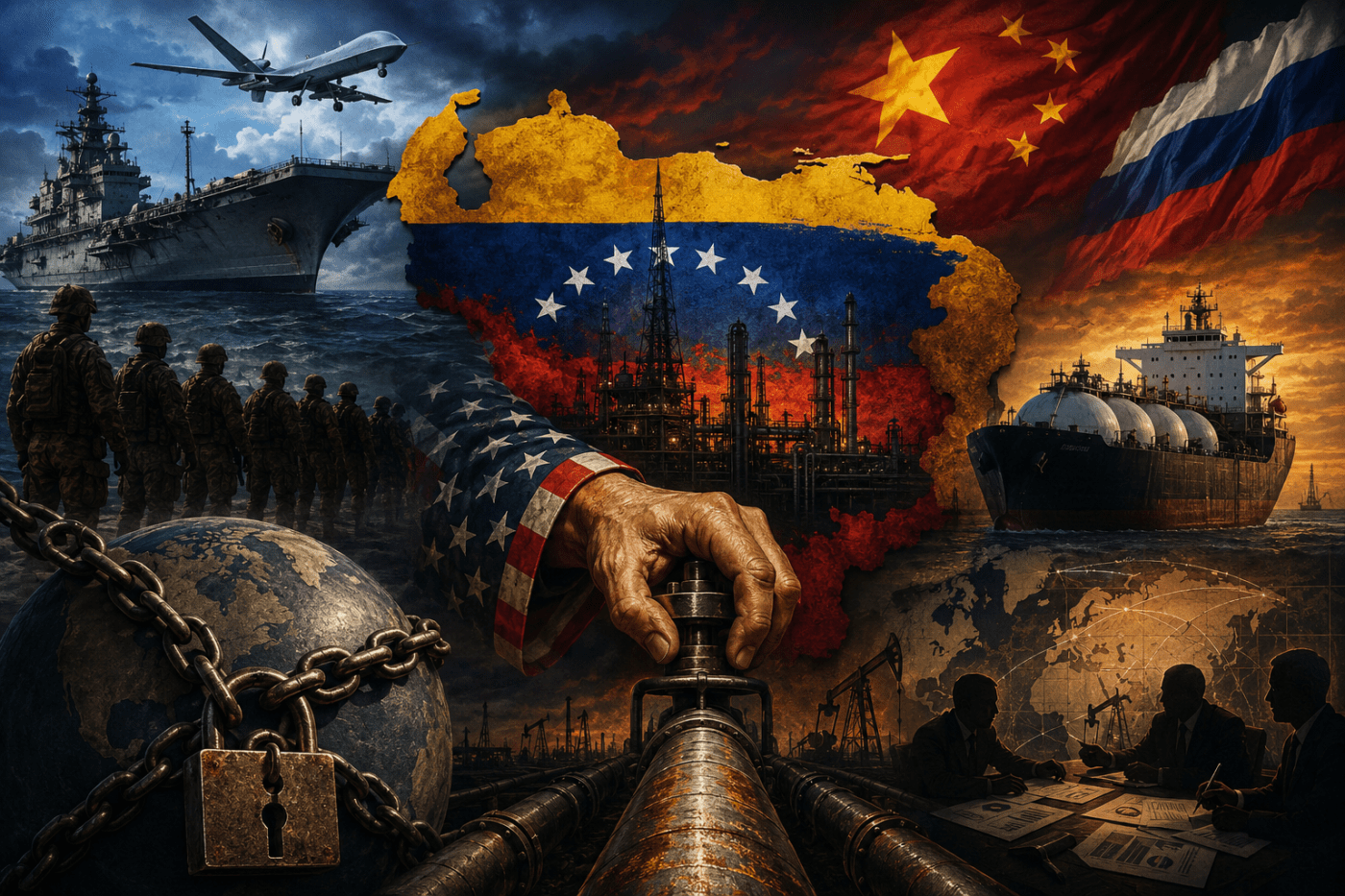
SCMP calls Washington a “gatekeeper,” but the article’s own language reveals how imperial control is disguised as debt management. The material record shows that Venezuela’s oil, China’s financing channels, and US sanctions are not separate issues but one struggle over sovereignty. The real story is financial piracy: the empire choking a nation, seizing the account, and calling itself the manager of recovery. The task now is to turn analysis into organization against sanctions, oil custody, debt trusteeship, and Fortress America.
Prince Kapone | Weaponized Information | June 29, 2026
The Gatekeeper and the Oil Ledger
“In Venezuela, China’s oil-for-loan deals run into debt restructuring, US ‘gatekeeper’ risk,” written by Ji Siqi and published by the South China Morning Post on June 26, 2026, presents itself as a sober little finance story about Chinese exposure, Venezuelan debt, and the uncertainty of oil-backed repayment. On the surface, the article asks whether Beijing will be able to protect its old oil-for-loan mechanism after Washington’s intervention in Venezuela and the coming disclosure of a massive debt pile. But beneath the clean language of restructuring, risk, accounts, creditors, and revenue flows sits the real political question the article keeps stepping around like a man avoiding a body in the street: who gave the United States the right to become gatekeeper over Venezuela’s oil income?
The outlet matters here. The South China Morning Post is not a revolutionary paper, not a party bulletin, and not a dispatch from the barrios of Caracas. It is a Hong Kong-based corporate media institution owned by Alibaba, positioned for English-language elites, investors, diplomats, China watchers, policy analysts, and the well-fed class of people who can read about another country’s oil being routed through foreign-controlled accounts and call it “risk management.” Ji Siqi writes from within the professional world of China economy journalism, where the great crimes of the age often arrive wearing the vocabulary of markets. Empires do not always enter the text as empires. Sometimes they enter as “gatekeepers.” Sometimes theft arrives as “recovery.” Sometimes the seizure of a nation’s lifeblood is introduced as a technical complication in debt restructuring.
This is the article’s central maneuver. It tells the reader that China’s oil-for-loan arrangement with Venezuela may be disrupted because the United States now holds the stronger hand over Venezuelan oil revenues. That is true enough as far as it goes. But the article’s framing turns the conquest of sovereignty into an accounting dilemma. Venezuela appears less as a nation than as a distressed balance sheet. China appears less as a strategic partner than as a creditor with exposure. The United States appears not as the imperial power that helped create, enforce, and exploit the crisis, but as the new adult in the room, the gatekeeper, the manager of proceeds, the handler of the debt mess. One almost expects the robber to send an invoice for guarding the vault he just broke into.
The propaganda here is not loud. It is not the barking kind. It is the soft, polished, financial kind, the kind that lives in the passive voice and sleeps inside expert quotations. The article relies on narrative framing to make imperial control appear administrative. It relies on source hierarchy to grant authority to analysts, shipping data, debt specialists, risk consultants, and financial logic, while Venezuelan sovereignty, Venezuelan popular power, and the long war against the Bolivarian process are pushed off the page. It uses doublespeak with remarkable discipline: “gatekeeper,” “restructuring,” “recovery framework,” “oil proceeds,” “creditor claims.” These words do not clarify the situation; they deodorize it. They spray perfume over the carcass of intervention.
There is also a neat bait and switch at work. The headline invites the reader to think the problem is China’s fading influence in Caracas. The deeper problem is that Washington is attempting to reorganize the economic command of Venezuela after political rupture, using oil revenues, debt settlement, investor confidence, and creditor negotiations as instruments of power. The article does not need to deny this outright. It merely lowers its voice when the subject comes near the crime. It mentions US control, then quickly returns to the safer terrain of what Beijing might lose, what creditors might recover, what investors might expect, and how the restructuring might proceed. The question of Venezuelan sovereignty sits there like a worker locked outside the boardroom where his own wages are being discussed.
That omission is the most important device in the piece. The article can describe Washington as the “gatekeeper” without excavating the gate, the fence, the owner, the prisoner, or the gunman standing nearby. It can speak of Venezuela’s oil revenues without making the elementary anti-colonial point that these revenues belong to Venezuela. It can speak of debt settlement without asking who imposed the siege conditions under which the debt became unmanageable. It can speak of China’s strategic setback without asking why the United States considers any independent relationship between Caracas and Beijing to be intolerable in the first place.
This is how imperial common sense works. It does not always need to shout that the empire has rights over the hemisphere. It simply writes as if those rights already exist. It assumes Washington may supervise Venezuela’s oil money, discipline China’s repayment channel, shape the restructuring, signal to investors, and call the result order. The reader is then invited to debate whether China will adapt, whether creditors will collaborate, whether the new arrangement will be stable. The basic theft has already been smuggled into the premises.
So the article is useful, but not in the way it thinks. It gives us a small window into the polite grammar of modern imperialism. The old colonial officer carried maps, rifles, missionaries, and flags. The new one carries sanctions licenses, payment channels, debt frameworks, tanker rules, and analyst quotes. The old empire said, “This land is ours.” The new empire says, “These proceeds require supervision.” Different costume, same appetite. The job of excavation is to strip away the financial cologne and name the thing plainly: Venezuela’s oil sovereignty is being reorganized under US power, and the article treats that as a market complication rather than an imperial crime.
The Ground Beneath the Gate
The South China Morning Post article begins from the debt ledger. Venezuela is preparing to disclose a debt pile of roughly US$240 billion, placing the country inside one of the largest sovereign debt restructuring processes in modern history. China’s past lending to Venezuela exceeded US$60 billion, with the remaining balance commonly estimated between US$10 billion and US$20 billion. The article identifies the oil-for-loan mechanism as the core repayment channel, with Venezuelan crude exports serving as the material basis for China’s recovery of its loans. Washington now sits over that channel as the principal “gatekeeper”, controlling oil revenues in a way that threatens to interrupt the existing China-Venezuela repayment structure.
The article also establishes that Venezuelan crude shipments to China have collapsed under the new arrangement. China had been one of the major outlets for Venezuelan crude under the previous sanctions regime, but Venezuelan oil loaded in 2026 no longer flowed to China in the same pattern. The article places this collapse inside the broader restructuring dispute, where China’s preferred outcome would be the continuation of repayment through crude shipments, while Washington’s control over oil revenues gives the United States decisive influence over which creditors are paid and on what terms. In the article’s own factual terrain, the debt issue is therefore inseparable from oil flows, creditor hierarchy, and the post-Maduro control of Venezuelan revenue.
The article’s facts, however, are only the visible tip of the ledger. AidData’s long-term accounting shows that China made 106 loan commitments to Venezuela totaling US$105.59 billion between 2000 and 2023, with roughly US$95 billion structured for oil-backed repayment. More than 91 percent of Chinese lending to Venezuela was backed by commodities, primarily oil. Venezuela became China’s largest state-backed borrower in Latin America and its fourth-largest worldwide. This was not a small side arrangement. It was one of the largest South-South financing relationships in the contemporary world economy.
The article omits the formal diplomatic architecture underneath that financing relationship. China and Venezuela elevated bilateral relations to an all-weather strategic partnership in 2023. Beijing pledged support for Venezuela’s sovereignty, national dignity, and lawful rights, while opposing external interference in Venezuelan internal affairs. Caracas and Beijing signed 31 cooperation agreements covering industry, mining, energy, the digital economy, education, green development, infrastructure, and Belt and Road cooperation. The oil-for-loan mechanism therefore sits inside a broader bilateral relationship involving finance, production, infrastructure, diplomacy, and development planning.
The article also omits the sanctions architecture that shaped the very debt problem now being reorganized. OFAC is the US office that administers and enforces economic and trade sanctions under US foreign policy and national security authority. Executive Order 13808 restricted transactions involving new debt of the Venezuelan government and PDVSA, along with bonds, securities, and dividend payments. The White House described the order as prohibiting dealings in new debt and equity issued by Venezuela and PDVSA. These measures constrained financing, debt operations, securities transactions, and the state oil company’s room to maneuver before Washington reappeared as the manager of the restructuring process.
The article further omits the coercive oil-revenue machinery that now governs the creditor dispute. Reuters documented how US control over Venezuelan oil exports complicated restructuring of Venezuela’s foreign debt, including Chinese claims. AP reported that US authorities had begun seizing Venezuelan oil tankers and managing oil sales, with proceeds deposited into supervised accounts. China warned against interference in its sovereign economic relationship with Venezuela. Chinese analysts identified US control over Venezuela’s oil sector as the principal obstacle to continuing the oil-for-loan mechanism.
The material stakes are obvious once the oil economy is placed back into view. Venezuela possesses the world’s largest proven crude oil reserves. Oil generates the overwhelming majority of the country’s export earnings and a substantial share of state revenue. China became Venezuela’s largest creditor and one of its principal commercial partners. The oil-revenue channel is therefore not simply a creditor instrument. It is the hinge connecting Venezuelan state revenue, Chinese repayment, export capacity, and the wider struggle over who controls the country’s main source of foreign exchange.
The Maduro seizure marked an escalation from sanctions into direct political decapitation. Venezuelan oil, sanctions, debt control, and naval power now operate inside the consolidation of the American Pole. Venezuelan crude exports sit at the intersection of Chinese commercial access and US hemispheric control, where a barrel of oil is never merely a barrel of oil, but a route, an account, a creditor, a buyer, and a political alignment.
The wider context is hemispheric. Venezuela, Cuba, Nicaragua, Guyana, Panama, and the Caribbean sea lanes form a strategic map of regional command. Drug-war language supplies the moral costume for intervention throughout Latin America and the Caribbean. Sanctions function as legal, financial, logistical, and diplomatic warfare. The Venezuelan debt and oil dispute belongs to this larger hemispheric machinery of sanctions, maritime pressure, account control, resource supervision, and anti-China containment.
The China dimension is also larger than Venezuela alone. WI’s previous analysis of Saudi Arabia’s eastward turn placed oil trade, Chinese demand, and the weakening of the US-centered oil order inside a broader global realignment. Venezuela became one of China’s principal Latin American partners in finance, infrastructure, and energy cooperation. The fight over Venezuelan crude therefore belongs to the same global terrain as the fight over alternative oil buyers, non-Western finance, Chinese development partnerships, and the erosion of the US-centered energy order.
The historical baseline is the long US sanctions record against Venezuela. Washington imposed successive Venezuela-related sanctions through executive orders, Treasury actions, and related legal authorities. Those measures restricted Venezuelan government debt, PDVSA debt, securities transactions, and oil-related financial activities. The present struggle over oil revenues and debt restructuring emerged from this legal and economic terrain, where sanctions, debt, oil, creditor claims, and geopolitical alignment were already bound together before the SCMP article named Washington the “gatekeeper.”
The Robber Calls Himself the Gatekeeper
Now we can say plainly what the polite article will not say. This is not a story about China’s exposure to Venezuelan debt. This is not a story about whether creditors can negotiate a tidy arrangement after years of financial disorder. This is not a story about “risk,” “gatekeeping,” or “restructuring,” as if history were a spreadsheet and imperialism were merely a clerical inconvenience. This is a story about the United States attempting to seize command over Venezuela’s oil sovereignty after choking the country through sanctions, isolating its financial channels, criminalizing its government, disrupting its commercial relations, and then arriving at the scene with the face of a manager. The arsonist has put on a firefighter’s helmet and now expects applause for controlling the hydrant.
The contradiction at the center is simple: Venezuela’s oil belongs to Venezuela, but empire treats it as hemispheric property under Washington’s supervision. That is the whole matter, stripped of the economist’s perfume. The Bolivarian state tried to survive a siege by building alternative lines of credit, trade, investment, and diplomatic partnership outside the imperial core. China became part of that survival architecture. The oil-for-loan mechanism was not socialism in a bottle, not a perfect instrument, not a saintly arrangement floating above the world market. It was a hard bargain made under hard conditions. But in a world where the dollar system, sanctions law, shipping insurance, bond markets, and military force are organized against any disobedient country, even an imperfect alternative channel can become a material trench in the sovereignty struggle.
That is why Washington moved against it. The United States did not object because it suddenly discovered a humanitarian concern for the Venezuelan people. It did not object because it has a tender conscience about debt burdens in the Global South. If imperialism cared about debt, Africa would not be bled through repayment schedules written in Paris and Washington. If it cared about hunger, sanctions would not be used like invisible bombs against ordinary families. If it cared about democracy, the hemisphere would not be littered with the bones of governments murdered for daring to govern their own land. Washington objects because China’s relationship with Venezuela opened a door in a wall the empire insists must remain sealed.
This is the New Cold War Against China in its hemispheric form. The lazy version of the New Cold War sees it only in the Taiwan Strait, in semiconductor controls, in war games around the South China Sea, in the Pentagon’s maps of the Pacific. But the actual conflict is global because China’s rise is global. It moves through ports, oil contracts, railways, satellites, development banks, mining agreements, currencies, shipping routes, and political relationships with countries that are tired of being treated like raw-material warehouses with flags attached. In Venezuela, that New Cold War enters through crude oil, debt repayment, and the question of whether Caracas can maintain sovereign economic relations with Beijing without passing through the American cashier.
The United States calls this “influence.” That is the old imperial joke. When China signs agreements, it is influence. When Venezuela sells oil, it is influence. When a sanctioned country finds a buyer, it is influence. But when Washington controls the sanctions list, the payment channel, the oil license, the tanker route, the creditor process, and the political future of the state, that is called order. The empire names everyone else’s sovereignty a threat and its own domination stability. It sees Chinese credit as penetration, Venezuelan resistance as criminality, and US account control as responsible governance. The thief accuses the owner of trespassing.
Debt here is not neutral. Debt is one of the modern forms through which colonial power returns without needing to raise the old flag. The formal empire of governors and colonial offices has been replaced by the empire of credit ratings, sanctions compliance, seized accounts, bondholder committees, investment risk, and “restructuring frameworks.” The plantation ledger has gone digital. The colonial administrator has become a lawyer, a consultant, a Treasury official, a fund manager, a risk analyst, a respectable vampire in a navy suit. The instrument has changed, but the relation remains: the laboring people and resource nations of the Global South are made to pay for a world order built on their subordination.
Venezuela’s oil is therefore not just oil. It is condensed sovereignty. It is schools, medicine, food imports, infrastructure, public wages, diplomatic maneuvering room, industrial recovery, and the possibility of breathing outside the imperial noose. To control the oil revenue is to control the state’s oxygen. To control the repayment channel is to decide which international relationships live and which ones suffocate. To control the restructuring is to write a new constitution of dependency in the language of finance. This is why the word “gatekeeper” is so obscene. The gatekeeper is not guarding Venezuela’s future. He is standing at the door of a country he helped starve, deciding who may enter, who may be paid, and who must bow.
Fortress America is not a retreat from empire. It is empire tightening its rear base. The American Pole is the attempt to lock down the hemisphere as the wider unipolar order cracks. In this project, Venezuela is not an isolated target. Cuba, Nicaragua, Haiti, Panama, Guyana, the Caribbean sea lanes, the oil routes, the ports, the minerals, the banks, the migration corridors, the military partnerships — all of these become pieces of a single continental security and extraction architecture. The empire cannot dominate Eurasia with confidence if its own hemisphere is slipping into multipolar relations. So it returns to the old Monroe Doctrine with new machinery: sanctions instead of gunboats when sanctions work, gunboats when sanctions are not enough, debt law when the gunboats need a polite cover.
This is hyper-imperialism in the Americas: not one policy, not one president, not one crude act of bullying, but a whole system of military, financial, legal, logistical, diplomatic, and informational power fused into a single machine. It does not merely invade. It licenses, freezes, ranks, seizes, narrates, brokers, supervises, and disciplines. It turns relief into leverage, markets into weapons, debt into custody, and oil into obedience. The poor are told to endure the pain while the imperial accountant measures “recovery.” The nation is told to surrender its arteries so the creditor body can be made whole.
The SCMP article catches a glimpse of this machine but refuses to name it. It sees that China’s position is weakened. It sees that Washington has become the decisive gatekeeper. It sees that the debt restructuring may become a geopolitical standoff. But because it remains inside the language of elite finance, it cannot tell the real story. It cannot say that the United States is attempting to subordinate Venezuela’s oil economy after years of coercion. It cannot say that the restructuring is a continuation of sanctions by other means. It cannot say that creditor management becomes counterinsurgency when the targeted state is punished for anti-imperialist alignment. It cannot say that the Global South is being taught a lesson: borrow elsewhere, trade elsewhere, ally elsewhere, and the empire will come for the account.
The revolutionary task is to refuse the vocabulary that hides the crime. We do not call this “gatekeeper risk.” We call it financial piracy. We do not call this “recovery management.” We call it imperial trusteeship. We do not call this “debt restructuring” when the restructuring is organized under the power that helped strangle the debtor. We call it neocolonial command. We do not pretend the issue is whether China gets paid on time. The issue is whether Venezuela, and by extension the nations of the Global South, have the right to build economic relations outside imperial permission.
And this is where the class question stands up from beneath the oil barrel. The Venezuelan worker, the nurse, the farmer, the mother in the barrio, the child in the clinic, the technician in the refinery, the driver waiting for fuel, the public employee paid in a battered currency — these are the people whose lives are disciplined by sanctions, debt, and oil custody. Imperialism never attacks an abstraction called “the state.” It attacks the material conditions of the people through the state. It blocks imports, starves revenue, destroys planning capacity, drives migration, weakens public institutions, and then points to the suffering as proof that the targeted society has failed. First they break your legs, then they publish a report on your poor running form.
So let the matter be clear. Venezuela is not merely a debtor. China is not merely a creditor. The United States is not merely a gatekeeper. This is a struggle over sovereignty under the conditions of imperial decline. It is a struggle over whether the hemisphere remains a private estate of Washington or becomes a field of multipolar relations. It is a struggle over whether oil-rich nations may use their resources for national survival rather than imperial discipline. It is a struggle over whether the Global South must forever enter the world economy through the servant’s door.
The answer from the anti-imperialist camp must be just as clear. Hands off Venezuela’s oil. Break the sanctions architecture. Reject the American Pole. Defend the right of oppressed and neocolonized nations to trade, borrow, build, and align without imperial permission. The robber is not the gatekeeper. The empire is not the judge. The hemisphere is not Washington’s plantation. And the people who produce the wealth of the world owe nothing to the thieves who have spent five hundred years learning how to rename plunder as policy.
Turn the Gate Into a Front
The task is not to admire the map of empire. The task is to organize against it. If Washington can turn oil revenues, sanctions licenses, tanker routes, debt accounts, military deployments, and anti-China hysteria into one machinery of control, then our response cannot remain scattered into single-issue outrage. Venezuela solidarity must become anti-sanctions work. Anti-sanctions work must become antiwar work. Antiwar work must become opposition to the New Cold War Against China. Opposition to the New Cold War must become a defense of resource sovereignty across the Global South. The empire connects the fronts because it has to. We must connect them because we intend to win.
This begins inside the imperial core, where the war machine expects obedience, confusion, and silence. The Black Alliance for Peace has condemned US intervention in Venezuela as an attack on Venezuelan sovereignty. That work should be brought into unions, churches, campuses, community centers, neighborhood assemblies, and Black political spaces as anti-SOUTHCOM education, anti-sanctions agitation, and direct opposition to the US military command structure over Latin America, the Caribbean, and Africa. The point is not symbolic solidarity. The point is to make empire visible where it lives: in our tax dollars, our ports, our military bases, our media, our politicians, and our silence.
CODEPINK has produced Venezuela sanctions education and anti-sanctions campaign material. Revolutionaries must tap into that infrastructure for call-in days, webinars, congressional pressure, local public forums, and coordinated anti-sanctions actions. But this work can’t be reduced to polite lobbying. Every call, every public comment, every banner, every teach-in, every confrontation with an elected official should name the real demand: end the sanctions, end US control over Venezuelan oil revenues, and end the use of debt and licenses as weapons against sovereign countries.
ANSWER Coalition has also organized against US intervention and sanctions on Venezuela, and ANSWER states that donations are processed through its fiscal sponsor, Progress Unity Fund. That street infrastructure matters. When the empire moves through Treasury, State, SOUTHCOM, banks, think tanks, courts, and the White House, people must meet it in public. Demonstrate at federal buildings. Hold emergency forums. Confront local representatives. Table at campuses and transit centers. Bring Venezuela into every antiwar action, because the war does not begin when the bombs fall. It begins when the account is frozen, the tanker is seized, the debt is supervised, and the country is told who it may trade with.
The struggle against Fortress America also needs a front against the New Cold War Against China. Veterans For Peace’s China Working Group organizes against anti-China propaganda and supports Pivot to Peace with China. This work must be connected to Venezuela because Washington’s fight with China is not only fought in the Pacific. It is fought wherever China builds trade, credit, infrastructure, technology, energy, or diplomatic relations outside US command. To defend Venezuela’s right to trade with China is to oppose the New Cold War in practice, not as a slogan but as a concrete line of struggle.
That same task belongs to socialist China-solidarity formations. Friends of Socialist China identifies itself as a platform supporting friendship and solidarity with the People’s Republic of China and opposing the New Cold War. Their educational work should be used to break the anti-China common sense that makes US resource grabs look normal. The empire teaches workers in the imperial core to fear China so they do not notice their own rulers seizing oil, militarizing seas, sanctioning nations, and calling it defense of democracy. That lie has to be broken in every shop floor conversation, every classroom, every podcast, every pamphlet, every social media thread, and every political education circle.
The Global South is not waiting for permission to fight. ALBA Movimientos brings together popular movements across Latin America and the Caribbean, and its organizers describe the network as rooted in Bolivarian integration, popular power, and continental anti-imperialist struggle. Their example should guide solidarity in the North: do not treat Venezuela as an object of pity, but as part of a living regional struggle over sovereignty, integration, land, labor, resources, and political power. North American organizers should amplify Latin American and Caribbean voices first, translate their statements, circulate their calls, invite their speakers, and stop treating imperial-core NGOs as the natural managers of solidarity.
The resource question must also be widened beyond oil. WoMin African Alliance works with women and communities affected by mining, extractives, and destructive development across Africa. Oilwatch International organizes around community resistance to fossil fuel extraction>. These struggles are not identical to Venezuela, and they should not be flattened into one slogan. But they belong on the same map of resource sovereignty, extraction, debt, climate damage, and imperial control over the lands and waters of oppressed nations.
The debt front must also be organized. Debt Justice campaigns against unjust debt and for debt cancellation. Debt justice work must be pushed beyond charity language and into the question of power: who lends, who sanctions, who restructures, who controls the account, who gets paid, and who is made to starve so creditors can be satisfied. In Venezuela, debt cannot be separated from oil. Oil cannot be separated from sanctions. Sanctions cannot be separated from the New Cold War. The creditor’s ledger and the admiral’s map belong to the same system.
So the work ahead is concrete. Build teach-ins that connect Venezuela, China, sanctions, debt, and resource sovereignty. Move unions, churches, student groups, tenant organizations, migrant justice groups, veterans’ groups, climate justice formations, and neighborhood councils to pass resolutions against US sanctions, oil custody, debt trusteeship, SOUTHCOM militarization, and the New Cold War Against China. Organize call-in days, banner drops, campus forums, short videos, pamphlets, reading groups, and public confrontations with elected officials. Demand that labor bodies oppose sanctions as working-class warfare and reject the lie that US workers benefit when our rulers loot the Global South.
The line must be plain enough for the bus stop and sharp enough for cadre: hands off Venezuela’s oil; end the sanctions; no US debt trusteeship; no imperial gatekeepers; no New Cold War Against China; no Fortress America; defend the right of oppressed nations to control their resources, choose their partners, and build their futures without Washington’s permission. The empire has already built its front. Now we build ours.


Leave a comment