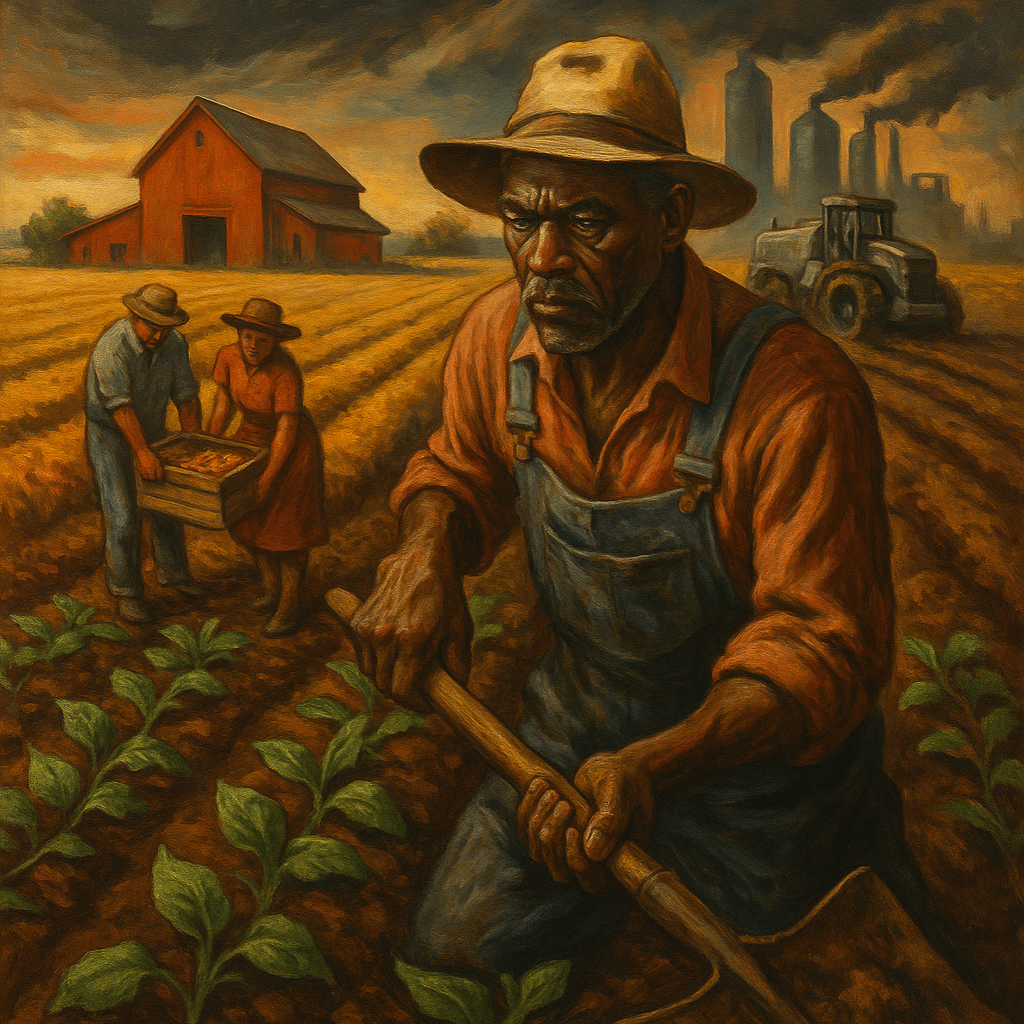
Behind the census math and pastoral nostalgia lies a system of dispossession: Black farmers erased by bureaucracy, migrant workers disciplined by deportation, Indigenous nations robbed of sovereignty, and Wall Street financiers turning soil into spreadsheets. The “two million farms” myth is their camouflage, but resistance is already germinating across the land.
By Prince Kapone | Weaponized Information | September 9, 2025
The Myth of Two Million Farms
On the surface, the article A Quarter of America’s Farms Aren’t Really Farms presents itself as a tidy correction to a statistical misunderstanding. We are told that millions of “farms” dot the countryside, though many of them are really backyards, weekend ranches, or tax shelters. The hook is that this inflated number is used to win subsidies and block regulation. It sounds like a revelation—until you notice how carefully the story keeps its gaze locked on arithmetic while sidestepping the deeper violence of land, labor, and power.
The messenger is familiar. Marina Bolotnikova writes under the banner of Vox’s Future Perfect, a philanthropic-capitalist silo dressed up as neutral analysis. Her words arrive to us through MSN, Microsoft’s aggregator, another cog in the machinery that transforms every story into a digestible product for the middle classes. This is not the voice of a sharecropper pushed off the land or a farmworker living in the shadows; it is the voice of the professional-managerial class, whose role is to turn contradictions into curiosities and conflicts into talking points.
The amplifiers are equally well known: the Farm Bureau, the commodity councils, the pork and poultry lobbies. They speak as if they were the voice of millions, invoking the “two million farms” line as a chant, an article of faith. By repetition, they build the illusion of mass—an army of smallholders whose interests supposedly align with the giants of agribusiness. It is a sleight of hand that lets the true powers hide in plain sight.
What gives this article its quiet force are the devices woven into its fabric. The story begins by narrowing the problem to a question of counting, as if the real crisis were a matter of misclassification. It gestures toward the barnyard, the berry patch, the weekend beekeeper, so the reader pictures bucolic variety rather than industrial concentration. It leans on imagery of small-town virtue—the red barn, the backyard flock—suggesting continuity with an agrarian past that no longer exists. It draws the reader’s attention to a spectacle of bureaucratic absurdity, chuckling at government definitions, while the deeper story slips out of view. And it sets up a false symmetry: the same word, “farm,” binds together the family with a few hens and the corporation with a thousand-acre feedlot. In this way, the vast gulf between them disappears, and the reader is left nodding along to a narrative where everything blurs together.
The genius of such propaganda is that it never announces itself as propaganda. It appears modest, even corrective, a nudge toward truth. Yet its modesty is its weapon. By focusing attention on the number two million, it invites the audience to marvel at a statistical trick while never asking who benefits from the trick, who writes the rules of the game, and who disappears when the numbers are invoked. This is how power protects itself—not only by lying, but by telling the truth selectively, and by arranging those truths so that the structure of domination remains unseen.
Extracting Beneath The Soil Of Settlerism: What the Numbers Conceal
The MSN piece repeats the official baseline: 1.9 million farms recorded in the 2022 Census of Agriculture. It notes that a quarter of them reported zero sales and another 30 percent earned between $1,000 and $10,000 a year. The article also observes that only about 390,000 farms sell more than $100,000 annually, roughly 20 percent of the total. Production, meanwhile, is shown to be highly concentrated: just 347 egg farms produce three-quarters of the nation’s eggs, the largest six percent of hog farms produce 75 percent of pork, and 4.4 percent of farms produce nearly half of all U.S. food. These facts alone undermine the pastoral image invoked by industry, yet the narrative stops short of tracing how policy, capital, and empire produced this structure.
The omitted history is decisive. USDA’s 1970s “get big or get out” mandate made consolidation the official policy of the American state, driving small farmers into bankruptcy and debt. Federal aid has overwhelmingly favored scale: the Environmental Working Group shows that the top ten percent of recipients captured four-fifths of all commodity subsidies between 1995 and 2021. The land itself has followed the same trajectory. National Family Farm Coalition research reports that the top ten percent of landowners now control roughly seventy percent of U.S. farmland. This concentration is not an accident of economics but the result of deliberate state policy.
Corporate land grabs deepen the story. BlackRock, Vanguard, and billionaire investors like Bill Gates now rank among the largest farmland owners in the country, using speculation and financial engineering to turn soil into a rent-extracting asset. The propaganda of “two million farms” helps disguise their role, creating the illusion of a broad, dispersed farm base while capital quietly consolidates control.
Racialized dispossession is erased from the mainstream narrative. The USDA recently removed equity language and dismantled programs for “socially disadvantaged” farmers, undoing fragile redress for Black farmers long targeted by discrimination. Legal challenges and bureaucratic erasure ensure that land stolen over generations remains in the hands of white agribusiness, while the myth of “equal treatment” is mobilized to bury history. These moves continue the slow-motion counterinsurgency against Black agrarian survival.
The labor foundation of U.S. agriculture is also silenced. Most hired farmworkers are foreign-born, and a majority lack stable legal status. Their precarious position is weaponized: deportations are used as economic warfare to discipline wages and recalibrate the labor market. The pastoral myth erases these workers completely, replacing them with images of patriotic yeomanry that have never reflected reality.
The environmental consequences reveal the depth of the distortion. Factory-scale livestock operations are regulated under the Clean Water Act, yet reports by the Natural Resource Defense Council show that most CAFOs avoid meaningful oversight, with many states requiring permits only after documented discharges. This exemption regime is not incidental; it is the fruit of lobbying that leans on the “too many farms to regulate” myth.
There is another omission that cuts to the heart of the settler-colonial order. None of these statistics begin from neutral ground. The entire farm economy rests on land stolen from Indigenous nations who cultivated sophisticated agricultural systems long before colonization. The slaughter of the buffalo, the forced removals, the boarding schools, and the commodity ration system were all tools to break Indigenous food sovereignty. Today, Standing Rock’s resistance to the Dakota Access Pipeline and Apache Stronghold’s defense of Oak Flat show that land grabs are not just history but present tense. Native-led farming and food sovereignty projects across the continent continue to reclaim ancestral practices, insisting that agriculture cannot be separated from the struggle for Indigenous survival.
Situating these facts exposes the larger contradictions. The myth of millions of small farms functions as political cover for agribusiness lobbying, deflecting scrutiny from monopoly power and environmental harm. Neoliberal globalization has turbocharged the process: the WTO’s Agreement on Agriculture and NAFTA’s restructuring of North American trade dislocated campesino farmers in Mexico while fueling U.S. industrial farms with cheap labor and expanded markets. Today, the same agrarian myth is recycled alongside anti-China red scares, the erasure of racial justice, deportation terror, and the ongoing theft of Indigenous land. All of these threads tie back to a single apparatus: a system that hides monopoly behind nostalgia, conceals dispossession with statistics, and disciplines labor with fear.
Reframing the Barn Illusion: From Arithmetic to Power
Strip away the surface and the “two million farms” mantra is not a slip of the calculator but a weapon of perception. The state, the lobbyists, and the corporate media deploy it as camouflage, making monopoly look like diversity, dispossession look like abundance. To name this apparatus for what it is requires more than numbers—it requires tracing how the machine fuses law, finance, and repression into a single mode of rule. This is where the polite vocabulary of reform falls short, and where we must speak plainly about the structures that actually govern food and land.
What we are confronting is Technofascism: the welding of agribusiness, finance, bureaucracy, and digital oversight into a regime that shields the giants from accountability. It is not enough that the USDA inflates the farm count; it also strips equity protections from Black farmers, writes regulations to exempt factory polluters, and collaborates with financiers who treat soil as a spreadsheet asset. Deportations terrorize the labor force, algorithms erase whole categories of farmers from public support, and the census itself becomes a weapon. This is not error—it is engineering.
The myth is maintained through Cognitive Warfare. When BlackRock and Vanguard seize thousands of acres, the media doesn’t shout “Wall Street land grab.” Instead, it feeds us panic headlines about Chinese investors, stirring xenophobia to redirect the anger. When a handful of barns produce three-quarters of the nation’s eggs, the press hands us an “average farm” with a few dozen hens, as if backyard flocks could explain industrial dominance. By manipulating the images lodged in public consciousness—red barns, family plots, patriotic slogans—the system wages a war on our very ability to perceive reality.
At the same time, the slow suffocation of justice for Black farmers shows how Settler-Colonial Pacification adapts in bureaucratic form. No militias are dispatched to seize land; instead, memos strike the words “socially disadvantaged” from statutes, courts rule that redress violates “equal treatment,” and programs designed to repair centuries of theft are dissolved in silence. The colonial project continues, now in the language of neutrality and merit. It is pacification by paperwork, erasing the history of plunder while consolidating its results. The same logic applies to Indigenous nations: treaties signed and broken, lands seized and renamed, food systems deliberately dismantled. From the slaughter of the buffalo to the surveillance of water protectors at Standing Rock, the pacification project has always been about cutting people off from their land and lifeways. Today, Indigenous food sovereignty movements—seed rematriation, traditional farming cooperatives, land defense struggles like Oak Flat—carry that resistance forward.
The financiers complete the circle through Financial Piracy. Land becomes an investment vehicle, stripped of its social and ecological meaning, bundled into portfolios by private equity firms and billionaires. Rent extraction replaces cultivation, speculation replaces stewardship. Meanwhile, the farm myth is weaponized to justify subsidies that flow directly into the hands of those same investors. It is piracy with a flag of convenience: the stars and stripes flying over a barn that is, in truth, a balance sheet. And just as Wall Street speculates on stolen farmland, the state continues to greenlight projects that loot Indigenous territories for pipelines, mines, and fracking wells, tightening the noose of financial extraction on both settler and Native ground.
Once the fog of nostalgia lifts, the contradiction is impossible to miss. The “two million farms” narrative is not about farmers at all—it is about empire at home, a domestic counterpart to the same logic that drives coups abroad and sanctions against the Global South. At the center is the same class project: consolidate land, discipline labor, and package it all as the natural order of things. Against this stands not a handful of reforms but the demand for food sovereignty, for collective ownership, for an agrarian future that answers not to Microsoft’s algorithms or BlackRock’s balance sheets but to the needs of the people who labor on the land. And in this demand, Indigenous nations—who never ceded their sovereignty, and who continue to defend their right to farm, hunt, and live in relation to the land—stand alongside Black farmers, migrant workers, and small producers as part of a single front of resistance. To get there, we must call propaganda by its name, expose the camouflage, and tear away the red-barn mask.
Mobilizing Beyond the Barn: From Exposure to Struggle
Once the mask is lifted, the question becomes: what do we do with this knowledge? It is not enough to laugh at the absurdity of counting backyard coops as farms, nor to shake our heads at the hypocrisy of subsidies flowing uphill. We are living on a battlefield where land, labor, and life itself are treated as disposable inputs for monopoly profit. Mobilization, then, cannot be an abstract exercise—it must flow from the concrete contradictions already erupting across the countryside, and from the communities who have carried the weight of this system the longest.
The first front is solidarity with those directly dispossessed. Black farmers continue to fight against USDA erasure, not with nostalgic rhetoric but with lawsuits, cooperatives, and land trusts clawing back stolen ground. Their struggle is not symbolic; it is a living confrontation with settler bureaucracy that tries to vanish them with the stroke of a pen. Standing with them means channeling resources into their hands, amplifying their demands for land justice, and refusing to let bureaucratic pacification pass as neutrality.
The second front is with the workers whose labor makes the system function while their humanity is denied. Migrant farmworkers, mostly from the Global South, are the ones bent double in the fields, living under the permanent threat of deportation. Their strikes, boycotts, and organizing drives—from Immokalee to Washington state—are not side stories; they are the frontline of class struggle in American agriculture. Solidarity here means legal defense funds, strike support, and building worker-to-worker ties that stretch across borders, breaking the isolation that the deportation regime tries to enforce.
The third front is Indigenous nations and their ongoing struggle for land and food sovereignty. The farm myth erases their history, but their resistance remains carved into the landscape. Standing Rock’s fight against the Dakota Access Pipeline showed the world that energy infrastructure is also an agricultural issue—water, soil, and sovereignty bound together. The Apache Stronghold’s defense of Oak Flat is another battlefront, resisting the conversion of sacred farmland into a copper mine. Native farmers and food sovereignty projects—from seed rematriation networks to community-led agriculture on reservations—are reclaiming ancestral practices that challenge both corporate monopoly and settler erasure. Solidarity here means not only defending land from extractive projects but also supporting Native-led farming initiatives as living alternatives.
These are not separate battles—they are the outlines of a common front. Small and mid-sized farmers resisting foreclosure, Black farmers reclaiming land, Indigenous nations defending sovereignty, and migrant workers fighting deportation are all confronting the same enemy dressed in different uniforms: the corporate-state machine that hides behind the barnyard myth. Our tactical actions must flow from this terrain: expose and map the landholdings of Wall Street firms and demand divestment; support community-controlled farmland, Black and Indigenous land trusts, and worker-owned cooperatives; link urban consumers with rural producers through solidarity economies; treat every deportation raid, every foreclosure, every pipeline project, and every polluted river as flashpoints in a broader war for food sovereignty.
The “two million farms” myth will keep being repeated because it works—it cloaks monopoly in nostalgia, it confuses the public, it buys agribusiness another decade of impunity. Breaking that spell requires more than counter-arguments. It requires action that makes the hidden visible: the worker in the field, the farmer robbed of land, the water protector facing down a pipeline, the financier counting profits. When those struggles converge into a living movement, the red barn ceases to be an image of deception and becomes a symbol of resistance. The soil is ours to reclaim, not for numbers on a census form, but for the people who till it, defend it, and refuse to let it be stolen again.
 Weaponized Information
Leave a comment