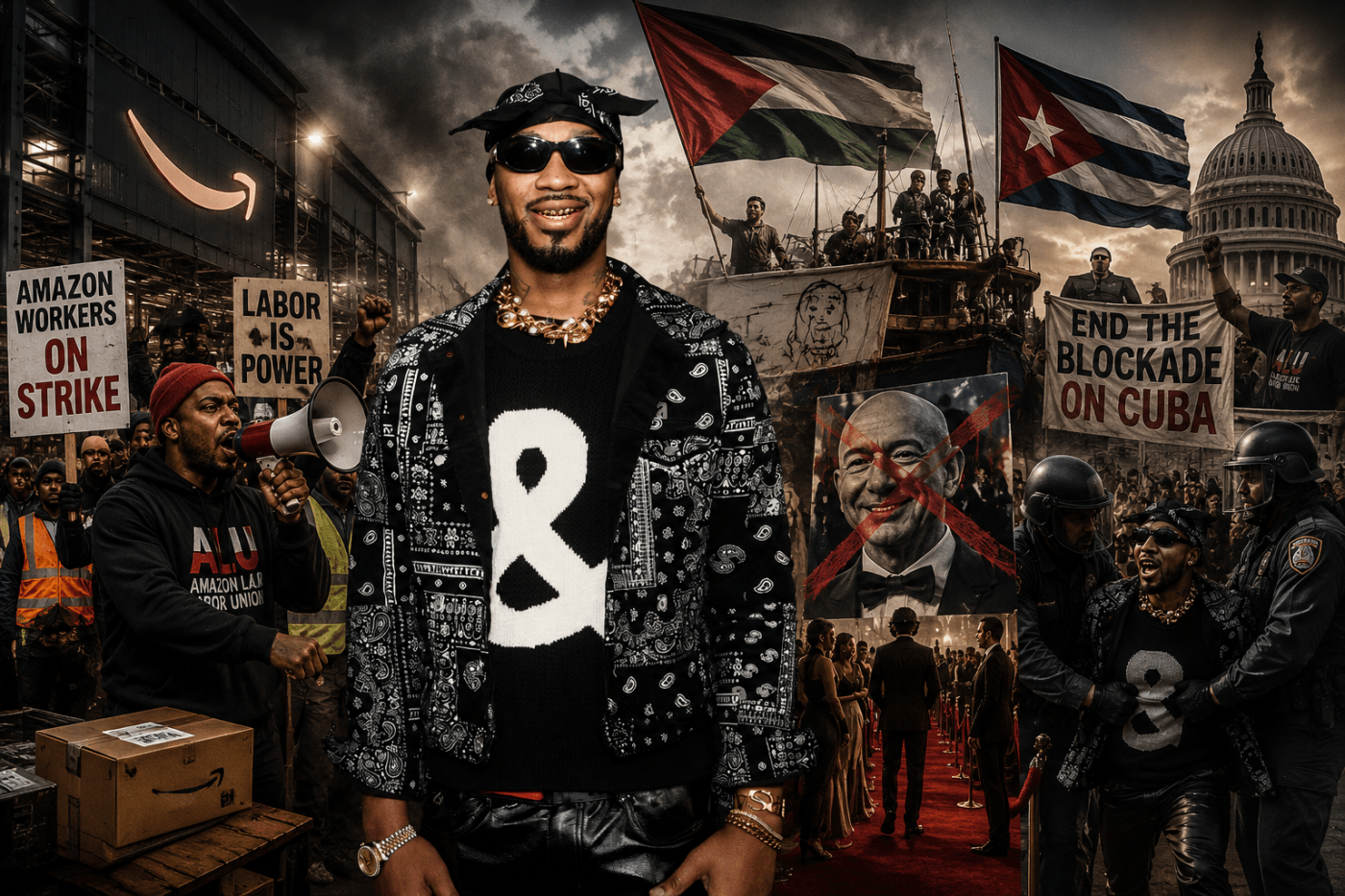
Jacobin says Chris Smalls fell because ego swallowed his politics. But the real story is more dangerous: a Black Amazon worker moved from warehouse insurgency into Palestine solidarity, Cuba solidarity, anti-ICE confrontation, anti-Bezos direct action, and open contempt for liberal containment. The respectable Left can tolerate labor militancy when it stays domestic, contractual, grateful, and manageable; it panics when that militancy begins to recognize the empire behind the boss. This essay does not canonize Smalls — it exposes the political function of the attack on him: to turn Black anti-imperialist labor politics into a morality tale about personal excess.
By Prince Kapone | Weaponized Information | June 5, 2026
They Loved the Poster, Then Feared the Line
Jacobin has discovered another fallen hero. This time the body dragged onto the respectable-left examination table is Chris Smalls, the Black working-class organizer who helped crack open one of the most powerful corporations on earth and made union struggle look alive in an age of managed defeat. He was useful when he could be held up as proof that the American labor movement still had a pulse. He became dangerous when he refused to remain inside the narrow lane assigned to him.
The article presents itself as a review of Smalls’s memoir, When the Revolution Comes. It is not merely that. It is a political intervention dressed in the clothes of literary judgment. Its title, “The Rise and Fall of Chris Smalls,” tells the reader what verdict to reach before the evidence is weighed. This is not a neutral frame. It is the old morality play of the unruly worker who flew too high, talked too loudly, traveled too much, wore too much gold, took up too much space, and forgot his place.
Jacobin admits that Smalls played a major role in the historic Amazon Labor Union victory at JFK8. It admits that he was charismatic at a time when labor desperately needed energy. It admits that he helped make organizing visible, exciting, and culturally legible to people who had been taught to see unions as dead institutions from another century. Then the article gathers the whole story into the same little bucket: ego. The worker who broke through becomes the worker who loved himself too much. The insurgency becomes a personality problem. The political line becomes a psychological profile.
That is the operation. Not analysis first, judgment later. Judgment first, analysis afterward. The conclusion is built into the architecture. Smalls’s style becomes evidence. His charisma becomes evidence. His public conflicts become evidence. His refusal to flatter politicians becomes evidence. His movement into anti-imperialist solidarity becomes evidence. Everything is made to testify against the same accusation: the brother became intoxicated with himself. How convenient. The boss wages class war, the state moves at the speed of a dying mule, the official labor movement struggles to organize the largest warehouse empire in the country, and somehow the story becomes the inner life of Chris Smalls.
No serious person needs the fantasy version of this argument. Smalls is not beyond criticism. No organizer is. A union cannot live forever on charisma. A campaign cannot substitute visibility for rooted organization. A contract fight requires workplace structure, democratic discipline, leadership development, and rank-and-file power strong enough to survive any one personality. Those are real questions. But Jacobin does not begin from those questions honestly. It begins from a character indictment, then borrows the language of labor strategy to make the indictment sound responsible.
This is why the article matters. It is not simply petty. It is disciplinary. It tells us what kind of worker the respectable Left is prepared to celebrate and what kind it is prepared to punish. The worker may be militant, but not too militant. Charismatic, but not too visible. Political, but not too internationalist. Angry, but only at approved targets. He may speak about wages, schedules, and working conditions. But when he begins connecting the workplace to the wider machinery of empire, the tone changes. Suddenly he is no longer a symbol of labor’s revival. He is a celebrity. He is sectarian. He is self-promoting. He is unserious.
The deeper issue is not whether Chris Smalls made mistakes. Of course he did. The deeper issue is why those mistakes become the container into which Jacobin pours the entire crisis of organizing Amazon, the entire weakness of American labor law, the entire fear of working-class charisma, and the entire discomfort produced when a Black worker refuses to separate labor struggle from anti-imperialist struggle. The article does not merely criticize Smalls. It cuts him down to a size the respectable Left can manage.
That is the hidden discipline behind the polite prose. The worker is allowed to be a poster, but not a line. He is allowed to symbolize labor’s comeback, but not to define labor’s horizon. He is allowed to inspire the movement, but not to accuse its politicians. He is allowed to fight Amazon, but not to point toward the world system in which Amazon lives. The moment he does, the magazine that once needed his image discovers that his image was the problem all along.
Weaponized Information starts from a different place. We are not here to canonize Smalls. We are not here to pretend that charisma is organization, or that every direct action is strategy, or that every public fight is politically sharp. We are here to expose the function of this attack. Because when a Black Amazon worker moves from workplace insurgency toward Palestine solidarity, Cuba solidarity, anti-ICE confrontation, anti-Bezos direct action, and open contempt for liberal containment, the question is not simply whether he has an ego. The question is why so many people become comfortable explaining his politics through ego.
They wanted a worker, not a rebel. They wanted a face, not a line. They wanted the warehouse victory without the world-system conclusion. They wanted Chris Smalls as evidence that American labor could be cool again, but not as evidence that American labor must break with empire or remain trapped inside it. That is why this essay will not join the respectable chorus. The task is not to save Smalls from criticism. The task is to save the political meaning of his trajectory from being buried under the cheapest accusation in the book: that the worker became too full of himself when he stopped being useful to people who preferred him smaller.
The Boss Hid Inside the Procedure
Once the spotlight is pulled away from Chris Smalls’s personality, another figure appears in the room: the boss. Not the boss as an abstraction, not the boss as a cartoon villain, not the boss as a bad manager with a clipboard, but the boss as a class force armed with lawyers, consultants, algorithms, public relations departments, courts, politicians, and the slow poison of procedure. Amazon did not need to defeat the workers in one dramatic confrontation. It only had to do what monopoly capital does best: absorb the shock, challenge the result, exhaust the insurgency, wait out the enthusiasm, and turn legality itself into a strikebreaker.
This is the part of the story that Jacobin’s morality play cannot metabolize. In the respectable-left version, the union’s post-victory crisis becomes a parable about personal discipline. Smalls traveled too much. Smalls talked too much. Smalls enjoyed the camera too much. Smalls did not sit still and become the tidy administrator that labor commentators prefer after the inspiring photograph has been taken. But the material fact underneath the gossip is that Amazon contested the union’s legitimacy, refused recognition, and relied on the institutional drag of U.S. labor law to keep workers from transforming an election victory into a contract. The National Labor Relations Board later summarized the core of the case plainly: Amazon contested the union’s certification and refused to bargain, arguing that the union was not a valid exclusive bargaining representative. That is not a personality conflict. That is class struggle conducted through paperwork.
We should be precise about the mechanism. The workers win the vote. The employer challenges the vote. The case moves through hearings, objections, review, appeals, procedural delays, and legal maneuvers. Months become years. The workplace changes. Workers quit, are fired, transfer, burn out, or disappear into the churn. The excitement of victory becomes the exhaustion of waiting. The union is forced to defend the legitimacy of a victory it already won instead of immediately using that victory to force concessions from the boss. This is how the law works under capital: it does not always need to openly outlaw the workers’ struggle. Sometimes it simply allows the boss to drown that struggle in process.
The polite term for this is “labor relations.” A more honest term is legalized attrition. The employer keeps operating. The packages keep moving. The surveillance system keeps watching. The injury rate keeps chewing through bodies. The managers keep managing. The lawyers keep billing. The workers, meanwhile, are told to wait for the state to confirm what they already declared with their own ballots. If they grow frustrated, they are undisciplined. If they escalate, they are reckless. If they look for broader alliances, they are distracted. If their leader becomes a national symbol, he is intoxicated with celebrity. The boss turns time into a weapon, and the commentators ask why the workers did not maintain perfect organizational form while being slowly strangled.
The later affiliation with the Teamsters should be understood in this context. When Amazon Labor Union members voted to affiliate with the International Brotherhood of Teamsters, the question was not simply whether an independent union had “failed” and needed rescue by a larger institution. The question was what kind of force is required to confront a corporation whose scale exceeds the capacity of ordinary local unionism. The Teamsters reported that ALU members voted 98.3 percent in favor of affiliation, bringing the Staten Island workers into a larger national organization with resources, staff, legal capacity, and bargaining weight. That was not proof that the original insurgency was meaningless. It was proof that the original insurgency had run into the wall every serious Amazon campaign eventually faces: the wall of monopoly power.
Monopoly power changes the meaning of every strategic debate. Against a small employer, a union might lean on local pressure, public embarrassment, community support, and direct shop-floor disruption. Against Amazon, the battlefield is continental. The company can shift volume, absorb losses, saturate workers with anti-union messaging, litigate endlessly, and present itself to the public as the infrastructure of everyday life. Amazon is not only a warehouse employer. It is a logistics system, a cloud system, a data system, a consumer habit, a state contractor, and a billionaire myth machine. To organize Amazon is not to organize “a workplace” in the narrow sense. It is to confront a private planning apparatus that already governs large portions of social life.
That is why the article’s obsession with individual temperament is politically shabby. Of course leadership matters. Of course mistakes matter. Of course a union cannot substitute visibility for organization. But when a publication treats the leader’s ego as more narratively important than the employer’s power, it has already chosen its frame. The boss becomes the weather: unpleasant, powerful, but somehow natural. The organizer becomes the subject: flawed, excessive, guilty, available for correction. This is how liberal labor commentary launders class power. It converts the organized violence of capital into background conditions and converts the contradictions of the worker into the main event.
Amazon’s anti-union posture was not limited to one refusal-to-bargain dispute. In 2024, a federal administrative law judge ruled that Amazon CEO Andy Jassy violated federal labor law with certain anti-union comments made during media interviews. The finding mattered not because one executive said a few careless words, but because it exposed the ideological campaign from above: workers were to be told that unionization would make them less empowered, slower, more bureaucratic, less able to act. In other words, the corporation that subjects workers to algorithmic discipline, productivity quotas, surveillance, and managerial command presented the union as the real threat to freedom. The plantation owner warned the field hand about bureaucracy.
This is the comedy of capitalist freedom. The worker is free to sell labor under conditions designed by the boss. Free to be watched. Free to be measured. Free to be injured. Free to be replaced. Free to vote for a union. Free to wait years while the employer contests the result. Free to read essays explaining that the true obstacle to liberation was the ego of the organizer who made the victory visible. Marx would have recognized the joke immediately. The worker is free in the double sense: free to choose, and free of the power required to make the choice real.
The larger Amazon labor terrain confirms the pattern. Reporting on organizing at other Amazon facilities has described allegations of scare tactics, misinformation, anti-union messaging, captive-audience meetings, and legal complaints surrounding union drives beyond Staten Island. At the ONT8 warehouse in California, workers accused Amazon of using illegal tactics to stall a union drive, while similar complaints emerged in other Amazon organizing fights. These are not isolated episodes. They are the normal operating procedures of a corporation that understands labor law not as a moral boundary, but as a terrain to be gamed.
Once this terrain is understood, the weakness of Jacobin’s framing becomes obvious. It is not wrong to say that unions need structure. They do. It is not wrong to say that leaders must be accountable. They must. It is not wrong to say that charisma can become a substitute for organization. It can. But these truths become lies when ripped out of the class relation and used as clubs against the worker while the employer’s organized sabotage fades into the scenery. A structure test inside a warehouse is one thing. A structure test inside a legal regime built to give the boss endless procedural weapons is another. If the analysis does not account for that difference, it is not serious strategy. It is etiquette for the defeated.
The real scandal is not that Chris Smalls became visible. The real scandal is that visibility became necessary because the official labor movement had failed to make Amazon workers visible for years. The real scandal is not that Smalls spoke in the language of spectacle. The real scandal is that millions of workers live inside corporate dictatorships that require spectacle before anyone in polite society notices their suffering. The real scandal is not that one worker-organizer tried to become larger than one warehouse. The real scandal is that Amazon already was larger than one warehouse, larger than one city, larger than one union, larger than the old categories through which too much of the Left still tries to understand labor.
The boss hid inside the procedure. Jacobin went looking inside the worker’s personality. That tells us almost everything we need to know before the next question appears: why was that personality made to look so suspicious in the first place?
The Ego Bucket
Once the boss disappears into procedure, the worker’s personality is made to carry the whole explanation. This is where the magic word enters: ego. Ego becomes the little bucket into which respectable commentary pours everything it does not want to understand. Charisma goes in. Style goes in. Anger goes in. Social media conflict goes in. Impatience with politicians goes in. Disgust with labor respectability goes in. By the time the bucket is full, the reader no longer sees a political trajectory. He sees a personality disorder.
This is not accidental. It is method. Jacobin does not simply argue that Smalls made strategic errors or failed to consolidate organization after the initial breakthrough. That would be one argument, and it could be debated concretely. Instead, the article builds an atmosphere around him. It tells the reader that Smalls was a “former party promoter”, that he moved through the labor world like a “music act,” that his public image turned the union into “something like a fashion brand,” and that he appeared in “gold grills and chains”, union merchandise, political streetwear, and “eye-catching ALU union drip.” These details are presented as description, but they function as indictment. They teach the reader how to feel before they teach the reader how to think.
The trick is old. You do not have to say the Black worker is arrogant. You describe him until arrogance appears to have described itself. You do not have to call him undisciplined. You assemble the wardrobe, the jewelry, the car, the celebrity photograph, the party-promoter background, the public anger, and then let the reader do the sentencing. The politics disappears behind the aesthetic. The line disappears behind the look. The organizer becomes a vibe, and the vibe is declared unserious.
There is a class politics in this discomfort. The respectable Left loves the working class in the abstract, but it often wants workers to arrive already translated into middle-class political manners. It wants anger with citations, militancy with meeting notes, rebellion with foundation-approved phrasing, and charisma scrubbed of any odor of the block, the club, the street, the hustle, the informal economy, or the cultural life of poor and working people who were not raised inside graduate seminars. A worker can be authentic, so long as he does not become too loud about the conditions that produced him. He can be charismatic, so long as the charisma remains useful to the institutions that platform him. He can be visible, so long as the visibility does not become power.
This is why the article’s treatment of style matters. Style is not superficial in a class society. The ruling class has style. The nonprofit world has style. The labor bureaucracy has style. The academy has style. The elected socialist has style. The magazine editor has style. But those styles usually present themselves as neutrality, seriousness, professionalism, adulthood. When working-class Black style enters the room without apology, it is treated as excess. Gold becomes vanity. Streetwear becomes branding. A loud voice becomes narcissism. Public anger becomes instability. The worker’s body itself becomes evidence for the prosecution.
Jacobin wants to have it both ways. It admits that Smalls’s charisma helped bring labor organizing into the mainstream and made the movement appear glamorous, thrilling, and alive. Then it turns around and treats the same charisma as the seed of decay. In other words, the quality is useful when it sells the labor revival, dangerous when it no longer obeys the magazine’s preferred script. The worker is permitted to be electric at the moment of symbolic breakthrough. Afterward, he is expected to fold himself into procedure, soften his edges, lower his voice, stop embarrassing the allies, and become grateful to the people now explaining his limits.
But charisma is not the enemy of organization. Charisma is a force. Like every force, it can be used, misused, disciplined, squandered, or transformed. The question is not whether charisma exists. The question is whether a movement can absorb charisma into collective power without killing the living energy that made masses of people pay attention in the first place. The bureaucrat’s answer is usually simple: drain the charisma, keep the structure. The celebrity’s answer is also simple: keep the charisma, ignore the structure. A revolutionary answer must be harder than both. It must build durable organization without amputating the qualities that allow the oppressed to recognize themselves in struggle.
That is the distinction Jacobin collapses. It does not merely warn that charisma can substitute for organization. It implies that Smalls’s charisma was already suspect because of the form it took. Had he been a soft-spoken graduate of the proper institutions, had he dressed like a policy fellow, had he moved through the world with the exhausted politeness of a professional progressive, the same visibility might have been called leadership development, public education, narrative strategy, or movement communications. But because Smalls came wrapped in the cultural language of the Black working class, the old suspicion was waiting at the door.
The language of ego also performs another service: it dissolves political conflict into interpersonal drama. When Smalls criticizes Democratic socialist elected officials, the issue becomes his need for attention. When he clashes with media personalities, the issue becomes his temper. When he rejects parts of the labor establishment’s advice, the issue becomes arrogance. Maybe some of these statements were overstated. Maybe some were badly aimed. Maybe some were politically immature. But even then, the serious question is not whether Smalls has an inflated sense of himself. The serious question is what kind of political system produces worker-leaders who must scream to be heard, then punishes them for screaming.
That is the usefulness of the ego frame. It allows a political disagreement to be settled without political argument. Smalls’s critique of collaboration with the Democratic Party can be waved away as bitterness. His impatience with elected officials can be waved away as personal resentment. His anger at being used, abandoned, misrepresented, or ignored can be waved away as narcissistic injury. The content does not have to be answered once the character has been marked defective.
The frame also protects the reader from harder questions. Why should labor struggle stop at wages when the corporation is embedded in state power? Why should workers treat politicians as benefactors rather than targets of pressure? Why should the style of a Black worker be treated as more suspicious than the deadening respectability of a labor movement that has presided over decades of retreat? Why is polish mistaken for seriousness when so much polished politics has led the working class into one clean defeat after another?
These questions are uncomfortable because they expose the class manners hidden inside respectable socialism. The professional Left often claims to want workers at the center, but not always workers as they actually are: funny, angry, contradictory, stylish, wounded, proud, impatient, culturally alive, politically uneven, and unwilling to speak in the flattened language of institutional adulthood. It wants working-class energy without working-class autonomy. It wants authenticity without disorder. It wants the oppressed to testify, but not to command.
This is not labor strategy. It is political containment with a union vocabulary. It accepts the worker as raw material for a revival narrative, but rejects him as an autonomous political force. It praises the spark, then complains about the fire. It wants the movement to look alive, but not to become uncontrollable. It wants the working class to speak, but not to interrupt. It wants Black charisma to mobilize attention, but not to reorganize the map.
So let us empty the bucket. Smalls’s charisma is not proof of ego. His style is not proof of unseriousness. His anger is not proof of pathology. His conflicts are not proof that the line is wrong. His mistakes, whatever they are, do not cancel the political fact that his public presence exposed a deep fear inside the respectable Left: the fear that the worker it once celebrated might stop being a symbol and become an actor.
The next question, then, is not whether charisma should be worshiped or punished. The next question is what kind of discipline can transform insurgent energy into collective power without suffocating the very force that made the insurgency possible.
Discipline for the Worker, Patience for the Boss
The respectable critic always arrives with discipline in his mouth after the insurgent has already broken the door open. Before the breakthrough, the worker is told to be realistic. During the breakthrough, he is celebrated as proof that history still moves. After the breakthrough, when the enemy responds with the full weight of capital, law, delay, and institutional sabotage, the critic returns with a clipboard to explain that the worker should have been more disciplined. This is one of the oldest rituals in the politics of defeat: ignore the impossible task, applaud the impossible victory, then audit the victor for not managing the aftermath according to a manual written by people who did not win it.
No one serious needs the childish version of this debate. Organization matters. A union is not a mood. A campaign is not a press cycle. A contract fight is not won by charm, slogans, celebrity endorsements, or viral photographs. Workers need committees, lists, meetings, majority participation, shop-floor communication, leadership development, strike preparation, and democratic accountability. Jane McAlevey’s argument against shallow mobilizing models was rooted in the need to build durable worker majorities capable of exercising real power, not in the fantasy that good messaging alone can substitute for organization.
But a correct principle can become a false weapon when it is ripped out of the concrete situation and aimed in only one direction. Jacobin invokes the language of structure as if the central problem at Amazon was that Smalls would not stay put, hold enough meetings, and obey the proper sequence of organizational development. That is too neat. It makes the crisis of the Amazon Labor Union appear as a failure of personal maturity rather than a collision between an insurgent worker formation and a corporation whose whole shop-floor regime is built around speedup, turnover, surveillance, exhaustion, and fear.
A structure test inside an ordinary workplace is already hard. A structure test inside Amazon is something else. What does majority participation mean in a workplace designed to wear people down and cycle them out? What does leadership development mean under constant pressure from management, productivity tracking, anti-union messaging, and the quiet threat of retaliation? What does democratic deliberation mean when the boss can stall bargaining, flood the shop with propaganda, and wait for the churn of the warehouse to dissolve the memory of victory? These are not excuses. They are material conditions. Strategy that does not begin from material conditions is not strategy. It is moral instruction.
McAlevey’s strongest contribution was never a call to worship procedure. It was a call to make ordinary workers the organized force capable of moving power. But in Jacobin’s hands, “structure” begins to sound less like a weapon against the boss and more like a stick used on the worker who embarrassed the respectable Left. The language of organization is turned inward, downward, and backward. Why did Smalls not build enough structure? Why did Smalls not stay home? Why did Smalls not listen? Why did Smalls not become the proper administrator after the victory? Meanwhile, the larger questions are treated as scenery. Why was a democratic worker victory so difficult to enforce? Why does the legal regime give the employer so much time to sabotage momentum? Why did the official labor movement fail to organize Amazon before an insurgent formation did what the institutions could not? Why is discipline demanded most fiercely from the least powerful actor in the room?
This is the asymmetry at the center of the critique. Amazon receives analysis as structure; Smalls receives analysis as personality. The state receives analysis as context; Smalls receives analysis as culpability. The labor movement’s long decline receives analysis as tragedy; Smalls receives analysis as ego. Elected officials receive patience, nuance, and strategic understanding; the worker who criticizes them receives a lecture on sectarianism. Everybody else gets historical conditions. The Black worker gets character defects.
No revolutionary should fear the word discipline. The oppressed need discipline because the oppressor already has institutions. The boss has discipline. It is called management. The courts have discipline. It is called procedure. The police have discipline. It is called command. The politicians have discipline. It is called party loyalty. Capital has discipline. It is called accumulation. If the workers do not build their own discipline, they will be crushed by the enemy’s discipline. But proletarian discipline is not the same thing as respectability. It is not obedience to the sensibilities of left magazines. It is not learning to become palatable to politicians. It is not the quiet burial of every unruly force that makes the masses feel struggle might be possible.
Proletarian discipline means transforming anger into organization without murdering the anger. It means transforming charisma into collective confidence without pretending charisma is a sin. It means transforming visibility into recruitment, recruitment into committees, committees into power, and power into confrontation. It means correcting errors without joining the enemy’s psychological profile of the rebel. It means saying, yes, a movement cannot depend on one person — and also saying, no, we will not let the people who failed to build the movement explain the movement’s crisis as the moral collapse of the one worker they once needed to advertise it.
The danger of celebrity politics is real. A movement that becomes dependent on one face can be disoriented when that face leaves, falls, fractures, or is attacked. A leader who confuses public recognition with organized power can become a bottleneck. A union that cannot reproduce leadership from below will eventually be forced to borrow authority from above. These are serious dangers. But there is an equal and opposite danger that respectable socialists prefer not to name: bureaucratic politics that kills every spark before it becomes a fire, confuses dullness with seriousness, treats militancy as a branding problem, and calls the result maturity.
The history of labor is full of both errors. There are leaders who become too large for their organizations. There are also organizations that become too small for their historical tasks. There are movements damaged by personality cults. There are also movements buried alive by committee culture, legal caution, electoral dependency, and professional staff who know how to write strategy documents but not how to make the class move. The task is not to choose between the celebrity and the bureaucrat. The task is to build forms of organization capable of absorbing insurgent energy into durable collective power.
That is where Jacobin’s critique becomes thin. It scolds the celebrity form, but it does not seriously ask how insurgent workers can be organized without being domesticated. It tells us charisma is insufficient, which is true. It tells us structure is necessary, which is true. But it slides too easily toward the old posture: militant language, cautious practice, patience with institutions, impatience with rebels. The unruly worker must be corrected. The politician must be understood. The union bureaucracy must be navigated. The law must be respected. The boss must be fought, but in the proper sequence and temperature.
Revolutionary discipline begins somewhere else. It does not flatter disorganization, but it also does not confuse control with power. It does not worship public figures, but it also does not join the chorus when a worker who broke through gets reduced to a cautionary tale. It asks how the energy that made a campaign visible can be rooted, reproduced, and sharpened. It asks how leadership can be held accountable without being handed over to the enemy’s contempt. It asks how a movement can correct mistakes without amputating the force that made people believe struggle was possible in the first place.
So yes, let us talk about discipline. But let us talk about it like revolutionaries, not school administrators. Discipline for the workers must mean collective power against the boss, not moral correction for the worker who made the boss bleed. Discipline must mean organizations strong enough to outlive individuals, but alive enough that real people still want to join them. Discipline must mean refusing both the empty spectacle of personality politics and the dead respectability of institutional containment.
The question, then, is not discipline against charisma. The question is what kind of discipline can carry insurgent energy beyond the workplace without dissolving it into spectacle or suffocating it inside procedure. That question becomes unavoidable the moment Smalls steps from the Amazon battlefield onto the road to Gaza.
The Warehouse Gate Opens Onto Gaza
Gaza is where the polite border around American labor politics begins to collapse. The worker who follows the chain far enough eventually reaches the blockade, the port, the weapons shipment, the cloud contract, the pension fund, the university endowment, the congressional vote, the police department, and the military contractor. At that point, the old instruction — stay focused on the workplace — begins to sound less like strategy and more like a leash. Capital does not stay in the workplace. Why should labor?
Smalls’s participation in the Freedom Flotilla to Gaza is therefore not a decorative episode in a celebrity activist itinerary. It is a political fact. The Freedom Flotilla Coalition identified him as part of the Handala mission challenging the blockade of Gaza, a mission that attempted to bring humanitarian aid to a besieged people. Israeli forces intercepted the ship. The coalition later said Smalls was physically assaulted in custody, and The Guardian reported that he was the only Black person aboard and was allegedly choked and kicked by Israeli forces. Strip away the polite fog and what remains is simple: a Black worker from Amazon tried to bring aid to Gaza and was met by the violence of a settler-colonial military state.
That should have forced a serious socialist publication in the imperial core to ask better questions. What does it mean when an Amazon labor organizer places his body against the blockade of Gaza? What does it mean when a worker from the United States says that starvation, siege, and occupation are not foreign policy abstractions but working-class questions? What does it mean when the same empire that protects billionaires, disciplines migrants, arms Israel, and shields monopoly capital is confronted by a worker who refuses to separate those fronts? Instead of following that line, Jacobin folds the action back into the story of personal drift. The man is detained by Israel for attempting to reach Gaza, and the lesson drawn is that he enjoys attention.
Smalls named the politics more clearly than his critics. In an interview after his return, he described Gaza as a “working-class issue”. That phrase is a direct challenge to the provincialism of U.S. labor politics. It says that the worker in New York is connected to the worker in Gaza not by charity, sentiment, or moral branding, but by the structure of imperial power. It says that hunger imposed by blockade, bombs paid for by empire, technology supplied by corporations, and repression defended by politicians are not outside the labor question. They are the labor question when labor is understood globally rather than domesticated inside the borders of the oppressor nation.
This is exactly where the respectable Left becomes nervous. It is comfortable with international solidarity as ceremony. It can print statements, host panels, circulate petitions, and mourn the dead with careful language. But when labor solidarity becomes confrontation with the imperial state and its allies, the tone changes. Suddenly there are concerns about strategy, optics, focus, discipline, messaging, coalition management, and whether the worker has become distracted from the “real” struggle. The real struggle, in this framework, always seems to be the one that does not yet require a break with empire.
The connection between Amazon and Palestine is not imaginary, nor is it merely symbolic. Amazon is part of the technological infrastructure that binds capital to state power. Amazon Web Services and Google entered into the Israeli government’s Project Nimbus cloud contract, and reporting on internal documents found that Israeli military and security agencies had significant involvement with the project. Workers and activists have protested these ties for years, arguing that cloud infrastructure can support surveillance, military operations, and the machinery of occupation. This is not a separate “issue” sitting beside labor. It is the same corporate system extending from the scanner in the warehouse to the server farm, from the server farm to the state, from the state to the battlefield.
The tech-worker revolt against these contracts confirms that the question is not confined to one organizer’s imagination. Google workers were fired after protests against Project Nimbus, and The Guardian reported that workers objected because the project could aid Israeli surveillance of Palestinians and support illegal settlement expansion. These workers understood something that too much of the labor movement still evades: the modern workplace is not politically innocent. The code, the cloud, the warehouse, the delivery route, the database, the border checkpoint, and the drone feed are not sealed moral compartments. They are parts of one system of command.
The same truth has appeared wherever workers have tried to interrupt the material flow of war. In Barcelona, dockworkers announced that they would refuse to load or unload military material amid Israel’s war on Gaza. In Belgium, transport unions called on members to refuse handling military equipment being sent to Israel. These actions matter because they show what internationalism looks like when it passes from statement to choke point. The worker does not merely express sympathy. The worker interrupts the chain.
That is the lesson Smalls was gesturing toward, however unevenly. He was not wandering away from Amazon. He was walking along one of Amazon’s own wires into the imperial circuitry. A company that disciplines warehouse labor also sells infrastructure to states. A company that presents itself as convenience also participates in the architecture of surveillance capitalism. A company that fights unionization at home can still be treated by the state as a partner in national security, border control, and technological modernization. This is the world in which labor now organizes. To pretend otherwise is to bring a lunch pail to a drone war and call it strategy.
U.S. labor’s silence on Palestine is therefore not a neutral omission. It is a political position. When unions refuse to confront the empire’s wars, occupations, blockades, sanctions, and client states, they teach workers that their power should stop at the nation’s edge. They teach workers in the imperial core to bargain over their own conditions while ignoring the global conditions that make imperial life possible. They teach a narrowed class consciousness, one that can recognize exploitation by the boss but not domination by the empire. That is not internationalism. That is economism with a flag hidden in its pocket.
Smalls’s criticism of U.S. labor on Gaza must be read against that silence. In The Nation, he called for unions to be more militant against the genocide in Gaza and drew inspiration from workers who had blocked weapons shipments and pushed for divestment from Israeli companies. Whether one agrees with every phrase or tactic, the political content is unmistakable. He is arguing that labor has power beyond contracts. Workers can interrupt the flow of weapons. Workers can challenge the investments of their institutions. Workers can refuse to let their labor and dues become quiet accomplices to imperial violence.
That is a dangerous idea because it transforms labor from a bargaining subject into an anti-imperialist force. It says the dockworker, the warehouse worker, the tech worker, the driver, the nurse, the teacher, and the public employee are not merely workers inside the U.S. economy. They are potential choke points inside the imperial machine. They can interrupt not only production, but domination. They can make solidarity material. They can turn statements into stoppages, resolutions into refusals, sympathy into disruption. This is the point where labor politics begins to threaten more than the employer. It begins to threaten the state.
The division between “labor issues” and “foreign policy issues” is one of the empire’s most useful lies. The worker in Gaza is not outside the class struggle. The nurse operating without supplies is not outside the class struggle. The dockworker loading weapons is not outside the class struggle. The tech worker building cloud infrastructure for a violent state is not outside the class struggle. The Amazon worker whose employer participates in state and military infrastructure is not outside the class struggle. The class struggle is not a local grievance procedure. It is the struggle over who commands labor, land, technology, food, movement, life, and death.
Palestine exposes the poverty of a labor politics that fears anti-imperialism. It reveals whether “solidarity” means anything beyond the border of the empire. It reveals whether workers in the imperial core can see themselves as part of a world class, or only as citizens seeking better terms inside the imperial household. It reveals whether the Left understands that capital is international, war is economic, blockade is labor discipline, and occupation is a form of class rule enforced through colonial violence. It reveals whether socialism is a world project or just a nicer management plan for the metropole.
Smalls did not solve these contradictions. One person cannot. But he touched the nerve. If Gaza is a working-class issue, then labor cannot remain neutral on empire. If Gaza is a working-class issue, then corporate cloud contracts, logistics power, and state partnerships are labor issues. If Gaza is a working-class issue, then U.S. unions must answer for their silence. Palestine exposes whether labor can recognize colonial siege as class violence. Cuba sharpens the question further, because there the jailer is not an ally of Washington. The jailer is Washington itself.
The Crime of Standing With Cuba
If Gaza reveals whether labor politics can recognize colonial violence as a working-class question, Cuba reveals something even more specific: whether the Left inside the United States is willing to confront its own empire when that empire is the jailer, the strangler, and the arsonist. Palestine exposes the global architecture of occupation. Cuba exposes the local address of imperial power. The blockade is not somewhere else. It is written in Washington, enforced through U.S. law, tightened through U.S. threats, and justified through the old imperial sermon that some peoples must be punished until they learn obedience.
The U.S. government does not hide the existence of this machinery. The State Department states plainly that the United States maintains a comprehensive economic embargo on Cuba, and the Treasury Department’s Office of Foreign Assets Control maintains a dedicated Cuba sanctions program. The legal architecture is not rumor, propaganda, or some fever dream of the anti-imperialist Left. It is codified. The Cuban Assets Control Regulations state that, unless authorized, persons subject to U.S. jurisdiction may not engage in direct financial transactions with restricted Cuban entities. In plain language: the empire has built a legal machine to decide how Cuba may trade, bank, travel, receive resources, and breathe.
This is why Smalls’s participation in the Nuestra América Convoy matters. It was not a vague humanitarian gesture, and it was not a lifestyle excursion for left celebrities collecting radical stamps in their passports. It was a direct political act against the blockade. Reuters reported that the convoy delivered vital aid to Cuba amid a deepening economic crisis, including food, medicine, solar panels, and bicycles, while organizers described the effort as a way to bypass U.S. sanctions restricting fuel and other essential goods. A blockaded country needed supplies. Internationalists organized to bring them. The empire did not like it. The respectable Left treated it as one more item in the file of Smalls’s wandering activism.
Let us pause over the obscenity. A country is squeezed for more than six decades by the most powerful state in the hemisphere. Its access to fuel, finance, trade, medicine, credit, and normal development is systematically obstructed. Its people are then blamed for the shortages produced by the siege. When internationalists bring aid, they are treated as propagandists, dupes, extremists, or useful idiots. When a Black labor organizer joins them, the action is not allowed to speak politically. It is folded back into a story about personal drift. The empire creates the wound, then mocks the bandage.
The scale of the convoy also matters because it shows that Smalls was not acting as a lone performer on a private stage. JURIST reported that the Nuestra América Convoy brought more than 650 delegates from more than 33 countries and 120 organizations to Cuba with twenty tons of aid. This was not a one-man drama. It was a coordinated international action against an imperial policy. To isolate Smalls from that collective act is to perform the very distortion being criticized: the politics is stripped away so the person can be made to stand alone.
The U.S. state understood the politics clearly enough. If this were merely humanitarian theater, there would be no need for suspicion, detention, device seizures, subpoenas, or intimidation. But the empire knows that solidarity with Cuba is never merely symbolic. It challenges the imperial right to decide which countries may trade, which peoples may eat, which economies may function, and which revolutions may survive. The Verge reported that, after returning from a humanitarian aid trip to Cuba, twenty American members of the CODEPINK delegation were detained and questioned by Customs and Border Protection at Miami International Airport, with eighteen having phones and digital devices seized. That is not a footnote. It is the state’s own confession that humanitarian solidarity becomes dangerous when it refuses imperial permission.
The blockade itself is a school of class rule. It teaches the world what empire means when a small country refuses to kneel. Cuba is punished not because it threatens the United States militarily, but because it threatens the political imagination of the hemisphere. It says that land, medicine, education, sovereignty, and dignity do not have to be organized according to the appetites of U.S. capital. For that crime, Cuba has been made to live under a system of economic strangulation whose purpose is not only to weaken a government, but to make an example out of a people. The message is simple: revolt, and we will make daily life difficult enough that your children inherit the punishment.
The world knows this. Year after year, the United Nations General Assembly votes against the U.S. embargo, and year after year Washington ignores the will of the world. In 2025, the General Assembly again called for an end to the embargo, adopting the resolution by 165 votes in favor, seven against, and twelve abstentions. That vote did not end the blockade, because the United States does not run its empire by referendum of humanity. It runs its empire by force, finance, law, and threat. The vote matters because it exposes the isolation of the U.S. position. The blockade survives not because the world accepts it, but because the world has not yet built enough power to defeat it.
This is where the difference between charity and solidarity becomes decisive. Charity says, “These people are suffering; let us help them.” Solidarity says, “These people are suffering because our state is attacking them; let us fight the attack.” Charity leaves the imperial relationship untouched. Solidarity names the perpetrator. Charity can be photographed without consequence. Solidarity invites retaliation. Charity makes the donor feel noble. Solidarity makes the empire feel accused. The Nuestra América Convoy mattered because it did not simply bring supplies to Cuba. It exposed the fact that Cuba needs such supplies in part because the United States has spent generations trying to break it.
That is precisely why this action cannot be separated from labor politics. The blockade is not only foreign policy. It is political economy by coercive means. It is an attempt to discipline a whole society for choosing a development path outside U.S. command. It is the international version of the same logic workers face at home: obey the boss or suffer the consequences; accept the market or be punished; submit to the rules written by power or be made an example. Cuba is the workplace discipline of empire applied to a nation. The supervisor is Washington. The write-up is sanctions. The lockout is the blockade.
A labor movement worthy of the name must understand this. If workers in the United States only oppose exploitation when it appears as a bad shift schedule, a low wage, or an abusive manager, they will never understand the full machinery of capital. Capital does not merely exploit workers inside the factory or warehouse. It disciplines nations. It blocks development. It controls finance. It punishes sovereignty. It organizes hunger. It turns access to fuel and medicine into a weapon. It uses the same basic lesson everywhere: those who resist command will pay.
Cuba also breaks the moral geography of imperial liberalism. In that geography, the United States is the normal country, the judge, the rescuer, the source of standards, the adult in the room. Cuba is the problem to be solved, the deviation to be corrected, the failed experiment to be pitied, the authoritarian island that must explain itself forever. But a materialist begins from the relation, not the sermon. Who has blockaded whom? Who has sanctioned whom? Who has invaded, sabotaged, isolated, threatened, and punished whom? Who claims the right to decide another people’s economic life? Once those questions are asked, the imperial story begins to stink like week-old fish in a hot room.
Smalls’s presence in Cuba solidarity therefore carries a sharper meaning than Jacobin can allow. He is not simply moving from one “issue” to another. He is standing, however imperfectly, in the lineage of Black internationalism that has long recognized Cuba as part of the struggle against empire. That lineage does not view the Black freedom struggle in the United States as a domestic civil-rights complaint waiting for better manners from the state. It views Black oppression as tied to colonialism, imperial war, capitalism, and the global color line. Cuba has mattered in that tradition because Cuba stood, with all its contradictions, as a small country that defied the giant and paid for it.
This is the real offense. A Black worker may be allowed to demand dignity from Amazon. He may be allowed to symbolize labor renewal. He may even be allowed to criticize billionaires in the abstract. But when he stands with Cuba, the whole field changes. He is no longer merely asking for better treatment inside the imperial economy. He is identifying with those whom the imperial economy seeks to crush. He is stepping outside the national common sense that says American workers should fight only for themselves, on American terms, inside American horizons. He is saying, in practice, that the worker in the empire has obligations to the nations targeted by the empire.
That obligation is what respectable socialism fears, because it leads beyond reform. It leads beyond a better National Labor Relations Board, beyond nicer politicians, beyond social-democratic management of the imperial core. It asks whether workers in the United States can become a force against the U.S. state’s domination of the world. It asks whether labor can oppose sanctions, blockades, coups, occupations, and economic war not as “foreign policy issues,” but as central mechanisms of the capitalist world system. It asks whether the American working class can be organized not only against its employer, but against the empire that gives its employers global reach.
That is why the convoy matters more than its tonnage. Yes, the material aid was limited compared with the scale of Cuba’s crisis. Reuters noted that the mission was largely symbolic relative to the depth of Cuba’s economic distress. But symbols are not nothing when they identify the enemy correctly. A convoy cannot undo a blockade by itself. A few ships cannot reverse decades of economic war. But a convoy can break the silence. It can teach. It can expose. It can show that the blockade is not an act of God, not a weather pattern, not the natural consequence of Cuban inferiority, but a policy imposed by a state that claims to love freedom while punishing a people for exercising it.
The empire fears that kind of symbol because it can travel farther than the supplies themselves. Food is eaten. Medicine is used. Solar panels are installed. But the political example remains: people from across the world defied the blockade and stood with Cuba. A Black labor organizer from the United States stood among them. That image carries a message the empire has always tried to suppress: the oppressed inside the imperial core and the nations resisting imperial domination have a common enemy, even when their conditions are not identical. The common enemy is not an abstraction. It has banks, borders, courts, police, corporations, military bases, sanctions offices, and cultural institutions ready to turn ruling-class power into respectability.
So let us name the crime as the empire experiences it. Smalls’s crime was not visiting Cuba. His crime was refusing to treat Cuba as untouchable. His crime was standing with a sanctioned people without first asking permission from the liberal conscience of the empire. His crime was acting as though the blockade is not a debate topic but a form of organized violence. His crime was bringing the moral authority of a Black worker who fought Amazon into a space where U.S. imperialism is the accused.
The respectable Left can tolerate solidarity when it is vague. It can tolerate anti-imperialism when it is safely historical. It can tolerate Cuba as nostalgia, Che posters, music, medical brigades, and tragic complexity. What it cannot tolerate is Cuba as a living line of struggle that demands a position now. It cannot tolerate the blockade as a test of whether one’s socialism means anything beyond the borders of the United States. It cannot tolerate a worker who refuses to hate only his boss while remaining neutral toward the empire that protects the boss’s world.
Cuba sharpens the question because here the jailer is not hidden. It is not an ally acting with U.S. approval or a proxy state funded from afar. It is Washington itself, with its statutes, sanctions offices, border agents, banks, and threats. If Gaza reveals the outer violence of empire, Cuba reveals the imperial hand at close range. And if Cuba reveals the hand, the Met Gala reveals the glove: monopoly capital dressed as culture, smiling for the camera while workers stand outside the barricade.
The Worker Brought the Warehouse to the Gala
After Gaza and Cuba, the Met Gala may look like a smaller battlefield: celebrities, gowns, cameras, jewelry, perfume, police barricades, and obscene wealth staged under the holy lights of elite culture. But this is exactly why it matters. Empire does not only rule through bombs, blockades, borders, and bosses. It also rules through culture. It turns plunder into elegance, exploitation into philanthropy, monopoly into glamour, and billionaires into patrons of civilization. The Met Gala is not simply a party. It is a ritual in which class power puts on a costume and asks the rest of us to applaud the tailoring.
This is the world Chris Smalls walked into when he confronted the Bezos-backed Met Gala. Jeff Bezos and Lauren Sánchez Bezos were named honorary chairs and financial sponsors of the 2026 event, and reporting on the backlash noted that activists targeted their role because of wealth inequality and Amazon’s controversial partnership with Immigration and Customs Enforcement. That is the point Jacobin’s framing flattens. This was not merely a random celebrity disruption. It was a confrontation at the place where monopoly capital tries to wash itself clean in front of the cameras.
Every ruling class needs a wardrobe. The old aristocracy had crowns, estates, portraits, and church blessings. The modern billionaire class has museum galas, foundation grants, magazine covers, streaming documentaries, climate pledges, university donations, and photo spreads in which the people who dominate social life appear as generous custodians of culture. The gala is where capital removes the blood from its hands and replaces it with silk gloves.
Bezos’s presence at the Met Gala was therefore not a private matter of fashion-world gossip. It was image management for monopoly capital. Amazon workers and labor activists understood this clearly enough to organize counter-spectacle. Democracy Now reported that labor unions staged a “Ball Without Billionaires” as protests confronted the Bezos-sponsored gala. The Guardian likewise reported that activists and Amazon workers staged a protest fashion show called “Labor is Art” to spotlight the workers behind Amazon’s success and challenge the billionaire domination of culture. The workers did not reject beauty. They rejected the theft of beauty by people who make others ugly with exhaustion.
That distinction matters. The working class is not against art, fashion, music, style, celebration, or beauty. The working class produces all of it. It sews the garments, lights the rooms, cooks the food, drives the cars, cleans the bathrooms, ships the packages, builds the platforms, runs the servers, sells the tickets, guards the doors, and returns home too tired to be photographed. What the working class opposes is not culture, but the capture of culture by those who turn labor into misery and then buy front-row seats to civilization.
The protest actions around the gala understood this contradiction with more intelligence than the entire etiquette wing of socialist commentary. Activists placed hundreds of fake urine bottles inside the museum, a grotesque but precise reference to longstanding complaints about Amazon’s brutal work pace and the pressure placed on workers’ bathroom access. The Washington Post reported that this action was tied to workers’ claims that Amazon employees had skipped bathroom breaks and urinated in bottles to keep up with productivity demands. The ruling class called it tasteless. Of course it was tasteless. That was the point. It brought the taste of the warehouse into the mouth of the gala.
The bourgeoisie loves realism in museums and cannot stand it in politics. It will hang paintings of suffering workers, starving peasants, dead rebels, broken bodies, and scenes of misery on the wall, then call security when living workers carry the same suffering through the front door. It can admire poverty as composition, but not as accusation. It can purchase radical aesthetics, but not tolerate radical interruption. It can display the laboring body as art, but not listen when the laboring body speaks.
This is why Smalls’s arrest outside the gala cannot be understood as isolated spectacle. CBS New York reported that Christian Daniel Smalls was accused of jumping a barricade outside the Metropolitan Museum of Art and faced multiple charges. The barricade is the perfect symbol. On one side: billionaires, celebrities, donors, cameras, couture, institutional art, and police protection. On the other side: workers, protesters, debt, injury, surveillance, immigration enforcement, and the people whose labor makes the glitter possible. Smalls crossed the line, and the state restored the border.
The barricade did not exist only to protect celebrities from embarrassment. It existed to protect the image of class society from the people who know what that image hides. The police were not guarding art in the abstract. They were guarding the social arrangement that allows a billionaire to be celebrated inside a museum while the workers associated with his empire protest outside. This is how cultural power works under capitalism: the ruling class buys the room, names the theme, funds the institution, invites the cameras, and then calls it public culture. The public may look, admire, and consume. It may not interrupt.
Smalls interrupted. That is why the action mattered. Not because every tactic was perfect. Not because jumping a barricade by itself defeats Amazon, wins a contract, ends ICE collaboration, or abolishes billionaire culture. No serious person thinks that. It mattered because it broke the spell. It refused the gala’s demand that everyone pretend the costume party was innocent. It forced the warehouse into a room built to exclude it. It reminded the public that behind the smile, the dress, the donation, the headline, and the museum wall stands a corporation whose power rests on labor discipline.
Jacobin folds this action back into the familiar charge of lone-wolf spectacle. But capital already uses spectacle every day. Bezos at the Met Gala is spectacle. Billionaire philanthropy is spectacle. Museum sponsorship is spectacle. Corporate diversity branding is spectacle. Politicians praising workers while courting donors is spectacle. The question is not whether spectacle exists. The question is who commands it and what social relation it reveals or conceals.
Ruling-class spectacle conceals labor. Counter-spectacle reveals it. Ruling-class spectacle turns wealth into beauty. Counter-spectacle turns beauty back toward exploitation. Ruling-class spectacle makes the billionaire appear generous. Counter-spectacle makes the worker visible. That does not mean every protest image is strategically sufficient. But condemning disruptive spectacle while tolerating billionaire spectacle is not serious politics. It is class manners.
The Met Gala protest also exposed the hollowness of liberal culture’s claim to progress. These institutions love the language of inclusion. They can celebrate Black designers, queer artists, immigrant aesthetics, working-class references, and radical motifs, so long as these appear as style rather than power. They can absorb the look of rebellion while excluding the rebel. They can display the symbols of oppressed people while keeping oppressed people outside the barricades. They can turn resistance into a theme, a runway, a panel, a grant, a collectible object. But when resistance appears not as a motif but as an organized accusation, the police arrive.
This is why Smalls’s presence was intolerable. He did not arrive as a model of safely consumed labor authenticity. He arrived as a worker against the billionaire. He did not ask to be represented by the gala. He accused it. He did not admire the spectacle from outside. He disrupted the boundary that made the spectacle possible. He refused the class arrangement in which capital may enter the museum as patron while labor remains outside as service, security threat, or aesthetic reference.
There is a deep continuity between the warehouse, the blockade, the flotilla, and the gala. At first they appear separate: one is labor, one is foreign policy, one is humanitarian solidarity, one is culture. But capitalism lives by making these separations appear natural. The same society that disciplines warehouse workers also funds museums with billionaire money. The same state that arms and protects allies abroad also polices protest at home. The same corporations that shape consumption also sell infrastructure to governments. The same class that demands speed from workers demands reverence from culture.
Smalls’s action at the Met Gala was therefore not a departure from the earlier line. It was the domestic face of the same confrontation. Gaza showed the violence of empire at the colonial frontier. Cuba showed economic strangulation against a sovereign people. The Met Gala showed the ruling class at home, dressed for applause, guarded by police, laundering its image through culture. In each case, the worker steps into a space where he is not supposed to belong and names the social relation everybody is being paid to hide.
The answer to billionaire spectacle cannot be mere individual heroics. It must be organized disruption, worker-led cultural counterpower, anti-imperialist labor education, and a movement capable of making the gala impossible to enjoy without seeing the warehouse behind it. But that conclusion does not require joining the character assassination of the worker who brought the contradiction into public view. It requires learning from the action, sharpening it, collectivizing it, and turning the interruption into a campaign.
The worker brought the warehouse to the gala. The police dragged him back outside. The magazines called it ego. But the image remains: the billionaire entered through the front door as culture’s benefactor, and the worker was arrested for telling the truth at the barricade. There, in one scene, is the whole rotten beauty of capitalist civilization. And because the worker who crossed that barricade was not merely a worker in the abstract, but a Black worker moving through labor, Palestine, Cuba, and anti-billionaire confrontation, the next question cannot be avoided: why does Black internationalist militancy so often become a personality problem in the mouths of the respectable?
When Black Struggle Refuses the Domestic Cage
By now the pattern is visible. The issue is not simply Chris Smalls, Amazon, Jacobin, or one union’s internal contradictions. The deeper issue is what happens when a Black worker refuses to keep labor politics domestic. He begins with the warehouse, but the warehouse does not contain him. He follows the chain outward: to the blockade, the border, the police, the politician, the billionaire, the server, the port, the colony, the sanctioned country, the occupied people. At that point, the old categories begin to tremble. The worker is no longer only an employee with demands. He becomes a political subject with an international horizon.
We should be disciplined here. The argument is not that Jacobin’s writer consciously sat down to attack Black anti-imperialism. Intentions are often less important than function. Liberalism is full of people doing the work of discipline while believing they are merely being reasonable. Respectable socialism has its own version of this innocence. It does not have to say, “We oppose Black anti-imperialist labor politics.” It says, “We are concerned about personality.” It says, “We need structure.” It says, “We must avoid sectarianism.” It says, “We must not confuse spectacle with organizing.” Sometimes these statements are true in the abstract. But in the concrete, they can become the vocabulary through which an unruly political direction is cut down to size.
Black radical politics in the United States has always become most dangerous to the ruling order when it breaks out of the domestic cage. The system can tolerate a demand for inclusion more easily than a demand for liberation. It can tolerate civil rights more easily than human rights. It can tolerate a workplace complaint more easily than an international indictment. It can tolerate a worker asking for dignity more easily than a worker identifying the United States as an imperial power. The former asks for admission. The latter questions the house.
Malcolm X understood this with brutal clarity when he tried to move the Black struggle from civil rights to human rights, from a domestic appeal to the conscience of the oppressor to an international case before the colonized world. The Organization of Afro-American Unity’s program declared the need to join hands with people of African origin in a grand alliance, restoring communication, solidarity, and political orientation across the African world. This was not symbolism. It was strategy. Malcolm knew that the United States wanted the Black question trapped inside its own courts, its own parties, its own press, its own moral language. He wanted to drag the case before the world.
The same pattern appears in the history of Black solidarity with Palestine. In 1967, the Student Nonviolent Coordinating Committee published what became known as its Palestine statement, placing the Palestinian struggle inside the politics of anti-colonialism and Third World liberation. SNCC paid a price for that position. The respectable world did not say, “Here is an oppressed people recognizing another oppressed people.” It said the movement had gone too far. It said the radicals were reckless, hateful, irresponsible, divisive, captured by foreign ideology. Different decade, same alarm bell: once Black struggle turns international, the guardians of acceptability begin to panic.
Martin Luther King Jr. encountered the same machinery when he broke publicly with the Vietnam War. The man now embalmed by the state as a harmless dreamer was denounced in his own time for declaring at Riverside Church that racism, poverty, and war were bound together in one system of violence. In “Beyond Vietnam: A Time to Break Silence,” King refused the instruction to stay in his lane. He would not confine himself to voting rights while Vietnamese peasants were burned in the name of freedom. He would not speak of poverty at home while ignoring imperial slaughter abroad. For this, he was told he had damaged the movement, confused the issues, alienated allies, and stepped outside his proper role. The empire always loves its radicals after death, once it can remove the internationalism from their mouths.
Paul Robeson learned the lesson even earlier. A singer, actor, athlete, lawyer, and son of Black America, Robeson became intolerable to the U.S. state not because he had talent, but because his talent carried a world perspective. He linked Black freedom to labor, anti-colonial struggle, socialism, and peace. His passport was seized, his career was strangled, and his public life was attacked because he refused to let the United States define the boundaries of his loyalty. Historians of Black labor internationalism have shown how Robeson’s ties to Black dockworkers illuminate a tradition of labor-left Pan-Africanism, where Black workers understood themselves not as isolated citizens begging for fairness, but as part of a world struggle against colonialism, racism, and capitalist domination.
These histories matter because they reveal a political method used against Black radicals when they become internationalists. First, their domestic legitimacy is questioned. Then their judgment is questioned. Then their motives are questioned. Then their personality becomes the explanation for their politics. They are angry, vain, unstable, arrogant, extremist, theatrical, irresponsible, manipulated, self-important, or hungry for attention. The attack does not have to defeat the argument if it can make the person carrying the argument appear defective. This is how politics is buried under biography.
Chris Smalls is not Malcolm. He is not King. He is not Robeson. He is not SNCC. He is not the Black Panther Party. The point is not to inflate him into a monument or baptize every action he takes as historically perfect. That would be childish, and Weaponized Information is not in the business of building paper saints. The point is that the method of containment is recognizable. When a Black worker-organizer moves from a domestic labor breakthrough into solidarity with besieged and blockaded peoples, and when the respectable Left responds by turning the trajectory into a story about ego, style, and attention, we are not looking at a neutral personality review. We are looking at an old political reflex wearing new clothes.
That reflex says: keep the Black struggle local. Keep the worker economic. Keep the union contractual. Keep solidarity ceremonial. Keep Palestine humanitarian. Keep Cuba complicated. Keep anti-imperialism historical. Keep the empire unnamed. Keep the politicians respectable. Keep the worker grateful. And if he refuses, call him divisive. If he keeps refusing, call him narcissistic. If he still refuses, call him fallen.
Smalls’s trajectory disturbs those instructions. He did not simply remain an Amazon worker seeking a contract, though that struggle remains central. He did not simply become a public speaker, though public speech can become dangerous when separated from organized power. He did not simply travel, though travel can become empty when detached from a political direction. He moved, unevenly and controversially, toward a politics that recognized Amazon as more than an employer and the United States as more than the neutral background country in which labor disputes occur. He began to act as though the working class in the imperial core has responsibilities to the peoples crushed by the empire.
That responsibility is Black in a historical sense, not a biological one. It emerges from a people whose oppression in the United States has never been merely “domestic.” The plantation was connected to the world market. The slave ship was connected to European finance. The cotton field was connected to British industry. The ghetto was connected to colonial counterinsurgency. The prison was connected to labor discipline. The police department was connected to empire. The Black radical tradition at its strongest has always understood that the color line is also an international division of labor, land, sovereignty, and violence.
It is anti-imperialist because it refuses the lie that U.S. workers can be liberated while remaining loyal to the U.S. state’s domination of the world. It refuses to let workers in the core bargain over their conditions while looking away from sanctions, occupations, blockades, military bases, debt regimes, and settler-colonial wars. It refuses to turn international solidarity into moral hobbyism. It insists that the worker who wants freedom from the boss must also confront the empire that gives the boss global reach.
Respectable socialism becomes frightened at precisely this point. Not because it hates workers in some simple way. Not because it consciously loves empire in every case. It becomes frightened because anti-imperialist labor politics destroys the fantasy that socialism in the United States can be built as a nicer domestic arrangement without a full confrontation with the global foundations of U.S. power. It says there is no clean socialism inside a dirty empire. It says a welfare state built on sanctions, military domination, border violence, and unequal exchange is not liberation. It says the working class in the core must be organized against the imperial privileges and illusions that bind sections of it to the ruling order.
Jacobin’s article does not want to go there. Its preferred terrain is safer. It can discuss contracts, structure tests, officer elections, celebrity culture, social media fights, and electoral strategy. Those are legitimate questions, but they become evasions when they are used to avoid the harder one: what happens when a Black worker connects labor to anti-imperialism and refuses to let the Left domesticate him? That question cannot be answered by calling him egotistical. It cannot be answered by counting his public appearances. It cannot be answered by laughing at his comparisons, policing his tone, or measuring his outfits against the dress code of socialist respectability.
The real fear is not that Smalls thinks too highly of himself. The real fear is that workers might begin thinking too highly of themselves. They might begin to believe they have the right to speak on Palestine, Cuba, borders, police, technology, war, and empire. They might begin to believe that their labor gives them power not only over their workplace, but over the circuits that make imperial life possible. They might begin to understand that the dock, the warehouse, the server, the classroom, the hospital, the road, and the airport are not just job sites. They are strategic positions in a world struggle.
That possibility is what has to be disciplined. Not simply Smalls. The possibility. The image of a Black Amazon worker standing with Gaza, standing with Cuba, confronting Bezos, attacking political respectability, and refusing the border between labor and empire has to be made to look childish, vain, unstable, or unserious. If that image becomes serious, then the horizon changes. Labor is no longer merely about bargaining. It becomes a front in the struggle against imperialism. The worker is no longer merely a victim of the boss. He becomes a potential saboteur of the whole machine.
That is why this fight over a Jacobin article is larger than a Jacobin article. The article is merely the occasion. The deeper struggle is over the meaning of labor politics in the imperial core. Will labor remain domestic, economistic, electorally managed, embarrassed by the Global South, and allergic to Black radical internationalism? Or will it become what history demands: organized, disciplined, anti-imperialist, proletarian, and willing to break with the empire from inside its own belly?
Smalls did not invent that question. He did not resolve it. He may not even be able to carry it consistently. But he made it visible. And once it became visible, the respectable Left reached for the oldest solvent in the bottle: make the politics disappear into the person. We should refuse the trick. The history is there. The method is familiar. The enemies are recognizable. And the next battlefield is the political form that Jacobin keeps trying to lead workers back into: the safe exit ramp of electoral containment.
The Exit Ramp Back to the Politicians
Every ideological operation has a destination. It does not only tell the reader what to reject. It tells the reader where to return. In Jacobin’s article, the rejected figure is Chris Smalls: unruly worker, excessive personality, unreliable vessel, failed symbol of serious labor politics. The return is more revealing: back to disciplined coalitions, back to legislative transformation, back to democratic socialist electeds, back to the patient machinery of respectable politics. After all the warnings about ego, individualism, and one person becoming the focus of a collective struggle, the article quietly escorts the reader toward a different form of substitution: faith in the elected official.
This is the deeper arc. The article begins with a worker who broke through Amazon’s wall and ends with a familiar social-democratic promise: elect better politicians, rewrite labor law, transform politics through mass electoral coalitions, and make labor struggle legible to the institutions of the state. Jacobin says labor needs militant discipline, but then routes the horizon through “mass politics” and the election of democratic socialists who can rewrite labor law. The worker is warned not to become larger than the collective. The politician, however, is allowed to become the doorway through which the collective is supposed to enter history.
This is not a small contradiction. It is one of the central contradictions of respectable socialism in the United States. It distrusts the worker who becomes uncontrollable from below, but trusts the representative who becomes respectable from above. It fears the worker’s ego, but rarely names the ego of office. It sees danger when a labor organizer attacks elected officials, but sees maturity when movements subordinate their tempo, language, and horizon to those same officials. It says no one person can fight the boss alone, which is true, then returns to a politics whose emotional center remains the good candidate, the brave legislator, the socialist mayor, the congressional ally, the elected tribune who will carry the movement into law.
This is not an argument against elections in the abstract. Only fools confuse abstention with revolutionary purity. Workers need every terrain on which power can be contested: workplaces, streets, schools, unions, tenants’ organizations, cultural institutions, digital infrastructure, courts when unavoidable, and elections when useful. The question is not whether elections matter. The question is whether electoral politics becomes the commanding form to which every other struggle must adapt. The question is whether workers are being organized to use electoral openings, or whether electoralism is using workers as the living decoration of campaigns whose real logic remains inside the state.
Jacobin’s own political universe makes this return predictable. The magazine has long been one of the principal intellectual homes of democratic-socialist electoral strategy in the United States, publishing arguments about the relationship between socialism, mass action, and electoral politics, including pieces that frame the central strategic debate around whether existing democratic institutions can be used for socialist transformation. That debate is not irrelevant. It becomes suffocating only when every insurgency is eventually measured by how well it can be translated into campaigns, legislation, and institutional reform.
The article’s treatment of Smalls’s conflicts with elected democratic socialists is therefore not incidental. Jacobin complains that he lashed out at figures such as Alexandria Ocasio-Cortez and Bernie Sanders, portraying these attacks as self-promoting, sectarian, and ungrateful toward politicians who helped boost him early on. Perhaps some of Smalls’s attacks were wrong in tone, wrong in target, or politically clumsy. That is possible. But the article does not seriously ask why an insurgent worker might become angry with elected officials, why gratitude should be expected from below, or why the worker’s obligation is to preserve the reputation of politicians rather than test them against the needs of struggle.
The respectable Left often treats elected allies as fragile property. They must be protected from excessive criticism, shielded from militant impatience, defended against the unruly demands of the base, and understood always in context. There is context for every compromise from above. There is strategy behind every silence. There is complexity behind every retreat. There is a long game behind every failure to confront empire. But when the worker from below speaks sharply, context vanishes. Suddenly we are back in the court of manners. He is bitter. He is divisive. He is self-important. He does not understand how politics works.
Workers understand politics well enough. They know promises arrive before elections and excuses arrive afterward. They know politicians appear at picket lines when the cameras are present and disappear when the machinery of the state has to be confronted. They know that “allies” often support labor as long as labor remains useful, photogenic, and electorally productive. They know that the Democratic Party is a graveyard with good lighting, a place where movements go to be praised, processed, pacified, and turned into fundraising language.
This is why the gratitude demand is politically rotten. A worker who helped build a historic labor victory owes no permanent loyalty to politicians who showed up to support it. Solidarity is not patronage. Support is not ownership. A rally appearance does not purchase silence. A tweet does not buy obedience. A speech does not make the worker a client of the elected official. If politicians support workers, good. Let them do it. Then let them be judged, criticized, pressured, embarrassed, and confronted like every other actor in the class struggle.
The problem for Jacobin is not simply that Smalls criticized politicians. The problem is that he did so from outside the approved channels of criticism. He did not write a careful strategic memo. He did not wait for the internal meeting. He did not wrap his anger in the proper language of comradely disagreement. He attacked publicly, sharply, and sometimes messily. That messiness makes him easy to scold. But the scolding hides the deeper fact: the worker refused the subordinate position. He refused to behave as though the elected socialist is the adult and the worker is the beneficiary.
The electoral-socialist imagination always has trouble with this refusal. It says movements must remain independent, but in practice it often organizes emotional loyalty upward. It insists that elected officials are accountable to movements, but then treats harsh movement criticism as destructive. It says workers are the subject of history, but then asks workers to understand the constraints of office before office understands the urgency of workers’ lives. It says politicians are tools, but reacts as though the tool is a sacred object when the worker throws it against the wall.
The issue becomes sharper when anti-imperialism enters the picture. Elected socialists in the United States operate inside an imperial state. They do not merely legislate within a neutral democracy. They hold office in a settler empire with military bases, sanctions regimes, intelligence agencies, border police, arms pipelines, and bipartisan loyalty to global domination. To build socialism through those institutions without being captured by them would require an organized force outside the state strong enough to discipline the officeholders. But Jacobin’s framework too often reverses the relation: the elected official becomes the respectable face of the movement, and the unruly organizer becomes the problem to be managed.
This is why Smalls’s anti-imperialist turn makes his criticism of politicians more dangerous. If the dispute were only about labor law, perhaps it could be folded into the usual program: elect socialists, pass reforms, strengthen unions. But once the worker says Palestine is a working-class issue, once he stands with Cuba against blockade, once he confronts ICE, once he attacks Bezos in the cultural palace, the politician is no longer simply an ally in domestic reform. The politician becomes a test. Where do you stand on empire? Where do you stand when labor solidarity conflicts with U.S. foreign policy? Where do you stand when the movement demands more than legislation?
That is a test many elected socialists do not want to face, and many magazines do not want to administer. It is easier to say the worker has become sectarian. It is easier to say he makes extraordinary demands of popular democratic socialist electeds. It is easier to say he defames allies. It is easier to return the reader to the comforting idea that the path forward runs through mass electoral coalitions and legislative change. The difficulty is that empire also runs through legislation. Empire also runs through budgets. Empire also runs through committees, appropriations, contracts, police powers, and bipartisan consensus. If the movement cannot force electeds to break with that machinery, then the machinery will train them to manage it.
Bernie Sanders himself, in advice published by Jacobin to elected socialists, told them, “You gotta do your job” and said that doing the job well gives officials latitude to speak about other issues. That formulation captures the governing temptation perfectly. First prove competence inside the institution. First show you can administer. First demonstrate that you can do the job. Then, perhaps, you may speak more broadly. But for the oppressed, the order is often reversed. The house is burning now. The bombs are falling now. The blockade is strangling now. The warehouse is injuring people now. The border is deporting people now. The police are arresting people now. The politician asks for time. The movement lives under the clock.
This does not mean every demand for immediate confrontation is tactically correct. It means the movement cannot allow the tempo of liberation to be set by the calendar of office. The state always teaches radicals to wait: wait for the hearing, wait for the bill, wait for the majority, wait for the election, wait for the next session, wait for the better balance of forces, wait for the right messaging. The worker who refuses to wait is then called immature by people whose maturity consists of learning how to live comfortably with delay.
This is why Jacobin’s conclusion feels less like a strategy than a return to order. After the unruly worker has been diagnosed, after his charisma has been narrowed, after his internationalism has been treated as drift, the reader is led back to the familiar institutions. Do not center one person. Build collectives. Elect democratic socialists. Rewrite labor law. Transform politics. Some of this is necessary. But the missing question is decisive: who will discipline the electeds, and on what line? A movement that cannot answer that question will eventually become the human background of somebody else’s career.
The working class does not need to reject elections. It needs to demote them. Elections should be one trench in a wider war, not the headquarters. The headquarters must be the organized power of workers, tenants, students, oppressed communities, and anti-imperialist formations capable of confronting capital and the state directly. Elected officials may be useful when they amplify that power, expose the enemy, open space for struggle, and accept discipline from below. They become obstacles when the movement begins protecting them more than they protect the movement.
That is the real strategic lesson hidden underneath the Smalls controversy. The danger is not simply celebrity politics. The danger is substitution in all its forms. The celebrity can substitute himself for the organization. The bureaucrat can substitute procedure for struggle. The politician can substitute representation for power. The magazine can substitute commentary for accountability. The nonprofit can substitute funding cycles for movement building. The union official can substitute contract administration for class struggle. The revolutionary task is to reject all these substitutions, not merely the one attached to an unruly Black worker.
Smalls, with all his contradictions, refused to behave as though the elected official was the summit of politics. That refusal is part of why the respectable Left finds him so irritating. He did not simply criticize politicians. He disturbed the hierarchy in which politicians are treated as the mature expression of the movement and workers as raw energy to be organized, thanked, and managed. He said, in effect: I am not your backdrop. I am not your prop. I am not your labor mascot. I am not your grateful worker. I have a line, and I will speak it.
That is what cannot be forgiven. Not because every word was correct. Not because every target was chosen well. Not because every tactic advanced the struggle. But because the refusal itself points toward a politics beyond containment. A worker who refuses to be owned by politicians can become difficult. A movement that refuses to be owned by politicians can become dangerous. The task is not to make workers easier for electeds to manage. The task is to make electeds afraid of betraying workers.
The exit ramp back to the politicians is always well paved. It has donors, staff, consultants, polling, messaging, endorsements, legal teams, and a thousand arguments for patience. The road to independent working-class power is rougher. It is full of errors, contradictions, undisciplined figures, necessary corrections, and hard lessons. But it is the only road that can produce a labor movement capable of using elections without being used by them. The final task, then, is to define that higher form: neither mascot nor manager, neither celebrity substitution nor bureaucratic containment, but organized anti-imperialist labor power.
Neither Mascot Nor Manager
The final lesson is not that Chris Smalls was right about everything, nor that Jacobin was wrong about every danger it named. That would be too simple, and simple answers are often where political thought goes to die. The real lesson is harder: the working class does not need mascots, and it does not need managers. It does not need a movement reduced to one face, one founder, one viral arrest, one memoir, one personality, or one heroic image. But it also does not need a politics so bureaucratized, cautious, polite, and domesticated that every living spark is treated as a fire hazard.
The false choice must be rejected from both sides. Celebrity politics is not power. Visibility is not organization. A microphone is not a base. A public figure can inspire workers and still fail to build durable structures. A leader can break through the silence and still become a bottleneck if the movement cannot reproduce leadership from below. The people do not need saints. Saints are useless to the working class except as candles.
But bureaucratic respectability is not power either. A union with structure but no fire becomes an office. A movement with discipline but no courage becomes a calendar. A political organization with procedures but no revolutionary horizon becomes a waiting room. The working class has been buried under enough professional seriousness to know that dullness is not strategy. The enemy is organized, yes. But the answer is not to make workers more boring. The answer is to make them more dangerous.
The task is synthesis. The energy that made Smalls visible has to be collectivized, not mocked. The charisma has to be disciplined into organization, not sterilized into respectability. The anger has to be sharpened into analysis, not pathologized as instability. The anti-imperialist instinct has to be developed into a line, not dismissed as issue-hopping. The direct action has to become campaign strategy, not isolated theater. The workplace fight has to be connected to the empire, not dissolved into abstract slogans. The revolutionary task is not to choose between the spark and the structure. It is to build a structure that can carry fire.
That is what an anti-imperialist labor politics must mean in practice. It means the union does not treat foreign policy as foreign. It means workers are taught how their employer participates in global systems of extraction, surveillance, logistics, militarism, policing, border control, and state power. It means contract demands are linked to political demands where the employer’s operations touch prisons, police, immigration enforcement, occupation, sanctions, or war. It means rank-and-file committees discuss not only wages and schedules, but the world their labor helps reproduce. It means workers learn to see themselves as a class with international obligations, not merely citizens seeking a better share inside the imperial household.
This does not weaken labor struggle. It strengthens it. A worker who understands only the supervisor may fight bravely on one front. A worker who understands the corporation fights more intelligently. A worker who understands the state knows why the law moves slowly. A worker who understands empire knows why some peoples are made poor so others can be sold cheap abundance. A worker who understands the whole chain can see where to apply pressure. This is not moral education added onto labor politics. It is strategic education inside labor politics.
The dockworker who refuses weapons shipments, the teacher who exposes military recruitment, the tech worker who resists surveillance contracts, the warehouse worker who links speedup to monopoly power, the nurse who connects hospital austerity to war budgets, the migrant worker who connects the border to labor discipline, the public employee who refuses to let pensions finance occupation, the union local that demands divestment from apartheid and sanctions regimes — these are not distractions from labor politics. They are previews of labor politics becoming conscious of itself.
This kind of politics will be messy. It will produce contradictions. It will attract personalities. It will generate conflicts with union officers, elected officials, nonprofits, media figures, and comfortable socialists who prefer struggle at a manageable temperature. It will make mistakes because every living movement makes mistakes. The dead make no mistakes. The managed make no mistakes. The defeated make no mistakes because they no longer attempt anything difficult. A revolutionary movement has to learn how to correct errors without confusing correction with domestication.
That is the proper way to understand Smalls. Not as a model to copy. Not as a saint to defend from all criticism. Not as a fallen star to be discarded by polite people who once found him useful. His trajectory should be studied as a symptom of the moment: the hunger for insurgent leadership, the weakness of labor institutions, the danger and necessity of visibility, the unresolved relation between rank-and-file power and public symbolism, the fear of Black anti-imperialist labor politics, and the desperate need for a movement that can carry all of this beyond one individual.
The correct question is not whether Chris Smalls is the answer. He is not. The correct question is what his rise, conflict, internationalism, repression, and public vilification reveal about the terrain. They reveal a labor movement desperate for figures who can make workers feel powerful, but structurally unprepared to transform that feeling into durable organization. They reveal a Left that celebrates insurgency when it is useful, then retreats into etiquette when insurgency becomes uncontrollable. They reveal an empire so integrated with capital that any serious worker politics eventually collides with foreign policy, policing, borders, and war.
The method, then, is clear. When a worker becomes visible, build organization around the visibility. When an organization becomes dull, inject it with political life. When direct action breaks through, connect it to a campaign. When a campaign wins attention, root it in the base. When elected officials offer support, accept it without surrendering discipline from below. When the state delays, expose the delay as class power. When the employer hides behind procedure, drag the employer back into the open. When the struggle touches Gaza, Cuba, ICE, police, or war, do not retreat. Follow the chain.
The movement we need must be able to produce leaders and survive them. It must be able to use spectacle and transcend it. It must be able to win reforms without becoming reformist. It must be able to contest the law without worshiping legality. It must be able to enter elections without becoming electoral property. It must be able to fight the boss without forgetting the empire. It must be able to stand with the Global South not as charity, but as class duty.
That is the path beyond the false debate. The worker is not a mascot. The organizer is not a brand. The politician is not a savior. The union is not a service desk. The magazine is not the movement. The movement is the organized power of the oppressed, disciplined by history, sharpened by struggle, and internationalist because capital itself is international. Anything less is not strategy. It is management of decline.
So let the closing be plain. Chris Smalls’s contradictions are real. Jacobin’s containment is real. Amazon’s power is real. The crisis of labor is real. The hunger for anti-imperialist working-class politics is real. The answer is not to bow before the celebrity or crawl back to the bureaucrat. The answer is to build a labor movement fierce enough to absorb the rebel, disciplined enough to outgrow him, and internationalist enough to know that the warehouse, the border, the blockade, and the battlefield are all part of the same war.


Leave a Reply