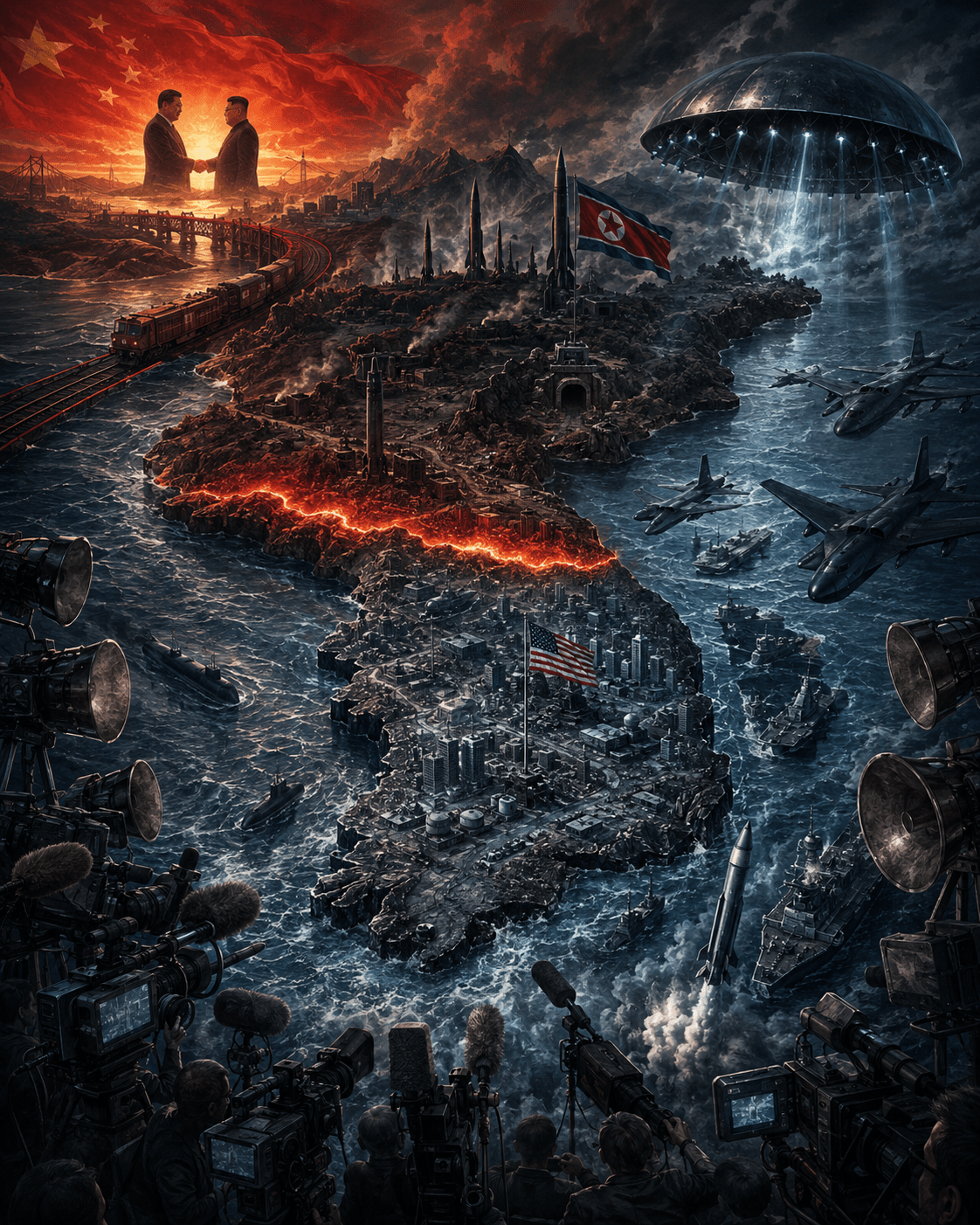
AP hears danger in what China did not say, but hears nothing in the war structure the United States has kept alive on the Korean Peninsula for generations. By turning Xi Jinping’s silence on “denuclearization” into a scandal, the imperial press hides the armistice-without-peace order, the U.S. military presence, the nuclear umbrella, the sanctions architecture, and the regional war planning surrounding Korea. North Korea’s deterrent did not fall from the sky; it emerged inside a world system where empire calls its own bombs stability and everyone else’s survival a threat. The task is not to repeat Washington’s language, but to organize for a real peace: end the Korean War, lift the sanctions, dismantle the war machine, and defend Korea’s right to determine its own future.
By Prince Kapone | Weaponized Information | June 9, 2026
The Silence They Heard Was Their Own
The Associated Press article “Analysis: Chinese President Xi’s silence on nuclear arms is a gift to North Korea’s Kim Jong Un”, written by Foster Klug and published on June 9, 2026, presents itself as sober geopolitical interpretation. Its basic claim is simple enough: Chinese President Xi Jinping met with North Korean leader Kim Jong Un in Pyongyang; Chinese and North Korean state media celebrated the summit in thousands of words; but neither side publicly mentioned Washington’s sacred phrase — “denuclearization.” From this omission, AP constructs its drama. Xi’s silence, we are told, may represent a strategic gift to Kim, a setback for Washington, Seoul, and Tokyo, and perhaps even a tacit Chinese acceptance of North Korea’s nuclear status.
This is the old imperial habit dressed in the plain clothes of wire-service prose. The article does not mainly ask what China and North Korea said to each other, what they emphasized, or how they presented their relationship on their own terms. It asks what they failed to say for Washington. The absence becomes evidence. The silence becomes confession. A summit between two neighboring states is turned into an intelligence riddle for the anxieties of U.S. power.
AP’s institutional position matters here, not because every AP journalist is handed a script by the State Department, but because institutions have locations inside the political economy of information. The Associated Press describes itself as an independent, not-for-profit global news organization, a wire service whose reports circulate through newspapers, broadcasters, and digital platforms across the world. It is not formally owned by the U.S. government. It does not need to be. A wire service rooted in the U.S. media system, funded through member and subscriber licensing, and woven into the daily machinery of corporate news production can reproduce the assumptions of U.S. power without anyone needing to stamp the copy “approved by empire.” The leash is most effective when it looks like professionalism.
Foster Klug’s professional location also matters. Klug is AP’s news director for the Koreas, Japan, Australia, New Zealand, and the South Pacific, with long experience reporting from Asia, including trips to North Korea. That background gives the article the authority of regional expertise. But expertise is not innocence. The question is not whether Klug knows the region. The question is what political grammar organizes that knowledge. In this article, the grammar is clear: Washington, Seoul, and Tokyo appear as the worried custodians of stability, while Pyongyang and Beijing appear as actors whose words and silences must be decoded for signs of danger.
The first propaganda device at work is narrative framing. The article frames Xi’s public silence on nuclear arms as the central event, even though the summit itself concerned relations between China and North Korea. The story could have been framed around regional diplomacy, bilateral cooperation, border stability, trade, public health, agriculture, construction, or the history of relations between two neighboring states. Instead, AP chooses the imperial frame: what does this mean for Washington’s effort to make North Korea give up its deterrent? Once that frame is established, every detail is pulled into its orbit. China’s silence is no longer silence. It becomes a signal, a concession, a gift, perhaps even a betrayal of “the international community,” that lovely phrase which usually means the United States, its allies, and whatever microphone is nearest.
The second device is source hierarchy. The article leans on analysts who speak from within the U.S.-aligned security conversation around Korea. Their function is not merely to comment, but to interpret reality for the reader. Chinese and North Korean official statements appear as texts to be decoded suspiciously, while U.S., South Korean, and allied analytical voices appear as the reasonable custodians of meaning. This is how imperial journalism launders perspective into objectivity. One side has “state-run media.” The other side has “experts.” One side has “propaganda.” The other side has “analysis.” One side has motives. The other side has concerns.
The third device is omission. The article speaks constantly about North Korea’s nuclear weapons but does not organize the story around the conditions that make the nuclear question politically intelligible. It does not ask why the language of “denuclearization” is contested. It does not ask why China would avoid repeating Washington’s preferred formulation. It does not ask why Pyongyang treats its deterrent as non-negotiable. Instead, the article begins from the North Korean bomb as the central problem and then invites the reader to treat China’s silence as the new scandal. Imperial journalism loves consequences without causes. It adores smoke, provided nobody asks who lit the fire.
The fourth device is fear. North Korea’s nuclear program is described through the danger it may pose to the United States and its allies in Asia. The emotional geography of the article is therefore clear. The reader is invited to worry with Washington, Seoul, and Tokyo. But the article does not invite the reader to ask what North Koreans may fear, or how fear itself is distributed unequally in imperial reporting. Their fear does not count as security. Their memory does not count as history. Their deterrent does not count as deterrence. In the imperial dictionary, only empire and its clients are allowed to feel threatened. Everyone else merely threatens.
The fifth device is begging the question. The article assumes that “denuclearization” means North Korea giving up its nuclear weapons, and then interprets China’s refusal to publicly repeat that demand as a problem. But this smuggles the whole argument into the language itself. “Denuclearization of the Korean Peninsula” has never meant the same thing to every actor involved. AP does not have to argue for Washington’s definition because the article simply breathes inside it. The premise is already packed into the suitcase before the reader arrives at the station.
There is also a quiet bait and switch. The summit is formally about China and North Korea, but the real protagonists of the article are the United States and its allies. The reader is taken to Pyongyang only to be returned immediately to Washington’s problem. What did Xi’s silence mean for U.S. strategy? What did it mean for Seoul’s expectations? What did it mean for Tokyo’s fears? The people actually living under the shadow of this crisis appear mainly as pieces on a board. The peninsula itself is reduced to a security puzzle for the managers of empire.
What makes this article useful for excavation is precisely that it is not hysterical in tone. It is calm, polished, and professionally written. That is how the best propaganda often works. It does not always shout. Sometimes it merely arranges the furniture of reality so that the reader sits facing empire’s preferred window. AP does not need to call North Korea irrational on every line. It only needs to make U.S. assumptions appear natural, allied anxieties appear universal, and Chinese or North Korean refusals appear suspicious.
So the headline tells us that Xi’s silence is “a gift” to Kim Jong Un. But perhaps the more revealing gift is the one AP gives us: a clean specimen of imperial media logic. It teaches the reader to hear danger in what China does not say, while refusing to hear the omissions built into its own frame. It worries over silence in Pyongyang and Beijing, but not the silence of the article itself. The silence they heard was not Xi’s. It was their own.
The Bomb Did Not Fall From the Sky
The article’s first factual layer is straightforward. On June 8, 2026, Chinese President Xi Jinping and DPRK leader Kim Jong Un held talks in Pyongyang, where Chinese state media reported that the two sides agreed to strengthen political trust and expand practical cooperation in economy and trade, agriculture, construction, science and technology, and health care. South Korea’s Yonhap, summarizing KCNA, described the summit as opening a “new era” in DPRK-China relations. AP’s central factual observation is that these official accounts, despite their length and ceremony, did not publicly mention North Korea’s nuclear weapons or the phrase “denuclearization”. From that omission, AP argues that Xi’s silence may suggest a change in Beijing’s public posture and may give Kim Jong Un diplomatic space to press for recognition of the DPRK as a nuclear weapons state.
The article is also correct that this moment differs from the public language surrounding Xi’s earlier diplomacy. In 2019, Chinese media presented Xi as willing to play a constructive role in the “denuclearization of the Korean Peninsula”, while in 2026 the public language centered on stability, friendship, development cooperation, and strategic coordination. China’s own readout emphasized that Beijing was ready to strengthen the alignment of development strategies with the DPRK, while the Chinese Foreign Ministry, asked about the Korean Peninsula on June 9, 2026, stated that China’s position on the issue maintains “continuity and consistency”. The point is simple: China did not announce a new nuclear policy, but it also did not organize the summit around Washington’s preferred vocabulary.
The DPRK side has made its position equally visible. Kim Yo Jong rejected the U.S. claim that Trump and Xi had reaffirmed a shared goal of North Korean denuclearization, calling that claim “false information” and describing renewed U.S. denuclearization pressure as an “anachronistic dream”. Days before the summit, Reuters reported that Kim Jong Un inspected a new nuclear-material production facility and called for the country’s nuclear forces to be strengthened “at an exponential rate”. Whatever one makes of that position politically, it is not hidden. The DPRK has publicly tied its nuclear program to state security and long-term strategic survival.
The first major fact AP does not center is that the Korean Peninsula is not a normal diplomatic arena. The Korean War did not end with a peace treaty. It ended with an armistice. United Nations Command states that after the 1953 armistice, the 1954 Geneva talks failed to produce a formal peace treaty, meaning “the Korean Peninsula technically remains in a state of war”. That unresolved structure is the legal and military setting in which every later security dispute on the peninsula has unfolded.
The second omitted fact is the U.S. military architecture built into that unresolved war. United States Forces Korea states that it is responsible for supporting and training joint ROK-U.S. forces and United Nations Command multinational forces, and that it participates annually in joint and combined operations to maintain readiness. The U.S.-ROK Combined Forces Command defines its mission as deterring aggression and, if necessary, defending the Republic of Korea while maintaining stability in Northeast Asia. In February 2026, U.S. and South Korean officials announced that the annual Freedom Shield exercise would run from March 9 to 19, while Reuters noted that North Korea has long denounced such drills as a rehearsal for invasion. AP gives the reader North Korean weapons, but not the permanent military system facing the DPRK.
The third omitted fact is the consolidation of U.S.-ROK-Japan security coordination. The 2023 Camp David framework committed the United States, Japan, and South Korea to intensified trilateral coordination, including security cooperation, missile warning, cyber coordination, and regional strategic alignment. The U.S. State Department later described the U.S.-ROK Nuclear Consultative Group as a bilateral body tailored to the Korean Peninsula to strengthen extended deterrence against the DPRK nuclear threat. These institutions matter because they show that the nuclear question is not only about Pyongyang’s arsenal. It is also about the military and nuclear planning structures surrounding the peninsula.
The fourth omitted fact is that nuclear weapons on the Korean Peninsula did not begin in Pyongyang. The United States deployed nuclear weapons in South Korea continuously for thirty-three years, from 1958 to 1991, and the South Korean-based U.S. arsenal peaked at approximately 950 warheads in 1967. The National Security Archive’s account of the first U.S. nuclear weapons on the peninsula states that the first nuclear-capable U.S. artillery systems were deployed to South Korea in January 1958. This history establishes a basic sequence often missing from contemporary reporting: U.S. nuclear coercion entered the Korean Peninsula decades before the DPRK possessed its own nuclear deterrent.
The fifth omitted fact is the sanctions architecture. The United Nations Security Council’s 1718 sanctions regime maintains a formal sanctions structure against the DPRK, including sanctions lists, committee procedures, exemptions, and implementation rules. The U.S. Treasury’s Office of Foreign Assets Control maintains a separate North Korea sanctions program. OFAC also states that authorization from the Bureau of Industry and Security is required to export or reexport any item subject to the Export Administration Regulations to North Korea, except food and medicine classified as EAR99. In February 2024, OFAC amended North Korea sanctions regulations to broaden certain humanitarian-related general licenses, including authorizations related to NGO, humanitarian, journalistic, agricultural, medical, and medical-device activities. The existence of these carve-outs also confirms the wider restriction: normal economic, financial, and development activity with the DPRK remains heavily constrained.
The sixth omitted fact is the material China-DPRK economic relationship. Reuters reported that China’s trade with North Korea rose in early 2026, with Chinese exports to North Korea increasing by 19 percent in January and February and including soybean oil, footwear, and frozen ducks. Reuters also reported ahead of Xi’s visit that train and flight services between China and North Korea had been restored after limited exchanges during the pandemic period. These are concrete forms of reconnection: food oils, consumer goods, transportation links, and border movement all affect ordinary life, supply channels, and post-pandemic recovery. The summit’s language about agriculture, construction, science, technology, trade, and health care belongs to that material setting.
The seventh omitted fact is the bilateral history itself. The summit took place in the context of the approaching 65th anniversary of the China-DPRK Treaty of Friendship, Cooperation and Mutual Assistance, and AP’s own follow-up coverage acknowledged that the visit revived strategic and economic cooperation through trade, agriculture, construction, and technology. Chinese state media presented the summit as a reaffirmation of traditional friendship and practical development cooperation, while DPRK-linked reporting emphasized political trust and a new stage in relations. The relationship is therefore not reducible to Beijing “managing” Pyongyang for Washington. It is a state-to-state relationship shaped by geography, treaty history, and current economic needs.
The eighth omitted fact is the historical destruction that shaped the DPRK’s security environment. During the Korean War, U.S. bombing devastated the North. Time’s historical account cites General Curtis LeMay’s later statement that the United States “burned down every town in North Korea” and estimated that 20 percent of the population died. That history is not sufficient by itself to explain every later DPRK policy decision, but it is necessary context for understanding why security is discussed in Pyongyang through the language of survival, deterrence, and sovereignty.
Put the missing pieces back, and the scene changes. China’s public language on the peninsula has long differed from Washington’s narrower formulation. Beijing speaks of the denuclearization of the Korean Peninsula, while Washington and its allies usually translate that phrase into unilateral DPRK disarmament. The difference matters because the peninsula contains not only North Korean weapons, but U.S. extended deterrence, U.S.-ROK nuclear consultation, U.S.-Japan-ROK military coordination, sanctions, bases, exercises, and the unresolved armistice order. China’s June 2026 language did not create those facts. It appeared within them.
North Korea’s nuclear policy has also moved from negotiation posture into domestic state doctrine. Reuters reported in 2023 that the DPRK amended its constitution to enshrine nuclear force-building as a permanent basic law of the state. That development narrows the space for any diplomacy based on simple unilateral disarmament demands. Any serious diplomatic approach would have to address the security structure that the DPRK identifies as the basis for its nuclear posture.
Weaponized Information has already mapped this media pattern in prior Korea coverage, especially in its excavation of how imperial reporting turns Korean sovereignty politics into pathology rather than history, as in our analysis of the BBC’s framing of Ahn Hak-sop. WI has also situated Japan’s rearmament and U.S. regional military integration inside the return of imperial war planning in Asia, as in its analysis of Japan, the United States, and the remilitarized Pacific. These prior analyses are relevant here because AP’s article isolates the DPRK’s response while giving limited attention to the wider pressure system around it.
The factual terrain is larger than AP’s article foregrounds. It includes the unresolved Korean War, the armistice-without-peace structure, the U.S. military presence, U.S.-ROK exercises, U.S.-ROK-Japan coordination, U.S. nuclear history in South Korea, sanctions, restored China-DPRK economic links, treaty history, and the DPRK’s codified nuclear doctrine. Those are the conditions Section III must now synthesize.
The Empire Calls Its Bombs Peace
The real story is not that Xi Jinping gave Kim Jong Un a diplomatic gift by failing to chant the sacred word “denuclearization.” The real story is that the imperial vocabulary is beginning to lose its automatic command over world politics. For decades, Washington has treated the Korean Peninsula as a courtroom where it sits as judge, prosecutor, jailer, and nuclear executioner, while the DPRK is summoned to stand trial for refusing to disarm before the very power that never ended the war. AP hears danger in China’s silence because empire is most frightened when other countries stop repeating its language.
The article begins with the weapon in Pyongyang, and from that starting point the whole world appears upside down. Begin instead with the suspended war order restored in the previous section, and the question changes. It is no longer enough to ask why North Korea refuses to disarm. The deeper question is what kind of world system makes deterrence appear to a besieged state as the price of survival. That is the question AP cannot ask, because to ask it honestly would require placing U.S. power inside the frame rather than behind the camera.
This is where imperial journalism performs its favorite magic act. It disappears history, then calls the victim irrational for remembering it. The North Korean bomb is made visible. The American bomb is made atmospheric, like gravity, like weather, like the invisible hand of God. U.S. nuclear force becomes “extended deterrence.” North Korean nuclear force becomes a threat. U.S.-aligned military planning becomes readiness. DPRK military preparation becomes provocation. Washington’s coercion becomes pressure. Pyongyang’s refusal becomes defiance. The same act changes name depending on who performs it. This is not analysis. It is class power speaking in the grammar of objectivity.
The first contradiction, then, is the contradiction of Nuclear Apartheid. The empire and its allies claim the right to possess, threaten, deploy, consult, rehearse, and organize around nuclear force, while the besieged state is told that its own deterrent is uniquely illegitimate. The nuclear hierarchy is not about humanity’s survival. If it were, the greatest nuclear powers would begin with themselves. It is about monopoly. It is about who gets to threaten and who must remain threaten-able. It is about preserving a world in which the imperial center can point a gun at the periphery and call the gun “stability.”
The second contradiction is the contradiction of permanent emergency. Korea has not been allowed to settle into peace. It has been held inside a military limbo where ceasefire becomes structure, where unresolved conflict becomes management system, where every new cycle of tension justifies the machinery that produced the danger in the first place. Under this arrangement, the United States does not need to reconquer the peninsula each year. It only needs to keep the war politically alive, the allied command structures active, the sanctions functioning, and the fear machine well fed. Unresolved war is useful. It disciplines allies, pressures enemies, contains rivals, and gives empire a reason to remain armed in someone else’s home.
The third contradiction is sovereignty under siege. The DPRK is not making security choices in a clean room. It is making them under conditions of pressure, punishment, isolation, and military encirclement. One does not need to romanticize the North Korean state to understand this. Historical materialism does not ask us to clap like fools for every government that resists Washington. It asks us to identify the concrete pressures shaping behavior. A country living under an unfinished war and a sanctions architecture does not experience sovereignty as a decorative word in a speech. It experiences sovereignty as food, medicine, fuel, transport, industrial inputs, diplomatic space, defense capacity, and the ability to survive without being strangled into obedience.
This is why the summit between China and the DPRK cannot be reduced to a “gift” from Xi to Kim. That childish phrase belongs to palace gossip, not political economy. What is unfolding is a material process of international realignment. States under pressure are restoring routes, rebuilding channels, coordinating development priorities, and refusing to let Washington decide which relationships are legitimate. The sectors named in the summit matter because ordinary life matters. Agriculture matters because people eat. Construction matters because people live in buildings. Health care matters because bodies break under sanctions as surely as under bombs. Trade matters because isolation is one of the empire’s preferred weapons.
The AP frame cannot see this because it begins from imperial entitlement. It assumes China is supposed to discipline North Korea for Washington. It assumes Beijing’s proper role is to help manage Pyongyang inside the U.S.-designed order. But the world is no longer moving cleanly along the rails of unipolar command. China’s refusal to publicly organize the summit around Washington’s demand signals something larger than diplomatic omission. It signals a weakening of the old choreography, where major states were expected to bow before the American script, repeat the American keywords, and help enforce the American perimeter.
This is Multipolar Recalibration in living motion. It is not pure. It is not sentimental. It is not a children’s story where every force outside Washington is automatically revolutionary. But it is a real shift in the structure of world power. The imperial center can no longer assume that every crisis will be resolved through its vocabulary, its sanctions, its military alliances, and its media definitions. The oppressed and besieged nations are finding room, sometimes narrow and contradictory, to maneuver. That maneuvering space is one of the central facts of the present world situation.
The Korean question also exposes the deeper Crisis of Imperialism. The United States built a regional order through military dependency, nuclear hierarchy, political subordination, and strategic containment. That order now faces limits. The old formulas of management no longer command the field as they once did. A state hardened by siege cannot be frightened into unilateral surrender by the same threats that produced its security doctrine. U.S. allies are being pulled deeper into regional war planning even as the region itself becomes more dangerous. The empire responds to its own decline not with humility, but with more coordination, more exercises, more sanctions, more consultations, and more press narratives about threats. Like an old landlord whose tenants have learned to organize, it mistakes louder knocking for renewed authority.
Here the Imperialist Media Apparatus performs its assigned labor. It does not have to lie crudely. It merely arranges the facts in the proper imperial order. First, make U.S. power disappear into the background. Second, make allied anxiety the emotional center. Third, make North Korean deterrence appear as the origin of danger. Fourth, make Chinese independence from Washington’s script appear suspicious. Fifth, call the whole thing analysis. This is not journalism as neutral information. It is journalism as ideological maintenance, the daily repair work of a world system whose legitimacy is cracking.
From the standpoint of the global working class and oppressed nations, the issue is not whether nuclear weapons are beautiful. They are not. Nuclear weapons are monstrous products of a monstrous system. But to condemn the weapon while defending the imperial order that makes the weapon rational for besieged states is liberal hypocrisy, not peace politics. A serious anti-imperialist peace line must begin with the war structure itself. Otherwise “peace” becomes another word for disarming the target while leaving the empire armed to the teeth.
This is the story AP cannot tell because it would indict the whole architecture it takes for granted. The DPRK’s nuclear policy is not isolated madness floating above history. It is one outcome of a world order built through war, division, coercion, and nuclear hierarchy. China’s silence is not the scandal. The scandal is the world system in which the United States can keep a war unresolved for generations, surround a country with pressure, punish it through sanctions, and then act bewildered when that country refuses to make itself defenseless.
The empire calls its bombs peace and everyone else’s survival a threat. That is the lie at the center of the article. Once the missing history is restored, the headline collapses. Xi’s silence was not a gift to Kim. It was a refusal to turn a bilateral summit into a performance for Washington. The real gift in this moment belongs to us: another chance to tear the mask from imperial language and show the people what stands behind it — not peace, not stability, not denuclearization, but a decaying empire demanding that the world continue to fear its weapons while surrendering their own means of resistance.
Turn the Silence Into Organization
If the AP article trains people to mistake omission for danger, our task is to teach people to identify the violence hidden by that omission. That means moving from analysis into organization. The Korean question cannot remain trapped in the hands of generals, think tanks, sanctions lawyers, and wire-service interpreters. It belongs to the Korean people first of all, and to every worker, student, veteran, parent, and organizer who understands that an unfinished war in Asia is not a distant issue. It is part of the same war system that eats schools, hospitals, housing, wages, and life itself.
The first practical step is to support Korean-led anti-imperialist organizing in the diaspora. Nodutdol identifies itself as a diasporic Korean organization based in the United States and Canada organizing for a world free of imperialism and for Korea’s re/unification and national liberation. Its U.S. Out of Korea campaign demands the withdrawal of U.S. troops from Korea, an end to U.S. military exercises, the lifting of sanctions against North Korea, and the redirection of war spending into housing, education, health care, and climate justice. The immediate task is concrete: circulate Nodutdol’s materials, join or build local U.S. Out of Korea formations, and carry the demand into unions, classrooms, churches, campuses, tenants’ meetings, and antiwar coalitions.
The second practical step is to build pressure around a peace agreement to finally end the Korean War. Veterans For Peace’s Korea Peace Campaign works to achieve a peaceful end to the lingering Korean War, heal the wounds of the war, and promote reconciliation between Korean and American people. Veterans can puncture the mythology of “readiness” with the authority of people who know what war does to human beings. Local chapters should be pushed to host public forums on the armistice, pass city resolutions calling for a peace agreement, confront congressional offices, and connect the Korean War to the domestic theft of public resources by the war economy.
The third practical step is to amplify women-led peace organizing rooted in the demand to replace the armistice with peace. Women Cross DMZ describes itself as a global movement of women mobilizing for peace on the Korean Peninsula through education, advocacy, and organizing. Its Korea peace work argues that a peace agreement officially ending the Korean War is the most realistic and effective method for resolving the security crisis on the peninsula. This can be carried directly into teach-ins, women’s organizations, unions, churches, classrooms, and community spaces to show that the unresolved war separates families, militarizes daily life, and keeps the peninsula in a state of permanent danger.
The fourth practical step is to turn media response into disciplined counter-propaganda. CODEPINK’s People’s Peace Treaty campaign calls on the U.S. government to officially end the Korean War by concluding a peace treaty with the DPRK, lift sanctions, and normalize diplomatic relations. Every article that pretends North Korea’s nuclear policy emerged from irrationality should be answered with the missing history: the unfinished war, the sanctions, the bases, the exercises, the U.S. nuclear umbrella, and the demand for peace.
The fifth practical step is to keep the demands sharp and campaign-rooted. Do not dissolve the Korean question into a soft liberal plea for “dialogue.” Dialogue without ending the war structure becomes theater. The line must be concrete: replace the armistice with a peace treaty, end U.S.-ROK war exercises and withdraw U.S. troops, lift sanctions that punish the Korean people, organize through Korea peace networks against militarization and for a peace-first settlement, and defend the right of Koreans to determine Korea’s future without imperial command. These demands can be carried into labor meetings, student organizations, Black liberation spaces, anti-base campaigns, Palestine solidarity networks, China-war opposition work, veterans’ groups, and faith communities that still know how to speak the word peace without first asking permission from the Pentagon.
The final task is to make this AP article politically useful by turning it against itself. Use it in study groups as a specimen. Put the headline on the screen and ask: whose danger is being centered, and whose violence is being hidden? Then place beside it the history of the unresolved war, the U.S. nuclear record on the peninsula, the sanctions architecture, and the organizations already fighting for peace. Assign each participant a task: one person tracks the media frame, one reconstructs the omitted history, one gathers campaign materials from Korean-led and antiwar organizations, and one drafts the local action step. Then move the study into practice: circulate Nodutdol’s U.S. Out of Korea materials, push Veterans For Peace chapters toward local resolutions, use Women Cross DMZ resources in community education, and answer imperial media frames through CODEPINK-style rapid response. The people do not need another polished imperial bedtime story. They need tools, memory, organization, and a line clear enough to move with: peace in Korea will not come from North Korean surrender. It will come from ending the war the United States refuses to let die.


Leave a Reply