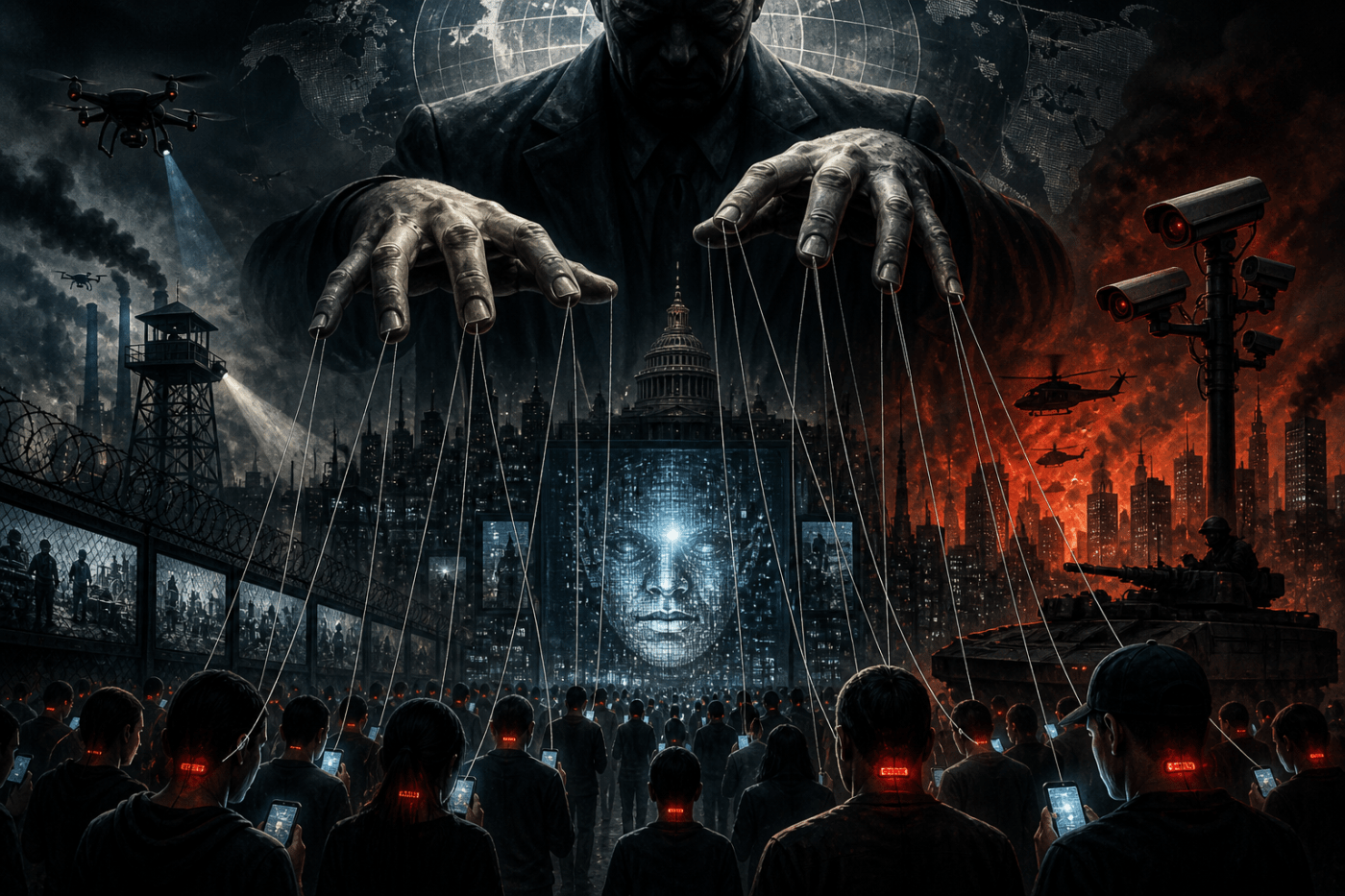
The United States is not collapsing politely—it is reorganizing itself into a system of financial command, digital surveillance, labor discipline, and imperial enforcement. What the ruling class calls innovation is the old colonial logic upgraded through artificial intelligence, data extraction, and integrated security infrastructure. As global dominance becomes more contested and domestic stability erodes, the system turns inward on its own population while tightening its grip on the world’s strategic chokepoints. But every system built on total control reveals its own limits—and once the machinery is seen clearly, the struggle shifts from resisting its effects to confronting its structure.
By Prince Kapone | Weaponized Information | May 2, 2026
Learning to See the Machine Before It Finishes Building the Cage
The first trick of liberal ideology is not to deny fascism—it’s to teach people to recognize it only after it’s already tightened its grip. By the time they finally admit what’s happening, the prisons are packed, the unions are smashed, the press is housebroken, and the police have stopped pretending they serve anything but power. Then the experts show up, right on schedule, notebooks in hand, to tell us—very calmly—that something unfortunate has taken place. This is the politics of “not yet.” Not yet, because elections still happen. Not yet, because courts still issue rulings. Not yet, because the news still argues with itself and some politician gets to perform dissent before signing off on the next war budget. Liberalism confuses procedure with power. It sees the outer shell still standing and declares the system alive, while the machinery inside has already been rewired.
We start somewhere else. We don’t wait for the corpse to cool before we name what killed it. The enemy has to be identified while it’s still moving, still assembling itself, still testing its parts. Fascism isn’t a relic from the 1930s, something locked in black-and-white film with uniforms and salutes. It’s a political response to crisis, and like any tool of ruling power, it adapts to the conditions that produce it. In a world shaped by monopoly finance, artificial intelligence, permanent war, mass surveillance, and imperial decline, this new formation doesn’t need to tear down liberal institutions in one dramatic sweep. It can hollow them out from within, route around them, automate their functions, and sell the whole process as progress—while power quietly relocates to places the public never voted for and cannot see.
Here is the contradiction, stripped of polite language: the form remains, but the function moves. Elections still run on schedule. Courts still speak. Media still circulates noise and spectacle. The rituals continue, and that continuity is the illusion. Because underneath it, real power is reorganizing itself into a dense network—security agencies, military contractors, asset managers, cloud empires, data brokers, platforms, and artificial intelligence systems working in coordination. The state you can see is not the state that decides. The visible state performs legitimacy; the operational state executes control. People are still invited to participate, but increasingly governed through systems they never approved, contracts they never read, and algorithms they are not allowed to question.
You don’t have to speculate about this shift—you can see it taking shape. Take Palantir’s role in the Pentagon’s Project Maven. This isn’t about whether technology is good or bad—that’s the kind of childish framing that keeps people from asking real questions. The issue is structural: private systems are becoming organs of state power. Reuters reported that Palantir built an artificial intelligence system for Maven, secured a 2024 contract worth up to $480 million, and then watched that ceiling expand to $1.3 billion as the Pentagon moved to make it a core military system. That’s not just buying software. That’s outsourcing perception itself—how the military sees, sorts, and acts on reality.
Now watch how the liberal mind tries to make sense of this. It clings to categories that no longer hold. A company is supposed to be separate from the state. A contract is supposed to be neutral. A tool is supposed to obey its user. But real history doesn’t follow civics textbooks. When platforms double as intelligence infrastructure, when cloud systems carry the nervous system of the state, and when AI participates in targeting decisions, the line between public authority and private capital doesn’t just blur—it collapses. This is no longer cooperation at the edges. It’s integration at the core. The capitalist doesn’t need to break into the state. He’s already inside it—writing its code, managing its data, financing its operations, and calling it innovation.
So we proceed without illusions. What we’re looking at cannot be reduced to personalities, policies, or gadgets. It is a reorganization of power itself, shaped by a system under strain. As imperial stability cracks, the ruling class doesn’t surrender control—it rebuilds it. Coercion, finance, and administration are being reassembled through digital infrastructures that operate beneath the visible surface of democracy. And here’s the key: power doesn’t announce that it has moved. It shifts quietly, accumulates strength, and consolidates until the institutions people still trust no longer make the decisions they think they do.
If you wait until that process is complete, you’re not doing analysis—you’re writing an obituary. You’re describing a system after it’s already hardened into place. That’s useless for anyone trying to understand or change it. The task is different. We study the process while it’s unfolding. We name the forces while they’re still aligning. We map the structure before it locks in. Because the cage is not finished yet—but the machine building it is already humming, and it’s not slowing down.
Beyond the Ballot Box: Power, Class, and the Machinery Beneath Democracy
Liberalism begins its analysis of political life the way a tourist studies a city—from the surface. It looks for elections, courts, newspapers, constitutions, parties, and rights, and once it finds them, it declares the system alive and well. This is not speculation; it is codified method. Freedom House explicitly defines political systems through “political rights and civil liberties,” measured through elections, pluralism, and institutional guarantees. The Varieties of Democracy project similarly evaluates regimes through indicators like clean elections, judicial constraints, freedom of expression, and party competition. Even when refined, the lens remains the same: democracy is what can be seen, counted, and procedurally verified. The ritual matters more than the result. The form becomes the content.
But this method has a blind spot so large it swallows reality itself. It cannot ask who owns the infrastructure through which society operates. It cannot ask who controls the means of coercion. It cannot ask who determines what the state is materially capable of doing. It cannot ask who finances the system, who writes the code, who builds the databases, who supplies the weapons, who runs the platforms, and who ultimately decides what happens when the procedures collide with power. Liberal formalism can tell you whether a court exists; it cannot tell you whether that court governs or merely reacts. It can tell you elections occur; it cannot tell you whether policy is decided before or after the vote. It can measure press freedom; it cannot measure the structural ownership of the channels through which truth must pass. In short, it records appearances while power migrates elsewhere.
Historical materialism begins where liberalism refuses to look. In State and Revolution, Lenin dismantles the polite fiction of the neutral state and restores it to its real foundation: a special organization of force arising from irreconcilable class antagonisms. The state is not a referee hovering above society; it is an instrument rooted in property relations, sustained by coercion, and structured to defend the dominant class. This shift in method changes everything. Democracy is no longer reduced to legal procedure. It becomes a question of who commands, who owns, and who enforces. Courts, elections, and rights are not dismissed—but neither are they treated as decisive. They are located within a broader structure of power that determines their limits.
Nicos Poulantzas deepens this analysis by defining the state as a “material condensation” of class forces, not a fixed institution but a shifting terrain shaped by struggle. This is crucial, because it allows us to understand how transformation occurs without spectacle. Institutions can remain intact while their internal composition changes. The court still rules, but whose interests structure its decisions? The election still takes place, but who has already determined the range of possible outcomes? The agency still operates, but whose data, whose contracts, whose infrastructure does it depend on? The state, in this view, is not a static object but a dynamic configuration—one that can mutate internally while preserving its external form. This is how transitional systems operate. This is how power moves without announcing itself.
The problem of fascism, stripped of liberal mystification, is clarified by Georgi Dimitrov’s definition of fascism as the rule of the most reactionary, chauvinist, imperialist elements of finance capital. Fascism is not a style, not a mood, not a loud voice or an offensive slogan. It is a class configuration under conditions of crisis. The mistake is not in recognizing fascism too early; the mistake is in recognizing it only when it has already assumed its historical costume. Our task is not to search for replicas of the twentieth century, but to trace how the same class logic reorganizes itself under new conditions—digital, financialized, automated, and imperial in scope.
This is where the dialectical method becomes indispensable. History does not move by polite institutional replacement; it moves through accumulation and rupture. What appears at first as quantity—a few contracts, a few databases, a few surveillance programs—gradually becomes quality. The U.S. Government Accountability Office found that federal agencies more than doubled reported AI use from 2023 to 2024, expanding acquisition pathways and embedding algorithmic systems deeper into governance. What begins as assistance becomes infrastructure. What begins as infrastructure becomes authority. What begins as authority becomes command.
The same pattern appears in coercion. Federal law enforcement agencies now rely on non-federal facial recognition systems while lacking mechanisms to track or fully assess their use. Meanwhile, fusion centers integrate private corporations into intelligence operations, blur military and civilian roles, and expand data-mining practices under conditions of legal ambiguity. Each step appears incremental. Each can be justified. Each can be defended as necessary, temporary, or technical. But taken together, they mark a transformation: coercive power is no longer confined to the formal state; it is distributed across a network of public and private systems that operate continuously, invisibly, and with minimal democratic oversight.
At a certain point, the tools cease to be tools. When major technology firms sign classified agreements with the Pentagon to integrate artificial intelligence into mission planning and targeting, the question is no longer whether technology assists governance. The question is whether governance has been reorganized through technology. The distinction matters. A hammer is a tool. A factory is a system. A networked AI infrastructure embedded in military, intelligence, and administrative operations is something else entirely: a governing logic.
Transitional systems are always contradictory. They carry the old and the new together. They preserve institutions even as they hollow them out. They maintain procedures even as they relocate power. This is why they are so often misrecognized. The liberal observer sees continuity and concludes stability. The materialist sees contradiction and identifies transformation. The question is not whether elections still happen, courts still rule, or newspapers still publish. The question is whether these institutions remain decisive—or whether decision-making has migrated into systems of capital, code, and coercion that operate beyond their reach.
This is the methodological divide. Liberalism asks whether the forms have vanished. Historical materialism asks whether the forms still govern. The first waits for collapse. The second identifies mutation. And in a moment when power is reorganizing itself through contracts, algorithms, surveillance, and privatized infrastructure, the difference between those two questions is the difference between analysis and irrelevance.
When Wealth Swells and Life Shrinks: Monopoly Capital in Its Terminal Logic
If you want to understand the kind of political system taking shape, you don’t start with speeches or elections—you go down into the engine room. That’s where the real story is. And what you find there is not a system starving for growth, but one choking on its own excess. Monopoly-finance capital doesn’t suffer from scarcity—it suffers from surplus. As Baran and Sweezy’s framework, carried forward by Monthly Review, makes clear, modern capitalism produces more than it can profitably absorb. It builds capacity faster than people—kept broke by design—can consume what’s produced. The problem is not production. It is absorption.
Once that contradiction sets in, the system reorganizes around it. Outlets are not created because they are socially necessary, but because capital must discharge its excess. Advertising becomes permanent, manufacturing demand to match overproduction. Goods are engineered for turnover, not durability. Finance expands, converting future income into present profit streams. Data extraction turns everyday life into a site of accumulation. And militarism emerges as the ultimate sink—where destruction itself becomes economically functional. What appears irrational at the surface is, at the level of system logic, entirely coherent: surplus must be absorbed, by whatever means necessary.
Financialization crystallizes this shift. Profit moves away from producing use-values and toward controlling claims on future value. The economy becomes less about making things and more about managing entitlements, assets, and risk. Federal Reserve data shows household and nonprofit net worth reaching $184.1 trillion by late 2025, even as debt expands alongside it. The surface appears prosperous—assets rise, balance sheets expand—but this expansion is tethered to obligation. Wealth inflates in abstraction while the material conditions sustaining it grow more strained.
That strain becomes visible the moment you shift from aggregates to lived conditions. Real wages for the lowest-paid workers declined, even as asset values surged. At the same time, Federal Reserve surveys report widespread difficulty covering basic expenses. The contradiction is not incidental—it is structural. The system’s expansion depends on conditions that compress the capacity of the majority to reproduce their own lives. Growth persists, but it is decoupled from social well-being.
Debt is the mechanism that stabilizes this contradiction in the short term. Household debt approaching $18.8 trillion is not simply a reflection of consumption—it is a system of discipline. Debt binds labor to future work, constrains mobility, and enforces compliance under conditions where wages alone no longer secure stability. It extends exploitation beyond the workplace, ensuring that obligation persists regardless of economic volatility. Payment becomes continuous, even when employment is not.
At the level of firms, the same logic operates through financial control. Private equity buyouts structured around heavy leverage shift risk onto the acquired company, while rapid value extraction strategies prioritize short-term returns over long-term viability. Production becomes secondary to financial engineering. Firms are not developed—they are reorganized for extraction, often leaving diminished capacity in their wake. The enterprise ceases to be an end; it becomes a vehicle.
Above this process sits a highly concentrated structure of ownership. BlackRock, Vanguard, and State Street hold dominant positions across the corporate landscape, while research on asset manager capitalism demonstrates how ownership spans sectors and aligns interests structurally. Coordination does not require explicit conspiracy—it is embedded in the architecture of ownership itself. Capital organizes as a system.
From this base, the political implications follow directly. A system that expands abstract wealth while contracting material life cannot sustain legitimacy indefinitely. As integration falters, policy shifts accordingly: precarity replaces stability, austerity replaces support, and discipline replaces inclusion. Projected cuts to social programs threaten employment and income, while declining access to basic assistance signals the withdrawal of even minimal guarantees. What had been framed as shared prosperity is reconfigured as managed scarcity.
At this point, the transition from economics to politics is not a leap—it is a continuation. When the system can no longer stabilize itself through material inclusion, it must stabilize itself through control. Financialization, debt expansion, declining living standards, and insecurity are not separate developments; they are components of a single trajectory. And that trajectory points toward a form of rule designed not to resolve crisis, but to contain it—a system that fuses finance, technology, and coercion to maintain order under conditions it can no longer fundamentally repair.
That system is not yet complete. But its foundation is already in place. The engine is running. And everything that follows will carry the imprint of the logic established here: a system in which accumulation expands, while the conditions of life that sustain it are increasingly subordinated to its continuation.
The Silicon Matrix: How Empire Built a Nervous System and Put It in Corporate Hands
They like to tell a story about Silicon Valley. A nice, clean story. Some kid in a garage, a soldering iron, a lucky idea, and suddenly the future is born. It’s a comforting myth—because it hides where this system actually comes from. The reality is colder, more deliberate, and far more dangerous. DARPA itself admits that the foundations of the Internet were laid through military research, not for social connection or online shopping, but for coordinating distributed computing under conditions of war. The Internet Society confirms that ARPANET grew out of Cold War funding streams tied to institutions like RAND. And that first message sent in 1969—from UCLA to SRI—was not the birth of a marketplace. It was the birth of a command system.
That matters, because the system never forgot what it was built to do. This infrastructure was designed to solve a very specific problem: how to maintain control across distance, disruption, and crisis. DARPA’s own history lays it out plainly—networking was about linking distributed assets, ensuring communication under pressure, keeping command intact even when systems were under attack. Strip away the technical language and you get the core logic: command, control, and survivability. Not communication for its own sake—communication as power.
From the start, the system carried three functions. First, command—getting decisions from one place to another under unstable conditions. Second, control—organizing information so it flows where it needs to, when it needs to. Third, prediction—modeling threats before they arrive, anticipating disruption before it happens. Packet-switching and network protocols weren’t just technical breakthroughs—they were solutions to a political problem: how to govern complexity at scale without losing control.
What changed over time wasn’t the logic. It was the ownership. As the Internet moved into civilian life, it didn’t shed its military DNA—it expanded it. What used to connect labs and command centers now connects entire populations. But here’s the twist: it didn’t become public infrastructure. It became private property.
And that’s where the mutation happens. A system built for coordination becomes a system for extraction. A research network becomes a profit machine. As Shoshana Zuboff puts it, human experience itself gets turned into raw material—collected, analyzed, sold. Platform capitalism takes that even further—building entire systems designed to capture activity and convert it into value. You’re not just using the platform. You are the resource being mined. Every click, every search, every movement—tracked, stored, monetized.
And once that system scales, you get a new structure of power. By 2026, cloud infrastructure alone is pulling in over half a trillion dollars annually, controlled by a handful of firms. Amazon, Microsoft, and Google dominate the backbone, while Meta, Google, and Amazon control the flow of visibility and attention. Communication, commerce, and social life don’t happen in public space anymore—they happen inside privately owned systems.
That’s what people don’t quite grasp yet: we’re not just using these platforms. We’re living inside them. To speak, you go through a platform. To find information, you go through an algorithm. To organize, you rely on infrastructure you don’t control. Social life itself gets routed through systems built for extraction. The nervous system of society—its communication, coordination, perception—has been enclosed.
And the state isn’t standing outside watching this happen. It’s wired directly into it. The Pentagon’s Joint Warfighting Cloud Capability program plugs Amazon, Microsoft, Google, and Oracle into military infrastructure at every level. Palantir’s Maven system becomes a core platform for command and control. And agreements with major AI firms integrate artificial intelligence into classified military networks. At this point, saying the line between public and private is “blurring” is too polite. It’s gone.
What emerges here isn’t just Big Tech. It’s a full system—a matrix. Cloud infrastructure stores and processes data. Platforms shape communication and visibility. Data extraction turns life into value. AI systems sort, predict, and decide. Logistics networks move goods and people. Surveillance systems track behavior. Military and intelligence systems act on the information produced. All of it connected. All of it interdependent. One system, multiple functions.
Through that system, the state sees. Through it, capital extracts. Through it, police and military act. Through it, ideology circulates. What started as a Cold War solution to command problems has become the operating system of modern power. Not a metaphor. Not a slogan. A material infrastructure that reorganizes how governance actually works.
And here’s the part that matters most: the state hasn’t disappeared. It’s been rewired. Authority no longer runs primarily through institutions—it runs through systems. The visible state still performs its role, but the real work happens inside infrastructures that are increasingly owned and operated by private capital. That is the technical foundation of what we’re dealing with—not theory, not speculation, but a concrete reorganization of power in the digital age.
The Permanent War at Home and Abroad: Counterinsurgency as the System’s Operating Logic
They tell you counterinsurgency is something that happens “over there.” A special tactic for special wars, used against distant enemies in distant places. That story is useful—it keeps the violence contained in people’s minds. It lets the public believe that what’s done abroad stays abroad. But if you actually read the doctrine, the illusion falls apart. U.S. counterinsurgency manuals don’t just talk about defeating armed groups—they talk about shaping entire environments: populations, information flows, political behavior. The target isn’t just the insurgent. The target is the society that could produce one.
Once you understand that, counterinsurgency stops looking like a tactic and starts looking like a method of rule. It maps people, tracks relationships, isolates dissent, and manages perception. “Population-centric” doctrine says it plainly: control the population, influence the population, shape the population. At that point, the language of citizenship quietly disappears. People aren’t political subjects anymore—they’re terrain. Something to be studied, divided, secured, and administered. This isn’t an anomaly. It’s what happens when a system can’t generate real legitimacy and has to manufacture compliance instead.
And this didn’t come out of nowhere. It’s colonial to its core. U.S. military analysis of the Philippine-American War treats it as an early success story—translation: a testing ground for controlling populations that refused to submit. Historical work on U.S. rule in the Philippines shows the full picture—military force combined with labor control and racial domination. The pattern is already there: where consent doesn’t exist, it gets replaced with management. People aren’t governed—they’re handled.
That logic doesn’t stay overseas. It evolves, sharpens, and comes back. Vietnam is the turning point. The Phoenix Program is often described in dry language—“intelligence coordination,” “neutralizing infrastructure.” What it actually meant was building databases on entire populations, mapping networks, targeting political organizers, and eliminating them through imprisonment or death. The important thing isn’t just the brutality—it’s the structure. Data collection. Network mapping. Behavioral targeting. Coordinated action. That’s modern counterinsurgency taking shape.
And once that structure exists, it doesn’t disappear. It gets repurposed. It gets redeployed. It comes home. COINTELPRO didn’t hide what it was doing—it openly targeted domestic political movements, especially Black liberation organizations like the Black Panther Party. What had been framed as counterinsurgency abroad becomes internal security at home. Dissent becomes threat. Organizing becomes subversion. Whole sections of the population are redefined—not as participants, but as problems to be contained.
The War on Drugs deepens the process. Military equipment flows into local police departments. Surveillance expands. Entire communities are treated as zones of suspicion. Drug war policy becomes the justification. But the structure underneath is the same: identify, monitor, control. The language says law enforcement. The practice says counterinsurgency.
After September 11, the integration is complete. Surveillance powers expand. Fusion centers link federal, state, local, and private actors into a single intelligence web. The system no longer distinguishes cleanly between domestic and foreign, civilian and military, public and private. It just processes information and acts on it. The language shifts—from war to security—but the method stays the same.
And even when the system admits the risks, it keeps going. Early warnings about fusion centers pointed to exactly what was coming—unchecked data sharing, corporate integration, erosion of civil liberties. Even DHS acknowledges the privacy risks. But nothing slows down. Because this isn’t a mistake—it’s how the system functions now.
And once that infrastructure is built, it doesn’t stay contained. It spreads. It leaks. Recent exposure of DHS data systems shows how easily information flows beyond its intended boundaries—contractors, foreign nationals, unknown actors. That’s not an accident. It’s what happens when you build a system designed to monitor everything—it eventually spills everywhere.
So when you step back, the pattern becomes impossible to ignore. This isn’t a collection of policies—it’s a continuous line. Colonial counterinsurgency in the Philippines. Systematized population control in Vietnam. Domestic repression through COINTELPRO. Militarized policing under the War on Drugs. Integrated surveillance under the War on Terror. And now a fully networked system of monitoring and control through fusion centers and digital infrastructure.
Technofascism doesn’t invent this logic. It inherits it. What changes is the scale and the medium. The same methods—mapping, monitoring, isolating, controlling—are now embedded in digital systems, automated through data, and applied across entire populations. The war never stopped. It just stopped announcing itself. What used to require boots on the ground now runs through code, networks, and databases. That’s the reality: this is not a system preparing for war. It’s a system already at war—with its own population as much as anyone else. The only thing that’s changed is how that war is carried out.
The Code Is Old: How Colonial Power Learned to Think in Systems
There’s a mistake you hear everywhere now, especially in polite discussions about “digital authoritarianism.” People talk like surveillance, predictive systems, and behavioral control simply emerged with Silicon Valley—as if domination were a recent invention of software engineers. That story isn’t just wrong—it’s dangerous, because it severs the present from its historical foundation. Technofascism in the United States did not begin with code, artificial intelligence, or Big Tech. It began with land theft, slavery, and conquest—with the construction of a racial order designed to organize exploitation. The displacement of Indigenous nations was not incidental—it was foundational. What we are witnessing today is not a new system, but the extension of an existing one through more advanced means.
Digital systems do not introduce a new logic. They extend an existing one—expanding its reach, compressing its timelines, and embedding it more deeply into everyday life. To see that logic clearly, you don’t begin with contemporary technology. You begin with the institutional sites where power first learned to operate systematically: the plantation, the reservation, the prison, and the border. These are not metaphors. They are the historical laboratories in which methods of control were developed, refined, and generalized.
The plantation establishes the foundation: total surveillance of labor. Every movement tracked, every output measured, every deviation punished. The overseer functioned not only as an enforcer, but as a manager of quantified productivity. As Simone Browne demonstrates, practices we now identify as modern surveillance have direct roots in these systems. Plantation accounting transformed human activity into measurable data, establishing a framework in which labor could be monitored, compared, and optimized. This is not an analogy—it is an early form of systematic data governance.
Contemporary labor systems extend this foundation rather than replace it. Warehouse technologies track workers in real time, measuring speed, movement, and output against algorithmic benchmarks. What changes is the interface—not the relation. Direct supervision gives way to distributed monitoring systems, but the objective remains continuous extraction under conditions of total visibility.
The reservation develops a different dimension: spatial control. Indigenous populations were confined within imposed territorial boundaries, governed through external authority and administrative segmentation. The Dawes Act further fragmented collective land into individually controlled units, facilitating absorption into broader systems of control. Territory becomes an instrument of governance—mapped, divided, and regulated to structure movement and limit autonomy.
This spatial logic expands beyond its origin. Urban zoning, policing patterns, and territorial governance reproduce similar structures—organizing populations through geography, concentrating surveillance, and designating areas for containment. Space ceases to be neutral. It becomes operational.
The prison internalizes these mechanisms. The carceral system organizes governance around classification, monitoring, and continuous supervision. Digital extensions—risk scoring, predictive policing, persistent data tracking—expand this logic beyond confinement. The prison evolves from a site into a system, operating across time and space to manage populations through categorization and control.
Even confinement itself becomes flexible. Electronic monitoring extends supervision into homes and communities, dissolving the boundary between incarceration and everyday life. Control is no longer anchored to a location—it becomes mobile, continuous, and embedded.
The border synthesizes these dimensions into a comprehensive system of identification and movement control. Biometric tracking fixes identity at the level of the body, while aerial surveillance extends observation across terrain. Integrated databases connect these inputs across agencies, producing a system in which mobility itself becomes conditional. The border is no longer a fixed line. It becomes a function that can be activated wherever enforcement is required.
Taken together, these institutions form a coherent historical sequence: surveillance of labor, control of space, classification of populations, and regulation of movement. Each develops a distinct capacity. Together, they establish a generalizable model of governance under conditions of domination.
Digital technology does not break from this sequence—it integrates it. It links these capacities into unified systems, automates their operation, and extends them across entire societies. Surveillance becomes continuous, spatial control becomes dynamic, classification becomes predictive, and mobility becomes programmable. What appears as innovation is, in structural terms, consolidation.
This is the critical distinction. The present is not defined by a sudden departure into something unfamiliar, but by the intensification of a long-standing system. The United States is not becoming something new—it is extending its foundational logic into new domains with greater speed and coordination. The code may be new. The logic is not. And once that continuity is recognized, the present no longer appears anomalous. It appears as a development—one that has reached a level of integration capable of operating at full scale.
Three Faces of One Power: Finance, Frontier, and the Digital Command
It is tempting—too tempting—to treat the ruling class as a single, unified actor moving with perfect coordination. Reality is more uneven, and therefore more dangerous. The system is not run by identical men in identical rooms thinking identical thoughts. It is organized through fractions—distinct centers of power with different material bases, different styles, and at times competing interests. But these are not separate ruling classes. They are components of a single bloc, bound together by the necessity of maintaining empire. Their unity is not automatic; it is produced—especially in moments of crisis—and stabilized through shared commitments to accumulation, domination, and global control.
To understand this bloc in its current form, we have to name its dominant fractions: the Yankees, the Cowboys, and the Digerati. Each represents a distinct mode of power. Each performs a necessary function. Together, they form the architecture of technofascism.
The Yankees are the managers of financial empire. They operate through Wall Street, central banks, asset managers, regulatory agencies, and policy institutions. Their power flows through the dollar—through credit, debt, and the institutional frameworks that structure global capitalism. Sanctions policy makes this explicit: asset freezes, trade restrictions, and financial isolation deployed as instruments of state power. This is empire refined—less occupation than obligation, less invasion than enforcement through dependency.
Their style is technocratic. They speak the language of stability, regulation, and the “rules-based order.” Treasury monitoring of global currency practices reflects this posture—presented as governance rather than domination. Their authority rests on legitimacy: the belief that the system they manage is natural and necessary. But that legitimacy is fragile. Even within official circles, there is recognition that excessive reliance on financial coercion risks undermining the dollar itself. The Yankees rule through confidence—and that confidence is beginning to erode.
The Cowboys operate on different ground. They represent extraction, militarism, and the politics of the frontier. Their base lies in fossil fuels, agribusiness, arms production, and industries that convert land, labor, and conflict into profit. “Energy dominance” policy makes clear that resource extraction is treated as a pillar of national power, while Defense Production Act determinations frame infrastructure as strategic necessity. Extraction is not just economic—it is geopolitical doctrine.
For the Cowboys, war is not an exception. It is an industry. Arms corporations generate hundreds of billions in revenue, with U.S. firms dominating the field, while analysis of the defense industrial base shows a tightly concentrated cluster of contractors shaping military production. Their political style reflects this base: open nationalism, frontier mythology, and a willingness to discard liberal restraint. Where the Yankees speak of order, the Cowboys speak of force.
The Digerati are the newest and fastest-growing fraction. They control the infrastructure through which modern life is organized: platforms, cloud systems, artificial intelligence, data networks, and the flows of attention that shape perception. They own the interface—and through it, they mediate reality. Agreements with the Pentagon integrate AI systems into classified military networks, while additional contracts embed private capabilities directly into national security operations. These firms are not external partners. They are components of state capacity.
Their mode of power differs from the other factions. They do not primarily extract resources or manage global debt. They organize information, attention, and behavior. Their systems sort, predict, and influence human activity at scale. They shape the environments in which ideology circulates—where narratives rise, fall, and take hold. In this sense, they do not simply support the system. They structure how the system is experienced.
The decisive point is not their differences, but their convergence. Crisis forces alignment. The Yankees require stability, but stability is weakening. The Cowboys push expansion, but expansion produces conflict. The Digerati offer tools—systems of coordination, prediction, and control that promise to manage instability without resolving it. From this, a settlement emerges.
The Yankees retain financial discipline: dollar dominance, debt enforcement, institutional continuity. The Cowboys secure militarized extraction: resource expansion, defense spending, normalized conflict. The Digerati consolidate digital control: platforms, data, and infrastructure as instruments of power. And the population receives the combined result—intensified surveillance, deepening precarity, austerity, and a constant ideological effort to present all of this as inevitable.
This is technofascism in practice—not as a sudden rupture, but as a convergence. A negotiated alignment among ruling class fractions under pressure. A system reorganizing itself to maintain control as its old mechanisms falter. And like all such arrangements, it carries contradictions within it—contradictions that will shape the conflicts to come.
The Threshold Problem: When the System Changes Without Announcing Itself
Let’s start where the liberals feel strongest—because that’s exactly where the confusion begins. They point out, correctly, that the old forms are still standing. Elections still happen. Power still appears to rotate within the narrow lanes of acceptable politics. Courts still issue rulings—sometimes even against the executive—like when federal appeals courts blocked parts of Trump-era detention policy, or when judges pushed back against executive intimidation. Civil society still makes noise. Firms still compete. Rights still exist—at least on paper—reflected even in establishment measures like Freedom House’s assessment of the United States.
All of that has to be taken seriously. Because the mistake isn’t that liberal analysis sees nothing—it’s that it sees too late. It waits for collapse. It looks for the moment when institutions are formally abolished—parties banned, courts neutralized, dissent crushed out in the open. It recognizes the end result, not the process. Even as reports document long-term democratic decline and research tracks backsliding across Western states, the framework stays stuck at appearances. As long as the shell remains, the system is declared intact.
But systems don’t wait for their own funeral before they change. They cross thresholds quietly—when the ability to actually decide shifts location. That’s the real question: not whether institutions exist, but whether they still determine outcomes. Do courts decide, or do they respond? Do elections govern, or do they ratify? Does oversight command, or does it document what has already been done? Increasingly, it’s the latter. Even within the judiciary, the rise of emergency rulings and expedited decisions—what analysis of the Supreme Court’s shadow docket exposes—shows how power gets exercised through speed, opacity, and limited scrutiny rather than open deliberation.
And beneath these visible forms, something more decisive is happening. The center of gravity is shifting. The operational core of the state is moving out of legislatures and courts and into technical systems, security architectures, and corporate infrastructures. You can see it in the data. The GAO reported in 2026 that federal agencies doubled their use of artificial intelligence in a single year—rolled out through fragmented procurement systems that largely bypass standard oversight. These systems aren’t being debated into existence. They’re being installed. Governance trails behind deployment. The machine moves first. Accountability tries to catch up.
At the level of coercion, the shift is even clearer. In 2026, the Pentagon formalized agreements with major tech firms to integrate AI directly into classified military networks. Reporting on an “AI-first” military strategy shows these systems being positioned as the nervous system of decision-making itself. And when private firms operate inside classified environments, the distinction between state authority and corporate infrastructure doesn’t blur—it disappears. Decisions don’t move through institutions anymore. They move through systems.
The clearest example is Palantir’s Maven system. As confirmed in 2026 reporting, Maven is now a core command platform—processing live data from drones, satellites, and sensors to generate targeting decisions. This is the threshold in concrete form. When a privately built AI system becomes part of the decision-making core of military power, you’re no longer talking about tools. You’re talking about structure. Procurement turns into transformation. The form of the state stays in place—but the substance shifts underneath it.
And once that shift happens, everything else starts to make sense. Elections continue—but they increasingly ratify outcomes shaped elsewhere. Courts continue—but they react to processes already in motion. Oversight continues—but it records rather than directs. Meanwhile, real power consolidates in executive command structures, security networks, corporate contractors, and financial systems that bind them together. Even at the level of capital, research shows how concentrated asset managers coordinate influence across sectors in ways that never pass through democratic channels.
This is the threshold the liberal framework can’t recognize. It looks for rupture—something dramatic, visible, undeniable. But transformation doesn’t need spectacle. It happens through displacement. Institutions remain, but they no longer decide. Power moves, but it doesn’t announce the move. And once it settles into new structures—technical, financial, operational—the old forms can keep functioning indefinitely as theater. That’s the point we’re at now. Not the collapse of the old order—but the moment when it no longer governs. The shell is still there. The decisions are being made somewhere else.
Technofascism: The State Form of Capital in Crisis
What we are confronting is not a slogan or a loose metaphor. It is a specific transformation in the form of rule—one that emerges out of the contradictions of monopoly-finance capital under strain. Technofascism names that transformation. It is a transitional state form in which the command functions of capital—economic, coercive, and administrative—are reorganized through integrated digital systems, enabling ruling class power to operate with greater speed, scale, and insulation than previous forms allowed.
The classical insight remains decisive. Dimitrov’s definition of fascism as the rule of the most reactionary elements of finance capital still holds. What has changed is not the class content, but the means through which that rule is exercised. Where earlier forms relied on direct mass mobilization, centralized propaganda, and overt repression, this formation operates through distributed systems—financial networks, computational infrastructures, and integrated security architectures. Power is no longer organized primarily through spectacle. It is organized through execution.
At its base is the consolidation of financial command. Ownership is no longer simply a claim on profit—it is a mechanism of governance. Large-scale capital does not merely invest; it restructures, disciplines, and directs economic life according to its own imperatives. Firms become instruments through which extraction is intensified and risk is displaced downward. Entire sectors are reorganized to serve financial return, regardless of social consequence. This is not market coordination in any meaningful sense—it is command exercised through ownership, operating across industries and borders with minimal democratic mediation.
This financial command is inseparable from an expanded apparatus of coercion. Not coercion in the narrow sense of force alone, but as a structured capacity to monitor, intervene, and enforce across domains. Programs like the Joint Warfighting Cloud Capability show how corporate infrastructure is embedded directly into the operational architecture of state power. This is not outsourcing. It is integration. The systems through which decisions are executed—logistical, informational, and strategic—are increasingly shared across public and private actors, forming a unified operational field.
The distinctive feature of this formation, however, lies in how power is processed. Digital infrastructure does not simply extend existing capabilities—it reorganizes them. Cloud systems operating at global scale provide the capacity to store, integrate, and act upon vast quantities of information in real time. This allows for forms of coordination that bypass traditional institutional rhythms. Decisions can be generated, refined, and executed within systems that operate continuously, rather than through periodic deliberation. The result is a shift from episodic governance to persistent management.
This shift carries an ideological consequence. Control no longer depends on securing uniform belief. It depends on structuring the conditions under which belief forms. As Tricontinental analysis notes, contemporary power increasingly relies on targeted communication and informational control. Platforms do not simply distribute ideas—they organize visibility. They determine what appears, what circulates, and what disappears. Ideology becomes less about imposing a single narrative and more about shaping the field in which narratives compete. The outcome is not consensus, but managed fragmentation.
This is where technofascism diverges sharply from earlier forms. It does not require uniformity of expression or centralized ideological apparatuses. It tolerates noise, dissent, and contradiction—so long as they remain within parameters that do not threaten the underlying structure. Where earlier regimes imposed coherence, this one manages incoherence. Where earlier forms relied on visible repression, this one often operates through modulation—adjusting visibility, access, and reach rather than issuing direct prohibitions.
To understand this form clearly, it must also be distinguished from neoliberalism. Neoliberalism dismantled public capacity, expanded market mechanisms, and privatized state functions while intensifying coercive infrastructures in the background. Technofascism does not reverse that trajectory—it consolidates it. The systems built for accumulation become systems of governance. Surveillance, financial control, and coercive capacity converge into a single operational framework. What was once separate—market, state, and security—becomes functionally unified.
This unity does not eliminate contradiction. It reorganizes it. The persistence of formal democratic institutions is not an anomaly—it is part of the system’s operation. These institutions continue to legitimize authority, absorb dissent, and mediate conflicts within the ruling bloc. But their role is increasingly circumscribed. They function within boundaries shaped elsewhere, adapting to decisions they do not originate. Continuity at the surface masks transformation at the core.
Technofascism, then, should not be understood as a completed break or a finished system. It is a direction of development—a state form in motion. It arises from the need of capital to secure its reproduction under conditions where traditional mechanisms of stability—growth, legitimacy, integration—are weakening. It does not abolish prior forms outright. It reorganizes them to operate under new constraints.
What defines it is not any single institution or policy, but a configuration: financial command, integrated coercive capacity, and digital systems that enable continuous management of populations and processes. Together, these elements form an apparatus capable of maintaining control without resolving the underlying contradictions that necessitate it.
The War for the Mind: How Power Learns to Shape Reality Before It Is Understood
There was a time when power had to argue. It had to justify itself, persuade, make its case in the open terrain of public thought. That process was unstable, contested, and never guaranteed. But the system has moved beyond that. It has found a more efficient method. It no longer waits to win arguments—it shapes the conditions under which arguments are even formed. Consent is no longer the primary terrain. Perception is.
This shift is not theoretical—it is engineered. Research on ranking systems shows how platforms optimize for engagement—clicks, reactions, shares—turning attention into something measurable and manageable. Ongoing development of AI-driven feeds is aimed at extending that control—holding attention, cycling emotion, and structuring how information is encountered over time. The result is not a population convinced through reasoning, but one conditioned through repetition, exposure, and sequencing. Thought doesn’t disappear—it gets pre-structured.
This is where ideology changes form. It is no longer primarily delivered—it is arranged. Search systems continuously adjust what is visible and what is buried, while investigations into search practices show how entire categories of information can be elevated or suppressed. Recommendation systems extend this further, determining not just what appears, but what follows—structuring the sequence through which reality is assembled. The question is no longer simply what is true, but what is seen, when, and in what order.
And from there, control moves into participation itself. App ecosystems can determine whether platforms exist at all, while financial systems can exclude actors from economic life entirely. Regulatory findings show how data extraction, communication, and economic participation are fused together. To speak, organize, or transact is to operate within systems that simultaneously monitor and shape those activities.
In that environment, moderation becomes something more than policy—it becomes boundary-setting. Legal challenges around platform moderation reveal how closely state actors and private systems interact in shaping what can circulate. Research on platform governance shows how influence is exerted indirectly—through pressure, alignment, and coordination rather than direct command. Formal censorship becomes less necessary when the environment itself can be structured to produce the desired limits.
This layer of control is inseparable from surveillance. Government audits document the widespread use of monitoring technologies across agencies, while investigations into enforcement practices show how behavioral data flows into systems of policing. The same streams of information that shape perception also feed mechanisms of control. Observation and intervention become linked processes.
What is new is not that power seeks to influence thought. It is that this process is now organized systematically. NATO’s concept of cognitive warfare makes this explicit—defining perception, cognition, and sensemaking as domains of conflict. Military doctrine similarly places information operations at the center of strategy. The population is not just governed—it is targeted at the level of awareness itself.
And this layer does not stand apart from the rest of the system. Integration between technology firms and military systems ensures that the same infrastructures shaping perception are linked to the systems executing policy and force. The distinction between shaping understanding and acting on it collapses. Influence and enforcement become part of the same process.
What emerges is not simply propaganda in a new form, but an environment in which perception is continuously structured. Power does not need to impose a single narrative. It shapes the field in which narratives emerge, compete, and dissolve. It does not need to eliminate dissent outright—it can fragment it, redirect it, or bury it in noise.
But this system is not without limits. It depends on participation, on attention, on the very social interaction it seeks to organize. The same networks that fragment can connect. The same systems that shape perception can expose their own mechanisms. The terrain is controlled, but not closed.
That is the contradiction. Power seeks to organize consciousness, but in doing so it creates new sites of struggle within consciousness itself. The conflict is no longer only over material conditions or political institutions—it is over perception, interpretation, and meaning. The battlefield is wherever reality is assembled before it is understood.
Technofascist Labor Recalibration: The Controlled Demolition of the U.S. Working Class
What is unfolding inside the United States is not simply the tightening of labor discipline. It is a restructuring of the entire labor regime. The system is no longer oriented toward integrating the majority into stable employment, rising wages, and predictable life conditions. It is reorganizing the population itself—sorting, filtering, and managing it according to the needs of capital under strain. Some will be retained. Others retrained. Many displaced. Some deported. Some warehoused. All made more governable. This is what Weaponized Information has identified as Technofascist Labor Recalibration: the reorganization of the working class under conditions where stability is no longer the goal—control is.
The foundation of this process is the production of surplus population. The system no longer requires mass industrial employment at previous levels. It requires availability—labor that is flexible, fragmented, and insecure. As WI’s analysis of Fortress America shows, the domestic labor regime is being reorganized through precarity, controlled migration, and technological discipline. The shift is not chaotic. It is structured. Household debt nearing $18.8 trillion illustrates one of its key mechanisms: even as stability declines, obligation remains constant. Work becomes uncertain. Payment does not.
Artificial intelligence accelerates this restructuring. Early 2026 data shows tens of thousands of layoffs linked to automation, alongside mass layoffs across the U.S. tech sector. Nearly half of affected positions were cut due to AI or automation. These numbers are often presented as adjustment. They are, in reality, structural displacement. AI does not simply replace labor—it reduces demand, intensifies remaining work, compresses wages, and expands the population that must be managed outside stable employment.
The official projections make the direction unmistakable. BCG estimates that over half of U.S. jobs will be reshaped in the near term, while Goldman Sachs projects hundreds of millions of jobs globally exposed to automation. “Reshaping” here means compression: fewer workers, higher output expectations, diminished entry points, and expanded precarity. The system does not eliminate labor. It reorganizes it under harsher terms.
This domestic transformation is inseparable from imperial constraint. As WI’s analysis of imperial recalibration shows, declining external extraction pressures capital to reorganize internally. Reshoring does not restore earlier industrial conditions. It imports conditions historically imposed on the Global South—low wages, weak protections, high surveillance, and heavy subsidy of capital. The logic of the colony is not abandoned. It is internalized.
Deportation operates as a central instrument within this restructuring. Mass deportation must be understood as labor-market engineering: removing segments of the workforce, intensifying fear, and lowering wage expectations across sectors. Its effect extends beyond those expelled. It disciplines those who remain. It signals that labor rights are conditional, revocable, and enforced through coercion.
The infrastructure supporting this process is already in place. ICE’s case-management systems integrate data collection, tracking, and coordination, while federal contracting records show continued reliance on private platforms to operate this machinery. Investigations into enforcement systems reveal a networked model—databases, local law enforcement, predictive tools, and detention capacity functioning as a unified system. What appears as immigration enforcement is, structurally, a model of population management.
At the point of production, this recalibration takes the form of algorithmic discipline. Investigations into warehouse labor document intensification of work through metrics, quotas, and continuous monitoring. Research on gig labor shows how workers are governed through opaque systems determining pay, scheduling, and access. Authority becomes distributed across systems rather than located in a single figure. Control is continuous rather than episodic.
For those pushed outside stable employment, discipline continues through administrative systems. Studies of welfare automation show how benefits are increasingly governed through rigid digital processes—verification, scoring, suspension. Research on algorithmic administration highlights how these systems scale error and exclusion. Support becomes conditional on compliance with systems that operate with limited flexibility and oversight.
This structure remains unevenly distributed. Racialized and colonized populations continue to face the sharpest forms of enforcement and exclusion. But the scope is widening. As WI’s broader analysis of imperial decline indicates, the capacity to sustain previous forms of integration is diminishing. Sections of the population that were once relatively stabilized are being drawn into conditions of precarity and control. The hierarchy persists, but its base expands.
Technofascist Labor Recalibration, then, is not a set of disconnected policies. It is a coherent system. Debt maintains obligation. Automation reduces labor demand. Deportation disciplines and restructures the workforce. Algorithmic systems govern production. Administrative systems manage exclusion. Surveillance underpins all of it. The objective is not general prosperity. It is stability under conditions where prosperity cannot be broadly delivered.
This is domestic class conflict in its reorganized form. The question is no longer simply wages or conditions within employment. It is who remains employable, who is rendered surplus, and how both groups are governed. The system is constructing its answer through integration, discipline, and control. The response to that construction will determine what comes next.
Arteries of Empire: Infrastructure, Chokepoints, and the Machinery of Hyper-Imperialism
If technofascism organizes rule at home, then hyper-imperialism organizes it across the world. These are not separate processes. They are two expressions of the same system under pressure. The same ruling bloc that restructures labor, disciplines populations, and stabilizes crisis internally must also secure the external conditions that make accumulation possible. What appears as domestic control and foreign policy are, in practice, different fronts of a single struggle: maintaining command over the flows of value in a world that is becoming harder to dominate.
That command is no longer exercised primarily through formal empire or direct territorial rule. It operates through infrastructure—through the physical and digital systems that move energy, goods, capital, and information across the planet. As Tricontinental’s analysis of hyper-imperialism shows, contemporary imperial power integrates military force, financial leverage, sanctions regimes, and surveillance into a coordinated structure. The scale of that structure is measurable. Global military spending reached $2.887 trillion in 2025, not as an anomaly, but as the ongoing cost of maintaining a global enforcement system.
Within that system, chokepoints function as levers of control. These are not simply geographic features—they are strategic bottlenecks through which the global economy must pass. Roughly 20 percent of global petroleum flows through the Strait of Hormuz, with a similar share of liquefied natural gas dependent on the same route. The Red Sea and Bab al-Mandeb serve as another critical corridor, where recent conflicts have disrupted shipping and forced costly rerouting. These sites concentrate vulnerability. Control over them allows states to exert pressure far beyond their immediate location.
In East Asia, the scale expands further. A third of global shipping passes through the South China Sea, linking industrial production to global markets. The Malacca and Taiwan Straits form interconnected nodes within this network, each carrying flows that are essential to the functioning of the global economy. These routes are not neutral pathways. They are contested spaces, continuously patrolled, monitored, and, when necessary, threatened. Trade flows here are inseparable from military presence.
Beneath the surface, another layer carries the signals that coordinate this system. Subsea cables transmit the overwhelming majority of global data traffic, linking financial markets, communications networks, and command systems. Their concentration creates points of fragility. Security assessments warn that these cables are increasingly exposed to disruption and geopolitical targeting. Control over data flows becomes as critical as control over physical trade routes.
Above these systems, satellites extend coordination into orbit. Commercial satellite networks now play central roles in communication, targeting, and battlefield coordination. What appears as civilian infrastructure functions simultaneously as military support. The distinction between these domains becomes operationally irrelevant. Systems designed for communication become systems of war.
At the core of this architecture lies computational capacity. Agreements between the Pentagon and major technology firms demonstrate how cloud computing and artificial intelligence are integrated into military systems. These platforms process information, coordinate logistics, and enable real-time operational decisions across dispersed environments. They are not supplementary tools. They are the mechanisms through which command is exercised at scale.
The entire structure depends on a narrow industrial base. Advanced semiconductor production remains highly concentrated, with Taiwan occupying a central position. Key manufacturing technologies are controlled by a small number of firms and states. This concentration turns semiconductors into a strategic bottleneck. Without them, the systems that coordinate production, communication, and warfare cannot function.
Beneath this layer lies the material foundation of the energy transition. Critical minerals—lithium, cobalt, nickel, rare earth elements—are essential to batteries, electronics, and advanced manufacturing. Demand for these materials is accelerating, intensifying competition over extraction and control. The language of sustainability masks continuity. Extraction remains concentrated. Labor exploitation persists. The form changes; the relation does not.
Taken together, these elements form a coherent structure. Military bases project force. Chokepoints regulate movement. Cables transmit information. Satellites coordinate operations. Cloud systems process decisions. Semiconductors enable computation. Minerals sustain production. Each layer supports the others. This is not a collection of separate systems, but a single architecture through which global power is organized.
Within this structure, the connection between technofascism and hyper-imperialism becomes clear. Internal control and external domination are mutually reinforcing. The stabilization of populations at home allows for sustained projection of power abroad. The securing of global flows enables the continued reproduction of the domestic system. Neither can function independently. Together, they form a unified response to crisis.
And that response carries its own contradictions. As control becomes more dependent on infrastructure, it also becomes more exposed to disruption. As the system expands its reach, it increases the number of points at which it can be contested. The same networks that enable coordination create vulnerabilities. The same concentration that produces efficiency produces fragility.
The arteries of empire are visible in a way they have not been before. What moves through them—energy, data, capital, commodities—is not neutral. It is the material expression of power. And as that power is stretched across an increasingly contested world, the infrastructure that sustains it becomes both its greatest strength and its greatest point of risk.
When Control Becomes Crisis: The Contradictions of Technofascist Rule
Every system carries the limits of its own logic. Technofascism is no exception. It does not resolve crisis—it reorganizes it. What appears as consolidation is, in practice, intensification. What appears as stability is pressure redistributed. The system survives by displacing its contradictions—across time, across regions, across populations—but in doing so, it multiplies them. Control expands, but so does the field of instability it must contain.
At the economic level, the contradiction is structural. The system generates value through mechanisms that undermine its own foundation. Militarization sustains demand, but only through destruction. Financial expansion produces wealth, but that wealth depends on rising debt and fragile expectations. Warnings of stagflation and bond-market instability signal the strain. At the same time, sectors built on data and abstraction expand without reproducing the material conditions of life. The system grows numerically while eroding materially. Accumulation continues, but its base becomes less secure.
Politically, coercion fills the space left by declining legitimacy. Public trust remains historically low, and participation persists increasingly without belief. Institutions continue to function, but their authority weakens. The expansion of monitoring, prediction, and preemption reflects not strength, but limitation—the inability to stabilize rule through consent. The system governs, but it struggles to justify itself. Compliance becomes procedural rather than ideological.
The technological contradiction exposes a deeper tension. Systems designed to enhance coordination and efficiency generate new forms of disruption. The integration of AI into command structures concentrates decision-making, while automation reshapes labor faster than new forms of stability can emerge. Projections of widespread job restructuring indicate the scale of this shift. Productivity increases, but the social capacity to absorb that increase weakens. The system becomes more efficient in production while less stable in reproduction.
Ecological limits deepen the contradiction further. The infrastructures that sustain digital expansion require escalating inputs of energy and material extraction. Rising energy demands from AI systems and record electricity consumption projections illustrate the trajectory. At the same time, the extraction of minerals necessary for these systems intensifies environmental degradation. The system attempts to manage the future while accelerating the erosion of the conditions that make that future possible.
Socially, the contradictions converge in the erosion of stability within the imperial core. The structures that previously mediated conflict—material security, upward mobility, and relative privilege—are weakening. Shifts in support among sections of the population reflect growing strain. At the same time, collective actions and mobilizations indicate that pressure produces response. Control generates adaptation. The system disciplines, but in doing so, it produces new forms of opposition.
Globally, the contradiction takes geopolitical form. Hyper-imperialism operates in a world where alternative centers of power are emerging. Multipolar formations such as BRICS reflect uneven but real shifts in global alignment. The expansion of sanctions, military presence, and strategic competition signals not uncontested dominance, but pressure. Control must be asserted more aggressively because it is less secure.
Even within the ruling bloc, alignment produces tension. The priorities of financial, extractive, technological, and military sectors do not fully coincide. Energy demands associated with technological expansion illustrate the strain between growth imperatives and material constraints. The system holds together through shared interest, but its components pull in different directions. These tensions remain contained, but they accumulate.
Taken together, these contradictions define the limits of technofascist rule. It can organize instability, but it cannot eliminate it. It can delay crisis, but it cannot resolve it. Each mechanism of control introduces new pressures. Each attempt at stabilization produces new points of strain. The system persists by intensifying the conditions that threaten its persistence.
This is the turning point. Not the collapse of control, but its overextension. Not the disappearance of power, but its saturation. A system that must continuously expand its mechanisms of management reveals its own instability. And instability, once generalized, does not remain contained. It accumulates. It shifts. It opens.
The People Must Become the Infrastructure
By this point, the illusion should be finished. The idea that the institutions managing this system will dismantle it has no material basis. Courts can delay. Elections can shift personnel. Regulatory bodies can impose limits. These moments matter—they can create space, slow harm, and expose contradictions. But they do not alter the underlying structure. The apparatus remains intact. Reform can modify outcomes within that structure, but it cannot replace it. And without replacement, every gain remains conditional—reversible the moment it conflicts with accumulation.
This is where the question changes. Not whether the system can be pressured, but whether something else can be built. What is required is not resistance alone, but counter-authority—institutions rooted in the working class and the colonized that can organize and govern aspects of life directly. Dual power, in this sense, is not symbolic. It is material. It means constructing structures that perform functions currently monopolized by capital and the state: feeding, housing, educating, defending, and coordinating social life.
That requirement follows directly from how the system itself operates. Power is institutional. It is embedded in durable structures that make decisions, allocate resources, and enforce outcomes. As concentrated corporate systems demonstrate, control is exercised through organization, not abstraction. Counter-power must therefore take institutional form as well. Without structure, there is no continuity. Without continuity, there is no capacity to govern.
The task is concrete. Food sovereignty means building systems of production and distribution that reduce dependence on supply chains subject to corporate control and geopolitical disruption. Tenant organizations move beyond advocacy when they function as collective bargaining bodies capable of enforcing demands, coordinating strikes, and preventing displacement. Workplace organization becomes strategic when it develops the capacity to intervene in production itself. Migrant defense networks operate as protective infrastructure when they can monitor enforcement activity, mobilize rapid response, and sustain legal and material support.
Alongside these forms must emerge parallel infrastructure. Independent media establishes channels of communication that are not governed by platform incentives or external filtering. Secure communications reduce exposure within systems built on surveillance. Political education provides the analytical capacity necessary for sustained organization. Mutual aid networks become durable when they coordinate logistics, distribution, and production at scale. These are not supplementary activities—they are the early formation of an alternative base of social organization.
A decisive component of this process lies within technical labor. Engineers, developers, analysts, and system operators occupy positions within the infrastructures that organize surveillance, logistics, and financial control. Their labor sustains the system’s operational capacity. That position creates leverage. Instances of refusal, exposure, and non-cooperation demonstrate that these systems are not self-sustaining—they depend on human input. The strategic question is whether this layer of labor can be organized toward coordinated non-cooperation and redirected toward alternative systems that serve collective needs.
This construction cannot remain confined within national boundaries. The system operates globally, and its mechanisms of control connect internal and external domains. The same circuits that enforce sanctions abroad structure economic conditions at home. The same technologies deployed in conflict zones appear in domestic governance. Effective opposition requires linking these terrains. Labor struggles, anti-war movements, migrant defense, and anti-imperialist efforts must be coordinated materially, not rhetorically. Supply chains of resistance must confront supply chains of control.
The sequence is not abstract. It unfolds in stages. First, the recognition that existing structures cannot resolve the crisis. Second, the construction of institutions capable of meeting immediate needs. Third, the consolidation of those institutions into coordinated systems of governance. Fourth, the expansion and connection of these systems across sectors and regions. From this process emerges a capacity that does not rely on the existing order—a capacity to organize production, distribution, and decision-making independently.
At that point, the terrain changes. The question is no longer whether the existing system can be modified. It becomes whether it can maintain itself in the presence of an organized alternative. Systems persist while they monopolize function. Once that monopoly is broken, their stability becomes contingent. The emergence of counter-infrastructure is therefore not supplementary to struggle—it is the condition under which transformation becomes possible.
When the Machine Turns Inward: Crisis, Clarity, and the Revolutionary Horizon
By this point, the system is no longer a collection of developments. It is a structure that can be seen as a whole. What appeared as scattered phenomena—contracts, platforms, deportations, militarization, labor instability—resolves into a single pattern: a reorganization of power under conditions where the previous model of empire can no longer reproduce itself without strain. Technofascism is not an interruption of that model. It is its continuation under constraint—its attempt to maintain control as its foundations shift.
The United States stands at the center of this transformation. Not as an exception, but as its most developed form. The mechanisms that once stabilized its dominance—external extraction, internal integration, ideological cohesion—are weakening simultaneously. In response, the system does not retreat. It restructures. It consolidates authority, integrates infrastructure, and reorganizes populations in order to sustain itself under new conditions. The result is not the disappearance of earlier forms, but their subordination to a deeper operational logic.
This is why the transformation cannot be understood as simple decline. It is an active process. Internally, the population is reorganized through precarity, displacement, and discipline. Externally, global flows are secured through infrastructure, strategic control, and force. These processes are not parallel—they are connected. The management of labor at home depends on the control of resources and markets abroad. The projection of power abroad depends on the stabilization of the population at home. Together, they form a single system of reproduction under pressure.
But reproduction under pressure is not stability. It is tension made permanent. The system maintains itself by intensifying the forces that destabilize it. Financial expansion increases fragility. Technological integration increases dependency. Coercion compensates for weakening legitimacy. Each solution generates new constraints. Each adjustment produces new points of strain. The system persists, but it does so by deepening the contradictions it cannot resolve.
These contradictions are not abstract. They appear in the erosion of social stability, in the limits of global control, in the tensions within the ruling bloc, and in the expansion of resistance across multiple fronts. They appear in the gap between what the system requires and what it can sustain. And as that gap widens, the mechanisms of control must expand to contain it. This is the dynamic of the present moment: a system that must continuously extend its reach in order to manage the consequences of its own operation.
Yet the same processes that extend control also expose it. The integration of infrastructure reveals how power operates. The expansion of surveillance reveals the fear that underlies it. The restructuring of labor reveals the limits of the system’s capacity to sustain life. The more the system develops, the more visible its logic becomes. And visibility changes the terrain. What once appeared as isolated conditions becomes recognizable as a unified structure.
That recognition is decisive. Because the divisions that sustain the system—between worker and migrant, citizen and foreigner, domestic and global—depend on fragmentation. Once the underlying structure is understood, those divisions can be seen as components of a single process. The same circuits that organize one condition organize others. The same mechanisms that govern one population govern many. What appears separate begins to converge.
This is where analysis becomes strategic. The system is preparing for a future defined by managed instability, where large segments of the population are rendered surplus and governed accordingly. The response cannot be limited to opposition within that framework. It must involve the construction of alternative capacities—forms of organization capable of operating beyond the limits imposed by the system itself. The emergence of such capacities is not guaranteed. But without them, the trajectory remains unchanged.
History does not move through inevitability, but through contradiction. Systems persist as long as they can contain the tensions they produce. When those tensions exceed the mechanisms designed to manage them, transformation becomes possible. Not automatic, not predetermined—but materially grounded. The conditions now emerging are not those of equilibrium, but of increasing strain.
The significance of this moment lies in that strain. The system is not stable—it is stabilized. It is not resolved—it is managed. And management has limits. Those limits are not reached in theory. They are reached in practice, through struggle, through organization, and through the development of forces capable of acting within and against the conditions that exist.
The machine is no longer hidden. Its circuits are mapped, its logic laid bare, its function exposed as a system that feeds on instability while calling it order. What once operated behind abstraction now stands revealed as a structure—coherent, deliberate, and vulnerable to being understood as a whole. And that is the danger it cannot neutralize. Because power can withstand outrage, absorb dissent, and survive reform—but it cannot indefinitely withstand a population that recognizes the structure it is living inside, traces its lines, names its mechanisms, and begins to act with that knowledge. At that point, control faces its limit: not resistance in fragments, but consciousness in motion.
 Weaponized Information
Leave a comment