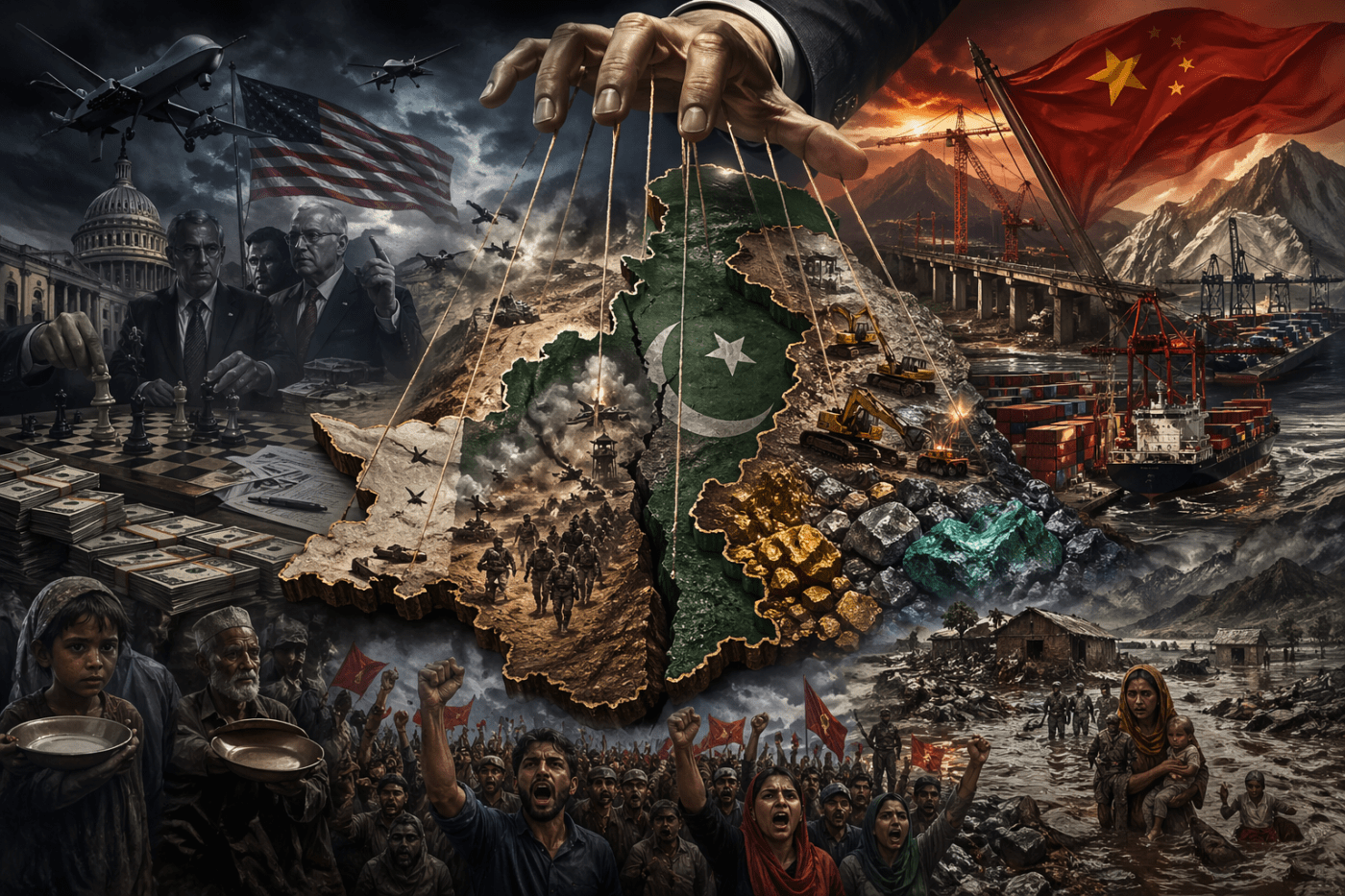
Asia Times frames Pakistan’s instability as a strategic obstacle, obscuring the material and political forces shaping the terrain. The crisis emerges from IMF austerity, elite domination, climate catastrophe, and a deepening political rupture following the coup against Imran Khan. Imperialist recalibration collides with multipolar transition, exposing the struggle between sovereignty and neocolonial extraction. Workers, peasants, and anti-imperialist movements are already organizing—turning instability into a site of struggle over who will shape Pakistan’s future.
By Prince Kapone | Weaponized Information | April 23, 2026
When Instability Becomes an Imperial Complaint
“Pakistan is the hole in America’s Great Game strategy”, published by Asia Times on April 23, 2026 and written by Saima Afzal, arrives dressed in the sober clothes of geopolitical realism. The article tells us that Pakistan’s chronic instability is no longer a merely local problem, but a structural obstacle to Washington’s plans across Asia. In Afzal’s telling, the United States needs Pakistan to stabilize three linked ambitions at once: access to critical minerals, access to Central Asia, and a workable security architecture stretching from the Gulf to Afghanistan. China, meanwhile, is presented as the patient and disciplined strategist that has already embedded itself in Pakistan through CPEC, Gwadar, and long-term political alignment, while the United States remains hampered by risk, hesitation, and the bad habit of needing order where history has delivered disorder. It is a clean argument, efficiently arranged, and that is precisely the problem. Clean arguments often do the dirtiest ideological work.
To understand that work, we have to begin with the political-economic location of the outlet itself. Asia Times presents itself on its own terms as an independent platform covering Asia for a global audience, but it also openly defines its readership in terms of executives, investors, professionals, and policy-oriented consumers of geopolitical information. Its corporate identity is not that of a people’s paper trying to make the world legible to the masses, but of a strategic-information commodity positioned inside the marketplace of elite interpretation. In other words, it sells not just news, but orientation for those who manage risk, move capital, and think of whole nations as corridors, bottlenecks, or exposure points. That class standpoint saturates the article. Pakistan does not appear as a country of workers, peasants, national minorities, and uneven historical development. It appears as a malfunction in somebody else’s spreadsheet. That somebody, naturally, is Washington.
Afzal’s own positioning reinforces that framing. She is introduced as a researcher specializing in South Asian security, counterterrorism, Afghanistan, the Middle East, and Indo-Pacific dynamics, and as a PhD candidate in Germany. That does not disqualify her from analysis, but it does tell us something about the lens being used. This is not a view from Gwadar’s docks, from Baloch villages, from Pakistani labor, or from the anti-imperialist tradition. It is a security-studies view, written in the idiom of strategic management, where the first question is not what external pressure, internal contradiction, and historical violence have done to produce instability, but how instability affects the operational freedom of great powers. That is the first ideological move of the piece: narrative framing. Pakistan is not granted subjecthood. It is treated as terrain.
From there the article deploys omission with professional elegance. “Instability” is repeated as though it were a weather pattern drifting in from the mountains, rather than a condition produced through war, regional intervention, state fragility, class contradiction, and the long wreckage left by imperial management of Afghanistan and its borderlands. The article never has to lie outright, because it performs the more respectable labor of strategic journalism: it subtracts cause and preserves effect. It also leans on a familiar source hierarchy, steering readers through the worldview of policy institutes and imperial security discourse while leaving the region’s own public voices largely absent. The result is a polished exercise in card stacking. China is depicted as persistent, embedded, and comfortable with complexity; the United States as rational but constrained. Washington thus appears not as an implicated force in the production of regional disorder, but as an unfortunate planner whose blueprints keep getting stained by reality. Finally, the entire argument is wrapped in the vagueness of investor language: “risk,” “uncertainty,” “strategic space,” “tolerance for complexity.” Such phrases are the silk gloves worn by empire when it wishes not to leave fingerprints. What disappears beneath them are the people who actually live inside these “corridors,” whose lives are treated as secondary to the frustrations of American grand strategy. That is the real work of the article. It does not simply describe instability. It converts a living social contradiction into an imperial complaint.
From Corridors to Crisis: The Material Terrain Beneath “Instability”
The article gives us a skeleton, but the flesh of the story lies in the material terrain it only partially reveals. Pakistan does not sit at the crossroads of empire as an abstraction—it sits there through infrastructure, minerals, labor, war, and geography that has been fought over, built upon, and contested in concrete terms. What is presented as a strategic dilemma for Washington is in fact a dense web of projects, pressures, and contradictions that stretch from the mountains of Balochistan to the ports of the Arabian Sea.
At the center of this terrain stands the China-Pakistan Economic Corridor (CPEC), not as a speculative idea but as an already materialized network of highways, energy projects, industrial zones, and logistics infrastructure designed to connect western China to the Arabian Sea. Gwadar Port is not merely symbolic—it anchors a wider system of transport and energy integration, tied to long-term planning documents that map out decades of coordinated development. This is reinforced at the highest level of state policy, where China and Pakistan have formally committed to deepening an “All-Weather Strategic Cooperative Partnership”, expanding cooperation not just in transport but in mining, industrial production, agriculture, and finance. What appears in the article as China’s “early move” is in fact a structured, state-backed integration project that has already reshaped the economic geography of the region.
Running parallel to this infrastructure is the question of minerals, where Pakistan is not passively waiting for foreign investment but actively reorganizing its economy to attract it. The Special Investment Facilitation Council has been tasked with fast-tracking large-scale investment in mining, energy, and infrastructure, with Reko Diq positioned as a flagship project. The scale of that project is immense: Reko Diq is one of the largest undeveloped copper and gold deposits in the world, with a projected multi-decade operational life and significant output potential that places it directly within the global struggle over critical minerals. This is not a marginal site—it is a node in the emerging global supply chain for energy transition metals and industrial inputs.
But the ground beneath these projects is not stable, and that instability is neither incidental nor easily contained. The regions most central to mineral extraction and corridor expansion—particularly Balochistan—are also zones of persistent conflict. Security incidents have already affected project timelines and investment calculations at Reko Diq, while the Pakistani state has been forced to publicly guarantee enhanced protection for Chinese personnel and assets following repeated attacks. The contradiction is immediate and material: the same territory that holds immense mineral wealth is also a site of insurgency, uneven development, and political tension. Investment does not eliminate that contradiction—it enters directly into it.
This instability is further intensified by the unresolved dynamics along the Pakistan-Afghanistan frontier. The collapse of the previous Afghan state structure and the reconfiguration of power after 2021 did not bring stability; it redistributed insecurity across borders. Cross-border violence and civilian casualties between Pakistan and Afghanistan have continued to mount, while militant activity has surged in key regions. These are not isolated incidents but structural pressures that shape the viability of trade routes, infrastructure corridors, and mineral extraction zones. Stability here is not a switch that can be turned on—it is the outcome of a regional security order that remains unsettled.
Even the question of access—so central to the article’s argument—proves more complex when placed in its full context. Pakistan offers one of the shortest land routes from Central Asia to the Arabian Sea, a fact reflected in regional transport and connectivity frameworks that position Pakistani corridors as key transit pathways. But that access is contested. When crossings close or security deteriorates, trade does not simply stop—it reroutes. Afghanistan has already demonstrated the ability to shift commerce toward Iran’s Chabahar port and Central Asian routes, revealing that Pakistan’s geographic leverage exists within a competitive and adaptive regional system. No single corridor monopolizes movement; it competes with others shaped by shifting alliances and conditions on the ground.
Above all of this hangs the broader restructuring of global supply chains and geopolitical blocs. The United States is not approaching Pakistan in isolation—it is part of a wider attempt to reorganize mineral sourcing and industrial inputs away from China. The Minerals Security Partnership explicitly seeks to mobilize capital and state coordination to secure alternative supply chains for critical resources. Pakistan’s mineral wealth thus becomes legible not as a national asset alone, but as a contested component of a global restructuring effort driven by technological competition, energy transition, and strategic decoupling.
At the same time, the region’s maritime and energy dynamics are tightening the stakes. As tensions around the Gulf intensify and the stability of the Strait of Hormuz becomes increasingly uncertain, alternative routes and ports gain strategic significance. Gwadar, positioned along the Arabian Sea, becomes more than a commercial outlet—it becomes part of a wider attempt to mitigate chokepoint vulnerability. This is where corridor politics, energy flows, and military-strategic calculations converge into a single field of struggle.
But to stop here would still be to misunderstand the terrain, because what appears as “instability” in the article is also the afterlife of a deeper political rupture and a much longer structural crisis. In April 2022, Prime Minister Imran Khan was removed through a parliamentary no-confidence process, triggering a prolonged political crisis that has not subsided but intensified, a crisis that unfolded into mass protests, confrontation with the state, and a cycle of repression and resistance. Imran Khan himself was imprisoned and sentenced to 40 years (later overturned in court), causing a severe crisis of legitimacy for the state. This is not background noise—it is part of the terrain upon which all corridor, mineral, and geopolitical projects now operate.
This political rupture cannot be separated from the structure of power within Pakistan. The country has long been dominated by a coalition of military and landed elites whose control over the state has shaped both political transitions and economic policy, a reality emphasized in the Tricontinental dossier on IMF restructuring and Pakistan’s political economy, which situates political instability within a durable class structure tied to external capital and internal elite control. Governments rise and fall within this structure, but the underlying configuration of power remains remarkably durable. What appears as rapid political turnover is not instability in the abstract—it is the visible expression of a system struggling to reproduce itself under changing conditions.
At the same time, the economic foundation beneath this political crisis is under severe strain. Pakistan’s economy has entered a period of contraction marked by inflation, debt dependency, and declining growth, with IMF-imposed austerity measures intensifying the burden on the working population. These policies—privatization, subsidy removal, and fiscal tightening—have not resolved structural imbalances but deepened them, locking the country into cycles of dependency and external financing.
The consequences are material and immediate. Millions have been pushed into poverty, wages have stagnated or declined in real terms, and the country’s development trajectory has been increasingly defined by its insertion into the global division of labor as a supplier of cheap labor and low-value exports. At the same time, Pakistan has faced catastrophic climate shocks, including floods that inundated large portions of the country, destroyed agricultural production, and displaced tens of millions. These crises—economic, political, and environmental—do not operate separately. They compound each other.
When placed together—corridor infrastructure, mineral extraction, insurgency, cross-border conflict, political rupture, elite domination, IMF discipline, climate catastrophe, and global supply chain restructuring—the picture changes fundamentally. Pakistan is not simply a “hole” in someone else’s strategy. It is a site where multiple systems intersect: imperial ambition, national development, class struggle, and the reorganization of global production. The instability described in the article is not an anomaly within that system. It is one of its central expressions.
Where Empire Trips Over Its Own Feet: Pakistan, Multipolar Calibration, and the Struggle Over Sovereignty
They tell us Pakistan is the “hole” in the strategy—as if the land itself is defective, as if the people woke up one day and decided to inconvenience Washington. This is the kind of arrogance only empire can afford: when its plans fail, it blames the terrain. But Pakistan is not the problem. Pakistan is the mirror. It reflects back the contradictions of a system that once commanded the world and now negotiates with it, stumbles through it, and occasionally collides with it headfirst.
The United States arrives here not as a master builder, but as a landlord discovering the foundation is cracking. Its priorities—minerals, corridors, security—are not the blueprints of expansion, but the patchwork repairs of imperialist decay. It needs new supply chains because it has lost control over the old ones. It wants secure routes through regions it helped destabilize. It demands order in places where its own history has sown disorder. This is not strategy in the grand sense—it is crisis management dressed up in the language of geopolitics.
And the crisis it encounters is not imported from outside. It is produced—patiently, systematically—through decades of neocolonial arrangement. Pakistan’s instability is not an accident of culture or geography. It is the result of a political economy built on debt, discipline, and dependency. IMF austerity squeezes the working class while promising “stability.” External financing props up the state while hollowing out its autonomy. This is what sovereignty looks like when it has been leased out in installments: a flag without full control over the terms of its own survival.
But empire alone does not explain everything. To understand Pakistan, we must look inside the house, not just at the landlord. The state is not an innocent victim of external pressure. It is structured by class power—military authority, landed elites, and comprador capitalists who sit comfortably between foreign capital and domestic control. Governments change, slogans change, parties rise and fall, but this bloc remains. It is the silent continuity behind the noise of politics. What looks like instability is often the system adjusting itself, like a machine shaking but not yet breaking.
Then comes the rupture. The removal of Imran Khan was not simply a procedural event—it was a moment when contradictions surfaced openly. A leader who attempted, however partially and inconsistently, to maneuver for greater autonomy collided with both internal power structures and external pressures. His fall did not restore order; it widened the cracks. What followed was not calm governance, but a struggle over legitimacy itself—mass protests, repression, imprisonment, and a population increasingly aware that power operates above and beyond the ballot box. This is what happens when sovereignty becomes theater: the script is written elsewhere, but the performance must still be staged at home.
Meanwhile, the economic ground continues to shift beneath everyone’s feet. Inflation eats away at wages. Jobs become scarce or precarious. Migration becomes not a choice, but an economic necessity. Pakistan is pushed deeper into its role within the global division of labor—not as a center of production, but as a supplier of labor and low-value output. Workers produce value they will never consume. The nation exports its people as much as its goods. This is capitalism in its global form: winners and losers not just within countries, but between them.
And then the sky itself collapses—floods, displacement, destroyed livelihoods. Climate catastrophe does not arrive as an equalizer; it deepens inequality. It exposes the fragility of a system already stretched thin. It shows, in brutal clarity, that development built on dependency cannot withstand the pressures of a changing planet. The crisis multiplies: economic, political, environmental—each feeding the other, each tightening the constraints on what the state can do.
It is within this storm that multipolar recalibration takes shape. Pakistan does not simply choose between Washington and Beijing like a customer browsing options. It navigates. It hedges. It tries to loosen one set of chains without immediately falling into another. This is not a revolution—it is a maneuver, a cautious step in a world where full independence remains a distant horizon. Multipolarity, in this sense, is not liberation delivered—it is space opened, unevenly and conditionally.
China enters this space not as a carbon copy of Western imperialism, but as a different kind of actor shaped by its own historical path. It operates within the global system, yes, constrained by the law of value, but it also pushes against that system, constructing alternative circuits of trade, infrastructure, and cooperation. Its projects are not charity, nor are they simple domination—they are part of a broader attempt to build something new within the ruins of something old. Roads, ports, energy systems—these are not just economic tools. They are instruments that reshape possibility.
This is why infrastructure matters. A road is not just a road. A port is not just a port. These are lines of power drawn across the earth—what we might call weaponized infrastructure. They determine who moves, what moves, and on whose terms. They bind economies together over time, creating relationships that outlast governments and outmaneuver short-term speculation. Where Western capital hesitates, calculating risk in quarterly returns, this model commits, builds, and embeds itself in the terrain.
But let us not romanticize. These developments do not dissolve contradiction—they relocate it. The same corridors that promise connectivity pass through regions marked by neglect and resistance. The same mineral wealth that attracts investment sits beneath communities that have long been excluded from its benefits. Wealth accumulates, but unevenly. Development proceeds, but selectively. This is accumulation and dispossession walking side by side, hand in hand like old partners.
And when tensions rise, the response is not dialogue—it is control. Security forces move in. Infrastructure is protected. Dissent is managed. What investors call “risk,” people experience as coercion. Counterinsurgency becomes the shadow companion of development. Stability, in this context, is not peace—it is order imposed under unequal conditions.
Regionally, the situation remains volatile. The frontier with Afghanistan is not just a line on a map—it is a wound that has not healed. Years of war have left behind a landscape where stability cannot be assumed. Every corridor that passes through this space carries with it the weight of unresolved conflict.
Globally, the stakes rise even higher. Trade routes, energy flows, and chokepoints form the circulatory system of capitalism. When these arteries are threatened, the entire body feels it. Pakistan’s position within this system makes it more than a regional actor—it becomes part of a global struggle over how the world moves, how it connects, and how it survives under pressure.
So let us be clear. The contradiction is not simply between the United States and China. That is the surface story. Beneath it lies the real struggle: between sovereignty and extraction, between development that serves the people and development that serves accumulation. Multipolar recalibration creates openings—it allows states to breathe, to negotiate, to imagine alternatives. But it does not resolve the fundamental question of who controls the process and who benefits from it.
Pakistan is not a hole. It is a fault line. It is where the pressures of imperialism, class power, and global transition converge. It is where the old order stumbles and the new one struggles to take shape. And like all fault lines, it is unstable—not because it is broken, but because it is alive with movement. The question is not whether it will stabilize, but in whose interests that stability will be built.
From Analysis to Alignment: Building Real Solidarity Across the Fault Line
The first task is to stop treating Pakistan as a case study and start treating it as a frontline. The contradictions laid out in this essay—IMF austerity, military-political domination, extractive development, labor dispossession, climate catastrophe, and geopolitical pressure—are already generating organization on the ground. In Pakistan itself, forces such as the National Trade Union Federation Pakistan and the Haqooq-e-Khalq Party are organizing around labor rights, privatization, democratic rights, redistribution, and popular sovereignty. These are not imported talking points. They are living nodes of struggle inside the very terrain the article reduces to “instability.”
That means solidarity cannot remain a moral posture. It has to become political alignment with organizations already confronting the concrete machinery of class rule. Where the Pakistani ruling bloc uses repression, elite brokerage, and the language of national necessity to keep the people in line, these formations are trying to turn scattered suffering into organized force. The point is not to romanticize every formation or pretend the contradictions disappear because people are resisting. The point is to recognize that the working class and the poor are not waiting for foreign analysts to discover their misery. They are already in motion, and our task is to study those movements, amplify them, and build relations with them on principled anti-imperialist terms.
Across greater Eurasia and the wider Global South, the agrarian front is just as decisive. Land, food, rural dispossession, and resource extraction are not side issues to the Pakistan question; they are part of its living foundation. That is why movements such as La Vía Campesina matter so much. It is a real international peasant movement with member organizations across Asia, Africa, Europe, and the Americas, and it openly identifies itself as being sustained by its supporters in order to preserve its autonomy. When we talk about sovereignty, food systems, land control, and anti-extractive struggle, this is one of the real transnational infrastructures where that fight is already being waged.
At the same time, there are regionally rooted campaigns already mobilizing around the very issues we have named: landlessness, agrarian dispossession, and imperial control over development. The Asian Peasant Coalition remains active as an Asia-wide coalition of peasants, landless farmers, fisherfolk, agricultural workers, Dalits, Indigenous peoples, herders, women, and youth, and its recent Day of the Landless mobilization shows exactly the kind of cross-border organizing that connects Pakistan’s contradictions to a broader Asian struggle over land, resources, and imperial domination. This matters because the crisis in Pakistan is not only urban, parliamentary, or military. It is also rural, territorial, and agrarian.
In the imperial core, the task is different but no less urgent. People in the Global North have to organize not as spectators cheering one bloc against another, but as enemies of the war system headquartered in their own states. That is where formations such as the Black Alliance for Peace become important. BAP is not a generic peace brand; it explicitly names imperialism, militarization, and anti-colonial struggle as central questions, and it is actively organizing campaigns, action calendars, and regional solidarity work, including an ongoing Zone of Peace campaign.
What all this means is that Section IV cannot be reduced to a shopping list of respectable nonprofits. The line has to stay sharp. We are not looking for organizations that “care about Pakistan.” We are looking for formations already confronting the same historical forces revealed by Pakistan’s crisis: debt discipline, militarized rule, labor super-exploitation, agrarian dispossession, and imperial encirclement. The labor front in Pakistan, the peasant front across Asia and Eurasia, and the anti-war front inside the imperial core all belong to the same field of struggle, even if they stand on different pieces of the map. The task is to connect them consciously.
That means building real circuits of solidarity: bringing Pakistani labor struggles into anti-austerity forums abroad; linking peasant movements fighting land grabs in Asia to debates over minerals, corridors, and sovereign development; connecting anti-war work in the Global North to the concrete consequences of IMF rule, military management, and counterinsurgency in the Global South. It also means following the organizations where they actually live—through their own websites, their own sign-up structures, their own campaigns, and their own social media—rather than filtering them through the usual imperial media gatekeepers. The point is not to admire struggle from afar. The point is to enter into relation with it.
So the practical line is clear enough. Follow and study the NTUF and the HKP to understand how class struggle is unfolding inside Pakistan. Build ties with the agrarian internationalism of La Vía Campesina and the regional land struggles amplified by the Asian Peasant Coalition. And for those organizing inside the imperial centers, use formations such as the Black Alliance for Peace to sharpen anti-war, anti-sanctions, and anti-militarist work against the very states that keep producing these crises. Pakistan is not an abstraction. It is one battlefield in a world struggle over whether sovereignty will mean popular development or merely a new arrangement for old forms of extraction.


Leave a Reply