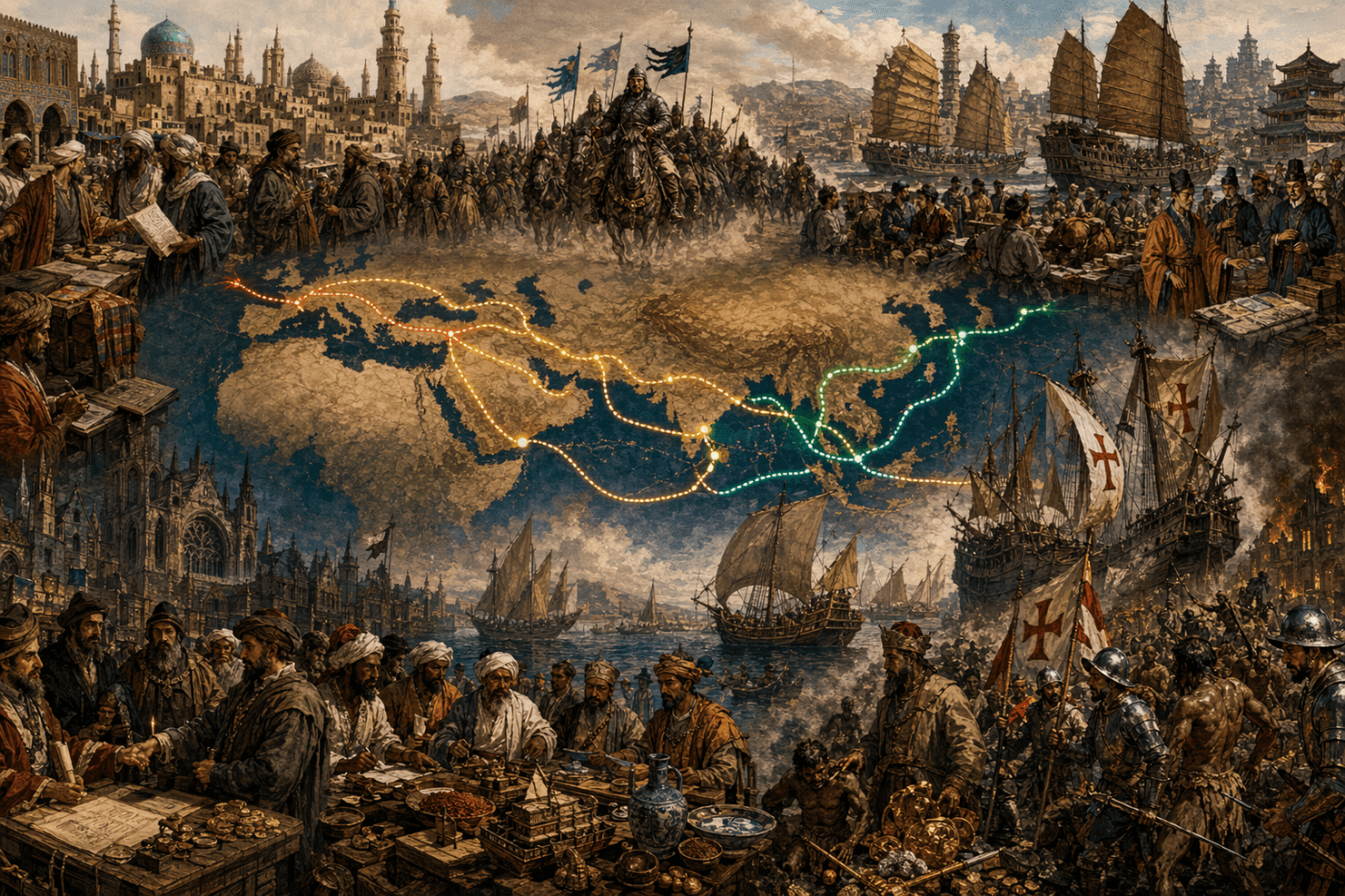
This Weaponized Intellects review of Before European Hegemony by Janet Abu-Lughod goes straight for the throat of one of the dirtiest lies ever told by the imperial academy: that Europe rose because it was smarter, freer, more rational, or somehow chosen by history itself. Abu-Lughod shows that long before Europe crowned itself master of the earth, a dense and living world system already stretched from China to the Mediterranean, built through the labor, trade, statecraft, and technical capacities of peoples Europe later learned to rob, imitate, and dominate. Our review takes that foundation and pushes the blade deeper, tracing how Europe entered that world late, fed off its institutions, learned from its wealth, and finally seized advantage through rupture, violence, and historical breakdown. This is not the fairy tale of “the Rise of the West.” It is the story of how a peripheral thug studied a house it did not build, then kicked in the door and called itself the owner.
By Prince Kapone | Weaponized Information | Weaponized Intellects Book Review | April 20, 2026
When Europe Was Still an Apprentice to a World It Did Not Build
Janet Abu-Lughod begins this book with an act of historical sabotage against the old bourgeois fairy tale. She does not start with Columbus, with “the West,” with some choir of self-congratulating Europeans stumbling out of the fog and inventing motion, commerce, reason, and the rest of the mythology they have spent centuries pinning on their own chest like medals. She starts earlier, and by doing so she makes a far more dangerous claim: the world was already alive before Europe crowned itself king. The thirteenth century, she writes, was “a remarkable moment in world history,” a period when “many parts of the Old World began to become integrated into a system of exchange.” That single move is the chapter’s great strength. It tears a hole in the smug fabric of Eurocentrism and forces the reader to confront a reality the imperial academy has long tried to blur—that Europe did not create the first large interregional system of exchange; it entered one that was already being forged through the labor, technique, and political organization of others.
Abu-Lughod is strongest when she insists on the material breadth of this emerging system. This was not a dreamy civilizational conversation among refined gentlemen sipping philosophy across continents. It was trade, transport, bookkeeping, contracts, currencies, credit, and production. Between roughly 1250 and 1350, she argues, an international trade economy stretched from northwestern Europe to China. It was “worldwide” in reach if still narrow in social depth. Manufactured goods, not just spices and exotica, stood near the center of this network. That point matters. It means she is not describing a thin luxury fringe floating above otherwise disconnected societies, but a serious structure of production and exchange requiring surpluses, labor mobilization, technical development, and durable commercial institutions. Goods moved. Prices were set. Exchange rates were negotiated. Credit was extended across distance. Partnerships were formed. Records were kept. Agreements, more often than not, were honored. That is not incidental contact. That is systemic life.
And Abu-Lughod does something else here that deserves respect: she refuses to let Europe smuggle itself backward into primacy through the rear door of inevitability. She rejects the pious little sermon that history was always leaning westward, just waiting for the proper European hand to push it along. “There is no unique way for the parts to be organized,” she writes. World systems are not static. They evolve. They change. The one that came later under European hegemony was not the only possible outcome. This is not some minor methodological aside. It is the chapter’s central political intervention. Once you deny inevitability, you deny destiny. Once you deny destiny, you deny the moral alibi of empire. The usual story of the “Rise of the West” depends on reading modern European dominance backward into the past, then treating that outcome as proof of its own necessity. Abu-Lughod refuses that trick. She tells us plainly that if we begin from another vantage point, we tell another story. And she is right. History does not march to the drum of victors because the victors were superior. More often it is written that way because the victors seized the printing press, the university, and the bayonet.
She is also right to insist that Europe was, at this stage, a lesser region in the larger field. She describes Europe as “hitherto the least developed region,” and later even more sharply as “an upstart peripheral to an ongoing operation.” That is exactly the kind of sentence that should make every schoolbook in the Atlantic world burst into flames. Europe was not the furnace of civilization here. It was not the natural core of anything. It was a latecomer attaching itself to routes, institutions, and networks already in motion through the Mediterranean, the Red Sea, the Persian Gulf, the Indian Ocean, the Strait of Malacca, and China. Without those preexisting “world-economies,” as she puts it, Europe would have reached outward and “grasped empty space rather than riches.” There is the truth, laid out in plain language. Before the West could loot the world, the world had to already exist in a richly developed form for the West to loot.
But this is also where the chapter begins to reveal its limits, and we do Abu-Lughod no favor by tiptoeing around them. She sees the system, but she does not always force herself to name its antagonisms. She tells us that the expanding networks of exchange brought “pandemic prosperity for its rulers.” Good. That phrase matters, because it lets slip a class truth that much of the chapter otherwise muffles. Prosperity was not general. It was prosperity “for its rulers.” Yet elsewhere the argument softens. She writes that by the twelfth century many parts of the Old World became integrated into a system of exchange “from which all apparently benefited.” Apparently is carrying a lot of freight there. It is the kind of cautious academic word that sneaks class contradiction out the back window while the prose is looking the other way. All benefited? At what level of society? On what terms? Through what mechanisms of labor discipline, rent extraction, state protection, merchant privilege, and coercion? If prosperity was concentrated at the top, then this was not some grand mutual aid society spread across Eurasia. It was a structured order of surplus production and appropriation. Abu-Lughod knows this, but too often she stops with the architecture and leaves the class relations dimly lit.
That problem runs through her treatment of cultural efflorescence as well. She beautifully evokes the splendor of the age: Sung celadonware in China, turquoise-glazed bowls in Persia, inlaid furniture in Mamluk Egypt, cathedrals in western Europe, temple complexes in south India. She notes that this flourishing of artistic and intellectual life was tied to surplus and to expanding economic integration. She is absolutely right to join material development to cultural production. High culture does not descend from the clouds. It is built on labor, stored wealth, and organized surplus. But again the chapter’s language tends to slide too quickly from surplus to civilization, from prosperity to beauty, without dwelling hard enough on the social relations that make such concentration possible. Ornamentation and scholarship are not floating achievements of “civilization”; they are funded by extraction. If there was enough surplus to underwrite artisans, scholars, monumental architecture, and elite display across multiple regions, then the question is not only how much wealth existed, but who worked, who appropriated, and who commanded. Abu-Lughod opens the door to that question, then leaves it half shut.
Her discussion of capitalism and world-systems theory is similarly rich, contradictory, and revealing. There is real intellectual courage in her refusal to get trapped in theological debates over the one true birthday of “modern capitalism,” as if history were a church waiting for the correct christening date. She pushes against sterile definitional battles, whether with Wallerstein or with older historiography, and instead urges us to examine concrete historical moments in concrete places. Good. That instinct is healthy. It rescues the analysis from scholastic nonsense. She also marshals serious evidence to show that many of the commercial and institutional features often treated as uniquely European—credit mechanisms, merchant networks, monetization, large-scale trade, even forms of wage labor and industrial production—either existed earlier elsewhere or developed in parallel across regions. Her point that Europe borrowed rather than invented many monetary and credit practices is especially important. Gold coinage, letters of credit, banking functions, and partnership arrangements were hardly miraculous Latin eruptions from some special European brain-pan. Much of this existed in the Middle East and Asia before Europe’s merchants got clever enough to copy it. In that sense, Abu-Lughod is smashing the old porcelain idol of European uniqueness with a very satisfying hammer.
Still, she sometimes swings so hard against rigid definitions that the object under study risks dissolving into a moving fog of analogies and institutional similarities. When everything becomes a matter of flexible terminology, there is a danger that the specifically capitalist form of accumulation gets blurred. Yes, free labor predates modernity. Yes, slave labor survives into the modern era. Yes, large trade networks existed before Europe’s ascent. But that does not eliminate the need to distinguish between a multipolar commercial order and a world capitalist system consolidated through colonial conquest, primitive accumulation, racial slavery, and armed maritime supremacy. Abu-Lughod is right to refuse lazy periodization. She is less convincing when this refusal leaves the decisive transition undertheorized. Her chapter is excellent at proving that Europe was not uniquely dynamic at the outset. It is less developed on the question of how one kind of interregional order was eventually transformed into another through violence, reweighting, and imperial restructuring. She can tell us, rightly, that there was no necessity favoring the West. But once the West does rise, we will still need a harder theory than contingency alone to explain how.
What sharpens the chapter further is her insistence on perspective—on the fact that the historical narrative changes depending on where one starts and what outcome one presumes. This is one of the chapter’s most weaponizable insights. Abu-Lughod understands that historiography is never innocent. If one starts from the industrial revolution and marches backward, then all roads get made to lead to Europe. If one starts earlier, when the outcome is not settled, the map changes. New centers appear. Different questions matter. Europe’s later triumph no longer looks like the flowering of inner virtue and begins to look instead like one possible result of a larger, unstable field. She is right to say that the standard narrative of Europe’s hegemony conceals what her earlier vantage illuminates. This is exactly how ruling-class history works: it universalizes the victor’s outcome, then calls that universalization common sense. Abu-Lughod does not fully escape bourgeois method, but here she puts a blade right to one of its softest organs.
Her treatment of the system’s geography is also more serious than much of the chatter that passes for global history today. She does not imagine a flat earth of abstract connections. She gives us circuits, nodes, heartlands, oases, ports, routes, and “archipelagos of towns.” Europe itself appears as a patchy zone of uneven development, with monetized centers linked to foreign trade standing amid vast seas of rural subsistence. The same complexity exists across the Middle East, India, and China. This matters because it prevents the childish habit of treating civilizations as monoliths. China is not one thing. India is not one thing. The Middle East is not one thing. Even Europe is not one thing. Each contains uneven levels of integration, different urban-rural relations, and distinct links to the larger network. Abu-Lughod’s emphasis on cities rather than countries is one of the chapter’s best methodological choices. It lets her track the high points of the system where exchange, finance, production, and political coordination actually concentrate. She is mapping not nationalist fables, but material relays.
And yet here too, the chapter’s politics remain restrained by its academic skin. Abu-Lughod tells us that when the system reached its zenith, “no single power could be said to be hegemonic” and that “each gained from the system but not to the detriment of others.” That is a bridge too far. One can agree that there was no singular hegemon in the later European sense and still reject the idea that all gained without detriment. Systems of long-distance exchange do not float above antagonism like angels over a battlefield. They produce advantages, dependencies, vulnerabilities, and asymmetries. Some nodes command routes. Some states mint and guarantee currencies. Some merchants dominate intermediation. Some hinterlands are drawn into supplying export demand more than others. Abu-Lughod herself provides ample evidence of uneven development, regional hierarchy, and differentiated institutional capacity. But when she says all gained without detriment, the chapter briefly slips from historical materialism toward a kind of courteous multilateralism. It is a very respectable sentence. Respectability is often where critique goes to die.
The most compelling part of the chapter, however, lies in the problem it sets for the rest of the book. If Europe was peripheral, if the Middle East was a geographic fulcrum, if China and other eastern regions possessed at least equal and often superior economic institutions, if there was no inherent necessity pushing history westward, then the rise of Europe cannot be explained by some mystical entrepreneurial essence. Abu-Lughod says as much. To explain Europe’s later hegemony, she argues, one must look “beyond her internal inventiveness and the virtues of her ‘unique’ entrepreneurial spirit.” Exactly. That sentence should be nailed above the door of every department still teaching that Europe won because it was more rational, more curious, more free, or whatever other self-flattering rubbish the imperial mind uses to perfume its crimes. Abu-Lughod points instead to context—geographic, political, demographic—and to the disarray of the Orient as the opening through which Europe advanced. That is a vital correction, even if it still stops short of a fully worked theory of imperial seizure.
So Chapter 1 does two major things at once. First, it performs an indispensable act of demolition. It strips Europe of its false title as the natural origin of the world system and forces the reader to reckon with a multipolar thirteenth-century order whose centers of wealth, technique, and coordination lay largely outside the West. Second, it constructs a framework that is bold but incomplete. Abu-Lughod shows us the system before European hegemony, but she does not yet fully theorize the class antagonisms within it or the violent processes through which it would later be restructured. She gives us circulation more readily than exploitation, interdependence more readily than domination, merchants and states more readily than laboring classes and surplus extraction. That does not make the chapter weak. It makes it contradictory. And contradiction is precisely why the chapter is worth struggling with. Abu-Lughod has written an introduction that tears up the old map and forces a new starting point onto the table. Our task as revolutionaries is to take that map, mark the routes of labor and plunder more clearly, and refuse the old lie that Europe rose because history loved it best. History did not love Europe. Europe found an opening in a changing world and, in time, learned to kill and seize on a planetary scale. Chapter 1 does not yet tell that whole story. But it clears enough rubble for us to begin telling it properly.
From the Ruins of Rome to the Fairs of Champagne: How a Broken Europe Rejoined a World Already in Motion
If Chapter 1 cleared away the pious fiction that Europe created the first great system of interregional exchange, the next movement of Abu-Lughod’s argument asks a sharper question: how did Europe, especially its northwestern zone, claw its way back into a world from which it had long been partially severed? The answer she gives in “Emergence from Old Empires” and Chapter 2 is not the old nursery rhyme about innate European vigor, entrepreneurial genius, or some hereditary instinct for progress. It is a harder, more material story. Europe did not stride into history like a conquering hero. It limped back into a wider system after centuries of fragmentation, ruralization, militarization, and relative backwardness. The first thing Abu-Lughod does right is insist on the uneven meaning of Rome’s collapse. What later Europeans would romanticize as the “fall of Rome” was not a single event but a long unraveling, and it did not strike every region with equal force. The so-called “Dark Ages,” she reminds us, belonged above all to northwestern Europe, not to the entire Mediterranean world. That distinction matters. It keeps us from swallowing the usual civilizational fog in which all decline becomes universal and all recovery becomes mysteriously European. Europe’s northwest sank furthest. Other zones retained more continuity, more commerce, more urban memory, and more living contact with wider circuits of exchange.
This is where the ideological stakes of Abu-Lughod’s framing become clear. If northwestern Europe endured the deepest rupture, then its later ascent cannot be read backward as proof of some buried superiority waiting patiently beneath the ashes. Quite the opposite. Abu-Lughod shows that after the western Roman order broke apart under successive Germanic invasions, what emerged in much of northwestern Europe was a regression in administrative sophistication, commercial density, and urban integration. Perry Anderson’s formulation, which she quotes, is useful here: the successor states represented a lower level of sophistication than the Roman order they replaced. Charlemagne’s attempt at reunification in the eighth and early ninth centuries was real but fragile, and after his death the whole thing splintered again under Magyar and Viking pressures. By the end of the ninth century, northwestern Europe had cobbled together a defensive social formation—protofeudal and then feudal—rooted in local fortification, fragmented authority, and a rural order built as much on protection as confinement. Anderson’s line that the “castellar landscape” served as both protection and prison for the peasantry deserves to be taken seriously. A social order of this kind does not announce the birth of modern dynamism. It announces fear, enclosure, coercion, and localized power. Europe did not begin its climb as a field of liberated burghers bursting with commercial imagination. It began, in these regions, as a battered zone digging trenches and building castles while much of the wider Afro-Eurasian world kept trading.
Abu-Lughod is particularly strong when she refuses to separate Europe’s internal recovery from its external reinsertion into wider circuits. That is the heart of this section. Northwestern Europe’s emergence was not a self-generated miracle. It was tied to the reopening of horizons beyond itself. Towns multiplied, surplus increased, and coastal and riverine linkages expanded, yes—but this internal revival was bound up with the reopening of contact with the Mediterranean and, through it, the Middle East and beyond. Here she cuts straight through nationalist mythology. Europe’s recovery was not merely endogenous. It was relational. It depended on reconnection.
And the vehicle of that reconnection, in her account, was the Crusades. Now here we need to be careful, because bourgeois history loves to dress crusading plunder in the robes of spiritual fervor or civilizational encounter. Abu-Lughod is more honest than that. She makes clear that the Crusades, however draped in religious language, functioned materially as a mechanism that reinserted northwestern Europe into a broader world system. The first crusaders marched awkwardly overland because the north was still split from the Mediterranean world. But later crusades traveled on Italian ships, and in that fact alone the changing geography of power inside Europe becomes visible. The maritime cities of Italy, unlike much of the northwest, had preserved connections across the Mediterranean. Venice in particular had been born out of refuge and adaptation, maintaining ties to Byzantium and serving as a bridge across a sea whose commercial pulse had dimmed for the northwest but never stopped entirely. When Islam spread across North Africa, the Fertile Crescent, Persia, and beyond, it did not extinguish world exchange; it reorganized it on a broader basis. The Islamic Umma, as Abu-Lughod notes, became the nucleus of a new world economy. Northwestern Europe did not create that economy. It battered its way back toward it under the sign of the cross and then stayed for the trade.
That point needs to be pressed harder than Abu-Lughod presses it. She says, rightly, that the Crusades eventually failed in their military-religious aim but succeeded in establishing regular trading channels that linked northwestern Europe, through Italian intermediaries, to preexisting circuits connecting the Middle East with India and China. Exactly. The Crusades were not simply failed holy wars; they were violent bridges into a richer commercial world. They widened Europe’s horizons because they exposed European ruling classes to wealth, techniques, goods, and opportunities that lay outside their relatively cramped feudal order. Spices, silks, brocades, porcelain, metalwork, and other goods whetted appetites and reorganized desires. Abu-Lughod writes that the Crusades may have begun with a desire to capture souls but were sustained partly by the capture of booty. There is more truth in that sentence than in libraries full of chivalric nonsense. Once plunder became trade, Europe needed something to sell. It had silver, timber, furs, slaves, and eventually cloth. And here the old story of Europe’s internal flowering is turned on its head. Production in northwestern Europe did not rise in some splendid isolation. It was stimulated by external demand, by the need to exchange, by the chance to insert local surpluses into a wider system whose centers still lay elsewhere. European woolens did not become central because the European soul suddenly discovered industry. They became central because a recovering region found a niche in a broader field of exchange.
This is exactly why Abu-Lughod pairs “Emergence from Old Empires” with the Fairs of Champagne. The sequence is logical and materially sharp. First comes the historical condition: a northwestern Europe emerging from fragmentation under feudal forms while southern Europe, especially the Italian coastal cities, maintains Mediterranean contact. Then comes the institutional mechanism: the fairs as relay points through which Europe’s internal revival is linked to wider interregional exchange. The fairs are not accidental. They are social machinery for reconnection.
Her discussion of the fair as an institution is one of the most concrete and useful parts of this section because it strips commerce of the abstract glamour bourgeois historians often give it and returns it to logistics, place, and enforcement. A fair is not magic. It is not “the market” descending from heaven. It is a historically specific arrangement that appears where transport is limited, productive regions are unevenly linked, and merchants need periodic sites of exchange under conditions of risk. Abu-Lughod starts with the logic of the periodic market itself: merchants move on circuits, carrying goods to sparsely connected populations; money changers emerge as multiple currencies encounter one another; credit appears as delivery, order, repayment, and risk become temporally stretched; banking grows out of the practical needs of circulation. This is strong historical materialism at the level of institutional form. The fair becomes intelligible not as a quaint medieval spectacle but as a necessary commercial solution under definite technological and social constraints. It is the sort of passage that makes one wish more historians would stop genuflecting before abstractions and instead explain how things actually worked.
When she turns to Champagne itself, Abu-Lughod again usefully destroys the illusion of natural destiny. The four fair towns—Troyes, Provins, Bar-sur-Aube, and Lagny—did not become central because Providence put its finger on east-central France. Their location mattered, yes, but location alone explains nothing. Many sites in Europe had Roman roads, river access, or defensible points. What made Champagne decisive was political privilege and institutional design. The independent counts of Champagne and Brie, poised uneasily between kings, church, and rival lords, had strong incentives to make their fairs more attractive than other possible sites. They offered safe conduct. They enforced contracts. They provided a tribunal and administrative apparatus capable of policing transactions and penalizing default. In other words, they built a commercial jurisdiction. This is one of the section’s most important lessons. Markets do not thrive because states or lords kindly step aside. They thrive because authorities create, secure, and regulate the conditions of profitable exchange. Safe passage, fair guards, courts, penalties, seals, registers, tolls, rental halls—none of this is laissez-faire. It is rule. The counts took their cut, certainly, but they also made the fairs possible. So much for the bedtime story that capitalism blossomed wherever noble hands were lifted from the economy. Even here, in a formative European commercial zone, political authority did not disappear; it organized exchange, extracted revenue, and enforced obligations.
The role of the fair guards is especially revealing. Their power to bar defaulting traders from future fairs shows how reputation, future profit, and political enforcement fused into one commercial discipline. Contracts were not sacred because merchants possessed superior morality. They were honored because a governing apparatus stood behind them and because access to future gain could be denied. Again, Abu-Lughod’s material sensibility is sound: the fair became a nonnatural monopoly because the counts manufactured more favorable conditions there than elsewhere. Once those conditions vanished under French annexation, the fairs lost their special edge. It is a fine example of how world-economic importance is politically constituted, not naturally bestowed.
Her reconstruction of the internal life of the fair is equally rich. The cycle of assembly, cloth sales, leather and fur trading, spices and bulk goods, and then banking and account settlement shows a remarkably advanced choreography of exchange. The cloth fair comes first because cloth is the heart of the system. This is no medieval flea market. It is a carefully staged meeting point between northern industrial production and southern commercial intermediation. Flemish and French merchants bring woolens and other manufactures. Italians bring spices, silks, dyes, precious goods, and above all the banking and commercial techniques necessary to turn periodic meetings into long-distance exchange. The fair, in short, is the hinge between Europe’s emerging productive zones and the wider Afro-Eurasian system. That is why Champagne matters so much in Abu-Lughod’s story. It is not Europe’s origin point; it is Europe’s relay station.
The social world that grows around the fairs also deserves more emphasis than most standard narratives give it, and Abu-Lughod rightly gives it. These towns were not merely passive stages on which merchants acted. The fair stimulated local production, urban growth, and class differentiation. Provins and Troyes in particular became sites where textile production expanded for export, where guilds formed, where merchants financed labor, and where urban patriciates tightened control. Abu-Lughod’s description of cloth merchants effectively running dispersed “factories” by providing wool and buying back finished products is especially telling. Here we can already see a putting-out system, merchant control over inputs and outputs, and an emerging division between capital-owning merchants and increasingly dependent laborers. This is one of the section’s most politically useful points. Europe’s commercial revival did not simply generate cheerful burghers exchanging goods in civic freedom. It also generated sharper forms of labor discipline and class structure. The urban poor and workers did not float into prosperity on the same tide as the merchant-bankers. The industry’s geography within the towns—more desirable central zones for elites and commercial functions, more marginal quarters for polluting trades and laboring people—makes that plain enough. Abu-Lughod does not overstate the case, but the evidence she marshals is enough for us to say clearly what she implies: Europe’s reconnection to the world system deepened class differentiation inside Europe itself.
And then there are the Italians. Abu-Lughod is absolutely correct to center them. Without them, the Champagne fairs would have remained important regional markets, not international hinges. The Italians—especially Genoese and, to a lesser extent, Venetians and Tuscans—were the key intermediaries linking Europe north of the Alps to the older commercial circuits of the Mediterranean, the Levant, and through Muslim intermediaries to the farther East. Here again she performs a useful demystification. European historians, drunk for too long on their own civilization talk, have often treated Italian commercial sophistication as if it sprang from some unique Latin genius. Abu-Lughod is having none of that. She insists that the Italian port cities preserved continuity with Byzantium and the Muslim world and learned from those regions many of the institutions of long-distance trade. Gold coinage, letters of credit, partnership arrangements, banking benches, and methods of handling currency exchange were not miraculous inventions of the Italian mind. The Italians adapted and refined practices long known elsewhere. Even their use of Byzantine and Egyptian gold coinage before issuing their own is a reminder of their subordinate or semiperipheral position. They were brilliant brokers, yes, but still brokers within a system whose deeper arteries ran through the Middle East and Asia.
This point cannot be stressed enough because it cuts directly against one of the core lies of bourgeois historiography: that Europe advanced because it uniquely innovated institutions the rest of the world lacked. Abu-Lughod shows instead that Italy’s merchant-bankers became formidable precisely because they stood at a learning point between northwestern Europe and the older commercial systems of the Mediterranean and the Muslim East. They carried spices, dyes, silks, and luxury goods; they also carried techniques. They were translators of commerce as much as movers of cargo. To say this is not to deny their skill. It is to place it in history rather than myth.
The decline of Champagne then becomes instructive in a different way. Abu-Lughod’s account of its fall is one of the finest parts of the chapter because it shows just how contingent strategic centrality really is. The fairs did not collapse because local people lost their work ethic or forgot how to trade. They declined because the world system moved. Political conditions changed after the annexation of Champagne and Brie to the French crown. Flemish merchants were harassed. Italians faced restrictions. Maritime routes improved. Genoese and then Venetian ships could reach Bruges more directly. The Black Death shattered populations and routines, especially around the Mediterranean. Business practices changed as merchants relied more on correspondence, fixed agents, and bills of exchange. Italian industry expanded. The world system no longer needed a periodic meeting ground in east-central France the way it once had. Abu-Lughod puts the lesson plainly: external geopolitical factors are decisive in making a site “strategic” for world trade. Champagne did not deserve to fail. Bruges did not inherently deserve to succeed. Cores become peripheries and peripheries become cores “often through no fault or virtue of their own.” There, in a sentence, she wrecks another pillar of civilizational self-congratulation. Success is not always earned; failure is not always deserved. Sometimes the map shifts and men write morality afterward.
For our purposes, the political significance of this section is immense. Abu-Lughod shows that Europe’s reentry into a broader world system came through a combination of inherited Mediterranean links, crusading violence, Italian intermediation, lordly regulation, and new centers of exchange like Champagne. None of this supports the fairy tale of autonomous European emergence. Europe did not spring whole from its own soil. It was reintegrated through older routes, richer worlds, and more advanced circuits than its northwestern feudal landscape could have generated on its own. The fairs of Champagne were not the cradle of European greatness. They were one of the workshops in which a backward region learned how to connect itself to a system it had not made.
But this section also shows the limits of Abu-Lughod’s own framework. She is excellent on structure, routes, institutions, and geopolitical context. She is less willing to sit with the violence and class antagonism embedded in the story. The Crusades appear correctly as mechanisms of reconnection, but not quite fully as organized campaigns of predation by feudal ruling classes seeking land, booty, and leverage. The fairs appear as administrative triumphs of commercial regulation, but not always as spaces where embryonic merchant capital and lordly authority jointly tightened discipline over labor and exchange. The section repeatedly gestures toward power, coercion, taxation, monopolies, and control, but often stops just short of making them central analytic categories. That is the contradiction of Abu-Lughod’s book at its best: she provides the evidence to demolish Eurocentric mythology, but she does not always extract from that evidence the full class meaning it contains.
Still, what she gives us here is already a weapon. Europe’s ascent begins not with its superiority, but with its weakness. Not with its originality, but with its borrowing. Not with its freedom, but with feudal fortification, clerical legitimation, crusading violence, merchant intermediation, and state-backed commercial privilege. That is a much more truthful beginning. And once we accept that beginning, we are already far beyond the old Western lie. Europe did not rise because it was chosen by history. It rejoined a world already in motion, learned from it, fed off it, and slowly positioned itself within it. The later crime—the seizure of hegemony—has not yet fully arrived. But the apprenticeship has begun.
From Loom to Ledger, From Port to Empire: Flanders and the Italian Command of Trade
If the fairs of Champagne showed Europe learning how to reconnect, then Flanders shows Europe learning how to make, and the Italian port cities show Europe learning how to move, finance, and fight over what was made. That is the real historical movement across these chapters. Abu-Lughod does not give us a nursery rhyme about industrious burghers, clever sailors, and the happy birth of commerce. She gives us something sharper, whether she always means to or not: a picture of a European subsystem thickening through labor, discipline, dependency, violence, and increasingly sophisticated forms of merchant power. In Ghent and Bruges, the loom begins to matter as much as the fair. In Genoa and Venice, the ship, the counting house, and the armed convoy become instruments for wrenching Europe more deeply into a world economy whose richer arteries still ran through the Mediterranean, the Levant, Egypt, the Black Sea, and beyond. This is not yet Europe ruling the world. It is Europe learning, with blood on its hands and other people’s techniques in its satchel, how a world system works.
Abu-Lughod is absolutely right to distinguish Flanders from Champagne. In Champagne, special political conditions created commercial centers that later stimulated industry. In Flanders, she says, the process was “the reverse.” That reversal is not a casual detail. It is the whole point. Bruges and Ghent did not become important because merchants happened to stop there. They became important because textile production expanded, and that expansion pulled urbanization and commerce along behind it. This is the first real industrial muscle we have seen in Europe so far. Ghent’s economy rested above all on high-quality cloth production, and at its peak that industry employed somewhere between a third and a half of the labor force. That is not a decorative sideline to agricultural life. That is a social order being reorganized around commodity production. The city is no longer just a place where people gather. It is increasingly a machine for processing labor into goods and goods into wealth. Abu-Lughod does not overdramatize this point, but the evidence she assembles speaks loudly enough: by the thirteenth century, parts of Flanders were already producing the sort of urban concentration, occupational specialization, and market dependence that would later be treated as the peculiar badge of modern capitalism.
The industry itself did not materialize out of civic virtue or some Flemish gene for enterprise. Abu-Lughod traces it to monasteries, rural craft traditions, favorable ecological conditions, dense populations, and improvements in technique. The shift to the vertical loom in the eleventh century sharply increased output. That matters because it marks a movement from scattered craft toward more intensified production. It is one thing to have peasants weaving for local use or monasteries turning out fine cloth in modest quantities. It is another thing entirely to have a city’s labor force bent around the rising demand for export textiles. Once that transition occurs, the social consequences follow with grim regularity. Workers are pulled off older rhythms of life and into an economy where their survival depends more directly on market activity, merchant control of inputs, and access to wages. Abu-Lughod’s account is especially good when she refuses to romanticize this. She notes that urban growth, class structure, and international trade in Flanders were all tied to textile expansion. Exactly. The city rises not as a republic of equals but as a hierarchy built upon production, and production means some command while others obey.
And command there was. Abu-Lughod is careful with her language, but she gives us all the raw material needed to see the incipient class order in Ghent and the other textile centers. There is the patriciate, the alliance of rich merchant-industrialists and impoverished nobles joined by marriage, office, and common interest. Then there are the workers: weavers, fullers, threadmakers, and others who, as she puts it, had only their labor to sell. One need not wait for Manchester to recognize the arrangement. The spatial organization of the city already tells the truth. The ruling layers occupy the old fortified centers, the desirable areas, the secure property zones. Workers are shunted toward the margins, and in some places are even “walled out” to keep them from “causing trouble.” There is something almost comical in the honesty of that phrase. The upper classes spend centuries producing trouble for everyone beneath them, then build walls when the poor threaten to answer back. Abu-Lughod also notes the legal inequality with admirable clarity: only the poorters could hold city land in freehold; only citizens had access to urban justice; workers could neither own land nor receive the same legal standing. So much for the charming myth of the medieval free city. It was free in roughly the same way the modern labor market is free: free if you own, constrained if you work.
What strengthens the chapter further is that Abu-Lughod does not hide the resulting antagonism. The poor did not simply suffer quietly while historians centuries later wrote hymns to civic progress. They revolted. Valenciennes in 1225, Douai in 1245, Ghent in 1252 and 1274, then the wider upheavals of 1280 across the textile towns—these were not random disturbances in an otherwise harmonious order. They were class responses to exploitation, exclusion, and political strangulation. The ruling class had the laws, the magistrates, the walls, and often the nobility as kin. The workers had numbers, militancy, and, at times, a willingness to throw themselves into larger military conflicts in the hope of breaking elite control. Abu-Lughod is especially sharp when she shows how the workers were drawn into the triangular struggle among France, England, and local Flemish political forces. Here the social conflict inside the city becomes inseparable from interstate conflict beyond it. The workers are not liberated by being folded into these wider battles; they are used by them. Still, their role matters. Their militias helped alter outcomes, including at Courtrai. The urban poor were not passive matter. They were historical agents, though operating inside a field rigged against them.
But Flanders’ brilliance was also shackled from the beginning to a deeper material weakness, and here Abu-Lughod’s analysis becomes especially useful. The great cloth industry depended on imported English wool. Without that raw material, the whole elaborate urban apparatus could not sustain the quality that made Flemish cloth famous. The merchants’ control over workers rested in no small part on this very fact: they controlled access to the indispensable input. Meanwhile the input itself was controlled by an external political power. England could embargo, ration, privilege, and later internalize its own wool supplies as its domestic textile industry developed. Abu-Lughod does not quite use the fully sharpened language here, but she is describing dependency with remarkable precision. Flanders industrialized, yes, but in a structurally dependent form. Its urban power rested on supply chains it did not command. Its prosperity depended on the political decisions of a rival power. When England moved from exporting raw material to processing more of it at home, the knife turned. Flemish decline was not due to some sudden loss of thrift, skill, or work ethic—that old Protestant bedtime story before Protestantism. It came because an externally anchored system of production was squeezed by shifts in raw material control, political leverage, and competitive manufacturing. The much-praised supremacy of Flemish textiles was real, but it was never sovereign.
This is what makes Abu-Lughod’s treatment of Bruges so powerful. Bruges begins as a port serving the surrounding productive zone, but over time it becomes something else: a commercial and financial hinge whose relation to production grows more distant even as its global importance expands. It is the city where the industrial energies of Flanders and the merchant-financial energies of Italy lock together. The decline of Champagne and the opening of the direct sea route from the Mediterranean to the North Sea transformed Bruges from a regional staging point into an international entrepot. That shift was not simply a matter of larger ships finding a northern harbor. It was a reorganization of power. Genoese heavy galleys reached Damme in 1277. By 1290, regular service between Genoa and Bruges had begun. Venice, never eager to be left behind where profits were concerned, followed by 1314. Once the Italians no longer needed Champagne as an intermediary meeting ground, Bruges became the place where cloth, wool, credit, and long-distance trade could be handled more directly. In one sense, that made Bruges the most important European market north of the Alps. In another sense, it made the city vulnerable to forces far more powerful than the local bourgeoisie could command. :contentReference[oaicite:6]{index=6}
The Italians arrive in Bruges not as lonely adventurers but as an organized social power. Abu-Lughod’s discussion of the foreign “nations” is one of the most revealing parts of the chapter. These were not just friendly ethnic clubs for homesick merchants. They were disciplined corporate colonies with consuls, charters, privileges, internal rules, and quasi-extraterritorial standing. The Genoese, Venetians, Florentines, and others secured official recognition, tariff protections, safeguards against arbitrary seizure, and a legal status that allowed them to operate with considerable autonomy from local authority. Read that slowly and the picture becomes plain. The Italians did not merely participate in Bruges’ commerce; they inserted organized foreign capital into the city under politically negotiated protections. The local elite increasingly adjusted to this presence rather than commanding it. Abu-Lughod does not indulge in nationalist lamentation over this, and she is right not to. But she does see the irony clearly: native merchants were gradually reduced, in the higher circuits of international exchange, to brokers, innkeepers, drapiers, courtiers, service personnel for a foreign-controlled commercial apparatus. The resemblance to later comprador layers is not accidental. Bruges continued to prosper for a time, but more and more of that prosperity was mediated by outsiders whose loyalty was to accumulation, not to the city as such.
Abu-Lughod’s treatment of finance is especially strong because she does not make it mystical. She shows how the change in the organization of Italian business—head partners staying home while factors operated abroad—required more advanced instruments of administration, credit, and exchange. The bill of exchange appears here not as a technical curiosity for economic historians to admire through pince-nez spectacles, but as part of a broader transformation in the mobility of capital. Money could now be moved across distance with less need to transport coin physically. Risks could be shifted. Investments could be redirected. Firms could keep branch operations abroad through salaried agents rather than family members. This matters enormously. It means that capital is becoming less tied to the person of the merchant and more able to move as an impersonal force. Abu-Lughod is right to call this a commercial revolution. It is not yet industrial capitalism in the later sense, but it is certainly mercantile capitalism growing teeth. And Bruges, for a moment, becomes one of the places where those teeth sink in deepest.
But capital is as loyal as a snake in winter. The same mobility that made Bruges rich made it disposable. Once Flemish textiles weakened, once harbor conditions worsened, once better routes and better returns appeared elsewhere, the Italians moved. Abu-Lughod is unsparing in her conclusion: dependency “killed” the industrial capitalism of Flanders. That is well put and deserves emphasis. The local bourgeoisie of Bruges became passive agents trying to supervise a system whose strategic decisions were increasingly made elsewhere. The Italians mediated foreign trade, controlled high finance, and reallocated investment according to profitability, not civic loyalty. If the city’s canals silted, if the wool supply faltered, if Antwerp offered a better position for deep-draught ships and German land routes, then off they went. The city could not command capital because capital had never truly been its own. Thus the rise of Bruges, like the rise of Flanders more broadly, contains its own lesson in political economy: industrial and commercial growth without control over inputs, finance, and strategic routing is growth on borrowed legs. It walks impressively for a while and then collapses the moment the lender changes his mind.
Chapter 4 then widens the frame and shows us the larger forces that made this reorganization possible: Genoa and Venice, the merchant mariner powers whose struggle helped tie Europe more tightly to the eastern world economy. Abu-Lughod does something very important here. She refuses the old nonsense that Italy’s maritime rise was some miracle born of Latin genius. Venice and Genoa had advantages, yes, but their ascent was inseparable from older eastern systems, Byzantine links, Muslim commercial circuits, and the wider traffic of the Mediterranean. Venice, in particular, is shown as having long benefited from ties to Byzantium. Before the year 1000, Abu-Lughod notes, Greeks, Syrians, and other easterners still carried most of the trade between Venice and the Levant. Italy, Braudel reminds us through her, was still a poor peripheral region offering timber, grain, linen, salt, and slaves. There is the truth again, stated plainly: before Europe could command, it had to serve. Before it could monopolize, it had to apprentice itself to richer systems of exchange.
The Crusades sharpen this process decisively, and Abu-Lughod handles them with more honesty than the old romantic literature ever did. Genoa and Venice did not go east out of a noble hunger for salvation. They went for footholds, concessions, port quarters, toll exemptions, and access to wealth. Crusade and commerce were interlocked. The French and Flemish knights might have wrapped themselves in sermons about the Holy Land, but the Italian cities saw with clear merchant eyes what was available in the eastern Mediterranean. Genoa joined early and aggressively, winning shares in conquered cities like Acre and Jaffa. Venice, more cautious at first because of her preexisting eastern connections, joined when success looked likely and extracted her own portions of coastal towns and privileges. In each case, military violence opened commercial doors. Abu-Lughod’s account strips away the pious glaze and shows the underlying material logic: the Crusades widened Europe’s access to eastern goods and made the Italian maritime states indispensable intermediaries in that exchange. Once again, Europe did not create the rich circuits of trade; it fought its way into them.
And what an ugly entry it was. Abu-Lughod’s use of the sources here is excellent because she does not let the barbarism disappear beneath admiration for Italian commercial skill. She notes the asymmetry clearly: Europe was still an underdeveloped region relative to the great centers of Islamic and Asian civilization. The Muslims, in many cases, regarded the Franks with a mixture of disgust and contempt, seeing in them ferocity without refinement. The Crusaders, meanwhile, were dazzled by the splendor of the East even as they butchered their way through it. One of the virtues of Abu-Lughod’s chapter is that it holds these truths together. Europe desired the East because the East was richer, more urbane, more skilled, more advanced in commerce and culture. The looting, the violence, the concession-seeking, the naval warfare—these were not the acts of a superior civilization carrying light forward. They were the acts of a hungry and ambitious periphery trying to seize access to wealth it had not produced. Marx, had he sat down with these chronicles, might have chuckled darkly at the spectacle: Christian knights discovering that the quickest route to the sepulchre was through the warehouse.
Abu-Lughod is particularly good on the Fourth Crusade because it condenses the whole moral comedy of medieval Europe into one episode. The crusaders set out to strike Egypt and the Holy Land, then under Venetian pressure turn instead on Zara and finally Constantinople itself. Fellow Christians are besieged, looted, and set aflame. The city is admired in one breath and plundered in the next. Piety kneels down beside sack and fire and thanks the Lord for the loot. Venice then appropriates the best part of the imperial territory and excludes its rivals from the resulting sphere of dominance. It is difficult to imagine a better demolition of the old tale that the Crusades were primarily about faith. Abu-Lughod’s narrative shows what they were materially: a route by which merchant mariner states expanded their footholds, altered the geography of access, and pushed Europe’s center of gravity southward toward the Italian cities. Constantinople becomes not merely a holy city in imperial decline but a strategic commercial prize. And once that truth is visible, the history stops smelling like incense and starts smelling like a ledger book singed at the edges.
The later sections of the chapter on shipbuilding, navigation, public debt, convoy protection, and business forms are among the most valuable in the book because they show us how power in trade is built materially. Better ships, larger cargo capacity, armed convoys, improved nautical charts, the compass, the organization of public debt, pooled investment, family firms, commenda partnerships, salaried factors, shares in vessels, and intricate notarial records—none of this is glamorous in the way schoolbook history likes its “great civilizations” to be. But this is where actual historical transformation lives. Abu-Lughod demonstrates that Genoa and Venice were not merely lucky ports; they were institutional innovators under conditions of fierce competition. They devised better ways to move goods, distribute risk, mobilize capital, and bind state power to commercial profit. This is why her treatment of the “Great Debate” on capitalism is so useful. She does not simply declare these cities capitalist in the full modern sense, nor does she accept the tedious argument that because they were not yet nineteenth-century Manchester they therefore belong to some innocent precapitalist garden. She shows instead that merchant capitalism was taking shape within and against older feudal forms. That is the right way to pose it. History does not leap from one ideal type to another like a flea across textbook chapters. It develops through contradiction, overlap, and ugly hybrid forms.
Still, Abu-Lughod’s greatest strength in these chapters is also tied to her limit. She shows brilliantly how Flanders and the Italian city-states contributed to the formation of a European subsystem inside a wider world economy. She demonstrates that production in the north and shipping-finance in the south became increasingly integrated. She tracks how Bruges depended on Italian merchants, how Genoa and Venice depended on eastern goods, how the Crusades widened connections, how changing routes reshaped fortunes, and how no part of this story makes sense if Europe is treated as an autonomous civilizational miracle. All of that is enormously valuable. But once again she tends to stop just shy of the hardest edge. She describes class structure but does not always drive it home as class struggle over surplus. She details violence but sometimes lets it remain violence in commerce’s shadow rather than commerce as organized violence. She shows dependency clearly, yet often leaves it underdescribed as a system of domination rather than merely a condition of unequal reliance. The evidence is there, thick on the page. The task falls to us to push it one step further.
What Chapters 3 and 4 reveal, when read without the polite blinders of the academy, is a Europe still in apprenticeship but now advancing from mere reconnection into production, finance, and maritime coercion. Flanders shows that Europe could organize labor intensely, but only in dependent form. Bruges shows that European commerce could grow enormously, but under foreign financial discipline. Genoa and Venice show that European merchants could become formidable, but only by entering, borrowing from, and violently prying open older eastern systems. There is no natural supremacy here. No pure originality. No self-sustaining civilizational spark. There is instead a region learning to work, to count, to fight, and to exploit within a world it did not build. The later rise of Europe will not come from some essence hidden in its soul. It will come, if it comes at all, through the further sharpening of precisely these contradictions—through deeper forms of dependency, more organized violence, broader command over labor, and the gradual seizure of routes, resources, and institutions that had long belonged to others. In these chapters, the apprentice has not yet become master. But he has begun studying the craft with a thief’s attention.
The Steppe, the Sword, and the Ledger: How the Mongols Opened the Road and Broke It Too
If the previous section showed the heartland of the old world system being reorganized around the struggle for its great routes, then Abu-Lughod’s chapter on the Mongols forces the matter into even sharper relief. Here the issue is no longer simply who sits at the hinge between regions, nor which city gains by commanding a chokepoint, but what kind of political power can temporarily lower the costs of long-distance movement across a vast and hostile landmass. The Mongols did not build an industrial center like Flanders. They did not become maritime merchants like Venice and Genoa. They did not command an old civilizational-commercial axis in the manner of Baghdad or Cairo later on. Their historical role, Abu-Lughod argues, was different: they made possible, for a brief and violent moment, a more secure overland passage across Central Asia. That is the real significance of the so-called northeastern passage. The Mongols did not create the world system, and they certainly did not civilize it. They battered open a land corridor through which older circuits of trade could move with reduced risk, for a time, under a single overriding military authority.
That point matters because Abu-Lughod is quietly demolishing another piece of European vanity. When Europeans finally begin to “discover” Central Asia and Cathay in the thirteenth century, they are not entering a blank map. They are stumbling, late and wide-eyed, into spaces that Muslim and Jewish merchants had traversed long before them. Abu-Lughod is explicit on this. The forbidding zone of the steppes had not been empty of commerce before the Mongols unified it. Muslim and Jewish caravans had already been moving through these regions, and the Radhanite merchants described by Ibn Khordadbeh had linked west and east by land and sea centuries earlier. This is one of the chapter’s most devastating insights, and Abu-Lughod is too modest about just how hard it hits. Europe did not “open” Asia. Europe arrived belatedly to routes already known, already worked, already partially institutionalized by others. The Italians, the friars, the diplomats, the Polo clan with all their theatrical self-advertisement—these were not pioneers in any absolute sense. They were latecomers elbowing their way into an ongoing field of exchange.
But Abu-Lughod is equally right not to romanticize the steppe world into some peaceful commons of transcontinental fraternity. The terrain itself imposed severe constraints, and the social world organized upon it was hardly benign. Central Asia appears in the chapter as a hard country: sparse population, long barren stretches, uncertain water, desert tracks, mountain passages, caravan cities separated by punishing distances, and political fragmentation that could turn passage from costly into impossible. Pegolotti’s itinerary, with its weeks by ox-cart, camel, and pack-ass, does not read like the smooth flow charts of modern globalization. It reads like labor, risk, and attrition stretched across space. Abu-Lughod is good here because she refuses fantasy. Overland trade was never cheap in any simple sense. Transport itself might at times be manageable, but protection, extortion, tribute, robbery, and political uncertainty could drive the real cost through the roof. In other words, what mattered was not only distance but rule. The decisive variable was not geography alone. It was whether someone could impose enough order over that geography to make calculation possible.
This is the exact historical service the Mongols performed. Abu-Lughod does not sentimentalize it, nor should she. The Mongols were not merchants with a social conscience. They were conquerors. They unified territory by crushing rival powers, imposing tribute, deporting populations, and subordinating settled producers to a military elite. The reduction in “protective rent” that Abu-Lughod highlights did not fall from the sky like rain on thirsty merchants. It was produced by conquest. Competing tribute gatherers were eliminated because stronger tribute gatherers had ridden over them. Roads became safer because alternatives had been beaten flat under hoof and sword. A single authority could regularize tolls and passage because it had already established, by terror and destruction, that nobody else in the zone would do the same. This is why the old liberal language about the Pax Mongolica always rings a little too clean. Peace, yes—but the sort of peace the graveyard clerk might praise for its tidiness. Abu-Lughod knows this, even when she speaks in the measured tone of the sociologist. The order she is describing is military order, and military order is always paid for by somebody else’s body.
Her treatment of Mongol political economy is one of the most useful parts of the chapter because it strips away the romance of mounted empire and shows the structural weakness underneath. The Mongols, she insists, contributed neither productive specialization nor transport services in the ordinary sense. Their role was facilitative, and even that facilitation rested on a parasitic base. They lived by tribute, by the appropriation of the labor and surplus of conquered peoples. Abu-Lughod’s sources are especially revealing here: the sedentary populations paid for the armies that ruled them; artisans were deported; foreign experts were recruited into administration; taxation was systematized not for some noble common good but to maintain a conquering elite that could not sustain itself through its own economic organization. This is where the chapter is at its sharpest. The Mongols lowered transaction costs for merchants while resting their own state on coercive extraction. They improved circulation without creating a generative social order beneath it. That contradiction is central. It explains why the whole arrangement could widen trade for a time but could not stabilize into a durable civilizational-commercial synthesis. It had an impressive military shell and a weak social foundation.
Abu-Lughod’s formulation that the Mongols transformed the “social climate” of Central Asia, even though they could not transform its physical terrain, is exactly right—but it also invites a harder conclusion. What they transformed was not simply the mood of the route. They transformed the political cost structure of circulation. A merchant now crossing the steppe had fewer petty predators to pay, fewer rival authorities to negotiate, and greater reason to believe that a pass or safe-conduct issued at one point would be honored at the next. That is no small matter. It means commerce begins to move under more predictable conditions. But predictability is not neutrality. It was secured under a conquering power whose relation to the territories it ruled was fundamentally extractive. Abu-Lughod notes that the Mongols drew Muslim merchants, Jewish merchants, and later Italian merchants into expanded exchange across the route. Quite so. But she also shows, perhaps more clearly than she stresses, that the route’s vitality depended on political conditions wholly external to the merchants themselves. Their prosperity rode on the back of empire. And when empire faltered, so did the trade.
This becomes even clearer in the chapter’s treatment of European ignorance. Some of Abu-Lughod’s finest moments come when she lets the absurdity of Latin self-regard expose itself. The Europeans, she shows, approached the Mongol world with a mixture of panic, fantasy, missionary zeal, and commercial hunger. They mistook Tatars for creatures out of Tartarus, searched for Prester John like children hunting for a bedtime ghost, and repeated the sort of grotesque ethnographic nonsense that reveals not knowledge but civilizational provincialism. Abu-Lughod handles this material with understated irony, but it deserves to be stated plainly: Europe at this moment was not the knowing center of anything. It was a half-literate intruder trying to gather intelligence about a world far beyond its ordinary horizon. The friars and envoys did not stride eastward as representatives of a superior civilization; they blundered eastward as emissaries of a region still largely ignorant of the systems it hoped to enter. There is more historical truth in Rubruck’s gullibility about dye-making creatures and monstrous races than in a thousand later schoolbook hymns to Europe’s innate curiosity. Curiosity, yes—but curiosity born of backwardness, exclusion, and desire, not superiority.
The contrast between the missionaries and the merchants is also handled well by Abu-Lughod, and it opens a larger question about the relation between ideology and accumulation. The friars came looking for souls, allies, and marvels; the merchants came looking for silk, price differentials, and access. By the time we reach the Polo family, the tone changes. Marco Polo observes not merely customs but commodities, not just religions but outputs, markets, manufactures, and ports. His gaze is that of an apprentice bourgeois, and Abu-Lughod knows what to do with that. She treats him neither as pure fantasist nor as some transparent window into the East. She reads him as a sign of Europe’s changing relation to the wider world. The very fact that he catalogues production, urban scale, merchant quarters, and commercial possibility tells us that Europe’s ruling strata were beginning to study Asia not as fable but as opportunity. Yet even here the hierarchy remains plain. Polo’s descriptions of great cities and commercial concentrations reveal not a Europe bringing the world into being, but a Europe astonished by the richness already there. The merchants lodged in Cathay “from every nation” are not waiting for Europe to activate trade. They are evidence that the system has long been alive without it. Polo, for all his swagger, serves partly as a witness for the prosecution against Eurocentrism.
Abu-Lughod is especially strong when she shows that even the Italian commercial breakthrough into Mongol lands did not amount to European command. Italian merchants entered the route because Mongol unification reduced uncertainty and because older Muslim commercial networks had already made such movement intelligible. They sold silk in Champagne, maintained colonies, accompanied friars, and even helped carry diplomacy eastward. But they did not dominate the route in the way later European imperial mythology would suggest. They were participants, sometimes energetic, sometimes skillful, sometimes opportunistic, but participants nonetheless in a field whose larger conditions they did not set. This is why the chapter’s treatment of the Genoese presence in China, of Monte Corvino’s mission, and of the final embassies before the route collapsed is so important. It demonstrates the real expansion of Europe’s commercial horizon while also keeping that expansion in proportion. The Italians had entered. They had not mastered. They rode a door opened by Mongol force and older Asian commercial life. When that door began to shut, they could not keep it open by wish, prayer, or bookkeeping.
The real brilliance of the chapter, however, lies in the way Abu-Lughod links success to collapse. This is where her world-systems perspective earns its keep. The same unification that allowed wider, safer, and more regular exchange also created conditions for a more devastating general crisis. Here the Black Death appears not as an accident falling from the heavens but as a catastrophic expression of intensified interconnection. Abu-Lughod draws on McNeill to show how the reopening and thickening of transcontinental contact allowed disease pools once relatively insulated from one another to interact more destructively. The steppe route, linked through Mongol communications, cavalry movement, caravans, and relay systems, did not merely carry silk, envoys, and missionaries. It carried plague. That is not incidental. It means that integration itself had become materially dangerous in new ways. A system capable of moving goods farther and faster had also become a system capable of moving death farther and faster. The world-economy had grown nerves, and therefore it could now feel pain at a greater distance.
Abu-Lughod is too disciplined a scholar to indulge in melodrama here, but the implication is devastating. Once the plague moved through the route system, it did not merely kill bodies. It shredded the political conditions that made the northern passage viable. Mongol ranks thinned. Rebellions multiplied. Administrative coherence weakened. Merchants lost confidence. Missions ceased. Traders who had once preferred the overland route were forced back to sea. What had looked like a durable breakthrough began to reveal itself as historically narrow and structurally brittle. And here again Abu-Lughod’s critique of Eurocentric inevitability deepens. Europe did not fail to dominate the overland route because it lacked daring. It failed because the route itself was embedded in a larger historical ecology of empire, disease, and political fragmentation that no Latin merchant house could control.
Her discussion of Samarkand brings this contradiction down to the level of the caravan city itself, and it is one of the richest parts of the chapter. Samarkand appears not as some romantic Silk Road postcard but as a historically layered urban formation shaped by irrigation, fortification, trade, imperial conquest, and repeated political reorganization. Abu-Lughod’s use of sources here is superb because she lets the city appear as both resilient and vulnerable. It survives conquest, it continues to function, it remains a meeting place of routes, but its prosperity always depends on wider political conditions it cannot itself command. In a sense Samarkand becomes the perfect emblem of the whole northern system: strategically placed, commercially alive, culturally significant, but never sovereign over the forces that animate or starve it. When trade flourishes, Samarkand flourishes. When the political field collapses, Samarkand contracts or is forced into a different role. Even Tamerlane’s later restoration of the city as an imperial capital only proves the point. He could make it glitter again by concentrating artisans, force, and court expenditure there, but he could not restore the wider trans-Asian conditions that had once made the northern route broadly viable. The city could be magnified; the system could not be resurrected in the same form.
The chapter’s closing “lessons” are among the clearest Abu-Lughod writes anywhere in the book, and they deserve to be taken seriously. A facilitator state whose chief role is to secure transit is inherently unstable. A tribute-based military order is parasitic, not generative. A system that depends on constant geographic expansion cannot easily stabilize once expansion stops. And a route made profitable by reduced uncertainty can lose that advantage the moment political fragmentation returns. These are not merely observations about the Mongols. They are broader propositions about the fragility of any order built on coercive facilitation without a durable productive base. Abu-Lughod does not quite say it this way, but the Mongol case shows that empire can momentarily lubricate world-systemic movement without resolving the contradictions beneath it. It can clear the road without building a home.
That, finally, is what makes this chapter so important for the larger argument of the book. The Mongols did not create a road to Europe’s destiny. They created a temporary opening in a multipolar world system still centered elsewhere. Europe used that opening to learn, to trade, to fantasize, to study markets beyond its own thin horizons. But the opening closed. The northern route, which seemed for a moment to offer an alternative to the routes governed by the Islamic heartland, collapsed under the combined weight of political fracture, plague, and the internal weakness of tribute empire. Abu-Lughod’s deeper point is devastating for every triumphalist myth of Western ascent: Europe’s advance did not unfold along a smooth arc of self-generated superiority. It moved through openings created by other powers, along routes built by older systems, under conditions it did not command, and amid crises it could neither predict nor prevent. The apprentice had entered the workshop, yes. But the workshop itself was already shaking.
Between Gulf and Red Sea: Baghdad, Cairo, and the Battle to Command the World’s Circulation
If the northern route showed us how conquest could temporarily force open a continental artery, the middle and southern routes show something even more decisive: how the real struggle in a world system is not merely over production, but over circulation—over who commands the passages through which value moves, who taxes it, who secures it, who strangles it, and who lives off the difference. Abu-Lughod is exceptionally strong in this part of the book because she shifts our attention away from Europe’s usual self-love and back toward the Middle East, where the actual logistical intelligence of the system lay. The corridor through Baghdad and the Persian Gulf, and the corridor through Cairo and the Red Sea, were not incidental routes running somewhere offstage while Europe slowly prepared its historical entrance. They were central arteries of Afro-Eurasian exchange long before Europe had the means to do more than knock at the side door. What these chapters reveal, when read without bourgeois blinders, is that the battle over world trade was already a battle over chokepoints, mediation, and state power. The issue was never simply who made things. The issue was who controlled the movement of what had been made.
Baghdad appears here not merely as a famous city of the Islamic past, not merely as a glittering cultural capital for nostalgic recital, but as one of the great coordinators of exchange in the pre-European world system. Abu-Lughod is right to insist on this. Founded as the capital of the ‘Abbasid empire, Baghdad was not just politically important. It was commercially and intellectually central, a place where information, commodities, routes, and administrative capacities converged. The middle route that ran from the eastern Mediterranean across Mesopotamia to Baghdad and then down through Basra into the Persian Gulf was not a loose trail of wandering traders. It was a structured corridor supported by merchant practice, geographic knowledge, port organization, and long historical habit. Arab and Persian sailors knew the passage to the East well. Muslim geographers mapped it. Merchants moved through it with a confidence born not of innocence but of repeated commercial experience. If one wants to know where Europe’s later merchant classes learned to think in wider spatial terms, one answer is simple: they arrived late to a world in which others had already been doing this work for centuries.
Abu-Lughod’s treatment of Baghdad is especially useful because she refuses to reduce the city to a passive warehouse standing between East and West. Baghdad coordinated more than goods. It coordinated expectation, timing, and confidence. Long-distance exchange requires more than pack animals and seaworthy hulls. It requires information about routes, prices, credits, and risks. It requires rules, customs, and instruments capable of managing delay across vast distances. It requires merchants who know not only where spices or silks are found, but where they can be transferred profitably, under what terms, through which intermediaries, and against what dangers. Baghdad’s significance lay precisely there. It condensed these capacities into urban form. The city’s centrality was not mystical. It was organizational. And that is one of Abu-Lughod’s deeper insights throughout the book: great commercial centers do not become important by divine favor or civilizational perfume. They become important because they solve practical problems of circulation better than their rivals.
This is why the Mongol destruction of Baghdad in 1258 must be understood as more than an episode of military devastation, however ghastly that devastation was. It was a systemic rupture. Abu-Lughod is absolutely right to frame it in those terms. When Hulegu’s forces besieged and sacked Baghdad, they did not merely destroy a city and execute a Caliph. They crippled one of the great coordinating points of the middle corridor. The route through Iraq did not vanish overnight, just as trade never disappears so neatly as historians sometimes pretend. But its coherence weakened. Its political anchoring shifted. Iraq lost centrality as rule moved eastward into Persia under the Il-Khanid order. The passage through Baghdad no longer functioned with the same weight, confidence, or institutional gravity. In one of Abu-Lughod’s sharpest historical formulations, the city’s eclipse resembles the earlier moment when Persian isolation under the Sassanids had broken the connection between the Gulf and the Indian Ocean. The point is not that history repeats itself like a bored bureaucrat rubber-stamping the same file. It is that circulation depends on organized centers, and when such centers are broken, the surrounding system must reorganize under new conditions or begin to fray.
Yet Abu-Lughod is too disciplined a historian to let us think that one route simply dies and leaves the field empty. The world system shifts its weight. And here the southern route becomes decisive. What the destruction of Baghdad and the changing political balance of the Middle East did was not eliminate east-west trade, but push greater strategic significance onto the Red Sea corridor anchored by Cairo. This is where Abu-Lughod’s analysis bites hardest, because she shows that Cairo’s rise was not simply a happy accident of geography. It was political consolidation around a chokepoint. The route through Alexandria, Cairo, the Red Sea, and onward into the Arabian Sea and Indian Ocean became the dominant surviving artery linking the Mediterranean to Asia. Whoever commanded that artery could tax circulation, discipline access, and bargain from strength with Mediterranean traders desperate to keep eastern luxuries and strategic goods flowing westward. In plain language: Cairo became powerful because others had to pass through its hands.
The state that commanded this position, however, was not some serene merchant republic smiling benevolently over open commerce. It was the Mamluk sultanate, a military formation born under intense external pressure and stamped by its own peculiar internal logic. Abu-Lughod handles this with care, and she deserves credit for refusing the sentimental habit of discussing the Mamluks only as colorful rulers or picturesque warriors. She shows instead that the Mamluk order emerged from crisis—above all from the double pressure exerted by Crusader invasion and Mongol advance. Egypt and Syria were squeezed from both sides. In such a situation, militarization was not incidental. It became the condition of survival. The older Fatimid mercantile order, however commercially vibrant it had once been, proved unable to defend Cairo-Fustat against Christian attack. The Ayyubids, under Saladin and his successors, pushed the system further toward military organization. Then the Mamluks, slave-soldiers who had been developed as a praetorian military caste, finally seized state power directly between 1250 and 1260. So the southern route’s supremacy was established not under a freewheeling commercial order, but under a barracks state whose lifeblood depended on controlling trade without ever allowing trade to rule it.
This contradiction is essential. Abu-Lughod shows that Cairo became the most important capital in the Muslim world after Baghdad’s decline, but she is equally clear that the Mamluk achievement came at a price. Militarization preserved territorial independence and protected the route, yet it imposed heavy burdens on economic development and commercial vitality. The Mamluk system was extractive. It lived off agricultural surplus, taxes, levies, and the strategic rent produced by controlling passage between seas. It did not abolish commerce; it subordinated commerce to the reproduction of a military elite. That distinction matters a great deal. Too much writing on trade imagines that once goods move, everyone involved must be serving the same broad commercial interest. Rubbish. Cairo thrived as a node, yes, but the social order governing it was not oriented toward the general flourishing of exchange for its own sake. It was oriented toward preserving a military caste through the capture and distribution of surplus. Trade fed the state, and the state guarded trade, but each did so under tension with the other.
Abu-Lughod’s discussion of Baybars makes this concrete. Baybars becomes the first real Mamluk sultan not because of pious legitimacy or some abstract constitutional transition, but because he defeats the Mongols at Ain Jalut and then turns the momentum of that victory into political consolidation. Here again history laughs at the pretensions of clean causality. Europe was earlier “saved” from Mongol advance by Ogodei’s death; the Middle East is later “saved” in part because Mongke dies at a critical moment and Hulegu’s reduced forces are beaten in Palestine. Chance matters, but chance enters a field already structured by larger contradictions. Baybars then moves quickly to expel Crusader positions from Syria and Palestine and to secure Cairo’s centrality in the new regional order. Abu-Lughod rightly emphasizes that this did not simply restore an older equilibrium. It created a new configuration in which the Syrian coast lost much of its former commercial significance and became subordinated to an Egyptian-centered strategic economy. Palestine and Syria recovered in part, but they no longer stood as autonomous or near-autonomous gateways of the same order they had once been. Cairo had no intention of sharing the chokepoint advantage with a dependent province.
One of the most revealing dimensions of Abu-Lughod’s account is her insistence that the expulsion of the Crusaders from the Syrian coast actually narrowed Europe’s practical options. Once the Franks lost their Levantine footholds, the Latin merchants were forced outward—to Cyprus, Crete, and other islands—and had access in effect to only two major avenues into Asia: the northern overland route through the Mongol sphere and the southern maritime route through Egypt and the Red Sea. That is a decisive point. Europe was not yet in a position to command entry on its own terms. It remained dependent on routes controlled by others. And because the southern route was historically preferred and logistically stronger once the middle route weakened, Egypt gained enormous leverage. This is the sort of hard geopolitical fact that later Eurocentric history likes to bury under fairy tales about European dynamism. Dynamism is one thing. Dependence on someone else’s corridor is another. In the thirteenth and fourteenth centuries, Europe still needed permission, protection, or negotiation to reach the East.
Abu-Lughod’s treatment of the Italians in relation to Cairo is one of the most illuminating in the book because it punctures a very stubborn illusion. We often hear that Venice and Genoa linked Europe to the East. True enough, but incomplete. They did so on terms they did not fully control. More striking still, the Italians rendered to the Mamluk state a service so essential that it helped secure their own access to Egyptian ports: they supplied the very military recruits who reproduced the slave-soldier elite. This is one of those details that should make every smug civilizational narrative choke on its own velvet. The same Italian merchant mariners who dreamed of breaking eastern monopolies and reaching Asia more directly were also helping sustain the regime that blocked them from doing so. They brought not only cloth, metals, and money; they helped deliver boys from the Black Sea zones who would be converted, trained, militarized, and folded into the ruling apparatus of the Mamluk state. That was the price of doing business. The irony is exquisite and brutal. European commerce did not merely penetrate the East. In this case, it serviced the very non-European military machine that kept Europe in a subordinate bargaining position.
This should also sharpen how we think about the relationship between trade and power. Abu-Lughod never falls into the liberal fantasy that commerce naturally pacifies the world. On the contrary, her account repeatedly shows that trade routes are sustained by forms of force, and that merchants often flourish most where states can secure the channels of movement while exacting their share of the proceeds. The Mamluk state and the Italian mariner powers needed one another, but not as equals in some mutual-benefit fairy tale. Each used the other. Egypt needed commercial connection to Mediterranean markets and access to military manpower. The Italians needed entry into the Red Sea gateway and access to the goods moving through it. This was not peaceful interdependence in the sentimental sense. It was structured bargaining under unequal but reciprocal need. Abu-Lughod’s refusal to romanticize this relationship is one of the finest features of the chapter.
At the same time, her analysis points to a deeper contradiction she does not always bring fully to the front. Cairo’s strength was built on command over circulation rather than command over the origins of production. That gave it immense leverage, but it also created a particular kind of fragility. Any state that lives heavily off transit rent, taxation, and strategic mediation becomes dependent on preserving the exact configuration that makes its mediation indispensable. It must secure the chokepoint, suppress rivals, manage foreign merchants, maintain naval or coastal defense indirectly if not directly, and ensure that no alternative route becomes too attractive. In other words, the state becomes strong through control over flow, but also hostage to the continuity of that flow. Abu-Lughod shows enough of this to make the point, even when she does not always theorize it explicitly. Cairo’s dominance was real, but it was not eternal. It rested on a historical configuration that others, eventually, would seek to outflank.
So what does this section finally reveal? It reveals that the heart of the thirteenth- and fourteenth-century world system lay not in Europe’s supposed genius, but in the Middle East’s command of circulation. Baghdad shows us an older form of coordination, where knowledge, finance, and route management converged. Cairo shows us a later and more militarized form of chokepoint control, where a barracks state turned geographic leverage into political supremacy. Between them, we can see a shift in the structure of the system itself: from a broader and more articulated middle corridor toward a narrower but more tightly controlled southern passage. That shift did not end interregional exchange. It reorganized it under new terms. And those new terms mattered enormously for Europe, because they left the Latin powers more dependent than ever on routes they did not command. If Europe would later seek to break free of that dependence, the motive was already here. Abu-Lughod does not yet narrate the full European breakout, but she gives us the pressure building toward it. When a region remains shut out from direct access and forced to bargain through stronger intermediaries, sooner or later it begins looking for another road. Cairo’s triumph, in that sense, contained the distant future enemy already in embryo. The chokepoint that made Egypt rich also taught Europe what it would one day need to destroy.
The Hinge of the Ocean: South India, the Monsoon World, and the Limits of a Strategic Middle
By the time Abu-Lughod turns to the Indian Ocean, the argument of the book has already cleared away one major lie: Europe did not build the first interregional world system. But here, in her treatment of Asia’s sea trade, she goes further. She shows that even this wider system—stretching from the Red Sea and Persian Gulf to China—did not function as one smooth imperial basin under a single master. It moved through a set of interlocking circuits, each shaped not simply by human ambition but by geography, seasonality, commercial habit, and state power. That matters because it knocks down another childish fantasy, namely the idea that world trade naturally tends toward a single commanding center. Abu-Lughod’s Indian Ocean is more complex than that. It is integrated, yes, but it is also segmented. It is connected, but not flat. It has meeting points, relay zones, and cultural overlaps, but no single state governs the whole expanse. The sea, in other words, was already global in consequence without yet being globally ruled.
Her tripartite division of the Indian Ocean world is one of the most useful pieces of the book because it gives us a way to think about large-scale maritime exchange without collapsing everything into vague “East-West contact.” The western circuit, linking the Red Sea and Persian Gulf to the western coast of India, was dominated above all by Muslim merchants, shipowners, and resident commercial colonies. The middle circuit, connecting south India to the Strait of Malacca, bore stronger South Indian and Southeast Asian cultural marks, especially Hindu and Buddhist influences in the earlier period. The eastern circuit, running from the straits and island world up toward the ports of south China, lay most fully within the orbit of Chinese state and commercial power. What is crucial here is that Abu-Lughod does not treat culture as some free-floating perfume hanging over each region. She makes clear that these so-called cultural zones were rooted in material patterns of movement. The monsoon winds set the rhythm. The winds broke the ocean into manageable commercial theaters. And within those theaters, repeated exchange laid down durable social worlds—merchant communities, resident diasporas, religious institutions, languages of trade, and habits of law and trust.
That is exactly the sort of point most civilizational history mangles. It imagines cultures radiating mysteriously across the seas because ideas are apparently fond of travel. Abu-Lughod is better than that. She shows that cultural spread followed the tracks carved by trade, residence, and recurring contact. Islam did not simply drift into Indian ports or the Malay world like incense smoke over the water. It moved through merchant colonies, intermarriage, patronage, commercial privilege, and the durable presence of Muslim traders who made the entrepots of the ocean into beachheads of social transformation. The same is true, in a different register, of Indian religious and political influence across Southeast Asia. If Hinduism, Buddhism, and forms of Indian court culture spread eastward, they did so not because India floated above the waves like a civilizational sunbeam but because ports, merchant groups, and ruling circles made use of these connections in a wider system of exchange. Culture here is not detached from economy. It is sediment left by repeated material contact.
The monsoon structure gives this whole story its hard physical skeleton. Abu-Lughod is entirely right to foreground it. Ships did not go wherever captains pleased whenever ambition struck them. They moved under compulsion from the wind system. The ocean was not an open field for arbitrary decision; it imposed a calendar. That calendar created bottlenecks, layovers, and relay points. One could not simply move from the Red Sea to China in a single seamless commercial swoop and call it global efficiency. The winds forced subdivision. They forced waiting. They forced merchants to reside for months in ports where the cycle of departure and return made long-term settlements all but inevitable. This is one of Abu-Lughod’s deepest insights in the Asian chapters: geography does not mechanically determine trade, but it heavily conditions the form trade takes. The monsoon did not abolish human agency. It disciplined it. It made certain ports indispensable, not because God loved them more, but because the winds did.
South India therefore appears not as some secondary appendage in the middle of the voyage, but as one of the great hinges of the entire system. Abu-Lughod’s phrase “on the way to everywhere” is not rhetorical garnish. It names a structural reality. The subcontinent, especially its southern reaches, linked westward and eastward worlds. Ships from the Middle East and East Africa made landfall on the western coast; vessels moving toward Southeast Asia or China intersected with circuits on the eastern coast. South India stood at the seam between the western and middle circuits, and because of that it should, one might think, have become an unrivaled hegemon of the oceanic world. But this is precisely where Abu-Lughod is most instructive, because she shows that strategic location by itself does not guarantee durable command. A hinge can connect doors without owning the house. South India mattered enormously to the world system, but it did not convert that importance into total maritime supremacy. The reasons for that failure are among the most politically fruitful parts of the chapter.
First, Abu-Lughod insists on the internal differentiation of south India itself. This is essential, because too much history treats “India” as a civilizational block when what mattered here were specific ecological and political formations. The Malabar coast on the west and the Coromandel coast on the east were not interchangeable zones with different names on a tourist brochure. They were distinct macroregions with different ecological bases, social orders, and external orientations. Malabar looked westward toward the Arab world and thrived above all on maritime trade, especially pepper and the entrepot functions tied to the western Indian Ocean. Coromandel, by contrast, was more deeply tied to agrarian hinterlands, textile production, and political formations rooted in the eastern plains. One zone lived more directly by the sea; the other turned the sea into an extension of a more complex inland order. Abu-Lughod’s refusal to flatten these regions into “South India” as a single undifferentiated actor is not just good scholarship. It is the only way to understand why the subcontinent could be central without being unified in purpose.
The west coast, especially Gujarat and later Malabar, reveals with particular clarity how the Indian Ocean system functioned through resident merchant colonies and accumulated commercial habit rather than through exclusive national command. Gujarat had been tied into maritime exchange for an extraordinarily long time. Abu-Lughod emphasizes that this coast had old links westward, possibly reaching back to the earliest urban systems of Mesopotamia and the Indus world. By the classical period, trade with the Mediterranean was already well established, and Roman gold flowed into Indian markets with such regularity that the imbalance of exchange practically announced itself in metal. India sold far more than it bought. That pattern, as Abu-Lughod notes, did not disappear in the medieval period. It deepened. Indian textiles, spices, dyestuffs, forest products, and luxury commodities were in great demand, while India itself remained relatively self-sufficient in many of the goods that drove long-distance exchange elsewhere. This gave the subcontinent a peculiar position in the wider system: it was indispensable as a source of goods, but less compelled than others to seek domination through maritime aggression.
That point deserves to be driven home. Wealth can produce appetite, but it can also breed relative strategic passivity. A society that absorbs bullion and exports high-demand commodities has less immediate reason to gamble everything on seaborne coercion if others are willing to carry the goods and bring payment to its shore. Abu-Lughod does not romanticize this. She does not suggest some peaceful Indian essence floating above conflict. Rather, she shows that the very richness of the subcontinent made it the object of other peoples’ maritime energies. Arabs, Persians, later Gujaratis Islamized through long contact, and eventually Europeans all had powerful reasons to insert themselves into these circuits. South India could profit greatly from the system without always needing to command the carrying trade itself. This is one of the great ironies of the chapter. Strategic centrality did not automatically yield strategic ambition. Sometimes being the great prize in the system leaves others more eager to master the routes than you are.
Gujarat exemplifies this dynamic brilliantly. It was ancient in trade, deeply tied to ports in the Gulf and Arabian world, and increasingly absorbed into wider Muslim commercial networks long before Delhi’s political expansion reached it. Abu-Lughod traces the region’s fortunes through larger systemic shifts with admirable precision. When Baghdad and the Persian Gulf flourished, Gujarat thrived within that western orientation. When Mongol conquest disrupted Iraq and reweighted the system toward Egypt and the Red Sea, the structure of trade changed. Yet Gujarat remained commercially vigorous, in part because of its own productive base and in part because its merchants adapted across routes, linking not only to the Middle East but also to East Africa and the west coast of India. This is important because it shows that great commercial regions do not simply rise or fall like stage curtains. They bend, redirect, and survive through adaptation. Gujarat’s merchants were not passive reeds in the wind. They were active navigators of systemic reorganization. But the system in which they operated was increasingly Muslim in commercial coloration, and that fact mattered for the rest of the subcontinent.
Malabar, and particularly Calicut, presents the next decisive turn. Abu-Lughod’s account here is one of the strongest in the entire book because it shows how shifts in distant political centers can suddenly make one port-city surge upward while another decays. Calicut’s rise was not a miracle of local genius alone. It was tied to the weakening of the Persian Gulf route after Baghdad’s destruction and to the strengthened role of Egypt and the Red Sea under the Mamluks. Arab merchants, especially the Karimi traders connected to Cairo, increasingly shifted their operations toward the western coast of south India. Calicut offered them favorable conditions, and the Zamorin, needing their support for regional expansion, gave them what they needed. Thus a new alignment emerged: Arab merchant capital and local political power reinforcing one another in a port whose strategic value grew precisely because larger routes had been reweighted. Abu-Lughod is excellent here because she never lets the reader imagine that Calicut became important in isolation. It was thrown up by the movement of the whole system.
At the same time, she shows that this commercial dominance was never ethnically pure in the silly nationalist sense. The Muslim presence on the Indian coast included long-settled foreign merchant families, recent arrivals, converts, mixed communities, and locally rooted Muslim traders who were as Indian as anyone else except in the fever dreams of later communal historians. This matters because the Indian Ocean world did not operate through neat national blocs. It operated through diasporic commercial communities, layered sovereignties, local rulers, and merchant groups who could be indigenous and transregional at once. Abu-Lughod sees this clearly. The merchant colony is not an alien body hovering above society; it becomes part of the social fabric even while preserving wider external ties. That is why the west coast could become so deeply integrated into the Muslim commercial world without ceasing to be part of India. Only people trained by later nationalism find that hard to grasp.
The east coast tells a related but different story. Coromandel was tied more strongly to agrarian states, textile production, and the long older movement of influence toward Southeast Asia. Abu-Lughod’s treatment of the Cholas is especially valuable because it helps destroy another cliché: that premodern India was somehow incapable of commercial organization or industrial sophistication until outsiders arrived to stir it awake. Rubbish again. The textile centers of the Tamil country, especially places like Kanchipuram, reveal a highly developed productive world with labor specialization, merchant coordination, and considerable technological sophistication. Raw cotton was acquired and redistributed, thread spun, cloth woven, finished goods marketed by professional merchants. Abu-Lughod is careful about exactly how far we can push the evidence, but she plainly shows a system far more organized than the old Orientalist picture of static village simplicity. One sees here a kind of protoindustrial order, with merchant intermediaries, urban concentrations of artisans, and long-distance export ties. This is not Lancashire, no. But neither is it the sleepy timeless India of British fantasy. It is a dynamic society with its own forms of organized production.
What makes the Coromandel case even more important is that its commercial vitality did not rest solely on foreign merchant initiative. Tamil merchant corporations, port administrators, and local assemblies played major roles in connecting inland production to overseas demand. The Chola state supported this system, but never fully swallowed it. Abu-Lughod’s discussion of nagaram institutions and merchant bodies is especially good because it shows a world in which state power and merchant organization were interdependent without collapsing into one another. This is not a centralized despotism dictating every transaction from the top. Nor is it a pure free market utopia. It is a negotiated field where rulers collect revenue, merchants manage exchange, and local institutions retain real weight. Again, the actual historical world proves more interesting than the caricatures.
Yet here too the contradictions intensify. By the thirteenth and especially fourteenth centuries, Muslim traders from the western basin increasingly expanded their role into circuits once less fully under their control, while Chinese shipping also pressed more strongly westward in earlier periods. The result, as Abu-Lughod suggests, was that south India’s own role in carrying trade could become relatively thinner even as its importance as a source of goods and a hinge of routes remained immense. This is one of the most striking arguments of the chapter. The more deeply the subcontinent was drawn into the mature Indian Ocean system, the less decisive its own control over maritime movement became. Others came to carry more of the trade to and from its shores. South India remained central, but it was central as a pivot used by multiple sea powers rather than as the singular master of the oceanic field.
The fourteenth century then sharpens the problem further. In the north, Delhi weakens and is struck by the catastrophe of Tamerlane’s sack. In the south, Vijayanagar rises as an inland military-feudal power more oriented toward agrarian extraction and terrestrial control than toward commanding the sea. Abu-Lughod is extremely suggestive here. The Vijayanagar order did not abolish production; indeed, textile manufacture seems in many ways to intensify under it. But the relation to overseas trade changes. Merchant organizations that had once linked internal production and maritime exchange lose some of their older centrality. More of the overseas traffic passes into the hands of Muslim traders operating out of west coast and transoceanic networks. In effect, the subcontinent’s productive dynamism persists while its direct command over external circulation diminishes. That is a crucial distinction, and one Abu-Lughod handles very well.
The larger consequence of these shifts is one of the most important in the entire book. By the late fourteenth and early fifteenth centuries, the Indian Ocean system is no longer one in which several major sea powers share the field in relatively distributed fashion. Instead, the western basin is increasingly dominated by Muslim commercial groups and states tied to the Red Sea and Arabian world, while the eastern basin remains under Chinese naval weight—until the Ming withdrawal changes everything. South India, which might have served as a counterbalancing hinge-power, has turned more inward under new political conditions. The middle no longer commands the sea. It services it, profits from it, influences it, but does not rule it. That is the vacuum-in-formation Abu-Lughod wants us to see. A system once shared by several regional forces becomes increasingly bipolar, and when one pole withdraws, the whole oceanic order stands dangerously exposed.
This is why her concluding lesson from the Indian case is so devastating to every story of European “initiative.” The Portuguese did not burst into a robust, fully defended, evenly contested maritime world and triumph because they were uniquely ingenious. They entered a system already weakened by internal shifts. The East, she insists, had already substantially fallen before Europe seized the remains. That sentence is not an excuse for conquest, but it is a necessary correction to imperial mythology. No virtue inhered in the conquerors. They did not create the wealth of the Indian Ocean. They did not invent its routes, its ports, its commercial habits, or its productive bases. They inherited a fractured system and then militarized its control with an originality born not of moral excellence, but of organized violence. Abu-Lughod is exactly right on this score. The plum was ripe before the thief reached for it.
This section, then, gives us something indispensable. It shows that South India was central without being hegemonic, wealthy without becoming globally commanding, and deeply entangled in oceanic exchange without converting that entanglement into undisputed maritime supremacy. It shows that the Indian Ocean system was segmented by monsoon realities, structured by merchant diasporas, and shaped by multiple overlapping powers rather than a single imperial master. And it shows that when the subcontinent’s own maritime initiative diminished under changing internal and external conditions, a crucial balance in the oceanic world began to give way. Abu-Lughod’s deeper point is unmistakable: the making of a Eurocentered world did not begin with Europe’s inner genius. It began with fractures elsewhere—with the weakening of old coordinations, the narrowing of old circuits, and the emergence of strategic vacuums in a world Europe had long desired but had not built. South India stood at the center of that transition, not as the victor of the next age, but as one of the great hinges on which the old one turned and then broke.
The Gullet of the World: Malacca, China, and the Vacuum Europe Did Not Create but Inherited
By the time Abu-Lughod reaches the Strait of Malacca and then turns to China, the argument of the book has arrived at its most consequential terrain. Here the question is no longer whether a world system existed, nor even whether Europe was late to it. Those points have already been settled. The real question now is how this system, whose most dynamic centers lay outside Europe, lost its balance. Why did the zones that coordinated, facilitated, and energized the old Afro-Eurasian order fail to consolidate their advantages? Why did the strongest power in the system step back rather than forward? And how did Europe, still a rough apprentice in earlier chapters, eventually find an opening wide enough to shove its armed ships through? Abu-Lughod does not answer these questions with mystical tales about Western genius. She answers them by tracing fragility, dependency, withdrawal, and political fracture. That is what makes these chapters so important. They bring the whole book to the edge of its final historical contradiction.
The Strait of Malacca, in Abu-Lughod’s telling, was one of the indispensable choke points of the premodern world economy. Tome Pires, writing later under Portuguese conditions, said that whoever held Malacca had “his hands on the throat of Venice.” The phrase is melodramatic, but the underlying point is sound. The strait was the gullet through which a great mass of east-west maritime exchange had to pass. Yet Abu-Lughod is too careful a historian to let geography do all the explanatory work. She makes clear that the ecological importance of the strait did not automatically produce a durable hegemon on its shores. That is one of the chapter’s central lessons. The region was naturally unavoidable, but no single port within it was naturally destined to rule. Palembang rose, then dimmed. Jambi mattered, then receded. Malacca later surged. Singapore in our own time inherits that role. The waterway persists, but the entrepot changes. In other words, geography made the zone strategic; politics decided which town would profit from that fact.
That distinction is crucial because it allows Abu-Lughod to expose the real character of the straits polities. These were not major productive cores. They were not industrial centers on the scale of south China, nor agrarian-commercial powers on the scale of India, nor financial-administrative pivots on the scale of Cairo or Baghdad in their strongest periods. They were entrepots, gateways, relay states—places whose importance derived from mediating the movement of goods, not from originating the decisive bulk of them. Abu-Lughod is blunt about this in the “Lessons from the Straits.” Their role was comprador. That word is exactly right and should not be softened. The ports of the strait lived by servicing a wider system generated elsewhere. They could extract tolls, police passage, warehouse goods, attract merchant communities, and broker exchange among foreign traders. But they could not generate the world trade they handled. Their prosperity depended on the continued vitality of other zones: India’s textiles and spices, China’s silks and ceramics, the Middle East’s merchant capital, and the wider circulation tying all these together.
This is why Abu-Lughod’s opening image of the region in the present—quiet Palembang, diminished Malacca, the dead grandeur of ports once crowded with ships—is so effective. It is not literary ornament. It is political economy made visible. These places were world cities only so long as a particular structure of international trade required them. Once that structure shifted, their greatness evaporated with remarkable speed. That is the fate of gateway states in every era. When empire reroutes the pipeline, the valve town decays. There is no moral drama in it, only hard systemic logic. Malacca’s later eclipse by Penang and Singapore under British rule makes the point perfectly. The same logic that once elevated the port could also discard it. Strategic advantage is real, but it is never self-sufficient. A choke point without command over the forces that create demand for its services is a glorified tollbooth waiting for history to change the road.
Abu-Lughod is also very good on the internal composition of the straits world. She does not treat it as an empty maritime corridor through which ships merely drifted. The zone was peopled by layered and interacting communities: forest peoples and sea nomads, inland extractive labor linked to gold, tin, camphor, and other raw materials, local rulers trying to convert location into sovereignty, and merchant diasporas from India, the Arab world, and later China. Here again she resists nationalist fantasy. The real social life of the entrepot was mixed, improvised, and transregional. The ports functioned because traders from very different worlds could dock, store goods, bargain, worship, marry, and settle disputes in a setting designed to profit from cosmopolitan circulation. These were not modern nation-states with flags planted in every warehouse. They were politically contingent marketplaces held together by practical toleration and the promise of gain. That is precisely why they were so vulnerable. Their social cohesion was never rooted primarily in a strong internal productive base or a deeply consolidated national order. It rested on the successful servicing of others.
This vulnerable prosperity also explains why the region became such fertile terrain for cultural sediment. Abu-Lughod handles this with much more intelligence than the old “Indianization” school that imagined Southeast Asia as a passive sponge soaking up civilization from superior outsiders. She is not denying the deep Indian cultural imprint, nor the later spread of Islam, nor the importance of Chinese connections. But she refuses the fairy tale that one civilizational sun simply shone on an inert tropic sea. Instead, the straits appear as an active zone of reception, relay, and recombination. Hindu and Buddhist court forms moved through ruling circles and port networks; Islam later took deeper root through merchant communities, institutions, and durable settlement. In each case, the entrepot acted as the beachhead. Culture traveled in the hull of commerce. Belief followed contact. The mosque, the counting house, the port office, and the warehouse often arrived in one bundle. That is far more materialist than the old textbook vision of holy men wafting across the seas dispensing civilization to the grateful.
The case of Srivijaya, or rather the problem of Srivijaya, brings all this into sharper focus. Abu-Lughod is appropriately cautious about the more inflated claims surrounding a grand “empire” centered on Palembang. The evidence is thin, fragmentary, and filtered heavily through outside observers, especially Chinese sources that had their own ceremonial and political vocabulary. Still, even if one strips away the more ambitious imperial language, the essential point remains. Palembang and allied straits polities occupied a privileged intermediary role at a time when direct access to Chinese ports was more restricted and tribute relations mattered more. Their status derived not from overwhelming productive strength, but from their ability to stand between China and the merchants of the wider Indian Ocean world. They were middlemen elevated by selective exclusion. They thrived because China’s relationship to maritime trade still required, or at least strongly favored, such intermediaries.
Once that changed, their special status weakened. And here Abu-Lughod’s transition to China becomes decisive. The rise of more active Chinese maritime participation under the Sung and especially the Yuan fundamentally altered the strategic significance of the straits entrepots. If Chinese ships sailed farther outward and if Muslim, Indian, and other foreign merchants gained broader access to Chinese ports, then the old gatekeeper role of Srivijaya-like intermediaries necessarily diminished. The route still passed through the strait, yes, but passing through a place is not the same as being hostage to it. This is one of Abu-Lughod’s most important clarifications. The straits remained vital as a corridor, but the power of the towns upon it to monopolize access fluctuated according to larger systemic decisions made elsewhere—above all in China. The more assertively China entered maritime trade, the less indispensable the old intermediaries became.
That sets up the Chinese question in its sharpest form. Abu-Lughod presents China in Chapters 9 and 10 not as a sleepy giant waiting for Europe to awaken it, but as the most populous, technologically sophisticated, and potentially hegemonic region in the medieval world. This is not romantic exaggeration. It is the sober conclusion to which the evidence points. China possessed enormous population, advanced agriculture, large-scale iron production, technical ingenuity in paper, printing, ceramics, navigation, and weaponry, and an internal market of extraordinary complexity. In the late Sung and Yuan periods, its southern commercial cities were among the greatest urban concentrations on earth. Hangchow alone appears in her account as a city whose scale and sophistication dwarfed anything Europe then possessed. Marco Polo’s admiration may be embroidered in places, but the broad point stands. Any thirteenth-century observer attempting an intelligent forecast of world predominance would sooner have bet on China than on Europe. Europe, at that stage, still had more mud on its boots than strategy in its head.
Abu-Lughod is especially strong when she cuts through the old Weberian nonsense about China supposedly lacking a commercial spirit. She shows that the state’s official ideological disdain for commerce did not prevent very substantial commercial development, maritime exchange, merchant organization, credit practices, and even forms of state-backed paper money far ahead of Europe’s institutional reach. Tribute trade was one layer of the story, but never the whole story. Beneath the ritual vocabulary of the dynastic histories stood a much denser reality of private trade, supervised exchange, resident foreign merchant communities, state intervention, and large-scale urban-commercial life. In other words, China did not stand outside the world economy because its philosophy disapproved of buying and selling. It was deeply enmeshed in it, though on terms heavily mediated by the state. Abu-Lughod’s point here is devastating to Orientalist cliché: Chinese participation in trade was neither marginal nor accidental. It was structured, significant, and at times expansive enough to reshape the wider system around it.
The evidence she marshals for China’s material capacity is overwhelming. The Chinese were not simply producing beautiful things for aristocrats to admire under lamplight. They had large-scale iron production centuries ahead of Europe, sophisticated paper and printing technologies, advanced shipbuilding, gunpowder weaponry, a powerful navy, and strong internal communications linking north and south. Their ceramics and silks moved in great volume through the wider system. Their paper money and administrative instruments allowed forms of circulation and fiscal coordination unknown in most of the rest of the world. One should pause over that for a moment. While Europe was still taking baby steps toward more integrated commercial mechanisms, China had already pushed deep into questions of state-backed currency, mass production, maritime transport, and military technology. This does not mean China was destined to rule the globe. History is not a prizefight decided by points on a clipboard. But it does mean that any account of Europe’s later ascent that begins from supposed Chinese backwardness belongs in the rubbish bin with the rest of imperial mythology.
Which brings us to the great problem of Chapter 10: if China was so strong, why did it not become the hegemon of the entire system? Why did it not convert its technical superiority, its naval power, and its commercial reach into decisive command over the Indian Ocean? Why, after Cheng Ho’s spectacular voyages and the evident capacity of the Ming to project power across the sea, did China retreat instead of tightening its grip? Abu-Lughod’s answer is more material and therefore more convincing than the old cultural explanations about Confucian disdain for commerce. Those explanations contain a sliver of truth but too often function like incense in a room full of smoke: they distract from the fire. She argues instead that China’s withdrawal has to be understood in the context of systemic crisis—the disintegration of the very world economy within which China had been thriving.
Here the argument reaches real depth. China’s rise in the thirteenth and early fourteenth centuries had depended not only on its own powerful internal developments, but also on the larger integration of the world system. It sat at the eastern end of both overland and maritime circuits. When both were functioning—when the Central Asian route linked northward and westward zones, and the Indian Ocean route tied southern China into the maritime world—China’s strategic position was extraordinary. It was not simply a great civilization unto itself; it was a crucial terminal and coordinating zone within an increasingly reticulated transcontinental order. But when plague, Mongol fragmentation, political upheaval, and route disruption tore that system apart, China could not remain untouched. Abu-Lughod’s great insight is that China’s “withdrawal” was not merely a self-willed philosophical decision. It was also the expression of delinking under conditions of systemic breakdown.
That is why her discussion of the fourteenth-century crises matters so much. The plague, which likely entered and spread through China with devastating force, weakened populations and destabilized rule. The Mongol order that had once helped knit together the land route across Eurasia fractured. Tamerlane later blocked what remained of major overland connections. The Ming inherited a China that remained immensely capable, but whose position in the larger world system had been badly altered. The northward and westward circuits that had once given China geopolitical breadth were no longer reliable. The sea route remained, and the early Ming made one last great effort to project outward through it. Cheng Ho’s voyages were the magnificent proof of that capacity. But they also revealed the limits. Naval projection is expensive. Maritime dominance is not maintained by ceremony alone. And if the wider commercial environment is already contracting, the effort to command it grows harder, not easier.
Abu-Lughod therefore refuses the heroic fable that China simply threw away world rule because mandarins preferred calligraphy to commerce. No doubt court ideology and political faction mattered. But what mattered more was that the system around China had already started to break apart. The Ming state faced economic strain, fiscal problems, internal reconstruction, military pressures, and the burden of sustaining an enormous navy at the very moment when returns on such projection were becoming less secure. Withdrawal was not philosophically pure; it was historically conditioned. It was the strategic choice of a great power facing altered costs in a fragmenting system. That is a harder, more honest explanation than the old civilizational sermon about an incurious East.
And here the larger historical irony comes into view. The straits world was too dependent to command the system. China was strong enough to command it, but stepped back under conditions of crisis and reorientation. South India had immense centrality but did not convert it into lasting maritime control. The Islamic merchant world remained commercially formidable, but lacked the kind of unified naval coercion that could seal the ocean against a new armed intruder. In other words, the older system did not fall because Europe smashed a unified and vigorous order head-on. It fell because the major non-European zones that had sustained it were each, in different ways, constrained, fractured, or self-limiting. Europe entered that field later, not as the inventor of world integration, but as the beneficiary of a vacuum produced elsewhere.
This is the sharpest political lesson of Section VII. Europe’s rise, as Abu-Lughod demonstrates with considerable force, cannot be explained by intrinsic superiority. It has to be explained by timing, violence, and entry into a weakened but still immensely valuable system whose prior builders had lost the capacity or will to hold it together on the old terms. The straits ports could service the world but not rule it. China could have ruled more of it than any other power, but retreated under crisis. And the Portuguese, when they finally came, did not discover a blank map. They arrived after the sea had already been charted, after routes had been established, after merchant communities had settled, after centuries of wealth had circulated, and after major powers had already loosened their grip. That is the truth Abu-Lughod keeps putting before us. Europe did not create the old world system. It inherited its fractures, forced its way into its remnants, and then militarized the inheritance.
So if these chapters have a single unifying conclusion, it is this: the making of a Eurocentered world required not only European aggression, but the prior weakening of the non-European order that had long organized Afro-Eurasian exchange. Abu-Lughod is not absolving the conquerors by saying this. She is stripping them of their myth. No special virtue carried them eastward. No civilizational essence entitled them to rule. The ports of the strait, the productive worlds of India, and the enormous capacities of China all prove the opposite. Europe rose through an opening created by the breakdown, withdrawal, and reweighting of older powers. That is why Section VII is so indispensable to the review as a whole. It takes us right to the brink of the modern world—not by praising Europe’s ascent, but by explaining the historical defeat and dispersal of the order Europe came to dominate.
Before the West Ruled, the World Had Already Been Made: Abu-Lughod’s Final Reckoning and Ours
Abu-Lughod closes Before European Hegemony by asking the question that has haunted the whole book from the opening pages onward: not why Europe was great, not what miracle was hidden in the European soul, not what special civilizational perfume floated out of Christendom and settled on the world like divine favor—but why one world system failed, and how its failure created the conditions for another to be built atop its wreckage. That is the great strength of her conclusion. She refuses the old schoolbook lie that Europe rose because it was destined to rise. She refuses the merchant fairy tale that superior thrift, superior rationality, superior religion, superior temperament, superior whatever-you-please simply carried Europe upward by its own internal genius. Instead, she returns the reader to the harder ground of history: systems are made, systems are linked, systems become unevenly integrated, and systems can come apart. Europe did not emerge in a vacuum. It entered a world already in motion, benefited from routes already forged, adapted institutions already in use, and later rose through the dislocation of structures older, richer, and in many ways more advanced than itself.
This is where Abu-Lughod’s concluding synthesis hits hardest. She reminds us that the thirteenth-century world system was not some primitive prelude waiting to be fulfilled by Europe. It was, by the standards of its own time, highly sophisticated—commercially, institutionally, logistically, and technologically. Shipping techniques were advanced. Credit mechanisms existed. Partnerships for pooling capital existed. Systems of exchange and monetization existed. Industrial production for export existed. Large-scale coordination across regions existed. In other words, the usual European self-congratulation has nowhere serious to stand. If the later world system became European-centered, that was not because Europe alone possessed commerce, dynamism, risk-taking, urbanity, or the capacity for accumulation. Abu-Lughod’s conclusion tears up that smug little script. She shows that no single culture had a monopoly on inventiveness, no single religion had a monopoly on disciplined economic life, and no single region had a natural claim to command. Christianity did not produce a unique commercial genius. Islam did not suffocate it. Confucianism did not forbid it. Hindu civilization did not preclude it. The world of the thirteenth century was full of merchants, manufacturers, shipbuilders, financiers, rulers, and workers making history under very different institutional and cultural forms.
And yet, for all that, the system did not endure. This is where Abu-Lughod is most useful, and also where our review must tighten the knife. Her answer is not mystical. World systems do not “fall” because of civilizational fatigue, as though history were a tired old horse needing pasture. They devolve when their connections fray, when the routes that gave them coherence are blocked, when demographic shocks break the rhythm of production and exchange, when political orders lose the ability to secure the flows on which wider integration depends, and when the rise of one zone no longer feeds the rest but begins to pull the fabric apart. That is a far better framework than the stale language of “decline” and “rise” so lazily tossed around by historians drunk on empire’s hindsight. Abu-Lughod insists that what failed was not “the East” as some civilizational essence, but a historically specific pattern of connection. The parts lived on. The cities lived on. The merchants lived on. The routes, in part, lived on. What broke down was the old way they had been articulated together.
This is one of the sharpest insights in the book, and one we should hold onto. Systems do not vanish into thin air; they are restructured. Older lines persist inside new arrangements. The pieces are inherited, but their rank and relation change. In this sense Abu-Lughod is right to say that the sixteenth-century world system did not spring ex nihilo from Europe’s forehead like Athena from Zeus. The groundwork had already been laid in the preceding centuries. Trade routes had already been explored. Commercial centers had already risen. Maritime knowledge had already accumulated. Banking and credit practices had already developed. The old system, even in collapse, furnished the materials out of which the new one was built. Europe did not invent the world economy. It inherited, adapted, and then violently reorganized one.
And here Abu-Lughod makes her most politically dangerous point: the “Fall of the East” preceded the “Rise of the West.” That sentence should be treated like contraband in every department still teaching children and undergraduates that Europe conquered because it was simply better at being human. Abu-Lughod shows that the old centers of the world system had already been weakened, fragmented, or narrowed before Europe made its decisive leap. The Mongol order that had temporarily unified Central Asia disintegrated. The old overland links deteriorated. The south and southeast Asian circuits contracted. Chinese maritime withdrawal altered the balance of the wider system. The Venetian-Egyptian axis held for a time, but more as a narrowed thread than as a flourishing multipolar weave. In that setting, Europe did not storm a healthy and fully coordinated world from the outside. It entered a system already under stress, already losing cohesion, already opening spaces. That does not diminish Europe’s later violence. It clarifies the conditions under which that violence succeeded.
Still, this is also where Abu-Lughod remains too restrained, and where our review must say what her evidence makes plain. She is absolutely correct that Europe’s internal characteristics do not sufficiently explain its eventual hegemony. But she does not fully press what replaces that weak explanation. The issue is not merely that Europe found an opening. Plenty of powers in history have found openings and failed to transform the world. The decisive question is what kind of force entered the opening, and with what method. Abu-Lughod nods toward this when she notes that Europe’s takeover of preexisting pathways was “not according to the old rules,” and that the newcomers came not simply to trade but with a new trade-cum-plunder logic. Exactly. That phrase should be unfolded much more ruthlessly than she unfolds it. The old system, for all its inequalities and rivalries, rested broadly on coexistence among multiple centers that benefited from long-duration exchange. The European intrusion increasingly fused exchange to armed seizure, monopoly, primitive accumulation, and eventually colonial restructuring on a world scale. Europe did not merely join the game more skillfully. It changed the rules with cannon, cross, charter, and chain.
That is why Abu-Lughod’s conclusion is strongest when she speaks against deterministic explanations and weakest when she stops short of a full theory of imperial rupture. She is devastating against Eurocentric triumphalism. She is devastating against cultural mysticism. She is devastating against technological miracle stories. She is devastating against the fantasy that Europe rose because only Europe possessed dynamism. But when she comes closest to the question of how the system was actually transformed, she still writes like a sociologist trying not to alarm the furniture. She speaks of restructuring, reorganization, shifts in cores, realignment of routes. All true. But history was not rearranged by nouns alone. It was rearranged by conquest, by piracy with state backing, by colonial land seizure, by enslavement, by silver extraction, by destruction of competitors, by monopolization of sea lanes, and by the conversion of older reciprocal or plural commercial fields into a hierarchy increasingly ruled by armed accumulation. Abu-Lughod clears the ground magnificently. She leaves it to us to name the bulldozers.
Even so, the richness of her final chapter should not be understated. Her argument that world systems can be organized according to different principles is a major contribution and one that speaks directly against the provincial arrogance of modern Western social theory. The modern capitalist world system, with its single dominant core and hierarchically ordered semiperipheries and peripheries, is not the only possible form of large-scale integration. The thirteenth-century system was organized differently: multiple coexisting cores, shifting subimperial powers, strategic entrepôts, manufacturing zones, and intersecting routes without a single unquestioned hegemon. That matters enormously, because once we grasp that historical fact, the modern Euro-American order loses its aura of inevitability. It becomes what it actually is: one historically specific arrangement among others, born under definite conditions, maintained by definite forms of violence, and therefore no more immortal than those that came before it.
This is also why Abu-Lughod’s final reflections on restructuring remain so alive, even now. She suggests that the center of dynamism had already begun moving again in her own time, from the Atlantic toward the Pacific, and that the age of undisputed Western hegemony might itself be passing. Whether one agrees with every element of that late-century forecast is secondary to the larger truth she is trying to force onto the page: no system should be mistaken for eternity. Hegemons age. Routes shift. Players once peripheral become central. Zones once treated as marginal become engines of reorganization. If that was true when the Mediterranean lost primacy to the Atlantic, it can be true again when the Atlantic order enters prolonged crisis. In that sense, Abu-Lughod was not writing antiquarian history. She was trying to recover a method for understanding systemic change itself.
And that, finally, is what makes this book so necessary and so contradictory at once. It performs an indispensable demolition job against Eurocentrism. It restores the Middle East, India, China, Southeast Asia, and the steppe worlds to their proper place in the making of interregional history. It proves that Europe was late, dependent, derivative, and opportunistic before it became dominant. It shows that the world economy had older bones than the West admits. But it also bears the limits of its own formation. Abu-Lughod gives us routes more readily than classes, structures more readily than social struggle, circulation more readily than labor, and systemic rupture more readily than colonial violence as a specific historical method. She breaks open the old lie, but she does not always drive all the way through the opening she creates.
So the conclusion of this review must say plainly what the book allows us to say more forcefully than the book itself finally does. Before European Hegemony is not valuable because it flatters the East or humiliates the West as a matter of wounded civilizational pride. It is valuable because it helps us understand that world power is historical, relational, and contingent. Europe did not ascend because history loved it best. It ascended through a conjuncture: the weakening of older centers, the inheritance of older routes, the adaptation of older institutions, and the eventual deployment of a far more predatory regime of accumulation than the old multipolar system had known. Abu-Lughod gives us the map of the world before that seizure. Our task is to mark, more clearly than she does, the routes of labor, the sites of extraction, the mechanisms of domination, and the violence through which one world was broken so another could be built on its back. That is why this book matters. It does not finish the argument. It arms it.


Leave a Reply