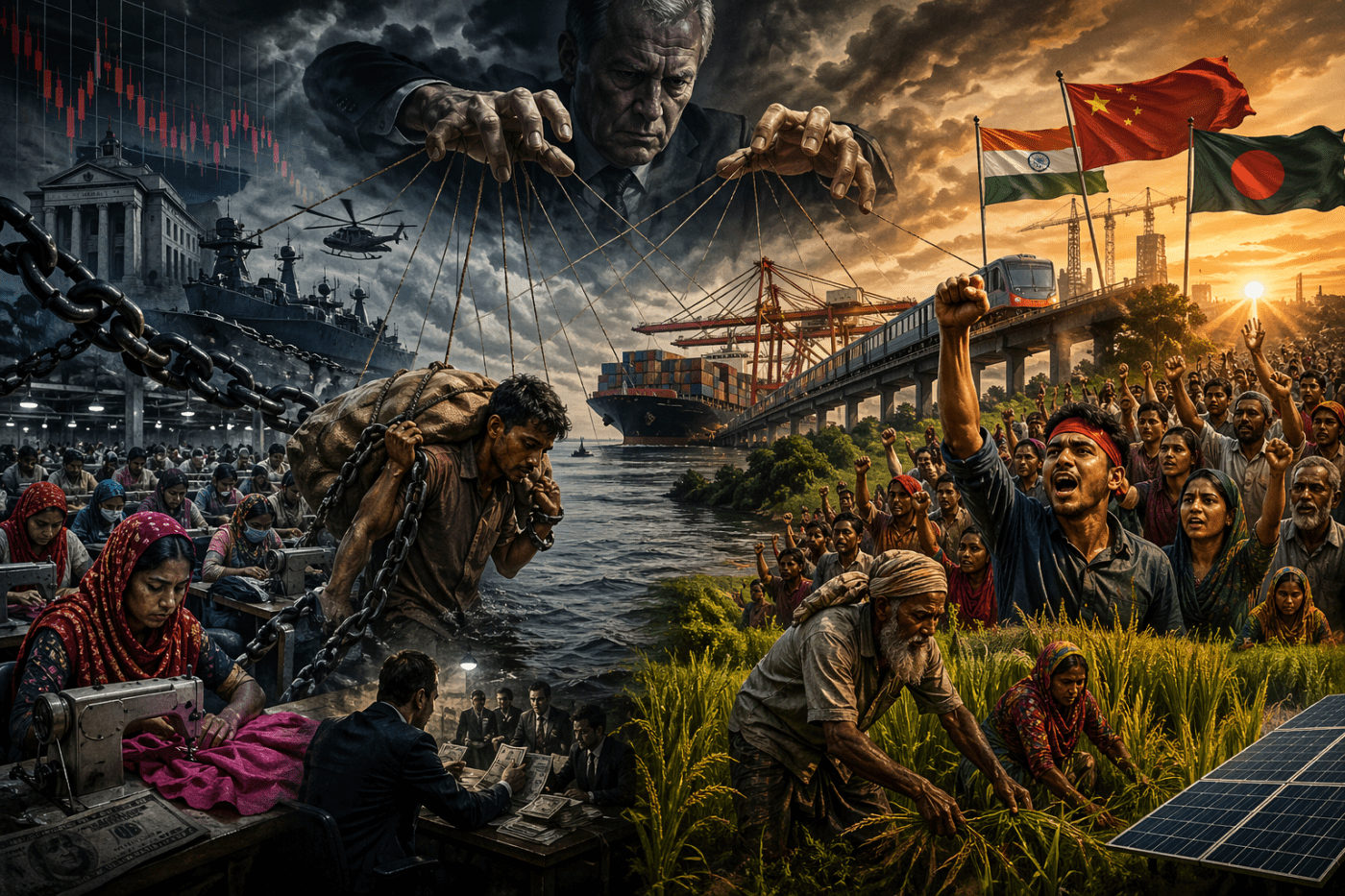
Asia Times doesn’t just argue for strategy—it reframes dependency as sophistication, urging Bangladesh to negotiate its place in a system it does not control. Beneath the language of leverage lies a material reality of export concentration, external inputs, financial discipline, and geopolitical pressure shaping every move. Multipolarity opens space—but only within limits, where new alignments can either deepen dependency or become tools for transformation depending on who holds power. The real struggle is not over better positioning, but over whether the working class and peasantry can turn maneuver into liberation.
By Prince Kapone | Weaponized Information | April 20, 2026
The Gospel of Leverage for a Small State in a Hungry World
“‘Friendship to all’ no longer good enough for Bangladesh”, published by Asia Times on April 20, 2026 and written by Md Obaidullah, arrives dressed in the sleek suit of strategic realism. Its message is plain enough: Bangladesh must retire the old doctrine of “friendship to all, malice toward none” and learn to speak the harder language of leverage, bargaining, and commercial purpose. In the world imagined by the article, caution is no longer prudence but weakness, and the nations that win are the ones that know how to turn geography, infrastructure, and great-power rivalry into a sharper yield. It is a familiar sermon for our age. The old vocabulary of diplomacy is treated like an antique in a glass case, while the new catechism of statecraft is recited with the confidence of a banker explaining compound interest to a starving man.
That confidence is not accidental. Asia Times presents itself as an independent platform of geopolitical and geo-economic insight, but its real habitat is the ecosystem of investor-facing analysis, elite policy chatter, and strategic commentary for people who do not till soil, stitch shirts, or queue for diesel. It is a publication structurally oriented toward those who study the movements of states the way traders study the movements of commodities. Its ownership and marketing profile tell you what kind of common sense it is in business to produce: not the common sense of laboring people trying to survive a violent world, but the common sense of those who see that world as a field of maneuver, a board of positions, a map of risks and opportunities. In such a space, “national interest” is usually a polite alias for the priorities of those who already command property, institutions, and access.
Obaidullah writes squarely from within that professional-policy stratum. His background is rooted in political science, great-power competition, foreign policy, and strategic behavior. That matters. It does not disqualify him from speaking, but it situates the speaking. His article does not emerge from the shop floor, the peasant field, the fishing coast, the refugee camp, or the flooded district. It emerges from the seminar room and the policy memo, from a worldview in which states are treated as actors in search of advantage and diplomacy is treated as a competitive instrument rather than a terrain conditioned by class, coercion, and unequal power. This is why the article can speak so smoothly about Bangladesh needing a sharper strategy without ever really asking: sharper for whom?
The first ideological move the article makes is to reframe Bangladesh’s traditional foreign-policy formula as noble but outdated. This is narrative framing in its clean bourgeois form. The past is granted ceremonial dignity only so it can be dismissed as inadequate to the present. “Friendship to all” is cast as a relic of another historical moment, respectable perhaps in the age of decolonization, but unsuited to the rough marketplace of contemporary geopolitics. In its place comes the new realism: flexible, transactional, unsentimental. This move is effective precisely because it sounds so sober. But it is also mischievous. It smuggles in a whole interpretation of the world without ever confessing its assumptions. It assumes that caution is merely habit, not perhaps the expression of historical memory, strategic asymmetry, or an effort to avoid being swallowed by contending blocs. The article does not argue this so much as arrange the stage so that only one kind of adult behavior seems plausible: hard bargaining inside the storm.
Then comes the card stacking. India, Indonesia, and Brazil appear as the chosen examples, each one presented as proof that muscular multi-alignment is the order of the day. India buys discounted Russian energy while deepening security ties elsewhere; Indonesia uses nickel to pressure capital into building infrastructure; Brazil converts scale and geography into concessions from larger powers. Each example is carefully selected to flatter the thesis. But examples, like mirrors, can be angled. What disappears here are the internal contradictions of those states: the class forces benefiting from such arrangements, the uneven burdens placed on workers and peripheral regions, the environmental and social costs buried under the phrase “national gain.” The article invokes these countries as though they were unified strategic organisms rather than class societies whose ruling blocs often present their own ambitions as the destiny of the nation itself. This is the old ventriloquist trick of bourgeois politics: capital throws its voice and the flag answers.
The prose itself helps do this work. The article is full of glittering generalities, those polished phrases that sound like wisdom because they remain pleasantly vague. “Strategic purpose.” “Leverage.” “Capability.” “Indispensability.” “Economic statecraft.” “Maximum national yield.” Such language gives the piece a polished technocratic glow, the sheen of competence, the fragrance of the think tank. But one must always ask what these words are hiding by refusing specificity. Indispensable to whom? Leverage for which class forces? Capability deployed in what social direction? Yield extracted from which bodies, landscapes, and futures? The beauty of these abstractions is that they can make class rule sound like patriotism and accumulation sound like destiny. One can almost hear the applause of logistics consultants and foreign ministry interns.
The argument is also pinned together by a quiet either/or fallacy. Bangladesh, we are told, faces a choice between an overly cautious posture that offers only the illusion of safety and a smarter, sharper strategy that bargains aggressively for gain. But once the world is narrowed to those two options, the truly dangerous questions never have to appear. Why must the available futures be limited to passive balancing or more aggressive integration into great-power competition? Why not sovereign development planning, deeper South-South coordination, labor-centered regionalism, food and energy resilience, or a deliberate refusal to let outside powers define the strategic grammar of the age? The article reduces the horizon of possibility to an elite menu, then congratulates itself for choosing the bold item.
Most revealing of all is what the article omits. It mentions Bangladesh’s export concentration, maritime location, climate diplomacy, and energy-hub potential, but strips each of these from the structures that make them meaningful and dangerous. It does not foreground the dependence of the garment sector on foreign buyers and external control over markets. It does not dwell on how infrastructure can be financed and shaped through outside capital. It does not seriously engage the fact that energy vulnerability is worsened by global war, import dependence, and shipping pressures. It does not reckon with the military-strategic weight gathering around the Bay of Bengal and the wider Indo-Pacific. In other words, it speaks the language of leverage while muting the conditions that limit leverage. It celebrates the possibility of maneuver while lowering the lights on the architecture of constraint.
This is why the article should not be read simply as a bad argument about Bangladesh, but as a revealing ideological artifact of the present conjuncture. It teaches the small state to dream in the idiom of the strategist while remaining silent about the class and imperial structures inside which strategy must operate. It flatters a peripheral ruling stratum with the promise that it can master history through harder bargaining, as though the problem were merely tone, posture, and nerve. The old line of “friendship to all” is not rejected because it has been materially disproven; it is rejected because it offends a new elite aesthetic, one that worships sharpness, flexibility, and transactional nerve as though these were virtues sufficient unto themselves. That is the little sermon hidden in the piece: not free yourself from dependence, but negotiate your dependence with greater swagger. And there, beneath all the polished talk of realism, the class content of the article quietly shows its hand.
The Material Ground Beneath the Talk of Strategy
The article does not invent Bangladesh out of thin air. It rests, selectively and unevenly, on a series of real conditions that must be brought into the open before any serious analysis can begin. Bangladesh has indeed long articulated its foreign policy through the doctrine of “friendship to all, malice toward none”, a formulation embedded in its own Indo-Pacific Outlook as an attempt to maintain broad engagement without formal subordination to any single bloc. This is not myth or nostalgia—it is a declared state orientation rooted in the realities of navigating a world structured by unequal power. The article is also correct in identifying the central pillar of Bangladesh’s economy: ready-made garments form the backbone of export production, described by the state itself as the foundation of industrialization, growth, and employment, while this single sector accounts for more than 85 percent of total exports. This is not diversification—it is concentration at scale.
The article is equally correct to point toward infrastructure as a site of emerging importance. The Matarbari deep seaport project, backed by Japanese development financing, is explicitly designed to expand Bangladesh’s logistics capacity and integrate it more deeply into regional trade flows. Its construction marks a historic step toward the country’s first deep seaport. At the same time, Bangladesh’s own policy documents recognize that it now operates inside an Indo-Pacific arena defined by intensifying competition among major powers, with official materials and regional analysis both situating the country between contending geopolitical forces. Geography, too, is not incidental. Bangladesh’s coastal position, climate exposure, and agrarian base give it a significance that cannot be reduced to garments alone, as seen in the expansion of agricultural support systems such as the Farmers’ Card program, which reflects the continuing weight of rural production and vulnerability.
Yet even in what it gets right, the article presents only a flattened version of reality. It gestures toward Bangladesh’s position between major powers but does not fully name the structure of that position. In practice, the country operates within a dual economic dependence in which exports flow primarily toward Western markets while the inputs that make those exports possible—machinery, textiles, chemicals, industrial components—are overwhelmingly tied to China, a relationship documented across regional economic reporting and Bangladeshi business coverage. This is not balance in the abstract; it is integration into two different poles of a single global system, one that consumes Bangladesh’s labor and supplies its production inputs in a tightly coupled circuit.
What disappears from the article’s narrative is precisely what gives these facts their meaning. Bangladesh’s own Export Policy 2024–27 openly acknowledges that remaining at the current level of export concentration is not sufficient, calling for deeper integration into higher-value segments of the global value chain and the development of backward and forward linkage industries. This is a quiet admission that exporting more shirts does not equal structural power. The underlying problem is not simply volume, but position. As policy research makes clear, Bangladesh remains concentrated in low-complexity production—cutting, sewing, and assembly—while design, branding, and distribution remain controlled elsewhere. The global garment system is not an open market; it is a buyer-driven chain in which foreign firms determine price, standards, and access. Bangladesh produces, but others decide what that production is worth.
This position is sustained by a labor regime that the article refuses to confront directly. Bangladesh’s export strategy continues to emphasize labor-intensive industries, while independent labor analysis shows that garment workers’ purchasing power remains among the weakest in major exporting countries. Cheap labor is not an unfortunate side effect—it is a structural feature of competitiveness within this system. The celebrated “success” of the garment sector rests on a social foundation of suppressed wages and constrained worker power. To speak of leverage without speaking of labor is to describe a machine without mentioning the hands that keep it running.
The article also avoids the financial architecture within which Bangladesh operates. The state’s own policy framework calls for exchange-rate flexibility, fiscal reform, and adaptation to the pressures of LDC graduation in 2026, indicating that external market conditions and institutional pressures are already shaping domestic decision-making. This is reinforced by an environment of IMF-linked stabilization and constraint, where reporting on IMF engagement and the IMF country report point to weaknesses in banking systems, governance, and fiscal space that limit autonomous policy maneuver. The language of “strategy” begins to sound different when the parameters of that strategy are already partially set from outside.
Nowhere is this structural constraint clearer than in energy. Bangladesh depends on imports for approximately 95 percent of its energy supply and faces a multi-billion-dollar deficit in its energy sector, forcing it to seek external financing simply to keep fuel flowing, as reported by Reuters. When global conflict disrupts supply chains, the consequences are immediate and material: fuel prices rise, freight costs increase, insurance premiums climb, and domestic inflation follows. The same reporting shows that Bangladesh raised fuel prices by 10 to 15 percent in April as war in West Asia rippled through global energy markets. Strategy, in this context, is not a game of choice but a response to shocks transmitted through systems beyond national control.
These shocks do not remain confined to balance sheets—they reach directly into the soil. Bangladesh’s agrarian sector, still central to national stability, is already under pressure from both structural vulnerability and geopolitical disruption. The expansion of the Farmers’ Card initiative reflects an attempt to stabilize agricultural production, while the procurement of large volumes of fertilizer underscores dependence on imported inputs. At the same time, reporting on a war-driven diesel shortage shows how external conflict can disrupt irrigation during critical planting seasons, directly threatening food production. Climate shocks compound this vulnerability: flooding has already disrupted cotton supply, reducing garment output and linking environmental instability directly to export earnings.
Infrastructure, too, appears in a different light once its material conditions are examined. The Matarbari project is not a neutral asset waiting to be activated by clever policy—it is a Japanese-financed development embedded in regional logistics strategies and bilateral arrangements. Ports such as Matarbari and Chattogram sit within a Bay of Bengal region increasingly shaped by strategic competition, where regional analysis and research institutions warn of rising geopolitical pressure and the potential militarization of infrastructure. The same port that promises trade can also become a node in a larger strategic contest.
Within this environment, Bangladesh’s relationship with China is not a future possibility but an existing structural reality. Diplomatic and economic materials—from China’s foreign ministry to Bangladeshi reporting—identify China as the country’s largest trading partner and a key supplier of industrial inputs, while Chinese firms are expanding into infrastructure, logistics, and manufacturing. This relationship extends beyond trade into production itself, with growing investment in garment and related sectors. At the same time, Bangladesh remains linked to India through cross-border energy arrangements, with reporting on electricity imports showing continued dependence under conditions of supply strain. The reality is not alignment with one pole or another, but entanglement across several.
Finally, there is a historical dimension the article leaves unspoken but which continues to shape the present. Bangladesh did not emerge as a neutral participant in global markets. It was born out of the violence of 1971, when the Pakistani military’s Operation Searchlight unleashed mass killing and displacement, and a national liberation struggle reshaped the political map of South Asia. This experience of war, rupture, and sovereignty struggle is not an abstract memory—it informs how the state navigates external pressure, alliance, and risk.
What emerges from all of this is a picture very different from the one offered by the article. Bangladesh is not simply a small state choosing between caution and boldness. It is a labor-intensive export economy embedded in global value chains, dependent on external inputs, markets, and financing, exposed to climate and energy shocks, and positioned within a region of intensifying geopolitical competition. Its policy space is structured, constrained, and contested. The language of strategy may speak of leverage, but the material reality reveals the conditions under which that leverage must operate—and the limits it cannot easily escape.
Between Leverage and Limits: Strategy in a World That Isn’t Yours to Command
Once the ground is cleared and the real conditions are brought back into view, the Asia Times argument reads very differently. What it presents as hesitation is not confusion or timidity—it is the political expression of a state trying to maneuver inside structures it does not control. What it calls for is not liberation, but a more aggressive form of adaptation. Bangladesh is not standing outside the system choosing its posture like a consumer at a market stall. It is already inside—stitched into global production, dependent on imported inputs, disciplined by finance, and exposed to shocks that no clever policy line can dissolve. The question is not whether Bangladesh should be more “strategic,” but what kind of maneuver is possible here—and in whose interests it is carried out.
The article’s central illusion lies in its treatment of leverage as something freely available. Geography, ports, labor, location—these are presented as tools waiting to be used. But leverage is not simply picked up and deployed; it is shaped by the conditions in which it exists. Bangladesh produces within buyer-controlled chains dominated by transnational capital. It works, but others determine what that work is worth. Its ports are financed externally. Its energy is imported. Its agriculture depends on inputs it does not control. These are not neutral assets. They are positions inside structured relations of dependency. To speak of leverage without those relations is to confuse being placed somewhere with having power there.
At the same time, the terrain itself is shifting. The global order is not static—it is reorganizing. But this reorganization does not produce a single, uniform field. It produces differentiated power centers that operate in distinct ways. Bangladesh is not simply dependent—it is integrated across overlapping relations. On one side stands the Western bloc, enforcing discipline through financial systems, currency power, and geopolitical pressure. On the other stands China, advancing through infrastructure, trade integration, and state-led development finance without the same immediate imposition of austerity or political restructuring. These are not identical forces. They reshape the terrain differently, even as they operate within a broader system that still produces unequal outcomes.
This is the contradiction of the present moment. Multipolarity opens space—but it does not abolish structure. Chinese trade and investment can expand industrial capacity, provide inputs, and build infrastructure. They create real openings. But those openings are not self-executing. They are filtered through Bangladesh’s internal class relations, its export model, and its position in global value chains. Without transformation of those internal conditions, new relationships can be absorbed into old patterns. The partners change. The position remains.
This is why the article’s reliance on examples like India, Indonesia, and Brazil collapses under scrutiny. These states are treated as proof that clever maneuvering yields results. But they operate from different material bases—larger markets, greater resource control, more diversified production. Even then, the gains are unevenly distributed, reinforcing class divisions rather than resolving them. To present them as templates for Bangladesh without examining these conditions is to confuse resemblance with equivalence. It offers imitation without foundation.
More fundamentally, the article never steps outside the logic of competitive integration. It assumes the goal is to secure a better position within existing circuits of trade and production. But Bangladesh’s place in the garment industry is not simply a rung on a ladder—it is a position structured by a system that concentrates higher-value functions elsewhere. Moving beyond that position requires more than sharper bargaining. It requires industrial development, technological capacity, labor power, and the reorganization of production itself. In short, it requires transformation. That possibility does not appear in the article’s framework.
The geopolitical dimension sharpens these limits further. The Bay of Bengal is not just a corridor for trade—it is becoming a strategic zone shaped by competing powers. Maritime surveillance, logistics corridors, alliance structures, and naval positioning are all converging in this space. Infrastructure becomes dual-use. Ports become potential nodes of control. In this environment, statecraft is not neutral. It is shaped by pressures that extend beyond markets into military and strategic competition. Bangladesh’s room to maneuver is therefore defined not only by economics, but by the evolving architecture of power surrounding it.
So what does multipolarity actually mean in this context? Not freedom. Not equality. Not the end of hierarchy. It means reorganization. It expands the number of possible alignments. It introduces new sources of capital and trade. It creates openings for maneuver. But it preserves unequal exchange, class dominance, and structural dependency. The result is not emancipation, but structured maneuvering space—real, but limited, and unevenly distributed.
That is why the celebration of boldness rings hollow. A state can be bold in deepening dependency just as easily as it can be bold in transforming it. It can open itself further to external capital, or it can demand conditions that build internal capacity. It can chase short-term gains, or it can attempt long-term restructuring. Without specifying direction, boldness is just a word—one that easily becomes a mask for the interests of those already in command.
The real contradiction, then, is not between caution and maneuver, but between class-controlled adaptation and structural transformation. Bangladesh does not lack direction. What it faces is a struggle over who defines that direction, which external relationships are leveraged, and how the gains and costs are distributed. Without confronting that question, calls for sharper policy remain what they have always been: instructions for managing dependency more efficiently rather than overcoming it.
And so the article stands exposed—not as a roadmap for development, but as an ideological expression of the present moment. It encourages movement within the system while obscuring the structures that govern that movement. The task ahead is more difficult. It is not simply to move better within the terrain, but to change the terrain itself. That is the question the article avoids—and the one that cannot be avoided any longer.
From Strategic Chatter to Organized Solidarity
If the article wants Bangladesh to become a more efficient broker for capital, our task is the opposite: to locate the people already fighting on the ground against the very social order that makes “leverage” mean more discipline for workers, more insecurity for peasants, and more exposure for those living at the edge of floodwater and fuel shock. The first line of solidarity has to be with Bangladesh’s own labor movement, especially the National Garment Workers Federation, a registered countrywide federation founded in 1984 with offices across the major garment zones, and with a documented record of organizing unions, campaigning for wage boards, regular pay, factory safety, maternity leave, gender equality, and accountability from multinational brands, as set out in its own published achievements. This is not a think-tank abstraction or a social-media mood board. It is an actual workers’ formation rooted in the core contradiction revealed in the article: a national economy made to depend on cheap labor while the command points of value remain elsewhere.
For comrades and readers outside Bangladesh, one concrete solidarity channel in the Global North is UnionAID’s partnership with NGWF, which explicitly supports the federation’s organizing and crisis-response work, including periods when the union itself lost income while redundancies, illegal terminations, and health and safety abuses intensified. UnionAID is not presented as a benevolent charity descending from the heavens with sacks of moral concern. It openly frames itself as a solidarity organization of working people, invites recurring member donations through its solidarity membership model, and publishes annual and financial reports through New Zealand charity reporting channels. That makes it useful not because New Zealand will save Bangladesh—let us not flatter the North with fantasies—but because it offers one verifiable route through which workers in one part of the world can materially back workers in another without laundering the relationship through empire’s favorite humanitarian theater.
The second front of struggle is agrarian, because Bangladesh is not only a garment platform but a peasant and rural society pressed from all sides by land hunger, climate instability, input dependency, and the violence of “development” imposed from above. Here the Bangladesh Krishok Federation and the women’s peasant formation Bangladesh Kishani Sabha matter enormously. Reports published by and about these organizations describe their work among small and marginal farmers, landless peasants, and climate-vulnerable communities, including struggles around land, livelihoods, disaster response, and organizing in the coastal belt. Their solidarity reporting also states that support has come through individual-donor campaigns and the Europe Solidaire Sans Frontières solidarity fund, a volunteer-run structure that says 100 percent of donations are transferred to partners and that it functions without salaries or administrative extraction. That is politically important. In a world where too much “aid” arrives with hidden strings, consultants, and geopolitical ventriloquists tucked behind the curtain, a donation-based volunteer solidarity channel is not the revolution, but it is at least closer to solidarity than to the usual development racket.
These Bangladesh-based struggles are not isolated village dramas or local labor skirmishes. They connect directly to a wider global fight over food sovereignty, agrarian reform, climate justice, and the right of working people to control the conditions of life. That is why the broader international peasant movement La Via Campesina deserves attention here. It brings together 180 local and national organizations in 81 countries, and its own annual reporting describes work sustained through regional funds and contributions from member organizations. That matters because the contradiction exposed in Bangladesh—between export integration, agrarian vulnerability, and class power—is not uniquely Bangladeshi. It is written across the Global South, from land grabs to fertilizer dependence to climate disaster. La Via Campesina provides a living international framework through which peasant struggles in Bangladesh can be understood not as national misfortunes, but as part of a common struggle against a system that wants rural people everywhere to disappear quietly into debt, migration, or cheap labor.
The practical line that follows from all this is simple and unsentimental. Do not take the bait of elite strategy talk and start dreaming about how Bangladesh can negotiate itself into a sweeter form of subordination. Build support instead for the forces already contesting the terms of that subordination from below. That means materially backing garment union organizing through channels such as UnionAID’s NGWF partnership; supporting peasant and women-peasant organizing through the ESSF solidarity fund that has long carried reports and appeals from BKF and BKS; and politically linking Bangladesh’s labor and agrarian struggles to broader transnational formations such as La Via Campesina. It also means producing political education that names the real chain of command: Western buyer power, imported-input dependence, debt and monetary discipline, energy chokepoints, and the creeping militarization of the Bay of Bengal.
In the final draft, this section should close with a hard insistence that solidarity is not charity, and certainly not charity with a flag pinned to it. It is organized commitment. It is workers backing workers, peasants backing peasants, movements recognizing themselves in each other across oceans and supply chains. The article under excavation wants Bangladesh to become more “indispensable” to global circuits of power. We should want something else entirely: that the people who keep Bangladesh alive become more indispensable to one another in struggle. Support the NGWF. Support the BKF and BKS. Use verifiable solidarity channels like UnionAID and ESSF. Connect those efforts to the wider peasant and food-sovereignty internationalism of La Via Campesina. That is how the story turns from leverage for elites to power for the people who actually bear the weight of this world.


Leave a Reply