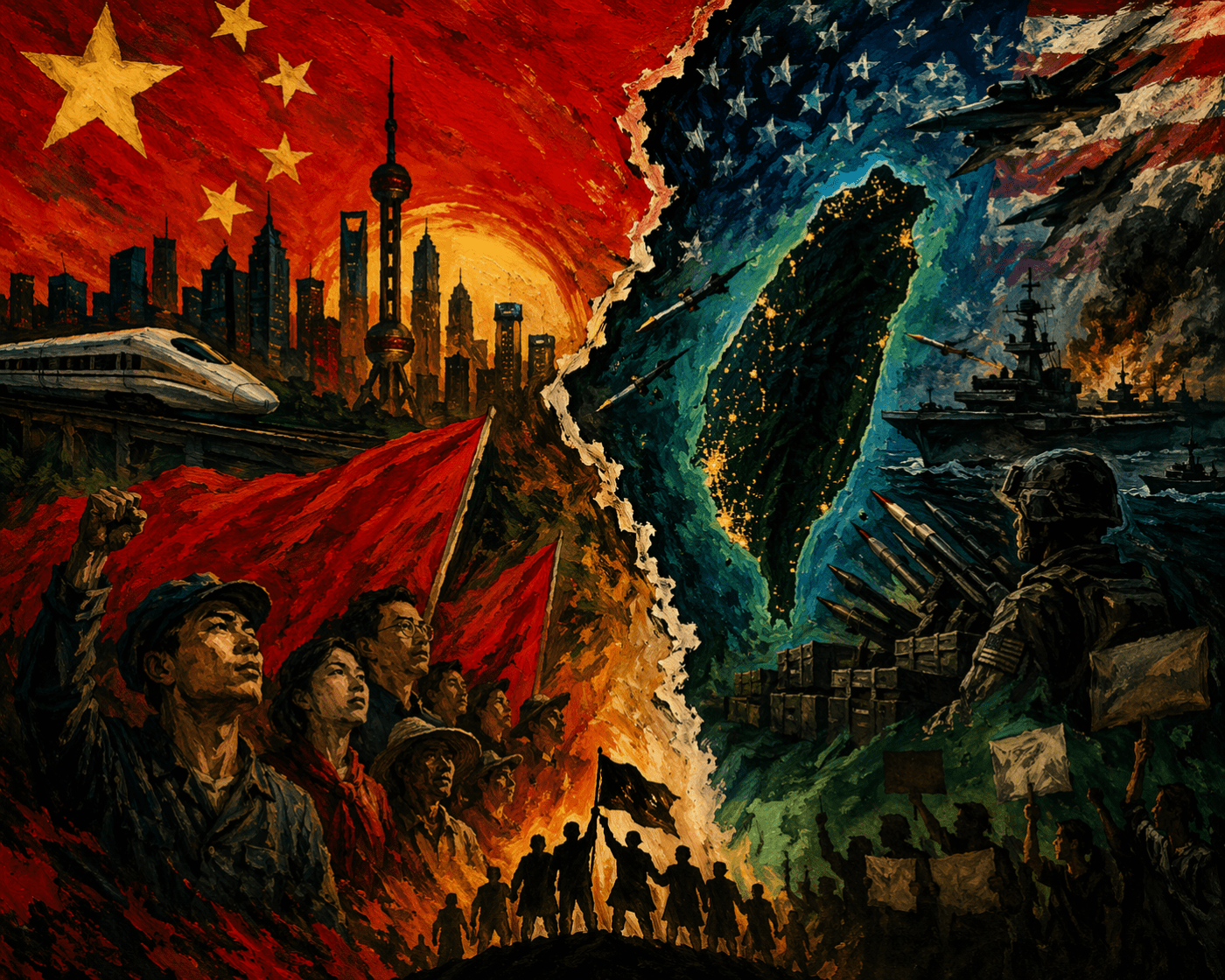
Reuters doesn’t just report events—it organizes reality through an imperial lens that disciplines how China is seen and understood. Beneath the surface, the Taiwan question reveals a dense structure of civil war legacy, U.S. militarization, legal contradictions, and economic interdependence. The truth is not “cross-strait tension,” but an unfinished revolutionary contradiction weaponized by empire to contain China. The task before us is not passive analysis, but organized resistance against the machinery preparing another catastrophic war.
By Prince Kapone | Weaponized Information | April 16, 2026**
Peace in the Mouth of Empire
In “China will not tolerate independence for Taiwan, Xi tells island’s opposition leader”, published by Reuters on April 10, 2026 and written by Liz Lee, the reader is handed what corporate journalism loves to market as a clean, disciplined, no-nonsense report. Xi Jinping meets Kuomintang chair Cheng Li-wun in Beijing. He reaffirms the “one China” principle, condemns Taiwan independence, calls for reunification, and the article moves briskly through responses from Taipei and Washington as though this were merely a diplomatic weather bulletin passing over the world for a day or two. But Reuters is never just “reporting” in the innocent sense. It is arranging the field of perception. It is deciding whose voices enter history as authority and whose lives remain background scenery. The article presents the basic event, yes, but it does so inside the smooth administrative grammar of empire, where official statements appear as reality itself and where the largest political contradictions are clipped down to fit the dimensions of a wire dispatch. Reuters, after all, is not a peasant newsletter or a worker’s bulletin pieced together by people with dirt under their fingernails and history still in their throats. It is the news arm of Thomson Reuters, a vast information conglomerate serving financial, legal, and corporate elites across the capitalist world. Its public creed is neutrality, but neutrality in such institutions usually means something very specific: the assumptions of dominant power are allowed to walk in through the front door without ever being asked to identify themselves.
That institutional location matters because it shapes the very texture of the report. Liz Lee writes from inside the conventions of corporate foreign correspondence, where compression is treated as professionalism and elite sourcing as seriousness. She is not positioned among the fishermen, factory workers, students, conscripts, or ordinary families whose lives would be torn apart by war in the Strait. Nor is she writing from the standpoint of colonized peoples who have learned, through bitter experience, that “stability” in imperial language often means the stabilization of domination. She writes as a functionary within the international information apparatus, where access, speed, official quotation, and rhetorical restraint are prized above historical depth. The result is prose that appears modest and factual while quietly performing ideological labor. It is the old trick of bourgeois journalism: speak softly enough and the class character of the message disappears behind the polish of the sentence.
The first device at work here is narrative framing. Reuters stages the event almost immediately as a drama of “peace” endangered by “independence,” allowing Beijing’s phrasing to set the article’s central axis while pretending merely to transmit it. This is not a trivial choice. Once the contradiction is defined in those terms, the reader is ushered away from the deeper material questions: the unresolved legacy of civil war, the role of U.S. militarization, the political uses of “strategic ambiguity,” and the larger imperial struggle over the Pacific. Instead, the event is narrowed into a moral tableau in which “peace” glows with the holy innocence of a church candle while “independence” flickers like the devil’s cigarette in the alley. But peace for whom, on what terms, and under which structure of power? Reuters has no interest in pausing long enough to ask. In corporate reporting, words like peace are treated like self-explanatory goods, as though they descended from heaven untouched by class power, state interests, or historical struggle. The article does not merely relay language; it organizes the reader’s emotional and political entry into the event.
The second device is source hierarchy, that old bourgeois method by which the world is made to appear as a conversation among officials while the masses remain mute. Reuters gives us Xi, Cheng, Taiwan’s top China policymaker, and the U.S. State Department. Here power speaks to power while the people are consigned to the role of spectators in a drama staged in their name. There is no ordinary Taiwanese voice, no mainland worker, no antiwar movement, no peasant memory, no proletarian stake in the future being debated over polished tables beneath chandeliers. The article thus reproduces one of the central disciplines of the imperialist media apparatus: history is narrated from above. The state speaks, the journalist records, and the reader is taught to mistake that arrangement for objectivity. But there is nothing objective about a world in which only those already seated closest to power are allowed to explain what is happening. It is not neutrality. It is class filtration.
The third device is the laundering of political code words through quotation. Reuters repeats terms like “separatist,” “chief culprit,” and “one family” without excavating the struggle condensed inside them. Because these words are presented as reported speech, the outlet preserves its alibi. It can always claim that it is merely quoting what others said. But quotation is never innocent when it becomes the main carrier of ideological freight. To call someone a separatist in an unresolved sovereignty struggle is not like reporting the weather or the price of eggs. It is to circulate a judgment rooted in a specific political project. Likewise, “one family” is not just a tender metaphor floating above history. It is an instrument of state discourse, packaging hierarchy, unity, memory, and discipline into a phrase that sounds soft enough to enter the public ear without resistance. Reuters handles such language with the ritual cleanliness of a servant polishing silver before a banquet. The words arrive gleaming, detached from the struggle that forged them, ready for respectable consumption.
The fourth device is omission, which in sophisticated propaganda is usually more important than outright fabrication. Reuters notes that Beijing has “stepped up military pressure” and that Washington is Taiwan’s main source of arms, but these facts are left hanging in the article like coat racks in a hallway. They are present, but never unpacked. Pressure is noted without being reconstructed. Arms are mentioned without being politicized. What should appear as an architecture of force becomes atmospheric background, as though military encirclement and arms transfers were simply seasonal patterns to be observed and not active mechanisms of domination. This is how the corporate press performs one of its most valuable services for empire: it acknowledges decisive facts only in miniature, just enough to appear credible, but never enough to clarify the structure that gives them meaning. The reader is told there is a storm, but not who engineered the weather.
The fifth device is false balance, wrapped in the familiar Reuters language of the “status quo.” The U.S. line opposing unilateral changes “from either side” is presented as calm reason rising above the quarrel, as though Washington were some wise uncle separating two angry cousins at the dinner table. But this symmetry is fraudulent. It collapses radically different forms of power into a neat formula designed to protect the appearance of imperial moderation. Constitutional claims, military deployments, arms sales, state recognition, and political interference are all flattened into a single phrase about not changing the status quo. Yet the status quo itself is not neutral terrain. It is a historical arrangement shaped by war, revolution, counterrevolution, imperial recognition regimes, and the permanent intervention of the United States. To treat that arrangement as though it were natural is to naturalize the power that produced it. Reuters does not explain this because its job is not to make power visible; it is to make power appear orderly.
And then there is concision, that great virtue of the wire service and one of its most ideologically useful weapons. In the hands of Reuters, brevity is not merely an editorial preference. It is a mechanism of discipline. A civil war, an unfinished national question, a defeated counterrevolutionary state formation, U.S. strategic management, PRC law, Taiwanese party conflict, and military escalation are all compressed into a handful of clipped paragraphs. This creates the illusion of lucidity while ensuring that the reader never confronts the full mass of the contradiction. One leaves the piece with a headline in the head and a few official quotes in the pocket, but with little sense of the historical terrain underfoot. This is the genius of modern imperial journalism. It does not need to tell grand lies at every turn. It simply reduces great struggles to digestible fragments, then calls the resulting thinness “clarity.”
So the Reuters article is not false in the cheap sense. It is more efficient than that. It is a managed corridor of perception. A meeting took place. Xi spoke. Cheng responded. Taipei objected. Washington counseled calm. But what the article really does is arrange those facts into a scene that reproduces the assumptions of the imperial information order: that official speech is the substance of politics, that compressed context is enough context, that the United States is merely one voice among others rather than a structuring force in the entire drama, and that the largest contradictions can be safely folded into the language of “peace” and “stability” without the reader ever having to confront the history beneath them. This is propaganda in its better suit. It does not foam at the mouth. It clears its throat, adjusts its tie, and ushers the reader politely past the locked doors of history.
The Strait Is Not a Mystery, It Is a Structure
What Reuters presents as a tense but essentially self-contained diplomatic moment is, in fact, only the visible surface of a much larger political structure. The article does establish a few immediate facts. Xi Jinping told KMT chair Cheng Li-wun that Beijing would “absolutely not tolerate or condone” Taiwan independence, reiterated that both sides of the Strait belong to “one China,” and called on the KMT and CCP to move together toward reunification. Cheng described her April 7 to April 12 visit to China as a “peace” mission, while Taiwan leader Lai Ching-te declared before the trip that “we are not part of the PRC.” Taiwan’s Mainland Affairs Council denounced Cheng’s so-called peace framework as a “unification framework” and insisted that “the 23 million people of Taiwan can decide their future.” At the same time, the KMT skipped key defense talks in Taipei while Cheng was in Beijing, and U.S. Senator Jim Banks publicly pressured Taiwan’s parliament to pass Lai’s roughly $40 billion defense package. Those are the article’s basic pieces. But what matters is what the article refuses to reconstruct around them.
To begin with, Beijing’s position is not some improvised outburst delivered for ceremony in the Great Hall of the People. It is grounded in the legal doctrine of the Chinese state itself. The 2005 Anti-Secession Law states plainly that both the mainland and Taiwan belong to one China, identifies the Taiwan issue as a remnant of the civil war, and authorizes “non-peaceful means” if prospects for peaceful reunification are judged exhausted. This matters because Reuters quotes Xi’s warning while burying the actual legal and historical framework from which it arises. The same is true militarily. Reuters says pressure is increasing, but does not tell the reader what that means in concrete terms. Taiwan’s Ministry of National Defense reported that from April 8 to April 9 it detected 6 PLA aircraft sorties, 8 PLAN ships, and 1 official vessel around Taiwan, with 5 aircraft crossing the median line into Taiwan’s air defense identification zone. That is not atmosphere. That is operational pressure.
Nor is Washington some disinterested third party murmuring about calm from the sidelines. The Taiwan Relations Act explicitly commits the United States to maintaining the capacity to resist coercion directed at Taiwan, meaning U.S. involvement is structured into the question at the level of law and strategy. And this involvement is not symbolic. Defense Security Cooperation Agency notices from December 2025 show U.S. approvals for HIMARS, self-propelled howitzers, Javelins, loitering systems, software, and related support worth billions of dollars. Reuters mentions that Washington arms Taiwan, but in the way one mentions that a casino serves drinks—lightly, politely, as though it were incidental rather than part of the business model.
The article also strips out the material economic dimension of the contradiction. Cross-strait politics are not sustained by flags, speeches, and aircraft alone. They are wired through trade, production, and capital. Taiwan’s own Cross-Strait Economic Statistics Monthly reports that exports to Hong Kong and mainland China accounted for 40.58% of Taiwan’s total exports in the cited period, while Taiwan’s government data portal maintains ongoing official datasets tracking cross-strait trade. The point is simple. This is not merely a military flashpoint or diplomatic quarrel. It is a contradiction embedded in deep circuits of accumulation and interdependence. Even Cheng’s trip was more than theater. The KMT’s own April 10 press release said she proposed jointly researching institutional arrangements for peace and building sustainable mechanisms for cross-strait dialogue and cooperation. Reuters quotes the peace language but omits the fact that the KMT was advancing a party-to-party mechanism outside the elected executive, which is rather an important detail when one is pretending to explain politics.
Let’s cut through the fog and call it what it is. The authorities in Taipei are not governing a separate, internationally recognized “Republic of Taiwan.” That state does not exist. Taiwan is officially named the Republic of China—and still claims, right now, to be the legal and legitimate sovereign authority over all of China. It has never renounced that claim. At the same time, it also recognizes itself as part of China. That is the contradiction in plain sight: a state that says it rules all of China, but in reality has no power over the mainland, where the PRC actually governs. Even bourgeois scholarship is forced to acknowledge this. Legal analysis published in The China Quarterly confirms that the ROC still carries de jure claims over China as a whole while exercising authority only over what it calls the “free area.” So what exists is not a normal, settled nation-state, but a fractured political formation—claiming China, confined to Taiwan, and sustained inside a broader geopolitical arrangement shaped by defeat and imperial backing. And yet Reuters talks about “Taiwan” as if it were a clean, fully recognized sovereign country. That’s not reporting. That’s ideological laundering.
The same silence surrounds the international recognition question. UN General Assembly Resolution 2758 restored the lawful rights of the People’s Republic of China at the United Nations and expelled the representatives of Chiang Kai-shek. Taiwan has no UN seat and is not recognized by the UN as a separate country. And despite all the noise and weaponry, the U.S. State Department itself states that Washington’s policy is guided by the “One China” policy, anchored in the three U.S.-PRC Joint Communiqués and the Taiwan Relations Act, while relations with Taiwan remain unofficial. So even the empire does not formally recognize Taiwan as independent. It recognizes the PRC as the government of China while simultaneously arming, backing, and leveraging the authorities in Taipei. That is not diplomatic clarity. That is structured ambiguity as a strategic instrument.
Once these omitted facts are restored, the larger context becomes much harder to evade. Beijing’s own law explicitly defines the Taiwan issue as a civil war remnant, and Reuters itself acknowledges that the KMT-led Republic of China fled to Taiwan in 1949 after losing that war. The “status quo” is therefore not some neutral resting point but a structure produced by revolution, defeat, retreat, U.S. protection, and continued strategic management. UN recognition of the PRC in 1971 did not erase the contradiction on the ground, but it did establish the core institutional fact that the PRC, not the ROC, holds China’s place in the international system. The authorities in Taipei still operate under the name Republic of China, while Washington sustains only unofficial ties even as it provides arms and political backing. That is why this is not a normal dispute between two fully recognized states. It is an unfinished civil war nested inside an imperial strategy.
And the structure is still moving. After Cheng’s trip, Reuters reported that Taiwan security officials insisted any engagement over Beijing’s new measures must be led by the government, while Focus Taiwan reported that the PRC announced ten measures including restored tourism and fuller normalization of direct flights. Pressure and inducement are thus operating together. Meanwhile, prior Weaponized Information work has already situated this entire theater in the broader militarization of the Pacific. “Theater of Protection: CNN, Japan, and the Manufacturing of Pacific Militarism” argued that mainstream reporting routinely launders Indo-Pacific war preparation into the language of defense, while “Voices of Sovereignty: The Global South at the UN” situated China within a wider multipolar struggle rather than as an isolated object of Western concern. Once that lens is restored, Reuters’ little wire dispatch stops looking like a clean report and starts looking like what it really is: a highly compressed ideological rendering of a conflict shaped by revolution, counterrevolution, sovereignty, trade, military pressure, diplomatic ambiguity, and the long hand of U.S. imperial management.
The Empire Wants a Wound, Not a Resolution
Reuters presents a meeting. What actually stands before us is a historical contradiction that the imperial press can neither explain honestly nor tolerate politically. The Taiwan question is not a quarrel between two normal sovereign states that just happen to have strong feelings about one another. It is the unfinished political afterlife of the Chinese Revolution, the defeat of the Kuomintang in 1949, and the preservation of that defeated remnant under the shield of U.S. imperial power. Once that is understood, the fog begins to lift. The People’s Republic of China is not merely one claimant among several. It is the sole legitimate government of China, born out of revolutionary victory, recognized by the overwhelming majority of the world, and entrusted with China’s place in the international system. Taiwan, by contrast, is not some naturally separate nation-state wandering outside Chinese history. It is a part of China whose present political condition was shaped by civil war, retreat, foreign protection, and the long imperial refusal to accept the full consequences of the Chinese Revolution.
This is why the Reuters framing is so rotten at its core. It stages “Taiwan independence” as though it were just another democratic opinion in the marketplace of ideas, as innocent as a campaign slogan or a village council dispute. But under imperialism there is no innocent marketplace. There is no clean, abstract, floating principle of independence detached from the world balance of power. The slogan of independence in Taiwan does not emerge in a vacuum, and it does not travel alone. It moves inside a structure built by U.S. arms, diplomatic manipulation, strategic ambiguity, military planning, and the wider campaign to contain and weaken the PRC. What the corporate press calls a matter of self-determination is, in practice, inseparable from the geopolitical ambitions of the same imperial order that has spent generations trying to discipline, fragment, isolate, and if possible subordinate revolutionary China. The words may wear local clothes, but the scaffolding behind them is imperial steel.
The contradiction is therefore not simply Beijing versus Taipei. It is revolution versus its unfinished enemies. The KMT lost China on the battlefield of history. It lost not because of bad luck, a procedural error, or some unfortunate misunderstanding at a conference table, but because the Chinese Revolution defeated it. Yet the old counterrevolution did not vanish into the grave where history had prepared a place for it. It was preserved on Taiwan under U.S. protection, armed, subsidized, and repurposed as a strategic remnant. That remnant still governs under the name Republic of China, which is itself a political confession. It does not declare a settled Taiwanese republic severed from Chinese history, because its very constitutional skeleton still bears the mark of the state that once claimed to govern all China. What remains on Taiwan is not a second legitimate China. It is the residue of a defeated order that survives because imperialism found it useful to keep the corpse breathing.
Beijing’s insistence on anti-secession and reunification must be understood in that light. Reuters wants the reader to encounter Chinese sovereignty as menace, as though the demand that China remain whole were inherently threatening while the permanent military encroachment of the United States were merely prudent housekeeping. But China’s position is not some irrational tantrum of nationalist temperament. It is rooted in the historical completion of revolution, in the struggle against fragmentation, in the defense of territorial integrity, and in the refusal to allow a civil war remnant to be weaponized forever by hostile foreign power. The imperial press hears the language of reunification and translates it as aggression because empire always experiences the sovereignty of others as an offense. A country that refuses dismemberment is, from the standpoint of imperial strategy, a rude inconvenience.
The KMT, for its part, moves through this contradiction like a class formation that has learned how to survive defeat without ever transcending it. It speaks of peace, dialogue, and institutional frameworks, but it does so as a bourgeois current within a state form that no longer has any material power over the mainland and exists only because Washington long ago decided that this fragment should be preserved. It seeks accommodation, yes, but an accommodation shaped by its own historical role as the political remnant of the old order. The KMT’s diplomacy is therefore not the diplomacy of emancipation. It is the diplomacy of a defeated class force trying to manage the terms of its survival inside a contradiction it no longer controls. Even its peace language is saturated with this limitation. It cannot resolve the question because it is itself one of the unresolved residues of the question.
The broader pro-independence current in Taiwan appears, on the surface, to offer a cleaner break. It speaks in the language of democracy, local identity, and self-determination. But under imperial conditions these words do not arrive untouched. They are rapidly incorporated into the strategic logic of the United States, which does not even formally recognize Taiwan as independent yet has every interest in deepening its political, military, and psychological separation from the mainland. This is the trap. An “independence” that depends on imperial patronage is not sovereignty. It is dependency with new branding. It is a pathway not out of domination but deeper into it, binding Taiwan more tightly to the military, diplomatic, and ideological machinery of the Western capitalist order. In that sense, the independence current functions not as a road to liberation but as a comprador tendency, a would-be bourgeois project of separation that would deliver Taiwan not into freedom, but into more intimate subordination to U.S. power.
This is why Reuters’ balancing language is such an efficient little fraud. It presents Beijing and Washington as though one were applying pressure while the other sought calm. But Washington does not seek calm. Washington seeks leverage. It seeks a durable strategic wound inside the Chinese body politic, something that can be irritated, inflamed, armed, narrated, and mobilized whenever the larger project of containing China requires it. Taiwan is useful to empire precisely insofar as it remains unresolved. A settled question is of little use. A wound, on the other hand, is politically versatile. It can justify budgets, alliances, deployments, think tank conferences, cable news hysteria, sanctions architecture, regional militarization, and the permanent fiction that the United States is merely responding to instability rather than manufacturing the conditions under which instability becomes profitable.
That is the deeper logic of the whole affair. The long-range objective of imperial strategy is not peace for the people of Taiwan, nor democratic flourishing, nor some tender concern for local consent. It is to obstruct Chinese consolidation, preserve a zone of vulnerability, and maintain a platform for future confrontation against the PRC. And beyond that lies the larger dream of the Western ruling classes: that China might one day be weakened, fractured, politically reversed, or otherwise brought back into a condition more favorable to outside domination. In plain language, the aim is to roll back the historical gains of the Chinese Revolution and return China to a more penetrable, more controllable, more exploitable position inside the world system. The colonizers never forgave the revolution for winning. They simply learned to be patient.
From the standpoint of the global working class and oppressed nations, the task is therefore not to indulge the liberal theater of equal claims between empire and anti-imperialist sovereignty. It is to see clearly which force completed a revolutionary unification and which force has spent decades trying to hold open a breach inside it. It is to recognize the PRC as the legitimate expression of Chinese sovereignty after revolution, to oppose the use of Taiwan as a U.S. proxy platform, and to understand that so-called independence under imperial sponsorship is not real emancipation but a political form of managed dependency. The issue is not whether Washington can teach the world to say the right words about democracy. The issue is whether empire will be allowed to fracture a sovereign people for strategic gain. The just horizon is not the normalization of permanent separation, nor the laundering of containment through humanitarian language. It is the defeat of imperial interference, the refusal of separatist manipulation, and the defense of Chinese sovereignty against every attempt to turn an old civil war remnant into the fuse of a wider imperial war.
Turn the Strait into a Front of Struggle, Not a Theater of War
The task now is not simply to understand the Taiwan question, but to intervene in the political conditions that allow it to be weaponized against the people of China and the broader global working class. The danger is not abstract. War in the Taiwan Strait would not be a localized conflict. It would be a catastrophic escalation drawing in the United States, its military alliances across the Pacific, and potentially the entire global system of imperial coordination. It would devastate working people in Taiwan, on the mainland, and across the region, while the ruling classes that engineered the confrontation would retreat to their bunkers and balance sheets. So the first responsibility is clarity, and the second is organization.
Clarity means breaking the ideological monopoly of the corporate press. That begins with political education rooted in material reality, not headlines. Organize study groups, teach-ins, and public discussions that map the actual machinery of escalation: the legal commitments embedded in the Taiwan Relations Act, the steady flow of weapons through U.S. arms sales approvals, the operational pressure reflected in PLA activity reports, and the legal framework of reunification laid out in the Anti-Secession Law. When people can see the structure, the propaganda begins to crack. The goal is not passive awareness but political consciousness that understands who benefits from escalation and who pays the price.
Organization means linking this understanding to real formations that are already contesting imperial war policy. The Black Alliance for Peace provides a concrete anti-imperialist framework rooted in the radical Black tradition, with a clear position against U.S. militarism and intervention across the globe. Their funding structure makes transparent that they are fiscally sponsored by Community Movement Builders rather than bankrolled by the liberal-imperial NGO complex. Their Asia-Pacific work directly connects U.S. military expansion in the region to the broader system of domination that sustains it. This is not abstract solidarity. It is a practical entry point for building antiwar infrastructure inside the imperial core.
At the same time, organizations like Veterans For Peace open another front, bringing in those who have seen the machinery of war from the inside. Their financial reports and member-supported structure provide transparency, while their campaigns expose the human cost of militarism in ways that cut through official narratives. Linking anti-imperialist analysis to veterans, military families, and rank-and-file workers is essential, because these are the social layers most directly drawn into imperial war projects. Turning them away from that role is not a moral appeal. It is a strategic necessity.
But organization without a sharp political line collapses into activism without direction. The line must be clear and uncompromising. Oppose U.S. militarization of Taiwan. Reject the use of the island as a forward base for confrontation with the PRC. Expose the fraud of “defensive” language that masks encirclement, arms buildup, and strategic provocation. Defend Chinese sovereignty against imperial interference. Refuse the ideological trap that presents this conflict as a neutral dispute between equal parties rather than a contradiction structured by imperial power and anti-imperialist resistance. Peace will not be secured by repeating the language of the State Department. It will be secured by dismantling the conditions that make war profitable.
Finally, this struggle must be connected to the broader global fight against imperialism. The Taiwan question is not isolated. It sits alongside U.S. base expansion in the Philippines and Japan, sanctions regimes across the Global South, naval encirclement strategies, and the steady militarization of entire regions under the banner of “security.” Antiwar work around Taiwan must therefore be integrated into a wider movement against empire as a system. That means building alliances across struggles, linking Pacific militarization to domestic austerity, exposing how war budgets drain resources from working people at home, and transforming opposition into organized resistance. The point is not to comment on empire. The point is to confront it, weaken it, and ultimately dismantle its ability to turn entire regions into battlegrounds for its own survival.
This is the real horizon. Not passive concern, not abstract calls for peace, but organized, disciplined opposition to the machinery of imperial war. The Taiwan Strait does not have to become the next front in a global catastrophe. But it will, if the system that feeds on conflict is allowed to operate unchecked. The task is to make that system visible, to build the forces capable of resisting it, and to ensure that the future of the region is not decided by those who profit from its destruction.


Leave a Reply