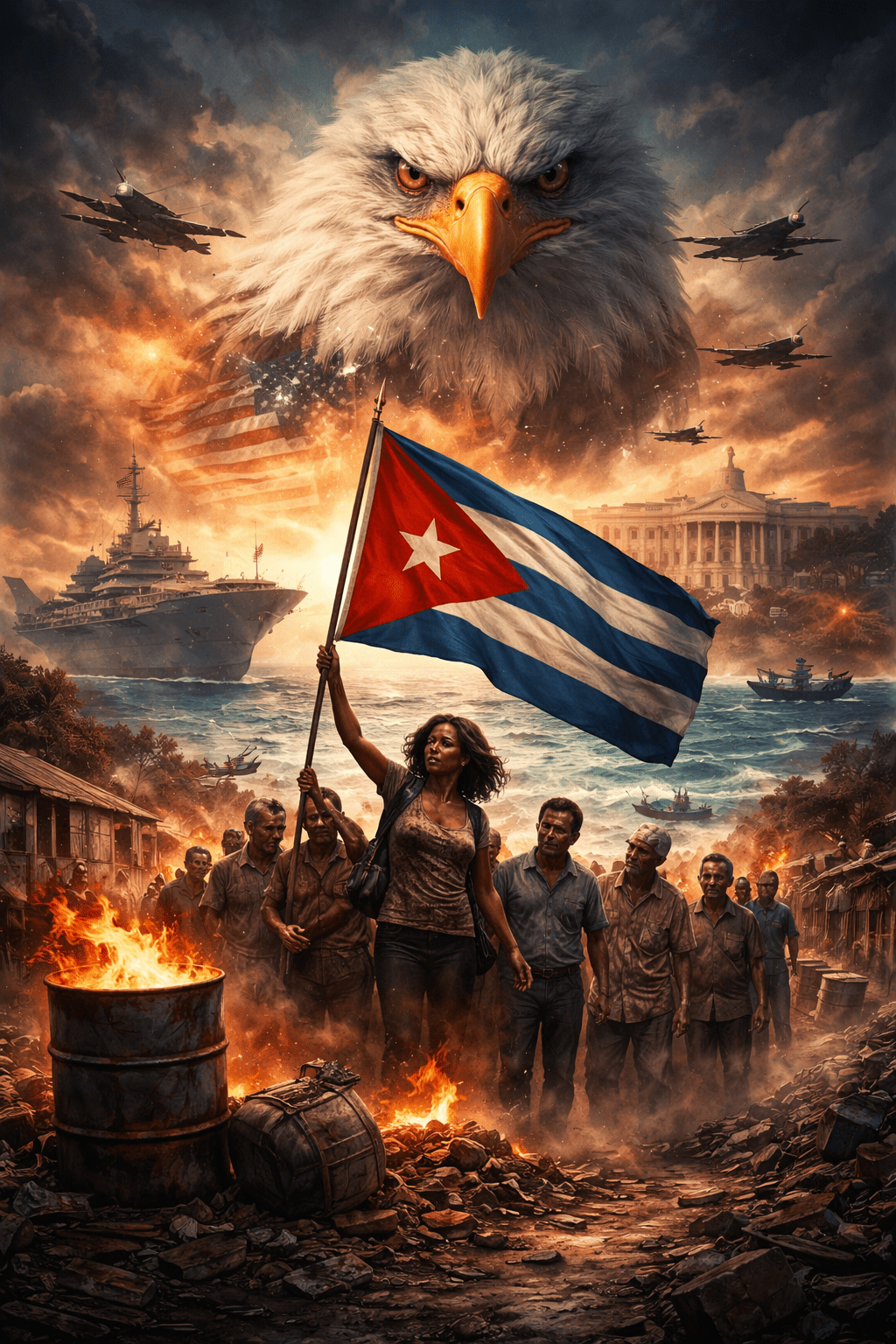
The New York Times launders U.S. regime-change demands into the language of negotiation, masking domination as diplomacy. Beneath the narrative, a coordinated campaign of economic strangulation—especially through energy chokepoints—reveals deliberate coercion, not Cuban failure. This pressure is part of a broader imperial recalibration: the consolidation of Fortress America as a hemispheric bloc under U.S. control. In resisting, Cuba stands not as an isolated anomaly, but as a fault line in the emerging American Pole and a test case for sovereignty in a multipolar world.
By Prince Kapone | Weaponized Information | March 29, 2026
The Grammar of Intervention
Trump Administration Said to Tell Cuba That Its President Has to Go, published by The New York Times on March 16, 2026 and written by Frances Robles, Edward Wong, and Annie Correal, arrives dressed up as sober reporting but moves with the confidence of an imperial memo translated into newspaper prose. On its surface, the article tells readers that Washington has informed Havana that meaningful progress in negotiations depends on President Miguel Díaz-Canel stepping down. It presents this as a limited, almost managerial adjustment: not the overthrow of the Cuban state, not the open destruction of the revolution, just a practical removal of one man so that “productive deals” may proceed. But even at the level of its basic architecture, the piece reveals its political function. It does not ask by what right the United States presumes authority over the leadership of a sovereign country. It begins instead from the assumption that such authority exists, and then invites the reader to debate only the technical wisdom of how it should be exercised.
That tone is not accidental. The New York Times is not a neighborhood circular, nor some accidental gathering of opinionated scribblers. It is a giant corporate media institution whose business model rests heavily on subscription revenue, elite readership, and its permanent role as an interpreter of world affairs for the professional classes of the United States. The paper speaks to managers, diplomats, policy hands, academics, investors, and that broad stratum of respectable empire that prefers its domination in a clean shirt. The byline itself tells a story. Robles comes out of long-form Latin America and Caribbean reporting, Wong out of the foreign-policy and diplomatic beat, and Correal out of regional and immigration reporting. Put those sensibilities together and you get precisely what this article delivers: a fusion of regional crisis narrative with Washington strategic framing, a text that makes coercion sound thoughtful and intervention sound like realism.
The first propaganda device at work here is narrative framing. The article does not frame Washington’s demand as blackmail, external diktat, or colonial interference. It frames it as negotiation. That single move does enormous ideological labor. The second is omission. Cuba appears throughout the piece as impoverished, unstable, besieged by shortages and blackouts, but the causality behind that suffering is softened, delayed, and partially buried, so that the pressure of U.S. policy recedes into the wallpaper while Cuban dysfunction takes center stage. The third is policy laundering. Anonymous officials and unnamed “people familiar with the talks” are used to circulate an extraordinary claim—that the United States is effectively demanding the removal of Cuba’s president—without making the empire fully stand in the dock for its own words. The fourth is appeal to authority, or more precisely source hierarchy: former U.S. officials and exile voices are brought forward to certify the reasonableness of the maneuver, while ordinary Cuban voices, mass organizations, and anti-imperialist analysts are nowhere to be found. The fifth is card stacking. Díaz-Canel is portrayed as both a hardened obstacle to change and a mere figurehead lacking real power. Notice the trick: if he matters, he must go because he blocks reform; if he does not matter, he can be removed at little cost. Either road leads to the same imperial destination. The sixth is doublespeak. Phrases like “symbolic win,” “productive deals,” and “open its economy” are polished verbal instruments meant to bleach the raw fact that Washington seeks not Cuban freedom, but Cuban compliance. That is the real grammar of the article: domination made to sound administrative, punishment made to sound practical, and submission made to sound like progress.
The Siege Behind the Story
The article’s own reporting, stripped of its polite phrasing, establishes a set of hard facts that deserve to be stated plainly. It reports that U.S. officials told Cuban negotiators that meaningful progress in talks requires President Miguel Díaz-Canel to leave office while at the same time signaling no immediate push against the Castro family figures who still hold institutional power. It further states that Washington views Díaz-Canel as a hard-liner and believes his removal could enable structural economic changes and greater opening to U.S. business, which is to say, the removal of a head of state is being openly tied to economic reconfiguration favorable to foreign capital. The article adds that U.S. negotiators are also pressing for the removal of additional older officials and for the release of political prisoners, extending the scope of intervention beyond one individual into the broader governing apparatus. It acknowledges that Washington has blocked foreign oil imports to Cuba as part of its pressure strategy and links this to the island’s worsening electricity and fuel crisis, quietly admitting that material deprivation is part of the negotiating environment. And it notes, almost in passing, that Trump publicly declared, “I do believe I’ll have the honor of taking Cuba,” while refusing to clarify whether that would be diplomatic or military, a statement that speaks less like diplomacy and more like possession.
But the terrain becomes clearer when we step outside the article’s frame and recover what it leaves buried. In January 2026, the Trump administration issued a national emergency declaration on Cuba and established mechanisms to impose tariffs on countries supplying oil to the island, meaning the fuel crisis is not incidental but deliberately engineered. This was followed by financial enforcement: the U.S. Treasury’s Office of Foreign Assets Control implemented licensing rules affecting Venezuelan-origin oil, and subsequent policy adjustments narrowed waivers to exclude Cuba, tightening the noose around its energy lifelines. From Havana’s side, the causal chain is not ambiguous. On March 14, Díaz-Canel stated publicly that Cuba had gone three months without oil imports and linked postponed surgeries, communications breakdowns, transport collapse, and blackouts to an “energy blockade”, a claim echoed in domestic reporting such as Cubadebate’s summary of the crisis. Cuban officials have also clarified their political reading of events: the deputy foreign minister stated that regime change is not negotiable and that the country must prepare for potential U.S. attack, situating the moment not as reform dialogue but as a sovereignty confrontation.
The omissions extend beyond immediate policy into the broader international and historical record. In October 2025, the United Nations General Assembly voted 165–7 to condemn and call for an end to the U.S. blockade on Cuba, demonstrating overwhelming global opposition to the very policy environment shaping the crisis described in the article. The long arc is equally telling: the U.S. economic blockade has been in place since 1962, and the State Department’s own historical archive records both the Bay of Pigs invasion and Operation Mongoose planning against Cuba, establishing a continuity of coercive intervention and terrorist violence stretching back more than six decades. The material consequences of that continuity are not abstract. According to Cuba’s official report to the United Nations, the blockade has caused billions of dollars in economic losses in recent years, shaping precisely the shortages and infrastructural strain that the article presents as internal failure.
Placed in its full context, the present moment reveals a tightly structured system of pressure. The energy crisis itself is part of a global configuration: Reuters reports that Cuba received only two oil tankers this year by late March, with Russia stepping in to provide humanitarian fuel, indicating both scarcity and geopolitical rerouting. At the same time, the United States has expanded controlled fuel exports to Cuba’s private sector while maintaining pressure on the state, suggesting a differentiated strategy aimed at reshaping internal economic relations rather than simply punishing the island. The political structure targeted by Washington is not a personalist anomaly but an institutional system: Díaz-Canel was reelected by the National Assembly in 2023, and that Assembly is constitutionally defined as the supreme organ of state power. Meanwhile, resistance to the blockade is not confined to Havana. An international convoy from more than thirty countries delivered humanitarian aid to Cuba in March 2026, signaling global solidarity networks responding materially to the crisis. The regional temperature is rising as well: Trump declared “Cuba is next” in a March 27 speech, placing the island within a broader hemispheric strategy of confrontation. And as the crisis deepens, Cuba has sought Vatican mediation to ease the oil embargo, underscoring that what is being described as negotiation is unfolding under conditions of acute material strain and urgent search for relief.
Fortress America and the Reordering of the Hemisphere
On the surface, they tell us this is about a man—about Díaz-Canel, about whether he stays or goes, about whether Cuba needs a “new face” to move forward. But history has a way of laughing at such small stories. What is unfolding here is not about a personality. It is about power reorganizing itself. The United States, confronted with a world it no longer fully commands, is tightening its grip where it still can. Not everywhere—just close to home. The hemisphere. The backyard, as they once called it with the arrogance of plantation owners. What we are witnessing is the construction of something more deliberate now—something colder, more calculated. Call it what it is: Fortress America. Call it the American Pole taking shape.
The empire has learned a few lessons. It knows now that global domination is expensive, unstable, and increasingly contested. So it consolidates. It pulls its resources inward, not in retreat, but in preparation. It begins to lock down the zone it considers essential—Latin America, the Caribbean, the arteries of trade, the flows of energy, the corridors of logistics. And inside that tightening circle sits Cuba, stubborn as ever, refusing to play its assigned role. Not because it is perfect—no society is—but because it has refused to surrender its right to decide its own path. And that, in the eyes of empire, is the original sin.
So what do they do? They don’t send the Marines—not yet. They don’t need to. They have something more efficient. They squeeze. They tighten. They choke the flows that make life possible. Oil becomes a weapon. Shipping becomes a weapon. Finance becomes a weapon. And then they step back and say, “Look, the system isn’t working.” Of course it isn’t working—you’ve got your hands around its throat. This is not chaos. This is design. This is what imperialism looks like when it trades boots for balance sheets, when it swaps invasion for infrastructure control. The violence is still there. It just travels through pipelines and ports instead of gun barrels.
Cuba matters in this picture not because of its size, but because of what it represents. It is a small island that refuses to behave like a small island. It has insisted, for decades, on existing outside the full command of U.S. capital and policy. In a hemisphere that Washington now wants to seal into a coherent bloc—a reliable base in an unstable world—that kind of independence becomes intolerable. Not inconvenient. Intolerable. Because one point of resistance is never just one point. It is an example. And examples travel.
That is why the demand to remove Díaz-Canel is not really about Díaz-Canel. The man himself is secondary. The message is primary. Power wants to be seen. It wants to demonstrate itself. It wants to say, in clear terms: governments in this hemisphere do not simply govern—they answer. And when they do not answer, they are replaced. Quietly, perhaps. Politely, even. But replaced all the same. That is what is being staged here—not a negotiation, but a lesson.
And then there is the economic side, where the real work is being done. Notice the precision. The state is squeezed, but the private sector is given carefully measured openings. This is not inconsistency. This is strategy. Starve one part of the system, feed another, and watch what grows. Encourage layers of society that depend on external markets, external supplies, external approval. Build a class that looks outward for its survival. And in time, that class becomes a political force. This is not reform. This is social engineering under siege conditions. It is the slow construction of a society that fits neatly into the machinery of the American Pole.
Energy sits at the heart of all of this. No fuel, no movement. No movement, no economy. No economy, no stability. It is that simple. And so oil becomes the lever. Restrict it, and you don’t just create inconvenience—you reorganize daily life itself. You determine who can move, who can produce, who can function. This is control at the level of metabolism, the level at which a society breathes. This is what chokepoint imperialism looks like when stripped of its polite language. It doesn’t conquer territory. It controls circulation.
And yet Cuba does not simply fold. It searches for alternatives. It looks outward—to allies, to partners, to anyone willing to break the isolation. It refuses the demand that its leadership be decided elsewhere. Not because defiance is romantic, but because surrender is permanent. What is at stake is not one presidency, not one policy adjustment, but the question of whether Cuba remains a country that decides for itself or becomes another piece fitted into a larger imperial design.
So the article’s story collapses under its own weight. This is not a negotiation between equals. It is pressure applied from above, resistance rising from below, and a struggle over the shape of an entire region. Fortress America is not an idea—it is a project, built out of sanctions, supply chains, and strategic necessity. And Cuba, small as it is, stands right at one of its pressure points, refusing to disappear into the architecture being built around it.
From Exposure to Organization
Once the fog is cleared, the task is no longer interpretation—it is alignment. Cuba is not facing a misunderstanding, nor a policy disagreement, but a structured campaign of economic strangulation designed to force political concession. That means the response cannot remain at the level of commentary. It must move into organization, into material solidarity, into the deliberate construction of pressure from below that counters the pressure imposed from above. The question is not whether people sympathize with Cuba. The question is whether they are prepared to act in ways that materially disrupt the blockade and politically isolate those who enforce it.
The first line of struggle begins with the forces rooted in Cuba itself. The island has not collapsed under pressure precisely because its social structure is organized, because its institutions—political, economic, and communal—operate as mechanisms of collective survival. The constitutional framework, expressed through bodies like the National Assembly as the supreme organ of state power, reflects a system in which governance is embedded in mass structures rather than detached from them. Public briefings such as state addresses detailing energy shortages and crisis management show a society mobilizing internally to maintain healthcare, transport, and basic services under siege. Solidarity with Cuba begins by recognizing that these structures are not the problem to be “reformed,” but the very mechanisms through which the population resists collapse.
Beyond the island, diaspora and solidarity formations have already moved from words to material action. Organizations like IFCO / Pastors for Peace have for decades built direct pipelines of aid, organizing campaigns such as the Cuba Friendshipment caravans that physically transport resources in defiance of U.S. sanctions. Their operational and financial structure is not hidden; it is publicly documented through filings such as their IRS-linked nonprofit records, demonstrating a model of transparent, people-funded solidarity work. This is not charity—it is organized defiance of imperial restriction. The same spirit is visible in the broader network of international actors, as evidenced by the 2026 convoy involving organizations from over thirty countries delivering aid to Cuba. That convoy is not an exception; it is a blueprint.
At the regional and global level, the terrain is already contested. Cuba’s ability to survive the energy chokehold depends in part on alternative alignments, as seen in external fuel support emerging from non-U.S. partners. At the diplomatic level, the blockade stands exposed as an isolated policy, with overwhelming global opposition expressed in repeated United Nations votes. These are not symbolic gestures. They represent cracks in the architecture of isolation, openings through which coordinated regional and international pressure can be intensified. The task is to connect grassroots organizing to this broader geopolitical reality—to translate global opposition into sustained political cost for those enforcing the blockade.
Within the United States itself—the center of the siege—the responsibility becomes sharper. Organizations like CODEPINK have already organized campaigns such as Breaking the Blockade actions, combining protest, delegation work, and political education aimed directly at U.S. policy. The Black Alliance for Peace has likewise connected Cuba to a wider anti-imperialist framework, articulating opposition to U.S. militarism and intervention through its organizational platform. These formations are not substitutes for Cuban struggle—they are extensions of it within the imperial core.
The practical tasks that follow from this are concrete. First, political exposure must be organized: teach-ins, union meetings, community forums, and campus actions that directly connect Cuba’s blackouts and shortages to the U.S. policy of restricting oil access and threatening third-country suppliers. Second, material solidarity must be expanded: fundraising, supply chains, and logistical coordination with organizations already delivering aid, recognizing that the crisis is immediate and physical, not abstract. Third, institutional pressure must be built: local governments, labor unions, and civic bodies must be pushed to adopt formal anti-blockade positions, leveraging the contradiction between U.S. policy and overwhelming international opposition to the embargo. Fourth, the struggle must be regionalized: Cuba’s situation must be framed as part of a broader hemispheric strategy, grounded in statements like “Cuba is next”, and linked to other sites of U.S. intervention across Latin America.
This is the dividing line. On one side stands a system that uses fuel, finance, and scarcity to force compliance. On the other side stand the people who refuse that logic—inside Cuba, across its diaspora, and within the very country that enforces the blockade. Solidarity here is not sentiment. It is participation in a material struggle: to break the mechanisms of strangulation, to expose the language that disguises them, and to stand with a people determined to decide their own future without permission from empire.
 Weaponized Information
Leave a comment