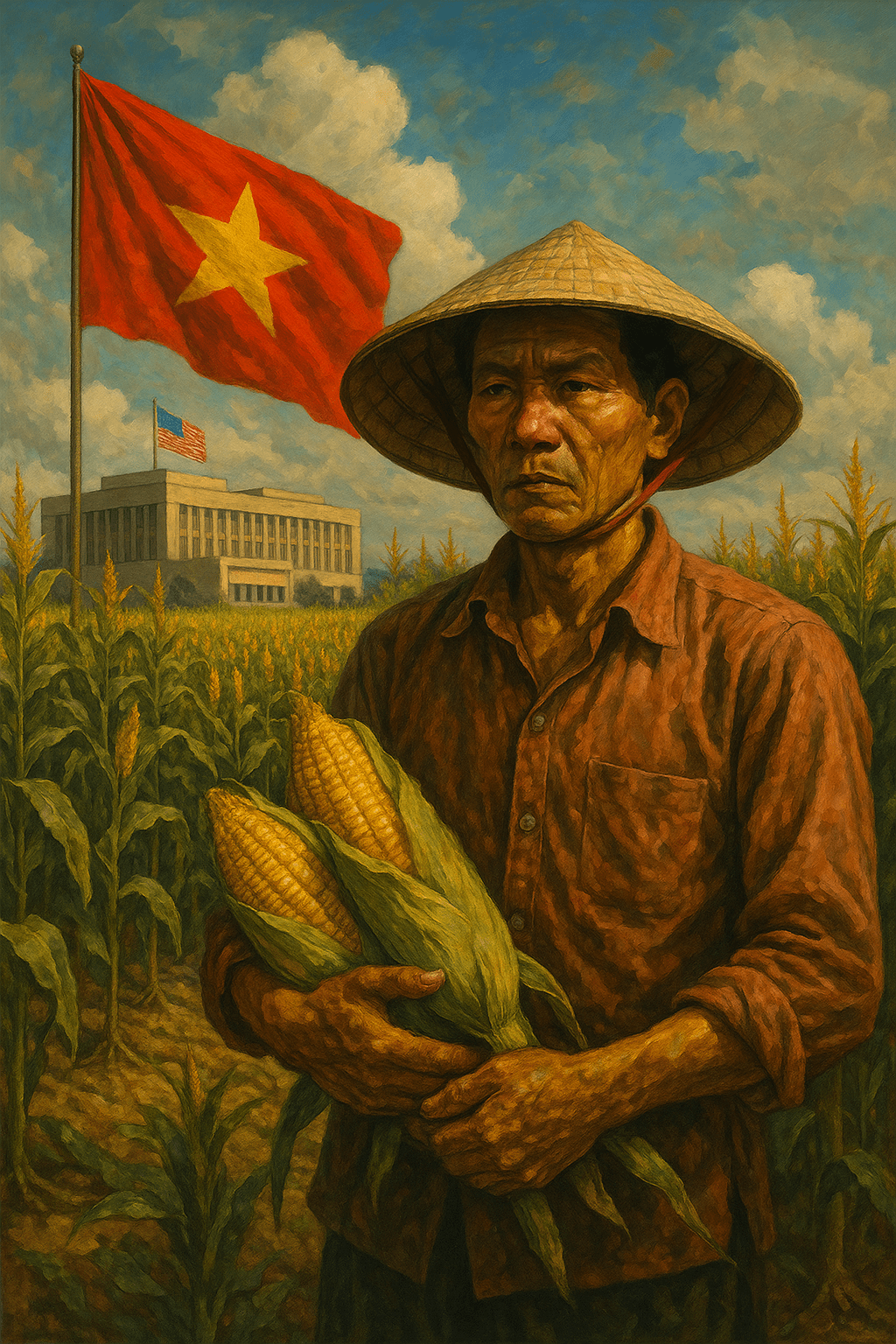
Behind the headlines of U.S.–Vietnam agricultural trade lies a deeper battle over food sovereignty, socialist survival, and the slow recalibration of empire in crisis.
The Corn Beneath the Curtain: Bloomberg’s Imperial Harvest
This article was penned by Hallie Gu, a professional amplifier of corporate agriculture narratives whose career has been spent laundering the contradictions of global capitalism into palatable business news. Her portfolio—filled with reports on China’s commodity markets, ADM restructuring, and U.S.-China grain friction—is steeped in investment logic, not investigative journalism. Gu serves the ruling class not by omission, but by commission—she crafts narratives that protect supply chains, obscure asymmetries, and reinforce the ideological legitimacy of Western agribusiness dominance. She works for Bloomberg, a cornerstone of the imperial media architecture, whose function is not to inform the public but to instruct markets, manage perception, and normalize the predatory operations of finance capital around the world.
This story, originally published on Yahoo Finance, was elevated by Ralph Lents of the Iowa Corn Promotion Board, USDA officials, and Vietnamese agriculture minister Do Duc Duy—figures who operate as brokers between imperial overproduction and comprador compromise, managing the logistical handoff between U.S. agribusiness monopolies and the bureaucratic technocracy of dependent states.
Now to the propaganda itself.
The Bloomberg piece opens with the news that Vietnam is expected to sign $2 billion in import deals for U.S. agricultural, forestry, and fishery products—framed immediately as a routine, cooperative act. In fact, it’s anything but. The real story is buried in the next line: Vietnam has pledged to remove all tariffs on U.S. imports to secure the deal and avoid high tariffs of its own. This is not a trade negotiation—it’s a geopolitical shakedown. Under the threat of Trump’s 46% retaliatory tariff regime, Vietnam was strong-armed into opening its markets to absorb surplus U.S. grain. This is not bilateralism. This is extraction.
The article quickly pivots to selling the illusion of market logic: Vietnam is “scooping up” U.S. grain because it’s more “attractive” than South American supply. No evidence is offered—no discussion of freight costs, input subsidies, or pricing distortions. The point is to imply choice, not coercion. The collapse in Chinese demand is acknowledged only to suggest U.S. sellers are shifting focus, not that they are dumping unwanted goods into any country vulnerable enough to accept them.
Then comes the photo op: a 50-person delegation from Vietnam, led by Do Duc Duy, arrives in Iowa to sign five MOUs with unnamed “private American companies.” What’s erased here is power—who holds it, who wrote the terms, and who profits. That’s left to Ralph Lents of the Iowa Corn Promotion Board, who delivers the PR line: this “showcased an increased commitment from Vietnam” and reinforced the “strong partnership” between the two nations. But a partnership implies parity. There is none here.
The article mentions two of the MOUs—900,000 tons of corn and 250,000 tons of DDGS—but offers no breakdown of what this means for Vietnam’s domestic producers. No concern for rural displacement, food system distortion, or long-term dependency. Instead, we’re handed USDA projections about Vietnam’s future corn consumption and reminded that the U.S. is simply helping to “meet demand.” What’s really happening is U.S. grain, subsidized and surplus, is displacing local agriculture and restructuring food sovereignty through quiet coercion.
There is no mention of the transnationals—Cargill, POET, Monsanto-Bayer—that stand to gain. No analysis of how tariff elimination undermines Vietnam’s ability to protect its domestic grain producers. No inquiry into whether these deals will open the floodgates to genetically modified seed monopolies or chemical-intensive feed regimes. The silence isn’t accidental. It’s tactical.
Not once does the article mention the historical context. That the U.S. used food as a weapon during the Vietnam War—burning rice fields, blockading hamlets, starving resistance. That Vietnam’s agricultural system, shaped by socialist land reform, was designed precisely to resist foreign dependency. That the Vietnamese people fought and died for the right to determine their own food systems, not to be force-fed surplus grain by the very power they once defeated.
And yet, this framing—devoid of politics, history, and power—has a very clear function: to transform recolonization into commerce. Bloomberg’s job is to make empire look like logistics. To make dependency look like development. To make dumping look like diplomacy.
But our job is different. Our job is to pull the curtain back.
Because this isn’t just about corn. It’s about how empire recalibrates under pressure—how it manages its internal crises by outsourcing them. It’s about how nations like Vietnam, still socialist in form and revolutionary in memory, are being economically coerced into absorbing the contradictions of the decaying imperial core.
And it’s about how propaganda functions—not through outright lies, but through silences. Strategic omissions. Language so sanitized you barely notice the blood underneath. This isn’t journalism—it’s cognitive warfare.
And what’s being planted isn’t food. It’s control. What’s being harvested isn’t cooperation. It’s obedience. And what’s being exported isn’t just grain—it’s imperialism, one ton at a time.
Corn for Concessions: What the Headlines Don’t Say
Let’s pull the facts out of the corporate fog.
Yes, Vietnam is importing over $2 billion worth of U.S. agricultural goods. Yes, that includes 900,000 tons of corn and 250,000 tons of dried distillers grains (DDGS). Yes, those deals were inked in Iowa between Vietnamese feed industry reps and private U.S. agribusinesses. Yes, the U.S. Department of Agriculture confirmed that Vietnam is now the third-largest corn importer globally, projected to bring in 12.7 million tons next season.
All of that is true.
But here’s what they didn’t say.
What the Bloomberg article leaves out—what it must leave out to do its job—is the pressure behind the deal. Vietnam’s “willingness” to eliminate tariffs on U.S. goods didn’t come from economic curiosity or agricultural innovation. It came under the shadow of Donald Trump’s threatened 46% retaliatory tariffs. It came in the context of Vietnam’s $123 billion trade surplus with the United States—a surplus the Trump regime has marked for discipline. Commerce Secretary Lutnick made the arrangement’s asymmetry explicit when asked if the U.S. would reciprocate with tariff cuts: “Absolutely not. That would be the silliest thing we could do.”
This wasn’t diplomacy. It was extortion in a pinstripe suit.
The article also ignores that this entire trade maneuver is born of U.S. crisis, not Vietnamese demand. U.S. agriculture is bloated with surplus. Years of subsidy-fueled overproduction, climate disruption, and the collapse of Chinese demand have left American grain suppliers with overflowing silos and shrinking markets. Between 2023 and 2024, the U.S. racked up a $123 billion shortfall in agricultural exports. This isn’t trade strategy—it’s economic triage.
Vietnam is being positioned not as a partner, but as a dumping ground.
And what does this mean for Vietnam? That’s another story Bloomberg avoids. The elimination of tariffs opens the door for multinational monopolies like Cargill, POET, and Monsanto-Bayer to flood the Vietnamese feed and grain market with subsidized, chemically intensive, genetically engineered product. Vietnamese domestic producers—many of whom operate in cooperative structures or rely on state-managed rural development programs—are now exposed to competition they cannot outspend or outmaneuver. This undermines not only livelihoods but food sovereignty.
And this isn’t happening in a vacuum. Vietnam’s agricultural policies have been shaped by a socialist state committed—at least structurally—to national planning and collective well-being. The system is not pure; market reforms since the Đổi Mới period have opened cracks. But state-led development, public sector coordination, and planning bodies still steer core industries. Tariff barriers weren’t just protective—they were necessary. Now they’re gone, and with them, a layer of national defense.
Let’s also not forget the historical memory that’s missing from Bloomberg’s narrative. Vietnam is not new to the weaponization of food. During the U.S. war on Vietnam, grain silos were bombed, rice fields torched, and food denied to resistance zones through “strategic hamlet” programs. Today, food comes dressed in spreadsheets and MOUs instead of napalm—but the function remains the same: domination by other means.
And then there’s the broader terrain: Vietnam is navigating a collapsing unipolar world, where the U.S. is scrambling to shore up influence in the face of Chinese ascent and the quiet rise of multipolarity. Vietnam is not naïve. It is trying to hedge, to maneuver, to survive. But this deal did not come from a position of strength—it came from a position of constraint.
Meanwhile, the U.S. is playing a longer game. This is not just about corn. It’s about locking Vietnam back into the orbit of empire—via logistics, not land invasions; via agriculture, not aircraft carriers.
And in that sense, this grain deal is the latest move in a recalibration strategy aimed at the Global South. As traditional imperial leverage—military, financial, technological—begins to wobble, the empire turns to the everyday: food, trade, logistics. Grain becomes geopolitics. Corn becomes coercion.
But you wouldn’t know any of that from reading Bloomberg.
Because the role of propaganda isn’t to lie—it’s to leave out the parts that explain everything.
From Dumping to Defiance: Reframing the Grain Frontline
Let’s turn this narrative around and tell the story from our side.
The United States didn’t just “find a new market” in Vietnam. It deployed the logic of imperialist crisis management—exporting its internal contradictions across the Pacific, dressing them up as diplomacy, and forcing a socialist nation to absorb the shock.
Vietnam, meanwhile, isn’t “growing closer” to the United States. It’s fighting to survive a global system that makes sovereignty a liability and dependency a precondition for trade. It’s walking the razor’s edge that all post-colonial states must walk: how to develop without submitting, how to engage without surrendering, how to stay alive in a world built to keep you subjugated.
From the standpoint of empire, this deal is brilliant. It converts surplus into leverage. It turns economic stagnation into geopolitical alignment. It binds Vietnam to U.S. agribusiness supply chains and undercuts any attempt at food self-sufficiency. It disciplines a defiant nation not with bombs, but with grain barges and spreadsheets.
But from the standpoint of the global working class—especially the rural poor—this deal is something else entirely.
It is a warning.
It is proof that imperialism doesn’t die. It mutates. That the U.S., as it loses dominance in tech, energy, and military projection, turns to the oldest weapon it has always held over the Global South: food.
And it is also a call.
Because while Vietnam has been cornered, it has not collapsed. The Party still rules. Planning bodies still guide. The revolutionary memory of the people—the memory of struggle, of collectivization, of anti-colonial sacrifice—still circulates. And the contradictions playing out now are not signs of defeat, but terrain of contestation.
Vietnam is not bowing to empire. It is maneuvering within the chokehold. And it is not alone. Across the Global South—from Haiti to Egypt to the Philippines—millions of people are waking up to the reality that food security under capitalism is not security at all. That every bite is priced in empire’s currency. That what you eat, how you grow it, and who controls the supply chain is not just economic—it’s political.
This is not a grain deal. This is a frontline.
It is a confrontation between two systems: one that feeds capital, and one that tries to feed people. One that sees food as leverage, and one that sees it as life. One that uses trade to discipline, and one that—however unevenly—fights to build sovereignty from below.
We must stand, not in abstract sympathy with Vietnam’s “right to trade,” but in material solidarity with its people, its workers, its farmers, its cooperatives, and its planners still fighting for balance inside the storm.
Because what this moment demands is not condemnation—but clarity.
Vietnam is not a problem. The system it must navigate is.
And the lesson for the rest of us—those in the imperial core and those still resisting its grip—is that unless we fight for food sovereignty, for collective land control, for real solidarity beyond borders, we will all be eating empire’s leftovers.
This is not just Vietnam’s contradiction. It’s ours.
Sowing Solidarity Against the Grain of Empire
This moment demands more than understanding—it demands alignment. The struggle over food, land, and sovereignty playing out in Vietnam is not isolated. It is one battle in a global war over who gets to eat, who gets to grow, and who decides what development looks like.
We stand in full ideological unity with the Vietnamese people—not just as a nation, but as a revolutionary force that has withstood direct invasion, economic blockade, and now, soft-power recolonization through trade. We affirm that their fight to maintain sovereignty—even under extreme pressure—is a fight shared by every colonized, landless, and working-class community around the world.
We also recognize that solidarity isn’t symbolic. It’s material.
In the 1960s and 70s, people’s movements across the Global South, the Black Liberation Army, the Young Lords, and other revolutionary organizations declared their support for Vietnam not in press releases, but through concrete action: anti-draft resistance, sabotage of imperial logistics, and political education campaigns that tied the rice fields of the Mekong Delta to the ghettos of the U.S.
Today, we must rebuild that spirit of internationalist discipline—not just with words, but with infrastructure.
That means exposing and disrupting the mechanisms of food imperialism here at home. We must organize against agribusiness giants like Cargill and Monsanto-Bayer. We must support Indigenous and Black land sovereignty movements that are actively resisting chemical farming, land grabs, and water privatization. We must fight to sever U.S. imperial policy from everyday logistics—ports, freight, grain transport—that underpin the empire’s ability to weaponize food.
It also means amplifying and materially supporting agroecology movements, cooperative farming models, seed-saving projects, and rural worker organizations in the Global South that are actively building the alternatives empire fears.
For organizers in the imperial core, the frontline is right here: in the belly of the beast, where the grain ships are loaded, where the propaganda is printed, where the surplus is planned. Our task is to sabotage empire’s ability to turn food into leverage.
For comrades in the Global South, our solidarity means defending every inch of space carved out for sovereign development—however contradictory, however compromised—against the recolonization of finance, fertilizer, and free trade.
We must expose the IMF’s quiet war on rural food systems. We must resist so-called “development deals” that come with dependency attached. And we must uplift socialist-oriented states like Vietnam that still struggle—despite overwhelming odds—to hold the line against total submission.
To that end, we propose:
- Building coordinated campaigns to expose U.S. grain dumping and agribusiness contracts that undermine food sovereignty worldwide
- Launching educational workshops that link Vietnam’s struggle to local fights for land, water, and cooperative production
- Organizing solidarity statements and teach-ins in collaboration with Vietnamese diaspora communities and anti-imperialist agricultural workers’ organizations
- Pressuring U.S. ports and logistics hubs to cut ties with companies involved in food imperialism
- Raising funds and resources to support independent peasant and cooperative movements in Vietnam and Southeast Asia
We live in a time when empire no longer needs to invade to dominate. It recalibrates. It disciplines through deals. It erases memory with media.
But we remember.
We remember the courage of the Vietnamese people, not just in war, but in the slow, patient labor of building sovereignty. We remember that their struggle was never theirs alone—it was always part of ours.
And we know that as long as food is controlled by empire, no one is free.
So we say this plainly: the grain deal is not over. The war for sovereignty is not over. And Vietnam is still fighting.
Let us fight with them.
 Weaponized Information
Leave a comment