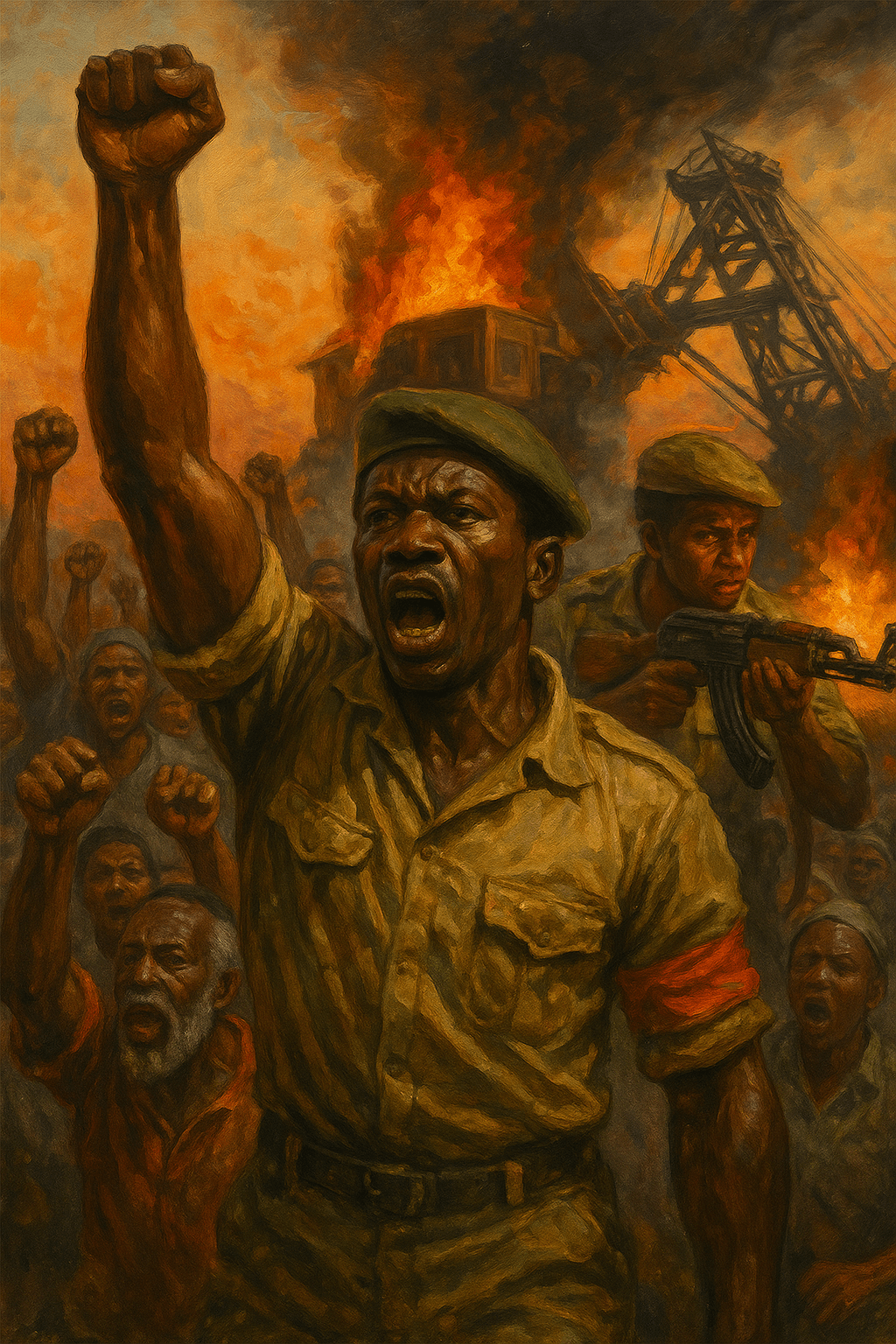
As revolutionary governments reclaim national wealth, imperial capital goes hunting for weaker prey
By Prince Kapone | Weaponized Information | May 7, 2025
Part I: The Propaganda of Plunder — How Reuters Sanitizes Neocolonial Flight
Reuters is not a neutral newswire. It is a British-based, Canadian-owned corporate information syndicate that exists to manage the ideological front lines of global capitalism. Operating under the parent company Thomson Reuters—a data analytics empire servicing the financial, legal, and surveillance sectors—it supplies sanitized propaganda to the world’s investors, banks, and imperial policy shops. It does not report on the plunder of Africa; it rationalizes it.
This particular dispatch, attributed to Maxwell Akalaare Adombila, follows a familiar trajectory. Adombila’s background includes reporting for Graphic Business and other pro-liberalization media in Ghana. His work has routinely framed foreign direct investment as Africa’s salvation, never its subjugation. Here, he functions less as a journalist and more as a stenographer for Fortuna Silver’s C-suite, broadcasting CEO Jorge Ganoza’s narrative with zero friction or interrogation.
We are told that Fortuna Silver is “eyeing opportunities” in Guinea after its “exit” from Burkina Faso, a framing that makes the imperial parasite sound like an adventurous tourist rather than a disgraced squatter fleeing eviction. The article laments the “regulatory instability” and “security costs” in Burkina Faso, but never names the real crisis: a sovereign people asserting control over their stolen gold. Nor does it explain why state equity demands of 30%—standard in anti-colonial policy—are portrayed as an unworkable burden.
Instead, we are handed a narrative of victimhood. Fortuna is cast as a responsible firm seeking “discovery” and “development,” while countries like Burkina Faso and Mali are made to sound like unruly children disrupting the family business. What is erased—intentionally—is the fact that these governments are responding to centuries of looting and decades of IMF-imposed underdevelopment. They are not unstable; they are decolonizing.
Note the linguistic softeners: coups are described as “military-run governments,” not as ruptures with colonial compradorism. Seizures of foreign mines are reduced to “new codes” and “tight deadlines,” rather than revolutionary policy to reclaim stolen national wealth. The revolutionary leaders of the Sahel—Traoré in Burkina Faso, Goïta in Mali, Tiani in Niger—are never named, as if to deny them legitimacy or vision. Instead, the only named actor is Ganoza, the CEO, whose capitalist voice narrates the entire piece.
Reuters’ coverage does not merely omit—it actively constructs a reality in which imperial extraction is normative and resistance is chaos. The reader is trained to sympathize with Fortuna’s loss of “70,000 ounces of gold,” not the millions of people deprived of the infrastructure and development those ounces could fund. Security costs are framed as a financial burden, not as the price of operating in a country no longer willing to sell its blood for pennies.
Meanwhile, Guinea is painted as the new “opportunity”—an obedient regime that has not yet upset the apple cart. By juxtaposing Guinea’s compliance with Burkina’s assertiveness, the article makes clear what capital considers “stable”: submission to looting. What is stable to the investor class is what remains colonized in fact, if not in name.
Part II: Gold, Guns, and Ghost Flights — Mapping the Material Terrain of Neocolonial Extraction
What Reuters calls an “exit” is better understood as a strategic retreat under fire—not from so-called jihadists, but from a rising tide of anti-imperialist sovereignty in the Sahel. Burkina Faso’s revolutionary government, led by Captain Ibrahim Traoré, is not “destabilizing” the mining sector. It is dismantling the imperial rentier economy built on centuries of theft. By demanding 30% state ownership of mining operations, Burkina Faso has violated the most sacred commandment of capitalism: thou shalt not touch foreign profit margins.
Fortuna Silver’s decision to cut and run was not dictated by bullets but by balance sheets. Its annual security costs ballooned to $7 million, a price not for safety—but for maintaining colonial extraction in a liberated zone. When Traoré’s government rewrote the mining code in July 2024, it didn’t create chaos; it asserted control over land and labor that had been stolen since the first shovel hit the dirt. What “foreign investors” call instability, colonized people call reclamation.
The imperialists aren’t just losing access—they’re losing control. In Mali, the government arrested foreign executives and seized gold reserves. In Niger, the state took back a uranium site once run by the French, cutting into Paris’s nuclear empire. Across the Sahel, AFRICOM and France’s Barkhane forces have been expelled, marking a tectonic shift in Africa’s political geography. The imperial center cannot hold, so it recalibrates: Fortuna flees southward, looking for weaker links in the neocolonial chain.
Enter Guinea. Still under military rule, but not yet rebellious. Still holding to a mining code shaped by colonial logic. Still willing to do business with firms like Fortuna, provided the profits keep flowing and deadlines are met. Guinea isn’t more stable—it’s more pliable. It has not yet followed Burkina Faso, Mali, or Niger in asserting state control over extraction. And so, it becomes the next “investment opportunity” for capital’s migration caravan.
This is how imperialist recalibration works: not through withdrawal, but through redirection. When one front of plunder becomes hostile, capital searches for softer terrain. The institutions and ideologues of hyper-imperialism—Reuters among them—supply the justifications. And as the resistance hardens, imperial extraction becomes more militarized, more securitized, more automated. We see the early infrastructure of technofascism: fly-in-fly-out labor, private mercenaries, remote-operated logistics, biometric checkpoints at mine perimeters.
Fortuna’s gold doesn’t just fund shareholders—it finances neocolonial continuity. The profits mined in Côte d’Ivoire and Senegal don’t stay in Africa. They are laundered through Toronto and London, reinvested in speculative markets, and reported in terms of ounces lost or gained—not lives exploited, water poisoned, or futures foreclosed. This is not development. It is necro-extractivism dressed up in ESG compliance reports and “discovery budgets.”
To understand the stakes, we must historicize the moment: the Sahel is not spiraling into crisis—it is rupturing from imperialist control. And the ruling class, through firms like Fortuna and outlets like Reuters, is trying to reframe this rupture as a threat rather than what it truly is: a long-overdue confrontation between imperialist plunder and anti-colonial power.
Part III: From Extraction to Eviction — Rewriting the Story from the Ground Up
Fortuna Silver wasn’t “investing” in Burkina Faso. It was squatting on stolen gold, profiting off land that colonialism never returned. Its presence was not a service but a siege—its departure not a loss, but a partial liberation. The company didn’t leave because it feared “jihadists.” It left because the people, through their state, raised the rent.
This is what anti-imperialist sovereignty looks like: rewriting mining codes, seizing foreign-controlled sites, and asserting that the wealth beneath African soil belongs to African people. Captain Ibrahim Traoré’s Burkina Faso is not a “security risk”—it is a revolutionary rupture in the global neocolonial architecture. It is what happens when the colonized begin to dictate terms.
And yet, in the Reuters frame, this liberation is a crisis. Sovereignty becomes “instability.” Redistribution becomes “regulatory overreach.” Self-defense becomes “terrorism.” These aren’t just misinterpretations—they are counterinsurgency tactics deployed through language. This is cognitive warfare: a class war fought on the terrain of narrative, perception, and ideological legitimacy.
Meanwhile, Guinea is cast as the new frontier—not for justice, but for exploitation. By contrasting Guinea’s “openness” to Fortuna with Burkina Faso’s “unpredictability,” Reuters sends a clear message to capital: invest where the state is still subordinate. Guinea is not celebrated for peace—it is rewarded for obedience. But that obedience is brittle. The fire that’s burned through the Sahel is heading south, and no ESG sticker can smother it.
The real story here is not about a company’s retreat—it is about a people’s advance. The crisis of imperialism is playing out in gold mines and copper pits, not just in stock markets and think tanks. And as the Global South rises, the imperialist core clings tighter to its narrative weapons, hoping propaganda can do what the gun and bank can no longer guarantee: compliance.
But even this story, told by Reuters, is beginning to crack. The readers know. In the comment sections—those neglected corners where proletarian clarity sometimes breaks through the digital fog—Africans call out the hypocrisy. They know Fortuna was chased out. They know who owns the gold. They know what this system is.
We must write with them, not about them. We must reject the imperialist grammar that makes plunder sound like policy and resistance sound like chaos. The Sahel isn’t failing—it’s fighting. And no amount of Reuters spin can turn that fire back into submission.
Part IV: From Solidarity to Strategy — What Revolutionaries Must Do Now
Revolution is not a spectator sport. Burkina Faso is not a symbol—it is a living frontline in the global class war. Its struggle is not just African—it is ours. As revolutionaries in the belly of the beast, we have a duty not only to understand this moment, but to intervene in it. The fight against Fortuna Silver and its ilk is not thousands of miles away—it is inside our pension funds, inside our banks, inside the imperialist governments that shield these firms from justice.
History reminds us that solidarity is not a slogan. When Amílcar Cabral and the PAIGC waged armed struggle in Guinea-Bissau, they were supported by Portuguese communists who sabotaged colonial military operations from within. When Sekou Touré broke with France and declared Guinea’s independence, it was dockworkers in Marseille and Le Havre who refused to unload retaliatory shipments. When Thomas Sankara revolutionized Burkina Faso in the 1980s, radical students and anti-apartheid activists in the West circulated his speeches, studied his policies, and built pressure against the IMF and World Bank.
And today? The material conditions demand no less. Traoré’s Burkina Faso has evicted French troops, rejected ECOWAS puppets, and rewritten the rules of extraction in favor of the people. That is revolutionary rupture. Guinea, though currently a haven for capital, is the land of Sekou Touré—the man who told De Gaulle to take his empire and leave, even if it meant building Guinea from scratch with no electricity, no medicine, and no outside help. That spirit lives on in the people—even under a junta—and it is our responsibility to support the masses, not the comprador elite.
So what can be done—here, now, from within the imperial core?
- Divestment Campaigns: Organize and pressure unions, universities, and municipalities to divest from Fortuna Silver, Barrick Gold, and other Canadian-Anglo mining parasites. Demand they cut financial ties to neocolonial extraction.
- Expose & Target Fortuna: Identify Fortuna’s board members, major shareholders, and lobbyists. Protest their AGMs. Leak their documents. Create public dossiers that shame and isolate them.
- Media Sabotage: Hijack the narrative. Flood social media with counter-propaganda that amplifies Burkina Faso’s revolution and exposes Reuters, Bloomberg, and other stenographers of capital.
- Direct Material Aid: Coordinate with African revolutionary organizations to channel funds, tech, education, and communication tools to grassroots organizers in Burkina Faso and Guinea. Material solidarity over performative sympathy.
- Build Dual and Contending Power: Infiltrate mining solidarity networks, create urban resistance hubs, and forge strategic unity between Black-led organizations in the U.S. and African movements abroad. Bring the revolution home.
We must never forget: the empire is brittle. Its wealth is stolen. Its power is fragile. Its propaganda is cracking. In every liberated inch of Burkina Faso, the ghost of Sankara walks again. In every strike, blockade, and classroom occupied here in the North, that spirit can be reborn. Let us not admire the revolution from afar—let us join it, feed it, and defend it.
The time for ideological solidarity is now. But solidarity without action is silence. Let us raise our voices, and then raise our fists. Fortune may favor the bold—but history favors the militant.
 Weaponized Information
Leave a comment