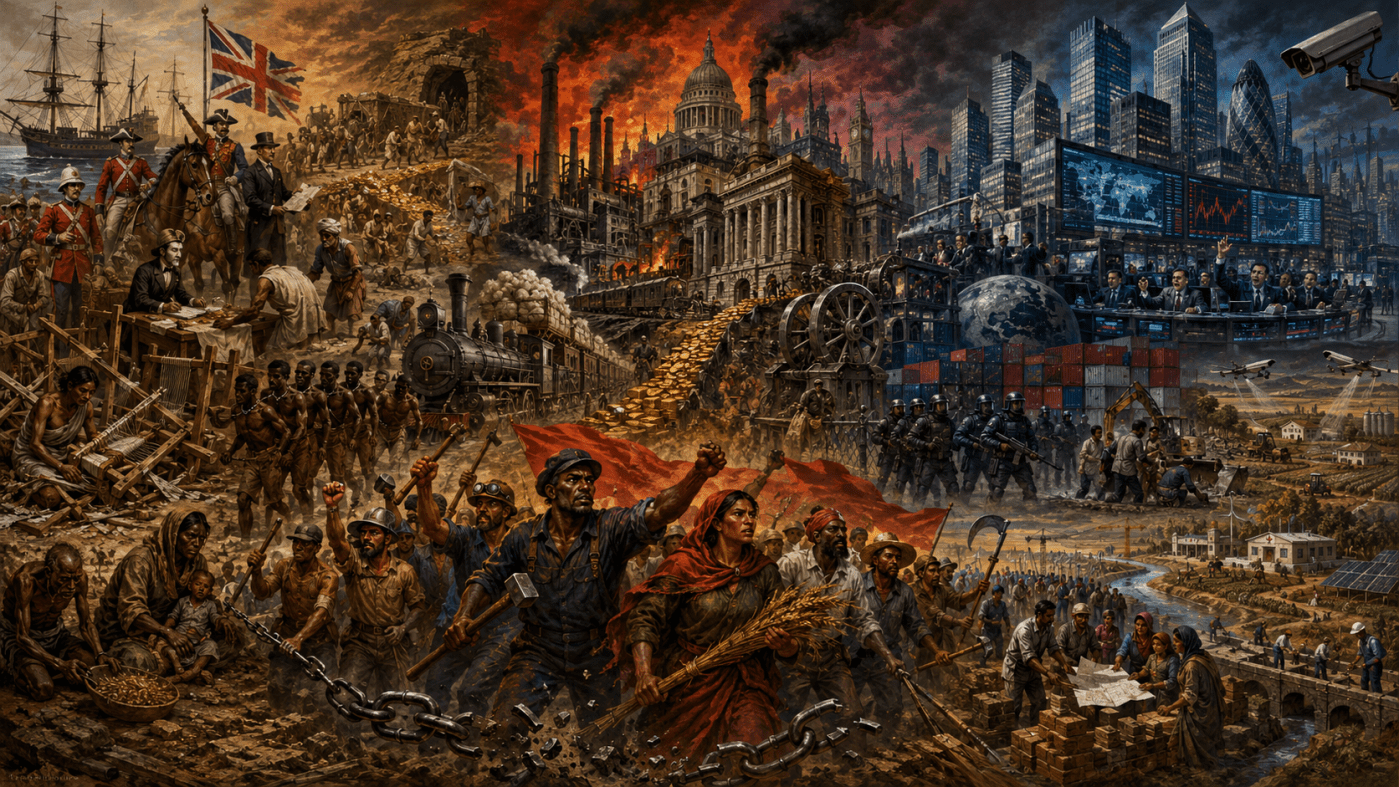
Utsa and Prabhat Patnaik shatter the closed-system mythology of bourgeois economics by showing that capitalism could never reproduce itself without subordinating the lands, labor and consumption of peoples beyond the metropolitan center. They reconstruct how colonial taxation, deindustrialization and the seizure of India’s external earnings financed European industrialization and settler expansion while manufacturing hunger and underdevelopment across the colonized world. When the old imperial arrangement fractured, capitalism descended into depression and colonial famine, only to survive through a postwar retreat that national liberation and organized labor imposed before mobile finance restored the economic discipline of empire under neoliberal rule. The book ultimately points toward the worker-peasant alliance, delinking and social control over finance, while leaving revolutionaries to confront the decisive unfinished question: what organized power can carry that program from the restraint of capital to its overthrow?
By Prince Kapone | Weaponized Information | Weaponized Intellects Book Review | July 26, 2026
The Closed-System Lie
Every ruling system invents a world in which it appears self-sufficient. Feudal lords found their harvest in the will of God. Capitalists commissioned a more mathematical miracle. In the textbooks, capitalism rises inside a sealed economy inhabited by workers and owners exchanging wages, commodities and profits under the neutral supervision of the state. The colonies vanish. The conquered peasant, ruined artisan and seized field vanish with them. Capital remains alone on the stage, taking credit for the scenery.
Utsa Patnaik and Prabhat Patnaik begin Capital and Imperialism by breaking open that sealed room. Capitalism, they write, emerged within a setting it entered, altered and bent toward its own reproduction; more decisively, “its very existence and expansion is conditional upon such interaction” (p. 7). The argument goes beyond saying that colonial plunder accelerated a capitalism already capable of standing on its own. The world outside the metropolitan factory belongs inside the theory because the factory cannot reproduce itself without subordinating that world.
The authors reach imperialism through money. A reader expecting colonial armies and plantations first encounters Say’s Law, involuntary unemployment and the wealth demand for money. The route is deliberate. They enter economic theory on its chosen ground and show that its isolated capitalism collapses before the first colony has even been returned to the map. As they state, “such an isolated capitalist economy simply cannot be a money-using capitalist economy in any meaningful sense” (p. 11).
Money does not pass automatically from every sale into another purchase. It can be held as wealth. Capitalists may prefer liquidity to investment, especially when markets weaken and factories already stand partly idle. Once money can be withdrawn from circulation, supply no longer creates its own demand. Goods remain unsold, production contracts and workers are dismissed even though society possesses both unmet needs and the capacity to satisfy them. Bourgeois economics treats this result as a malfunction caused by wages, regulation or mistaken policy. The Patnaiks locate it inside the normal operation of a capitalist economy in which money functions as actual money.
This changes the theory of accumulation. Capitalists add productive capacity when they expect markets to grow. Unused capacity discourages investment; reduced investment lowers employment and demand; weaker demand leaves still more machinery unused. Competition may compel each capitalist to accumulate wealth, but it does not compel anyone to build a factory for customers who cannot buy its products. Without an impulse entering this circle from outside, the system tends toward stagnation rather than permanent expansion.
Mainstream theory evades the problem by stripping money of its dangerous properties. Walras constructs an equilibrium world that barely needs money at all. Ricardo and the quantity tradition reduce it largely to a means of circulation. Keynes recognizes deficient demand but confines his breakthrough within an isolated capitalist sector, relying partly upon workers accepting changes in real wages without fully resisting them. The irrationality required to stabilize the theory is assigned, with customary elegance, to labor.
Marx comes far closer. He rejects Say’s Law, understands money as hoard and recognizes generalized overproduction. The Patnaiks’ criticism concerns the analytical architecture inherited from Capital, where the central reproduction schema can be read as capitalists and workers reproducing their relation internally while colonial dispossession remains historically important but theoretically supplemental. Later Marxists hardened that separation by confining primitive accumulation to capitalism’s prehistory. The Patnaiks reject the chronology: “primitive accumulation occurs throughout the history of capitalism” (p. 51). Dispossession does not prepare the stage and retire once wage labor enters. It remains one of the methods through which capital expands, repairs its conditions and transfers its crises onto weaker populations.
This is a reconstruction from within Marxism, not the familiar academic ceremony in which each specialist announces that Marx neglected the subject occupying the specialist’s desk. The authors preserve Marx’s discoveries and follow their implications beyond the isolated sector. If accumulation cannot sustain itself solely through demand already generated inside the system, then some independent stimulus must keep expansion moving. Innovation cannot reliably perform this role. New machinery may alter the form of investment, but firms do not necessarily enlarge total capacity when markets remain weak. The Patnaiks conclude that “the only two genuinely exogenous stimuli are state expenditure and the imperial arrangement” (p. 58).
The imperial arrangement does more than provide outlets for metropolitan goods. It also secures the primary commodities capitalism requires but cannot produce everywhere or in sufficient quantities: food, fibers, oils, minerals and other products tied to tropical and subtropical land. As accumulation expands metropolitan demand for these goods, their supply cannot always rise at the same pace. Land is finite. Irrigation, agricultural research and other land-augmenting measures require public investment. Colonial and capitalist states repeatedly refuse that investment when it would strengthen peasant producers rather than metropolitan capital.
The result is increasing supply price. Producing additional quantities requires more labor, poorer land or more costly extraction. If primary-commodity prices rise continuously, the consequences reach beyond a reduction in industrial profits. Wealth-holders begin expecting further price increases and shift from money into commodities. The value of money itself comes under pressure. Capitalism must therefore prevent the rising cost of indispensable goods from appearing fully inside the metropolis.
It accomplishes this by imposing a regime upon the regions supplying those goods. Their economies must remain open to metropolitan trade so commodities can be extracted. Capital must move freely so exchange-rate depreciation can insulate metropolitan currencies from inflation in the producing regions. Production must be redirected toward crops and materials required abroad. Most decisively, domestic absorption must be compressed. If output cannot increase sufficiently, workers and peasants in the producing country must consume less so that more becomes available for export.
This is the economic meaning of income deflation. It may be imposed through falling wages, taxation, austerity, unemployment, adverse prices or the destruction of public support for producers. Its specific mechanisms change, but its class content remains stable: the working population of the periphery absorbs the pressure generated by metropolitan accumulation. Capital protects the value of money and the command of wealth by reducing the command of colonized people over the goods they themselves produce.
The setting therefore performs several connected functions. Colonial markets provide demand. Appropriated transfers finance expansion. Peripheral labor reserves weaken the bargaining position of producers. Income deflation releases primary goods while restraining their prices in metropolitan currency. Armies, tax systems, financial institutions and colonial administrations enforce what economic theory later presents as exchange among free parties.
Here the Patnaiks give imperialism a definition broader than direct rule and more precise than a general language of domination. “Imperialism is a relationship between capitalism and its setting,” they write (p. 81). Its political form can change without removing its economic necessity. A colony may become formally independent. A domestic capitalist class may grow wealthy. Workers in the metropolis may lose earlier protections. Capital still requires access to land, labor, markets and primary goods under conditions that subordinate the consumption and development of the producing regions.
The formulation is powerful because it places empire inside capitalist reproduction. It must also be handled without making one mechanism swallow the whole phenomenon. Imperialism secures more than stable commodity prices and monetary wealth. It seizes territory, destroys rival social systems, monopolizes technology, creates racial hierarchies and organizes military command. The supply-price argument reveals a central economic necessity of empire. The larger history shows that this necessity can be imposed only through political and coercive power.
The phrase “pre-capitalist setting” carries a related tension. The authors insist that capital transforms the world it enters. Peasants, artisans and colonized societies are not untouched remnants waiting outside history. Centuries of taxation, commodity production, debt, landlordism, dispossession and wage labor make this setting neither pristine nor simply external. It is an uneven field of relations repeatedly reorganized by capital without being remade in the metropolitan image.
Once the closed-system lie is abandoned, imperialism can no longer be filed under foreign affairs while economists return to the supposedly serious business of money, prices and accumulation. The peasant enters the value of money. The colony enters metropolitan growth. The reserve army extends across continents. The state enters the market carrying a tax bill, a railway guarantee and a rifle.
Capital did not overcome the contradictions of the isolated system. It constructed an imperial world in which other peoples could be forced to absorb them. The historical question now becomes unavoidable: whose industries were destroyed to create metropolitan markets, whose surplus financed capitalist expansion and whose consumption was compressed so that Europe could mistake conquest for self-generated progress?
The Colonial Construction of Capitalism
Europe remembers capitalism as a domestic achievement. Improved agriculture releases labor, private property rewards thrift, invention multiplies productivity and the factory system carries a self-generated civilization outward. The colonies appear only after Europe has completed the difficult work of becoming modern. They supply raw materials, purchase manufactures and occasionally embarrass the national conscience, but they do not enter the machinery that supposedly produced capitalist development itself.
The Patnaiks reverse the sequence. Capitalism did not first build itself inside Europe and later acquire an empire. Colonial command helped construct the markets, transfers, labor reserves and international payments system through which metropolitan accumulation became possible. The capitalist state was never merely the night watchman of economic theory. Protectionism, conquest and the acquisition of colonies or “economic territory,” they write, “has been a feature of capitalism throughout its life” (p. 85). The state secured the conditions of accumulation long before twentieth-century economists discovered state intervention as a response to market failure.
This changes the historical question. We no longer ask why governments interfered with an otherwise autonomous capitalism. We ask how political and military power produced the world capitalism required. Colonies of conquest supplied taxes, markets, export goods and monetary transfers. Colonies of settlement opened vast territories to European migration and investment through the expulsion, confinement and destruction of Indigenous peoples. These forms differed, but they belonged to one international arrangement: conquered tropical societies helped finance accumulation across the temperate regions seized and settled by Europeans.
The argument begins by confronting the mythology of Britain’s internal transformation. Conventional histories grant the eighteenth-century “Agricultural Revolution” a heroic role: rising productivity supposedly fed the towns, released labor and created the conditions for industry. The Patnaiks do not claim that British agriculture stood still. They challenge the scale and causal status assigned to its transformation. The agricultural-revolution thesis, they argue, “has the effect of obscuring the actual role played by colonialism” (p. 101).
Industrialization required more than workers driven from the countryside. Urban populations had to be fed. Industry needed fibers, dyes, oils and other primary commodities. Animal power required feed, while rising metropolitan incomes increased demand upon the land. Britain’s domestic agriculture could not satisfy all these requirements without confronting serious limits. Empire widened the effective land base of British capitalism beyond Britain itself. Tropical and subtropical producers supplied goods that the metropolis could not produce, could not produce year-round or could not produce in sufficient quantities.
The colonies also supplied markets, but not through a peaceful encounter between equally placed producers. Metropolitan manufactures entered societies already subjected to colonial taxation, commercial regulation and political force. Local artisans confronted factory goods backed by an imperial state able to alter tariffs, redirect credit and reorganize trade. Their displacement was then recorded as the victory of efficiency over backwardness, as though the commodity alone had defeated them.
Deindustrialization performed two linked functions. It opened markets for metropolitan manufactures and drove ruined producers toward agriculture, casual labor and unemployment. Pressure upon land increased. Labor reserves expanded. The bargaining position of peasants, workers and petty producers weakened. Colonial poverty did not persist because capitalism had not yet arrived. It was produced through the particular form in which capitalism arrived: destroying existing occupations without creating sufficient alternative employment.
For this reason the authors describe colonialism, among the regimes capitalism constructed around itself, as “the ideal one from its point of view” (p. 115). Direct rule gave the metropolis extraordinary authority over taxation, trade, production and the use of external earnings. Colonial populations could be compelled to export commodities while being denied command over the proceeds. The colony had to meet metropolitan requirements before reproducing the life of its own people.
The relationship among Britain, the tropical colonies and the regions of white settlement reveals the full architecture. European migrants and capital entered the United States, Canada, Australia and New Zealand, where settler expansion demanded railways, ports, farms, roads and cities. These economies supplied food and raw materials to Europe and gradually developed manufactures of their own. Britain increasingly imported from newly industrializing Europe and the settler regions while exporting capital to them. The tropical colonies supplied the surpluses that allowed Britain to settle these external obligations.
India occupied a decisive position within this system. British manufactures entered its market as Indian craft production was undermined. Indian producers generated substantial commodity export surpluses. Yet those earnings did not return to India as foreign exchange available for imports, machinery, irrigation or industrial development. Colonial taxation supplied the rupees used to purchase export goods inside India, while the foreign-exchange earnings generated by those exports were appropriated in London.
The transaction looked like ordinary commerce only because colonial power divided it into separate operations. Indian taxpayers financed the purchase of Indian commodities. Foreign buyers paid for those commodities in gold or foreign exchange. Britain claimed the external payment. The colonized producer received money raised from the colonized population itself, while the empire acquired command over resources abroad.
The Patnaiks place this mechanism inside the history of Europe’s industrial ascent. “The West European powers appropriated economic surplus from their colonies,” they write, and this “materially and substantially aided their industrial transition” (p. 128). Industrialization at the center and deindustrialization at the periphery were not separate national experiences. Metropolitan development drew strength from the restriction of colonial development. The rise of one region cannot be explained apart from the enforced reorganization of the other.
The drain therefore involved more than unfavorable prices. It included the unrequited appropriation of export earnings. India exported more than it imported, but the surplus did not accumulate as Indian reserves or finance productive transformation within India. The “overwhelming bulk” of the earnings generated through India’s commodity export surplus, the authors write, was “successfully intercepted and appropriated by the metropolis” (p. 143). Britain converted colonial taxes and administrative authority into command over India’s external earnings, then assigned imperial expenses and sterling obligations to India’s account.
This mechanism also overturns the standard image of British capital export. Metropolitan history presents Britain as a nation whose internally accumulated savings financed railways, infrastructure and industry across the world. The Patnaiks show that Britain’s ability to export capital depended partly upon resources extracted through the empire. Britain ran deficits with Continental Europe, the United States, Canada and other regions receiving British investment. Its surpluses with the tropical colonies, especially India, helped settle those deficits.
British capital exports that accelerated the construction of “roads, railways, and factories in Continental Europe, the United States, and Canada,” they argue, “depended crucially on Britain’s ability to siphon off India’s gold and foreign exchange earnings” (p. 159). The capital sent into the temperate settler world was therefore not produced solely through British abstinence or metropolitan productivity. Behind a portion of it stood taxes levied in India, commodities produced in India and foreign exchange denied to Indian development.
The empire could then lend capital back to the colony. India’s own external earnings were appropriated, while infrastructure inside India was financed through borrowing in London and guaranteed returns to foreign investors. Colonial administration presented this as British investment in Indian development. The underlying relation was the opposite: India financed imperial accumulation and then paid interest for access to capital accumulated partly through its own dispossession.
The effects of this arrangement cannot be measured only through sterling balances. A country exporting goods without receiving an equivalent return loses command over what its people have produced. Colonial exports may rise while domestic consumption falls. Railways may expand while the food they carry moves away from those who need it. Government expenditure may appear in national accounts even when it serves imperial administration rather than popular development.
The Patnaiks therefore connect the drain to stagnant per capita income, mounting pressure upon agriculture and declining food-grain absorption. The balance of payments was written into the diet of the poor. What appeared in London as an external surplus appeared in India as diminished command over food, investment and the means of production.
This is the colonial construction of capitalism: markets opened through deindustrialization, labor reserves enlarged through displacement, tropical goods extracted from subordinated producers and external earnings transferred into metropolitan accumulation. The same arrangement assisted European industrialization and settler expansion while narrowing the productive possibilities of the colonies that helped finance them.
The system could sustain expansion only while its political and economic parts remained aligned. Britain required colonial markets, transferable surpluses and a monetary order capable of connecting them to its deficits and capital exports. New industrial powers, settler development, political resistance and instability in agriculture began to strain those relations. When the arrangement weakened, the capitalism that had credited itself with autonomous dynamism would discover how much of its movement had depended upon imperial supports it had trained economic theory not to see.
Breakdown, Depression, and Imperial Famine
The prosperity of an imperial order appears self-generated only while the machinery beneath it remains intact. Once that machinery breaks, economists begin searching for isolated mistakes: a monetary contraction here, a speculative collapse there, insufficient confidence everywhere. The Patnaiks return the crisis to the structure that had sustained the preceding boom. Capitalism did not merely suffer a downturn after the First World War. It lost the arrangement through which Britain had coordinated markets, transfers, capital exports and international payments.
By the “colonial arrangement,” they mean “the entire network of relationships that prevailed in the latter half of the nineteenth century” (p. 173). The word network prevents the argument from collapsing into a history of British possessions alone. Colonial markets absorbed metropolitan manufactures. Unrequited transfers helped Britain finance deficits and export capital. European migration and investment expanded settler economies. Sterling connected these flows under a monetary order backed by imperial command. Each relation supported the others.
The First World War fractured this system. Britain emerged weakened relative to the United States and other industrial powers. Settler economies developed industries that reduced their dependence upon British manufactures. Japan pressed into Asian markets. Colonial resistance made the old terms of command harder to enforce. Agricultural prices collapsed, yet colonial tax demands and sterling obligations remained. The peasant received less for the crop while the empire demanded the same money tribute.
This imposed a particularly destructive form of deflation upon the colonies. Falling prices reduced rural incomes and domestic demand, but colonial governments continued extracting the resources required for debt payments, administrative expenses and remittances abroad. The metropolitan states could contemplate deficits and public expenditure as responses to depression. The colonies were compelled to generate surpluses for the metropolitan financial system. The country most in need of relief was ordered to tighten the belt already cutting into its flesh.
The Patnaiks therefore argue that “the unraveling of the colonial arrangement…not only brought the long Victorian and Edwardian booms to an end but plunged the world economy into the Great Depression” (p. 185). The force of the argument lies in what it restores to the history of the crisis. Explanations centered upon credit, profitability, overproduction, the gold standard, agricultural collapse or the absence of international leadership examine real processes. What they commonly omit is the imperial structure that had previously mediated those contradictions.
The colonial-arrangement thesis should not be turned into a new monocausal mythology. Capitalist crises do not respect the tidy borders of academic specialization. Falling profits, debt, monetary deflation, collapsing commodity prices, weak investment and shrinking demand reinforced one another. The Patnaiks’ intervention is decisive because it shows that the breakdown of empire’s economic architecture belonged inside that chain. The problem was not simply that one hegemonic power declined before another accepted responsibility. British “leadership” had rested upon conquered markets and appropriated surpluses that no successor could reproduce in precisely the same form.
Interwar capitalism had, in the authors’ phrase, “run out of props” (p. 199). The old colonial arrangement no longer generated expansion as before, while large-scale state expenditure had not yet been politically established as an alternative source of demand. Private investment could not revive an economy whose markets remained depressed. Innovation did not rescue production from the absence of purchasers. The liberal states denounced public spending until rearmament and war supplied it under another name.
The Second World War ended the demand crisis in the metropolitan economies, but imperial power determined how the expenditure would be financed. India was drawn into Britain’s war without the consent of its people and compelled to bear enormous military costs. The colonial government expanded expenditure through monetary creation, raising prices far faster than wages and fixed incomes. Goods were redirected toward military purposes while the purchasing power of workers, laborers, artisans and poor peasants collapsed.
“The policy of profit inflation was deliberately followed by the British and colonial governments,” the Patnaiks write, “with a specific purpose: to raise resources from the Indian population by curtailing mass consumption in order to finance the Allies’ war in Asia with Japan” (p. 202). The policy did not merely permit inflation. It used inflation to redistribute command over goods. Prices rose ahead of mass incomes, forcing the poor to reduce consumption and releasing resources for the war effort.
The term forced savings gives this operation a polite economic name. Those deprived of food did not accumulate savings. Their reduced consumption created a surplus controlled by the state and used for purposes they had not chosen. The population sacrificed; the empire held the claim. The accounting category concealed a class transfer carried out through the erosion of real income.
Britain financed war differently at home because British workers possessed organizations capable of resisting unrestricted profit inflation. Trade-union pressure helped force greater reliance upon taxation, rationing and protections for lower-income households. Colonial India possessed no comparable power over the government making the decision. The contrast exposes the material relationship between metropolitan democracy and colonial dictatorship. Political rights in the center restricted how much could be extracted from British workers; their absence in India made the colonized population available for far greater sacrifice.
The Bengal famine followed from this political economy. Wartime disruption, speculation and local supply problems affected the crisis, but they cannot explain why millions lost access to food while military expenditure expanded purchasing power elsewhere. The crucial question was not whether food existed in the abstract. It was which classes retained the money and political authority to command it. Colonial policy deliberately shifted that command away from the mass of the population.
The authors write that “the extreme compression of mass demand to raise forced savings…led to three million civilian deaths” (p. 218). This formulation refuses the comforting distance created by the word famine. No natural shortage independently selected the victims. A colonial state reduced the real claims of the poor upon available goods so that imperial war could be financed without imposing equivalent burdens upon the metropolitan population.
The violence remained easy to disguise because it operated through budgets, prices and markets. No official order instructed three million people to die. The state expanded military demand, allowed food prices to outrun mass incomes and withheld the protections that could have defended consumption. Death then appeared as the impersonal outcome of scarcity. Imperial policy created the conditions; the market delivered the sentence.
This is the point at which the book’s monetary theory becomes a theory of organized mass violence. Demand management is often remembered as the humane correction of capitalism, the state raising employment when private investment fails. Colonial rule revealed its opposite. The state could manage demand downward, strip purchasing power from the poor and turn inflation into an instrument of extraction. Economic administration did not stand outside coercion. It became one of coercion’s most efficient forms.
The old colonial arrangement could no longer reproduce the long nineteenth-century boom, but its breakdown did not emancipate those trapped within it. During war, imperial power used the colony as a reservoir of finance and sacrifice. After the war, this method of rule faced a world transformed by socialist power, militant labor and national liberation. Capitalism would survive, but it could no longer simply restore the arrangement whose crisis had ended in depression and whose wartime defense had ended in famine.
Decolonization and the Temporary Restraint of Capital
The postwar settlement did not emerge because capital discovered compassion. The ruling classes faced a balance of forces they could no longer ignore. The Soviet Union had survived invasion and broken the Nazi war machine. Communist parties and militant unions carried immense authority. Colonial soldiers returned from imperial wars unwilling to resume colonial obedience. National liberation movements advanced across Asia and Africa, while workers in the capitalist centers refused another cycle of unemployment, fascism and slaughter. Capital conceded because organized people had made the old order dangerous to preserve.
Formal independence opened the struggle over the substance of sovereignty. Flags and parliaments did not return mines, plantations, banks, shipping routes or foreign-exchange earnings already tied to metropolitan accumulation. Political decolonization became materially threatening when newly independent states attempted to control resources, protect domestic production, direct investment and reduce their dependence upon imperial finance. The Patnaiks write that “political decolonization was followed by economic decolonization against which the metropolitan countries fought bitterly,” including through coups against leaders who nationalized resources and invasions of states that challenged imperial command (p. 222).
The distinction is essential. Imperialism could tolerate constitutional independence more easily than economic sovereignty. A former colony remained useful if its property relations, production pattern and external accounts continued serving metropolitan capital. Once national liberation reached beneath the flag toward oil, land, copper, banking and trade, liberal respect for self-determination disappeared. The ballot remained sacred until it touched the balance sheet.
Yet the violence directed against economic decolonization should not be mistaken for proof that imperialism retained its earlier security. Newly independent states protected domestic markets, built public enterprises, regulated foreign investment and expanded expenditure on irrigation, industry and infrastructure. Socialist assistance and nonalignment widened their room for maneuver. The old colonial regime had been broken, even where the social forces created under colonialism continued to obstruct deeper transformation.
Inside the advanced capitalist countries, organized labor and the prestige of socialism forced another retreat. Governments assumed responsibility for employment and aggregate demand. Public investment, welfare provision, progressive taxation and restrictions upon capital mobility reduced the power of finance and supported rising mass consumption. The authors are precise about the reach of this achievement: postwar state intervention “overcame one particular problem that had arisen with the end of the prop of colonialism, namely the problem of deficiency of aggregate demand” (p. 236).
The qualification matters. Demand management did not abolish capitalism’s other contradictions. It prevented private stagnation from automatically producing mass unemployment by supplying expenditure from outside the ordinary investment decisions of capitalists. In the United States, military spending performed much of this work. Weapons orders created demand and employment without placing large areas of civilian production under public control. The state sustained accumulation while presenting the subsidy as national defense.
Postwar expansion in the centers interacted with dirigisme across the newly independent world. Public sectors constructed infrastructure and productive capacity where private capital lacked either the means or the interest to act. Protection gave domestic industries room to develop. Agricultural investment could enlarge output rather than extracting additional supplies by reducing popular consumption. These measures remained uneven and compromised, but they opened economic possibilities colonial rule had deliberately foreclosed.
The Patnaiks therefore reject the claim that the 1950s and ’60s were merely imperialism operating under a softer disguise. They describe the period as “a loosening of the imperialist knot, when imperialism could not impose its will on the third world” (p. 247). This formulation restores historical agency to socialism and national liberation. If every nationalization, land reform or public industry is dismissed in advance as another form of imperial control, then the oppressed can never alter history; they can only change the costume worn by defeat.
The loosening was real but incomplete. Many postcolonial states inherited concentrated landownership, weak internal markets and bourgeois classes eager to convert public investment into private accumulation. Industrial protection and state expenditure raised growth without necessarily transforming property in the countryside. Landlords and capitalists demanded infrastructure, credit and subsidies while resisting the taxation needed to finance them. Governments increasingly relied upon indirect taxation and deficits, shifting part of the burden onto workers and poorer producers through inflation.
The contradiction was not excessive generosity toward the masses. It was an attempt to develop productive capacity without breaking the power of classes that appropriated the benefits of development. Public expenditure widened the market; concentrated property narrowed it. The state created opportunities for accumulation; the propertied classes resisted surrendering the surplus needed to sustain the process. Where agrarian transformation remained shallow, the expansion of rural demand and productive investment also remained limited.
The postwar compromise faced pressure in the metropolis as well. High employment strengthened workers’ bargaining power. Real wages rose, unions expanded and social claims upon output increased. Capital wanted the demand generated by full employment without the political strength full employment gave labor. At the same time, growing production increased demand for primary commodities, reviving pressures that could not be resolved through demand management alone.
The authors condense the limit of the whole arrangement when they write that “‘controlled capitalism’ could not withstand the ‘spontaneity’ of this mode of production” (p. 235). Regulation restrained capital’s movement without abolishing the compulsion to escape restraint. Firms resisted taxation, finance sought greater mobility and property owners opposed every institution that converted private surplus into public capacity. The postwar order had altered the terms under which capital operated; it had not displaced the class that commanded accumulation.
This is why the period cannot be understood either as capitalism’s humane maturity or as an empty illusion. It produced real gains because workers, socialist states and anti-colonial movements imposed limits upon capital. Those gains remained vulnerable because the social power of capital survived inside the settlement. The public sector expanded, but private wealth retained the ability to obstruct investment. Political independence advanced, but colonial economic structures persisted. Full employment strengthened labor, but ownership remained concentrated.
The postwar boom was therefore not proof that capitalism had finally learned to govern itself. It was the product of a historical retreat forced upon it. Once finance regained the ability to move beyond national controls, it acquired the means to punish governments, weaken labor and reverse the concessions won during the preceding decades. The temporary restraint of capital had improved millions of lives. Its instability revealed that restraints survive only as long as the forces capable of imposing them remain stronger than the property relations they leave intact.
Finance Restores the Colonial Function
Neoliberalism did not arrive by removing politics from the economy. It reorganized politics around the freedom of finance. The institutions built under the postwar compromise had treated employment, public investment, agrarian protection and social provision as legitimate claims upon the state. Internationally mobile capital reversed the direction of command. Governments would now be judged by creditors, currency markets and corporations capable of moving investment beyond national control. The electorate could still choose a government. Wealth acquired the power to veto its program.
The International Monetary Fund became one of the principal instruments of this transformation. Created to assist countries facing temporary balance-of-payments problems, it increasingly imposed structural adjustment upon indebted states. Public enterprises had to be privatized, subsidies reduced, trade barriers dismantled and domestic economies opened to foreign capital. The Patnaiks describe the IMF as “an instrument of international finance capital” (p. 258). The phrase identifies more than institutional bias. It locates the Fund inside a class project: national economic policy was subordinated to the security and mobility of financial claims.
Structural adjustment presented this surrender as technical necessity. Budgets had to be balanced, regardless of unemployment or hunger. Agriculture had to face world prices, regardless of subsidies enjoyed by producers elsewhere. Public industries had to prove profitability, while private creditors required protection from the consequences of their own lending. The language of discipline concealed a transfer of sovereignty. The debtor did not merely promise repayment; it accepted external authority over expenditure, production and the conditions of popular life.
The Patnaiks condense the neoliberal contradiction with exceptional precision: “Neoliberalism fulfills the role of colonialism that Keynesianism could not, but in the process it fails to fulfill the role that Keynesianism had done” (p. 263). Colonialism had compressed peripheral consumption, opened economies to metropolitan goods and capital, and restricted the ability of colonized populations to command the primary commodities they produced. Postwar dirigisme had loosened this discipline while sustaining demand through public expenditure. Neoliberalism restored income deflation in the periphery but dismantled the institutions that had supported mass demand and capitalist expansion.
This is the key to the period. Neoliberalism can force wages downward, cut public consumption, weaken peasants and open new fields for private accumulation. These measures improve the position of capital against labor and petty production. They also reduce the purchasing power required to realize the commodities capital produces. The more successfully finance defends profits from popular claims, the more thoroughly it recreates the demand problem that postwar intervention had partially contained.
None of this represents the disappearance of the state. “Neoliberalism entails not a retreat or a withdrawal of the state,” the authors insist, but a change in “the nature of state intervention” (p. 267). The state remains active in enforcing contracts, rescuing banks, privatizing public property, dismantling labor protections and opening agriculture to corporate penetration. It ceases to appear as an instrument through which organized workers and national movements can impose limits upon capital and becomes more openly the machinery through which capital imposes limits upon society.
The changed state attacks petty production with particular force. Peasants and small producers had depended upon price supports, public credit, procurement, trade protection and investment in irrigation or infrastructure. These measures never abolished exploitation or agrarian differentiation, but they restricted the speed at which large capital could destroy producers and seize their markets. Structural adjustment removed those defenses. Corporate power entered through seeds, credit, processing, distribution and foreign competition. The peasant remained legally independent while losing control over nearly every material condition of production.
Primitive accumulation therefore continued without requiring the restoration of formal colonial rule. Debt, falling producer prices, privatization and corporate encroachment separated people from land and livelihoods. Those displaced entered a labor market unable to absorb them into secure employment. The reserve army expanded across informal work, migration, temporary labor and chronic unemployment. Capital gained access to a larger workforce precisely because it required only fragments of that workforce at any given time.
The international mobility of production intensified this discipline. Capital could compare labor forces, shift investment and threaten relocation. Labor remained divided by borders, citizenship and unequal wage structures. Workers in lower-wage regions entered global production under conditions attractive to capital because those conditions were insecure. Workers in the older industrial centers were told that resistance would send their employment elsewhere. International production brought workers into one system while capital used national division to bargain against them separately.
The resulting inequality was not merely an unjust distribution appended to otherwise healthy growth. It weakened the mechanism through which output could be sold. Wages stagnated, petty producers lost income and governments reduced expenditure. A larger share of social output accrued to those least likely to spend it upon ordinary consumption. Capital accumulated claims upon wealth while narrowing the market for the goods through which profit had to be realized.
Finance bridged this contradiction through debt and asset inflation. Households borrowed against future income. Property and stock values rose. Corporations and wealthy individuals treated appreciating assets as additional wealth, sustaining consumption and investment without any equivalent restoration of wages or public provision. “Bubbles,” the Patnaiks write, “constitute the very mechanism through which growth is generated under neoliberal capitalism” (p. 295). Speculation is therefore not an excrescence attached to a productive system functioning beneath it. It becomes one of the methods by which deficient demand is temporarily overcome.
But a bubble cannot become a permanent market. Asset prices depend upon expectations of further increases, and debts ultimately depend upon incomes weakened by the very regime the bubble supports. When expansion ends, the state that had pleaded helplessness before unemployment suddenly recovers extraordinary powers. Banks are rescued, private liabilities absorbed and financial markets supplied with liquidity. The intervention prevents the immediate destruction of financial wealth without restoring the popular incomes whose weakness produced dependence upon the bubble.
Neoliberalism can therefore preserve financial institutions more easily than it can generate a stable basis for accumulation. Public power rescues the owners of claims while austerity continues against those who produce the underlying wealth. The system survives each crisis by protecting the structure that created it. Recovery becomes weaker, inequality becomes deeper and another round of speculation begins under still more fragile conditions.
The political consequences emerge from this stagnation. Workers confront insecurity, declining expectations and the erosion of protections won through earlier struggle. Peasants face debt and corporate control. Small enterprises are squeezed by monopoly. The ruling order cannot offer broad material improvement, so it redirects anger away from property relations and toward enemies fabricated within the population. Migrants, minorities, foreign nations and radical movements are blamed for a social decline produced by capital’s own victory.
“Neoliberalism thus creates conditions propitious for fascism,” the authors write (p. 306). Fascism does not descend upon capitalism from an irrational world outside economics. It recruits from the wreckage produced by capitalist development, mobilizing threatened and dispossessed strata while preserving the property relations responsible for their insecurity. Rage is encouraged, but its target is changed. The ruined petty producer is invited to attack the migrant rather than monopoly; the unemployed worker is offered national supremacy instead of social power.
The book properly distinguishes fascism from authoritarianism by emphasizing its mass character. Its framework also invites a further question about the machinery through which monopoly power now organizes society. Platforms, financial systems and digital technologies increasingly mediate employment, communication and access to public life. These developments do not eliminate the need for fascist mobilization or state coercion. They enlarge the technical capacity through which labor can be disciplined, political visibility controlled and resistance isolated. This extension requires its own evidence, but the direction of inquiry follows from the Patnaiks’ insistence that fascism grows from the impasse of capital rather than from bad ideas floating above it.
A second unresolved problem concerns the relation between globally integrated finance and rival capitalist states. The authors argue that “international finance capital contributes toward a muting of ‘inter-imperialist rivalry’” (p. 268). This captures a real unity of interest among financial oligarchies: open capital movements, secure property, disciplined labor and protection from national democratic control. Yet finance still relies upon currencies, laws, central banks, military power and states whose capacities remain profoundly unequal.
Integration does not require harmony. Capital may circulate internationally while rival states struggle over markets, technology, resources and control of the institutions governing that circulation. A shared imperial order can contain conflict over who commands it. The Patnaiks’ formulation therefore needs extension rather than simple reversal. International finance binds ruling classes together, but it does not abolish the state system through which capital enforces its interests and distributes power unevenly.
This tension also clarifies why neoliberalism can coexist with selective protection, militarism and state planning. Capital demands exposure to competition for workers, peasants and weaker economies while seeking public shelter for strategic monopolies and financial institutions. The doctrine promises a universal market. The actual regime differentiates between those who must submit to discipline and those whose power the state is organized to preserve.
Finance has restored much of colonialism’s economic function without restoring the old colonial arrangement’s capacity to sustain expansion. It can compress consumption, destroy producers, open markets and force governments to honor private claims. It cannot create prosperity by reducing the mass of people able to purchase what the system produces. Its triumph over labor becomes its failure as an accumulation regime.
The crisis is therefore not the result of neoliberalism departing from its principles. It arises from those principles operating successfully through class power. The freedom of capital has become the unfreedom of society. The question is no longer how to persuade finance to exercise its command responsibly, but what alliance can break that command before stagnation, fascism and war become the system’s only remaining forms of motion.
The Worker-Peasant Road Beyond Capital
If primitive accumulation continues throughout capitalism, socialism must be judged by how it treats the producers capital marks for destruction. The decisive question is not whether a new government can raise output faster than the old one. It is whether workers, peasants and petty producers gain collective command over the conditions of life, or whether dispossession continues beneath a different flag.
The Patnaiks state the dividing line plainly: “Socialism rejects primitive accumulation,” while capitalism possesses an “immanent tendency” to inflict it (p. 325). Capital separates people from land, tools and livelihoods, then presents the resulting dependence upon wage labor as modernization. Socialism cannot accept this destruction as useful preparatory work. It must defend petty producers against capital while creating the material conditions through which isolated production can be transformed voluntarily into cooperative and collective forms.
This position cuts against the productionism that measures historical progress by the multiplication of factories, machinery and commodities. Productive forces do not carry a socialist character stamped upon their steel. A project may enlarge output while concentrating property, disciplining labor and expelling peasants. Development becomes socialist only through the class relations governing it: who controls investment, whose needs organize production and whether expanded capacity strengthens collective power or private accumulation.
The same standard prevents romanticism about small production. Peasant property can reproduce inequality, patriarchy, exploitation and market competition. Rich peasants may accumulate at the expense of poorer cultivators. Traders, creditors and landlords can dominate formally independent producers. The Patnaiks do not propose freezing the countryside in its existing form. They distinguish two roads of transformation. Capital collectivizes property in private hands by ruining producers. Socialism must collectivize through security, persuasion, cooperation and material advantage.
This distinction places the worker-peasant alliance at the center of transition. The industrial worker confronts exploitation through the wage relation. The peasant and petty producer confront debt, adverse prices, corporate markets and the threat of dispossession. These are not separate struggles assigned to different historical eras. They arise within one system that extracts surplus from wage labor while continually attacking independent producers.
The authors therefore insist that “the tendency of skepticism toward a broad worker-peasant alliance that is so prevalent within the Marxist tradition has to be overcome” (p. 328). The alliance is not an electoral arithmetic in which one constituency is added to another. It is the class bloc capable of fighting exploitation and primitive accumulation together. Without the working class, agrarian resistance can remain trapped within private property and local defense. Without the peasantry, socialism abandons millions of producers to capital and narrows revolution to those already gathered inside large-scale industry.
The alliance acquires strategic content through a program of land reform, public investment, cooperatives and universal economic rights. Concentrated landownership must be broken. Irrigation, research, credit and infrastructure must raise agricultural productivity without squeezing peasant consumption. Public procurement and price support must protect producers from monopoly traders and corporate buyers. Cooperation must offer greater security and productive capacity than isolated competition, not arrive as an administrative order imposed upon people already stripped of alternatives.
Such a program immediately encounters finance. A popular government that taxes wealth, expands employment, protects agriculture and enlarges social expenditure will be judged intolerable by capital long before it announces the abolition of private property. Money will move abroad, investment will be withheld and pressure will fall upon the currency. The celebrated neutrality of the market means that property reserves the right to overturn political decisions by fleeing from them.
A government that remains committed to its social base therefore “has to put restrictions sooner or later upon the free flow of finance out of the country” (p. 330). Capital controls are not an optional badge of radicalism. They follow from the attempt to govern for people whose needs conflict with the demands of international wealth. Either the government controls finance, or finance disciplines the government until its popular program has been emptied out.
This first restriction generates further necessities. If capital flight reduces access to foreign exchange, imports must be prioritized. Trade controls become necessary. Strategic goods must be produced domestically or secured through political alliances that do not demand surrender in return. An investment strike by private capital requires expansion of the public and cooperative sectors. Each defensive measure reveals another area in which society has been made dependent upon the permission of property.
Delinking therefore develops through confrontation. It is not autarky, national self-worship or withdrawal from the world. A society cannot escape international exchange, nor should it aspire to reproduce every good within its own borders. The issue is whether participation in the world economy remains governed by the mobility of finance and the demands of monopoly, or whether trade and investment are subordinated to a popular development program.
The class content of delinking is decisive. A capitalist government may restrict imports, subsidize domestic monopolies and invoke sovereignty while intensifying exploitation at home. That is not a road toward socialism. Socialist delinking weakens international finance in order to expand collective property, economic rights, agrarian cooperation and popular control over accumulation. National space becomes the immediate terrain of rupture because political power is still fought for through actual states, not because liberation can be completed within one country.
This framework also provides a sharper method for judging contemporary societies that combine planning, public ownership, markets, foreign investment and international trade. Participation in the world market does not by itself settle the class character of a social formation. Capitalist dependency, sovereign developmentalism and socialist transition may all employ commodity exchange. They differ in who commands finance, which property forms are expanding, how workers and peasants are treated, and whether contradictions are being resolved toward private accumulation or collective power.
The Patnaiks’ economic sequence is compelling, but it raises a political problem their final chapters do not fully resolve. The “progressive government” enters the argument already committed to workers and peasants, capable of resisting capital flight and prepared to deepen the transition when property retaliates. Yet the inherited state contains courts, bureaucracies, police, military institutions and property law formed under bourgeois rule. Capital does not defend itself through investment decisions alone. It commands institutions, ideology and organized coercion.
A worker-peasant program therefore requires more than correct policy. It requires revolutionary organization capable of maintaining the alliance through scarcity, sabotage and external pressure. It requires institutions through which working people participate in planning, supervise officials and prevent the bureaucracy from becoming a separate power. It requires political education strong enough to explain why each confrontation occurs, so that hardship imposed by capital is not successfully blamed upon the socialist measures taken against it.
The question of coercive power cannot be evaded either. Landlords will resist redistribution. Finance will organize flight. Private capital will withhold investment. Imperial states may answer delinking with sanctions, financial exclusion or support for internal counterrevolution. A government that prepares only economic regulations while leaving the old centers of power intact invites those centers to decide when the experiment ends.
This does not invalidate the Patnaiks’ transitional program. It reveals the political machinery required to carry it through. Capital controls, trade regulation, land reform and public production cannot remain disconnected policies administered from above. They must become moments in the transfer of power from capital to an organized worker-peasant bloc. Otherwise the state may restrain accumulation temporarily while leaving the class capable of reversing every restraint in place.
The authors conclude that the left must mobilize around “de-linking” from neoliberal globalization and “thereby commencing a journey toward socialism” (p. 339). The word commencing protects the argument from easy formulas. Delinking opens the road; it does not complete the transition. Capital controls cannot substitute for social ownership. Land reform cannot substitute for cooperative development. Public expenditure cannot substitute for popular power. A progressive government cannot substitute for the organized classes whose struggle gives it direction and whose institutions must eventually transform the state itself.
Capital and Imperialism therefore leaves revolutionaries with a strategic line rather than a policy menu. Defend the producers capital seeks to ruin. Unite workers and peasants against exploitation and dispossession. Break the veto of finance. Use national sovereignty as a terrain for constructing economic rights, collective property and international cooperation among peoples resisting imperial command. Then carry the struggle beyond restraint toward power.
The book’s unresolved distance between economic program and revolutionary statecraft is real. But it is a productive limit. Its analysis pushes directly toward the conclusion that the people cannot govern accumulation while capital retains command over the institutions that decide whether society may eat, work, invest and trade. The worker-peasant alliance must therefore do more than place demands upon the state. It must become the organized force capable of remaking it.


Leave a Reply