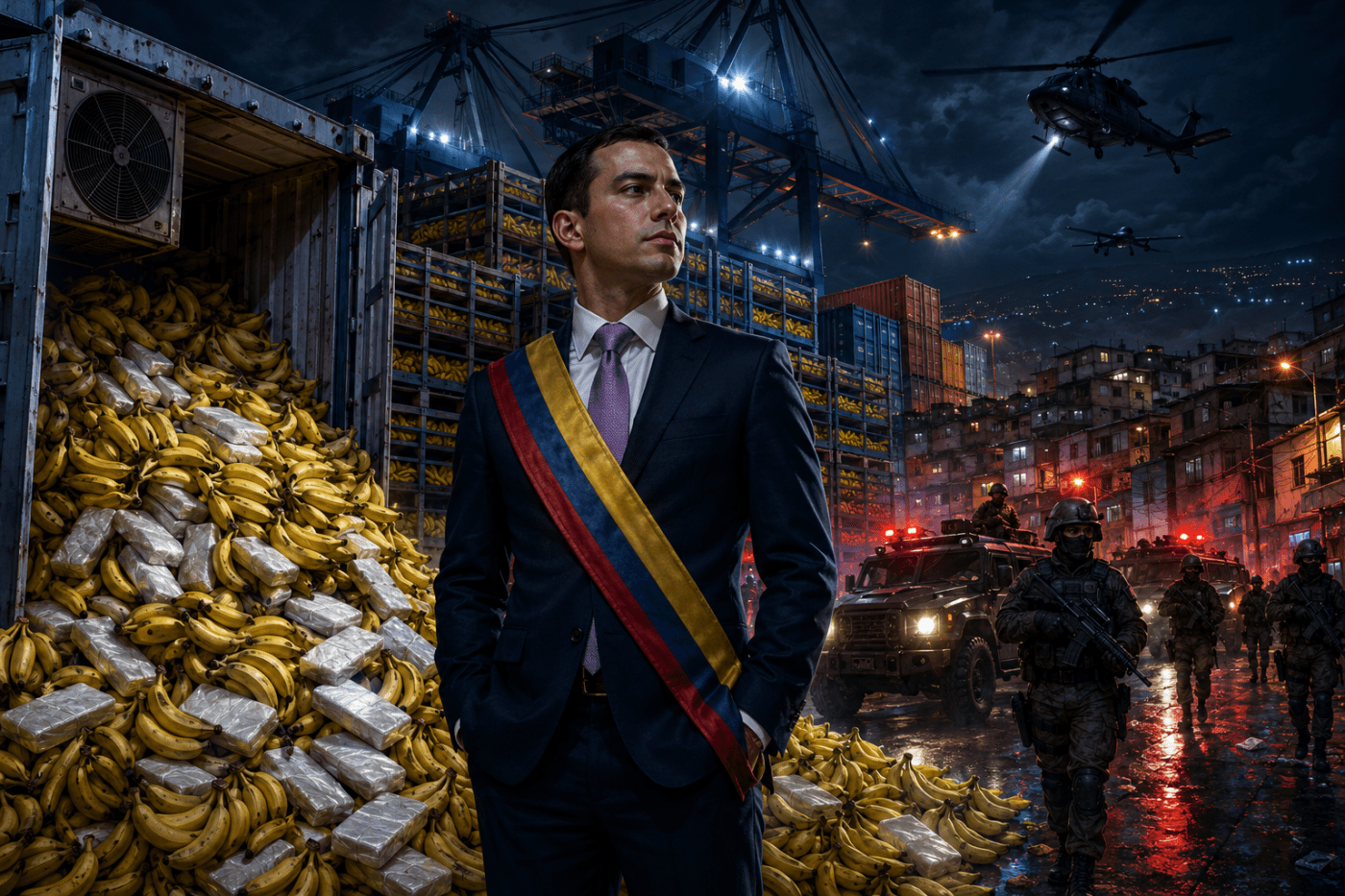
FreightWaves turns 770 kilograms of cocaine hidden among Ecuadorian bananas into a tidy freight-security story in which the drugs are criminal, the police are heroic, and the corporations moving the container are presumed innocent. The buried record leads directly into Daniel Noboa’s political and commercial world: a president formed inside his family’s banana-shipping empire, whose containers have repeatedly surfaced in documented cocaine operations while his government expands emergency rule and military cooperation with Washington. The real contradiction is not between legitimate commerce and foreign contamination, but between a single logistics system carrying both bananas and cocaine—and a class-selective drug war that attacks the visible trafficker while refusing to look upward at the export oligarchy. The answer is to open the manifests, defend Ecuador’s popular rejection of foreign bases, protect the workers trapped inside the supply chain, and follow the cocaine from the package to the boardroom and the empire gathering behind Noboa’s war.
Prince Kapone | Weaponized Information | July 27, 2026
The Cocaine Is Criminal, but the Supply Chain Is Innocent
In “Banana shipment from Ecuador to Europe concealed $290 million in cocaine,” published by FreightWaves on July 25, 2026, Phil Brink reports that Italian authorities discovered 650 packages containing nearly 1,700 pounds of cocaine inside a refrigerated container carrying bananas from Ecuador to the Port of Vado Ligure. The drugs are assigned a projected European street value of roughly $290 million, the photograph supplies the obligatory wall of white bricks, and the reader is directed toward the familiar conclusion: international criminals have once again violated the innocent arteries of global commerce.
Brink writes from the standpoint of the freight-security industry. His biography identifies him as the head of fraud media and education at FreightWaves, a former freight-brokerage owner and the developer of an industry compliance program. The resulting frame is straightforward. The container is a security problem, the police are the protagonists, inspection and intelligence are the remedies, and the corporations moving the merchandise remain unnamed scenery.
The article establishes its verdict before it establishes the chain of events. It calls the bananas a “legitimate” shipment and describes traffickers as having concealed cocaine inside it, although it identifies neither the exporter nor the Ecuadorian port, vessel, shipping line, consignee or point at which the container was accessed. Legitimate commerce receives the presumption of innocence by adjective. Criminality arrives from somewhere outside the supply chain, like vermin crawling aboard a spotless ship.
The largest omission is not hidden between the banana pallets. It is absent from the article altogether. There is no Daniel Noboa, no banana dynasty, no family shipping empire and no inquiry into the political ownership of Ecuador’s export infrastructure. Ecuador appears only as a place of origin—stripped of its ruling class, corporate power and presidential connection to the very industry through which the shipment moved.
The headline completes the operation by converting a projected retail calculation into “$290 million in cocaine,” as though investigators had opened the container and found banknotes stacked beside the fruit. The spectacle enlarges the contraband while shrinking the system that transported it. By the conclusion, the reader is invited to support more cargo inspections and intelligence work, but never to ask who owns the ports, who controls the manifests, who possesses container access or why the political economy surrounding the shipment has been edited out of the story.
The Containers, the Company, and the State
On July 21, 2026, Italy’s Guardia di Finanza announced that officers at the Port of Vado Ligure had found 650 packages containing more than 770 kilograms of high-purity cocaine among pallets of bananas inside a refrigerated container arriving from one of Ecuador’s principal ports. Italian authorities calculated that the shipment could generate approximately €250 million through eventual retail sales. The official notice did not identify the Ecuadorian exporter, departure port, vessel, shipping line, Italian consignee or any suspect, and it did not establish where the cocaine entered the container.
The shipment nevertheless moved through an export system built to record those commercial identities. Ecuador requires an electronic Customs Export Declaration through ECUAPASS identifying the exporter or declarant, consignee, destination, merchandise, quantity and weight, together with the corresponding commercial and transport documentation. The declared actors attached to the banana shipment therefore exist within Ecuadorian customs records even though they have not been released publicly.
The corridor carrying the container is one of the central arteries of Ecuador’s economy. Ecuador is the world’s largest banana exporter, while the national banana industry states that bananas account for roughly 66 percent of the country’s outbound containers—around 6,000 every week—with close to 30 percent sent to Europe. The industry also describes a logistics chain passing through farms, packing plants, inland transportation, ports, scanning systems and maritime carriers before the fruit reaches overseas buyers.
Daniel Noboa built his business career inside that export machinery. Before entering the presidency, he worked within the family conglomerate and became the youngest shipping director in Noboa Corporation’s history. Noboa Trading, one of the family’s principal banana-export companies, is majority-owned by the Panama-registered Lanfranco Holding. A 2015 Pandora Papers document recorded Álvaro Noboa transferring Lanfranco Holding to Daniel Noboa and his brother Juan Sebastián, while the company’s current beneficial ownership remains unavailable in public corporate records.
Containers belonging to Noboa Trading had appeared in cocaine proceedings before the Vado seizure. Documents circulated during Ecuador’s election campaign identified seizures of approximately 150 kilograms in 2020, 278 kilograms in 2022 and 69 kilograms in 2024. Plan V independently located judicial-system records confirming that the same company-authorized customs representative was apprehended on the relevant dates, but it could not authenticate every document used to reconstruct all three cases. The representative was released, and Noboa Trading maintained that its personnel had cooperated with investigators and had not been found responsible for the narcotics.
A later OCCRP-KRIK investigation reconstructed a more detailed set of shipments. Encrypted messages among alleged Balkan traffickers named three Noboa Trading shipments by container number, vessel and sailing date. Shipping and export records matched those details to actual banana containers leaving Guayaquil, including a shipment in container MEDU9747725 carrying 430 kilograms of cocaine. Croatian prosecution files described separate teams responsible for loading the cocaine in Ecuador and retrieving it in Europe. The three reconstructed shipments carried a combined 535 kilograms. The investigation found no evidence proving that Noboa Trading’s management knew about the contraband, but it established that traffickers possessed precise information about company containers and their movement.
As these commercial records accumulated, Noboa’s government expanded emergency rule. The president declared an “internal armed conflict,” designated criminal organizations as military enemies and repeatedly renewed states of exception. Ecuador’s Constitutional Court later ruled that one decree could be justified only under the narrower condition of grave internal disturbance, not under the government’s claimed internal-armed-conflict basis.
Foreign military cooperation expanded alongside the emergency regime. Ecuador had ended the United States’ decade-long use of the Manta air base in 2009, an act the Foreign Ministry described as the recovery of national sovereignty. A subsequent Status of Forces Agreement established privileges and operating rules for U.S. military personnel, aircraft, vessels and contractors in Ecuador. In November 2025, voters rejected removing the constitutional prohibition against foreign military bases by 60.82 percent. Four months later, U.S. Southern Command announced that Ecuadorian and U.S. forces had begun joint operations against organizations designated as “narco-terrorists”.
The Vado shipment has not been publicly connected to Noboa Trading. The established record is narrower: Ecuador’s president previously directed shipping within his family’s banana conglomerate; containers belonging to that commercial network have repeatedly appeared in documented cocaine operations; emergency rule and U.S.–Ecuador military cooperation have expanded; and the declared commercial actors behind the latest shipment remain undisclosed.
The Drug War’s Banana Republic
The cocaine discovered at Vado Ligure did not travel outside the world market. It moved through one of its ordinary arteries: Ecuadorian agricultural production, export declarations, packing systems, inland transport, port controls, refrigerated containers, maritime schedules and a European receiving route. The banana and the cocaine shared the same commercial vessel because the narcotics economy does not require a separate universe. It requires access to the infrastructure already built by capital.
This is the contradiction the freight-security narrative cannot examine. It treats legitimate commerce as a clean body attacked from the outside by criminal contamination. Yet the legal and illegal commodities entered the same containerized system, passed through the same administrative machinery and depended upon knowledge of the same movements. One commodity is declared, insured and sold. The other is concealed, seized and displayed before the cameras. The physical infrastructure unites them even as official language insists that they belong to opposite worlds.
Ecuador’s banana corridor is not a minor commercial sideline. It is a central export system moving thousands of containers every week, with a substantial share directed toward Europe. Control over this corridor means control over schedules, documentation, packing, transport and maritime circulation. Industrial cocaine shipments do not float anonymously into that machinery. They require precise information and access somewhere along the route.
The reconstructed Noboa Trading cases make that point unavoidable. Traffickers possessed exact container numbers, vessels and sailing dates. Separate teams handled loading in Ecuador and retrieval in Europe. That record does not prove that company management organized the shipments, and the current Vado container has not been connected to Noboa Trading. But it destroys the convenient fiction that cocaine enters export commerce through pure accident. Somebody inside the broader logistical chain must know which container is moving, when it will move and where it can be reached.
Daniel Noboa’s position gives this contradiction its political force. He did not approach the narcotics crisis as an outsider to Ecuador’s export oligarchy. He built his business career inside the family conglomerate and directed shipping, the point where agricultural wealth becomes international circulation. The offshore holding connected historically to Daniel and his brother, the family company’s repeated appearance in cocaine proceedings and the president’s own maritime expertise do not amount to proof of personal trafficking. They establish a profound conflict between the social origin of the drug warrior and the commercial structure his war leaves largely outside public scrutiny.
The state handles the two ends of this contradiction differently. Below, the narcotics crisis becomes an internal armed conflict, a military enemy and a justification for recurring emergency rule. Above, the export system remains a matter of corporate procedure, customs compliance and isolated container contamination. The same state that widens exceptional powers does not subject the banana-shipping oligarchy to an equivalent political emergency.
This is class power operating through the language of security. The state isolates the visible contraband from the infrastructure that carried it and then concentrates coercion upon the actors already designated as criminal organizations. Corporate ownership remains individualized and legally insulated. Emergency power becomes collective and expansive. The shipment is treated as evidence for more militarization, while the commercial identities attached to the latest container remain undisclosed.
Noboa’s performance as an uncompromising drug warrior helps stabilize this division. The more aggressively the government declares war against the lower and visible reaches of narcotics circulation, the easier it becomes to present the export elite as an innocent victim. The military campaign functions as a political certificate of innocence: surely the president who wages war against cocaine cannot emerge from a commercial world requiring investigation of its own.
But the contradiction is not resolved by theatrical severity. Cocaine continues to appear inside the same export corridors because militarizing the crisis does not change the ownership or organization of those corridors. The state may designate enemies, renew exceptions and deepen security cooperation, yet the fundamental logistical terrain remains intact. The drug war governs the consequences of the narcotics economy without necessarily transforming the commercial structure through which that economy moves.
The return of U.S. military power develops from this same crisis. Ecuador removed the U.S. presence from Manta in the name of sovereignty, and Ecuadorians later rejected eliminating the constitutional prohibition against foreign bases. Nevertheless, a Status of Forces Agreement expanded privileges for U.S. personnel and equipment, followed by joint operations against organizations relabeled as “narco-terrorists.” What the electorate rejected in the language of permanent bases reappears through the language of emergency cooperation.
This is the American Pole advancing through the drug war. Washington does not require a formal occupation when a compliant security partnership can secure access, operational privileges and military coordination. The narcotics crisis supplies the permanent justification. Ecuador’s emergency becomes an opening through which foreign power returns, not as an invader but as an invited technician of security.
The historical irony is severe. Manta was closed as an act of recovered sovereignty. Now sovereignty is thinned through agreements and joint operations presented as necessary responses to a crisis rooted in Ecuador’s own export economy. The banana corridor becomes simultaneously a route of national accumulation, a route repeatedly penetrated by cocaine networks and a pretext for deeper U.S. military integration.
Europe completes the circuit. The cocaine discovered in Italy required not only access in Ecuador but retrieval on the receiving side. Earlier reconstructed operations divided the labor between loading teams in Ecuador and extraction teams in Europe. The European market therefore cannot be treated as a passive victim receiving corruption from abroad. It is the destination that gives the shipment its commercial purpose.
The real story is not that criminals polluted an innocent banana shipment. It is that legal export capital and industrial narcotics trafficking occupy the same logistical world; that Ecuador’s president arose from the dynasty most closely associated with that world; and that his drug war directs political attention toward military enemies while corporate ownership, shipping access and commercial documentation remain comparatively protected. The cocaine is exposed. The ruling structure stays inside the container.
Open the Manifests, Defend the Mandate
The first demand is simple: publish the commercial record. Italian investigators and Ecuadorian authorities must release the container number, exporter, port of departure, vessel, shipping line, seal history, customs declaration and European consignee attached to the Vado Ligure shipment. Ecuador’s own export system requires records identifying the exporter, consignee, destination, merchandise, quantities and weight. The cocaine has been displayed before the world. The corporations and commercial actors that moved the container should not remain concealed behind official discretion.
The investigation must also move upward through the chain of custody. Banana workers, truck drivers, packing crews, customs employees and port labor understand how containers are loaded, sealed, inspected and transferred. Their knowledge must become the basis of demands for independent inquiry, worker protection and public accountability—not another excuse to arrest a disposable intermediary while the commercial structure remains untouched. The immediate task is to force scrutiny from the plantation and packing house to the port, shipping line and European receiving network.
In the United States, the Black Alliance for Peace’s Zone of Peace campaign documents U.S. military installations, training sites and operational structures throughout the Americas and provides an existing political framework for connecting Ecuador’s drug war to the expansion of SOUTHCOM. BAP has also situated Noboa’s security regime within the broader militarization of Ecuador and the Caribbean.
Teach-ins, labor discussions and anti-base campaigns should place the referendum mandate at the center of their work. Ecuadorians rejected removing the constitutional prohibition against foreign military bases by 60.82 percent. That decision must be defended against the steady reconstruction of foreign military access through agreements, privileges and joint operations conducted under the banner of fighting “narco-terrorists”.
Working people must reject the false choice between the trafficker and the militarized oligarchy. The path forward is to expose the entire circuit, defend workers from criminal and state coercion, enforce the popular rejection of foreign bases and force every investigation upward—from the package to the manifest, from the dock to the boardroom, and from Noboa’s drug war to the imperial machinery gathering behind it.


Leave a Reply