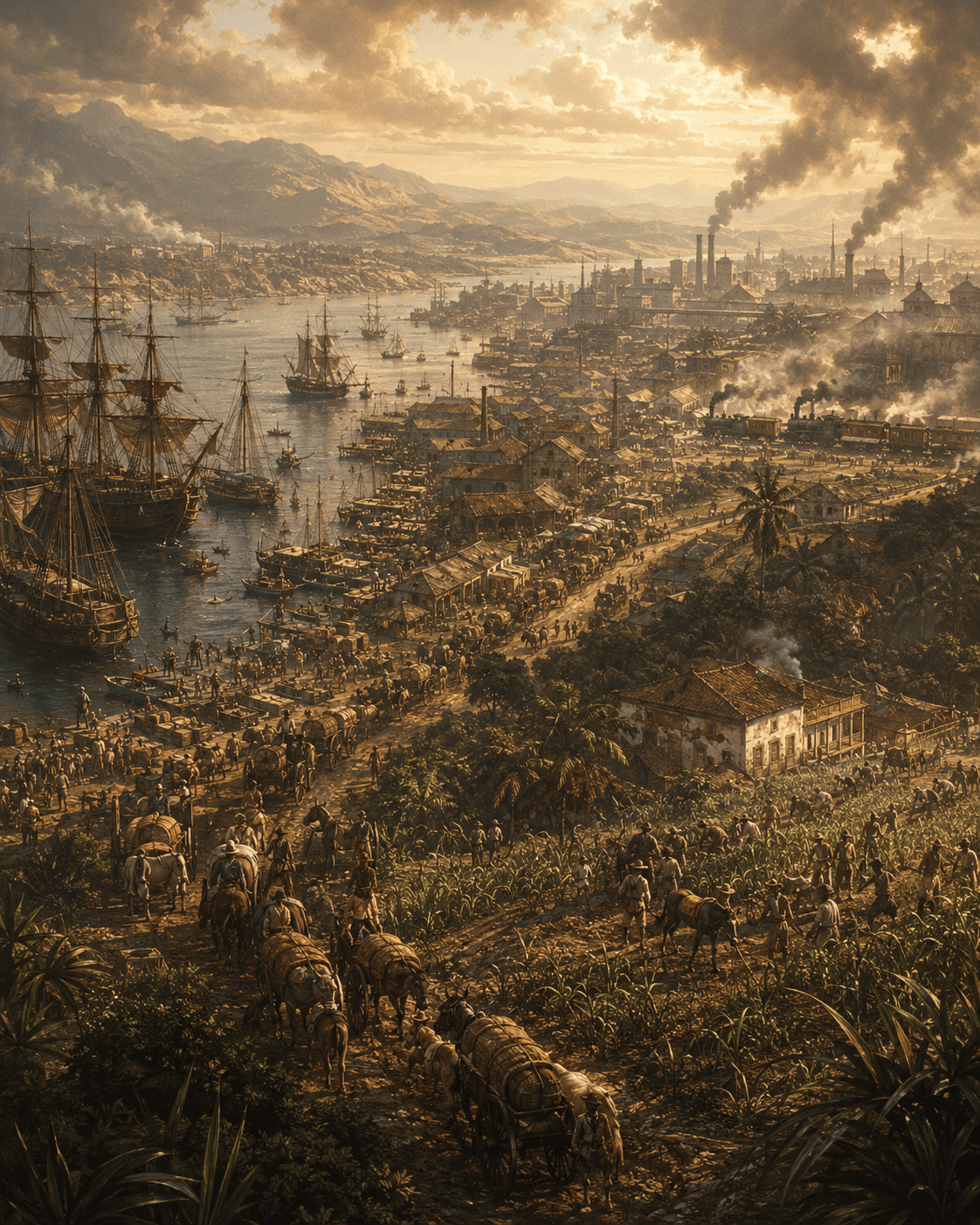
Sven Beckert strips capitalism of its favorite disguise, showing that the system did not rise from free exchange but from states, conquest, slavery, dispossession, and the organized capture of labor. His global history follows the factory back to the plantation and the colony, then tracks capital through corporate monopoly, fascism, welfare compromise, decolonization, and neoliberal counterrevolution. Yet the same historian who proves that rebellions and socialist revolutions can break the machinery of accumulation repeatedly folds their achievements back into capitalism’s story of adaptation and survival. This review takes Beckert’s immense historical arsenal seriously enough to draw the conclusion he resists: a world built through organized class and colonial power can be reclaimed only through a greater power organized by workers and oppressed peoples.
July 11, 2026
I. Capitalism, Denaturalized but Unjudged
Sven Beckert begins with a declaration so simple that its full meaning can slip past the reader: We live in a world created by capitalism.
Not merely an economy influenced by capitalism, not merely a marketplace where capitalist firms conduct business, but a world made in its image. Capital accumulation shapes the cities, the workplace, the countryside, the household, the state, and even the language through which people measure their own lives. Time is spent. Human beings acquire worth. Education becomes an investment. A home becomes an asset. The worker becomes human capital, which is a polite way of saying that a person must now carry the factory around inside himself. Beckert’s opening achievement is to make this arrangement strange again—to show that what confronts us as common sense is a historically peculiar form of social organization that humanity produced and therefore can supersede.
This act of denaturalization matters because capitalism draws enormous ideological strength from appearing not as a system but as reality itself. Feudalism announces its hierarchy with castles, titles, and hereditary rank. Colonialism plants a foreign flag over the stolen land. Capitalism prefers the modest costume of ordinary life. The wage appears as fair exchange. Private property appears as personal liberty. The market appears as a neutral meeting place where formally equal individuals pursue their interests. The enormous machinery of ownership, dispossession, law, police power, inherited wealth, and imperial hierarchy disappears behind the price tag. The rulers no longer need to declare that their rule is eternal. They need only persuade us that there is no rule at all.
Beckert cuts through this mystification by defining capitalism through the ceaseless accumulation of privately controlled capital.
Wealth under capitalism does not simply provide comfort, security, or social prestige. It must return to circulation and emerge enlarged. Money purchases labor, machinery, knowledge, land, and raw materials so that more money can be accumulated and reinvested. The process has no natural stopping point. A capitalist who announces that the firm has earned enough and may now rest has misunderstood his social function. Competition soon removes such tenderhearted souls from the field and hands their property to someone with fewer spiritual complications.
This definition moves beyond the nursery tale in which capitalism grows from humanity’s timeless desire to barter. Markets existed long before capitalist society. Merchants bought cheaply and sold dearly across immense distances without placing the whole of social life under the command of accumulation. Beckert therefore refuses to confuse commerce with capitalism. His capitalism requires not only exchange but the expansion of commodification, the productive investment of private wealth, and political institutions capable of securing property, contracts, labor discipline, and territorial order. The state is not a night watchman standing outside the market. It digs the riverbed through which capital moves.
Yet the definition stops just before the decisive question. Privately controlled capital accumulates, but through what social relation? Machines do not create value by holding meetings among themselves after the workers go home. Capital expands because one class controls the conditions of production while another must sell its capacity to work. Beckert includes labor and exploitation throughout his account, but he does not place class power at the center of the initial definition. The omission is not cosmetic. A definition centered on accumulation tells us what capital must do; a definition centered on class relations also tells us who must be compelled, dispossessed, disciplined, and ruled so that accumulation can occur.
The same tension appears in Beckert’s declared posture toward the system. After presenting capitalism as both an engine of extraordinary productive transformation and a history of exploitation, enslavement, colonial plunder, displacement, and ecological destruction, he says that the book will not contribute to the opposing debit and credit columns.
He asks the reader to approach capitalism with wonder rather than begin by pronouncing it good or bad. There is a defensible point buried here. Moral outrage cannot replace analysis. Calling a system evil does not explain how it reproduces itself, which classes defend it, why its institutions survive crises, or how ordinary people become entangled in its daily operation. A curse is not yet a theory.
But Beckert’s abstention also builds a comfortable balcony above the history he is about to narrate. Once an investigation identifies the relations that repeatedly generate conquest, forced labor, famine, racial hierarchy, and dispossession, political judgment is no longer an intrusion upon the evidence. It is one of the conclusions produced by the evidence. The surgeon may maintain a steady hand while describing the wound, but he cannot congratulate himself for neutrality between the knife and the flesh. Beckert does not conceal capitalism’s victims; that is precisely why the refusal to reach a verdict becomes so conspicuous. His history gathers the prosecution’s case and then asks the jury to remain enchanted by the complexity of the defendant.
The first chapter begins the long journey not in London, Amsterdam, or Manchester, but in the commercial worlds of Aden and the wider Indian Ocean. This geographical choice is one of the book’s most important interventions. The early history of capital did not belong exclusively to Europe. Merchants accumulated wealth across the Islamic world, Africa, India, China, and the Mediterranean. They organized credit, kept accounts, established trading diasporas, moved goods over great distances, and relied upon courts and political authorities to regulate commerce and enforce agreements. Europe enters this world as one participant among many, not as the solitary birthplace of economic reason.
Beckert writes that Capitalism is a process
rather than an event that arrived fully formed at a single place and moment. This enables him to recover centuries of commercial development, political experimentation, and accumulating knowledge that narrower origin stories throw away. It also prevents the British factory from appearing like a rabbit pulled from the hat of European genius. Industrial capitalism had preconditions, and those preconditions stretched across continents.
But a process can contain ruptures. Water heats gradually, yet boiling remains a qualitative change. By extending capitalism’s origins across a millennium, Beckert risks blurring the distinction his own evidence requires. Merchant capital may grow within tributary societies without commanding their basic reproduction. Traders may accumulate fortunes while most people retain access to land, produce for subsistence, meet obligations through custom, and organize economic life through institutions not governed principally by private accumulation. Capital exists, but society does not yet kneel before it.
Chapter 2 supplies the necessary correction. Beckert shows that early merchants remained enclosed within social orders they could exploit but not rule. Their wealth encountered communal claims, religious prohibitions, political levies, aristocratic authority, customary access to land, and the overwhelming weight of subsistence production. Commercial islands rose and fell, but they did not automatically flood the surrounding world. Capital did not possess some secret historical motor that guaranteed its eventual triumph.
Beckert condenses the lesson when he writes that capitalists needed allies.
This is the hinge upon which the entire history will turn. Merchants could accumulate, lend, speculate, and trade, but they could not by themselves transform land into alienable property, tear cultivators from independent means of subsistence, command armies, monopolize trade routes, construct colonial jurisdictions, or impose new labor regimes upon whole populations. For that they required organized political power. Capitalism did not emerge because the market peacefully expanded until it filled the earth. Capitalists had to acquire the capacity to break the walls containing them.
The opening of Capitalism: A Global History therefore gives us both Beckert’s greatest strength and the first limit we must struggle against. He understands that capitalism is recent, contingent, global, statist, and human-made. He knows that merchants are not enough and that markets do not automatically produce a capitalist society. But his thousand-year process threatens to soften the rupture through which capital moved from the margins of social life toward command over production, property, labor, and the state. Beckert has already placed the correct weapon in our hands: the distinction between capitalists living inside a society and capital becoming the power that reorganizes it. The question is whether he will hold that distinction when the merchants find their allies and begin tearing down the walls.
II. Conquest Before the Factory
The merchants have now found their allies. Chapter 3 follows the scattered islands of commercial wealth into what Beckert calls the great connecting
: the long rupture beginning around the fifteenth century when European capital owners joined their ambitions to the territorial power of states. Merchants supplied credit, ships, information, commercial networks, and an appetite sharpened by competition. Monarchies supplied charters, monopolies, soldiers, courts, diplomatic protection, and the useful habit of treating other peoples’ land as an administrative question. From this marriage came not a larger marketplace but a new capacity to seize distant territories, command labor, redirect production, and build commercial outposts from Cape Verde and the Caribbean to Potosí, Calcutta, Salvador, and Gorée. Capital ceased merely circulating among existing social worlds. It acquired the force to invade and reorganize them.
This is where Beckert’s global history cuts deeper than the polite mythology of capitalist origins. Europe did not pull ahead because its merchants possessed a superior love of risk, its rulers discovered economic liberty, or its people were uniquely afflicted with ingenuity. European capitalists broke outward because they secured unusually powerful coalitions with states struggling to enlarge their revenues and escape the limits of tributary rule. Genoese capital joined Portuguese power along the African coast. Trading companies received sovereign privileges. Fortified settlements became ports, plantations, mining zones, and colonial jurisdictions. Commercial competition unfolded beneath cannon smoke. The celebrated entrepreneurial spirit entered history accompanied by warships, armed monopolies, and men carrying royal documents granting them ownership of places their kings had never seen.
Beckert is especially strong when he shows that this expansion did not simply connect preexisting regions on equal terms. The new islands of capital opened what he calls commodity frontiers: territories where merchants and states could gain access to land, labor, metals, crops, and trade routes beyond the restraints imposed upon them at home. The frontier was not an empty edge awaiting development. It was an inhabited social world that had to be broken open. Connection therefore carried its own hierarchy. One side gained the right to roam, purchase, conquer, and accumulate; the other encountered the traveler as invader, tax collector, slave trader, or landlord.
The colonial relation is not a regrettable episode added later to an otherwise complete capitalist system. It is the means by which capital first gained the breadth and force required to subordinate production across great distances. Beckert establishes this repeatedly, even when he stops short of making colonialism the governing contradiction of his theory. The very geography of the “great connecting” gives the game away. European capitalists and states became the subjects who connected the world; Africa, the Americas, and much of Asia became the lands, labor forces, and commodity zones to be connected. The universal market was born speaking the language of command.
Chapter 4 brings this command into the countryside, where nearly all the world’s people still lived. Capital could not rule society while cultivators retained land, customary rights, subsistence resources, communal obligations, and meaningful control over their own labor. Those arrangements allowed people to produce and survive without presenting themselves each morning to an owner. From the standpoint of capital, this was intolerable idleness. A peasant feeding a family from common land was wasting an excellent opportunity to enrich somebody else.
Beckert describes the resulting transformation as the colonization of the countryside by capital owners
. The phrase is exact. Communal landholding was destroyed, Indigenous peoples were expelled, forests and grazing lands were enclosed, and rural cultivators lost rights that had sustained communities for generations. Dispossession created property by stripping others of possession. Capitalism’s first great stake, Beckert writes, came from a massive redistribution of social wealth between classes and regions. The rich did not begin with wealth and then prudently invest it. Much of the wealth became theirs through expropriation, backed by institutions that later issued clean titles over bloodstained ground.
The labor regimes built on this stolen terrain destroy the liberal fable that capitalism advances by replacing coercion with free work. In the Caribbean and the Americas, plantations concentrated land, commercial calculation, and enslaved labor on an unprecedented scale. Across eastern and central Europe, expanding grain exports encouraged landlords to impose a “second serfdom,” restricting peasant mobility and enlarging unpaid labor obligations. Elsewhere, tenancy, debt, taxation, tribute, and commercial pressure forced cultivators toward markets they had not chosen. These forms differed legally and historically, but they moved within the same expanding world economy. Cotton, sugar, grain, spices, and metals reached distant markets because workers were chained, bound to estates, expelled from land, trapped by debt, or compelled by taxes to produce for sale.
Beckert therefore names the supposed free market with admirable bluntness: capitalist expansion depended upon a state-sponsored anti-market
. This formulation does serious damage to Adam Smith’s fairy tale of utility-maximizing individuals gradually extending their exchanges. States established monopolies, destroyed competing property claims, enforced labor obligations, cleared populations from land, restricted movement, and placed armed force behind merchants entering the countryside. The market appeared free only after political power had violently rearranged who owned, who worked, who moved, and who starved. Once the state had driven people from the commons, the employer could magnanimously offer them the liberty to accept wages or go hungry.
Yet Beckert’s own evidence pushes beyond his theory. He shows colonial seizure operating from Scotland to Virginia, from the Banda Islands to Gujarat, but colonialism remains one process among several rather than the structure organizing their unequal relation. The trouble is not that every dispossession was identical. It plainly was not. The trouble is that some states acquired the power to organize dispossession across the world while other societies were converted into reservoirs of land, labor, tribute, and raw material. Without that hierarchy, “global connection” risks becoming an elegant phrase for a world in which one region increasingly claimed the authority to reorganize all the others.
Chapter 5 complicates any easy story of European economic superiority. Manufacturing was already extensive and sophisticated across Asia and the Islamic world. Chinese kilns, Indian textile producers, Ottoman workshops, and other centers combined skilled labor, commercial capital, urban production, and vast markets. In Jingdezhen, porcelain production employed tens of thousands of wageworkers and supplied elite consumers across continents. Beckert remarks that “China” became an almost universal class marker
among the wealthy, a reminder that European consumers once announced their status by possessing the products of Chinese industry, not by condescending to it as a backward workshop waiting for Western instruction.
European manufacturers learned techniques, imitated Asian goods, protected domestic producers, mobilized commercial capital, and relied upon states to secure markets and inputs. Their later ascendancy cannot be explained by pretending that productive intelligence lived in Europe while the rest of humanity supplied exotic scenery. Beckert’s account recovers a world in which India and China remained formidable manufacturing centers, while European states and merchants struggled to capture knowledge, labor, raw materials, and consumers. Industrial advantage grew through this struggle; it was not bestowed by civilization.
Chapter 6 gathers these processes into the “perfect storm” preceding industrial capitalism. Trade supplied capital and markets. Colonial conquest opened land. Enslavement and coerced labor expanded commodity production. States protected manufacturers and commercial routes. Dispossessed populations became available for new forms of labor discipline. None of these forces acted alone, and none can be cleanly separated from the others. The factory would later concentrate machinery and workers under one roof, but the wealth, markets, labor supplies, and raw materials necessary for that concentration were already being assembled through an international system of force.
Beckert gives this connection material form in Scotland, where merchant wealth accumulated through Atlantic commerce entered textile manufacturing. His formulation leaves little room for innocent misunderstanding: Capital accrued during the slave-powered transformation of the American countryside flowed into cotton manufacturing.
The same Atlantic world supplied export markets. Enslaved workers cultivated cotton, European manufacturers processed it, and cloth returned across the ocean—including to the slave societies whose coerced labor had supplied the fiber and helped furnish the capital. The circuit joined plantation and workshop before the mature factory system emerged.
This is the great achievement of these chapters. Beckert refuses to place conquest in one book and industrialization in another. He shows capital entering production through colonial expansion, rural dispossession, slavery, serfdom, protected manufacturing, and state power. The countryside was not a backward world that capitalism later modernized. Its violent reconstruction made capitalist modernity possible. Asia was not asleep until Europe brought industry. Its productive capacities, commodities, techniques, and markets formed part of the world from which European industrial power arose.
But the theoretical center still lags behind the historical evidence. Beckert presents colonialism everywhere as an engine of transformation without allowing the colonial contradiction to govern the explanation. His narrative shows particular states and capitalists acquiring the power to treat whole continents as hinterlands, yet his concept of global capitalism can flatten conqueror and conquered into participants in one connected process. They were connected, certainly, as the thief is connected to the house he enters. What matters is the relation organizing the connection.
Before there was a factory chimney to be admired, there was land to be seized, labor to be captured, resistance to be crushed, and a world to be divided between accumulating centers and sacrificial hinterlands. Beckert has recovered that buried foundation with extraordinary force. The next stage of his history will bring machinery, fossil energy, and concentrated wage labor to the foreground. But the factory does not supersede the plantation, the enclosure, or the colony. It rises upon them.
III. The Factory and Its Captured World
The factory did not merely introduce larger machines into production. It reorganized the worker’s relation to time, authority, movement, and survival. Chapter 7 is strongest where Beckert refuses to treat industrialization as a parade of inventions marching nobly from the laboratory into the marketplace. Machinery mattered. Coal mattered. The steam engine mattered. But none of these things could produce industrial capitalism without assembling human beings under centralized command and forcing them to surrender control over the pace and purpose of their labor.
That surrender did not occur naturally. Rural laborers and artisans often resisted factory employment because they still possessed other ways of living, however poor or precarious. They worked from home, cultivated small plots, relied upon family economies, or organized their labor around seasons and tasks. Factory work demanded something qualitatively different: regular attendance, prolonged exertion, obedience to supervisors, and submission to a mechanical rhythm that ignored the body’s needs and the community’s calendar. Workers who retained alternatives frequently regarded the mills as prisons. Beckert writes that wage labor encountered resistance because people understood it as a form of unfree labor
. The phrase punctures the smug equation between wages and liberty. A worker may be legally free to leave the mill, but hunger stands outside the gate as the owner’s unpaid foreman.
The factory transformed the meaning of time itself. Earlier labor could be punishing, but its intensity often followed the task, the harvest, the weather, or the rhythms of communal life. Industrial capital purchased hours and then sought to fill every minute with profitable motion. Bells summoned workers, clocks divided their meals, supervisors punished conversation, and rules reached into bodily conduct. Singing, looking out a window, leaving one’s station, or pausing outside the permitted interval became offenses against accumulation. Capital had purchased labor-power and behaved like any anxious purchaser who suspected the merchandise might be enjoying itself.
Women and children became central to this new discipline not because the factory emancipated them from household confinement, as the more cheerful histories sometimes suggest, but because employers believed they could command them more easily and pay them less. Concentration under one roof allowed owners to watch, measure, compare, and punish. Machinery did not simply increase the worker’s productive capacity; it transferred knowledge and control from the worker into a system owned by somebody else. The machine appeared as humanity’s triumph over nature while confronting the laborer as an alien power that set the pace, extended the working day, and threatened replacement.
Beckert therefore gives us a more useful Industrial Revolution than the one displayed in schoolbooks. Industrial capitalism joined capital-intensive machinery, fossil energy, concentrated production, wage dependence, and sustained increases in output. Coal loosened production from the geographical limits of water power and supplied energy on a scale that muscle, wind, and rivers could not match. Steam drove machines, transport, and eventually ships across expanding distances. Yet the leap in productive power did not abolish coercion. It installed coercion inside the architecture of the modern workplace and renamed the arrangement a contract.
This distinction matters because bourgeois ideology measures freedom by legal form while workers experience it through material power. The owner and the laborer may sign the same sheet of paper, but one controls the mill, the machinery, the stored wealth, and the conditions of employment; the other controls a capacity to work that must be sold before the rent comes due. Formal equality at the point of exchange conceals the class inequality that makes the exchange compulsory. Beckert’s account contains this truth in concrete form even when he does not sharpen it into a full theory of exploitation.
The factory’s concentrated command also depended upon a much larger reorganization beyond its walls. Chapter 8 follows industrial capital into the hinterlands that fed it. Beckert’s crucial contribution is to show that the industrial center did not simply purchase raw materials from an independent countryside. It participated in manufacturing the countryside it required. Land surveys, transport systems, military force, credit, commercial law, settlement policy, and racial domination turned vast territories into specialized suppliers of fibers, food, minerals, and labor.
The Mississippi Delta provides Beckert with one of his clearest demonstrations. Cotton cultivation expanded through the violent removal of Indigenous nations, the sale of seized territory, speculative finance, and the forced migration of enslaved Africans and their descendants. Plantation property was therefore built from two linked expropriations: Indigenous peoples lost the land, and Black people were converted into laboring property upon it. The result was not an agricultural region that happened to sell cotton. It was a settler-colonial production zone deliberately constructed for the world market.
Finance did not hover above this violence in clean gloves. Enslaved people themselves became collateral for mortgages and securities sold to investors far from the plantations. Banks and merchants advanced funds against future cotton crops and against the monetary value assigned to human beings. Beckert describes enslaved workers as the ultimate hedge against volatile global commodity markets
. When prices fell or harvests failed, a planter could sell the people whose labor had been pledged to secure the debt. The enslaved body absorbed the market’s risk so that investors did not have to.
Here Beckert shows how thoroughly modern finance and archaic-looking brutality belonged to the same system. A European investor did not need to own a plantation or crack a whip to draw income from slavery. Financial instruments distributed claims upon enslaved labor across borders, allowing distant capital owners to participate in the plantation complex while maintaining the civilized manners appropriate to a drawing room. Capitalism has always possessed this useful moral division of labor: one man applies the violence, another writes the contract, and a third collects the interest while expressing grave concern about human suffering.
The connection between factory and hinterland also produced a division of institutional capacity. Industrializing centers accumulated infrastructure, banking systems, legal protections, manufacturing knowledge, and increasingly powerful states. Their hinterlands lost productive diversity and political autonomy as land and labor were redirected toward export commodities. Beckert writes that the world economy depended on and created those inequities
. This is more than an observation about uneven outcomes. It means the prosperity of the center cannot be separated from the organized weakness of the periphery. Secure property for one class and one region rested upon dispossession elsewhere; formally free labor in one zone drew sustenance from enslaved or colonially compelled labor in another.
Chapter 9 names the emerging order a capitalist civilization. By the middle of the nineteenth century, capitalism was no longer an archipelago of commercial enclaves. Its rhythms increasingly shaped cities and countrysides, production and consumption, politics and culture. The ruling classes built museums, newspapers, schools, commercial associations, and civic institutions that presented their particular power as universal progress. The bourgeoisie did not merely own factories. It produced a social ideal in which discipline became virtue, wealth became proof of merit, poverty became evidence of personal failure, and obedience appeared as civilization.
The “gospel of work” preached by employers was never a celebration of labor in the abstract. Owners had no objection to leisure when they enjoyed it on estates financed by somebody else’s exhaustion. The gospel sanctified disciplined labor performed under command. Employers wanted workers punctual, sober, attentive, deferential, and grateful. The ideal worker surrendered both time and personality at the factory gate. Industrial civilization then congratulated itself for having taught the poor the dignity of work, as though the poor had not worked for millennia and required a capitalist to reveal the spiritual benefits of making him rich.
Yet the new civilization created concentrations of workers who could recognize their shared condition. Mills, mines, plantations, ports, and expanding cities gathered people into relations of dependence while also enabling communication, association, and collective action. Capital organized workers for production and thereby helped organize the social force capable of interrupting it. The factory bell that synchronized exploitation could also synchronize a strike.
Chapter 10 turns toward this insurgent capacity. Beckert’s formulation that capitalism was partly a product of rebellions
is one of the boldest claims in the book. It refuses histories in which rulers make the world while workers and colonized peoples merely suffer inside it. Enslaved people escaped plantations, organized revolts, carried news between territories, joined armies, and made slavery increasingly costly to defend. Peasants attacked rents, taxes, debts, and colonial demands. Industrial workers formed associations, stopped production, demanded political rights, and frightened bourgeois reformers who had previously spoken very warmly about universal liberty.
Beckert is particularly effective when he reconstructs emancipation as an achievement of the enslaved rather than a gift issued from above. During the U.S. Civil War, enslaved people abandoned plantations, crossed military lines, withheld labor, supplied intelligence, and entered the Union Army. Their movement helped transform a war initially waged to preserve the Union into a war that destroyed slavery. Rebellions and mass flights across Brazil, Cuba, Jamaica, and the wider Atlantic world strained the capacity of slaveholding states and accelerated abolition. The plantation system did not retire after losing a philosophical debate. The enslaved made it ungovernable.
Workers, peasants, national movements, anticolonial intellectuals, and sections of the bourgeoisie did not rebel for identical purposes. Their alliances were real but unstable. Capital owners opposing aristocratic privilege often welcomed popular mobilization until workers began demanding economic democracy. Bourgeois universalism became remarkably particular once the lower classes tried to collect on its promises. Property-owning liberals who had denounced hereditary domination soon discovered that the vote, the strike, and the peasant land claim threatened civilization itself.
This is where Beckert’s formulation becomes both illuminating and dangerous. Rebellion unquestionably shaped the capitalism that followed. Slave revolt helped destroy plantation slavery. Worker struggle altered law and political institutions. Peasant resistance disrupted colonial extraction. Bourgeois revolutions weakened old regimes. But to say that rebellion reconstructed capitalism can quietly turn the insurgent into an employee of the system he fought. The enslaved did not flee plantations in order to modernize labor markets. Workers did not build barricades so capital might enjoy a more efficient state. Colonized peoples did not resist empire to improve the flexibility of global accumulation.
The distinction Beckert must preserve is between what people struggle to create and what ruling classes manage to salvage from the confrontation. A rebellion may destroy an old institution without possessing the organization necessary to build a new social order. Capital may concede, retreat, reorganize, and absorb part of the insurgent demand. That outcome does not mean the rebellion’s historical purpose was capitalist reconstruction. It means the balance of organized power remained insufficient to carry the rupture farther.
By the end of this stage, capitalism has become more than a mode of production confined to mills and plantations. It has become a civilization: a hierarchy of regions, a discipline of time, a command over labor, a culture of property, and a state-backed order extending through both factory and hinterland. But it has also generated its gravediggers in many forms—not only the industrial proletarian celebrated in European theory, but enslaved workers, rural cultivators, anticolonial movements, artisans, migrants, and dispossessed peoples. They have already shown that the system can be broken open. The unresolved question is whether revolt will merely force capital to rebuild its house, or whether the insurgents can seize the ground and construct something beyond it.
IV. The State Builds the Cage
The rebellions of the nineteenth century shattered old arrangements, but they did not leave an empty field. Capital answered the crisis by rebuilding itself on a larger scale. Chapter 11 traces the rise of a new ruling bloc composed of industrial corporations, banks, professional managers, financiers, and increasingly powerful national states. The merchant house did not disappear, but it lost command to enterprises whose wealth was fixed in mines, mills, railways, chemical plants, power systems, and enormous factories. These investments could not be packed into a ship and moved when conditions turned unfavorable. Heavy industry needed territory secured, workers disciplined, raw materials guaranteed, and foreign rivals contained. Capital became more deeply national even as its reach grew more global.
Beckert opens this reconstruction through the Röchling dynasty, whose steel empire stretched from trading houses and coal mines to furnaces, banks, rail production, armaments, and political power. The family’s innovation was not simply technological. It sought vertical control over the entire chain of production—from ore and coal to steel and final sale. One chronicler described its objective as independence from market forces
. The phrase is worth holding onto. The great apostles of competition built their power by escaping competition wherever possible. They swallowed suppliers, absorbed rivals, secured monopolies, cultivated governments, and transformed the market from a law governing them into an instrument imposed upon everybody else. The invisible hand proved most useful when it could be cuffed behind the back.
This was the age when management became a social power. Large firms divided work among departments, managers, engineers, accountants, laboratories, and salaried specialists. Shareholders owned without supervising production, while professional administrators directed enterprises they did not personally own. Banks tied industrial firms together through credit and investment. Finance capital gained influence precisely because it could move between sectors, treating coal, steel, railways, chemicals, and colonial ventures as different openings for the same end: accumulation. Capital became less personal without becoming less class-bound. The individual owner receded behind the corporation, which could exploit workers, influence governments, and survive scandals with the serene immortality of a legal person that never had to enter a mine or face a firing squad.
Beckert correctly calls this a reconstruction rather than a simple expansion. Capital changed its institutional form because struggle and crisis had made the old form unstable. But his account leaves the class character of this reconstruction less explicit than the evidence demands. Capitalists, workers, cultivators, and states all appear as participants in a broad historical remaking. They did participate, but not from equal positions. The corporation did not emerge from a town meeting where labor and capital calmly designed the modern firm. Owners reorganized production to secure command over investment, technology, markets, and labor; workers organized to limit that command. The reconstructed order carried the marks of both forces, but the machinery belonged to one side.
Chapter 12 follows the corresponding reconstruction of labor. Emancipation, peasant resistance, migration, and worker organization had made many inherited systems of compulsion harder to sustain. Capital needed new methods to recruit and hold workers, especially across the plantations, mines, railways, and commodity frontiers of the colonial world. What emerged was not one universal labor market but a layered structure of wage work, tenancy, sharecropping, indenture, debt peonage, migrant labor, penal labor, and direct colonial coercion. Formal contracts spread, but the contract often recorded a relation already shaped by hunger, dispossession, debt, racial law, and state violence.
Indenture displayed this fraud with particular clarity. Millions of workers crossed oceans under agreements that supposedly distinguished the new order from slavery. Once recruited, they faced penal sanctions, confinement, beatings, restrictions on movement, and forced extensions of service. Beckert borrows the precise formulation that indenture mobilized labourers only to immobilize them
. The worker was moved across the world so that capital could prevent him from moving once he arrived. Contract law provided the respectable stationery; the plantation retained the iron collar.
The coexistence of these labor systems was not a temporary imperfection awaiting the full arrival of free wage labor. It was the method through which capitalism sorted humanity. Where workers held land, communal rights, or political leverage, capital relied upon taxes, debt, immigration controls, vagrancy laws, and colonial recruitment to weaken their independence. Where resistance blocked the restoration of slavery, landowners turned to sharecropping and tenancy. Where colonial states possessed overwhelming power, they imposed forced cultivation and compulsory labor. Wage work expanded most easily where people had already been separated from the means of living.
Race organized this hierarchy. Different populations received different wages, rights, legal protections, and freedom of movement, even when producing for the same world market. Colonial officials and employers then explained the inequalities they had created by inventing racial characteristics supposedly inherent in the workers themselves. Africans required coercion because they lacked discipline; Asians could survive on less because they desired less; Indigenous cultivators resisted regular work because they were backward. The wage appeared as an economic fact after empire had assigned a political value to the person receiving it. Capital did not encounter racial difference and make use of it accidentally. States and employers manufactured racial categories into labor institutions capable of dividing, cheapening, and governing the global working class.
Chapter 13 brings the state fully into view. Beckert describes Hokkaido as a training ground for Japanese colonialism
. After the Meiji Restoration, the Japanese state surveyed the island, imposed private property, brought settlers, constructed roads, created farms and mines, recruited forced workers, and dispossessed the Ainu from their lands and fishing grounds. Officials openly studied Anglo-American settler colonialism, especially the transformation of California. “Development” meant replacing an Indigenous social world with property titles, taxable land, commodity production, settler agriculture, prisons, and wage labor. The state did not arrive to regulate a market that had developed independently. It manufactured the territory, population, and legal order the market required.
The same pattern appeared across national and imperial spaces. Governments standardized property law, registered land, enclosed commons, built railways, restricted hunting and fishing, protected corporate charters, and translated overlapping customary claims into exclusive ownership. Statistics defined national economies; tariffs enclosed markets; borders sorted labor; colonial administrations opened entire regions to investors. Law converted conquest into title and title into collateral. Once the paperwork was complete, stolen land could enter a bank ledger washed of history.
Beckert sees this clearly, but his category of “the state” remains too smooth for the history passing through it. The Meiji state dispossessing the Ainu, the colonial state coercing African cultivators, the liberal state protecting corporations, and the workers’ state emerging from the Russian Revolution cannot be understood merely as different varieties of growing administrative capacity. A state concentrates organized power. The decisive questions are whose power, exercised against whom, and toward which social order. Without those distinctions, the state becomes an actor floating above the classes and nations whose antagonisms give it content.
Chapter 14 strips away whatever remained of the liberal fantasy that markets govern capitalism. The Great Depression exposed a system whose productive capacity had outrun the purchasing power and political arrangements sustaining it. Commodity prices collapsed, banks failed, unemployment spread, and world trade contracted. The response everywhere involved stronger states: relief, public works, industrial policy, currency controls, protectionism, planning, colonial blocs, rearmament, and direct coordination with business. Beckert states the lesson without ceremony: Market-as-God worship had always been an ideological illusion
. The crisis did not force capitalism to betray its principles. It revealed that those principles had never described actually existing capitalism.
The forms of state intervention were not politically interchangeable. Workers demanded relief, security, representation, and control over economic life. Socialist movements aimed at the abolition of private capital’s command. Fascism mobilized state power to destroy those movements, preserve capitalist property, reorganize production, and redirect social crisis toward racism, nationalism, militarism, and conquest. German and Italian capitalists did not lose their factories when fascists took office. They gained governments prepared to crush unions, imprison communists, regiment labor, subsidize industry, and seize new territories. The bourgeoisie surrendered portions of its liberal etiquette to save its class position.
Beckert’s return to the Röchling family makes the continuity impossible to miss. Hermann Röchling joined industrial command to Nazi expansion, administering occupied steelworks, coordinating armaments production, and distributing conscripted labor across German industry. By 1943, workers held under duress formed roughly two-fifths of the workforce at the Völklingen complex. The company maintained camps, security forces, corporal punishment, and its own prisons. Tatjana Jarosch, deported from the Soviet Union as a teenager, later summarized the entire arrangement in five words: Röchling stole my life.
Röchling was not an embarrassing exception standing outside respectable business. BMW, Mercedes-Benz, Volkswagen, Siemens, Krupp, IG Farben, Deutsche Bank, and much of German industry participated in forced labor, plunder, war production, or the camp system. Industrial modernity did not regress into some alien medieval darkness. Modern corporations, managerial science, advanced chemistry, state planning, racial ideology, and mass murder operated together. Fascism did not abolish capitalist rationality. It liberated that rationality from the inconveniences of organized labor, democratic accountability, and human equality.
These chapters deliver some of Beckert’s most devastating evidence. Capital reconstructed itself through the corporation, finance, management, differentiated labor regimes, national enclosure, colonial conquest, and the enlarged state. Liberalism presented these institutions as limits upon political power even as political power built every one of them. When crisis came, the market’s supposed autonomy vanished overnight. The state that bourgeois theory had hidden under the table stood up, armed itself, and began issuing orders.
Yet the state cannot remain merely capitalism’s all-purpose mechanic. It can enforce property, break unions, settle colonized land, mobilize forced labor, rescue banks, and coordinate imperial war. It can also be seized, transformed, and compelled by organized workers and colonized peoples. The coming struggle will turn upon that distinction. The world emerging from depression and war would not simply ask how capitalism might be managed. Across Asia, Africa, Latin America, and the socialist camp, millions would ask whether capital should continue to command society at all.
V. Decolonization, Socialism, and the Counterrevolution
After 1945, the peoples whom empire had treated as labor reserves, tax bases, military recruits, and sources of raw material entered history as organized political forces. The colonial map began to crack. India, Indonesia, Ghana, Algeria, Vietnam, Cuba, Mozambique, Angola, and scores of other nations broke formal imperial rule through movements that joined workers, peasants, intellectuals, soldiers, small traders, and sections of local capital. These alliances did not share one class program, but they shared an enemy and a minimum demand: the wealth of the nation could no longer be administered from London, Paris, Brussels, Lisbon, or Washington.
Beckert calls this the beginning of the end of capitalism’s most Eurocentric period. More precisely, it was an attempt by the colonized to end the arrangement through which Europe and North America monopolized industrial capacity while the rest of the world supplied cheap labor, food, minerals, and export crops. Independence therefore meant more than replacing a foreign flag. It meant constructing the state capacities colonialism had deliberately weakened: public finance, technical education, infrastructure, industrial administration, control over natural resources, and the ability to decide where national surplus would go.
Chapter 15 is at its strongest when it recognizes that decolonization was the beginning
, not the completion, of liberation. Political sovereignty arrived inside an inherited world economy whose banks, technologies, shipping networks, commodity chains, and productive centers remained concentrated in the old imperial powers. Britain had industrialized without confronting a planet already dominated by British industry. India gained independence in a world where British, American, and European capital already controlled the heights. The formally equal nation entered an international order designed during its subordination.
The anti-colonial movements understood this contradiction better than the development economists who later arrived with briefcases full of advice. Import substitution, protectionism, public ownership, national planning, land reform, currency controls, and control over foreign investment were not eccentric Third World deviations from economic reason. They were efforts to create the conditions of sovereign development in societies whose existing “comparative advantage” consisted largely of remaining poor and exporting cheaply. Empire had specialized them for dependency and then presented that specialization as natural law.
Beckert reconstructs the intellectual world generated by this struggle with unusual seriousness. Walter Rodney, Samir Amin, Raúl Prebisch, W. Arthur Lewis, Kwame Nkrumah, Jawaharlal Nehru, and the forces assembled at Bandung did not regard underdevelopment as an earlier stage through which Europe had already passed. They saw it as a relationship. Wealth accumulated at the center because labor, resources, and surplus were transferred from the periphery. National liberation would remain incomplete unless the newly independent states could alter those relations, redirect their economies toward popular development, and cooperate in building a different international order.
This was the meaning of Bandung’s worldmaking ambition. The formerly colonized were not asking to be admitted one by one into a hierarchy whose rules remained untouched. They were attempting to reorganize the world economy itself. National sovereignty, regional solidarity, commodity cooperation, public development finance, industrialization, and nonalignment formed parts of one project: creating room for nations to determine their own path without submitting either to colonial restoration or to the commands of imperial capital.
But the anticolonial alliance carried its own class struggle within it. National capitalists wanted protection from foreign monopolies, access to credit, and a state capable of developing domestic industry. Workers and peasants wanted land, higher wages, public services, labor rights, and control over the wealth they produced. The national bourgeoisie needed mass mobilization to defeat colonialism, then feared the masses whose mobilization made independence possible. In India, industrialists could support the Congress against British rule while recoiling when workers struck or Nehru spoke of socialism. They wanted a national state strong enough to discipline foreign capital, but not so democratic that workers might use it to discipline them.
This tension explains the mixed character of many postcolonial development projects. Public enterprises, planning commissions, protected industries, and nationalized infrastructure expanded productive capacity while private capital remained entrenched. The state financed the steel mill, built the dam, trained the engineer, and absorbed the risks; the local bourgeoisie waited nearby to collect the contracts. Yet these compromises were not simply capitalist development wearing nationalist colors. They reflected a real balance of forces in which labor movements, peasant struggles, communist parties, and the legitimacy of socialism compelled governments to limit private power and place portions of the economy under public command.
Beyond these mixed projects stood what Beckert calls postcapitalist forms
. By 1975, more than a third of humanity lived in countries that had attempted to organize economic life outside capitalist ownership and accumulation. China, Cuba, Vietnam, Korea, Laos, Mozambique, Angola, and other revolutionary states nationalized major industries, constructed planning institutions, redirected investment, and attempted to subordinate production to social and national priorities. Beckert deserves credit for refusing to write these societies out of capitalism’s global history or dismiss them as irrational interruptions in the market’s majestic progress.
His account of China is where the book’s political contradiction becomes impossible to avoid. Beckert acknowledges that the revolution created a state-centric model of development
, nationalized most companies, built an industrial administration, coordinated investment through plans, increased national income, and expanded heavy industry from an extraordinarily weak starting point. The new state did not inherit a mature industrial system waiting to be efficiently managed. It had to construct the physical, technical, administrative, and human foundations of modern production while defending sovereignty in a hostile international environment.
Then comes the retreat. Having recognized socialist construction as an effort to leave capitalist rule, Beckert reinterprets its achievements primarily as groundwork for China’s later market expansion. The revolution disciplines private capital, reorganizes property, builds industry, educates the population, expands infrastructure, and creates national capacity; the historian then enters these accomplishments into capitalism’s account book. Capital appears late to the construction site and claims to have poured the foundation.
The problem is not that later Chinese development involved markets, foreign investment, private firms, or contradictions favorable to capital. It plainly did. The problem is that markets do not settle the system question. Markets existed before capitalism and can operate under political limits imposed by a socialist state. The decisive matters are who controls the commanding heights, who directs finance and investment, whether private capital governs the state or the state retains the capacity to govern capital, which class interests set the developmental direction, and whether accumulation remains subordinate to a national socialist project.
By treating the expansion of production and commerce as evidence of capitalism’s renewed advance, Beckert risks converting socialism into capitalism’s most energetic preliminary stage. Revolutionary sacrifice becomes infrastructure policy. Expropriation becomes preparation for entrepreneurship. The political struggle over ownership and state power dissolves into a story about accelerated development. What disappears is precisely what made the revolution revolutionary: organized classes seized the state and changed who possessed the authority to determine the economy’s direction.
Chapter 16 turns from the socialist and postcolonial world to the postwar settlement inside the capitalist heartlands. Beckert shows that the celebrated prosperity of Western Europe, North America, and Japan was neither capitalism’s natural maturation nor the spontaneous generosity of enlightened employers. It was produced under pressure from militant labor movements, communist parties, antifascist resistance, socialist states, and populations unwilling to return to depression and war. Capital had to prove that it could deliver security and rising living standards while a rival system claimed to offer an alternative.
The result was the mixed economy
: strong unions, public ownership, welfare provision, high taxation, regulated finance, industrial policy, and commitments to full employment combined with continued private enterprise. This settlement materially improved millions of lives. It also preserved capitalist property by limiting what capital could do. Welfare states socialized portions of life because leaving health, pensions, housing, and employment entirely to the market had become politically dangerous.
The word “taming” is therefore appropriate but incomplete. Workers forced capital to accept a shorter leash; they did not take ownership of the kennel. The compromise remained concentrated in the industrial heartlands and depended upon cheap commodities, unequal exchange, and ecological costs displaced across the world. Capital accepted concessions while the balance of forces required them. Once those forces weakened, yesterday’s solemn social contract was discovered to contain a cancellation clause written in invisible ink.
Chapter 17 begins that cancellation in Chile. The overthrow of Salvador Allende did not merely replace one government with another. It destroyed a popular project built around national ownership, labor power, redistribution, and democratic control over strategic resources. The military regime murdered and imprisoned militants, outlawed unions, crushed collective bargaining, reduced real wages, privatized enterprises, restored foreign access, and reopened the country to international finance. Neoliberalism arrived not as the withdrawal of politics from economics but as politics armed against the working class.
Beckert’s Chilean history demolishes the mythology of the free market more effectively than a library of abstract criticism. Economic liberty required torture chambers. Flexible labor required broken unions. Investor confidence required a population deprived of the power to resist. Even Friedrich Hayek’s preference for a liberal dictator
merely stated the doctrine without its usual perfume: property could be free even when people were not.
Neoliberalism did not weaken the state in any general sense. It redirected state power. Public enterprises were sold, but police and military capacities remained. Controls on capital were removed while controls on workers tightened. Social spending was cut while debt obligations became sacred. National planning was denounced as tyranny, but corporations planned production across continents and international financial institutions dictated policy to indebted states. The enemy was never planning. The enemy was democratic planning exercised against capital.
From Chile, this counterrevolution spread through debt crises, structural adjustment, privatization, trade liberalization, weakened unions, and the restoration of capital mobility. The postcolonial project of using sovereignty to transform the economy was turned backward. States that had once sought to industrialize became responsible for reassuring creditors, protecting investors, and auctioning public assets. National independence remained printed in constitutions while economic policy was increasingly written elsewhere.
Beckert understands that neoliberalism was constructed through power, just as he understands that postwar reform had been compelled through struggle. Yet his long history repeatedly risks treating both victory and defeat as moments in capitalism’s endless capacity for reconstruction. The anti-colonial revolution opens sovereign possibilities; capital adjusts. Socialism constructs new institutions; capital later benefits from them. Workers win a social settlement; capital eventually dismantles it. The sequence is historically recognizable, but it can make capitalism look like the secret author of every transformation.
Capital did not create Bandung, the Chinese Revolution, the Cuban Revolution, the welfare state, or Chilean socialism in order to rejuvenate itself. People fought for futures beyond the limits capital imposed. That those struggles were contained, reversed, compromised, or forced into contradiction does not make them chapters in capital’s master plan. It reveals that historical rupture must be defended by organized power long after the flag is raised and the palace taken. The lesson of these chapters is not that capitalism absorbs everything. It is that liberation remains vulnerable wherever the forces of labor and national sovereignty cannot hold command over property, finance, production, and the state.
VI. A Future Capital Cannot Be Allowed to Own
Beckert closes where capitalism now lives most visibly: not in the polished boardroom, but at the factory gate before sunrise. Cambodian garment workers arrive in packed trailers, buy cheap food from roadside vendors, and hurry inside before the gates close at seven. Srey Mau left the rice fields for wage work, stitched clothing for a Chinese-owned factory, endured unpaid wages and arbitrary layoffs, and reduced the whole experience to one sentence: It is too easy to be thrown away as garbage.
That is contemporary capitalism without its public-relations department. The worker is indispensable to production and disposable the moment orders fall. Capital crosses borders with the dignity of a sovereign; labor crosses them through debt, recruitment agencies, dormitories, and fear.
The Epilogue is most powerful when it shows that the old mechanisms have not disappeared. They have widened their field. Land is still enclosed, but so are seeds, medicinal knowledge, scholarship, and the digital traces people leave while living ordinary lives. Beckert calls corporate harvesting of personal data a largely unremarked-upon and normalized theft
. Artificial intelligence intensifies the process: accumulated human language, art, research, and practical knowledge become privately controlled inputs, while algorithms are returned to workers as surveillance, speedup, and managerial command. The ILO estimates that one in four jobs has some exposure to generative AI. The question is not whether a machine has become intelligent. It is whether capital has found another instrument for separating collective intelligence from those who created it.
Debt performs the same work at the level of nations. Developing countries carried $11.7 trillion in external debt in 2024, with an estimated $1.6 trillion due in servicing—resources diverted from health, education, infrastructure, and sovereign development. The colonial administrator no longer needs to sit in the ministry when the creditor already occupies the budget. Debt converts formal independence into disciplined policy: export more, privatize more, cut social spending, and reassure markets whose confidence seems always to depend upon the population’s suffering. Beckert gives us the historical pieces of this machinery, but the present makes the imperial relation impossible to treat as merely one connection within a global totality. Some nations issue commands through finance; others surrender their future earnings to obey them.
Nowhere does Beckert’s evidence press harder against his restraint than in the ecological crisis. He writes that capitalism does not just draw nutrients from our past but also consumes our future.
The line should end the debate, yet he soon asks whether endless accumulation can coexist with a finite natural world and answers that the jury is out.
No, comrade historian, the jury has returned carrying floodwater in its shoes. The World Meteorological Organization reports that 2015 through 2025 were the hottest eleven years on record and that 2025 was roughly 1.43°C above the 1850–1900 average. Capital may invent greener machinery, but no technology abolishes the command to expand, sell, and accumulate. Beckert finally admits the system is expansionary not by choice but by necessity
. A necessity that threatens the conditions of life is not a puzzle awaiting neutral observation. It is a social relation awaiting defeat.
The alternative cannot be reduced to scattered shelters from the market. Beckert looks hopefully toward libraries, public education, communes, universal-income experiments, and other noncommodified islands. Such spaces matter; workers have fought to create them, and capital constantly tries to reconquer them. But islands do not become a new continent through moral example. The rulers possess banks, corporations, armies, media systems, logistics networks, and states. To imagine that capitalism will gradually erode as humane alternatives multiply inside it is to mistake tolerated refuge for contending power.
The present offers a sharper test. China’s 2026–2030 plan places manufacturing, infrastructure, technological development, and the stated objective of socialist modernization within a national planning horizon reaching toward 2035. This does not erase China’s contradictions or answer every question about its transition. It does demonstrate that large-scale planning, public direction, and political command over investment are not museum pieces. Beckert’s history proves that capitalism itself was built through organized power; his conclusion hesitates to name the organized power required to move beyond it.
This is why Capitalism: A Global History belongs in revolutionary hands, but not as holy writ. Beckert has assembled an immense record of accumulation advancing through conquest, labor discipline, state construction, rebellion, colonial hierarchy, corporate concentration, counterrevolution, and enclosure. He has shown that capitalism is neither nature nor destiny. Yet he too often transforms the forces struggling against it into mechanisms of its adaptation and leaves the future suspended between historical possibility and political agnosticism.
History does not guarantee our victory. It does something more useful: it identifies the battlefield. The future will not be secured by waiting for capital to exhaust its ingenuity or discover a conscience. It will be decided through struggle over who owns production, who commands finance, who plans technology, who governs land, and whose needs determine the use of the social surplus. Capitalism was made. It can be unmade. But only organized workers and colonized peoples, holding institutions strong enough to defeat private accumulation and durable enough to build another order, can make that historical possibility material.


Leave a Reply