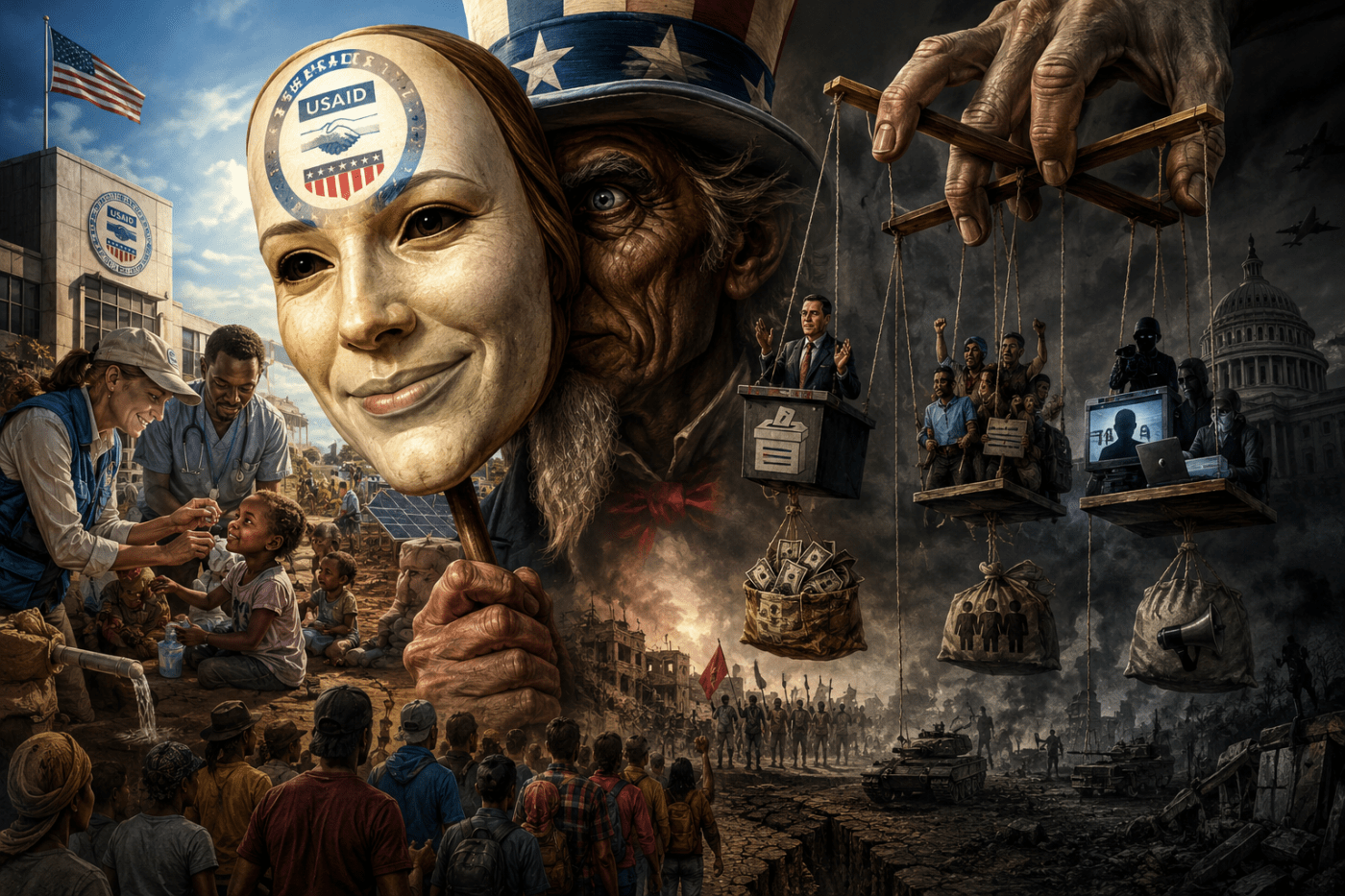
NPR mourns USAID as a fallen humanitarian institution while hiding the imperial machinery behind the tears. The record shows USAID embedded aid, civil society, media, elections, governance, and public health inside U.S. foreign-policy command. The real story is not aid versus no aid, but empire’s power to make survival itself dependent on Washington. The task now is to defend the people harmed by aid cuts while breaking the donor chain that turns solidarity into supervision.
Prince Kapone | Weaponized Information | July 6, 2026
The Tears of Empire
NPR’s interview with former USAID Administrator Samantha Power enters the USAID fight through grief. Fatma Tanis reports on the agency’s closure through Power’s memories, the pain of fired employees, the interruption of foreign-assistance programs, and the hope that USAID can someday be reconstituted. The immediate subject is the Trump administration’s dismantling of the agency. The deeper subject is the struggle over how U.S. empire presents itself to the world: as a fist, a flag, a grant application, or a doctor’s bag.
The outlet matters. NPR is not Fox News with tote bags, but neither is it some free-floating voice of the people. It is a Washington-centered nonprofit media institution inside the same political economy it often reports on: public broadcasting, foundation money, corporate underwriting, wealthy donors, liberal professional audiences, and official sources moving through the revolving door of elite legitimacy. In 2026, after federal funding cuts, NPR received $113 million from two private donors, including $80 million from Connie Ballmer, wife of former Microsoft CEO Steve Ballmer. That does not mean every NPR story is dictated by billionaires. It means NPR’s institutional location is not outside the ruling-class ecosystem that makes “public service” compatible with elite stewardship.
The interviewer matters too. Tanis is a global health correspondent whose public-facing work is organized around health crises, humanitarian systems, and communities affected by disease, poverty, and disaster. That beat naturally foregrounds human harm, service disruption, and medical catastrophe. In this article, that humanitarian lens becomes the frame through which USAID itself is interpreted. The agency is not first approached as an instrument of U.S. foreign policy. It is approached as a broken lifeline.
The interviewee matters most. Samantha Power is not simply a sad former administrator. She is a major figure in liberal imperial statecraft: former USAID administrator, former U.S. ambassador to the United Nations, Harvard professor of global leadership and human rights, and one of the most recognizable architects of humanitarian-intervention common sense in the Democratic foreign-policy world. Her official biography identifies her as USAID administrator from 2021 to 2025 and now as a professor at Harvard Kennedy School and Harvard Law School. Her career has joined human-rights language to U.S. power at the highest levels of the imperial state. NPR lets that class position speak as grief.
The first propaganda device is humanitarian laundering. Power points to HIV programs, girls’ education, disaster response, electricity, election monitoring, anti-corruption work, independent media, and fired aid workers. These are real human stakes, but the article arranges them so the institution appears mainly through its most sympathetic outputs. The reader meets the medicine, not the machinery.
The second device is source hierarchy. Power is allowed to narrate USAID’s meaning, while the governments, movements, and peoples who experienced USAID as political pressure, dependency, media penetration, and civil-society management do not appear. The third is soft-power nostalgia. Phrases like “goodwill,” “brand name,” and “Americans want to help” convert foreign-policy influence into national virtue. The fourth is omission. The article does not examine USAID’s democracy-promotion infrastructure, NGO funding, media programs, governance work, or relationship to the nonprofit-industrial complex.
The fifth device is false opposition. Trump’s crude nationalist assault becomes the only visible critique, allowing liberal empire to present itself as the humane alternative to barbarism. But the real contradiction is not Samantha Power versus Donald Trump. It is velvet-glove empire versus bare-fist empire. NPR wants the audience to mourn the loss of the mask. The task is to examine the face beneath it.
The Machinery Behind the Mercy
USAID was never a neutral charity office with a flag on the wall. Its democracy, human rights, and governance machinery includes elections, civil society, human rights, and governance programs, the exact institutional terrain through which foreign states shape political life without formal occupation. Once “aid” includes election systems, media development, anti-corruption bodies, civil society leadership, opposition-adjacent networks, and governance reform, the question is no longer whether Americans “want to help.” The question is who gets organized, who gets funded, who gets trained, who gets measured, and who gets made accountable to Washington rather than to their own people.
The humanitarian record is real, and that is precisely what makes the contradiction sharp. U.S.-funded HIV programs have helped keep millions of people alive, with UNAIDS crediting PEPFAR with saving more than 26 million lives and supporting over 20 million people on antiretroviral treatment. The collapse of that infrastructure threatens catastrophe for people who did not create the imperial system that made their treatment dependent on U.S. appropriations. But that truth does not sanctify USAID. It exposes a world order where medicine, food, disaster response, and public health can be funded, conditioned, frozen, or withdrawn by the ruling faction in Washington.
USAID’s political function becomes clearer in countries that refused to behave like grateful recipients. In Cuba, the agency created ZunZuneo, the so-called “Cuban Twitter” project whose leaders planned to push the island toward democratic change through tactical and temporary initiatives. Cuban media also remained tied to U.S. funding streams, with USAID’s 2024 Cuba funding going primarily toward independent media programs aimed at the island. This is the factual terrain NPR leaves outside the frame: civil society, media, and communications infrastructure used as political instruments against a sovereign state.
Bolivia saw the same pattern from the standpoint of a government defending national sovereignty. Evo Morales expelled USAID in 2013 after accusing the agency of conspiracy, political interference, and manipulation of union leaders. The issue was not “development” in the abstract. It was the relationship between U.S. funding and the internal political terrain of a country whose Indigenous, peasant, and worker movements had challenged imperial authority over resources, state policy, and national direction.
Venezuela makes the machinery even more explicit. U.S. “humanitarian aid” was inserted into a broader hybrid-war offensive in which sanctions, diplomatic recognition of a parallel authority, border spectacle, media warfare, and donor networks converged against the Bolivarian process. Tricontinental’s dossier on Venezuela and hybrid war situates the aid campaign inside the wider strategy of delegitimizing the Venezuelan state while presenting imperial pressure as rescue. Brasil de Fato’s summary of the same dossier identifies the 2019 border operation as a U.S. attempt to breach Venezuela’s borders under the pretext of delivering humanitarian aid.
This is where the NGO-industrial complex moves from background to center. USAID is not merely an agency that happens to fund NGOs. It is one state-command node in a donor system that converts political struggle into projects, metrics, trainings, deliverables, and professional careers. Monthly Review’s critique of imperialism and NGOs in Latin America identifies how donor-funded organizations can depoliticize struggle, co-opt popular sectors, and replace mass politics with professionalized management. The nonprofit form becomes a pressure valve inside imperial political economy: it absorbs crisis, translates rebellion into grant language, and disciplines resistance through dependency.
INCITE!’s The Revolution Will Not Be Funded gives this system its sharper name: the nonprofit-industrial complex. The point is structural, not moralistic. When movements depend on foundations, state grants, donor priorities, and professional staff models, accountability is pulled upward toward funders and away from the people in struggle. INCITE!’s own political history clarifies the trap: the organization rejected state funding after seeing state-funded anti-violence work get co-opted, and then recognized that foundation funding could reproduce the same discipline through softer channels.
That insight is essential for understanding USAID abroad. What domestic philanthropy does to insurgent movements inside the imperial core, USAID helps do internationally to anti-colonial, socialist, nationalist, peasant, feminist, labor, youth, media, and human-rights spaces across the Global South. ROAPE’s review of NGOs in Africa shows how NGO discourse can stifle the independence of radical movements by pulling struggle into donor priorities, Western rights language, and liberal organizational forms. Where colonialism, debt, structural adjustment, sanctions, war, and state destruction have weakened public capacity, the NGO arrives as both caretaker and governor.
Trump’s assault on USAID did not break this system from an anti-imperialist standpoint. It reorganized imperial aid under a more openly transactional command. The State Department’s response to NPR admitted the real dispute when it said foreign aid had often operated without coordination with the administration’s foreign policy and had funded a corrupt NGO-industrial complex. Strip away the hypocrisy and there is a confession inside the accusation: the argument in Washington is not whether foreign assistance serves power, but which faction of power gets to command it.
The larger context is not “aid versus no aid.” The real issue is whether human survival, public health, education, media, disaster response, and development are organized through sovereign, people-centered systems or routed through imperial machinery that can condition life itself on compliance. USAID’s closure exposed the cruelty of dependency. USAID’s history exposes who built that dependency, who benefited from it, and why the empire mourns the loss of its favorite mask.
The Mask and the Machinery
The real story is not that USAID helped people or harmed people, as if empire were a courtroom where one stacks good deeds against bad deeds until the scale tips. The real story is that U.S. imperialism learned how to bind genuine human need to the machinery of domination. Medicine became leverage. Disaster relief became influence. Civil society became terrain. Media became infrastructure. Elections became an entry point. Governance became supervision. The empire did not choose between charity and control. It built institutions capable of doing both at once.
That is why NPR’s grief narrative is so dangerous. It mourns the collapse of the delivery mechanism while leaving the social relation inside that mechanism untouched. The patient who needs treatment is real. The family that needs food is real. The community that needs electricity, schools, clinics, and disaster response is real. But so is the imperial state that made those needs pass through Washington’s hands. So is the donor system that trained movements to translate their demands into fundable language. So is the NGO layer that learned to speak upward to grant officers before speaking downward to the people. A chain can deliver bread. It is still a chain.
USAID’s precise function inside the U.S. empire was to internationalize the nonprofit-industrial complex. Inside the imperial core, foundations, state grants, and professional nonprofits discipline revolt by turning movements into institutions dependent on money from above. Abroad, USAID helped reproduce that structure across the Global South. It did not merely support “civil society.” It helped manufacture the kind of civil society empire prefers: fragmented, professionalized, measurable, donor-compliant, suspicious of revolutionary organization, fluent in rights language, allergic to sovereignty, and permanently dependent on external validation.
This is why Cuba, Bolivia, Venezuela, and the broader NGO terrain matter. They are not side examples. They reveal the operating logic. When a government defends sovereignty, mobilizes workers and peasants, nationalizes resources, or refuses Washington’s command, “aid” begins to mutate into communications infrastructure, media support, youth outreach, cultural programming, governance reform, opposition-adjacent networks, border spectacle, and humanitarian theater. The old colonial administrator carried a Bible, a rifle, and a ledger. The modern one carries a grant portfolio, a governance workshop, and a communications strategy.
Trump did not abolish this contradiction. He ripped at one mask of empire because his faction wanted another mask, uglier and more openly transactional. His attack on USAID was not liberation from imperialism. It was an internal ruling-class struggle over command, tempo, and presentation. Liberal empire wants the managed world to thank America. MAGA empire wants the managed world to pay tribute. Neither wants the managed world to stand up.
The anti-imperialist position must refuse the trap. We do not cheer when treatment collapses. We do not celebrate when food programs vanish. We do not sneer at aid workers who believed they were helping people. But neither do we canonize the agency that made life itself contingent on imperial administration. Our grief belongs to the people whose survival was routed through hostile institutions. Our anger belongs to the system that made that dependency appear natural.
USAID was the mercy department of the empire, and mercy under empire is never innocent. It arrives after debt, sanctions, structural adjustment, war, coup pressure, and state destruction have weakened the conditions of life. Then it offers relief in the language of compassion while preserving the order that made relief necessary. It bandages wounds without naming the weapon. It funds the clinic while protecting the system that keeps producing the patients.
That is the story NPR cannot tell. Not because every sentence is false, but because the frame is false. The article wants the old arrangement restored: the empire as benefactor, the administrator as humanitarian, the NGO as neutral helper, the Global South as grateful recipient. But the oppressed do not need empire with better manners. They need sovereignty, public systems, reparative justice, and international solidarity outside the command structure of the imperial state. The question is not how to restore USAID. The question is how to build a world where no people’s medicine, food, education, media, or political life can be held hostage by Washington ever again.
Break the Donor Chain
The answer is not to let people die so empire can be exposed. The answer is to defend every person harmed by aid cuts while attacking the imperial aid architecture that made their survival dependent on Washington in the first place. The people need medicine, food, clinics, schools, clean water, disaster response, and public systems. They do not need their lives routed through State Department priorities, NGO metrics, donor compliance, and soft-power management.
That work begins with political education against the nonprofit-industrial complex. INCITE!’s work on the nonprofit-industrial complex exposed how state and foundation funding can discipline radical movements, professionalize struggle, and pull accountability upward toward funders instead of downward toward the people, while Duke University Press identifies The Revolution Will Not Be Funded as a direct critique of the nonprofit system’s role in managing dissent. Every serious solidarity formation should ask before joining any “humanitarian” campaign: who funds it, who commands it, who benefits from it, and what political horizon does it make impossible?
The Global South already has currents confronting this matrix from inside the aid battlefield. Adeso’s decolonizing-aid current, rooted in Somali and African humanitarian experience, argues for aid that is locally owned and locally led, and its public support channels identify Adeso as a public charity relying on donations. The NEAR Network describes itself as a movement of local and national Global South civil-society organizations challenging top-down humanitarian systems, with membership rooted in local and national civil-society organizations. These currents are not substitutes for revolutionary organization, but they help expose the colonial structure of the aid regime from the side of those forced to live under it.
On the ideological front, No White Saviors identifies its work with Pan-Africanism and Black liberation while attacking the cultural politics of colonial charity: the rescue photograph, the celebrity humanitarian, the white savior influencer, the NGO brand built from African suffering. Its public funding channel is direct donor support, not a USAID-style grant portal. That terrain matters because imperial aid does not rule only through budgets. It rules through images that train people in the imperial core to see the Global South as helpless instead of seeing workers, peasants, women, youth, and nations struggling against a world system that steals from them and then sells compassion back at a markup.
Inside the United States, anti-imperialist organizing has to connect the USAID question to sanctions, war, bases, AFRICOM, debt, and regime-change policy. The Black Alliance for Peace organizes against U.S. militarism, sanctions, AFRICOM, NATO, and imperial domination, and its donation infrastructure runs through Community Movement Builders as fiscal sponsor. The ANSWER Coalition organizes mass anti-war mobilizations against U.S. war and intervention, with donations processed through Progress Unity Fund as fiscal sponsor. These are not the same thing as the explicit anti-NGO-industrial-complex work of INCITE!, Adeso, NEAR, or No White Saviors, but they are necessary fronts because the aid regime and the war regime are departments of the same empire.
The tactical line is clear. Build teach-ins on USAID as both humanitarian channel and imperial command node. Push unions, churches, student groups, and community organizations to adopt a no-USAID, no-NED, no-State-Department funding standard for international solidarity work. Support people-to-people medical solidarity and sovereign public-health systems without U.S. political conditionality. Link foreign-aid debates to anti-sanctions organizing, because sanctions often manufacture the humanitarian crises imperial aid later claims to relieve. Demand that resources stolen through empire return as reparative, unconditional support through sovereign, country-led, and genuinely multilateral systems — not through grant managers loyal to Washington.
The warning is simple: do not let liberals canonize USAID, and do not let MAGA turn exposure of USAID’s imperial role into racist abandonment of the Global South. One side wants the mask restored. The other wants the mask removed so the fist can be admired. Our side must defend the people, break the donor chain, and build international solidarity that cannot be switched off by the empire’s budget office.


Leave a comment