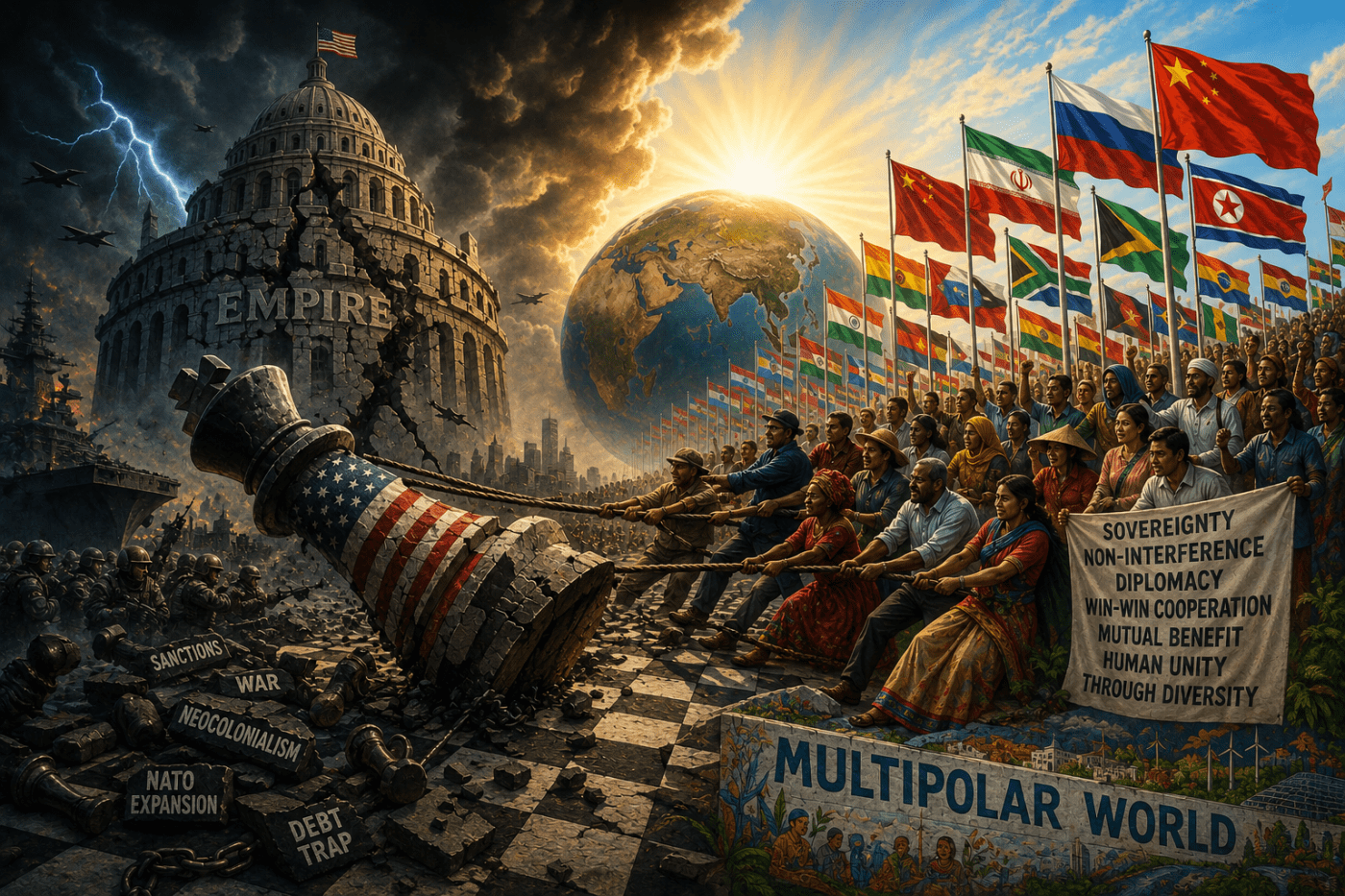
Foreign Affairs calls China, Russia, Iran, and the DPRK “worse than an axis” because the empire has no honest language for sovereign coordination outside its command. The facts show not a secret plan to conquer humanity, but a growing architecture of multipolar development, sanctions resistance, national sovereignty, security cooperation, and global-governance reform. The real fear is that the Western capitalist-imperialist world system may no longer be able to keep the Global South fragmented, dependent, and obedient. Our task is to refuse the war script before the ruling class turns its panic into policy.
Prince Kapone | Weaponized Information | July 2, 2026
The Empire Finds an Axis in the Mirror
Thomas Wright’s July 1, 2026 essay in Foreign Affairs does not arrive as a neutral warning from the mountaintop. It comes from inside the machine. Wright is not some lonely pamphleteer pacing outside the gates of power. He is a senior fellow at the Brookings Institution and a former senior director for strategic planning at the Biden National Security Council. Foreign Affairs is published by the Council on Foreign Relations, one of the old drawing rooms where the managers of U.S. power teach each other what to fear, what to bomb, what to sanction, and what to call democracy while doing it.
The title gives the game away: Worse Than an Axis. China, Russia, Iran, and the DPRK are placed before the reader like a lineup in an imperial police station. The charge is not that they have formed one army, one ideology, one command, or one treaty structure preparing to conquer the world. Wright admits the opposite. The cooperation is mostly bilateral, flexible, uneven, and short of a formal alliance. But in the logic of empire, that makes it more dangerous. The accused have committed the unforgivable crime of learning how to cooperate without first asking Washington to chair the meeting.
This is not analysis so much as anxiety with footnotes. The article turns the limits of the relationship into proof of its threat. No formal axis? That means it is harder to target. No single command structure? That means it is harder to disrupt. No clean alliance headquarters? That means it is harder to discipline. The empire is upset because the countries it has sanctioned, encircled, threatened, and demonized are not behaving like good victims. They are building relationships across trade, technology, security, diplomacy, finance, and political coordination, and they are doing so in forms not easily captured by the old imperial toolkit.
The propaganda device is selective causality. U.S. pressure enters the article as common sense, almost as weather. Sanctions simply exist. Military alliances simply stand. U.S. bases simply occupy the horizon. Export controls, financial pressure, NATO expansion, and diplomatic isolation appear as ordinary instruments of responsible policy. But when the targets of that pressure respond, history suddenly begins. China’s cooperation becomes sinister. Russia’s diplomacy becomes manipulation. Iran’s survival becomes escalation. The DPRK’s search for security becomes madness. Empire throws the first stone, builds the courthouse, writes the law, appoints the judge, and then calls the defendant violent for bleeding on the floor.
The article also works through source hierarchy. The reader is guided through the world by U.S. intelligence, Western officials, NATO anxieties, corporate press claims, and think-tank assumptions. The people who have lived under sanctions, military encirclement, colonial partition, technology denial, and regime-change pressure are not allowed to define the meaning of their own actions. They appear mainly as threats to be interpreted by the same institutions that helped produce the threat environment. This is how imperial common sense reproduces itself: first erase the injury, then criminalize the scar.
The ideological function is plain. Wright is not trying to help ordinary people understand why so many states are searching for exits from U.S.-European domination. He is preparing the ruling class for a long campaign to contain those exits. His concern is not peace, not development, not sovereignty, not the lives of workers and peasants who pay for these confrontations in hunger, debt, conscription, displacement, and austerity. His concern is effectiveness: how Washington can manage, expose, pressure, sanction, and limit a network it can no longer simply command.
That is the confession buried under the alarm. The empire does not fear an “axis” because it threatens humanity. It fears sovereign coordination because it threatens the world system through which the imperial core has treated humanity as raw material. The monster in this article is not China, Russia, Iran, and the DPRK. The monster is the old order glimpsing, in the movements of its enemies, the outline of a world it may no longer be able to rule.
The World-System the Article Cannot Name
The cooperation described by Foreign Affairs does not emerge from the ether. It emerges from a world system that has treated sovereignty outside Western command as a problem to be managed, punished, disciplined, or destroyed. Even the 2026 U.S. intelligence assessment describes China, Russia, Iran, and the DPRK as primarily connected through limited and bilateral relationships, not through a single formal alliance. Wright turns that limited bilateralism into the danger itself. But the factual terrain shows something more concrete than a secret “axis.” These states are building layers of trade, finance, diplomacy, security, energy, technology, and global-governance cooperation because the old Western machinery of isolation no longer produces obedience on command.
China and Russia have placed their relationship inside a larger language of international transition. Their May 2026 statements committed both governments to strengthening comprehensive strategic coordination and advancing a multipolar world and a new type of international relations. This is not the vocabulary of a formal military bloc. It is the vocabulary of a state system trying to widen the space for sovereign action against unilateral coercion, military pressure, and institutional monopoly. Beijing’s line is especially important because it gives the emerging architecture a positive program. China’s global initiatives are not isolated slogans. Chinese theoretical discussion presents the Global Development Initiative, Global Security Initiative, Global Civilization Initiative, and Global Governance Initiative as an interconnected framework built around development, security, civilizational exchange, and reform of global governance. China’s white paper on global governance grounds that framework in sovereign equality, international rule of law, multilateralism, a people-centered approach, and real action. That is the world-system proposal Wright’s article refuses to name.
Russia has explicitly aligned itself with that architecture. Beijing stated in May 2026 that China and Russia would make concerted efforts around the Global Development Initiative, Global Security Initiative, Global Civilization Initiative, and Global Governance Initiative. Chinese-language reporting also records Russian support for the Global Governance Initiative as part of building a fairer multipolar international order. Russian strategic discourse speaks in the same register. Lavrov’s 2026 Primakov Readings remarks presented multipolarity as a system based on sovereign equality, international law, and balancing interests, not as a descent into chaos. The relationship is not reducible to battlefield logistics or weapons anxiety. It is being framed as part of a world-order struggle over who gets to define development, security, legality, legitimacy, and civilization.
Iran fits the same material pattern. The Russia-Iran Comprehensive Strategic Partnership entered into force in October 2025 and covers political, economic, security, and institutional cooperation. Its logic is rooted in the sanctions environment imposed on both countries. The treaty framework includes cooperation in finance, transport, energy, trade, security, and institutional coordination, while independent analysis of the agreement highlights the effort to develop payment systems independent of third countries and expand national-currency settlement. Iran has welcomed the Belt and Road Initiative and Global Development Initiative and declared readiness to participate, and the Chinese embassy in Iran describes Tehran as actively supporting China’s four global initiatives and joining the Friends of Global Governance group. The material center is not “authoritarian friendship.” It is corridor building, sanctions resistance, currency insulation, energy cooperation, and development outside the financial chokeholds of the imperial core.
The DPRK’s role is also broader than the military alarm frame. The Russia-DPRK treaty came into force after ratification in December 2024 and commits both sides to maintaining and enhancing a comprehensive strategic partnership. The treaty includes mutual assistance provisions, but its field is wider than battlefield headlines. The text covers political, trade, investment, scientific, technological, legal, cultural, and security cooperation, along with opposition to unilateral coercive measures. China-DPRK statements emphasize strategic communication, governance exchange, sovereignty defense, and practical cooperation. DPRK reporting also places Kim Jong Un’s support for China inside the call for a fair and just multipolar world. There is still no clean public basis to claim Pyongyang has endorsed all four named Chinese initiatives as a package, but the DPRK’s alignment with China’s multipolar, sovereignty-centered direction is clear.
The wider Global South context exposes the weakness of the “axis” label. BRICS’ Kazan Declaration condemned unilateral coercive measures and illegal sanctions for damaging world trade, development, energy, health, and food security. The SCO Astana Declaration placed Eurasian cooperation inside principles of mutual respect, non-interference, sovereign equality, and diversified cooperation. The Group of Friends in Defense of the UN Charter organizes around sovereign equality, non-interference, peaceful settlement of disputes, and opposition to the threat or use of force. The Non-Aligned Movement’s Kampala outcome document reaffirmed sovereignty, self-determination, territorial integrity, non-interference, and opposition to unilateral coercive measures. Global South analysis of the Ukraine war shows that many non-Western states refused the Western demand to isolate Russia because their political agenda remains tied to sovereignty, peaceful relations, criticism of Western foreign policy, and reform of the Western-dominated international order. The issue is not that the Global South has suddenly discovered love for Moscow, Beijing, Tehran, or Pyongyang. The issue is that much of humanity knows what Western power looks like when it arrives carrying loans, soldiers, NGOs, sanctions, missionaries, consultants, and moral lectures.
Sanctions are central to this terrain. They are not neutral diplomacy. The UN Special Rapporteur mandate on unilateral coercive measures exists because these measures damage human rights, economic life, social rights, and the ability of targeted societies to develop. The 2025 report on unilateral coercive measures addressed their impact on labor, economic, and social rights. That material reality is buried when Western policy language treats sanctions as clean instruments of pressure. Sanctions attack currency access, trade, medicine, infrastructure, investment, labor conditions, and national planning capacity. They are weapons used to force political obedience without formally declaring war. The fact that targeted states are building alternative payment systems, national-currency settlement, transport corridors, and regional institutions is therefore not mysterious. It is a practical response to economic siege.
The missing world-system fact is simple. Western power has never been merely diplomatic. It rests on control over resources, finance, trade routes, military alignments, development paths, and political elites. Dependency and world-systems scholarship has long shown that underdevelopment is not a natural condition but a relationship reproduced through imperialism, unequal exchange, dependency, and core-periphery domination. Global South efforts to revise multilateralism are therefore not decorative. They are struggles over the distribution and governance of resources, power, development, peace, security, labor rights, and control over natural wealth. That is the terrain Wright’s article fragments into a threat map. The actual map shows something else: sanctions producing alternative finance, encirclement producing security coordination, technology denial producing industrial cooperation, and Western arrogance producing a growing demand for a world no longer ruled from the imperial core.
The Axis Panic Is Imperial Projection
The real story is not that China, Russia, Iran, and the DPRK are forming a monster. The real story is that the monster is frightened by the people climbing out of its stomach. The Western capitalist-imperialist world system was never a neutral order that accidentally became violent. Its violence is structural. It requires control over resources, finance, trade routes, technology, military alignments, development paths, and political elites. It requires nations of the Global South to remain open to extraction but closed to sovereignty. It requires local comprador classes to rule their own people as managers for foreign capital, foreign banks, foreign militaries, and foreign policy discipline. That is the system being defended beneath the polite vocabulary of “rules,” “stability,” and “international order.”
That is why sovereignty outside Western control appears as danger. If a country controls its own development path, it interrupts dependency. If it builds independent financial channels, it weakens sanctions. If it trades in national currencies, it loosens the dollar cage. If it builds transport corridors beyond imperial chokepoints, it reduces vulnerability. If it coordinates security outside NATO logic, it breaks the monopoly of fear. If it insists on civilizational respect, it rejects the old colonial hierarchy that taught Europe and the United States to mistake themselves for humanity. The empire calls this “adversary alignment” because it cannot say what it really means: the servants are no longer staying in their assigned rooms.
This is the contradiction the article cannot tell. The “axis” frame does not describe the emerging order. It polices the reader’s imagination before the reader can ask what the emerging order is actually proposing. China’s global initiatives matter here because they give the coordination a positive architecture: development without dependency, security without NATO command, civilization without Western supremacy, and governance without U.S.-European monopoly. They do not descend from heaven as finished socialism. They are not magic words that erase class struggle, national contradictions, or the uneven development of the states advancing them. But compared to the current imperial system, they widen the trench. They open maneuver. They create room for oppressed nations to breathe, bargain, build, trade, defend, and refuse.
This is what makes the panic so revealing. Washington does not fear a formal axis because a formal axis is easier to sell to the public and easier to target from the Pentagon. Washington fears an architecture. It fears the slow linking of ports, currencies, security arrangements, development banks, political forums, energy routes, diplomatic norms, and civilizational confidence. A treaty can be denounced. A headquarters can be mapped. A single alliance can be infiltrated or split. But a world-system alternative grows through need, pressure, memory, and survival. It grows because sanctions make new payment channels necessary. It grows because military encirclement makes security coordination rational. It grows because technology denial makes industrial cooperation urgent. It grows because the countries marked for discipline begin discovering that their wounds are connected.
The imperial core cannot admit this because it would have to confess that its own weapons are manufacturing the conditions of its decline. Every sanction teaches the sanctioned to seek another bank. Every military base teaches the encircled to seek another security arrangement. Every export control teaches the targeted to build another supply chain. Every moral lecture from the arsonist teaches the burned to stop trusting the fire department. This is not sentiment. This is historical motion. Pressure produces counter-pressure. Domination produces resistance. A world system built on dependency produces the struggle for delinking, sovereignty, and alternative institutions.
From the standpoint of the global working class and peasantry, this matters because the old order is not an abstraction. It is hunger, debt, austerity, militarization, underdevelopment, forced migration, stolen resources, broken public sectors, and comprador violence. It is the peasant pushed off land so export agriculture can serve foreign markets. It is the worker told the nation must tighten its belt because creditors demand discipline. It is the child whose medicine is blocked by sanctions and whose suffering is later blamed on the government Washington wanted to break. It is the people of entire regions told that their sovereignty is valid only when it serves the imperial balance sheet.
And inside the imperial core, the same system does not produce dignity for workers. It produces war budgets beside tent cities. It produces empire abroad and eviction at home. It produces police departments with military equipment and schools without supplies. It gives workers the psychological wage of empire, then charges them rent, debt, medical bills, addiction, prison, and despair. The ruling class says the worker benefits from domination abroad, but the worker’s life testifies otherwise. The imperial dividend never arrives as liberation. It arrives as a flag over a collection notice.
That is why the psychological function of the “axis” panic is so important. Many ordinary people in the West could read the language of sovereign equality, non-interference, shared development, common security, civilizational respect, and democratized global governance and recognize that it sounds better than the world they live under now. But the imperial reflex intervenes. China must be lying. Russia must be scheming. Iran must be plotting. The DPRK must be irrational. The Global South must be incapable of proposing a future except as camouflage for domination. That is not analysis. That is Eurocentrism with a security clearance. It is Yellow Peril thinking dressed up as strategic realism.
The ruling class needs that reflex because without it, workers in the imperial core might start asking dangerous questions. What if the countries we are trained to fear are not threatening our freedom, but threatening the system that exploits us too? What if the real danger is not that China and Russia want to replace Washington as the master of the world, but that a world with more sovereign centers would make it harder for any master to rule the world at all? What if multipolarity is not the end of struggle, but the opening of a wider battlefield where oppressed nations and working people have more room to move?
This is where dialectics cuts through the fog. The emerging multipolar order is not pure anti-capitalism. It contains socialist states, capitalist states, sanctioned states, besieged states, national bourgeois projects, class contradictions, and competing interests. But historical materialism does not ask whether a process is morally spotless before identifying its direction. It asks what contradiction it moves. It asks what power it weakens and what power it strengthens. It asks whether the movement of history expands the room for the oppressed or tightens the prison walls. On that terrain, the issue is clear. The emerging architecture weakens the unipolar imperial system that has organized the oppression and exploitation of the overwhelming majority of humanity for centuries.
This is why the article must turn a world-system crisis into a morality play. It cannot say that the “rules-based order” is losing legitimacy because its rules were written by thieves, enforced by bankers, protected by aircraft carriers, and explained by think tanks. It cannot say that sanctions are producing resistance, that NATO logic is producing counter-security, that dollar discipline is producing national-currency settlement, that Western arrogance is producing multipolar confidence. It cannot say that the Global South is not waiting to be saved by Washington, Brussels, London, or Wall Street. So it says “axis.” It reaches for the oldest imperial move: name the escape route as a trap.
The real danger, from the standpoint of empire, is not that the West will be conquered. It is that the West will be disobeyed. It is that more nations may learn they can trade, develop, govern, defend, and imagine without imperial permission. It is that workers and oppressed peoples may stop seeing the existing order as the natural horizon of human civilization and begin seeing it as one historical arrangement, built by violence, maintained by coercion, and now facing its dialectical opposite. The empire wants us to fear the countries building exits from its burning house. Our task is to notice who lit the fire, who locked the doors, and who is trying to break them open.
Refuse the War Script Before It Becomes Policy
The practical conclusion is not complicated. Workers in the imperial core have no interest in being recruited into another long campaign of sanctions, military expansion, proxy war, and psychological preparation against China, Russia, Iran, the DPRK, or any other state that refuses to kneel before Washington. The task is not to prettify every contradiction inside every country resisting U.S. domination. The task is to identify the principal contradiction clearly enough to refuse enlistment in empire’s next war script.
That begins with political education. The language of “axis,” “adversary alignment,” and “rules-based order” must be dragged out of the imperial temple and translated into ordinary speech. Sanctions are warfare. NATO expansion is not peace. Military bases are not freedom. Dollar discipline is not democracy. Export controls are not neutral policy. The U.S. ruling class knows this, which is why its own journals now speak so openly about limiting the effectiveness of rival cooperation. Our side must learn to read these articles not as news, but as planning documents.
The strongest organizing begins where anti-imperialism is already connected to the lives of the oppressed inside the empire itself. The Black Alliance for Peace works to rebuild the anti-war, anti-imperialist, and pro-peace tradition of the radical Black movement, opposing both domestic militarized repression and the global policies of destabilization, subversion, and permanent war. Its work is rooted in the understanding that the same state that wages war abroad wages police war, prison war, surveillance war, and austerity war at home. BAP’s Divest from the Military campaign opposes U.S. militarism and imperialism everywhere it appears, and its donation structure is publicly tied to Community Movement Builders as fiscal sponsor.
The anti-war movement must also confront the New Cold War directly. No Cold War describes itself as an international campaign building worldwide opposition to the U.S.-led New Cold War, especially the campaign to isolate and demonize China. That work matters because the ideological attack on multipolarity is not coming later. It is already here, embedded in every story that turns sovereign development into threat, every headline that treats Chinese diplomacy as a trap, every think-tank paper that treats cooperation among sanctioned states as a crime against “civilization.” No worker should let their fear be managed by the same class that cannot provide housing, healthcare, peace, or a livable future.
Korea is one of the clearest fronts where this politics becomes concrete. The Korean War was never replaced by a final peace settlement, and the peninsula remains trapped inside the military architecture of U.S. power in Northeast Asia. Korea Peace Now organizes in the United States for a peace agreement with North Korea, family reunification, and public education to end the war. Its Path to Peace report argues that a peace-first approach is necessary to resolve the security crisis on the Korean Peninsula. Women Cross DMZ describes itself as a global movement of women mobilizing for peace on the Korean Peninsula through education, advocacy, and organizing. The point is not symbolic sympathy. The point is to oppose the military infrastructure that keeps Korea divided, keeps the DPRK under siege, and keeps China encircled by U.S. force projection.
The tactical tasks flow from the contradiction. Build study groups on sanctions as warfare and multipolarity as a field of struggle. Hold public forums that compare the imperial “axis” panic with the actual language of sovereign equality, non-interference, development, security cooperation, civilizational respect, and global-governance reform. Pressure unions, churches, student groups, tenant organizations, and community formations to oppose sanctions, NATO expansion, anti-China militarism, and U.S. bases in Korea and the Pacific. Refuse every attempt to turn workers into foot soldiers for the same ruling class that exploits them at home. Support campaigns that demand diplomacy, peace agreements, military divestment, and an end to coercive measures.
There is also a warning. The NGO-industrial version of “peace” will always try to soften anti-imperialism into polite concern. It will condemn “all sides” while U.S. power keeps the bases, sanctions, fleets, banks, and vetoes. It will speak of dialogue without naming domination. It will mourn war without confronting the system that requires war. That is not our path. Our path is to break the spell that makes workers fear the collapse of the very order that is crushing them. The empire is telling us to fear an “axis.” We should fear the system that needs an enemy every time humanity tries to become free.


Leave a comment