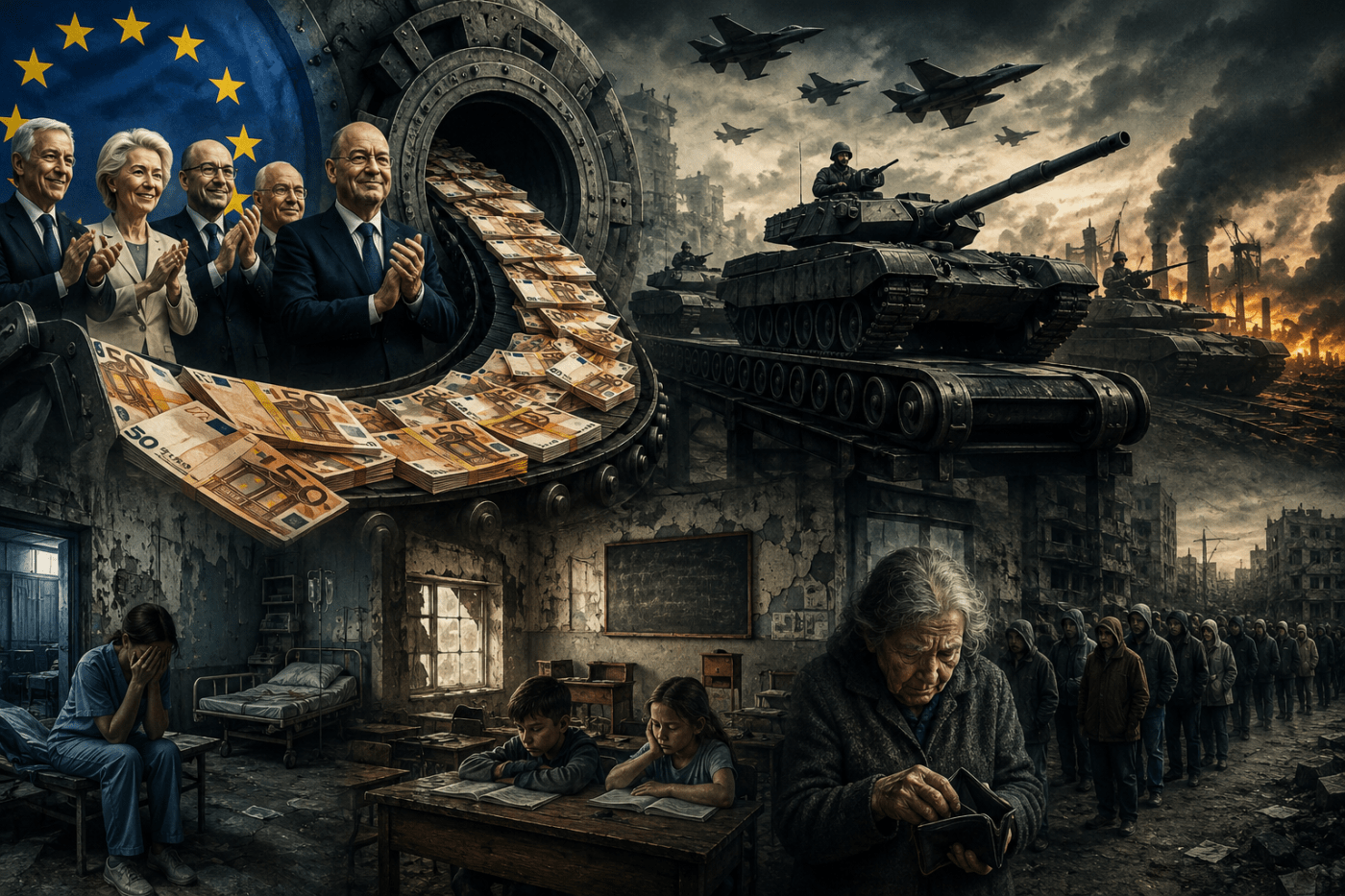
Deutsche Welle turns Europe’s rearmament drive into a managerial story about procurement delays, hiding the political decision to reorganize public life around militarization. The factual record shows that NATO, the EU, Germany, and the arms monopolies are already moving vast public resources into the war economy, even as European “autonomy” remains chained to U.S. weapons capital. What appears as a technical problem is really imperialist recalibration: austerity for the people, abundance for the arsenal, and dependency disguised as sovereignty. Against this war economy, the task is to build organized resistance through anti-NATO campaigns, arms divestment, union struggle, social-budget defense, and international working-class solidarity.
By Prince Kapone | Weaponized Information | June 24, 2026
The Arsenal Is Late, So the Priests of Empire Are Worried
“Europe is spending billions to rearm, so why the delays?”, written by Srinivas Mazumdaru and published by Deutsche Welle on June 23, 2026, presents itself as a sober business report on Europe’s military-industrial growing pains. The article’s basic claim is simple enough: European governments are pouring billions into defense after Russia’s 2022 invasion of Ukraine, but the continent’s defense industry remains too fragmented, too slow, too nationally divided, and too institutionally clumsy to deliver weapons at the speed NATO’s new war timetable requires. Germany is spending more. European arms companies have swelling order books. Joint fighter jets and tanks stumble through national quarrels. Procurement offices move like old priests carrying candles through a storm. The question posed is not whether Europe should be rearming, not whether ordinary people should be asked to finance another military buildup, not whether social life should once again be subordinated to the appetites of generals, contractors, and Atlantic planners. The question is only why the guns are not arriving quickly enough.
This is the article’s first trick. It smuggles the war premise into the room like a respectable guest and then asks us to discuss the furniture. Rearmament is treated as the natural weather of the age, as if tanks and fighter jets grow from the soil after every geopolitical thunderstorm. The article tells us that European defense was neglected after the Cold War, that Russia’s invasion of Ukraine produced a “wake-up call,” and that uncertainty over U.S. commitments under Donald Trump accelerated the turn toward military spending. This is not written as an argument. It is written as atmosphere. The reader is not invited to debate the strategic architecture of NATO, the conversion of public budgets into weapons pipelines, or the transformation of fear into industrial policy. The reader is invited to worry, like a shareholder, that Europe’s arms machine is not yet efficient enough.
Deutsche Welle occupies a very specific political-economic location in this story. It is not some barefoot newsletter passed hand to hand among dockworkers. It is Germany’s international broadcaster, funded through the German public order and positioned as a respectable voice of European liberal statecraft. That does not mean every sentence is dictated by a minister in a dark room, though the bourgeois imagination always prefers the cartoon conspiracy to the institutional fact. The point is sharper: DW speaks from inside the common sense of the German state, the European Union, and the NATO world. Its horizon is the horizon of managerial empire. Its anxieties are the anxieties of a ruling class trying to make war preparation sound like responsible administration. Its vocabulary is full of “security,” “procurement,” “readiness,” “coordination,” and “supply chains,” those clean little words that wash the blood off the invoice before the public is asked to pay it.
Mazumdaru’s professional position also matters. He writes as a business and geopolitics reporter, which shapes the entire field of vision. The article sees defense firms, investors, procurement agencies, national governments, experts, and military-industrial bottlenecks. It does not see the nurse whose hospital is underfunded, the pensioner whose retirement is threatened, the migrant blamed for a crisis caused by capital, or the worker told that a shell factory is now the highest form of industrial renewal. The reporting eye follows capital’s problem: orders are high, production is slow, profits are uncertain, coordination is messy. The people appear only as abstractions, as taxpayers beneath the floorboards of the discussion, present only because somebody must finance the next armored procession.
The article relies heavily on appeal to authority. Experts from defense institutes, policy councils, and economic think tanks are brought forward to explain that Europe’s problem is institutional rather than financial. Their role is not merely informational. It narrows the possible conversation. Once the “experts” define the crisis as procurement dysfunction, the political question disappears. The reader is no longer asking why Europe is preparing for prolonged militarized confrontation. The reader is asking how Europe can harmonize procurement, standardize weapons platforms, coordinate national industries, and perhaps bring startups into the sacred temple of organized destruction. This is the genius of respectable propaganda: it does not always shout falsehoods. Often it simply places the wrong question at the center and then congratulates itself for answering carefully.
Card stacking runs through the piece like a quiet accountant. We are given figures about NATO spending, German military expansion, defense-company order books, and the supposed need for self-sufficiency. We are told about fragmentation, diverging national priorities, and the collapse or delay of joint projects such as fighter jets and tanks. But the political economy of militarization is kept in soft focus. The article does not dwell on who profits when public borrowing limits are loosened for war but tightened for social need. It does not ask why “fiscal responsibility” becomes flexible the moment the weapons merchants arrive with polished shoes and patriotic brochures. Apparently there is no magic money tree for housing, hospitals, rail, schools, heat, food, or care. But for missiles, the orchard blooms overnight.
There is also omission, not as accident but as architecture. Anti-war forces are absent. Trade unions are absent. The working class is absent. The Global South is absent. The Ukrainian people appear only as the moral background against which European militarization is justified. Russia appears as the initiating threat, but the wider NATO structure is left unexamined. Europe’s colonial memory, its subordinate relation to U.S. military power, and its present effort to turn war spending into industrial policy remain outside the frame. The article does not need to deny these things. It only needs to organize the room so that they have nowhere to sit.
The language of the article performs another familiar operation: doublespeak. Rearmament becomes “readiness.” Military spending becomes “security.” Arms production becomes “jobs.” Weapons standardization becomes “efficiency.” The machinery of war is wrapped in the language of common sense until the cannon looks like a public service. This is how militarism walks into liberal society without wearing jackboots. It arrives with charts, procurement reform, industrial strategy, and a nervous expert explaining that the real problem is not enough coordination among contractors.
The deepest propaganda device is narrative framing. The article’s world begins after the alarm bell has already rung. Europe has been awakened. Russia has invaded. Trump has made U.S. guarantees uncertain. Therefore Europe must rearm. Everything before that is mist. Everything beyond that is logistics. This is how imperial media disciplines thought. It does not always tell the worker what to believe directly. It arranges the sequence of events so that the conclusion feels inevitable. First comes threat. Then comes spending. Then comes delay. Then comes the demand for faster delivery. By the time the reader reaches the end, the only scandal left is that the arsenal is late.
But even within its own frame, the article gives away the game. It admits that European governments now see defense spending not only as security policy but as a way to boost economic activity, sustain heavy industry, and generate exports. There it is, the little capitalist goblin peeking out from behind the flag. Rearmament is not merely a shield; it is a development model for a stagnating Europe. When civilian industry falters, when public legitimacy rots, when social democracy becomes a museum exhibit, the war economy returns wearing the perfume of national renewal. The bourgeoisie rediscovers the factory floor only when it can be used to manufacture death.
So the article must be read not as a neutral account of Europe’s defense delays, but as a polished specimen of imperial common sense. Its concern is not the danger of militarizing an entire continent. Its concern is that militarization is not proceeding smoothly enough. Its sadness is not for the public treasury, not for the working class, not for the peoples who will live beneath the shadow of these weapons, but for the procurement model that cannot yet keep pace with the ambitions of empire. Europe, we are told, is spending billions to rearm. The priests of the market are worried about the delays. The rest of us are supposed to mistake their anxiety for wisdom.
The Money Is Moving Faster Than the Machines
The first fact buried inside the respectable worry over European “delays” is that the money is not delayed at all. The military budgets are moving with a speed that would make a hospital administrator weep into an empty supply closet. According to SIPRI’s 2026 military expenditure data, world military expenditure reached $2.887 trillion in 2025, while spending in Europe rose by 14 percent. SIPRI further reports that European NATO members spent $559 billion in 2025, placing Europe at the center of the latest global surge in military expenditure. Germany alone is no small footnote in this process. SIPRI records that Germany’s military spending rose to $114 billion in 2025, a 24 percent increase from the previous year. This is the factual floor beneath the article’s anxiety: Europe is not suffering from a lack of money for war. It is suffering from the ordinary capitalist problem of turning public money into weapons, contracts, margins, and machines quickly enough to satisfy the timetable of empire.
NATO has already placed this rearmament inside a binding alliance discipline. At the 2025 Hague summit, NATO members committed to investing 5 percent of GDP annually by 2035 on core defense requirements and defense- and security-related spending, with at least 3.5 percent of GDP directed toward core defense expenditure. This is not merely a budget recommendation. It is a fiscal reorganization of the NATO states. It tells every ministry, every treasury, every parliament, every social program, and every working-class household that the alliance has written war-readiness into the future claims on public wealth. The DW article speaks of procurement problems, but the deeper fact is that procurement is now being reorganized under a NATO spending command. The machinery is not just industrial. It is budgetary, legal, fiscal, and ideological.
The European Union has followed with its own continental rearmament program. In March 2025, the European Commission presented its White Paper for European Defence and the ReArm Europe / Readiness 2030 plan, declaring the need to strengthen the European defense industry, accelerate military production, and build a more “ready” Europe. The European Parliament’s briefing on the package states that the plan was designed to mobilize more than €800 billion for defense investment. Once again, the key point is not that Europe lacks resources. The key point is that resources are being gathered, pooled, exempted, redirected, and politically sanctified for militarization. When the subject is bread, rent, care, wages, public transport, or heating, the public is lectured about limits. When the subject is artillery, suddenly Europe discovers the spiritual discipline of abundance.
Germany shows how this rearmament is being built into the state itself. The German Finance Ministry’s 2025 budget release states that the federal budget earmarked around €62.4 billion for defense, and that Bundeswehr special-fund spending and other federal expenditure brought Germany’s NATO-defined defense spending to 2.4 percent of GDP. Germany also altered its fiscal architecture so that military spending could move more freely than ordinary social need. Bruegel’s analysis of Germany’s debt-brake reform explains that defense spending above 1 percent of GDP was exempted from the constitutional debt brake. The old sermon of austerity has not vanished. It has merely been reassigned. Debt remains sinful for the poor, irresponsible for social programs, dangerous for public housing, but righteous when dressed in camouflage.
The article correctly notes that European arms firms have benefited from the spending boom, but the scale deserves to be named plainly. Rheinmetall reported that by December 31, 2025, its backlog had reached €63.8 billion, up from €46.9 billion the previous year. This is the sound of the public treasury becoming a dinner bell. The company’s expanding order book shows that the delays haunting Europe’s rearmament are not delays in state commitment to militarization. They are delays in converting that commitment into deliverable platforms, shells, vehicles, ships, sensors, drones, and margins. The workers are asked to call this “security.” The investor calls it backlog. The general calls it readiness. The contractor calls it opportunity. Each class names the same machine from its own seat at the table.
The procurement problem is also real, but not in the innocent way the article suggests. Bruegel’s March 2026 study found that the top ten contractors account for between 67 percent and 90 percent of military procurement in Germany, Poland, and the United Kingdom. This is not a democratic marketplace of innovation. It is a concentrated military-industrial order in which public money flows upward through familiar channels. The article says procurement is slow and biased toward large domestic manufacturers. The evidence confirms it. But the larger fact is that Europe’s “defense innovation” debate is already shaped by monopoly habits, national champions, protected contractors, and procurement systems built to reward the firms closest to the state.
Even the European dream of “strategic autonomy” runs into the hard wall of dependence. Mario Draghi’s report on European competitiveness notes that between mid-2022 and mid-2023, 78 percent of EU defense procurement spending went to non-EU suppliers, and 63 percent went to the United States. This is one of the most important omissions in the article’s framing. Europe speaks of self-sufficiency, but its emergency procurement has heavily fed U.S. defense capital. The European ruling class calls this autonomy while wiring the receipt to Washington. It wants independence in speeches and dependency in supply chains. It wants to stand on its own feet while ordering the boots from across the Atlantic.
The industrial bottlenecks are visible in European official data as well. The European Defence Agency reported that EU defense investment reached a record level in 2024, with defense equipment procurement expenditure rising to €88 billion, a 39 percent increase from 2023. The same institutional record shows that this increase was not a marginal adjustment but a structural surge in equipment procurement. The issue, then, is not whether Europe has begun to rearm. The issue is that a continent with overlapping national industries, divergent procurement rules, competing state-capital blocs, and long dependence on U.S. systems is trying to accelerate war production after decades of restructuring its economies around finance, services, austerity, and fragmented industrial policy.
Recent German procurement turmoil sharpens the point. Reuters reported on June 24, 2026, that Germany scrapped its delayed F126 frigate program after expected cost overruns, shifting instead toward an €11.6 billion purchase of eight smaller MEKO A-200 frigates from Thyssenkrupp Marine Systems. The same report noted that the F126 project had already involved billions in spending and had become a symbol of delay, cost escalation, and contractor uncertainty. This is exactly the kind of episode DW uses to illustrate the procurement problem. But the concrete fact also shows that rearmament is not a smooth patriotic assembly line. It is a battlefield of firms, ministries, shipyards, stock prices, delays, parliamentary approvals, and national industrial bets.
The U.S. pressure campaign also belongs inside the factual terrain. The Guardian reported that U.S. Defense Secretary Pete Hegseth accused NATO countries of “free riding” and linked U.S. commitments in Europe to whether allies meet higher defense-spending promises. That pressure helps explain why European rearmament is not simply a European choice. It is a response to Russian military pressure, the Ukraine war, U.S. demands, NATO discipline, and the uncertainty of American security guarantees. The European states are not floating freely in a neutral security marketplace. They are moving inside an alliance structure in which Washington still sets the rhythm, even when Europe sings the chorus in its own accent.
What DW leaves least developed is the social meaning of this turn. The article mentions that governments face strain from weak public finances and competing priorities such as health and welfare, but it does not reconstruct the class contradiction. Germany’s budget documents show defense moving upward through special funds and NATO-defined commitments, while NATO’s Hague target demands a long-term rise toward 5 percent of GDP. The European Commission’s Readiness 2030 plan organizes hundreds of billions for military investment. Rheinmetall’s backlog rises. Procurement contracts concentrate among dominant firms. U.S. suppliers capture a large share of emergency acquisitions. These are not scattered facts. They are the factual map of a continent reorganizing public capacity around war while presenting the whole operation as administrative necessity.
Weaponized Information has already treated this broader process as part of the crisis of European liberal order under hyper-imperial pressure. In its analysis of the EU’s strategic foresight agenda, WI argued that European “resilience” is increasingly being used to fold economic planning, infrastructure, technology, borders, and security into a single imperial management framework. The DW article confirms the same pattern from the defense side. Rearmament is not being sold only as military preparation. It is being sold as industrial policy, job creation, supply-chain security, innovation strategy, and national renewal. The gun is no longer presented merely as a weapon. It is presented as an economic development plan.
So the factual terrain is clear. Europe is not waiting to decide whether to militarize. It has already chosen the path. NATO has raised the spending command. The EU has built the financing language. Germany has opened fiscal space for defense. The arms firms have filled their order books. U.S. suppliers have captured a large share of emergency procurement. National contractors are fighting over the spoils. Procurement systems remain concentrated, slow, and fragmented. The public is told to accept all of this as sober realism. But behind the technocratic vocabulary stands a simple material fact: Europe is reorganizing its economies for war faster than it can reorganize its factories to produce the weapons.
Europe Calls the War Economy by Its Christian Name: Readiness
The real story is not that Europe wants to rearm but cannot. The real story is that Europe is rearming precisely because the old liberal order can no longer reproduce its authority through prosperity, social compromise, and quiet Atlantic obedience. The machine is not stalled because the ruling class lacks will. The money is moving. The spending targets are moving. The debt rules are bending. The order books are swelling. The alliance commands are hardening. What has not yet moved fast enough is the physical machinery of capitalist militarization: the factories, the supply chains, the shipyards, the contractors, the production lines, the procurement bureaucracies, and the national bourgeois factions all fighting over whose flag will be painted on the cannon before the cannon is sold back to the public as security.
This is why the language of delay is so useful to the imperial media apparatus. Delay sounds technical. Delay sounds managerial. Delay invites the reader into a world of bottlenecks, coordination problems, efficiency gaps, and institutional reform. But delay also hides the larger social crime. Nobody asks why the train to the hospital is late if the whole rail system is being converted to carry tanks. Nobody asks why schools crumble while fiscal rules are relaxed for fighter jets. Nobody asks why the continent suddenly discovers money for war after decades of lectures about discipline, restraint, competitiveness, and austerity. The article’s grief is not for the people forced to finance the arsenal. Its grief is that the arsenal is not yet punctual.
This is the character of imperialist recalibration in Europe. The old formula said that the United States would command, Europe would follow, and the whole arrangement would be wrapped in the velvet language of democracy. That formula still operates, but it now trembles under contradiction. Washington demands that Europe pay more for the same imperial architecture. Europe declares that it seeks autonomy, but its procurement trails, weapons systems, and security assumptions remain tied to U.S. power. The European bourgeoisie wants to be sovereign without breaking from empire. It wants independent capacity inside dependent strategy. It wants to stand upright while keeping its spine rented from Washington.
The contradiction is almost comic in its elegance. Europe names the project “strategic autonomy,” then sends emergency procurement money across the Atlantic. It calls the process “European readiness,” then organizes that readiness around NATO demands. It denounces dependency, then reproduces the supply chains of dependency. It speaks like a power learning to walk on its own legs, but the invoices show a different anatomy. Here Marx would not need thunder. A raised eyebrow would do. The bourgeoisie has once again discovered freedom as the right to purchase its chains wholesale.
At the center of this rearmament drive is the conversion of public wealth into military-industrial accumulation. The people are told that the problem is security, but the ledger tells another story. Military spending becomes a state-guaranteed development strategy for capital under conditions of stagnation. When civilian industry is weak, when investment is uncertain, when social legitimacy frays, the arms sector offers the ruling class a familiar solution: public money, private contracts, nationalist rhetoric, and a disciplined workforce. The cannon becomes an industrial policy. The missile becomes a jobs program. The shipyard becomes a shrine to national renewal. The state feeds the contractor, the contractor praises the nation, and the worker is invited to confuse employment under militarism with liberation from exploitation.
This is not an accident or merely a policy error. It is how capitalism manages crisis when peaceful accumulation falters. The war economy allows the ruling class to solve several problems at once. It directs public funds toward favored monopolies. It justifies exceptional borrowing. It disciplines political debate through fear. It binds workers to national industry under the sign of external threat. It turns social discontent outward, away from the bankers, landlords, arms executives, austerity managers, and Atlantic strategists who produce the daily insecurity of ordinary life. The people are made to fear the enemy at the border while the enemy in the boardroom signs the contract.
The DW article presents fragmentation as Europe’s Achilles heel, but fragmentation is not merely a bureaucratic problem. It is the normal form of capitalist competition inside an attempted imperial bloc. Each national state wants common militarization, but each national ruling class also wants its own factories protected, its own firms rewarded, its own workers disciplined under national banners, its own technological niche defended, its own prestige preserved. Cooperation is demanded at the level of strategy, competition returns at the level of contracts. This is why the European war machine advances like a committee of shopkeepers trying to build an empire together while each keeps one hand on the cash register.
The article also treats procurement concentration as an efficiency concern, as though the main question is whether startups and smaller firms can be admitted into the defense feast. But the deeper point is that militarized capitalism does not democratize production. It concentrates public power around firms already close to the state. The same political class that tells workers to accept market discipline does not subject the arms monopolies to any such morality play. Defense capital is not asked to compete in the sacred jungle like a street vendor selling fruit under police harassment. It receives orders, guarantees, subsidies, contracts, and strategic protection. The invisible hand becomes very visible when it signs a weapons deal.
This is where the class character of “readiness” becomes plain. Readiness for whom? Readiness for the tenant choosing between rent and food? Readiness for the nurse working short-staffed shifts? Readiness for the pensioner whose social protections are suddenly too expensive? Readiness for the migrant hunted by the same states that never run out of sympathy for weapons manufacturers? No. This is readiness for NATO logistics, for arms exports, for alliance discipline, for border regimes, for sanctions enforcement, for industrial militarization, and for the political survival of a European ruling class that has less and less to offer except fear wrapped in flags.
The article wants us to think the question is how Europe can move from spending to production. But the real question is how the ruling class moves from social crisis to war consensus. It does so by presenting militarization as common sense. It tells the public that the world is dangerous, which is true enough, but then forbids the public from asking who made it dangerous, who profits from the danger, and why the prescribed cure always enriches the same class of men who sell the disease. It speaks of sabotage, drones, hybrid threats, and critical infrastructure, but the worker already knows about sabotage. A closed factory is sabotage. A privatized rail system is sabotage. A hospital without beds is sabotage. A winter without heat is sabotage. A paycheck swallowed by rent is sabotage. But these forms of violence do not qualify as security crises because they do not require new missile contracts.
From the standpoint of the global working class and oppressed nations, European rearmament is not a defensive housekeeping matter. It is part of the wider architecture of hyper-imperialism in decline. The same powers that speak of European security have long organized insecurity elsewhere through sanctions, debt, military bases, extraction, coups, border regimes, and development strangulation. The same vocabulary of “resilience” used to militarize Europe is used to police migration, harden infrastructure, discipline energy flows, control technology, and manage crisis from above. The whole system is learning to speak in one language: security. Security of capital. Security of supply chains. Security of military blocs. Security of imperial access. Security of ruling-class continuity.
That is why this rearmament cannot be separated from the broader crisis of unipolarity. The old U.S.-led order is not collapsing in a single cinematic explosion. It is decomposing through wars, sanctions, bloc discipline, trade conflicts, financial coercion, and technological rivalry. Europe’s rearmament is one response to that decay. It is an attempt to harden the western bloc at the very moment the world is moving away from unquestioned Atlantic command. Multipolarity appears to the imperial countries not as a possibility for more balanced international relations, but as an existential insult. The empire does not experience equality as peace. It experiences equality as loss.
So Europe arms itself not simply because it fears war, but because war preparation has become one of the ways it manages its declining place in the world system. It arms itself to remain useful to Washington, to discipline Russia, to preserve NATO relevance, to secure industrial rents, to organize technological competition, and to keep its own populations inside a politics of emergency. The European worker is told this is defense. The neocolonized world recognizes the pattern. Whenever imperialism says it is defending civilization, someone else’s land, labor, resources, or future has already been placed on the menu.
The hidden story, then, is not Europe’s failure to rearm quickly enough. The hidden story is Europe’s success in normalizing the war economy as the next stage of liberal governance. Rearmament is being made ordinary. Debt exemptions for military spending are made responsible. Corporate backlogs are made patriotic. Procurement reform is made democratic. NATO pressure is made common sense. Dependency on U.S. suppliers is made temporary. Austerity for the people and abundance for the arsenal are made to appear as two separate questions when they are one class relation.
Against this mystification, the task is to name the machine. Europe is not merely preparing for threats. It is reorganizing itself through threat. It is not merely defending society. It is deciding which part of society deserves investment and which part can be left to rot. It is not merely correcting procurement delays. It is building a continental war economy whose delays are treated as more scandalous than the social ruin required to finance it. The article asks why Europe’s arsenal is late. The answer is that capitalism, having promised peace, prosperity, and democracy, now returns to its oldest profession: turning public fear into private profit and calling the invoice security.
From Rearmament to Resistance: Building the Front Against Europe’s War Economy
If Europe’s ruling class has already chosen its direction, then the responsibility of ordinary people is no longer simply to understand the process but to organize against it. Every euro diverted into missiles, tanks, warships, and military procurement is a political decision about what kind of society will exist tomorrow. The struggle is therefore not merely against higher military budgets. It is against the transformation of permanent militarization into common sense. It is against the normalization of a political economy in which hospitals must justify their existence while weapons factories are treated as indispensable national assets. The first task is to reject the false choice presented by Europe’s political establishment: that security and social welfare exist in competition with one another. Real security has always begun with housing, food, healthcare, education, dignified work, functioning infrastructure, and peaceful relations among peoples—not with ever-expanding procurement contracts for the arms industry.
Across Europe that understanding is already beginning to find organizational expression. The Stop ReArm Europe campaign has united hundreds of organizations, trade unions, peace groups, feminist organizations, environmental movements, and social justice campaigns around a common rejection of the European Union’s accelerating militarization. Rather than accepting the narrative that hundreds of billions of euros must inevitably flow toward rearmament, the campaign insists that these public resources belong to society itself and should instead strengthen public services, ecological transition, workers’ rights, housing, healthcare, and democratic development. Their coalition demonstrates an important strategic lesson: opposition to militarization becomes strongest when anti-war politics is connected directly to the material interests of ordinary people rather than treated as an isolated foreign-policy question.
The machinery of militarization also depends upon corporations that profit from perpetual insecurity, making economic pressure an equally important terrain of struggle. The Campaign Against Arms Trade (CAAT) has spent decades exposing Britain’s weapons industry, documenting arms exports, investigating government procurement, and organizing campaigns against the political influence of military contractors. Their publicly available financial reports demonstrate that the organization is funded primarily through supporters and donations rather than government sponsorship, allowing it to maintain independence from the institutions whose policies it challenges. Likewise, the World BEYOND War Divest from the War Machine campaign has developed practical tools enabling universities, municipalities, pension funds, religious institutions, and local governments to identify and withdraw investments from weapons manufacturers. Rather than treating militarism as an abstract moral issue, these campaigns identify the financial arteries through which public wealth is converted into private military profit.
Europe’s expanding military-industrial complex also requires political legitimacy, and legitimacy can be contested wherever ordinary people organize collectively. The European Network Against Arms Trade (ENAAT) continues to investigate European Union military-industrial policy, exposing how public research funding increasingly supports defense corporations while lobbying against expanded arms exports and military subsidies. Meanwhile, the Campaign for Nuclear Disarmament (CND) continues organizing against nuclear modernization, NATO escalation, and the diversion of public resources toward military expansion while maintaining transparent public reporting through its annual financial disclosures. Together these organizations remind us that militarization is not only fought on battlefields; it is fought inside budgets, procurement systems, investment portfolios, parliamentary committees, export licensing offices, research grants, and public consciousness itself.
The practical tasks flowing from this moment are neither mysterious nor unattainable. Workers can investigate whether their pension funds invest in major weapons manufacturers and organize campaigns demanding divestment. Students can examine whether their universities maintain research partnerships with defense contractors or military-funded technology programs. Local activists can scrutinize municipal procurement, expose subsidies flowing toward military industries, and pressure elected officials to oppose additional military appropriations. Trade unionists can challenge attempts to redefine weapons production as industrial renewal while advancing demands for publicly owned civilian manufacturing capable of producing infrastructure, renewable energy systems, transportation equipment, housing materials, and medical technology instead of instruments of war. Journalists and independent media can continue documenting the financial beneficiaries of Europe’s rearmament while refusing the language that disguises militarization as merely another economic stimulus package.
Perhaps most importantly, movements across Europe must refuse to allow ruling elites to separate anti-war politics from class politics. Every increase in military expenditure should be measured against overcrowded hospitals, understaffed schools, deteriorating transportation networks, unaffordable housing, shrinking pensions, rising utility costs, and declining living standards. Every announcement celebrating another defense contract should immediately raise the corresponding question: what social need has once again been postponed to finance it? Every promise that military spending creates jobs should be answered with a demand for publicly financed civilian industry capable of creating employment without requiring permanent international confrontation. The objective is not simply to oppose one procurement decision after another. It is to expose the broader political economy that makes militarization appear more financially possible than social reconstruction.
Solidarity must also extend beyond Europe’s borders. The peoples of Russia, Ukraine, Palestine, Yemen, the Sahel, Latin America, and every region living beneath the shadow of great-power confrontation share a common interest in dismantling the structures that transform geopolitical rivalry into profitable business. Likewise, workers throughout Europe share more in common with workers throughout the Global South than they ever will with the executives whose balance sheets expand every time another parliament authorizes military spending. The future will not be secured by building larger arsenals than yesterday. It will be secured by building stronger movements than yesterday—movements capable of replacing fear with solidarity, militarization with social development, and competition among peoples with cooperation among workers. Europe’s rulers have already begun organizing for the next war. The task before the working class is to organize for a different future altogether.


Leave a comment