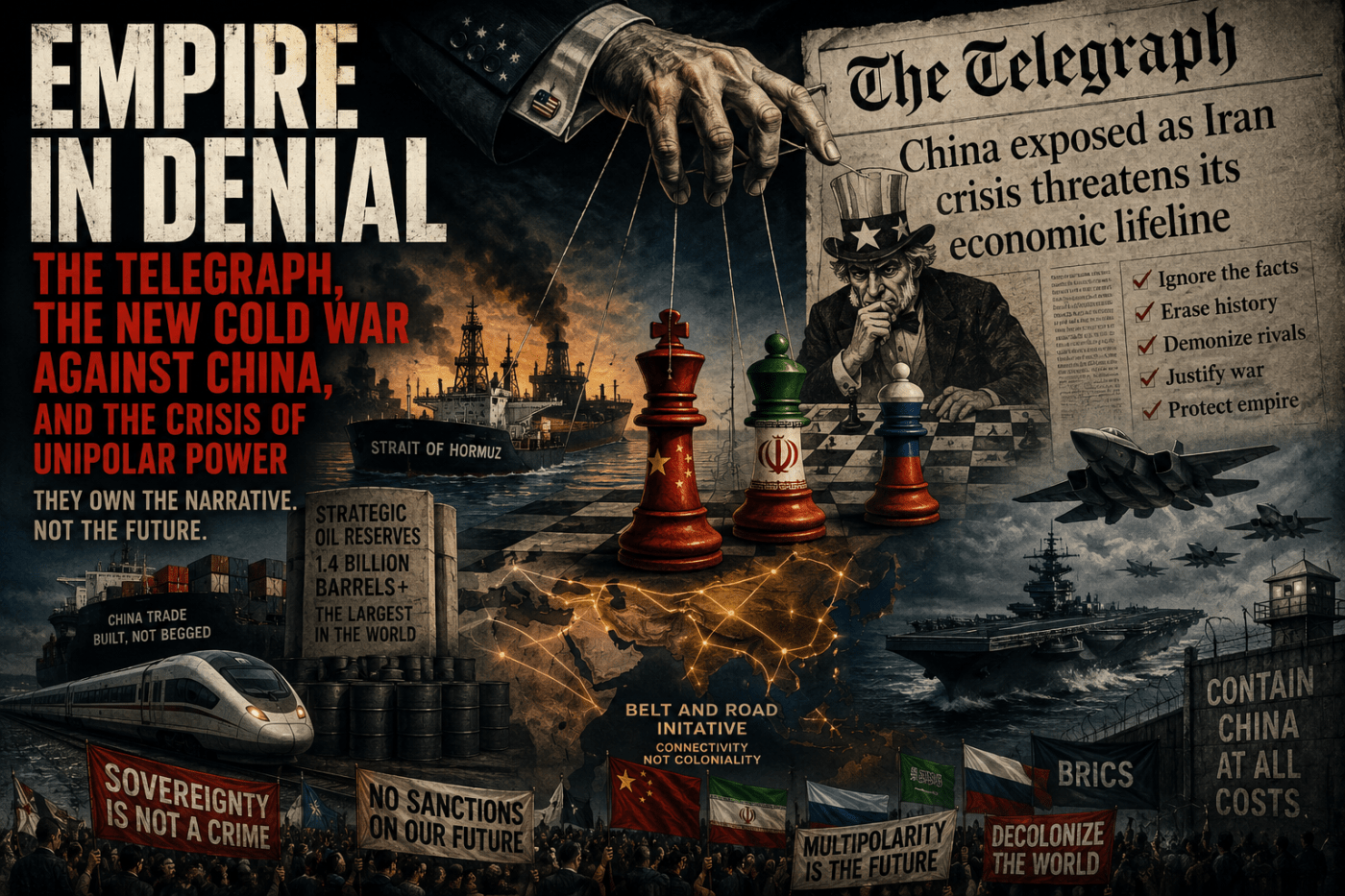
The Telegraph begins by trying to convince its readers that China is collapsing under the weight of economic weakness, geopolitical overreach, and strategic failure. Beneath that narrative lies a very different material reality: a world economy being reorganized through sanctions, energy chokepoints, military encirclement, and the growing fragmentation of U.S. imperial dominance. The article’s omissions expose how the Atlantic media apparatus erases the historical violence, coercion, and sovereignty struggles shaping relations between China, Iran, Russia, and the wider Global South. What finally emerges is not the story of a dying China, but the story of an empire increasingly unable to explain a world it no longer fully controls.
By Prince Kapone | Weaponized Information | May 15, 2026
The Empire Needs Someone to Laugh At
The article under excavation is “China isn’t the great power Xi pretends it is”, written by Con Coughlin and published in The Telegraph on May 13, 2026. Its central argument is straightforward enough: China, despite all the ceremony and spectacle surrounding Donald Trump’s visit to Beijing, is supposedly entering this moment from a position of weakness. Coughlin tells his readers that China’s economy is faltering, its energy lifelines are exposed in the Strait of Hormuz, its alliances are liabilities, Russia has become an embarrassment, Iran a burden, and Taiwan a reminder that American military power still towers over Asia like a landlord standing over tenants late on rent day. Xi Jinping, we are told, wants the world to believe China has arrived as a great power. But according to the article, Washington still owns the table, still deals the cards, and still decides who gets invited into the room.
But that phrase — “holding the cards” — is really the heartbeat of the entire piece. This is not ordinary reporting. It is morale-building literature for an aging empire that wakes up every morning checking whether the rest of the world still fears it enough. The Telegraph, like much of the old British ruling-class press, now survives by serving as a kind of emotional support animal for Atlantic power. Britain lost its empire some time ago, but sections of its press still wander the world carrying the faded map in their pockets, insisting history simply misplaced the crown jewels for a moment.
So the job of writers like Coughlin is not merely to explain events. It is to reassure Western audiences that, despite wars, inflation, industrial decline, military overstretch, and political decay, the empire remains the natural manager of humanity. In this worldview, Washington may stumble, but everyone else must crawl. China may build railways, ports, factories, industrial corridors, and telecommunications systems across half the planet, but one disruption in Hormuz and suddenly the old colonial press begins writing obituaries with the excitement of undertakers hearing a cough from the next room.
Coughlin writes from the familiar social location of imperial security journalism. His world is populated by generals, strategic summits, alliances, intelligence circles, and military calculations. The masses of humanity appear only dimly, if at all. Workers enter the story only as consumers. Iranians appear mainly as a problem. The Gulf exists as an oil tap. Taiwan exists as a military pressure point. The Chinese people themselves disappear almost entirely beneath abstractions about “Beijing” and “Xi,” as though a civilization of over a billion human beings can be reduced to the facial expressions of one politician sitting across from Donald Trump.
The first propaganda device at work is simple name-calling. Xi is not merely described as the president of China or the leader of the Communist Party; he is repeatedly cast as an “autocrat” and “despot.” China does not issue policy positions; it engages in “bluster.” This language does not clarify anything materially. It functions emotionally. Before evidence is introduced, the reader is instructed how to feel. The imperial press always begins by assigning moral costumes before explaining political conflicts. One side “rules,” the other side “regimes.” One side has “security concerns,” the other side has “aggression.” One side projects “leadership,” the other “ambition.” Colonial vocabulary survives long after colonial flags come down.
The second device is card stacking. Every contradiction facing China is gathered together and arranged dramatically on the table: slowing growth, oil dependency, military purges, Russia’s battlefield difficulties, instability in Iran, tensions over Taiwan. Yet the forces generating much of this instability mysteriously vanish from view. Sanctions disappear. Encirclement disappears. Military alliances disappear. U.S. naval dominance disappears. The long history of Western powers using trade routes, financial systems, and energy corridors as weapons disappears. China’s vulnerabilities are real, but the article presents them like acts of God descending from the heavens rather than pressures developing inside a world system heavily shaped by American military and financial power.
The third device is omission, and omission is often the most important propaganda technique because silence is cleaner than lying. Iran is discussed without the history of coups, sanctions, assassinations, and economic warfare imposed upon it. Taiwan is discussed without the vast U.S. military architecture surrounding China’s coastline. Russia is discussed without the long expansion of NATO eastward after the Cold War. Gulf monarchies are described as comfortably aligned with Washington while their deepening economic integration with China is pushed quietly offstage like an inconvenient stagehand during a royal performance.
Then comes the appeal to force masquerading as wisdom. The article praises the “devastating effectiveness” of U.S.-Israeli military operations as though military destruction automatically settles political questions. By that logic, every empire in history becomes morally correct whenever its bombs land accurately enough. The British Empire once claimed the same thing while starving India. The French claimed it in Algeria. The Americans claimed it in Vietnam, Iraq, and Libya. Apparently, imperial violence keeps failing historically while remaining permanently “effective” editorially.
Finally, the article performs the oldest trick in ruling-class journalism: turning temporary contradiction into permanent destiny. A war in Iran becomes proof of China’s decline. Russia’s difficulties become proof of a failed multipolar world. Energy disruption becomes proof that the Atlantic order remains historically inevitable. The conclusion is always prepared in advance. Facts are invited into the article only if they agree to wear the correct uniform.
What emerges in the end is not serious geopolitical analysis but something much more fragile: an imperial bedtime story for nervous Western audiences living through the slow erosion of unchallenged dominance. The purpose is psychological. The reader must leave reassured that the empire still commands the seas, still disciplines the world, still decides legitimacy, and still reserves the right to laugh at any nation trying to rise beyond the boundaries assigned to it by the old colonial order.
The Things the Telegraph Could Not Afford to Tell You
Con Coughlin’s article depends heavily on the idea that China is entering the current Iran crisis economically exhausted and strategically exposed. Yet the actual publicly available economic data tells a far more complicated story than the one presented to Telegraph readers over breakfast tea and imperial nostalgia. China registered 5.0% GDP growth in the first quarter of 2026 alongside 2.4% retail-sales growth, numbers which hardly support the dramatic image of a collapsing economy stumbling toward geopolitical irrelevance. During the same period, U.S. GDP grew by only 2%. This does not mean China lacks contradictions. Every major capitalist economy in the present period is burdened by overcapacity, slowing global demand, debt pressures, and uneven consumption. But “slowing” and “stagnant” are not interchangeable terms, except perhaps inside editorial rooms where adjectives work overtime to compensate for weak evidence.
The Telegraph’s broader argument rests heavily on the assumption that China’s dependence on Middle Eastern energy leaves Beijing dangerously exposed in the Hormuz crisis. It is true that China imported roughly half its crude oil and nearly one-third of its LNG from Western Asia in 2025. But this is only one part of the picture. U.S. Energy Information Administration estimates released in 2026 indicated that China holds the largest strategic oil reserves in the world, with stockpiles estimated at roughly 1.4 billion barrels by the end of 2025. At the same time, Chinese oil imports were diversified across Russia, Saudi Arabia, Iran, Iraq, Oman, the UAE, Angola, Brazil, and other suppliers. Beijing is vulnerable to disruption, but vulnerability is not the same thing as helplessness. China spent years constructing strategic reserves, pipeline networks, diversified suppliers, and logistical redundancies precisely because it understood the geopolitical risks surrounding maritime chokepoints dominated by U.S. naval power.
That context matters because the Telegraph portrays China’s relationship with Iran almost like an embarrassing geopolitical accident suddenly exposed by war. In reality, China and Iran formalized a comprehensive strategic partnership in 2016, covering political coordination, infrastructure, trade, defense cooperation, judicial collaboration, and regional diplomacy. Later, the 25-year Iran-China cooperation framework expanded those ties through long-term energy agreements, transportation infrastructure, industrial investment, and logistical integration. China needs stable energy access and trade corridors. Iran needs investment, infrastructure, export markets, and financial relationships capable of bypassing Western sanctions systems. The relationship did not emerge from ideology alone. It emerged from material pressures inside the world economy.
The Telegraph discusses the Iran conflict almost entirely through the calculations of Washington, Tel Aviv, and Gulf monarchies tied to the American security system. Yet the current war began with U.S.-Israeli attacks on Iran on February 28, 2026, including strikes that killed civilians and damaged civilian infrastructure. That is not some minor contextual detail. It is the political foundation of the conflict itself. The article presents instability as though it simply erupts naturally from the Middle East like a seasonal sandstorm. But the current crisis emerged from years of sanctions, sabotage, assassinations, military encirclement, economic warfare, and escalating confrontation carried out under the language of “security” and “regional stability.”
Even the Telegraph’s portrayal of China as passive during the Hormuz crisis becomes difficult to sustain under closer examination. China and Russia jointly circulated a draft resolution at the UN Security Council calling for de-escalation, diplomatic engagement, and protection of navigation through the Strait of Hormuz. One may debate the effectiveness of UN diplomacy, but the larger issue is revealing: Atlantic media recognizes military force as “action,” while diplomacy becomes invisible unless accompanied by sanctions, bombers, or aircraft carriers.
The article also frames Gulf monarchies as though they are naturally returning to exclusive alignment with Washington. Yet Saudi-Chinese summit statements continue to describe strategic cooperation in oil, logistics, renewable energy, petrochemicals, and industrial development, while the UAE continues expanding industrial and manufacturing cooperation with China. Gulf rulers are not neatly choosing one side over another. They are attempting to navigate an increasingly fragmented world order by balancing security dependence on Washington with expanding economic integration with Beijing.
The same contradiction appears in the Telegraph’s treatment of Russia. The article suggests China’s partnership with Moscow has become a humiliating liability because of the war in Ukraine. Yet China and Russia continue coordinating through BRICS, the Shanghai Cooperation Organization, energy agreements, UN diplomacy, and Global South political forums. Likewise, the 2024 DPRK-Russia Treaty on Comprehensive Strategic Partnership expanded strategic coordination between Moscow and Pyongyang. These relationships are not signs of a perfectly unified anti-Western bloc, but neither are they collapsing alliances held together purely by desperation.
The Telegraph also discusses Taiwan almost entirely through the framework of military competition and Chinese ambition. Yet China’s official summary of the Trump-Xi summit identified Taiwan as the central issue in China-U.S. relations, framing it as a question of sovereignty, territorial integrity, and national security. The island sits inside a much broader U.S. military architecture stretching across the Pacific through alliances, naval deployments, intelligence cooperation, and arms transfers designed to contain China’s regional influence.
Most important of all, the Telegraph strips the current crisis of historical memory. Yet U.S. government historical records acknowledge American involvement in the 1953 overthrow of Iranian Prime Minister Mohammad Mossadegh after he nationalized Iranian oil. Decades later, Washington’s withdrawal from the JCPOA and the reimposition of sweeping sanctions targeted Iran’s banking, shipping, energy, and industrial sectors. These historical pressures are not background noise. They are central to understanding why Iran seeks alternative partnerships, why China pursues diversified energy arrangements, and why an increasing number of states across the Global South are searching for political and economic space outside direct American supervision.
What emerges from all these omitted facts is not the image of a collapsing China abandoned by the world. Nor does it reveal a flawless anti-Western bloc marching in perfect unity toward inevitable victory. What emerges instead is a world system under mounting strain, where sanctions, military pressure, energy chokepoints, industrial competition, and sovereignty struggles are rapidly reshaping global alignments faster than the old Atlantic press can comfortably explain to its readers.
The New Cold War Is Really a War Against Sovereignty
The Telegraph wants its readers to believe they are witnessing the decline of China. What they are actually witnessing is the violent instability of an imperial order losing its monopoly over the organization of the world economy. These are not the same thing. But imperial propaganda depends on confusing them.
The article begins from a familiar assumption that has become central to the New Cold War Against China: any contradiction inside China must automatically be interpreted as proof that the Chinese project itself is fundamentally unsustainable. Slower growth becomes “collapse.” Energy vulnerability becomes “weakness.” Diplomacy becomes “impotence.” Strategic partnership becomes “authoritarian conspiracy.” The conclusion is prepared before the evidence even enters the room.
But the material reality reconstructed in Section II reveals something very different. China is not collapsing under the weight of the Hormuz crisis. Rather, Beijing is navigating the same global contradictions confronting every major industrial economy under conditions of intensifying geopolitical fragmentation. The difference is that China is doing so while facing direct containment pressure from the most militarized imperial bloc on earth.
This is the key ideological trick of the Telegraph article: it treats American power as neutral background scenery while portraying every Chinese response to that power as evidence of aggression, ambition, or insecurity. The United States surrounds China with military alliances, naval deployments, sanctions threats, intelligence integration, and strategic encirclement across the Pacific, yet China’s concern over Taiwan is framed as irrational nationalism rather than a response to Forward Containment Architecture built directly along its maritime frontier.
The same inversion appears in the treatment of Iran. The Telegraph presents China’s relationship with Tehran almost like an embarrassing diplomatic burden, as though Beijing accidentally wandered into partnership with Iran one drunken evening after making bad decisions at a geopolitical nightclub. But Section II shows something much simpler and far more material: Iran and China were pushed together through the logic of sanctions architecture, energy interdependence, infrastructure development, and the coercive behavior of the Atlantic powers themselves.
Iran needs investment, trade corridors, industrial cooperation, and alternatives to Western-controlled financial systems. China needs long-term energy stability, logistical integration across Eurasia, and protection against chokepoint coercion. The relationship did not emerge because Chinese and Iranian officials gathered in a secret volcano plotting world domination beneath dramatic lighting. It emerged because the existing imperial order increasingly punishes independent development outside direct American supervision.
And this is the larger contradiction buried beneath all the Telegraph’s language about “authoritarian alliances.” What Western media calls an “axis” is often simply the predictable consequence of coercion. When states are sanctioned, encircled, threatened, sabotaged, financially isolated, militarily pressured, and excluded from Western-controlled systems, they search for alternative partnerships. Then the Atlantic press points at the resulting relationships and declares them proof of hostile intent. The empire first builds the prison, then denounces the prisoners for speaking to one another through the walls.
The article’s discussion of Hormuz exposes the same imperial logic. The Strait of Hormuz is treated as evidence of Chinese fragility because the Telegraph quietly assumes that maritime chokepoints naturally belong under American military supervision. But there is nothing “natural” about this arrangement. The current global order was built through centuries of colonial expansion, naval dominance, financial centralization, military basing, and the concentration of coercive force inside Atlantic institutions.
China’s energy vulnerability therefore cannot be separated from the structure of the world system itself. Beijing understands this perfectly well, which is why it spent years building strategic oil reserves, diversifying suppliers, expanding pipeline infrastructure, and constructing logistical redundancy across Eurasia and the Global South. The Telegraph interprets this planning as weakness because imperial ideology can only recognize power when it arrives in the form of aircraft carriers, sanctions packages, or missiles streaking across television screens.
In fact, one of the clearest signs of imperial decline is precisely this narrowing definition of power. The old Atlantic order increasingly confuses domination with leadership and destruction with strength. It still possesses immense military capacity, enormous financial leverage, and the ability to inflict catastrophic violence almost anywhere on earth. But the capacity to bomb countries is not the same thing as the capacity to organize stable historical legitimacy.
This is why the article repeatedly celebrates the “effectiveness” of American and Israeli military operations while ignoring the political wreckage left behind by decades of intervention. Iraq was bombed in the name of stability and collapsed into chaos. Libya was destroyed in the name of democracy and fragmented into catastrophe. Afghanistan was occupied in the name of liberation and left poorer than before. Yet each new intervention arrives wrapped in the same moral language like reheated leftovers served on expensive plates.
The Telegraph also cannot explain why Gulf monarchies increasingly deepen economic ties with China while remaining tied militarily to Washington. From the standpoint of old Cold War logic, such behavior appears contradictory. But under conditions of Multipolar Recalibration, states increasingly hedge, maneuver, and diversify relationships because no single power center commands uncontested authority anymore.
This is why the New Cold War Against China differs from the original Cold War in important ways. The Soviet Union existed largely outside the capitalist world economy. China, by contrast, sits at the center of global manufacturing, infrastructure development, commodity circulation, logistics, and industrial production. The United States therefore confronts a contradiction it cannot fully resolve: it seeks to contain China while remaining deeply economically entangled with the very system it wants to discipline.
That contradiction produces the increasingly frantic tone visible throughout the Atlantic media system. Truly confident empires do not spend every waking hour announcing the weakness of their rivals. They do not require endless headlines insisting the future still belongs to them. They do not need entire ideological industries devoted to explaining why every disruption, every war, every sanction regime, and every crisis somehow proves the eternal supremacy of the Atlantic order.
What they fear is not simply China itself. What they fear is the erosion of historical inevitability. For nearly three decades after the Cold War, the Atlantic ruling classes governed as though history had ended and neoliberal capitalism under American supervision represented the permanent destiny of humanity. But history did not end. It merely became inconvenient again.
Now the world is crowded with competing centers of accumulation, competing trade corridors, competing diplomatic systems, competing development models, and competing political futures. BRICS expands. Sanctioned economies construct alternative payment systems. Eurasian logistics corridors multiply. Energy trade reorganizes outside traditional Atlantic supervision. More and more nations seek room to maneuver beyond direct imperial management.
This does not mean the arrival of a peaceful multipolar paradise. The emerging world remains dangerous, unequal, and deeply contradictory. But it does mean the old unipolar order no longer governs uncontested. And that, more than anything else, explains the nervous obsession running through articles like Coughlin’s.
The Telegraph is not really trying to understand China. It is trying to reassure the Atlantic world that history still belongs to the empire. But history has become crowded again. The old order still has fleets, banks, sanctions, military alliances, intelligence systems, and bombs. What it no longer possesses is the unquestioned authority to define reality for everyone else.
From Watching the Empire to Organizing Against It
The purpose of propaganda excavation is not simply to expose media lies and contradictions like a schoolteacher correcting homework in red ink. The point is to clarify the terrain of struggle so ordinary people can understand what forces are shaping their lives and how those forces might be confronted collectively. If the Telegraph article reveals anything clearly, it is that the ruling classes of the Atlantic world are preparing their populations psychologically for a future defined by escalating confrontation, economic warfare, military expansion, and permanent instability organized in the name of “security” and “order.”
The workers paying rent in London, the warehouse workers loading containers in Long Beach, the Palestinian family digging through rubble in Gaza, the Iranian mechanic watching prices rise under sanctions, and the Chinese factory laborer navigating an unstable global export market are all living inside the same world system, even if imperial media works day and night to convince them otherwise. One of the first responsibilities of anti-imperialist political work is therefore to reconnect struggles artificially separated by nationalism, propaganda, and information warfare.
That work cannot remain abstract. It must become organizational. It must become educational. It must become rooted in institutions capable of developing political clarity outside the ideological supervision of corporate media and state power.
Organizations like Black Alliance for Peace have already spent years building anti-imperialist campaigns against AFRICOM expansion, NATO militarization, sanctions warfare, and U.S.-led destabilization operations throughout the Global South. Their publicly documented nonprofit structure and independent political orientation can be reviewed through public nonprofit filings and financial disclosures. This matters because anti-imperialist organizing must remain independent from the very state and foundation structures responsible for manufacturing consent for imperial violence.
Likewise, CODEPINK continues organizing against war escalation targeting Iran and China while building grassroots antiwar campaigns across the United States. Their organizational structure and nonprofit records are also publicly accessible through independent nonprofit databases and tax filings. Whether one agrees with every tactical or ideological position these organizations take is secondary to recognizing the larger political necessity: antiwar infrastructure must exist before crises escalate, not afterward.
The immediate task is political education rooted in material reality rather than spectacle. People must learn to see sanctions not as abstract diplomatic tools but as forms of economic warfare that raise prices, destroy medical systems, block industrial development, and discipline populations through deprivation. They must learn to see naval encirclement and military bases not as defensive abstractions but as mechanisms for controlling trade routes, energy flows, and sovereign development. They must learn to recognize how corporate media transforms coercion into “leadership” and resistance into “aggression.”
This means organizing local study circles, workplace discussions, public forums, teach-ins, and political education programs capable of comparing corporate narratives with primary-source material from the countries actually being discussed. Workers should not have to rely exclusively on British and American corporate newspapers to understand China, Iran, Russia, Palestine, or the wider Global South any more than colonized people once needed colonial administrators to explain their own lives back to them.
It also means investigating the local architecture of empire itself. Every city inside the imperial core is connected materially to global coercion in ways often hidden beneath ordinary life. Ports move military cargo. Universities receive defense contracts. Technology firms build surveillance infrastructure. Logistics corporations profit from sanctions enforcement. Financial institutions facilitate economic warfare. Media outlets reproduce ideological discipline. The empire is not somewhere “over there.” It is woven into everyday economic life.
For workers and oppressed communities inside the imperial states, this creates an important political responsibility. Anti-imperialism cannot become a spectator activity where people merely observe geopolitical conflict from a distance like sports fans choosing teams. The task is to weaken the ability of ruling classes to mobilize populations behind militarism, chauvinism, sanctions, and war hysteria.
That means opposing further military escalation against Iran. It means rejecting attempts to transform Taiwan into a permanent military flashpoint. It means resisting sanctions regimes that collectively punish civilian populations while enriching financial and military sectors inside the imperial core. It means connecting antiwar struggle directly to housing insecurity, inflation, austerity, labor exploitation, surveillance expansion, and collapsing social infrastructure at home.
The same governments claiming there is endless money for aircraft carriers, missile systems, military exercises, intelligence expansion, and foreign intervention somehow discover empty pockets whenever workers demand healthcare, schools, housing, public transportation, or wages capable of sustaining human life. Empire abroad and austerity at home are not separate political phenomena. They are different expressions of the same social order.
And so the struggle against imperial propaganda must ultimately become a struggle for political consciousness itself. The ruling classes understand very clearly that a population incapable of connecting global war to domestic exploitation becomes easier to govern. That is why they flood the information system with fear, spectacle, nationalism, and endless geopolitical theater. Confused people are governable people.
Our task is therefore not simply to denounce the empire’s lies, but to help build the political clarity, solidarity, and organization necessary to outlive them.


Leave a comment