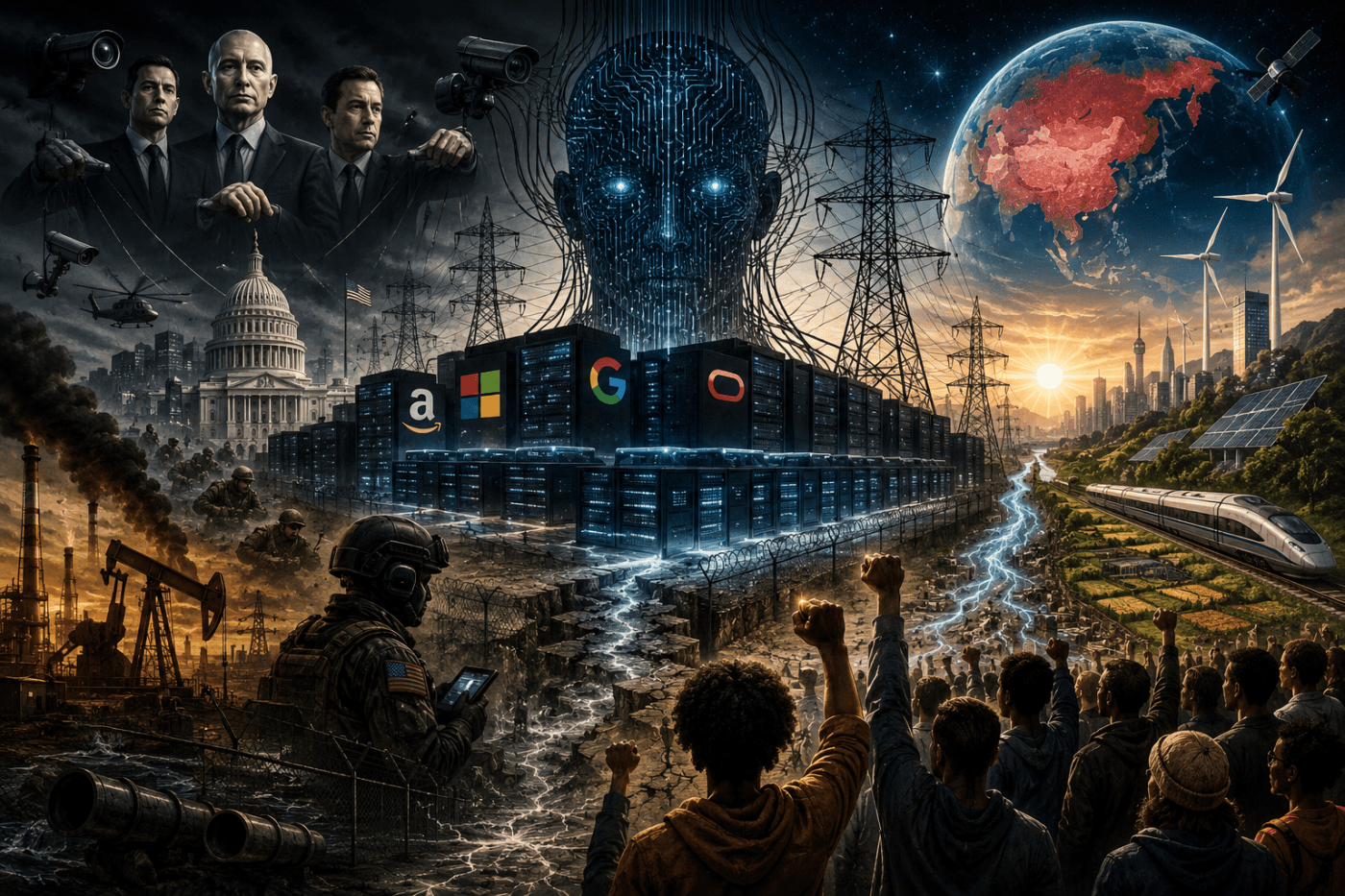
A Harvard policy brief on artificial intelligence and the electric grid accidentally exposes the deeper contradictions of a decaying empire trying to sustain technological supremacy through privatized infrastructure and monopoly extraction. Beneath the language of “innovation” and “modernization” lies a material crisis of energy bottlenecks, fossil fuel revival, public subsidy theft, ecological exhaustion, and military-cloud integration driven by Big Tech and the national security state. The comparison with China reveals the growing historical contradiction between a fragmented neoliberal energy regime and a state-directed model capable of coordinating industrial planning, electrification, and technological development at continental scale. As AI infrastructure becomes the backbone of Cold War 2.0, new struggles are emerging around public power, anti-imperialism, labor, ecological survival, and the fight to place energy and computation under democratic social control rather than computational empire.
By Prince Kapone | Weaponized Information | May 8, 2026
The Managers of the Machine Discover the Meter Is Running
On February 10, 2026, the Harvard Kennedy School’s Belfer Center published “AI, Data Centers, and the U.S. Electric Grid: A Watershed Moment”, written by Rachel Mural, Dipesh Pherwani, Chaitanya Gupta, Yiqi Yu, Ai Takahashi, Dongjoo Kim, Subir Majumder, Henry Lee, Minlan Yu, and Le Xie. The article examines the rapid growth of artificial intelligence data centers in the United States and the enormous pressure this growth is placing on the electric grid. It notes that data center electricity demand is rising sharply, that major regional markets such as Virginia and Texas are already facing serious reliability and cost-allocation problems, and that regulators must develop new policy tools to manage this new industrial load. On the surface, the piece appears sober, technical, and responsible. Harvard has gathered the engineers, policy people, utility experts, and grid managers around the table to ask a very serious question: how can the empire keep the servers humming without blowing out the wires?
But the table itself tells us something. The Belfer Center is not some village council of workers, tenants, farmers, and ratepayers trying to decide how electricity should serve human need. It is a policy institution lodged inside Harvard Kennedy School, one of the polished command posts of the American managerial class. Its intellectual function is not to overthrow the house but to inspect the cracks in the foundation before the guests arrive. It produces the kind of knowledge empire requires when its machinery begins to groan: calm language, technical diagrams, regulatory proposals, and just enough alarm to justify a new round of elite coordination. The article is therefore not crude propaganda. It is better than that, which makes it more useful to power. It tells part of the truth in order to keep the rest of the truth safely locked in the basement.
The authors write from the world of policy, engineering, energy systems, utility planning, and academic research. That professional location shapes the article’s horizon. They can see congestion, voltage instability, interconnection delays, stranded costs, and tariff design. They can see the wires, the substations, the data centers, the capital expenditures, and the regulatory disputes. What they cannot see—or will not name—is the class relation running through the entire system. Electricity appears as an infrastructure problem. Data centers appear as economic development. Artificial intelligence appears as technological competitiveness. The people appear, when they appear at all, as “consumers,” “stakeholders,” or “local communities” who must be protected from excessive costs after the basic direction of development has already been decided somewhere above their heads.
The article’s first major device is appeal to authority. The reader is escorted through a corridor of official credibility: Lawrence Berkeley National Laboratory, ERCOT, PJM, Dominion, Harvard, state legislatures, utility planners, and regulatory agencies. This gives the text the clean smell of expertise. No wild claims, no cheap slogans, no carnival barking. Just numbers, institutions, and respectable anxiety. Yet authority can illuminate a problem while also narrowing its meaning. When the only voices invited to explain the crisis are the managers of the system, the crisis becomes a management problem. The arson squad writes the fire code, and we are supposed to applaud the professionalism of the report.
The second device is narrative framing. The expansion of AI data centers is treated as a historical force moving forward with the inevitability of sunrise. The real debate, in this framing, is not whether monopoly-controlled artificial intelligence should reorganize public energy systems, but how regulators can make that reorganization smoother, cheaper, cleaner, and less politically explosive. The article speaks of “technological competitiveness” as though it were a neutral public good rather than a battlefield term in the new imperial race for computational supremacy. It does not begin from the needs of households facing shutoffs, workers facing instability, or communities watching land, water, and electricity redirected toward server farms. It begins from the premise that the buildout is coming, and therefore governance must catch up.
The third device is omission. The article acknowledges that data centers may raise electricity costs, strain local grids, require new generation, and provoke public backlash. But it does not excavate the deeper political economy behind these pressures. The privatization and commodification of energy remain in the shadows. The role of investor-owned utilities, shareholder returns, public subsidies, tax abatements, fossil fuel revival, and military-cloud integration is either softened or pushed outside the frame. The result is a strange kind of honesty: the article admits that the machine is overheating but avoids asking who built it this way, who profits from its heat, and who will be burned when it fails.
The fourth device is policy laundering. Corporate demands become regulatory dilemmas. Big Tech’s hunger for power becomes a question of “cost sharing.” Hyperscale monopoly expansion becomes a matter of “grid flexibility.” Public risk becomes an engineering challenge. This is how ruling-class language performs its little magic trick. It takes a conflict between private accumulation and public infrastructure, dresses it in a gray suit, hands it a clipboard, and calls it stakeholder coordination. By the time the phrase “equitable cost allocation” appears, the essential decision has already been smuggled past the reader: the data centers are assumed to deserve the power, and the only remaining question is how to distribute the burden.
The fifth device is greenwashing. The article repeatedly gestures toward clean energy, renewable integration, grid modernization, and climate goals. These are real concerns, but in the text they function as a soft pillow placed beneath a hard fact: the AI boom is an enormous material project that requires land, water, metals, substations, transmission lines, gas plants, backup generators, and public money. The “cloud” has always been a dirty metaphor, because clouds float above us while data centers squat heavily on the earth. They drink water, devour electricity, occupy land, and demand political obedience. The article knows this, but its language keeps trying to make the beast sound like a planning seminar.
Finally, there is vagueness around power itself. Amazon, Microsoft, Google, Meta, and the wider AI bloc appear as market actors responding to demand, not as monopolies reorganizing the physical infrastructure of society around their own accumulation needs. The state appears as regulator, not servant, broker, financier, and military partner. The grid appears as a technical platform, not as a class battlefield. This is the deepest ideological work of the article. It drains politics from the socket. It makes electricity look like a neutral current rather than a social relation.
And still, for all its limits, the article is valuable because it reveals the panic beneath the polish. The American ruling class can feel the contradiction gathering force. It wants artificial intelligence at imperial scale, but it must run that ambition through an electric system fractured by privatization, speculation, underinvestment, and regional fragmentation. It wants the computational power to dominate the twenty-first century, but it does not want to confront the rotten property relations that make such power unstable, expensive, and socially destructive. So Harvard arrives with a policy brief, the utilities arrive with rate cases, the tech monopolies arrive with capital budgets, and the people are told to prepare for another “watershed moment.” One must admire the elegance of the arrangement: when capital floods the basement, the workers are invited to pay for the pumps.
The Grid Beneath the Cloud
The Harvard paper presents the AI-electricity crisis as a sudden technical challenge, as though the nation simply woke up one morning and discovered that artificial intelligence consumes enormous amounts of power. But the deeper reality is more revealing and far less flattering to the mythology of American capitalism. The United States is not merely facing rising electricity demand. It is confronting the collision between a privatized energy regime built for shareholder extraction and a new imperial technological arms race requiring industrial-scale planning capacities the system no longer possesses.
The Department of Energy itself now acknowledges that data-center electricity demand could rise from roughly 4.4 percent of total U.S. electricity consumption in 2023 to between 6.7 and 12 percent by 2028. This is not a side issue tucked quietly inside the digital economy. It is one of the largest industrial-load expansions in modern American history. And yet the country attempting to dominate the future of artificial intelligence cannot even guarantee stable affordable electricity for millions of its own residents. The empire wants machine intelligence at planetary scale while running the wires through an infrastructure system carved up by deregulation, fragmented regional markets, private utilities, speculative finance, and decades of deferred public investment. The machine grows larger while the socket cracks beneath it.
In 2026, NERC issued a Level 3 Alert warning that hyperscale computational loads tied to AI create new forms of instability, oscillation, interconnection complexity, and reliability risks that the present grid was not designed to handle. One almost has to appreciate the comedy of empire here. Silicon Valley spent two decades telling the world it was building a frictionless “cloud,” only for the managers of the electrical system to suddenly discover that the cloud weighs millions of tons and eats electricity like a steel mill possessed by demons.
FERC has now opened proceedings specifically targeting large-load interconnection reform for facilities above 20 MW, explicitly including hyperscale data centers. Even the language of the regulators betrays the contradiction. The discussion revolves around “timely,” “orderly,” and “equitable” integration, as though this were merely a scheduling dispute between neighbors rather than a structural collision between public infrastructure and private monopoly expansion. Behind every polite bureaucratic phrase sits the real question nobody in power wants asked directly: who should bear the cost of rewiring society so Amazon, Microsoft, Google, Meta, OpenAI, Oracle, and their military partners can train larger models and dominate the computational frontier of Cold War 2.0? The answer, increasingly, is everyone except the monopolies themselves.
FERC’s own 2026 policy agenda openly frames the problem around protecting ordinary consumers from paying for infrastructure upgrades driven by large corporate loads. The EIA’s Annual Energy Outlook similarly warns that data-center expansion increases systemwide generation and transmission costs because utilities recover those costs across the broader customer base. In other words, the public grid is being reorganized around private AI empires while households are quietly prepared for higher bills. Capitalism has always loved socialism when the bill arrives.
The infrastructure bottlenecks themselves are staggering. Lawrence Berkeley National Laboratory reported that by the end of 2024 there were roughly 10,300 projects stuck in U.S. interconnection queues, representing approximately 1,400 GW of generation capacity and 890 GW of storage. The wealthiest capitalist empire in history now finds itself unable to efficiently connect power infrastructure because every region, utility, regulator, transmission operator, and private investor operates according to fragmented incentives and overlapping jurisdictions. The result is paralysis disguised as market efficiency.
And as always under capitalism, crisis becomes opportunity for another round of extraction. The EIA now projects that accelerated AI-electricity demand could significantly increase natural gas generation growth between 2025 and 2027, especially in ERCOT. So much for the clean digital future. The “green cloud” turns out to be tethered to pipelines, gas turbines, diesel backup generators, transmission corridors, substations, lithium extraction, and immense industrial consumption. The ruling class speaks in the language of innovation while quietly reopening the fossil fuel drawer beneath the desk.
The Department of Energy’s 2025 reliability report strips away even more of the mask. It explicitly warns that failure to power the AI sector could weaken America’s position in the global AI race and allow rival states to shape digital norms and technological standards. There it is in plain language: electricity is now geopolitical power. The AI buildout is not merely about chatbots, productivity software, or consumer convenience. It is about military supremacy, surveillance infrastructure, logistics, financial control, and technological dominance inside the emerging architecture of Cold War 2.0.
FERC has additionally warned that hyperscale firms are increasingly pursuing behind-the-meter and co-located generation arrangements that could effectively pull energy generation out of the public grid and behind private corporate fences. The old company town returns in digital form: not the factory owning the river anymore, but the data empire owning the power plant.
The public, meanwhile, subsidizes this entire arrangement. Good Jobs First reports that at least 36 states now offer tax incentives for data-center development, with Virginia and Texas leading the race to surrender public revenue to hyperscale capital. Their Virginia analysis found that FY2024 data-center tax exemptions reduced state revenue by roughly $1.02 billion, including approximately $267 million that otherwise would have supported K-12 schools. Their broader 2026 report estimated Virginia’s FY2025 revenue losses could reach $1.6 billion at the state level plus another $340 million locally. The same state that lectures teachers about budget constraints somehow discovers limitless generosity when a server farm arrives carrying the scent of venture capital and Pentagon contracts.
And the extraction does not stop with tax revenue. Reuters reported that North American data centers consumed nearly one trillion liters of water in 2025 alone. Bloomberg found that more than 160 new AI data centers have appeared in water-stressed regions across the United States in just three years. Suddenly the “cloud” begins to look suspiciously terrestrial. It drinks rivers, swallows electricity, and occupies land like any other industrial project. The difference is that steel mills at least produced something workers could touch.
Communities are beginning to react accordingly. Local fights are now emerging over noise pollution, water depletion, electricity demand, land use, and environmental impact from hyperscale facilities in places like Charlotte, Arizona, Utah, and beyond. The contradiction becomes impossible to hide once the abstraction called “AI” arrives physically in the neighborhood as transmission towers, diesel generators, concrete, pipelines, substations, fences, surveillance systems, and rising utility bills.
The militarized dimension of this infrastructure is equally important and almost entirely absent from the Belfer framing. The Pentagon’s Joint Warfighting Cloud Capability program formally integrated AWS, Google, Microsoft, and Oracle into military cloud architecture. The Pentagon’s Chief Digital and Artificial Intelligence Office has also signed major frontier-AI agreements with Anthropic, Google, OpenAI, and xAI for national-security applications. OpenAI itself received a $200 million Defense Department contract in 2025, while Palantir’s Maven platform is increasingly embedded inside U.S. military command-and-control systems. These are not separate developments. The data center is becoming the industrial base of the new digital warfare state.
And then there is China. This is where the contradiction becomes historically embarrassing for the American ruling class. China’s State Council announced a coordinated AI-energy integration strategy linking computing power, grids, renewable energy, storage, algorithms, and industrial planning into a unified national-development framework aimed toward 2030. China added more than 430 GW of wind and solar capacity in 2025 alone, pushing renewables above 60 percent of total installed power capacity. The country also completed 45 ultra-high-voltage transmission projects during the 14th Five-Year Plan period, spanning roughly 13,600 kilometers and massively expanding long-distance power-transfer capacity.
Meanwhile the United States struggles to build transmission lines, fights endless interconnection disputes, subsidizes monopolies to construct server farms, revives gas generation to sustain computational expansion, and sends shutoff notices to working families. Americans for a Clean Energy Grid reported that only 888 miles of new 345 kV+ transmission were built in the entire United States during 2024. EIA data shows that American households received roughly 94.9 million utility shutoff notices in 2024. The comparison speaks for itself. One system treats electrification as strategic civilizational infrastructure. The other treats it as a market opportunity until the lights begin flickering.
The United States is now attempting to wage an AI-centered technological Cold War against China while operating through an energy regime fragmented by privatization, utility profiteering, financialization, regional market chaos, and infrastructural decay. That is the deeper reality hidden beneath the Harvard paper’s calm managerial prose. The “grid crisis” is not merely technical. It is the material expression of an empire trying to sustain imperial technological supremacy after decades spent hollowing out the very productive foundations such supremacy requires.
The Empire Wants Chinese Power Without Chinese Planning
The Harvard paper accidentally reveals one of the central contradictions of our historical moment: the United States wants the technological supremacy associated with socialist modernity while preserving the property relations of monopoly-finance capitalism that increasingly make such supremacy impossible. That is the real story hiding beneath the language of “grid modernization,” “AI competitiveness,” and “large-load management.” The empire wants Chinese-scale computational capacity without public planning, without social coordination, without disciplined infrastructure policy, without developmental sovereignty, and without confronting the parasitic logic of finance capital that has spent decades hollowing out the productive foundations of American society.
This is why the ruling class suddenly sounds nervous. For years Silicon Valley sold the public a fantasy in which the digital economy floated above material reality. The “cloud” supposedly liberated society from geography, labor, industry, extraction, and infrastructure. The future would be frictionless, weightless, virtual. Then artificial intelligence arrived and rudely reminded everybody that machines run on electricity, electricity requires infrastructure, infrastructure requires planning, and planning is precisely what neoliberal capitalism dismantled in the name of market efficiency. The empire spent forty years worshipping deregulation and now acts shocked that the grid resembles a garage sale held together with copper wire and shareholder memos.
The contradiction becomes even sharper once we place the AI boom inside the larger terrain of Cold War 2.0. The American state increasingly treats computational capacity the same way earlier empires treated railroads, oil fields, naval chokepoints, telecommunications systems, and industrial steel production: as strategic infrastructure necessary for geopolitical dominance. Artificial intelligence is no longer merely a commercial sector. It is becoming the nervous system of military logistics, surveillance architecture, predictive policing, financial command systems, automated warfare, sanctions enforcement, cyber operations, intelligence coordination, and global platform control. The data center is not simply a warehouse of servers. It is a military-industrial fortress disguised as economic development.
That is why the Pentagon, the Department of Energy, the Commerce Department, Silicon Valley monopolies, utility operators, cloud firms, and Wall Street investors increasingly move in synchronized formation around the AI question. The empire understands that computational supremacy now sits near the center of global power. But the very structure of American capitalism prevents the kind of coherent infrastructural mobilization required to sustain it.
Under neoliberalism, energy ceased to be treated as a social foundation and became instead another arena for speculative accumulation. Utilities were fragmented. Transmission buildout slowed. Infrastructure investment became subordinated to shareholder return. Productive industry was offshored while finance capital ballooned into a bloated managerial aristocracy feeding on debt, speculation, mergers, rent extraction, and asset inflation. The ruling class transformed the economy into a casino and is now outraged to discover that casinos are poor at long-term industrial planning.
China followed a different path. This is the deeper source of Western panic, though it is rarely admitted openly because doing so would expose too much about the ideological bankruptcy of the imperial system. The Chinese state treated electrification, manufacturing, logistics, transmission systems, renewable energy, industrial policy, and technological development as interconnected civilizational projects rather than isolated profit opportunities. The result is not some mythical utopia free of contradiction, but a society capable of executing long-duration infrastructure planning at scales the contemporary United States increasingly struggles even to imagine.
That difference matters profoundly. The American ruling class still believes history belongs naturally to private capital. Yet the empirical terrain increasingly suggests the opposite. The very technologies capitalism celebrates as proof of its superiority—automation, AI, electrification, advanced manufacturing, computational integration—require planning capacities, infrastructural coordination, and state-directed investment patterns that neoliberal capitalism systematically undermines. Empire has become trapped inside its own ideology. It wants the fruits of planning while worshipping the fragmentation that destroys planning.
This contradiction explains the strange dual movement now unfolding across the United States. On one side, the ruling class speaks the language of innovation, green transition, and digital modernization. On the other, it quietly revives fossil fuel generation, accelerates utility expansion, militarizes AI infrastructure, subsidizes hyperscale monopolies, intensifies export controls against China, and pressures the public to absorb the social costs of computational expansion. The future arrives carrying nineteenth-century infrastructure politics under a twenty-first-century logo.
The social inversion produced by this system is almost grotesque in its clarity. Working-class households receive shutoff notices while billions in public subsidy flow toward server farms. Schools lose revenue so cloud monopolies can receive tax abatements. Communities face water depletion and rising electricity costs so military contractors and AI corporations can train larger models. Rural landscapes are transformed into corridors of substations, transmission towers, backup generators, and hyperscale facilities while ordinary people are told this is “innovation.” Capitalism always speaks of the future as though it belongs to humanity collectively right before mailing the invoice to the poor.
And yet the crisis is not merely domestic. It is geopolitical. The United States increasingly views China’s industrial and technological rise not simply as economic competition but as a civilizational threat to unipolar dominance itself. This is why export controls, semiconductor restrictions, sanctions architectures, supply-chain warfare, and AI containment measures have intensified so dramatically. Washington understands that the question is no longer who produces the cheapest goods. The question is which social system can most effectively organize energy, computation, logistics, industry, labor, and infrastructure at continental scale.
The irony is almost unbearable. The same empire that spent decades preaching privatization, austerity, deregulation, and deindustrialization now stares across the Pacific at a rival that used state planning, industrial policy, electrification, and infrastructure coordination to become the world’s manufacturing center and one of the leading powers in renewable energy, AI integration, and grid expansion. History possesses a vicious sense of humor. Wall Street outsourced production to maximize short-term profit and accidentally helped construct the industrial base of the very rival now terrifying the imperial core.
This is why the AI-grid crisis should not be understood as a temporary technical malfunction. It is a historical signal. It reveals the widening gap between imperial ambition and material capacity. The United States still seeks planetary technological supremacy, but the infrastructural foundations necessary to sustain such supremacy increasingly erode beneath the weight of privatization, financialization, and monopoly extraction. The empire wants infinite computational expansion while millions struggle to pay utility bills. It wants military AI dominance while transmission lines remain stalled for years. It wants to “win the AI race” while its electric system groans under decades of neglect and market fragmentation.
Electricity has therefore become more than infrastructure. It has become a diagnostic instrument of world order transition. The AI race is exposing not merely who possesses better algorithms, but which societies retain the capacity to coordinate productive life at scale. One system organizes energy around shareholder return and speculative accumulation. The other increasingly treats energy, computation, and infrastructure as strategic instruments of national development. That contrast terrifies the American ruling class because it undermines the central myth upon which neoliberal empire rested for half a century: that markets alone could organize the future.
The lights flickering beneath the AI boom are therefore not accidental. They are historical. Beneath every strained transmission line, every subsidy package, every emergency reliability proceeding, every revived gas plant, every water conflict, and every hyperscale server farm lies the same unresolved contradiction: an empire trying desperately to sustain technological hegemony after dismantling the very productive foundations that once made hegemony possible.
Power to the People or Power for the Machine
If the ruling class has understood anything clearly, it is that electricity, computation, logistics, and artificial intelligence are now strategic terrain. The monopolies are organizing accordingly. The Pentagon is organizing accordingly. Wall Street is organizing accordingly. Utility operators, hyperscale cloud firms, military contractors, venture capital, and state planners are converging around a shared objective: to build the infrastructural backbone of a new computational empire before the contradictions of American decline make such a project materially impossible. The question facing the working class and oppressed peoples is whether we intend to organize with equal seriousness or merely stand outside the data center fence taking photographs while the future is wired against us.
The struggles already emerging around this terrain are important precisely because they expose the physical reality hidden beneath the mythology of the digital economy. In Virginia, organizations like Piedmont Environmental Council are fighting hyperscale expansion, transmission sprawl, land seizure, and unchecked infrastructure buildout tied to the world’s largest concentration of data centers. In communities across the country, residents increasingly understand that the “cloud” arrives not as some magical abstraction but as noise pollution, water extraction, rising electricity demand, fossil fuel expansion, transmission corridors, and tax giveaways for monopoly corporations richer than many nations.
Groups such as CCAN Action Fund and Food & Water Watch are already challenging the ecological and infrastructural costs of hyperscale expansion, particularly around water consumption, utility accountability, fossil fuel dependency, and public subsidy extraction. These fights matter because they begin restoring the material language that Silicon Valley propaganda spent years trying to erase. Artificial intelligence is not floating in cyberspace. It is rooted in land, labor, water, electricity, mining, logistics, and state power. Every struggle around those material foundations chips away at the ideological fantasy of frictionless digital capitalism.
But ecological struggle alone is not enough. The AI buildout is also inseparable from militarization and Cold War 2.0. The same corporations constructing hyperscale data infrastructure are increasingly fused with Pentagon cloud systems, military AI integration, surveillance architecture, predictive warfare systems, and geopolitical containment strategy against China. This is why organizations like Black Alliance for Peace have become so important. BAP is among the few formations in the United States explicitly linking militarism, technological domination, imperialism, ecological extraction, and global class struggle into a coherent anti-imperialist analysis. Their work around NATO expansion, Pacific militarization, AFRICOM, and Cold War escalation helps expose the broader strategic function of AI infrastructure inside the contemporary imperial order.
Likewise, formations such as CODEPINK continue organizing against anti-China militarization, AUKUS escalation, sanctions architecture, and the widening campaign to reorganize the world around permanent technological confrontation. One need not agree with every tactical tendency inside these formations to recognize the importance of building resistance against the normalization of a computational arms race that threatens to consume vast amounts of public wealth, energy, labor, and ecological capacity in service of imperial competition.
The energy question itself opens another strategic front. One of the deepest contradictions revealed by this crisis is that the United States increasingly depends upon privatized investor-owned utilities to carry out what is now effectively a national-security-level industrial mobilization. This contradiction creates openings for public power struggles that would have seemed politically impossible only a decade ago. Organizations like the American Public Power Association and the Energy Democracy Project are already providing material and conceptual ammunition against utility privatization, corporate extraction, and monopoly-controlled energy systems. The fight for municipal utilities, democratic energy planning, community-owned infrastructure, and public transmission systems is no longer some distant reformist fantasy. It increasingly intersects directly with the crisis of American industrial capacity itself.
The labor dimension of this struggle must also become central. Artificial intelligence is not merely restructuring infrastructure; it is restructuring class relations. Automation, computational management systems, predictive software, and digital logistics platforms are transforming workplaces across transportation, warehousing, communications, public services, manufacturing, and administration. Unions like the American Postal Workers Union and formations inside the communications and tech sectors have already begun confronting automation, algorithmic management, and AI-driven labor restructuring. These struggles remain fragmented, but they point toward a larger reality: the battle over artificial intelligence is ultimately a battle over who controls production itself.
What is still largely missing, however, is a mass political formation capable of synthesizing these contradictions into a unified revolutionary line. The ecological struggle remains too separated from anti-imperialism. The antiwar movement remains too separated from infrastructure politics. Labor struggles remain too disconnected from public power and technological sovereignty. Anti-monopoly politics often stops at regulation while avoiding the deeper question of ownership and class power. The ruling class, by contrast, increasingly coordinates energy, military planning, finance, cloud infrastructure, AI development, and geopolitical strategy as parts of a single integrated project.
That reality imposes a responsibility on us. The answer to monopolized AI infrastructure cannot simply be nostalgia for a pre-digital world. The machine is not disappearing. The question is who commands it, who benefits from it, and whose future it serves. Under monopoly capitalism, artificial intelligence becomes another instrument of accumulation, surveillance, war, labor discipline, and imperial domination. Under democratic social planning, the same technological capacities could reduce socially necessary labor time, modernize infrastructure, coordinate renewable energy systems, improve healthcare logistics, expand scientific research, and materially improve life for billions.
The struggle therefore cannot be reduced to opposing “technology” in the abstract. The real line of struggle is between technological sovereignty for the people and computational supremacy for empire.
That means demanding the abolition of hyperscale tax abatements and corporate subsidy regimes that socialize infrastructure costs while privatizing the profits. It means fighting for public ownership of transmission systems, utilities, and strategic digital infrastructure. It means linking antiwar movements with energy democracy campaigns and labor struggles. It means exposing the ecological fraud of the “clean cloud” narrative while defending large-scale renewable and transmission buildout under democratic public control rather than monopoly extraction. It means rejecting Cold War hysteria against China while studying seriously why a state-oriented development model has proven capable of carrying out forms of infrastructural coordination the neoliberal West increasingly cannot.
Most importantly, it means refusing the ideological trap the ruling class is preparing for us: the demand that workers sacrifice living standards, public revenue, water, land, electricity, and social stability so a handful of monopolies can dominate the next technological frontier on behalf of empire. The future of energy and computation cannot be left in the hands of military contractors, cloud oligarchs, hedge funds, and utility monopolies any more than the future of food could be entrusted to arsonists carrying gasoline.
The electric grid now reveals the truth of the entire system. Capitalism has produced machines of extraordinary power while simultaneously hollowing out the social foundations required to sustain them rationally. The ruling class sees this contradiction clearly enough to panic. Our task is to see it clearly enough to organize.
 Weaponized Information
Leave a comment