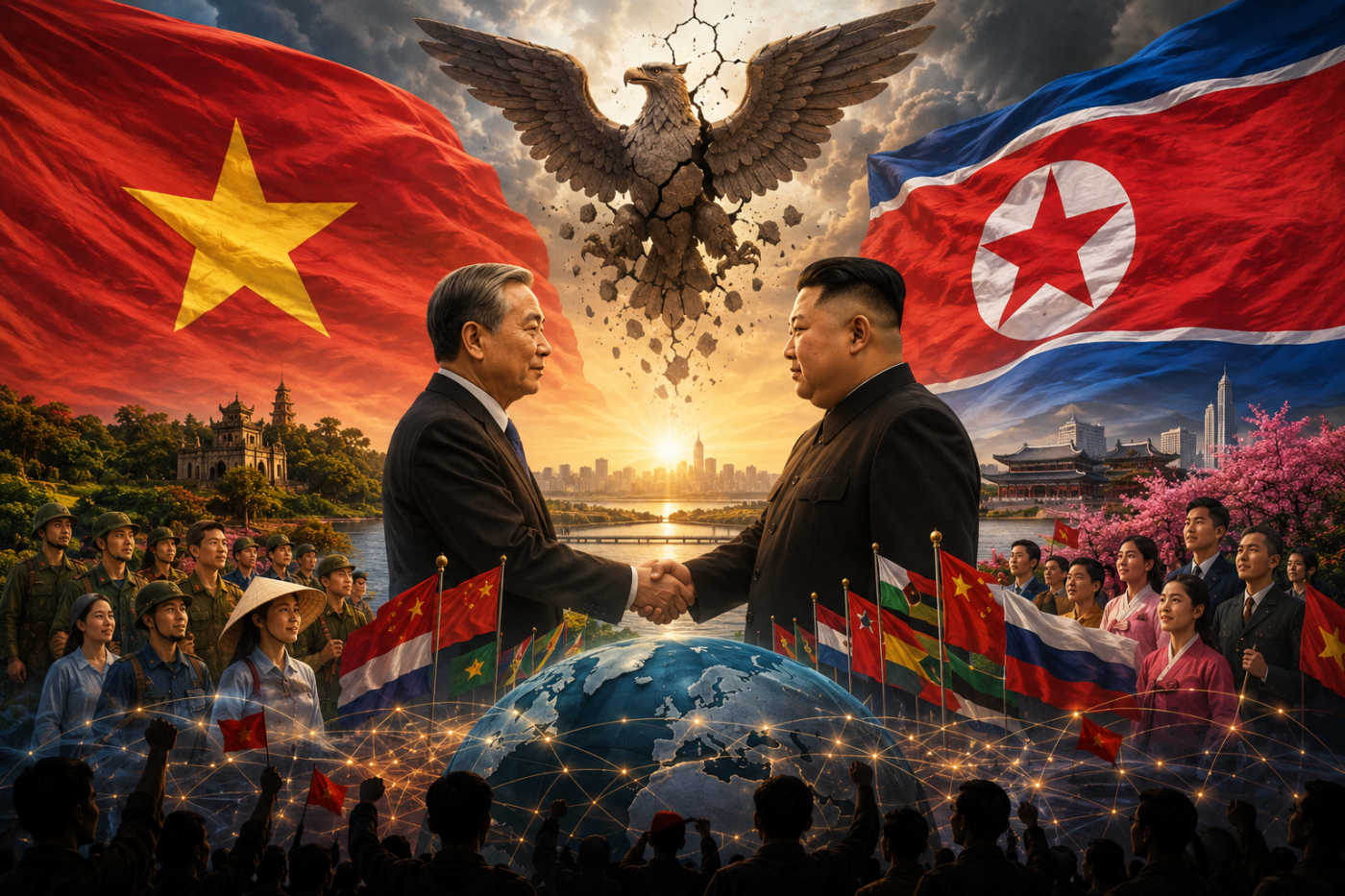
The renewed relationship between Việt Nam and the DPRK reveals more than bilateral diplomacy — it exposes the growing limits of U.S.-led imperial discipline in an increasingly fractured world order. Rooted in anti-colonial struggle, socialist continuity, and sovereign political memory, the relationship has moved from symbolic historical friendship toward renewed institutional, diplomatic, and informational cooperation. While Washington continues attempting to isolate Pyongyang through sanctions, military pressure, and narrative warfare, Việt Nam’s independent diplomacy demonstrates that even states deeply engaged with the global economy are not fully subordinated to U.S. geopolitical command. The reopening of Vietnam–DPRK relations offers a glimpse into the contradictions shaping the transition from unipolar imperial dominance toward a more unstable, uneven, and multipolar international system.
By Prince Kapone | Weaponized Information | May 13, 2026
The Meeting the Empire Pretended Not to See
On May 13, 2026, Vietnamese Foreign Minister Lê Hoài Trung, serving as special envoy of Party General Secretary and State President Tô Lâm, met in Pyongyang with senior officials of the Democratic People’s Republic of Korea. These were not minor protocol meetings tucked away in the dusty corners of diplomacy. Trung met with Kim Song Nam, member of the Political Bureau, Secretary of the Workers’ Party of Korea Central Committee, and Director of the WPK International Department. He also held talks with Choe Son Hui, member of the Political Bureau and Foreign Minister of the DPRK. The discussions focused on strengthening the traditional friendship between the Communist Party of Việt Nam and the Workers’ Party of Korea, deepening cooperation between the two states, expanding people-to-people ties, and coordinating at multilateral forums such as the United Nations and the ASEAN Regional Forum.
The Vietnamese side reaffirmed Việt Nam’s commitment to national independence and socialism, while the DPRK side emphasized the special importance it attaches to developing the traditional friendship between the two parties and two nations. The two sides agreed to deepen political trust, expand cooperation in areas of mutual interest, and strengthen coordination on regional and international questions. In plain language: two sovereign socialist states met, spoke to one another as comrades, and agreed to continue building relations outside the permission structure of Washington, Brussels, London, Tokyo, or Seoul.
For this reason, the story was met in the Western corporate press with the usual imperial discipline: silence. Not because the meeting was insignificant, but because it was too significant in the wrong direction. The Western media machine has spent decades manufacturing the image of the DPRK as a lonely, irrational, hermetically sealed state, a cartoon villain produced for liberal dinner tables and Pentagon budget hearings. A high-level meeting between the DPRK and Việt Nam does not fit that script. It shows the DPRK engaged in serious diplomacy with another socialist state whose revolutionary legitimacy was forged in the furnace of anti-imperialist struggle. It also shows Việt Nam refusing to reduce its foreign policy to the role assigned to it by the United States: a convenient pawn in the encirclement of China, the isolation of the DPRK, and the broader militarization of Asia.
This report treats the meeting not as an accident, nor as a diplomatic curiosity, but as an expression of the deeper historical relationship between Việt Nam and the DPRK, two nations shaped by colonial violence, imperial war, national division, socialist reconstruction, and the long struggle to defend sovereignty against a world system that prefers obedience to independence. The meeting is another small but revealing sign that the U.S.-led imperial order is no longer able to dictate the full political geography of Asia. Even where Washington has influence, it does not possess command. Even where it applies pressure, it does not always secure submission. That is precisely why the story had to be ignored.
Our thesis is straightforward: the May 2026 Vietnam–DPRK meeting represents the persistence of socialist internationalism, the durability of anti-imperialist state relations, and the failure of the U.S.-Western project to completely isolate and demonize the DPRK. It also demonstrates that Việt Nam, despite maintaining pragmatic relations with the United States and the West, continues to exercise sovereign diplomacy according to its own socialist, national, and regional interests. This is what imperial commentators cannot admit. They prefer a world where every country must choose between becoming a client or becoming a target. Việt Nam and the DPRK remind us that the peoples who defeated empire once are not obligated to think with the categories of empire now.
The sections that follow will place this meeting in its proper historical and political context. We will examine the anti-colonial foundations of Vietnam–DPRK relations, the renewed institutional cooperation emerging from recent high-level exchanges, the sanctions and coercive pressures imposed on the DPRK, Việt Nam’s sovereign navigation of regional contradictions, and the broader meaning of this relationship in an era of hyper-imperialism and multipolar transition. The point is not merely to report that a meeting happened. The point is to understand why this meeting matters, why the West ignored it, and what it reveals about a world slowly but visibly slipping out of imperial hands.
Forged in the Furnace of Anti-Colonial Struggle
The relationship between Việt Nam and the Democratic People’s Republic of Korea was not assembled in the sterile boardrooms of “international partnership,” where men in expensive suits speak about “regional stability” while selling bombs to half the planet. It was born in fire. In occupation. In partition. In war. It emerged from a century in which Asia was carved apart by colonial powers, occupied by foreign armies, bombed by imperial air forces, and forced to fight for the simple right to exist on its own terms.
Việt Nam and the DPRK established diplomatic relations on January 31, 1950, while the Vietnamese revolution was still fighting French colonialism with rifles, rice, and political determination. The DPRK was among the first countries in the world to recognize revolutionary Việt Nam. That recognition mattered because empire was still insisting that colonized peoples had no right to sovereignty unless Europe or Washington approved the paperwork first. The old colonial world liked to imagine independence as a gift handed downward from civilized masters to grateful natives. The revolutions of Asia answered differently: sovereignty belongs to those willing to fight for it.
In those years, diplomatic recognition itself became a weapon against imperial domination. France denied the legitimacy of revolutionary Việt Nam. Washington denied the legitimacy of revolutionary Korea. The socialist and anti-colonial world responded by recognizing each other before the empire did. That is the political soil from which Vietnam–DPRK relations grew. Not commerce first. Not geopolitical maneuvering first. But anti-imperialist legitimacy.
Hồ Chí Minh and Kim Il Sung are still remembered as the political founders of the relationship, and this is not merely ceremonial language repeated out of habit. Both men belonged to a generation of revolutionaries shaped by colonial violence. Hồ Chí Minh emerged from the struggle against French colonialism, Japanese occupation, and later U.S.-backed partition. Kim Il Sung emerged from the anti-Japanese guerrilla struggle and the catastrophe imposed on Korea after liberation, when foreign powers split the peninsula like thieves cutting stolen land across a table.
Hồ Chí Minh visited the DPRK in 1957. Kim Il Sung visited Việt Nam in 1958, where the two countries issued a joint statement and signed agreements for cooperation. These meetings were not diplomatic theater for television cameras and stock market analysts. They reflected two revolutionary governments trying to build socialism while standing inside the blast radius of the Cold War.
The modern Western political imagination has difficulty understanding relationships built through historical struggle because the imperial world treats diplomacy like a stock exchange. Today’s ally becomes tomorrow’s sanctioned enemy depending on pipeline routes, military contracts, or the emotional instability of Atlantic elites. Socialist and anti-colonial movements historically approached international relations differently. Shared sacrifice mattered. Historical memory mattered. The dead mattered.
One of the deepest bonds between Việt Nam and the DPRK emerged from the fact that both nations experienced partition as a weapon of imperial management. Việt Nam was divided at the 17th parallel after the Geneva settlement, supposedly as a temporary arrangement, though temporary arrangements imposed by empire have a strange habit of becoming permanent whenever the colonized begin demanding genuine independence. Korea endured the same logic. The Korean War armistice halted open fighting without ever ending the war itself, leaving the peninsula divided to this day.
Partition was not an accident of history. It was policy. Divide Korea. Divide Việt Nam. Divide Palestine. Divide the colonized world into manageable fragments and then lecture humanity about “stability.” The imperial powers feared unified revolutionary movements because unity creates political power. Partition fractures that power geographically, economically, psychologically, and militarily.
Both nations also understood each other through a shared experience of devastation from U.S. military violence. The destruction inflicted upon Korea during the Korean War was so immense that nearly every major structure in the North was destroyed. Entire cities disappeared beneath bombing campaigns. Infrastructure was obliterated. Civilian life was pulverized under industrial air warfare. The memory of this destruction remains central to the DPRK’s political consciousness.
A decade later, the same imperial machine moved southward into Southeast Asia. Korea had already seen what U.S. air power looked like when unleashed upon a revolutionary people. Việt Nam was about to learn the same lesson through napalm, chemical warfare, carpet bombing, and mass destruction. This is why solidarity between the two countries moved beyond ideology into something far deeper: recognition. Korea recognized its own historical experience unfolding again in Việt Nam.
The DPRK stood alongside Việt Nam during the war against U.S. intervention. Kim Jong Un later recalled that the Korean people gave wholehearted support to Việt Nam during the national liberation struggle. This support was not symbolic. It became material reality.
The clearest expression of that solidarity lies in Bắc Giang Province. DPRK pilots and personnel who died fighting against U.S. air attacks were buried there. Their remains were later repatriated, but the memorial site remains as testimony to a forgotten history. Fourteen graves marked the burial ground of DPRK pilots who died fighting alongside Vietnamese forces. More than one thousand DPRK soldiers and personnel reportedly served in North Việt Nam between 1966 and 1972.
These graves are politically inconvenient for the Western narrative because they expose something the corporate media prefers to bury beneath seventy years of propaganda: socialist internationalism once involved actual sacrifice. Not hashtags. Not NGO conferences funded by billionaires. Not carefully managed humanitarian branding exercises performed for cameras. Blood. Pilots. Graves. Shared struggle against imperial war.
As the relationship matured, it expanded into broader socialist-state cooperation. Both countries opened embassies in 1955. The 1958 meetings produced agreements in trade and cooperation. Educational, technical, scientific, and cultural exchanges followed in later decades, including cooperation projects and institutions funded through DPRK assistance.
Socialist internationalism functioned not only through speeches but through institutions: embassies, schools, technical exchanges, cultural programs, and material aid. The revolutionary horizon of the twentieth century imagined that formerly colonized peoples could develop collectively outside the command structure of empire. One may debate the contradictions, successes, failures, or limitations of these projects, but only an intellectually dishonest observer could pretend they did not exist.
What remains striking today is how persistently both countries continue returning to this shared history. The language of mutual support, national liberation, and socialist construction still defines the relationship. Both sides continue invoking Hồ Chí Minh, Kim Il Sung, and the generations that carried the relationship forward. Historical memory itself has become part of the political infrastructure connecting the two states.
By the time Việt Nam and the DPRK entered the post-Cold War period, their relationship already rested on foundations built through anti-colonial war, revolutionary leadership, partition, military devastation, wartime solidarity, and socialist cooperation. This is why the renewed engagement of 2025–2026 should not be misunderstood as some sudden diplomatic improvisation born from current geopolitical tensions alone. The relationship existed long before the present crisis of U.S. hegemony. It was forged in the struggles that shaped modern Asia, and it survived because both nations remember exactly what those struggles cost.
From Revolutionary Memory to Operational Cooperation
History alone does not sustain relations between states. Memory matters, but memory without institutions eventually becomes ceremony, and ceremony without implementation becomes little more than diplomatic theater performed beneath chandeliers for photographers and bureaucrats. What distinguishes the present phase of Vietnam–DPRK relations is that the relationship is moving beyond symbolic invocations of anti-imperialist friendship into renewed institutional coordination. The significance of the 2025–2026 reopening lies not primarily in rhetoric, but in the rebuilding of operational channels between two socialist states whose relations had remained politically warm but institutionally limited for decades.
The year 2025 was officially designated as the Vietnam–DPRK Friendship Year in commemoration of the seventy-fifth anniversary of diplomatic relations. This anniversary framework was not merely ceremonial pageantry arranged for nostalgia’s sake. It created the political atmosphere through which higher-level exchanges, ministry coordination, and institutional agreements could be accelerated. In diplomatic practice, anniversaries often function as political staging grounds: they legitimize reopening dormant channels while presenting expansion as continuity rather than rupture.
Throughout Friendship Year 2025, Vietnamese officials repeatedly emphasized strengthening practical cooperation and deepening bilateral friendship. That language matters. “Practical cooperation” signals a shift away from purely commemorative diplomacy toward mechanisms intended to produce recurring coordination between ministries, state agencies, and party institutions. The relationship was being prepared for operational expansion.
The decisive turning point came in October 2025. Vietnamese Communist Party General Secretary Tô Lâm traveled to Pyongyang during celebrations marking the eightieth anniversary of the Workers’ Party of Korea. The visit was politically significant not because summits themselves are unusual, but because this summit functioned as authorization for a broader reopening process. The two sides emphasized consolidating political trust, strengthening coordination between the Parties and states, and advancing bilateral cooperation into what they described as a “new phase.”
Reuters noted that the visit was the first by a top Vietnamese leader to the DPRK in nearly two decades. Even Western corporate outlets recognized that something materially important was occurring beneath the ceremonial language. This was not simply an anniversary celebration. It was the reopening of institutional channels that had remained comparatively quiet through much of the post-Cold War period.
One of the clearest signs of this transition appeared in the formalization of foreign ministry cooperation. Vietnam and the DPRK signed a cooperation agreement between their Ministries of Foreign Affairs during the October 2025 summit. The agreement did not emerge in isolation. It followed a series of deputy foreign minister–level policy exchanges, including the fifth policy exchange held in October 2024. This sequencing matters because it shows continuity rather than improvisation. Diplomatic coordination was being routinized through recurring bureaucratic channels.
That bureaucratic continuity became even clearer in May 2026. Vietnamese Foreign Minister Lê Hoài Trung’s visit to Pyongyang explicitly focused on advancing agreements reached during the October 2025 summit. The visit functioned not as a standalone symbolic exchange, but as an implementation phase. This is how durable state relations are constructed: summit diplomacy establishes political direction, ministries operationalize it, and recurring exchanges normalize coordination over time.
In practical terms, the reopening process means the relationship is becoming embedded inside administrative institutions rather than remaining dependent on occasional symbolic gestures. This distinction is politically important. Symbolic friendship can survive on speeches and anniversaries alone. Operational cooperation requires mechanisms, personnel, agreements, communication channels, and recurring implementation structures. It requires states to build habits of coordination.
Among the most politically significant developments was the reopening of defense contacts. During the October 2025 summit, the two countries signed a Letter of Intent on Defense Cooperation between their Ministries of National Defense. The signing ceremony took place publicly in Pyongyang and was acknowledged by both sides as part of the summit’s formal outcomes.
It is important not to inflate this development into fantasies of imminent military alliance or dramatic strategic realignment. The significance lies elsewhere. Defense ministries are among the most politically sensitive institutions inside any state. The reopening of formal defense coordination indicates that bilateral relations have expanded beyond historical symbolism into contact between core state-security structures. The relationship is no longer operating solely through commemorative diplomacy; it is now reaching into institutional sectors tied directly to sovereignty and state administration.
Media coordination formed another important pillar of the reopening process. Vietnam News Agency and the Korean Central News Agency signed a formal cooperation agreement during the October 2025 meetings. This might appear secondary to military or diplomatic agreements, but state media cooperation performs a concrete institutional function. It establishes official information-sharing channels, strengthens communication coordination, and reinforces bilateral political legitimacy through synchronized public narratives.
In the modern world, information infrastructure is part of state infrastructure. The Western corporate media system understands this perfectly well, which is why it invests enormous resources in shaping global narratives favorable to imperial power while accusing everyone else of “propaganda.” Empire reserves for itself the right to narrate reality while condemning others for attempting the same thing. The VNA–KCNA agreement reflects something simpler and more transparent: two states strengthening official communication mechanisms between their national media institutions.
The reopening process also expanded across multiple technical and administrative sectors. The two sides discussed and advanced cooperation in healthcare, civil aviation, legal assistance, commerce, investment protection, taxation coordination, and chamber-of-commerce relations. The October 2025 summit included agreements involving ministries, health cooperation structures, and commercial coordination bodies.
This is how long-term bilateral relations are normalized bureaucratically. Not through dramatic declarations alone, but through the layering of administrative cooperation across sectors. Ministries communicate with ministries. Technical agencies establish procedures. Agreements create recurring obligations. Diplomatic coordination becomes routine rather than exceptional. The relationship acquires institutional depth.
What emerges from the 2025–2026 reopening is therefore not simply renewed friendship, but renewed operational capacity. Summit diplomacy opened the political door. Ministry agreements built bureaucratic pathways through it. Defense contacts expanded institutional trust. Media cooperation strengthened official communication channels. Technical memoranda extended the relationship into administrative sectors tied to everyday state function.
By now, Vietnam–DPRK relations have clearly moved beyond commemorative references to historical solidarity into the reconstruction of mechanisms capable of sustaining long-term bilateral coordination. The relationship is no longer operating primarily through memory. It is being rebuilt through institutions. And once states begin reconstructing institutional channels, the political significance of the relationship inevitably extends beyond symbolism into the wider geopolitical terrain surrounding both countries.
Sanctions, Isolation, and the Limits of Imperial Command
The renewed relationship between Việt Nam and the DPRK matters because it is unfolding inside a pressure system designed to make such relations difficult, suspicious, and politically costly. The DPRK is not simply sanctioned. It is meant to be quarantined. The imperial objective is not only to restrict trade or punish particular state institutions. It is to make normal diplomacy with Pyongyang appear abnormal, dangerous, and illegitimate. This is how modern empire disciplines the world: not only with bombs and bases, but with paperwork, banking restrictions, blacklists, legal threats, and media hysteria.
The United Nations sanctions architecture against the DPRK restricts cargo, transfers, financial activity, and prohibited economic relations, while the United States maintains its own unilateral sanctions machinery targeting finance, trade, cyber activity, labor, and state-linked entities. This is not neutral law floating above politics like some immaculate angel of global order. It is coercive infrastructure. It narrows the DPRK’s room for development, pressures other states to avoid normal relations, and turns sovereignty itself into something that must be negotiated under threat.
Sanctions are often presented as mild alternatives to war, as if starving a country of trade, finance, medicine, machinery, fuel, and diplomatic space is somehow a civilized gesture. The empire bombs you with aircraft and calls it war. It strangles you through banks and calls it peace. Either way, the message is the same: submit, disarm politically, and accept the world as Washington has organized it.
But sanctions alone are not the whole strategy. The DPRK is also subjected to diplomatic quarantine. The goal is to make engagement with Pyongyang look like contamination. Any state that maintains relations with the DPRK is immediately surrounded by suspicion: What are they discussing? Are they violating sanctions? Are they undermining “international security”? This is how imperial discourse works. It does not merely criminalize the target. It criminalizes contact with the target.
This is why Vietnam–DPRK relations puncture the isolation narrative. Việt Nam and the DPRK have described their current relationship as entering a new phase of practical and effective cooperation. That is precisely what the Western script cannot easily absorb. The DPRK is supposed to appear sealed off, irrational, unreachable, and universally rejected. Yet here is Việt Nam, a socialist state with expanding relations across the world, maintaining and developing relations with Pyongyang as part of its own sovereign diplomacy.
The regional environment makes this even more important. The U.S. Indo-Pacific strategy rests on treaty alliances with Japan, the Republic of Korea, Australia, the Philippines, and Thailand, treating these alliances as the military and political foundation of U.S. power in the region. U.S.–Japan–ROK trilateral coordination has intensified around deterrence, extended deterrence, missile defense, information sharing, and security cooperation directed against the DPRK. In plain proletarian language: the DPRK is not facing “international concern.” It is facing a militarized bloc organized around U.S. power.
The empire prefers to describe this as stability. Of course it does. Every ruling class calls its own domination stability. A military base becomes a “security guarantee.” A sanctions regime becomes “rules-based order.” A naval buildup becomes “freedom of navigation.” The worker who cannot pay rent is told to respect the law; the empire that surrounds entire countries with missiles calls itself a peacekeeper.
Việt Nam understands this terrain well enough not to walk into it blind. Việt Nam has upgraded relations with the United States through a Comprehensive Strategic Partnership, but this does not mean Hanoi has surrendered its foreign policy to Washington’s regional agenda. Vietnamese diplomacy emphasizes independence, self-reliance, diversification, and multilateralization. This is not decorative language. It is the political method through which Việt Nam refuses to become trapped inside the binary logic of imperial blocs.
Vietnamese “bamboo diplomacy” is rooted in firmness of principle and flexibility in practice. Prime Minister Phạm Minh Chính has emphasized staying firm in policy while remaining flexible in implementation. This is the key to understanding Vietnam’s DPRK policy. Hanoi can develop relations with Washington, maintain relations with China and Russia, participate in regional diplomacy, and still preserve historical ties with the DPRK. That is not contradiction. That is sovereignty.
Washington wants every relationship translated into obedience or hostility. Either a state follows the U.S. line completely, or it becomes suspect. But sovereign diplomacy does not work that way. Việt Nam’s engagement with the DPRK shows that cooperation with the United States in some areas does not require submission to the U.S. agenda in all areas. The empire can secure meetings, partnerships, trade, and photo opportunities. What it cannot always secure is command.
The DPRK, for its part, has never treated sanctions as neutral law. Pyongyang has framed U.S. sanctions as hostile policy and an encroachment on sovereignty. DPRK statements have repeatedly described U.S. sanctions as evidence of Washington’s hostile posture. One does not have to adopt every formulation from Pyongyang to understand the political substance here. Sanctions are experienced by the targeted state not as abstract legal procedure, but as a weapon used to restrict its political, economic, and diplomatic life.
This is why the Vietnam–DPRK relationship carries weight beyond the bilateral level. It is normal diplomacy taking place in an abnormal pressure environment. It is a relationship between two sovereign socialist states developing under conditions where one of those states is supposed to be treated as untouchable. The mere continuation of contact becomes politically meaningful because the whole pressure system is designed to prevent such contact from becoming normal.
The failure of imperial discipline does not mean sanctions disappear. It does not mean the U.S. alliance system collapses overnight. It does not mean pressure evaporates because two socialist states hold meetings and sign agreements. That would be fantasy, and revolutionaries have no use for fantasy. The failure lies in the fact that sanctions and pressure do not fully determine the behavior of sovereign states. They constrain. They threaten. They punish. But they do not always command.
Việt Nam’s position demonstrates this clearly. Here is a country with substantial relations with the United States and the West, yet it continues to preserve and expand relations with the DPRK according to its own diplomatic principles. That is the wound in the imperial narrative. The U.S. can build alliances, issue sanctions, organize summits, produce strategy papers, and send its think-tank priesthood to explain the sacred texts of containment. Still, it cannot fully dictate the political conduct of every state in Asia.
Vietnam–DPRK relations matter because they unfold inside a system designed to make them costly. The sanctions regime, the alliance architecture, and the diplomatic quarantine all aim to discipline states into treating the DPRK as isolated, dangerous, and beyond normal engagement. Việt Nam’s bamboo diplomacy refuses that command. It maintains flexibility without surrendering principle. It expands relations without submitting to bloc discipline. It reminds the empire that influence is not ownership, partnership is not obedience, and sovereignty is not a favor granted by Washington.
Beyond Imperial Permission: Socialist Internationalism in the Multipolar Transition
The relationship between Việt Nam and the DPRK is not simply a bilateral relationship between two states. At its highest political level, it is a relationship between two ruling socialist parties that continue to understand themselves as participants in a historical process larger than ordinary diplomacy. This matters because the Western imagination prefers to interpret all international relations through the language of markets, alliances, and security management, as though history itself ended somewhere inside a NATO conference room and all remaining political questions could be settled by sanctions committees and investment summits.
Tô Lâm’s October 2025 visit to Pyongyang took place at Kim Jong Un’s invitation during celebrations marking the eightieth anniversary of the Workers’ Party of Korea. The symbolism here was political before it was ceremonial. The Workers’ Party of Korea and the Communist Party of Việt Nam were not meeting merely as governments managing technical relations. They were meeting as ruling socialist parties reaffirming continuity across generations shaped by anti-colonial struggle, socialist construction, war, partition, and survival under pressure.
Vietnamese officials described the visit as opening a new phase of practical and effective cooperation while reaffirming Việt Nam’s policy of valuing traditional friends. That phrase — “traditional friends” — carries political meaning beyond diplomatic etiquette. In the imperial vocabulary, alliances are often transactional and temporary, held together by military dependence, financial leverage, or strategic convenience. In the socialist and anti-colonial tradition, friendship has historically carried ideological and historical weight. It implies continuity through struggle.
KCNA coverage of the Vietnamese delegation emphasized the visibility of senior party, defense, and theoretical officials accompanying Tô Lâm. This detail matters because it reveals the multilayered political nature of the relationship. The reopening process is not limited to foreign ministries alone. It extends into party institutions, ideological organs, state media structures, and political education systems. The relationship operates simultaneously through state channels and party channels.
This continuity is repeatedly framed by both sides not as a temporary diplomatic adjustment, but as part of a longer socialist political inheritance. DPRK Ambassador Ri Sung Guk described strengthening relations with Việt Nam as a consistent policy linked to socialism building and solidarity among progressive forces internationally. KCNA also highlighted congratulatory exchanges between Tô Lâm and Kim Jong Un following Kim’s reelection as WPK General Secretary. These exchanges matter because they reproduce political continuity at the highest leadership level.
In the liberal imagination, history is often treated like a museum: something decorative, occasionally useful for speeches, but fundamentally disconnected from present political life. Socialist-state continuity works differently. Historical memory becomes institutional memory. Political inheritance becomes organizational reproduction. The relationship survives because each generation of leadership actively reaffirms it rather than leaving it buried beneath monuments and anniversaries.
One of the clearest examples of this institutional continuity emerged through cooperation between the Vietnam News Agency and the Korean Central News Agency. VNA and KCNA signed a formal agreement in Pyongyang in October 2025 focused on expanding information sharing and cooperation. The agreement was listed among the official documents signed during the summit.
This agreement should not be reduced to ordinary press cooperation. Information infrastructure is political infrastructure. VNA and KCNA are not private corporations chasing advertising revenue or billionaire investor satisfaction. They are state news agencies responsible for representing national political perspectives, transmitting official positions, preserving historical narratives, and shaping public communication.
The significance of this cooperation becomes clearer when placed against the global information order dominated by Western corporate media conglomerates. The DPRK exists inside one of the most aggressively managed propaganda environments in the world. Most people outside Korea encounter the DPRK almost exclusively through hostile interpretation filtered through Western governments, intelligence-linked think tanks, military analysts, sensationalist media narratives, and corporate news systems whose understanding of socialism rarely progresses beyond Cold War caricature.
The VNA–KCNA agreement matters because it establishes direct channels of communication outside those filters. Socialist informational sovereignty means the ability of states and peoples to represent themselves, exchange narratives directly, preserve political memory, and communicate without requiring validation from hostile information systems. It means refusing the imperial monopoly over interpretation.
Empire understands perfectly well that control over narrative is a form of power. That is why Western governments spend enormous resources financing media networks, information campaigns, digital infrastructure projects, NGO communication systems, and “democracy promotion” operations across the globe. The same governments that accuse everyone else of propaganda have built the most sophisticated propaganda architecture in human history. The difference is that imperial propaganda presents itself as neutrality while declaring everyone else ideological.
Vietnam–DPRK cooperation also expresses a broader anti-imperialist diplomatic vocabulary rooted in sovereignty, socialist construction, peace, and political independence. DPRK officials linked bilateral relations with the struggle for a just and progressive world and stronger solidarity among progressive forces internationally. Vietnamese officials simultaneously framed the relationship through practical cooperation and consistent friendship toward historical partners.
This does not mean Việt Nam and the DPRK are constructing a rigid ideological bloc in the manner imagined by Cold War fantasy literature. The relationship is more flexible and more modern than that. What exists instead is a shared political grammar: sovereignty, independence, socialist continuity, friendship, non-subordination, and resistance to diplomatic isolation.
This shared grammar also operates inside multilateral institutions often ignored in Western narratives about the DPRK. The DPRK has participated in the ASEAN Regional Forum since 2000. The DPRK acceded to the Treaty of Amity and Cooperation in Southeast Asia in 2008. ASEAN describes the treaty as a legally binding framework governing interstate relations in the region.
This matters because it demonstrates that the DPRK is not outside all diplomatic architecture, despite the way Western media often portrays it. Vietnam–DPRK coordination can function bilaterally while also intersecting with regional multilateral institutions. The isolation narrative survives only by pretending these channels either do not exist or do not matter.
The relationship therefore belongs to a broader Global South tendency toward preserving diplomatic autonomy outside rigid imperial gatekeeping. Việt Nam maintains relations across multiple centers of power while preserving ties with the DPRK. The DPRK continues cultivating relations with socialist and non-aligned partners despite enormous pressure designed to render it untouchable. Neither state is waiting for Western approval before deciding which historical relationships it is permitted to maintain.
This is where the ideological dimension of multipolarity becomes visible. Multipolarity is not merely about trade corridors, currency systems, or military balance — though those matter. It is also about legitimacy. It is about whether Western recognition remains the sole acceptable source of political validity in the international system.
The Vietnam–DPRK relationship quietly answers that question in the negative. Việt Nam can deepen relations with Washington while maintaining relations with Pyongyang. The DPRK can remain sanctioned and pressured while still participating in diplomatic, informational, and political networks beyond Western control. Sovereign states continue making political decisions according to their own historical memory and national priorities rather than imperial permission structures.
What emerges here is not simply bilateral friendship, but the persistence of competing international systems. The Western order attempts to organize the world through hierarchy: alliance discipline, sanctions enforcement, narrative management, selective legitimacy, and geopolitical obedience. Vietnam–DPRK relations express a different logic: sovereign equality, historical continuity, party solidarity, official information exchange, multilateral participation, and the right of states to sustain political relationships outside imperial supervision.
The relationship is not historically important because of its economic scale or military weight. It matters because it reveals that another diplomatic grammar still survives beneath the surface of the present world order. A grammar rooted not in domination, but in political memory. Not in sanctions, but in continuity. Not in imperial command, but in the stubborn insistence that sovereign peoples still possess the right to speak to one another directly, remember one another historically, and cooperate without asking permission from the empire first.
Vietnam, the DPRK, and the Fracturing of Imperial Hegemony
The renewed relationship between Việt Nam and the DPRK matters not because it suddenly transforms the balance of global power overnight, but because it reveals something deeper unfolding beneath the surface of the international system itself. What appears at first glance to be a bilateral diplomatic reopening is, in reality, a symptom of larger historical motion: the gradual weakening of the imperial center’s ability to fully monopolize legitimacy, discipline sovereign states, and define the acceptable boundaries of international political life.
The significance of the relationship lies less in its immediate economic scale than in what it exposes politically. The DPRK was supposed to be completely isolated. Vietnam was supposed to be progressively integrated into the U.S.-led regional order. Yet the two states continue expanding relations through party channels, diplomatic mechanisms, media cooperation, and institutional coordination. This does not overturn imperial power. But it reveals limits within that power. It reveals fractures in the architecture of unipolar discipline itself.
This contradiction sits at the heart of the present world order. The United States and its allies still possess overwhelming military reach, enormous financial leverage, vast sanctions capabilities, and a deeply entrenched global media system. Yet the more aggressively Washington relies on sanctions, containment, alliance discipline, information warfare, and coercive pressure, the more it reveals the declining consensual basis of its own hegemony. Power that once operated through broad legitimacy increasingly operates through enforcement.
Empire today resembles an exhausted landlord pounding on the apartment doors of the world demanding obedience while the building itself slowly cracks beneath him. Every new sanctions package, every expanded military deployment, every blacklist, every “rules-based order” lecture delivered from behind aircraft carriers and banking monopolies reveals not only imperial strength, but imperial anxiety. The coercive mechanisms grow more expansive precisely because the ability to command automatic political compliance is weakening.
Việt Nam’s position illustrates this contradiction with unusual clarity. Hanoi is neither an anti-U.S. proxy nor a subordinate client state. It engages the United States where beneficial, expands trade where useful, and participates in regional diplomacy pragmatically. Yet at the same time, it refuses to sever relations with historical socialist partners like the DPRK. This is what Washington cannot fully control. The empire can pressure, incentivize, threaten, and negotiate — but it cannot entirely dictate the diplomatic behavior of sovereign states operating inside an increasingly fragmented world system.
What emerges from this reality is not the collapse of imperialism, nor the triumphant arrival of some harmonious post-Western order. History is never that generous. The present transition is uneven, contradictory, unstable, and deeply conflictual. But it is precisely within these contradictions that new political space begins to appear.
One of the most important realities exposed by Vietnam–DPRK relations is the survival of socialist continuity after the so-called “end of history.” Liberal triumphalism in the 1990s declared socialism politically extinct, revolutionary memory obsolete, and anti-imperialist internationalism buried beneath the ruins of the Soviet Union. Yet the evidence assembled throughout this report points in another direction entirely.
Socialist political memory survived. Party institutions survived. Historical relationships survived. State-to-state solidarity survived. Not unchanged, not frozen in time like insects trapped in amber, but adapted to new historical conditions. The CPV and WPK continue to operate as ruling political structures shaped by twentieth-century revolutionary struggles while navigating twenty-first-century geopolitical fragmentation.
This does not mean a revived socialist bloc is emerging in the old Cold War form. The world today is far more complex, economically integrated, and politically uneven than the bipolar structure of the twentieth century. But the persistence of Vietnam–DPRK relations demonstrates that the socialist historical project was not erased by imperial proclamation. Institutions, memories, diplomatic practices, and ideological continuities endured beyond the moment when Western intellectuals declared history permanently resolved in favor of capitalism.
The same applies to multipolarity itself. Multipolarity is not inherently socialist. It is not automatically emancipatory. It does not abolish exploitation, class domination, nationalism, or inter-state competition. To romanticize multipolarity as the end of contradiction would only reproduce the same triumphalist thinking that liberalism once applied to globalization.
What multipolarity does create, however, is political maneuvering room. It creates fractures inside imperial discipline. It creates openings through which sanctioned, smaller, socialist, postcolonial, and non-aligned states can preserve diplomatic autonomy more effectively than under rigid unipolar domination. Vietnam–DPRK relations matter because they reveal this widening strategic space in concrete form.
In a more tightly consolidated unipolar order, maintaining and expanding relations with the DPRK would have carried far greater costs for states seeking diversified international engagement. Today, however, the international system is becoming increasingly fragmented by U.S.–China rivalry, sanctions overreach, regional balancing strategies, and declining Western ideological monopoly. Under these conditions, states acquire greater ability to navigate between centers of power rather than submitting fully to a single geopolitical command structure.
The informational dimension of this process is equally important. The imperial system does not merely seek military superiority or economic leverage. It also seeks authority over political meaning itself. Control over legitimacy, narrative framing, historical memory, and acceptable interpretation remains central to modern imperial power.
This is why the VNA–KCNA cooperation agreement carries significance beyond ordinary media exchange. It reflects an assertion of informational sovereignty: the right of states and peoples to communicate directly, preserve political memory, and narrate their own relationships without mediation by hostile ideological institutions. In a world where Western corporate media systems routinely function as informal extensions of imperial geopolitical interests, direct information-sharing mechanisms between socialist states become part of the broader struggle over reality itself.
The empire does not merely want obedience. It wants interpretive monopoly. It wants the power to decide which states are legitimate, which histories matter, which governments are “internationally accepted,” and which relationships are considered politically normal. Vietnam–DPRK cooperation quietly rejects that monopoly by continuing to operate according to its own historical logic rather than Western narrative permission.
Looking forward, the tendencies revealed by this relationship are likely to deepen rather than disappear. As U.S.–China rivalry intensifies, sanctions regimes proliferate, military blocs harden, and global fragmentation accelerates, more states will likely pursue diversified diplomatic strategies designed to preserve sovereignty and strategic flexibility. This does not mean unified resistance to imperialism will suddenly emerge in coherent form. The coming world will almost certainly remain deeply contradictory and unstable. But the capacity of the United States to fully discipline the diplomatic behavior of other states is increasingly constrained by the very fragmentation produced through its own overextension.
Vietnam–DPRK relations therefore matter because they illuminate the historical character of the present transition. They reveal that anti-colonial political memory still survives beneath the surface of contemporary geopolitics. They reveal that socialist continuity persists unevenly inside the emerging multipolar order. They reveal that sovereign states continue seeking diplomatic space outside total imperial supervision. And they reveal that the unipolar moment — once presented as permanent and irreversible — is increasingly fractured by contradictions the imperial system itself helped produce.
The relationship persists not because history stopped, but because history continues. Inside the widening fractures of imperial hegemony, the unfinished legacies of anti-colonial struggle, socialist internationalism, and sovereign political memory continue to evolve under new historical conditions. In an era marked by sanctions expansion, geopolitical fragmentation, and the erosion of unipolar authority, the renewed Vietnam–DPRK relationship stands as one small but unmistakable reminder that imperial power can still coerce the world, but it can no longer fully command it.


Leave a comment