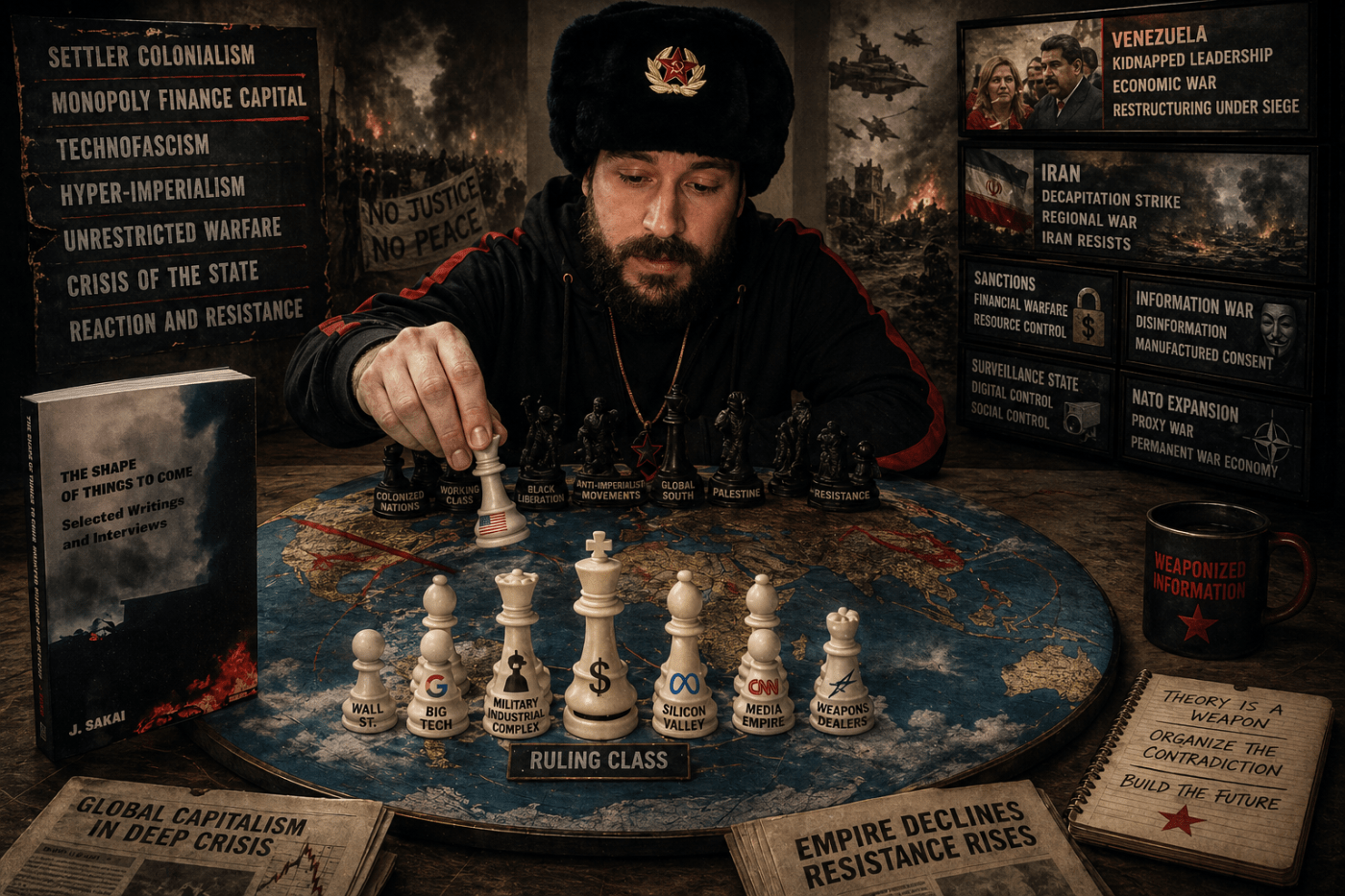
J. Sakai’s interviews force the U.S. left to confront the settler-colonial foundations it has spent generations avoiding. His analysis exposes the myth of the revolutionary white proletariat, the collapse of liberal illusions, and the expansion of war into every domain of life. But Weaponized Information pushes further, grounding his insights in monopoly finance capital, technofascism, hyper-imperialism, and the strategic rupture of multipolarity. This is not a tribute—it is a struggle over theory as a weapon.
By Prince Kapone | Weaponized Information | Weaponized Intellects Book Review | April 24, 2026
The Return of a Dangerous Question: J. Sakai and the Problem the Left Tried to Bury
There are some books and ideas that refuse to sit quietly on the shelf. They don’t age into harmless theory or get absorbed into polite academic debate. They linger, they provoke, they irritate—and most importantly, they expose wounds that never fully healed. The work of J. Sakai belongs to that category. For decades now, his writing has moved like an underground current through radical circles, resurfacing at moments of crisis, forcing the same uncomfortable question back into the conversation: what is the real class character of the United States, and who—if anyone—inside it can be counted as a revolutionary force?
When Settlers: The Mythology of the White Proletariat first circulated, it did not enter a neutral intellectual space. It landed like a political detonation. At a time when much of the U.S. left still clung to the idea of a unified, multinational working class—held together by shared exploitation and destined for collective liberation—Sakai cut straight through the narrative. He argued, with historical force and unapologetic clarity, that the white working class in the United States was not simply misled or insufficiently radicalized, but structurally formed within a settler colonial system that bound it materially and politically to empire. This was not a critique designed to be easily absorbed. It was a line drawn in the sand.
The response was predictable, and revealing. Sakai’s work was attacked as “divisive,” “defeatist,” even “racist”—a strange accusation, given that it was precisely an attempt to grapple with the material realities of race, class, and power in a settler society. But beneath the outrage was something more telling: discomfort. The kind of discomfort that arises when a theory does not simply challenge your conclusions, but undermines the assumptions that made those conclusions possible in the first place. For many on the left, Sakai’s intervention was not just wrong—it was dangerous, because it threatened to unravel an entire strategic orientation built on winning over the white majority.
And yet, history has a way of returning to unfinished arguments. The crises of the present—rising reaction, persistent racial domination, the repeated failure of reformist projects, and the visible fragmentation of the so-called working class—have only sharpened the relevance of the questions Sakai raised decades ago. The illusions that once held have thinned. The contradictions have become harder to manage, harder to explain away. What was once dismissed as fringe analysis now circulates again, not because it has been universally accepted, but because reality itself has begun to echo its claims.
The Shape of Things to Come emerges in this context—not as a retreat from those earlier positions, but as a continuation and development of them under new conditions. Written as an interview, the text moves with a certain looseness, but its implications are anything but casual. Here, Sakai revisits the core questions of theory, class, and empire, while situating them within the turbulence of the present moment: the uprisings of 2020, the consolidation of right-wing forces, and the ongoing restructuring of global capitalism. What we are given is not a systematic treatise, but something more volatile—a set of reflections forged in the middle of crisis, where the distance between theory and reality has collapsed.
This review approaches Sakai’s work in that same spirit. Not as an academic exercise, not as a neutral summary, but as a political engagement. The task is not simply to restate his arguments, but to test them—to examine where they clarify the terrain of struggle, where they leave gaps, and how they can be sharpened within the broader framework of contemporary revolutionary analysis. Because the question Sakai raises is not his alone. It belongs to all who are trying to understand what kind of world we are living in, and what kind of struggle it will take to change it.
What follows, then, is not a verdict delivered from a distance, but a confrontation—one that takes seriously both the power and the limits of Sakai’s intervention. If his earlier work forced the left to reckon with the colonial foundations of American society, this text challenges us to reckon with something even more immediate: what those foundations mean in a moment when the system itself is beginning to fracture, and when old answers are no longer sufficient to explain what we are seeing.
Rediscovering Fire in the Ruins: Theory, Memory, and the Struggle to Know
Revolutionary theory does not arrive to us polished, bound, and waiting patiently on a shelf. It comes to us torn, scattered, half-buried in the wreckage of past struggles—scribbled in the margins of defeat, whispered through memory, and often lost altogether. This is the first hard truth that J. Sakai forces us to confront. The comforting illusion that there exists a stable, cumulative body of knowledge—handed down intact from one generation of revolutionaries to the next—is precisely that: an illusion. In reality, theory decays. It slips through our fingers. It is forgotten, misused, or embalmed into lifeless dogma. And so, as Sakai insists, “every new generation must learn to apply revolutionary science themselves, rediscovering fire all over again.”
There is something both sobering and liberating in this. Sobering, because it strips away the arrogance of inherited certainty. Liberating, because it returns theory to its rightful place—not as scripture, but as weapon. Sakai is not interested in theory as an academic exercise, nor as a badge of ideological belonging. He is interested in theory as a tool forged in struggle, tested in real conditions, and discarded when it no longer cuts. “Knowledge isn’t something academic or abstract and made only by some intellectual elite,” he reminds us—a line that lands like a hammer blow against the pretensions of the professional left, those polished commentators of revolution who speak fluently about struggle but rarely risk anything in it.
This is where Sakai’s intervention cuts deepest. He exposes not only the fragility of revolutionary knowledge, but the profound incompetence that often masquerades as theory within the left itself. The metaphor he offers is almost too generous: “The best roller chest of chrome Snap-On tools is no help if the mechanic… has only an uncertain idea of what the problem is.” In other words, the issue is not merely that the tools are inadequate, but that those wielding them do not understand the machine they claim to repair. The result is predictable: misdiagnosis, improvisation, and ultimately failure—dressed up, of course, in the language of sophisticated analysis.
And here we begin to see the deeper polemic taking shape. Sakai is not simply critiquing bad theory; he is indicting an entire mode of theoretical production that has detached itself from material struggle. This is theory as performance, theory as identity, theory as career—a far cry from the “hard vagabond science” he describes, a science that refuses to sit still, that cannot be bottled, that demands constant movement, constant testing, constant risk. It is closer to guerrilla warfare than to classroom instruction—improvised, adaptive, rooted in terrain, and always aware that the enemy is not standing still.
But if theory must be continually remade, then the stakes of forgetting are immense. Sakai offers a haunting example in the figure of Michael Reinoehl, killed without the practical knowledge that might have helped him survive. The point is not individual tragedy alone, but collective failure—the failure to preserve, transmit, and operationalize the lessons of struggle. Revolutionary knowledge existed, Sakai tells us, but it was “scattered and lost… as though it never had been.” This is how movements die—not only through repression, but through amnesia.
What emerges from this opening is a ruthless clarity: theory is not a possession, it is a process. It does not belong to any canon, any party, or any tradition—it belongs to those who can use it. And to use it requires more than citation; it requires confrontation with reality in all its brutality and contradiction. Sakai is reminding us, in no uncertain terms, that the revolution will not be theorized into existence by clever formulations or recycled frameworks. It must be understood, again and again, from the ground up, in conditions that are always changing and never forgiving.
In this sense, the crisis of theory is not secondary to the crisis of capitalism—it is part of it. As the system mutates, as its forms of domination become more diffuse and more sophisticated, the old maps lose their accuracy. To cling to them out of habit or sentiment is not loyalty; it is surrender. The task, then, is not to preserve theory as artifact, but to remake it as instrument—to take what remains useful, discard what has failed, and forge something capable of meeting the present moment. Anything less is not merely inadequate; it is dangerous.
The Settler Lie and the Myth of the Revolutionary Worker
If the first illusion Sakai tears down is the stability of theory, the second is far more explosive: the myth of the revolutionary white working class. This is not a minor correction within Marxism—it is a direct assault on one of its most deeply held assumptions in the imperial core. For generations, the U.S. left—whether communist, socialist, or anarchist—constructed its entire strategy around a comforting image: a unified, multinational working class led, in practice, by white industrial labor, gradually shedding its prejudices and rising to overthrow capitalism. It is a beautiful story. It is also, as Sakai bluntly puts it, “a massive fiction.”
There is no gentle way to say this, and Sakai refuses to soften the blow. The problem is not that the white working class failed to live up to its revolutionary potential. The problem is that this “potential” was never there in the way the left imagined it. “In 400 years the euro-settler working class has never yet reached a revolutionary thing,” he writes, and the weight of that statement is not rhetorical—it is historical. From slave patrols to westward expansion, from imperial wars abroad to reactionary movements at home, the white working class has functioned not as a force against the system, but as one of its most reliable social bases.
What Sakai exposes here is not simply a political error, but a structural misunderstanding. The white working class in the United States is not just a segment of labor defined by its relationship to production. It is a class formation shaped within a settler colonial project, materially and psychologically bound to a system of domination that distributes privilege unevenly but deliberately. Even when impoverished, even when displaced, it does not stand outside empire—it stands within it, often defending its position in that hierarchy with ferocity. This is why Sakai dismisses the old left’s optimism with such finality: “It will never carry out that crackpot white left theory.”
Here, the sarcasm writes itself. For decades, the left waited patiently for racism to dissolve under the warm glow of class consciousness, as if history were a moral education program and not a battlefield. Trade unions would do the work, they said. Shared economic struggle would wash away centuries of colonial violence, they insisted. Meanwhile, the very workers being romanticized were participating—actively or passively—in the reproduction of that violence. The theory did not fail because conditions were unfavorable; it failed because it misidentified the nature of the class it sought to mobilize.
But Sakai does not reduce this to individual moral failing or bad intentions. He is careful, and correct, to point out that this was not simply the error of a few misguided thinkers. It was a systemic ideological formation, reproduced across generations of left intellectuals, from communists to social democrats. It persisted not because it was accurate, but because it was comforting—because it allowed the left to imagine a path to revolution that did not require confronting the full reality of settler colonialism. In this sense, the myth of the white proletariat was not just wrong; it was politically useful, a kind of lullaby that allowed the privileged to sleep through the contradictions of the system they inhabited.
What makes this analysis so dangerous—and so necessary—is that it shifts the terrain of struggle entirely. If the white working class is not the primary revolutionary agent, then the entire strategic orientation of the left must change. The focus moves away from winning over a mythical majority and toward recognizing the actual forces of resistance—those who have been historically positioned against the system, not partially integrated into it. This is where Sakai’s work intersects with the traditions of Black radicalism, anti-colonial struggle, and Third World Marxism, all of which have long understood that the road to liberation does not run through the settler majority.
At the same time, this is where the tension sharpens. Sakai’s formulation risks hardening into a kind of static analysis if it is not handled dialectically. To say that the white working class has historically functioned as a reactionary force is not to say that it is incapable of contradiction, fracture, or transformation under certain conditions. The danger lies not in Sakai’s critique, but in how it might be received—either rejected outright by those invested in the old myths, or embraced in a way that forecloses strategic thinking altogether. The task is not to replace one dogma with another, but to understand the material basis of these class formations and the conditions under which they might shift.
Still, the core lesson stands, and it is a brutal one: revolution cannot be built on illusions. The left’s long attachment to the white working class as its central subject has not only failed to produce transformation—it has actively obscured the real dynamics of power in a settler colonial society. To continue along that path is not simply ineffective; it is a form of complicity. Sakai forces us to confront this without apology, stripping away the sentimental attachments and leaving us with a question that cannot be avoided: if the foundation is rotten, what must be rebuilt, and on whose terms?
Empire Misunderstood: When Marx Looked at America and Saw a Mirage
Every ruling system survives not only through force, but through misunderstanding. If the previous section exposed the myth of the revolutionary white worker, this one cuts even deeper—into the theoretical foundations that allowed that myth to take root in the first place. Sakai does something here that many are too timid to attempt: he revisits the giants of revolutionary thought, not to discard them, but to show where they misread the terrain. And the terrain in question is not some peripheral question—it is the United States itself, the very heart of modern imperialism.
It is a striking moment when Sakai reminds us that Karl Marx himself described the United States as “the most democratic of nations.” Now, this is not a cheap gotcha, nor is it an invitation to dismiss Marx. It is a reminder that theory is always produced within historical limits, and that even the sharpest minds can be disoriented by a new formation that does not resemble the old world they are trying to escape. Marx and his contemporaries were fighting feudalism, staring down monarchies, aristocracies, and rigid class hierarchies rooted in land and lineage. Against that backdrop, the United States—with its absence of titled nobility, its apparent social mobility, and its loud proclamations of liberty—looked like a rupture, a democratic horizon.
But what appeared as a democratic breakthrough was, in reality, something else entirely: a settler colonial project expanding across a continent through conquest, genocide, and enslavement. “They didn’t get it,” Sakai writes bluntly. They did not grasp that this “brand-new militarized society… was a settler colonial capitalism,” born not out of the ruins of feudalism in the usual sense, but out of a violent reorganization of land, labor, and life itself. The absence of feudal hangovers was not evidence of democracy—it was evidence of total conquest, the clearing of the slate through extermination and dispossession.
There is a certain historical irony here that would not be lost on Marx himself, who spent a lifetime exposing how appearances conceal underlying relations. In this case, the appearance of democracy concealed a deeper structure of domination—one that did not rely on formal aristocracy because it had already established a racialized hierarchy embedded in the very fabric of the society. The settler did not need a title of nobility; his title was whiteness, backed by land stolen and labor enslaved.
What follows from this misreading is not a minor theoretical error, but a cascade of distortions that shaped the trajectory of the left for generations. If the United States is assumed to be a “normal” capitalist society, then its working class can be assumed to behave like the working classes of Europe. If it is assumed to be democratic in its foundation, then its contradictions can be resolved through the gradual extension of rights and reforms. But if, as Sakai insists, it is a settler colonial empire from its inception—an “infant empire,” in his words—then the entire analytical framework must shift.
This is where Sakai’s intervention becomes more than historical correction; it becomes a strategic realignment. By exposing the eurocentric assumptions embedded in early Marxist thought, he clears the ground for a different kind of analysis—one that begins not with abstract categories, but with the concrete realities of conquest, colonization, and resistance. It is no accident that this perspective resonates with the traditions of anti-colonial struggle, from the writings of Frantz Fanon to the praxis of revolutionary movements in the Global South. They did not have the luxury of mistaking empire for democracy; they experienced it directly, in its most violent forms.
At the same time, Sakai does not fully resolve the tension he opens up. To critique Marx’s misreading is necessary, but it raises the question of how to reconstruct a revolutionary theory adequate to the present. The danger is twofold: on one side, a dogmatic rejection of classical Marxism that throws out its analytical power along with its blind spots; on the other, a defensive orthodoxy that refuses to acknowledge those blind spots at all. Sakai pushes us toward a third path, though he does not fully map it out—a path that takes the insights of Marxism seriously while re-grounding them in the material realities of colonial and imperial domination.
This is precisely where the stakes of theoretical struggle become clear. To misunderstand the nature of empire is not an academic mistake; it is a political liability. It leads to strategies that aim at the wrong targets, alliances that rest on false assumptions, and movements that are perpetually surprised by outcomes they should have anticipated. The left’s long attachment to a eurocentric reading of the United States has done exactly this, producing a politics that is always one step behind reality, always reacting rather than anticipating.
Sakai’s contribution, then, is not to close the book on Marxism, but to reopen it under new conditions. He forces us to read it again, this time with the knowledge that the “democratic” experiment it once admired was, in fact, a laboratory of empire. And in doing so, he returns us to the central task: not to inherit theory as it was written, but to remake it in the image of the world as it actually exists—a world still structured by colonial domination, still driven by accumulation, and still in need of a theory that can grasp both at once.
When Empire Cracks: White Reaction, Black Revolt, and the Managed Crisis of Capital
By the time Sakai turns to the present moment, the theoretical groundwork has already been laid. The illusions have been stripped away, the historical errors exposed, and what remains is the living contradiction itself—unfolding in real time. The year 2020, with its uprisings, its pandemic, and its political volatility, is not treated here as an anomaly, but as a revelation. Something has shifted, Sakai insists. “Everything has somehow changed in this moment.” But what has changed is not the underlying structure of the system—it is the visibility of its contradictions, now impossible to ignore.
On one side stands the reassertion of settler power in its rawest form. Trump is not analyzed as an individual aberration, but as a political crystallization—the figure through which a broad segment of the white population expresses its historical position and its present anxieties. He is, in Sakai’s words, the “champion of the white race,” not because of rhetorical excess, but because he articulates what others have long practiced more quietly. The desire is not merely for policy change, but for restoration—for a return to a world in which the hierarchies of race, nation, and gender are less contested, more secure, more “natural.” It is, as Sakai puts it with chilling clarity, a desire for “White Power and an impossible return” to imperial dominance.
This is where the earlier analysis of the white working class comes into full view. The turn toward reaction is not a betrayal of some latent revolutionary potential; it is a continuation of a historical pattern under new conditions. As the material basis of settler privilege erodes—through deindustrialization, global competition, and systemic crisis—the response is not to abandon the structure, but to cling to it more tightly. The slogans may change, the symbols may be updated, but the underlying demand remains the same: to preserve a position within a hierarchy that is increasingly unstable.
Opposing this movement, though not in any simple or unified way, is the resurgence of resistance from the colonized and oppressed. The wave of protests associated with Black Lives Matter marks a significant moment—not because it introduces a new contradiction, but because it intensifies an old one. Sakai is attentive to both its strengths and its limits. On the one hand, there is a visible shift in leadership, with young Black organizers—often women, often queer—taking central roles in shaping the movement. On the other, there is a fragmentation, a lack of consolidated direction, and a susceptibility to absorption by the very forces being challenged.
It is here that Sakai’s analysis sharpens into something almost surgical. The spectacle of corporate solidarity—of multinational firms draping themselves in the language of resistance—reveals not a victory, but a strategy. When Facebook proclaims, “We stand with the Black community,” or when major corporations pledge millions in support of vaguely defined “initiatives,” the system is not conceding ground; it is repositioning. It is absorbing the language of dissent, neutralizing its edge, and redeploying it in a form that stabilizes the existing order. What appears as recognition is, in many cases, a form of containment.
There is a bitter humor in this, one that Sakai does not shy away from. The image of corporations—long implicated in exploitation and extraction—suddenly presenting themselves as allies is almost too absurd to take seriously. And yet, this absurdity is precisely how modern capitalism operates: through contradiction, through appropriation, through the constant reinvention of its own legitimacy. The danger is not that these gestures are insincere, though they often are; it is that they can be effective, reshaping the terrain of struggle in ways that are difficult to immediately perceive.
What emerges from this convergence of reaction and resistance is not a clear path forward, but a deepening instability. Sakai hints at the possibility of broader conflict—of a kind of internal rupture that commentators nervously label “civil war,” without ever fully explaining what that would entail. But to frame it in those terms alone is to miss the larger picture. This is not simply a domestic conflict; it is part of a global reconfiguration, a moment in which the structures of empire are being tested, stretched, and, in some cases, broken.
And yet, for all its clarity, Sakai’s analysis leaves certain elements underdeveloped. The role of digital infrastructure, of surveillance technologies, of the integration between state and corporate power—these are only hinted at, not fully explored. The machinery of control has evolved, and while Sakai captures the ideological and social dimensions of the crisis, the technical apparatus through which it is managed requires further elaboration. This is not a flaw so much as an opening—a space where the analysis must be extended if it is to fully grasp the present.
Still, the core insight holds: we are not witnessing the breakdown of a system that can be easily replaced, but the transformation of one that is fighting to survive. The old forms—liberal democracy, stable class compromise, predictable political alignments—are fraying. In their place, new configurations are emerging, combining elements of repression, co-optation, and spectacle in ways that are still taking shape. To navigate this terrain requires more than slogans or nostalgia; it requires a clear-eyed understanding of the forces at play, and a willingness to confront them without illusion.
Sakai does not offer a blueprint for what comes next, and perhaps that is the most honest position he could take. What he provides instead is a lens—a way of seeing that cuts through the noise and reveals the underlying dynamics of the moment. It is up to those engaged in struggle to take that lens and apply it, to test it, to refine it. Because if one thing is certain, it is that the crisis is not passing. It is deepening, and with it, the urgency of understanding—and acting within—it grows.
When Settler Privilege Starts to Rot, It Reaches for the Gun
In the second part of The Shape of Things to Come, Sakai begins where liberal analysis usually collapses: with Trump. Not Trump as personality, not Trump as circus act, not Trump as one more grotesque celebrity who wandered from television into state power like a landlord stumbling into a tenants’ meeting. Sakai is interested in Trump because Trump reveals something structural. He calls him “the elected white power President of the settler colonial majority,” and with that one formulation the fog begins to clear. Trump is not treated as an interruption of American democracy, but as one of its ugliest truths made visible. He is not the disease entering the body; he is the rash breaking through the skin.
This is why Sakai refuses the liberal fantasy that demographic change will somehow solve the colonial question. The mythology is familiar: people of color will become a numerical majority, the white nation will be gently outvoted, and history will drift toward justice like a benevolent weather pattern. Sakai smashes that fairy tale with the memory of Black Reconstruction. New Afrikans were once a numerical majority in much of the Old South, yet white settlers reorganized power through terror, law, capital, and armed dictatorship. Numbers did not defeat colonial power because colonial power was never simply arithmetic. It was organized violence, property, state machinery, and racial rule. The ballot box did not abolish the plantation; the plantation put on a suit, bought a courthouse, and hired police.
From there, Sakai moves beneath the surface of election cycles into the deeper motion of class crisis. “America’s” white classes, he reminds us, “are only privileged, not sacred or eternal.” They are not immune from capitalism’s own violence. They too can be discarded, downgraded, ruined, and thrown into the ditch by the same system they helped build and defend. But this does not automatically turn them into revolutionaries. That is the old left nursery rhyme, sung sweetly to itself while history laughed in the next room. Sakai’s point is sharper: when settler privilege is threatened, its reflex is often not solidarity with the colonized, but a desperate leap to the right, a demand to recover the “national birthright” of whiteness.
This is the bitter dialectic Sakai is working through. Capitalism has no permanent loyalty to the white working class, but the white working class has often maintained a deep loyalty to the racial order capitalism produced. When capital offshores jobs, destroys towns, miniaturizes wages, and leaves old industrial communities with nothing but fast food counters, bars, disability claims, and nostalgia, the question becomes: where does that anger go? Sakai’s answer is not sentimental. It often goes backward. It reaches for the old flag, the old gun, the old border, the old racial order. It tries to become “really white again” by demanding restoration from a system that has already begun feeding on its own children.
This is why the historical examples matter. Sakai does not present white reaction as new. He places it in a long history of settler class defeat, displacement, and recomposition. The defeated Confederate white working class was butchered in a war fought for slave power, then scattered west and north looking for new labor, new land, and new Indigenous territory to steal. Later, defeated white agrarian populists in the Plains were crushed by railroad monopolies and Wall Street finance, with many driven into tenant farming, wandering labor, or even migration into Canada. These were not identical moments, but they show a recurring pattern: white popular classes can suffer real blows from capital and still interpret their crisis through settler entitlement rather than revolutionary solidarity.
Here Sakai’s analysis is especially useful because it does not romanticize suffering. Poverty does not automatically produce revolutionary consciousness. Dispossession does not automatically purify a class. A ruined settler can still think like a settler. A worker robbed by Wall Street can still demand repayment in the coin of racial domination. This is the part of the lesson the respectable left never wanted to learn, because it ruins the sermon. It means the question is not simply whether white workers suffer under capitalism. Of course they do. Capitalism is a butcher even to its junior partners. The question is what political direction that suffering takes, what historical memory it draws from, what enemy it names, and what world it tries to restore.
That is why Trump matters. He gives political form to the grievance of a settler population experiencing decline without surrendering its sense of racial ownership. His promise is not merely economic revival, but colonial restoration. The factory may not return, the union hall may stay dead, the town hospital may never reopen, but the psychic wage of whiteness can still be inflated like counterfeit currency. The ruling class may have abandoned these people materially, but reaction offers them a consolation prize: they can still be border guards, police auxiliaries, militia patriots, school board crusaders, and culture-war foot soldiers in defense of the old order.
This is where Sakai’s formulation intersects powerfully with a deeper analysis of technofascism. The old settler compact is breaking, but not disappearing. It is being reorganized. The white popular classes are not simply returning to some previous fascism in antique costume; they are being folded into a new machinery of surveillance, border militarization, information warfare, and domestic counterinsurgency. MAGA is not merely nostalgia. It is nostalgia wired into platforms, police databases, algorithmic propaganda, billionaire funding networks, and a state apparatus learning how to manage imperial decline at home. Sakai gives us the settler anatomy of the crisis. The next step is to map the digital, financial, and police-military skeleton now being built around it.
The strength of Sakai’s argument is that he refuses to mistake instability for liberation. The fact that white settler classes are being destabilized does not mean they are moving left. The fact that empire is declining does not mean it is becoming less dangerous. A wounded beast does not become vegetarian. It bites harder. And when the beast has nuclear weapons, reserve currency power, settler militias, privatized media empires, and police departments occupying Black and Brown communities like domestic colonies, its crisis becomes everybody’s emergency.
So the first major lesson of this second interview is plain: the crisis of settler privilege is not the same thing as the collapse of settler power. It is the condition under which settler power mutates. Trump did not invent that mutation; he rode it, named it, flattered it, and gave it permission to stop whispering. Sakai’s intervention forces us to see that beneath the clown makeup of American politics sits a much older monster—the settler nation, frightened by decline, enraged by loss, and reaching once again for the weapons it has always known best.
The Double Game of Empire: Globalization and Nationalism Marching in Lockstep
After dismantling the illusion of settler innocence, Sakai proceed to dismantle the innocence of globalization. For decades now, we have been told a simple story—repeated in boardrooms, universities, NGO conferences, and even within sections of the left—that globalization represents a loosening of borders, a softening of nationalism, a slow drift toward a more interconnected and perhaps more humane world. Against this, Sakai offers a correction that lands with the force of lived history: globalization is not the opposite of nationalism. It depends on it. “Capitalist globalization needs and is structured around extreme nationalism,” he writes, cutting through the false binary that has organized so much confused political thinking.
This is not just a clever inversion. It is a structural claim about how power actually operates. Capital does not dissolve the nation-state; it reorganizes it. It stretches production across continents, yes, but it still relies on states to discipline labor, enforce contracts, police borders, and guarantee the conditions of accumulation. The factory may move from Detroit to Shenzhen, from Manchester to Dhaka, but the passport, the police force, and the military remain firmly in place. The system expands globally, but it does so through a patchwork of intensely managed national territories. What appears as fluidity at the level of capital is rigidity at the level of control.
This is why Sakai insists that the supposed conflict between “globalists” and “nationalists” is largely theater. These are not opposing forces struggling over the future of the system; they are different instruments within the same orchestra. The ruling class conducts both. On one hand, it promotes global integration—supply chains, financial flows, cultural exchange—because that is how capital grows. On the other, it mobilizes nationalist sentiment—language, identity, borders, race—because that is how populations are managed and divided. The contradiction is not between globalization and nationalism; it is between the needs of capital and the needs of humanity. Everything else is choreography.
Look at the details Sakai points to, and the picture sharpens. English becomes the mandatory language of global aviation, of scientific publication, of corporate communication—not because of some natural cultural evolution, but because power has a grammar, and that grammar has been written in the language of empire. Transnational corporations adopt English as their internal operating system, not out of love for Shakespeare, but because it streamlines command across borders. What we are witnessing is not the disappearance of imperial culture, but its diffusion—its spread into every corner of the global system, carrying with it the historical weight of Anglo-American dominance.
At the same time, nationalism does not fade—it intensifies. It becomes sharper, more defensive, more aggressive. Why? Because globalization produces winners and losers, and those losses must be managed politically. When industries are relocated, when jobs disappear, when entire regions are hollowed out, the ruling class does not step forward and say: this is the logic of capital, this is the cost of accumulation. Instead, it redirects anger. It blames migrants, foreign competitors, cultural outsiders. It wraps economic dislocation in the flag and hands it back to the people as identity crisis. The worker who has been displaced by global capital is invited to see his enemy not in the corporation that left, but in the neighbor who arrived.
Sakai’s intervention here is to show that this is not a failure of the system—it is its design. Globalization creates its own opposites. It generates the conditions for nationalist backlash, and then uses that backlash to stabilize itself. The same system that requires open markets also requires closed minds. The same corporations that depend on global labor arbitrage also benefit from populations divided by race, nation, and culture. This is why the rise of right-wing nationalism across the world—from the United States to Europe to parts of the Global South—cannot be understood as a rejection of globalization. It is globalization speaking in another voice.
And yet, Sakai is careful not to romanticize the alternative. The fact that the world is becoming more multipolar does not mean it is becoming more just. “More multi-polar but not… democratic,” he reminds us, and that distinction is crucial. The decline of a single dominant empire does not automatically produce liberation; it produces competition. It produces new centers of power, new configurations of class, new arrangements of capital. The map becomes more complex, but the underlying logic remains. Capital still accumulates. Labor is still exploited. Nations still serve as containers of control.
This is where the limits of liberal and even some left analysis become painfully clear. There is a tendency to celebrate multipolarity as if it were inherently progressive, as if the weakening of U.S. hegemony would naturally open space for a more equitable world. Sakai does not deny the importance of these shifts, but he refuses to mistake them for emancipation. The entry of new powers into the global arena—China, for instance, with its expanding trade and investment networks—changes the balance of forces, but it does not abolish the system itself. It reconfigures it.
What we are left with, then, is a more complicated and more dangerous landscape. Globalization and nationalism are not pulling in opposite directions; they are intertwined, reinforcing each other in ways that deepen the contradictions of the system. The worker is told he is part of a global economy, but he is governed as a national subject. Capital moves freely, but people are fenced in. Culture circulates, but identity hardens. It is, as Sakai suggests, a world of simultaneous integration and fragmentation—a system trying to expand beyond its limits while clinging to the very structures that make those limits unavoidable.
To understand this is to move beyond the surface debates that dominate political discourse. It is to see that the real question is not whether globalization or nationalism will prevail, but how both are being used to reproduce a system in crisis. Sakai gives us the outline of that process. The task now is to fill in the details—to trace how these dynamics operate through finance, technology, and state power in the present moment. Because if globalization is the bloodstream of modern capitalism, and nationalism its nervous system, then the body they sustain is still very much alive, even as it begins to show the symptoms of decay.
When the State Outlives Its Use: Nations as Tools, Crisis as the System’s Native Language
If globalization and nationalism are the twin instruments of capital, then the nation-state is the machine that plays them. Sakai strips away the sentimental language that usually surrounds it—the talk of sovereignty, citizenship, shared destiny—and brings us back to its material core. The nation-state is not a natural expression of human community. It is a historical construction, a device through which ruling classes organize territory, population, and violence. It is, in his words, a “class instrument,” a mechanism that grants “special bodies of armed men” the recognized authority to rule, discipline, and, when necessary, kill.
This is not new, but what matters is how this form is changing under pressure. Sakai argues that the nation-state is both indispensable to capitalism and increasingly unable to manage the contradictions capitalism produces. It is like an aging piece of machinery still required for production, even as its parts wear down, its functions falter, and its operators begin to lose control. “Capitalist nation-states… are breaking down,” he observes, not in the sense of disappearing overnight, but in the sense of failing to perform their stabilizing role. The old promise—that the state could mediate between classes, regulate markets, and maintain order—has become harder to sustain.
What replaces stability is improvisation. Sakai paints a picture that feels less like a system in equilibrium and more like a crowded room where everything is happening at once—production and destruction, cooperation and competition, survival and collapse. “Everything… doing their gig work… in one big crowded room,” he writes, capturing the chaotic simultaneity of late capitalism. Citizens hoard toilet paper and cryptocurrency; states hoard aging bombers and outdated infrastructure; supply chains stretch across continents even as geopolitical tensions threaten to snap them. It is not a system moving smoothly forward, but one stumbling, patching itself together, lurching from crisis to crisis.
This is where Sakai’s invocation of “creative destruction” becomes more than an economic concept. It becomes a description of the system’s inner rhythm. Capitalism does not simply grow; it destroys in order to grow. It wipes out industries, regions, and livelihoods, not as an unfortunate side effect, but as a necessary process. “Creative destruction… is what capitalism consists in,” as the old theorist Schumpeter put it, and Sakai reminds us that this logic has not softened with age. If anything, it has intensified. The scale has expanded, the speed has increased, and the consequences have become more global.
But there is a limit to how much destruction a system can absorb before it begins to undermine its own foundations. This is the tension Sakai is circling. Capitalism needs the nation-state to enforce order, but the very processes it unleashes—global competition, technological change, environmental degradation, social fragmentation—erode the capacity of that state to function effectively. Public health systems fail in the face of pandemics. Infrastructure decays. Political institutions lose legitimacy. The state remains, but its ability to govern is compromised.
At the same time, the ruling class does not simply stand back and watch this decay. It responds, but its responses are increasingly contradictory. On one hand, it doubles down on old forms—national identity, border control, military power—using them as a kind of “safety blanket,” as Sakai puts it. On the other, it continues to push forward with the very processes that destabilize those forms. The result is a system that is both expanding and contracting, integrating and fragmenting, modernizing and regressing—all at once.
This is what gives the present moment its particular texture. It is not just crisis, but layered crisis—a convergence of economic, political, and social contradictions that cannot be resolved within the existing framework. The nation-state, once the primary organizer of capitalist society, is now caught in a bind. It must manage a global system that exceeds its boundaries while maintaining the illusion of control within them. It must promise stability while presiding over instability. It must speak the language of sovereignty while operating in a world where sovereignty is increasingly compromised.
Here is where Sakai’s analysis brushes up against its limits. He identifies the breakdown, the instability, the loss of coherence, but he stops short of fully theorizing what is emerging in its place. What kind of state form arises when the old nation-state can no longer perform its role effectively? How does power reorganize when legitimacy declines but coercion intensifies? These questions hover at the edge of his argument, pointing toward the need for a more developed analysis of contemporary state power—one that can account for the fusion of corporate and governmental authority, the rise of surveillance systems, and the increasing normalization of emergency rule.
Still, the essential insight stands. We are not dealing with a system that is simply failing; we are dealing with a system that is transforming under pressure, shedding some functions, intensifying others, and searching—often blindly—for new ways to maintain itself. The nation-state is not disappearing, but it is changing, and those changes are being driven by the very contradictions that define capitalism in its current phase.
To understand this is to recognize that the crisis is not external to the system—it is its native language. Capitalism does not encounter crisis as an interruption; it produces crisis as a condition of its own existence. The question is not whether the system will return to stability, but what forms of instability will become normalized, and how those forms will be managed, resisted, or transformed in the struggles to come.
War Without Borders, Peace Without Illusions: The Battlefield Expands to Everything
By the time Sakai turns to war, the pattern is already clear: nothing in capitalism stays contained within its old boundaries. Not production, not politics, and certainly not violence. War, in this system, does not remain politely confined to battlefields between uniformed armies, declared by states and concluded by treaties. That was always more myth than reality, but now even the myth is collapsing. Sakai draws on the concept of “unrestricted warfare” to describe what has already become obvious to anyone paying attention: the battlefield is everywhere, and the distinction between war and peace has been eroded to the point of near meaninglessness.
This is not some futuristic speculation. It is the lived condition of our time. War is waged through sanctions that starve populations, through financial systems that can choke entire economies, through information campaigns that reshape perception, through cyber operations that disable infrastructure, through proxy forces that blur the line between state and non-state actors. The old categories—civilian and combatant, front line and home front—no longer hold. “There no longer are any rules,” Sakai notes, not as a moral lament, but as a material observation.
Take the Ukraine war, which Sakai treats not as an isolated conflict, but as a laboratory of this new form. Here we see regular armies operating alongside mercenaries, militias, and foreign fighters. We see information warfare running in parallel with artillery barrages. We see economic sanctions deployed as weapons with global reach. And we see populations drawn into the conflict not only as victims, but as participants—through social media, through surveillance, through the constant production and consumption of war as spectacle. This is not war as Clausewitz imagined it, a continuation of politics by other means. It is war as the saturation of all means.
But Sakai is careful to puncture the illusion that this is entirely new. The language of “fourth generation warfare” or “hyperwar” may sound modern, but the underlying logic is deeply rooted in the history of capitalism, particularly in its colonial dimensions. When the U.S. Army massacred Indigenous people at Wounded Knee, using newly developed machine guns against disarmed civilians, was that not already a form of total war? When populations are targeted directly, when propaganda is used to justify and normalize violence, when the line between military and civilian collapses, we are not witnessing a break with the past so much as an expansion of practices that have long been central to imperial domination.
This is where Sakai’s analysis intersects with a broader understanding of neo-colonial conflict. The wars of our time are not primarily about territorial conquest in the old sense, though territory still matters. They are about control—of resources, of populations, of strategic positions within a global system. They are about maintaining or reshaping the hierarchy of power in a world where no single actor can dominate as completely as before. Ukraine, in this sense, is not just a national struggle; it is a node in a larger network of imperial competition, where multiple powers test strategies, deploy resources, and measure each other’s limits.
Venezuela makes this logic unmistakable, because there the battlefield does not end with the strike—it begins with it. The attack on the Venezuelan state and the kidnapping of its constitutional leadership mark the opening phase of war. What follows is the deeper phase: forced restructuring under imperial supervision. This is unrestricted warfare after the explosion, where violence changes form without losing force. The battlefield becomes the hydrocarbons law, the mineral licenses, the offshore account, the sanctions regime, the diplomatic channel, the arbitration clause, the energy grid. The empire does not simply destroy—it reorganizes. It moves from missile to memorandum, from strike to spreadsheet.
In Venezuela, war is fiscal custody. It is oil revenue placed under outside control. It is sanctions selectively lifted to discipline rather than liberate. It is extractive sectors reopened under duress. It is diplomatic “normalization” that functions as supervision. This is how coercion becomes structure. Sovereignty remains visible, but its command is narrowed. The state still exists, but its decision-making field is compressed. This is war not as moment, but as condition—a slow tightening of control disguised as reform, recovery, or stabilization.
Iran shows the same logic at a higher and more explosive level. The joint U.S.-Israeli assault on February 28, 2026 did not merely initiate conflict—it escalated unrestricted warfare into open regional confrontation. The assassination of Ayatollah Ali Khamenei in a coordinated decapitation strike was not simply a military action; it was an attempt to fracture the political command structure of a sovereign state and trigger systemic destabilization. From that moment, the war expanded across the entire region: missile exchanges, attacks on infrastructure, maritime escalation in the Strait of Hormuz, economic warfare, and geopolitical realignment.
Here, the full meaning of Sakai’s framework becomes visible. The battlefield stretches from Tehran to Tel Aviv, from Gulf shipping lanes to financial markets, from nuclear facilities to civilian infrastructure. Schools, cities, oil routes, and regional alliances all become targets within a single integrated conflict system. War is no longer episodic—it is continuous, layered, and multi-dimensional. The assassination itself signals the collapse of previous restraints, eroding even the limited norms against targeting heads of state and accelerating a shift toward open political decapitation as a tool of imperial strategy.
In both Venezuela and Iran, the illusion of peace becomes impossible to maintain. Venezuela is not “post-conflict” because bombs are no longer falling; Iran is not “at war” only when missiles are visible. Both are operating within the same continuum of unrestricted warfare. In one case, war appears as administrative control and economic restructuring; in the other, as regional military escalation and decapitation strikes. But the underlying logic is identical: the fusion of all available instruments—military, financial, legal, informational, and political—into a single integrated strategy of domination.
At the same time, Sakai reminds us that revolutionary forces have also transformed the nature of war. The example of the Sino-Japanese war and the development of protracted people’s war under Mao is not introduced as nostalgia, but as a counterpoint. Here, too, the boundaries of warfare were expanded—not by capital, but by those resisting it. Time itself became a weapon, stretched and manipulated to wear down a more powerful enemy. The lesson is not that history repeats itself, but that the terrain of struggle is always changing, and that strategy must evolve with it.
And yet, as with his analysis of the state, Sakai stops short of fully mapping the contemporary apparatus of war. The role of digital platforms, of artificial intelligence, of real-time data collection and analysis—these are only faintly visible at the edges of his argument. The integration of Big Tech into military and intelligence operations, the use of algorithms to shape perception and behavior, the emergence of a permanent information battlefield—these developments demand a more detailed examination. The war without limits is also a war without pause, conducted continuously through networks that extend into everyday life.
This is why the Venezuelan and Iranian cases are so decisive. They show that unrestricted warfare under imperial decline is not simply a military doctrine. It is a governing method. The empire does not choose between invasion, sanctions, lawfare, propaganda, and economic restructuring—it layers them, synchronizes them, and deploys them simultaneously. The objective is not just to defeat an enemy, but to reshape the terrain on which that enemy exists.
Still, the core insight is undeniable. We are living in a moment where violence is no longer episodic, but structural; no longer exceptional, but normalized. The system does not simply go to war—it exists in a state of permanent conflict, even when no shots are fired. Economic competition becomes economic warfare. Political rivalry becomes hybrid conflict. Social unrest becomes a security threat to be managed and suppressed. The categories blur, but the consequences sharpen.
To understand this is to abandon the comfort of thinking in terms of clear beginnings and endings. There is no neat line separating wartime from peacetime, no safe space outside the reach of conflict. The question is not whether we are at war, but how that war is being waged, by whom, and toward what ends. Sakai gives us a framework to begin answering that question, even as the details continue to unfold.
In the end, the expansion of the battlefield reflects the expansion of the system itself. Capitalism has always sought to penetrate every aspect of life, to turn everything into a site of accumulation and control. Now, in its crisis phase, it turns those same spaces into arenas of conflict. The street, the screen, the market, the mind, the port, the oil field, the courtroom, the sanctions office, the embassy, the algorithm, the hospital grid, the shipping lane—all become contested terrain. And in that terrain, the old rules offer little guidance. What remains is the necessity of understanding the system as it is, not as it was, and of preparing for a struggle that will not respect the boundaries we once took for granted.
From Exposure to Construction: Weaponizing the Contradiction
To bring both interviews into a single line of motion is to recognize that Sakai is not offering a closed system, but opening a breach. Across every section of this work—from the instability of theory, to the settler formation of class, to the misreading of empire, to the fusion of globalization and nationalism, to the crisis of the state, and finally to the expansion of war into every domain—what we are witnessing is not a series of isolated insights, but a single unraveling. The system reveals itself not as coherent and stable, but as historically constructed, violently maintained, and now increasingly unable to conceal its own contradictions.
This is Sakai’s decisive contribution: he forces the confrontation. He removes the ideological cushions that allowed the left to misrecognize the terrain it was operating on. He shows that theory must be remade, that class must be re-understood, that empire must be named correctly, that crisis must be taken seriously as structure rather than exception. In a political culture saturated with illusion, this is no small intervention. It is a necessary rupture. It is, in the best sense, destructive.
But destruction alone does not win struggles. It clears the ground, but it does not build the structure that must stand on it. And it is precisely here that the Weaponized Information line must advance—not by discarding Sakai, but by continuing him through contradiction. Because what Sakai leaves underdeveloped is not secondary—it is decisive for the present moment.
First, the question of political economy cannot remain implicit. The system we are confronting is not only settler-colonial, not only imperial, not only crisis-ridden—it is dominated by monopoly finance capital at a historically unprecedented level of concentration and integration. Without centering monopoly finance capital—its control over credit, currency, debt, logistics, and global circulation—the analysis risks stopping at social formation without grasping the command structure that organizes it. The crises Sakai describes are not floating phenomena; they are driven by the imperatives of accumulation under monopoly conditions.
Second, the transformation of the state must be theorized beyond breakdown. Sakai shows us that the nation-state is failing in its traditional mediating role. But what replaces it is not absence—it is reconfiguration. The state is not withering; it is hardening, fusing with corporate and digital infrastructures into a new form of rule. This is what we identify as technofascism: the integration of Big Tech, finance capital, and the security apparatus into a continuous system of surveillance, management, and coercion. The settler reaction Sakai identifies is not simply ideological—it is being organized, digitized, and operationalized within this emerging structure.
Third, the global dimension must be grasped at the level of system, not tendency. Sakai correctly identifies the expansion of unrestricted warfare and the instability of global capitalism, but the full structure of that expansion requires a more developed framework. This is where the analysis of hyper-imperialism becomes essential. What we are witnessing is not merely competition among states, but the coordinated deployment of military, financial, technological, and legal power across the globe as a unified system. Venezuela under forced restructuring and Iran under regionalized war are not anomalies—they are case studies in how this system operates.
Fourth, and critically, the question of multipolarity must be handled dialectically. Sakai is correct to reject liberal fantasies that a multipolar world guarantees justice. But his skepticism risks collapsing real historical shifts into static continuity. The emergence of new centers of power—most importantly China as a socialist-rooted state and Russia as a sovereign counterweight—does not resolve the contradictions of capitalism, but it does alter the terrain of struggle in material ways. Multipolarity is not liberation, but it is not illusion either. It is a rupture—a condition that creates space, tension, and strategic possibility for the Global South and for revolutionary movements operating within it.
To miss this is to risk fighting yesterday’s enemy with yesterday’s map. To romanticize it is to fall into illusion again. The task is harder: to understand multipolarity as terrain, not destination; as opening, not solution; as a field in which different class projects operate simultaneously, including socialist ones. The presence of socialist states like China within this configuration is not incidental—it is one of the decisive contradictions shaping the present world system.
What emerges, then, from this synthesis is not a rejection of Sakai, but a sharpening. His work provides the social and historical grounding—the exposure of settler colonial formation, the critique of the white working class myth, the demystification of empire, the recognition of crisis and war as structural. But to move from exposure to strategy, that grounding must be fused with a developed analysis of political economy, state transformation, and global restructuring. Only then does the picture become complete enough to guide action.
Because this is the real point of the exercise. Not to interpret Sakai. Not to debate him as though theory were a spectator sport. But to use him—to take what clarifies, to struggle with what limits, and to produce something sharper, more adequate, more dangerous. Theory is not inheritance. It is production. And it is produced under pressure.
We are living in a moment where the old world is not simply decaying—it is being actively reorganized under conditions of crisis. Settler reaction is intensifying. The state is mutating. War is expanding into every domain. Finance capital is tightening its grip. At the same time, the global order is fracturing. New alignments are forming. Sovereign spaces are opening, however unevenly. The system is not stable—but neither is it collapsing cleanly. It is transforming.
That transformation is the terrain of struggle. And the responsibility is clear: to analyze it without illusion, to position within it without confusion, and to act within it without hesitation. Sakai gives us the fire—the destruction of comforting lies. The task now is to forge that fire into something usable. A weapon, not a warning. A line, not just a critique.
Because the contradiction is not something to observe. It is something to organize.


Leave a Reply