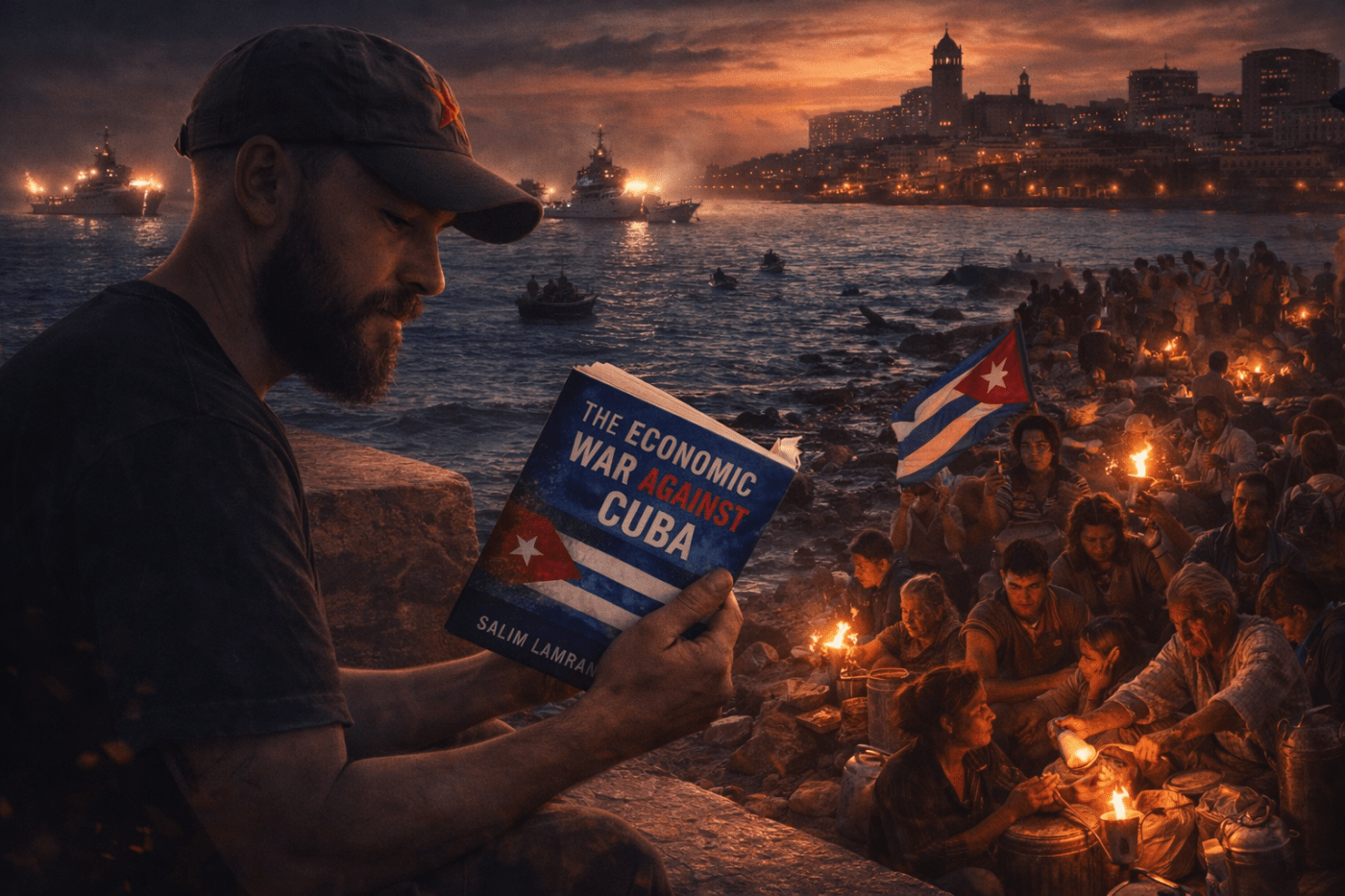
This review of The Economic War Against Cuba by Salim Lamrani excavates the historical architecture of the U.S. blockade and reinterprets it through the present conjuncture, revealing it not as a failed Cold War relic but as an evolving system of imperial economic warfare. Moving from trade embargo to extraterritorial coercion to full-spectrum energy siege, the analysis demonstrates how sanctions have systematically targeted Cuba’s social reproduction—healthcare, food systems, infrastructure, and now electricity itself—while exposing the blockade’s legal illegitimacy, genocidal logic, and function as a global mechanism of imperial discipline. Read dialectically, the book and the present converge to expose a single truth: the U.S. war on Cuba has not ended—it has intensified.
By Prince Kapone | Weaponized Information | Weaponized Intellects Book Review | March 29, 2026
When Empire Put Hunger on the Agenda
Let us be clear at the outset: this is not an exercise in flattening distinct histories into crude equivalence, but in exposing a shared logic of power that runs through them. The United States was not born as a neutral arbiter of “freedom and democracy,” but as a genocidal settler empire, and the capitalist system it defends has always advanced through organized dispossession, deprivation, and death. What we are confronting here is not policy error, but method. Across different geographies and political contexts, the same strategic grammar asserts itself with cold consistency: siege as policy, infrastructure as target, and collective life as the terrain of pressure. Food systems, energy grids, medical supply chains, water, and transport are not collateral damage—they are the battlefield itself, where empire intervenes to make life harder, thinner, more precarious, until survival becomes a daily negotiation with scarcity. The objective is not simply to confront a government, but to discipline a people by reorganizing the material conditions of their existence, converting deprivation into leverage and exhaustion into compliance. To name this convergence is not to erase difference, but to recognize a recurring technique of imperial rule: a system of slow, administered violence that places the very possibility of life under continuous siege in order to break sovereignty at its roots.
Salim Lamrani does not begin this book with hand-wringing, liberal balance, or the usual ceremonial nonsense about “complexity.” He begins where serious anti-imperialist work ought to begin: with the record. Not rumor. Not polemic detached from evidence. The file. The memo. The statement. The cold language of power speaking to itself behind closed doors. And that is what gives this opening section its force. The prose of empire is always driest at the very moment it is preparing its crimes. Lamrani understands this, and he lets the documents breathe just long enough for the stench to reach the reader. The United States did not stumble into hostility with revolutionary Cuba. It did not gradually develop concerns. It did not wait to see whether the new government would behave responsibly, as the moral idiots in Washington always pretend after the fact. No. From the outset, the verdict had already been reached. “We must stop Castro’s victory.” There it is, neat and unadorned. Not an interpretation. Not a metaphor. A line of policy. A line of war.
What makes Lamrani especially useful here is that he refuses the old fairy tale that the conflict began because Cuba became “communist.” That bedtime story has soothed generations of imperial apologists, editorial boards, and classroom frauds. But the chronology, which Lamrani lays out with quiet precision, wrecks the whole performance. Before the Soviet alliance hardened, before the Cold War script could be fully staged, before Washington could put on its usual costume of injured innocence, the real issue had already declared itself. Cuba had broken from the economic structure that tethered it to U.S. capital. The Revolution had begun to insist that Cuban land, Cuban labor, Cuban resources, and Cuban state power would no longer serve as the private feeding trough of foreign corporations. That was the offense. That was the scandal. That was the heresy. Empire can tolerate dictatorship, torture, corruption, and mass misery all day long—as long as the cash flows in the right direction. But let a small nation say that its wealth belongs first to its own people, and suddenly Washington discovers principle.
Lamrani’s account makes clear that pre-revolutionary Cuba was not simply engaged in unequal trade with the United States. It was locked into a structure of dependency. The island relied on the U.S. market for the overwhelming bulk of its exports and imports, while U.S. capital dominated strategic sectors of the economy and drained enormous wealth under extraordinarily favorable conditions. Lamrani notes that these firms contributed little to Cuba’s actual development even as they secured gigantic returns. In other words, this was not modernization. It was organized extraction. Not partnership, but plunder with paperwork. What the Revolution threatened, then, was not merely an alliance or a diplomatic arrangement. It threatened a system of accumulation. It threatened the right of foreign capital to own the metabolism of Cuban life. And when empire feels ownership slipping from its fingers, it does not respond with dialogue. It responds with punishment.
This is why one of the most devastating moments in Lamrani’s opening chapter comes when the language of policy becomes almost indecently honest. U.S. officials, discussing economic pressure on Cuba, state that “The sugar industry will suffer a rapid and abrupt decline that will entail general unemployment. Many persons will be without work and go hungry.” Read that sentence slowly, because there is a century of imperial strategy packed inside it. Hunger is not presented here as a regrettable side effect. It is not collateral damage. It is the policy lever itself. This is what empire means when it talks about “pressure.” It means pressure on the stomach, on the nerves, on the social fabric, on the ability of ordinary people to reproduce life from one day to the next. The objective is not to persuade the Cuban people with the superior beauty of capitalism. The objective is to make existence so hard, so precarious, so exhausting, that desperation might accomplish what invasion could not.
Lamrani, to his credit, does not let Washington hide behind its moral alibis. He reconstructs the legal basis of Cuba’s nationalizations and shows that they were consistent with established principles of sovereignty, including the right of peoples to control and dispose of their natural resources. He shows, too, that other states negotiated compensation agreements with Havana and accepted settlements, while the United States alone refused the process and chose confrontation. This matters. It matters because imperialism survives in part by laundering its violence through legality, by pretending that its punishments are merely the stern but necessary defense of civilization, property, and order. Lamrani strips that costume off. He demonstrates that the problem for Washington was never that Cuba acted outside all recognized norms. The problem was that Cuba acted like a sovereign state in defiance of U.S. supremacy.
But from the vantage point of the present conjuncture, we can press the point even further. The issue was never fundamentally legality. The issue was power. The United States did not reject Cuba because Cuba had wandered beyond the acceptable boundaries of international law. It rejected Cuba because Cuba had violated the actual constitution of empire, the unwritten but ruthlessly enforced rule that the sovereignty of the Global South must always bend before the property rights of imperial capital. Law, in this story, appears not as a barrier to domination but as one of its preferred dialects. Washington invokes it when useful, ignores it when inconvenient, and tramples it when necessary. The courtroom and the gunboat have always worked well together.
This is where Lamrani’s historical excavation becomes something more than a reconstruction of the past. Read now, in 2026, it becomes the opening chapter in a much longer war whose logic has only sharpened. The cutting of sugar quotas, the refusal of loans, the campaign to isolate Cuba economically—these were not isolated retaliatory gestures. They were the first organized steps in a strategy aimed at controlling the very conditions of social existence. In 1959 and 1960, that meant employment, trade, income, and access to markets. Today that same strategy has developed into something more infrastructural, more total, and in some ways more refined in its cruelty. The target is no longer just export revenue. It is fuel. It is electricity. It is transportation. It is the electrical grid, the hospital system, the food chain, the water system—the whole material circuitry through which collective life is reproduced.
And yet the logic remains exactly the same. Then, as now, the goal is not merely to “send a message” to a state. The goal is to engineer a crisis so comprehensive that the social order begins to fracture from within. The tools evolve, but the principle remains brutally stable: if you cannot directly overthrow a revolution, you attack the conditions that allow the people to live through it. Yesterday sugar. Today energy. Yesterday unemployment and hunger. Today blackouts, fuel shortages, stalled ambulances, disrupted surgeries, broken refrigeration, delayed transport, and the slow grinding pressure of everyday exhaustion. Empire has simply moved from one choke point to another.
That is why Lamrani’s opening chapter feels more alive now than many books written yesterday. He captures the origin of a strategy that has never really been abandoned, only modernized. The same state that once calculated how hunger might discipline Cuba now calibrates how fuel scarcity and electrical collapse might do the same work. The same imperial power that once moved to deny Cuba its sugar market now threatens and pressures third countries that might help keep the island supplied with energy. What liberal commentators call escalation is in fact continuity under altered material conditions. The war has not changed its purpose. It has changed its technical means.
But running through Lamrani’s account—and through the living present—is the contradiction that keeps humiliating Washington. From the beginning, the policy is premised on the expectation that sufficient pressure will produce surrender or collapse. From the beginning, that collapse does not arrive on imperial schedule. Cuba bends, improvises, reorganizes, absorbs shocks, and survives. The Revolution, rather than disappearing, is forced to develop under siege, and that fact alone has tormented U.S. ruling circles for more than six decades. What we are looking at, then, is not just domination. It is imperial frustration institutionalized as policy. Failure does not produce retreat. Failure produces escalation. The blockade persists not because it has worked in the way it promised, but because empire cannot tolerate the lesson of Cuban survival.
And that lesson is precisely why this first movement of Lamrani’s book matters so much. He shows us the moment when the U.S. state decided that Cuba had to be brought to heel—not because it represented a meaningful military threat, not because it endangered the physical survival of the United States, but because it posed a political example too dangerous to permit. A poor, formerly dependent Caribbean nation, ninety miles from the empire’s shoreline, had dared to assert that it could govern its own economy, nationalize foreign property, and place human need above the entitlement of U.S. capital. That was the real contagion. That remains the real contagion.
So to read this opening chapter today is to clear away the fog once and for all. The blockade was never temporary. Never an improvised Cold War residue. Never a regrettable misunderstanding waiting to be solved by better atmospherics and enlightened statesmanship. It was, from the very beginning, an economic war. And like all wars, it has evolved with the times, adapting its instruments while preserving its objective. The contemporary phase may involve more sophisticated coercive mechanisms, more global reach, and more infrastructural precision. But the essential decision was made long ago: to weaponize deprivation against a people who refused to kneel. Lamrani forces us to confront that decision not through slogans, but through the empire’s own voice. And once you hear it plainly, all the humanitarian rhetoric, all the pious editorials, all the counterfeit concern about democracy collapse into what they have always been—camouflage draped over a policy of organized suffering.
From Embargo to Siege: How Washington Turned Sanctions into a Permanent War System
If the first chapter of Lamrani’s book shows us the birth certificate of the blockade, the second shows us its growth into a full political technology of punishment. Here the book becomes less a simple chronology than a map of imperial persistence. Administration after administration, party after party, pretext after pretext, the same basic objective survives every costume change in Washington. Lamrani demonstrates that on March 17, 1960, the Eisenhower administration made the “formal decision to overthrow the Cuban government.” That line matters because it strips away the folklore. The sanctions regime was never designed as a defensive instrument, never meant merely to register disapproval, never crafted to secure some limited policy concession. Its aim from the beginning was regime change. Everything else—the speeches about democracy, the legal jargon, the periodic handwringing over human rights—came later as ideological wrapping paper around a very old imperial package.
Lamrani is especially strong in showing how this war hardened through stages. At first, the coercion takes forms familiar to classical imperial discipline: cutting sugar quotas, choking trade, denying oil deliveries, and weaponizing dependency. Then it expands into a total embargo. Then it acquires extraterritorial reach. Then it absorbs humanitarian life itself into the field of battle. By the time Kennedy imposes the total embargo, Lamrani notes that it included “a ban on drugs and food.” There, again, the moral fraud of empire becomes impossible to miss. A state that claims to defend civilization deliberately blocks food and medicine to an island nation and still expects to be called the guardian of liberty. One has to admire the nerve, if not the depravity. This is the old colonial trick polished for the twentieth century: first create the suffering, then blame the victim for bleeding badly.
Lamrani’s great contribution in this chapter is his insistence on continuity. He does not let the reader get lost in the personalities or the theatrics of presidents. Eisenhower, Kennedy, Johnson, Nixon, Ford, Carter, Reagan, Bush, Clinton, Bush again, Obama—different tones, different vocabularies, different emphases, but the same iron line of policy. Even where there are partial adjustments, as under Carter and to a lesser degree Obama, the strategic architecture remains intact. The empire may loosen one screw, but it keeps the machine. That is why Lamrani’s chronicle is so devastating. It reveals that Cuba policy is not best understood as a sequence of episodes. It is better understood as a state doctrine. The sanctions are not a reaction to Cuban behavior. They are one of the constitutive ways the U.S. empire disciplines disobedience in its near abroad.
This is also where Lamrani begins to read almost prophetically from the standpoint of 2026. He documents how sanctions moved beyond bilateral punishment and became extraterritorial coercion—ships blacklisted, subsidiaries restricted, third countries pressured, foreign companies threatened. What he is tracing, in effect, is the emergence of a global enforcement mechanism before the mechanism had fully matured. This matters because today that same logic has been pushed into an even more aggressive phase. Trump’s June 30, 2025 NSPM-5 openly reaffirmed a hardline regime-change framework toward Cuba, and on January 29, 2026 the White House escalated further by declaring Cuba an “unusual and extraordinary threat” and authorizing emergency measures tied to countries supplying oil to the island. What Lamrani recorded as the long historical expansion of sanctions has now become a new stage of open energy siege. The blockade has not merely survived. It has evolved.
And here the essential point must be made clearly. The present conjuncture does not contradict Lamrani’s chapter. It confirms it and forces us to extend it. Lamrani shows the bipartisan continuity of economic warfare. The current moment shows that continuity mutating into a more infrastructural form of coercion. In the sixties, the target was sugar, shipping, foreign exchange, industrial spare parts. In 2026, the target is fuel, electricity, logistics, and the social metabolism of the island itself. Cuban officials denounced the January 2026 move as an effort to impose a “total blockade on fuel supplies,” while UN experts condemned the order as a serious violation of international law and explicitly described it as a “fuel blockade.” This is why the old liberal phrase “sanctions policy” no longer suffices. What we are looking at is economic siege doctrine refined under conditions of imperial decline.
Lamrani includes one of the most important descriptions of the early embargo’s impact when he cites Louis Pérez Jr. on how the measures had a “devastating effect” and that “everything was devastated.” Factories stalled. Transportation systems broke down. Tractors went idle for lack of parts. Buses stopped running. Rail service deteriorated. This is not incidental evidence. It reveals the real terrain of sanctions warfare: not abstract GDP tables, but the practical circuitry of daily life. What the embargo attacks is not just the state treasury. It attacks motion, repair, timing, provision, and coordination. It attacks the means by which a society feeds itself, heals itself, and gets from one day to the next. Read through the lens of the present, this becomes even clearer. Today, Cuba’s energy shortages and grid failures are doing on a broader electrical scale what the early embargo did through trade strangulation and industrial dislocation. Reuters and AP have reported repeated blackouts and worsening energy stress, while Cuban and multilateral sources have tied the crisis to the tightening fuel siege and its spillover into health care and essential services.
What gives this chapter so much force is that Lamrani refuses the childish notion that sanctions persist because Washington still believes the next round will surely work. He shows, again and again, that failure does not discredit the policy. It hardens it. Consider the Torricelli Act, sold as the “final blow to the Cuban Revolution.” That phrase should be engraved over the entire sanctions regime, because it captures the recurrent delusion of imperial policy: each new turn of the screw is imagined as the one that will finally produce collapse. But collapse never arrives on schedule. Cuba adjusts, improvises, and survives. The result is not reconsideration in Washington, but escalation. The imperial mind interprets resilience not as evidence that the strategy is bankrupt, but as justification for more brutality. Failure becomes fuel for further aggression. That is the psychology of empire in decline: unable to retreat, unable to win cleanly, it doubles down on punishment.
And now, in the current conjuncture, we can see the contradiction in even sharper relief. The U.S. state has moved beyond broad embargo maintenance toward selective class engineering through scarcity. Reuters reported in March 2026 that the United States was ramping up fuel exports to Cuba’s private sector even while broader fuel access remained under siege. That move is politically revealing. Washington is not simply trying to starve Cuba. It is trying to reorganize Cuban scarcity in socially useful ways for imperial strategy—rewarding those channels of economic life it can politically cultivate while choking those linked to the state’s broader distributive capacity. In other words, the blockade has always been about more than deprivation. It is also about class restructuring. It seeks to make some forms of life economically viable and others untenable, not according to Cuban priorities but according to the needs of regime change.
Lamrani does not fully theorize this dimension, and that is one of the chapter’s limits from the standpoint of the present. He gives us the chronology and the legal-political evidence with admirable clarity, but he stops short of naming the blockade as a system for shaping class formation itself. Yet the seeds of that analysis are in his text. Once sanctions expand into food, medicine, transport, credit, shipping, and international commercial relations, they cease to be merely punitive. They become constitutive. They shape what can be produced, who can circulate, what sectors survive, and which institutions bear the heaviest burden of social reproduction. Under present conditions, with fuel interdiction and supply pressure aimed at the island’s electrical and logistical backbone, this truth has become impossible to ignore. Scarcity is being weaponized not only to punish Cuba, but to reorganize the terms on which Cuban society must endure.
Still, Lamrani is absolutely right on the central question. The sanctions are not episodic, not reactive, not the residue of some antique Cold War neurosis. They are a permanent war system. That is the real content of this chapter. The blockade persists because it serves an imperial function larger than Cuba itself. It disciplines the hemisphere. It sends a message to every nation that considers nationalization, nonalignment, or even modest sovereign control over strategic resources. It says: if you step out of line, we will not merely oppose your government. We will attack the material basis of your society. We will turn trade into punishment, finance into siege, and infrastructure into a battlefield.
This is why the contemporary turn to energy warfare matters so much. It is not a break with the old embargo. It is the embargo arriving at a more advanced stage of technical precision. Cuban state sources have described the current situation as a “bloqueo energético,” while recent reporting in Granma and Cubadebate has tied that siege to hospital strain, maternal care risks, delayed surgeries, and widespread stress on the national electrical system. People’s Dispatch has likewise framed the current phase as a U.S.-manufactured fuel crisis aimed at forcing surrender. Lamrani’s chapter gives us the architecture; the present shows us the latest weapon installed in the structure.
So the historical lesson of this part of the book is not simply that the embargo expanded. It is that U.S. policy toward Cuba gradually revealed its true nature as a comprehensive doctrine of economic war. The legal forms shifted. The rhetorical justifications changed. The Cold War ended. Presidents came and went. None of that altered the strategic core. What altered was the sophistication of the machinery. Lamrani traces its assembly piece by piece. The current conjuncture shows the machine running at a higher voltage.
To read this chapter seriously, then, is to see Cuba policy for what it has always been: a laboratory in which the United States refined methods of coercion later generalized across the world. Trade denial, financial isolation, extraterritorial punishment, humanitarian strangulation, third-country intimidation, and now energy interdiction—these are not separate instruments. They are chapters in the same imperial manual. And that is what makes Lamrani’s second chapter so valuable. It does not merely recount the history of sanctions. It shows us how embargo became system, how punishment became doctrine, and how doctrine became a durable form of war carried out by other means.
Life Under Siege: Quantifying the War on Social Reproduction
If the previous chapter reveals the architecture of the blockade, this section measures its effects in material terms. Lamrani does not leave us with impressions—he gives us a system whose consequences can be counted, tracked, and verified. What emerges is not a story of generalized hardship, but a structured regime of deprivation operating across healthcare, food systems, infrastructure, and national development. The blockade is not symbolic pressure. It is measurable economic warfare.
Nowhere is this more visible than in healthcare. U.S. sanctions prohibit the export of medicines and medical equipment containing more than a minimal percentage of U.S. components, effectively excluding Cuba from a significant portion of the global pharmaceutical and medical technology market. This forces Cuba to import from distant suppliers at inflated costs—often 30% to 50% higher due to intermediaries, transportation, and licensing barriers. The delays are not trivial. In a system dependent on timely access to treatment, these delays translate directly into prolonged illness, complications, and preventable deaths. The blockade thus imposes a quantifiable increase in the cost—and risk—of healthcare delivery.
The same pattern appears in medical technology. Approximately 80% of high-end medical equipment globally incorporates U.S.-manufactured components or patents, placing it under embargo restrictions. As a result, hospitals in Cuba face systematic equipment shortages, and existing machines frequently remain out of service due to lack of spare parts. This is not an isolated inconvenience—it reduces diagnostic capacity across the system, extending waiting times and limiting treatment options. What appears as “shortage” is in fact enforced technological exclusion.
The food system reflects a similar structure of constraint. While limited agricultural trade has been permitted since the early 2000s, it operates under strict conditions: Cuba must pay cash in advance, cannot access credit, and must route transactions through third parties. These conditions increase food import costs significantly—often by hundreds of millions of dollars annually when accounting for financing restrictions, shipping inefficiencies, and lost economies of scale. The result is not famine, but a persistent structural pressure on national nutrition, where the cost of feeding the population is artificially inflated by policy design.
At the macroeconomic level, the scale of this pressure becomes undeniable. Lamrani cites cumulative damages from the blockade exceeding $100 billion. More recent Cuban estimates have pushed this figure beyond $130 billion when adjusted for inflation and extended duration. This is not a theoretical number. It represents decades of lost production, blocked investment, increased import costs, and constrained development. Spread over the population, it amounts to thousands of dollars per Cuban citizen—an enormous burden imposed externally on a small developing nation.
Infrastructure disruption provides another measurable dimension. Historical accounts cited by Lamrani describe entire sectors slowed or stalled due to lack of spare parts. Agricultural machinery became inoperable, reducing output. Public transportation systems deteriorated, limiting worker mobility. Rail networks declined, affecting the movement of goods. These disruptions carry quantifiable economic consequences: reduced productivity, increased logistical costs, and inefficiencies across the entire economy. What is being attacked is not just output, but coordination—the ability of a society to function as an integrated system.
Even U.S. institutions have acknowledged the scale of this disruption. The Government Accountability Office concluded that sanctions have a “considerable impact upon daily life.” But this understated phrasing masks a deeper reality. When healthcare costs rise by double-digit percentages due to import barriers, when food imports are inflated by structural financial restrictions, and when national losses exceed $100 billion over decades, we are not dealing with “impact.” We are dealing with a sustained economic assault measurable across multiple sectors.
As of 2026, these measurable pressures have intensified into the energy domain. Fuel shortages—exacerbated by U.S. pressure on suppliers—have produced nationwide blackouts affecting millions of people simultaneously. Electrical generation shortfalls have at times reached significant portions of national demand, forcing rolling outages across the island. The consequences are immediate and quantifiable: hospital operations disrupted, refrigeration systems failing, water pumping systems halted, and transportation networks constrained. What Lamrani documented as sectoral disruption has now become systemic instability at the level of national infrastructure.
Taken together, these figures reveal a consistent pattern. Healthcare access is restricted through pharmaceutical and equipment barriers. Food systems are strained through financial and logistical constraints. Infrastructure is degraded through denial of parts and materials. The economy absorbs cumulative losses exceeding $100 billion. Energy systems are destabilized through fuel interdiction. Each of these is measurable. Each is documented. Together, they form a coherent system of pressure applied to every mechanism of social reproduction.
And yet, within this measurable assault, Lamrani identifies a contradiction that remains crucial. He notes that a majority of the U.S. population supports normalization of relations with Cuba. This reveals that the blockade persists not because of popular demand, but because of structural interests embedded within the state. Policy continues despite its measurable human and economic costs.
This persistence clarifies the function of the blockade. The data does not point to failure—it points to design. A policy that produces over $100 billion in damages, inflates essential imports, restricts medical access, and destabilizes infrastructure over decades is not malfunctioning. It is operating as intended. The objective is not efficient resolution. It is sustained pressure.
And still, despite this quantifiable assault, Cuba does not collapse. It adapts under measurable strain. It reorganizes its economy, develops alternative supply chains, and maintains core social services under conditions of externally imposed scarcity. This does not negate the data—it underscores it. The scale of pressure required to attempt such a collapse reveals the limits of coercion itself.
So this section, grounded in empirical data, leaves no ambiguity. The blockade is not a policy debate. It is a measurable system of economic warfare operating across healthcare, food, infrastructure, and energy. Its effects can be counted in billions of dollars lost, in percentage increases in essential costs, and in the degradation of systems that sustain daily life. And in that sense, it represents not just pressure on a state, but a continuous assault on the material conditions of an entire society.
Law as Weapon, Power as Principle: The Imperial Right to Punish Without Constraint
By the time Lamrani reaches the legal dimension of the blockade, the reader has already seen enough evidence to suspect the conclusion: this is not a policy constrained by law, but a system that uses law selectively, instrumentally, and often cynically. What this section does is remove any remaining illusion. It shows that the blockade is not merely unjust in practice—it is illegitimate in principle. And yet it persists. That contradiction is the key to understanding not only Cuba policy, but the broader structure of imperial power in the modern world.
Lamrani lays out the legal framework with clarity. International law, he reminds us, is not silent on questions of economic coercion. The United Nations Charter and subsequent resolutions establish that “No State may use… coercive measures” to force another state to subordinate its sovereign rights. This is not an obscure technicality. It is a foundational principle of the post-World War II international order: sovereignty is not conditional on compliance with the preferences of powerful states. And yet, the entire structure of the U.S. blockade is built precisely on such coercion.
What Lamrani demonstrates, step by step, is that Cuba’s actions—particularly the nationalization of foreign property—were not violations of international law, but expressions of it. The right of a people to exercise permanent sovereignty over its natural resources is well established. Compensation was offered. Agreements were reached with other countries. The legal path was available. The United States did not reject Cuba because Cuba acted unlawfully. It rejected Cuba because Cuba acted independently.
This distinction matters. Because it exposes the core ideological maneuver of empire: to present resistance as illegality, and domination as order. Lamrani dismantles this maneuver by showing that the United States stood virtually alone in refusing negotiated compensation, choosing instead to escalate toward confrontation. The issue was never legality. It was control.
But the most revealing dimension of this section lies in the question of extraterritoriality. The blockade does not stop at the U.S. border. It extends outward, attempting to regulate the behavior of third countries, foreign companies, and international institutions. Lamrani notes that these measures are “extraterritorial” and therefore in direct conflict with international law. This is a critical point. Because it shows that the blockade is not simply a bilateral dispute between the United States and Cuba. It is an attempt to restructure the global economic environment in accordance with U.S. policy objectives.
In practical terms, this means that companies in Europe, Latin America, Asia, and beyond are pressured—through threats of fines, exclusion from U.S. markets, and financial penalties—to comply with a policy that their own governments often oppose. Banks refuse transactions. Ships avoid Cuban ports. Firms withdraw investments. The blockade becomes global not because the world agrees with it, but because the United States has the power to enforce compliance. Law, in this context, becomes secondary to leverage.
From the vantage point of today, this extraterritorial logic has only intensified. The United States now openly threatens countries that supply fuel to Cuba, extending the blockade into the domain of energy with explicit global reach. What Lamrani documented as legal overreach has become normalized practice. Secondary sanctions, financial blacklisting, and supply chain pressure are no longer exceptional—they are standard instruments of U.S. foreign policy. The blockade of Cuba is not an anomaly. It is a template.
This is where Lamrani’s analysis must be pushed further. He exposes the illegality of the blockade, but the present forces us to confront a deeper reality: illegality does not constrain empire. It is absorbed into its operation. The United States invokes international law when it serves its interests, ignores it when it does not, and violates it when necessary. The legal order, rather than functioning as a universal system of rules, becomes a terrain of selective enforcement shaped by power.
This dynamic can be seen in the annual votes at the United Nations General Assembly, where the vast majority of countries consistently condemn the blockade. Year after year, the global community rejects the policy. And year after year, the policy continues unchanged. This is not a failure of diplomacy. It is a demonstration of hierarchy. The formal structure of international law exists, but its enforcement is uneven, contingent, and subordinated to geopolitical power.
Lamrani captures the absurdity of this situation when he notes the “obsessive focus on a nation that poses no threat.” Cuba, a small island nation with limited military capacity, is treated as a persistent target of one of the most powerful states in history. The justification cannot be security in any conventional sense. It must be understood politically. Cuba represents not a military danger, but an ideological one—the example of a society attempting to organize itself outside the framework of U.S. dominance.
And this brings us to the central contradiction of this section. If international law prohibits coercive economic measures, and if the blockade is widely recognized as such a measure, then why does it persist? The answer is not found in legal argument. It is found in the structure of power. Law, in this context, does not determine policy. Policy determines when and how law is applied.
This is what must be named clearly: the imperial exception. The United States operates not as one state among equals, but as a state that claims the right to suspend rules when they conflict with its interests. This is not declared openly. It is practiced. It is embedded in the routine functioning of sanctions regimes, military interventions, and economic coercion. The blockade of Cuba is one of the clearest expressions of this principle in action.
Lamrani gives us the legal case. He shows that the blockade violates international norms, contradicts established principles of sovereignty, and stands at odds with the formal structure of the global legal order. But the present conjuncture reveals the limits of that argument. Because the persistence of the blockade demonstrates that legality alone is insufficient to restrain imperial power. What matters is not whether a policy is lawful, but whether it can be enforced.
And here, the analysis returns to where it began. The blockade is not maintained because it is justified. It is maintained because it is possible. The United States has the economic, financial, and political leverage to impose costs not only on Cuba, but on any actor that engages with it. That leverage transforms a legally questionable policy into an operational reality. Power fills the gap where law fails.
So this section of Lamrani’s book, read today, becomes something more than a legal critique. It becomes a demonstration of how international law functions within an unequal system. It shows us that rules exist, but their application is selective. That norms are articulated, but their enforcement is contingent. That legality is invoked, but power decides.
In that sense, the blockade of Cuba is not simply a violation of law. It is a revelation of how law operates under empire. It exposes the distance between principle and practice, between formal equality and actual hierarchy. And it forces us to confront a difficult but necessary conclusion: in a world structured by unequal power, legality is not the limit of action—it is one of the instruments through which power is exercised.
Slow Death, Open Intent: Genocide, Energy War, and the Empire’s Need to Demonstrate Power
By the time Lamrani reaches the final movement of his book, he has already established more than enough to bury the liberal lie that the blockade is a regrettable but basically normal foreign-policy disagreement. What remains is the hardest question, and therefore the one polite critics are always most eager to dodge. When a state deliberately attacks food, medicine, fuel, infrastructure, and the material conditions of life over decades; when it openly seeks “economic dissatisfaction and hardship” to produce political submission; when it calculates hunger as leverage and deprivation as method—what exactly are we supposed to call that? Lamrani approaches the question carefully, even soberly. He asks whether we are dealing with an “Attempted Genocide?” That caution is understandable. But the evidence he assembles pushes harder than his tone. The text itself keeps dragging the reader toward a conclusion the respectable world does not want named.
Lamrani is on firm ground when he begins with intent. Cuba, he notes, has long condemned the blockade as a “genocidal policy,” and he grounds that claim not in rhetoric, but in documentary evidence and international law. The Convention on the Prevention and Punishment of the Crime of Genocide includes, among its relevant provisions, the deliberate infliction on a group of “conditions of life calculated to bring about its physical destruction in whole or in part.” Now place that standard beside the internal U.S. memorandum of April 6, 1960, which Lamrani quite rightly elevates to its proper place as one of the clearest confessions in the entire archive. Lester Mallory wrote that “The majority of Cubans support Castro,” that there was “no effective political opposition,” and that “The only foreseeable means of alienating internal support is through disenchantment and disaffection based on economic dissatisfaction and hardship.” This is not accidental suffering. This is policy speaking plainly about method. Hardship is the lever. Mass deprivation is the means.
The force of Lamrani’s argument lies in the way he ties this intent to the actual structure of the blockade. By the time we arrive at this final chapter, the book has already shown that the sanctions are total in scope, extraterritorial in reach, and aimed at all sectors of social life. Cuba itself, Lamrani reminds us earlier, accuses Washington of “attempting to starve the Cuban people by imposing extremely difficult living conditions, hoping these will trigger an internal revolt that will lead to regime change.” That sentence matters because it strips the whole matter down to its class content. The policy is not merely punitive. It is pedagogical. It seeks to teach a lesson to the Cuban people: that sovereignty brings hunger, that independence brings darkness, that revolution brings sacrifice without end. The hope is that exhaustion will eventually do the work that invasion and sabotage could not.
This is where Lamrani’s restraint is both a strength and a limitation. It is a strength because he does not overstate what the text can prove. He proceeds through legal categories, documentary admissions, and the cumulative effects of policy. But it is also a limitation because imperialism is rarely content to kill in one spectacular blow. More often it kills by administering life downward—by reducing caloric intake, delaying surgeries, degrading water systems, stalling transport, and normalizing weariness as a social condition. The blockade’s violence is not less real because it is infrastructural. On the contrary, that is precisely what makes it so enduring and so difficult for liberals to reckon with. They are trained to recognize the bomb crater, not the empty pharmacy shelf; the firing squad, not the operating room without power; the invasion force, not the fuel tanker that never arrives.
And this is exactly why the present conjuncture sharpens Lamrani’s final chapter rather than displacing it. In January 2026, the White House declared that the Cuban government constituted an “unusual and extraordinary threat” to U.S. national security and foreign policy, and announced a process for imposing tariffs on goods from countries that sell or otherwise provide oil to Cuba. That move matters because it confirms, in a more advanced form, the very logic Lamrani documents historically. The old blockade has now been intensified into open energy warfare. The target is no longer only trade and finance in the general sense. It is fuel, which in a modern society means electricity, transport, refrigeration, hospital functionality, water pumping, food circulation, and the entire metabolic chain of collective life. The empire is no longer simply trying to make Cuba poor. It is trying to govern the terms under which Cuba can physically function.
The significance of this development was clear enough that even United Nations human rights experts condemned the January 29, 2026 executive order as a “fuel blockade” and called it “a serious violation of international law” as well as “a grave threat to a democratic and equitable international order.” Cuba, for its part, denounced the move as a new escalation of the economic war and has repeatedly described the present phase as an energy blockade aimed at paralyzing the island’s essential systems. The point here is not to replace Lamrani’s argument with current events. It is to show that the structure he anatomized has developed into a sharper, more infrastructural form. The text asked whether the blockade was approaching genocide through the deliberate imposition of unbearable living conditions. The present answers by demonstrating that Washington has doubled down on exactly that method.
This is where the contradiction at the heart of the entire book becomes most revealing. Wayne Smith says in the prologue that the sanctions have “failed totally to achieve their objective,” namely the overthrow of the Cuban government. Lamrani’s whole study substantiates that judgment. Yet the policy not only persists; it intensifies. This tells us something crucial. The objective of the blockade cannot be reduced to simple regime change in the narrow sense, because a policy that has “failed totally” on those terms would have been abandoned long ago by any state acting rationally in the ordinary instrumental sense. It remains because it serves other functions as well. It punishes disobedience. It deters imitation. It dramatizes the reach of U.S. power. And under current conditions of imperial decline, it demonstrates that even a small Caribbean nation will be made to suffer if it insists on surviving outside Washington’s discipline.
That is why the genocide question cannot be treated as a technical legal riddle alone. It must also be understood politically. Empire does not always seek immediate extermination. Sometimes it seeks prolonged attrition. Sometimes it wants a people disciplined, exhausted, thinned out socially and materially, made permanently vulnerable, and held up as an example to others. What Lamrani shows, and what the present confirms, is that the blockade is a machinery for imposing precisely such conditions. It restricts medicine. It inflates food costs. It damages infrastructure. It obstructs fuel access. It aims, by its own documentary confession, to generate “economic dissatisfaction and hardship.” To pretend that all this sits comfortably outside the horizon of genocidal violence simply because the suffering is administered through banks, ports, regulations, and energy chokepoints rather than through concentration camps is to mistake form for substance.
At the same time, a serious revolutionary review cannot flatten the question into moral thunder alone. We have to preserve dialectical clarity. Cuba has not been destroyed. The Revolution has not been extinguished. The blockade produces immense harm, but it has not achieved the total physical destruction that genocide in its most maximal sense would imply. That matters analytically. It is one reason Lamrani poses the issue as a question rather than a slogan. But that caution should not become evasion. If the policy is not reducible to completed genocide, it nonetheless operates through genocidal logics: deliberate deprivation, collective punishment, the production of conditions of life designed to break a national population’s social and material capacity to reproduce itself. The proper conclusion, then, is neither liberal understatement nor sloppy inflation. It is sharper than both. We are confronting a long-duration regime of structural violence that approaches the genocidal through sustained economic siege.
And yet the most humiliating fact for Washington remains unchanged: Cuba survives. That survival is not a sentimental flourish. It is the great contradiction that haunts the entire sanctions regime. The empire has imposed what its own government once called “the most comprehensive set of American sanctions ever imposed upon a country.” It has done so for more than six decades, repeatedly tightening the screws, repeatedly predicting collapse, repeatedly mistaking endurance for weakness. But the social order it sought to break has refused to disappear. This is why the blockade has become more than policy. It has become obsession. Not because Cuba threatens the United States militarily, but because Cuba’s persistence threatens the ideological authority of empire. A people that survives organized deprivation without surrendering its sovereignty exposes the limits of coercion itself.
So Lamrani’s final chapter does not merely ask whether the blockade has crossed a moral threshold. It reveals why the question must be asked in the first place. The book shows us how intent, law, and material consequence converge. The present shows us what that convergence looks like under a new stage of imperial crisis: energy warfare, third-country coercion, and the deliberate attack on the infrastructures that make collective life possible. Taken together, they leave us with a verdict that polite discourse will always resist. This blockade is not a failed policy relic. It is an active strategy of organized suffering. It aims not only to overthrow, but to punish; not only to punish, but to deter; not only to deter, but to demonstrate that the empire still reserves for itself the right to decide which nations may breathe easily and which must live under siege.
That is the final truth this book pulls out of the archive. What began as an economic war has matured into a doctrine of slow violence against a sovereign people. Lamrani, measured as ever, gives us the evidence. The present gives us the continuation. And together they force the only serious conclusion: the blockade must be understood not as policy disagreement, but as a prolonged assault on the material basis of Cuban life—an assault whose cruelty lies precisely in its methodical, administrative, and openly intended character.
 Weaponized Information
Leave a comment