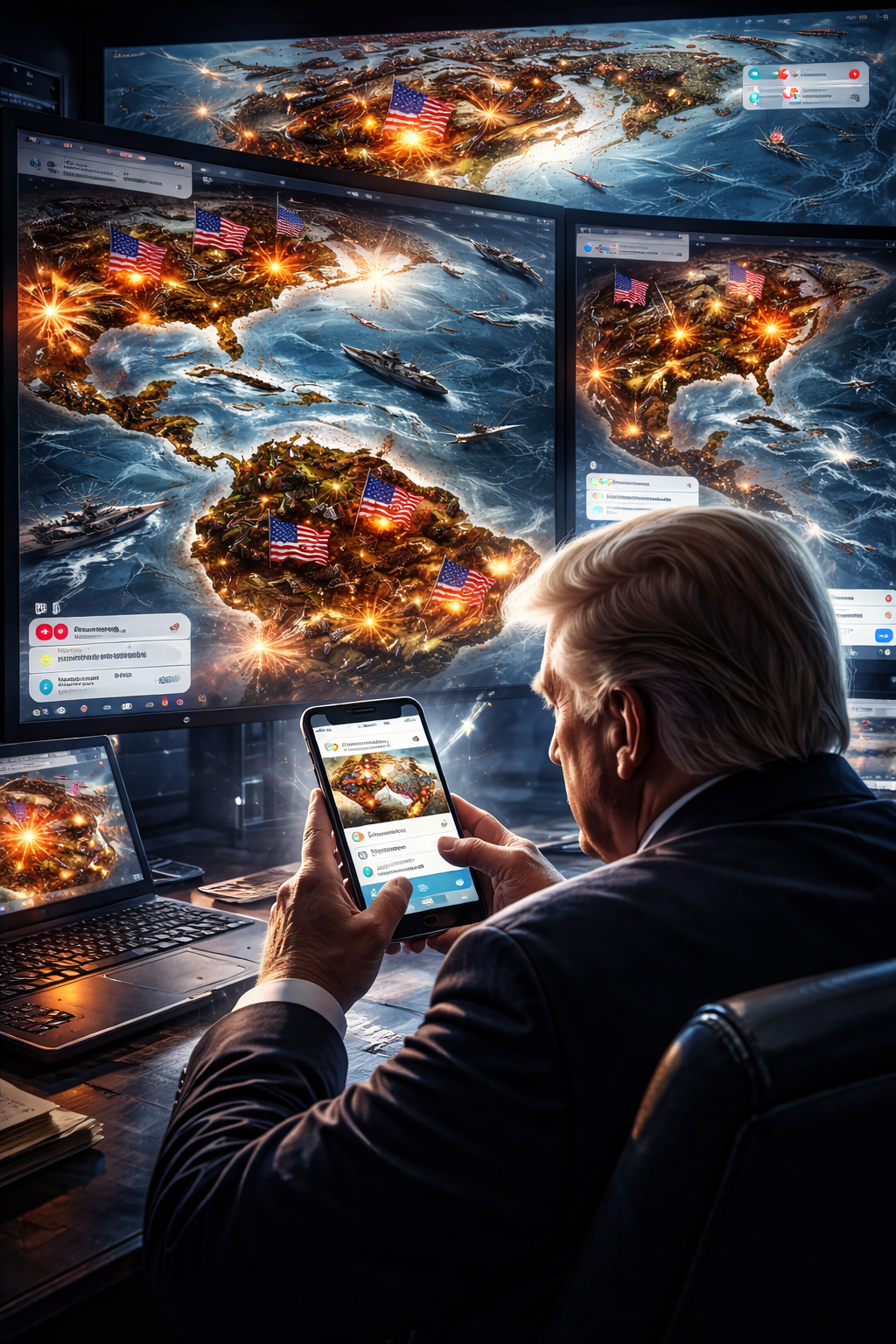
How Trump’s Social Media Declarations Signal the Geopolitical, Economic, and Strategic Architecture of Fortress America and the American Pole
By Prince Kapone | Weaponized Information | January 12, 2026
When Empire Posts Its Intentions
There are moments when the empire speaks in polished paragraphs—through white papers, summit communiqués, and the priestly language of “shared values.” And then there are moments when it stops dressing up for the audience and starts talking like what it is: a landlord with a gun, a banker with a blockade, a colonial power convinced that the hemisphere is a deed in its drawer. Trump 2.0 belongs to the second category. It is not merely that Trump says outrageous things; it is that the presidency now uses social media as a tactical platform to float, normalize, and rehearse forms of domination that the post–World War II order was supposed to banish from respectable speech. When Trump posts an edited image presenting himself as “Acting President of Venezuela”, the purpose is not to persuade historians. It is to condition the living—to train an audience to accept a new grammar of power in which sovereignty is not a right but a permission slip that Washington can revoke.
Taken literally, these posts can look like delusion—an imperial fever dream typed out in all caps. But empire has always relied on spectacle, and spectacle is not the opposite of strategy; it is often the strategy’s opening move. The old regime-change choreography depended on the fiction that the United States was merely “supporting democracy,” merely “recognizing” the rightful leader, merely “helping” a country return to normal life. Trump 1.0 still tried to operate inside that theater: proxies, parallel presidents, recognition rituals, sanctions framed as moral discipline. Trump 2.0 is posting something different. It is posting jurisdiction. It is posting custody. It is posting the idea that the United States can occupy the political vacancy of another nation by declaration, like stamping a form in an office that does not belong to it.
The pattern becomes clearer when the Venezuela post is placed beside the next signal: Trump responding approvingly to a post joking that Marco Rubio should be “president of Cuba”. A single reply can be dismissed as banter, the way a thief whistles while picking your pocket. But in context, the meaning hardens. We are watching a rhetorical shift from indirect rule to open political replacement: not “we support the opposition” but “we can appoint the administrators.” And then comes the most brazen frontier language of all—Trump threatening Greenland “the hard way,” a phrase reported amid international alarm over his repeated push to seize or take control of the territory, framed as an Arctic strategic imperative. The point is not subtle. It is territorial empire re-entering polite conversation through the back door of a post.
Once you see the posts as signals, the underlying project comes into focus. This is not random trolling; it is the public pedagogy of Fortress America. The American Pole is not an abstract geopolitical concept—it is an enclosure project. It says the hemisphere must be cleared of rival presence, locked into U.S.-managed logistics, and disciplined into compliance through choke points: energy flows, shipping lanes, finance rails, and the legal machinery of seizure. In that framework, Venezuela becomes an oil-custody problem; Cuba becomes a regime-replacement problem; Greenland becomes an Arctic-forward-base problem; and Canada becomes something darker still—an “ally” treated as strategic depth, resources, and territory to be folded into a continental fortress, a prospect that Canadian political observers now describe as potentially existential for NATO itself. If the inconceivable becomes reality, the postwar architecture is not merely strained; it is punctured.
That is why this essay treats Trump’s social media not as a sideshow but as a primary text. In an age where platform capitalism has fused with state power, “posting” becomes a low-cost instrument of high-stakes imperial communication. It tests the room. It recruits the base. It rattles adversaries. It reassures certain factions of capital that the old euphemisms are being retired and the empire is returning to direct speech: acquisition, annexation, custody, administration. The posts do not necessarily describe accomplished reality; they attempt to manufacture a new one. And the task before us is to read them the way the colonized have always learned to read empire—by tracking what it threatens, what it normalizes, what it rehearses, and what it is preparing to do when it thinks no one can stop it.
From Puppet Sovereignty to Colonial Claim
The difference between Trump 1.0 and Trump 2.0 is not a matter of temperament; it is a matter of method. The first term still tried to rule through the old neocolonial grammar, the language of proxies and parallel states. It was the age of recognition politics and press-conference legitimacy: anoint an “interim president,” assemble a choir of friendly governments, freeze assets, and wait for the palace doors to swing open. The Guaidó experiment was the purest expression of that model—an attempt to manufacture internal authority by external decree. It failed because it asked Venezuelans to accept a state they did not build and a leader they did not choose. Empire learned from that failure. It learned that legitimacy cannot always be conjured by paperwork and applause.
Trump 2.0 draws a colder conclusion. If the proxy cannot rule, dispense with the proxy. If the fiction of mediated legitimacy collapses, replace it with the claim of jurisdiction. This is why the new language sounds less like diplomacy and more like property management. When Trump posts himself as “Acting President of Venezuela,” he is not saying that Caracas needs better governance; he is saying that sovereignty is a vacancy he can occupy. When he signals approval for an American official to be “president of Cuba,” he is not endorsing reform; he is rehearsing appointment. When he threatens Greenland “the hard way,” he is not negotiating; he is asserting a frontier. The shift is from influence to command, from recognition to administration, from regime change to regime subordination.
This is the return of colonial sentence structure. The old order preferred the soft verbs—support, assist, partner, recognize. The new order favors the hard nouns—custody, annexation, acquisition, control. It is the difference between saying “we stand with the Venezuelan people” and saying “we will manage the oil.” The first pretends to speak in the voice of solidarity; the second speaks in the voice of a trustee who has already taken the keys. In this grammar, countries become assets, leaders become removable obstacles, and law becomes an internal memo that follows the raid. The empire no longer needs to persuade the world that it is benevolent; it needs the world to understand that it is in charge.
Read this way, Trump’s posting is not aberration but adaptation. The platform is merely the medium for a recalibrated imperial practice that has decided the old theater is too slow and too fragile. A post can move faster than a resolution, travel farther than a demarche, and land harder than a speech. It can be disavowed as “just a joke” while doing the real work of normalizing conquest. The spectacle does what the policy paper cannot: it makes domination feel familiar, even inevitable. By the time the ships are positioned and the licenses written, the audience has already been trained to think in the empire’s new tense—the future perfect: this will have been done.
And yet the pivot is not simply rhetorical. It is anchored in material power. The same administration that posts jurisdiction builds it through blockades, seizures, sanctions, and lawfare. The same voice that jokes about presidents enforces custody over flows—of oil, of ships, of money. This is why the comparison between Trump 1.0 and Trump 2.0 matters. The first tried to rule through a borrowed face. The second is posting the empire’s own. The first asked for consent. The second announces terms. The first still needed the costume of internationalism. The second is comfortable in uniform. In the long arc of imperial history, that is the moment when the colony is no longer prepared for; it is claimed.
Posting as Power: How Platforms Became Imperial Infrastructure
Empire has always needed a loudspeaker. In earlier centuries it was the proclamation nailed to a church door, the governor’s decree read aloud in a square, the newspaper that announced a protectorate as if it were the weather. Today the loudspeaker is a feed. Trump’s posts are not casual updates; they are the empire’s new bulletin board. They move faster than embassies, outrun cables, and bypass the rituals that once slowed imperial decisions long enough for resistance to gather. In the age of platform capitalism, posting is not commentary on power; it is a way of exercising it.
This is why the presidency’s social media has become a site of policy rehearsal. A post floats an annexation threat. Another post assigns a president to a country that has not asked for one. A third declares custody over a nation’s political office. Each message is small enough to be denied as theater and large enough to redraw the horizon of what is thinkable. The genius of the platform is its deniability: the same line can be read as a joke by the cautious, a threat by the targeted, and a promise by the base. The ambiguity is not a bug; it is the weapon. It allows empire to test the perimeter without paying the price of a formal declaration.
Platforms also solve an old imperial problem: how to normalize the extraordinary. A blockade announced in a treaty provokes outrage; a seizure tweeted into a timeline dissolves into the daily scroll. The feed trains attention to move on. Yesterday’s red line becomes today’s trending topic and tomorrow’s footnote. In this churn, conquest is broken into consumable pieces. A ship is taken. A license is revoked. A leader is mocked. A territory is “negotiated.” Each act arrives as content. Together they assemble a regime of control that feels less like war and more like administration.
There is a deeper fusion at work. The same corporations that monetize attention now host the state’s most aggressive messaging. The same algorithms that sort ads sort geopolitics. What trends becomes what matters. What is buried becomes what can be denied. In this ecosystem, empire does not merely communicate; it calibrates. It watches the metrics, reads the reactions, and adjusts the pressure. The feed becomes a sensor array for imperial mood. Resistance is measured in replies. Compliance is inferred from silence. The public square is privatized, and the empire rents it by the minute.
When Trump posts jurisdiction, he is not just speaking; he is moving. He is setting the tempo for agencies, emboldening enforcers, and reassuring capital that the old constraints are being retired. The post tells insurers where to look, banks where to pause, shippers where to hesitate. It signals to allies that alignment is expected and to adversaries that defiance will be costly. In this sense, posting is a low-friction command-and-control layer—soft on the surface, hard in its effects. The empire’s writ now runs through timelines.
This is why it is a mistake to read these messages as mere spectacle. Spectacle is the opening act of governance in an era where attention is the first battlefield. The post precedes the patrol. The meme precedes the memo. The declaration precedes the docking order. What looks like theater is the scaffolding of rule. In Fortress America, the platform is not just where policy is announced; it is where empire is practiced.
Venezuela at the Crossroads: Empire’s Strike and Sovereign Resistance
We cannot talk about Venezuela as a mere story of contested oil without confronting what actually happened in the early days of January 2026: the United States, acting under the authority of its president, ordered a massive military raid into the capital of a sovereign republic and seized its head of state, Nicolás Maduro, transporting him to New York to stand trial in an American courtroom. This was not a minor skirmish or an accidental clash at a border; it was a planned operation involving elite units, bombardment of strategic targets, and, according to multiple reports, dozens of casualties on both sides.
The empire’s own commanders called it a success — a tactical victory in what Washington described as a campaign against “narco-terrorism.” Trump himself declared that the United States would “run Venezuela” during a transition period, tying the operation to control over the country’s oil infrastructure. But on the ground inside Venezuela, the state apparatus did not crumble. Instead, Maduro’s vice president, Delcy Rodríguez, was sworn in as president, insisting that Venezuelan sovereignty remains intact despite the abduction of the official head of state. The Bolivarian political project did not dissolve under fire; it continued from within, bolstered by communal forces, the state’s institutions, and popular defiance.
The duel between imperial proclamation and sovereign continuation is crucial. Trump’s social media posts — the self-declaration as “Acting President,” the threats to Cuba, the fantasies of annexation — now sit atop a very real violent rupture. They are not symbolic signals floating above history; they are ideology in motion, attempting to narrate a seizure of power that the military action began but did not complete. In Caracas and across Venezuelan society, the narrative is different: obedience to an external claimant is rejected not in Google Analytics or foreign press releases, but in street mobilizations, in political speeches, in the routine operation of a state that refuses to concede its name to an extraterritorial post. This is sovereignty asserting itself against forceful erasure.
Empire insists its logic is legal — that the raid, the capture, the subsequent criminal charges are law enforcement writ large rather than an act of war. But the chorus of global criticism is unanimous in one point: a sovereign state does not lose its status because another state declares it so. The raid was widely denounced at international forums as a violation of international law and of the fundamental principle that one country cannot abduct the leader of another without consent or Security Council authorization.
The violence of that January operation, the deaths, the injuries, the displacement of power — these are not mere footnotes. They are the material conditions under which Trump’s posts are read. A tweet or Truth Social broadcast promising authority over Venezuela now overlaps with the ground reality of a state under siege and a political order that persists in spite of occupation, not because of it. Empire wants to translate military supremacy into administrative control, to treat Venezuela as a resource node whose circulation can be disciplined. Sovereignty, from this perspective, becomes a negotiable technicality rather than a living relation of power.
But power is not held by declarations alone. In Caracas, the continuity of the Bolivarian government — and its refusal to bow to extrinsic claims — fractures the very logic Trump’s messages attempt to enforce. The imperial order declared itself, then learned again that sovereignty is not a pop-up that disappears when a foreign power clicks “capture.” It is a lived constellation of social forces, institutional memory, popular legitimacy, and resistance. And in that collision between an invading gesture and a defiant polity, the real limits of hyper-imperial ambition are being tested.
Cuba as Vacancy: From Blockade to Political Replacement
If Venezuela is being rewritten as a resource node, Cuba is being rewritten as a vacancy. The island is no longer addressed as a sovereign polity with a government, a history, and a social project that survived invasion, sabotage, and six decades of siege. In the new grammar of empire, Cuba appears as an empty chair at a table Washington believes it owns. This is why Trump’s public approval of a post fantasizing that an American official could be “president of Cuba” lands not as a joke but as a rehearsal. It treats Cuban sovereignty as a clerical error to be corrected, a form to be filled, an office to be assigned.
The blockade always carried this ambition in its bones. It was never merely a sanctions regime; it was a policy of starvation designed to produce surrender. What changes under Trump 2.0 is the candor. The old language wrapped coercion in the vocabulary of “human rights” and “democratic transition.” The new language dispenses with the veil and speaks in the future tense of appointment. The island is warned to “make a deal” before it is too late; its lifelines are threatened; its alliances are targeted; and then, with a wink and a repost, its presidency is imagined as an American posting. The message is not that Cuba should reform. It is that Cuba should prepare to be administered.
This posture folds seamlessly into the architecture of the American Pole. In a hemisphere that Washington seeks to clear and discipline, Cuba occupies a symbolic and strategic place. It is a node of defiance that refuses the terms of enclosure. It hosts rivals, trades outside the preferred channels, and persists in a social order that denies the empire its preferred instruments of leverage. To neutralize that defiance, the empire does not merely tighten the blockade; it performs replacement. The fantasy of a U.S. official as Cuban president is the spectacle that announces a harder turn: from pressure to possession.
Here again, the platform is the proving ground. A post is enough to signal to allies that escalation is welcome, to capital that disruption will be managed, and to adversaries that the line has moved. It is a way to say what policy papers once dared not print: that the island’s future is being discussed as an internal matter of the imperial core. The deniability of the medium protects the move. It can be waved away as banter while the blockade tightens, the shipping routes constrict, and the costs of independence rise.
Yet the island’s history stands as a rebuke to vacancy politics. Cuba is not an empty seat; it is a society that organized itself against empire and paid for that choice in blood, scarcity, and sabotage. To treat it as a post to be filled is to repeat the oldest colonial error: confusing coercion with consent and power with legitimacy. The empire may declare an appointment, but it cannot appoint a people out of existence. The attempt to do so only clarifies the project at hand. In Fortress America, Cuba is not a neighbor to be engaged. It is a space to be enclosed, disciplined, and, if possible, reassigned.
Read alongside the Venezuela raid and the Greenland threats, the Cuba signal completes the picture. We are watching a return to political replacement as a normal instrument of hemispheric rule. Not recognition, not partnership, not even regime change as it was once marketed—but the open talk of who will sit where, under whose authority, and by whose leave. In this turn, the empire stops pretending to referee the game. It posts the lineup.
Canada and Greenland: The Return of Territorial Empire
The threats against Canada and Greenland tear the last curtain from the stage. For decades, U.S. power preferred to rule by lease and leverage—bases instead of borders, corridors instead of conquest, “partnership” instead of possession. Trump 2.0 discards that choreography. When he talks about annexing Canada and taking Greenland “the hard way,” he is not misreading the room; he is changing it. He is reintroducing territorial empire into a world that was told, for a generation, that borders were settled and conquest was history. The message is not influence. It is title.
Greenland sits at the hinge of a warming Arctic where shipping lanes are opening, minerals are coming into reach, and early-warning systems decide who sleeps and who panics. Whoever controls Greenland commands North Atlantic chokepoints, polar routes, and the forward geometry of missile defense. Previous administrations wrapped this reality in NATO language and investment brochures. Trump names it: land first, talk later. The threat of force is not an aberration; it is the frontier logic of a settler empire returning to its oldest instinct—secure the ground that secures the route.
Canada, long treated as an ally, is recast as strategic depth. In Fortress America, allies become buffers, buffers become resources, and resources become territory. Energy, freshwater, minerals, and Arctic access are folded into a continental calculus that treats the northern border not as a line between states but as a seam to be stitched shut. The imperial imagination moves from managing a neighborhood to enclosing a continent. If the world can no longer be dominated, it must be fenced.
This is why the language sounds like real estate. Acquisition. Control. Management. Repossession. It is not metaphor; it is method. The same landlord logic that turns Venezuela into a resource node and Cuba into a vacancy turns Greenland into a forward base and Canada into a hinterland. The empire does not ask whether these societies consent. It asks whether the corridor is secure. It does not debate sovereignty. It inventories assets.
The rupture with the post-1945 order is deliberate. The old script insisted that borders were inviolable and conquest illegitimate, even as Washington practiced domination by other means. Trump 2.0 replaces that hypocrisy with candor. If the Arctic is the new Mediterranean and North America the new metropole, then the map must be redrawn in the empire’s favor. The feed becomes the drafting table. A post becomes a claim. A threat becomes a title search.
Read alongside the Venezuela raid and the Cuba replacement fantasy, the Canada-Greenland axis reveals the project’s scale. This is not a series of disconnected provocations. It is continental consolidation. It is imperial contraction paired with territorial hardening. The perimeter shrinks; the grip tightens. Fortress America is not a slogan. It is a blueprint for a world where the empire stops pretending to referee borders and starts declaring them.
The American Pole: Enclosing a Hemisphere
Put the pieces together and the map draws itself. Venezuela is seized and narrated as a custody problem. Cuba is framed as a vacancy awaiting appointment. Greenland is marked as a forward base to be taken. Canada is reimagined as strategic depth to be folded into a continental fortress. Panama is spoken of as a canal to be repossessed. The Arctic is recast as a frontier to be militarized. What emerges is not a scatter of provocations but a single geography: the American Pole. This is the project of enclosing a hemisphere and locking it to U.S.-managed corridors—energy, shipping, finance, data, and defense—so that rivals are excluded not by argument but by architecture.
The logic is imperial contraction paired with territorial hardening. As global dominance frays, the empire narrows its perimeter and tightens its grip where it believes history grants entitlement. The Western Hemisphere becomes the last uncontested room, welded from the inside. Presence by others is redefined as provocation. Trade becomes access to be granted or denied. Investment becomes influence to be screened out. Diplomacy becomes a delivery system for ultimatums. In this order, sovereignty survives only insofar as it does not interfere with logistical control.
This is why the language keeps returning to routes and nodes. Oil must move through channels Washington can command. Ships must clear ports Washington can close. Payments must settle on rails Washington can interrupt. Data must traverse cables Washington can tap. Airspace, sea lanes, and polar passages are folded into a single operational picture. The hemisphere is rendered legible to power and governable by choke points. Once the valves are mapped, the question of who governs a country becomes secondary to who turns the handles.
The American Pole also redraws alliance. Partners are measured by their willingness to exclude rivals. Neutrality is treated as defiance. Multipolar relations inside the hemisphere are reclassified as violations of an unwritten property line. The old talk of partnership gives way to the demand for exclusivity. This is not a rules-based order; it is a membership club with a bouncer at every door.
Trump’s posting makes this enclosure audible. A claim here, a threat there, an appointment fantasy elsewhere—each message sketches a border, marks a gate, names a corridor. The feed becomes the empire’s cartography. It tells investors where the walls will be thickest, tells shippers which seas will be policed, tells rivals which rooms are now off limits. In Fortress America, geography is policy.
The consequence is a hemisphere disciplined by design. Not occupied in the old sense, but administered through infrastructure. Not persuaded, but conditioned. Not invited, but cleared. The American Pole is the empire’s answer to a world it can no longer dominate: enclose what you can, harden it, and rule it by the movement of things. That is the order being posted into existence.
Hyper-Imperialism: When Coercion Replaces Consent
What we are watching is not simply a louder empire; it is a different one. The old order needed applause. It staged summits, signed communiqués, and dressed coercion in the language of “shared values.” The new order runs on pressure. It prefers blockades to briefings, seizures to speeches, and ultimatums to invitations. This is hyper-imperialism: a regime of rule that has decided persuasion is inefficient and that consent is a luxury of stronger times. When power no longer believes it can convince, it commands.
Hyper-imperialism speaks first in outcomes and lets the world catch up. It announces custody over oil before negotiating contracts. It posts jurisdiction before drafting agreements. It threatens annexation before convening talks. Law trails behind like a clerk with a clipboard, filing after the fact. The choreography is inverted: force establishes the situation; paperwork comes later. In this order, legality does not restrain power; it records it.
The instruments are modular and scalable. A license is granted, then revoked. A tanker is seized, then released. Insurance is canceled. Ports are closed. Payments are frozen. A leader is abducted. Each move appears technical, almost administrative, yet together they assemble a standing siege that can be tightened or relaxed without ever declaring war. Hyper-imperialism governs by dials, not switches. It keeps societies permanently off balance, negotiating their survival one exemption at a time.
This is why the language of enforcement replaces the language of diplomacy. The empire no longer claims to referee disputes; it claims to police space. Criminal charges substitute for casus belli. Courts substitute for treaties. Indictments substitute for negotiations. The world is treated as an extension of U.S. legal space, where force is justified by paperwork backed with missiles. What cannot be governed through partnership is governed through subpoenas.
Trump’s posts fit this regime like a seal on an envelope. They broadcast the premise that authority is already settled and that resistance is a clerical error. They tell allies where the pressure will land and tell adversaries what is being prepared. They normalize the extraordinary by making it scrollable. In the feed, conquest arrives as content and leaves as background.
Hyper-imperialism is not confidence; it is contraction. It emerges when a power that once ruled the world decides it must lock down a zone it believes it cannot afford to lose. It trades legitimacy for leverage and persuasion for pressure. The American Pole is its geography. Fortress America is its architecture. And the posts are its public notice: the age of asking is over. The age of ordering has begun.
Technofascism at Home: The Garrison Behind the Fortress
An empire that rules by command abroad cannot govern by consent at home. Fortress America requires a garrison society, and hyper-imperialism demands a domestic architecture capable of disciplining labor, managing surplus populations, policing borders, and neutralizing dissent at machine speed. This is the technofascist mode of governance: a merger of monopoly capital, platform power, and the security state into a single apparatus that administers society through surveillance, prediction, and preemption. The same logic that turns countries into nodes turns citizens into datasets.
The wiring is already visible. Big Tech provides the sensors; finance provides the switches; energy and logistics provide the leverage; police and intelligence provide the muscle. Together they produce a regime that governs by algorithm and exception. Movement is tracked. Payments are scored. Speech is filtered. Work is precarized. Borders are militarized. The emergency never ends, and the rules change at the speed of a software update. This is not simply repression. It is management—population management for an empire that intends to enclose a hemisphere and cannot tolerate turbulence on the home front.
In this order, counterinsurgency becomes everyday life. Predictive policing maps neighborhoods like occupied zones. Financial blacklists function as silent sanctions. Deplatforming operates as civil death. Immigration enforcement runs as internal border control. The platform that hosts the president’s threats hosts the mechanisms that shadow the public. Colonial authority abroad mirrors domestic containment: blockade there, austerity here; occupation there, surveillance here; seizure there, eviction here. The techniques rhyme because the purpose is the same—to keep circulation under command.
Trump’s posting style is not an accident of personality; it is the vernacular of a regime that has fused governance with attention. The feed is the town square and the watchtower. It amplifies fear downward and reassures capital upward. It separates audiences and calibrates pressure. It performs strength while quietly stabilizing accumulation. In technofascism, spectacle is not decoration; it is control by other means.
The result is a domestic order trained for permanent mobilization. Workers are told that borders, tariffs, and annexations will secure their future, while the same system strips bargaining power, erodes wages, and converts insecurity into obedience. Dissent is recoded as risk. Solidarity is reframed as disorder. The social contract is replaced with a compliance manual.
This is the home front of the American Pole. The fortress needs guards, and technofascism is how they are recruited, ranked, and rotated. It is empire turning its colonial tools inward—making the methods of enclosure abroad the methods of governance at home. When Trump posts conquest, he is also posting the regime that makes conquest possible.
Delusion or Doctrine? Reading the Empire’s New Language
The easiest mistake is to treat Trump’s posts as the ravings of a man intoxicated by his own feed. That reading comforts those who want to believe the world is still governed by the old scripts. But empire has always relied on a productive ambiguity: the capacity to sound absurd to the complacent while sounding inevitable to the targeted. What looks like delusion to a distant observer often reads as doctrine to those living under the shadow of the fleet.
Consider the sequence. A decapitation raid into Caracas. A self-declaration as “Acting President.” A public nod to installing an American as Cuba’s leader. A threat to take Greenland “the hard way.” Talk of annexing Canada. Each move can be waved away as theater; together they form a grammar. It is the grammar of possession. It says: offices can be occupied by decree; islands can be reassigned by post; territories can be folded into a continental project by threat. This is not improvisation. It is a rehearsal conducted in public.
Empire often declares before it conquers. The declaration softens the ground. It moves the Overton window. It tells investors where to place their bets and tells allies how far the center is willing to go. It tells adversaries that resistance will be read as error, not disagreement. In this sense, the post is the opening volley of a longer campaign. It seeks to manufacture a future in which today’s outrageous claim becomes tomorrow’s bureaucratic routine.
There is also a domestic audience to be trained. An empire preparing to enclose a hemisphere must persuade its own people that enclosure is protection and that expansion is security. The feed supplies the fable. It turns annexation into a punchline and conquest into a promise. It recasts the costs of empire as benefits of order. When the garrison is asked to stand watch, it is told that the walls are being built for its own good.
This is why the line between spectacle and strategy is false. Spectacle is how strategy enters common sense. It is how the extraordinary becomes discussable and the discussable becomes doable. The post does not replace policy; it prepares it. It is the softening blow that makes the hard strike easier to absorb.
Read in this light, Trump’s messages are not evidence of confusion about the world. They are evidence of a decision about it. They say the empire has tired of asking and is learning to tell. They say the age of euphemism is ending. They say the perimeter is being drawn and the locks are being welded. Delusion would be harmless. Doctrine is dangerous. And what is being posted, line by line, is a doctrine for a world that the empire intends to fence.
When Empire Posts Its Future
Taken together, the posts form a dossier. Not a policy paper stamped and shelved, but a living document written in public and updated in real time. A self-appointment here, an annexation threat there, a replacement fantasy elsewhere—each line adds to the same brief: the empire is done pretending. It no longer needs to persuade the world that it leads by example. It intends to lead by command.
This is why the feed matters. In an age where platforms fuse with power, posting becomes proclamation. The medium collapses distance between intent and effect. It turns geopolitics into a scroll and turns conquest into content. The audience is trained to read claims as jokes, then to tolerate them as bravado, and finally to accept them as background. By the time the map is redrawn, the ink will feel familiar.
The American Pole is not a metaphor. It is a perimeter being sketched by threats, tested by seizures, and hardened by infrastructure. Fortress America is not a slogan. It is an enclosure project that trades legitimacy for leverage and consent for compliance. Hyper-imperialism is the method. Technofascism is the domestic form. Together they compose a regime that governs by choke points and administers by exception.
Empire has always spoken in two voices: the velvet of partnership and the iron of possession. What has changed is which voice it now prefers. The velvet is threadbare. The iron is out. The language has shifted from support to custody, from recognition to appointment, from cooperation to annexation. The grammar of rule is being rewritten in the present tense.
This does not mean the project will succeed. Sovereignty is not erased by declaration, and history does not bend simply because power demands it. But it does mean the direction of travel is being announced. The posts are warnings to rivals, instructions to enforcers, and lullabies to capital. They are the empire telling on itself.
Read them as such. Not as noise, but as notice. Not as spectacle, but as scaffolding. Not as delusion, but as doctrine. When empire posts, it is not merely speaking—it is staking a claim on the future and daring the world to contest it.
 Weaponized Information
Leave a comment