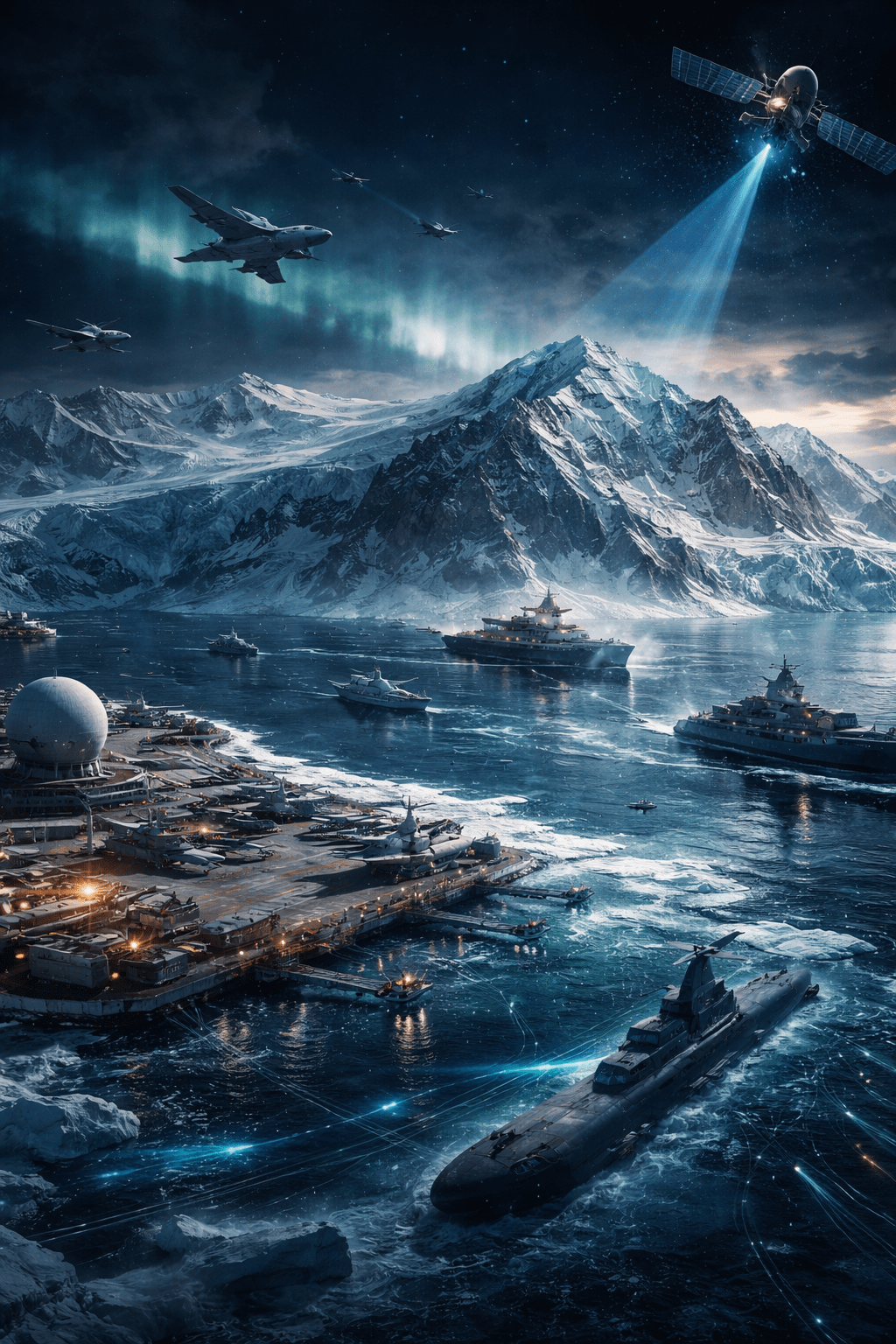
How U.S. Homeland Defense, Arctic Chokepoints, and Critical Minerals Are Converging into a New Territorial Imperial Project
By Prince Kapone | Weaponized Information | January 11, 2026
Greenland Was Never a Joke — It Was a Map of Empire Speaking Out Loud
When Trump first floated the idea of the United States “acquiring” Greenland, plenty of people laughed the way they laugh when a landlord says the quiet part loud. They treated it like a late-night punchline: a billionaire brain in a reality-TV suit confusing geopolitics for a real-estate listing. But empire loves the cover of comedy. A joke is a useful disguise for a threat, because it lets the powerful test the room. If the room applauds, it becomes “serious.” If the room recoils, it becomes “just kidding.” Either way, the message gets delivered: we are entitled to what we want.
The reason Greenland should never have been dismissed is simple: nothing about the island is abstract. Greenland is not a “symbol.” It is material geography—ice, air corridors, seabed routes, minerals under rock, and a location that turns distance into advantage. It sits at the hinge between the Arctic and the North Atlantic, where the world-system’s hard arteries run: the lanes that submarines use, the corridors missiles travel through, and the routes future shipping will fight over as the climate catastrophe melts open what used to be locked shut. This is why the language of “security” always shows up early and stays late. Not because security is sacred, but because “security” is the priest’s robe empire wears when it wants the congregation to accept theft as a public service.
Here is the first clarification we need, before we drown in headlines: the United States does not speak about Greenland because it lacks access. It speaks about Greenland because it wants control. There is a difference between being allowed to enter the house and owning the deed. The former is negotiated, conditional, and constrained. The latter is unilateral. Ownership is what converts a relationship into a hierarchy. And hierarchy is what empire is built to produce.
So when Trump says “we need to own it,” the statement functions less like a policy memo and more like a confession: the system is shifting from a phase where influence could be achieved through agreements, markets, and managed globalization, into a phase where influence must be hardened into territory, chokepoints, and exclusive zones. The old model was a world dressed up as a marketplace. The new model is a world reorganized as a fortress. This is what the American Pole project is really about: locking down the near abroad, securing the approaches, and converting the hemisphere-plus-Arctic perimeter into strategic depth for a U.S. ruling class that senses the ground moving under its feet.
In Weaponized Information terms, what we are watching is not a personality story. It is an imperial system under pressure, searching for durable leverage. Greenland appears in this search because it sits at the intersection of two converging wars: a military competition over early warning, missile defense, and Arctic reach; and an industrial competition over critical minerals, processing capacity, and supply-chain sovereignty. Put plainly: Greenland is where bases and supply chains start to look like the same thing. A radar station is a chokepoint in information. A processing plant is a chokepoint in production. Empire survives by holding chokepoints—over routes, over materials, over communication, over currency, over law. The objects change; the logic stays.
This essay is an attempt to stop treating Greenland like a curiosity and start treating it like a case file. We are going to put everything on the table: the military infrastructure that already makes Greenland part of the U.S. homeland-defense architecture; the legal regime that grants Washington deep rights without sovereignty; the Arctic-North Atlantic geometry that makes Greenland a gate, not a peripheral island; the minerals and industrial-policy pipeline that turns “resources” into U.S.-aligned circuits; and the political escalation that reveals the real aim—transforming access into entitlement, partnership into possession.
If you want a single sentence to hold onto as we move forward, make it this: Greenland is not being targeted because it is empty. It is being targeted because it is strategic infrastructure. And in the age of Fortress America, infrastructure is where imperial power hides in plain sight—steel and concrete, ports and runways, contracts and processing plants, treaties and threats—until someone calls it what it is: empire, trying to become permanent.
Greenland as a Wall of Sensors — How the Arctic Became the Northern Face of Fortress America
Before we talk about minerals, before we talk about shipping lanes, before we talk about diplomacy and sovereignty, we have to start with the cold steel reality that already exists on Greenlandic soil. Because the United States does not approach Greenland as an abstract island floating in a romantic Arctic fog. It approaches Greenland as a piece of its homeland defense machine. Not metaphorically. Literally.
Up on the northwest coast of the island sits Pituffik Space Base, the northernmost U.S. military installation on Earth. It used to be called Thule Air Base, a name that still carries Cold War weight. Today it is run by the U.S. Space Force, and its mission is not symbolic. It is operational. Pituffik hosts the Upgraded Early Warning Radar, a massive phased-array system designed to detect ballistic missile launches and feed real-time warning into the NORAD command structure. In plain language: this is one of the eyes that watches the sky for the first flash of nuclear war.
This radar is not sitting there as a relic of a bygone age. It is wired into a modernization program driven by a new generation of weapons—hypersonic glide vehicles, maneuverable warheads, polar-route missiles—designed specifically to exploit the curvature of the Earth and the thinning of Arctic defenses. The Arctic is no longer a frozen moat. It is the shortest flight path between nuclear powers. That makes Greenland the forward wall of the American fortress.
And Pituffik is not just a radar. It is a space node. Because of its extreme northern latitude, U.S. Space Force units stationed there can communicate with polar-orbiting satellites ten to twelve times per day. That makes it a critical relay point for missile warning, satellite tracking, and space domain awareness. In the twenty-first century, empire does not just control land and sea. It controls orbital corridors. Greenland is one of the places where the sky is wired into the command center.
None of this would matter if the base were a lonely outpost cut off from the world. But Pituffik has what every imperial node requires: a year-round airfield and the world’s northernmost deep-water port. In other words, it can be supplied, reinforced, expanded, and upgraded. Radar arrays can be modernized. Runways can host heavier aircraft. Fuel and matériel can move in bulk. This is not a listening post. It is a platform.
When the Pentagon talks about the Arctic as the “northern approaches” to the United States, this is what it means. Greenland is not outside the homeland defense perimeter. It is part of it. In U.S. military doctrine, the island sits on the front line of early warning, missile defense, and aerospace control. It is treated as the northern face of North America’s shield.
This is why the ownership rhetoric is so revealing. Washington already has access. It already has a base. It already runs radar, satellites, and logistics. What it does not have is unilateral authority. Every upgrade, every expansion, every new capability still runs through treaties, consultations, and political negotiation with Denmark and Greenland’s self-government. Access is conditional. Control is not.
In imperial history, this is a familiar tension. Empires are never satisfied with leases. They are not content with permissions. They want deeds. A treaty is a vulnerability. A base agreement can be renegotiated. A sovereign territory, once absorbed, is treated as eternal. That is why empire always gravitates toward maps and borders. You can cancel a contract. You cannot easily cancel a border.
So when Trump says “we need to own Greenland for security,” what he is really saying is that the current architecture of negotiated access is no longer enough for an empire that feels its margins shrinking. The Arctic is heating up. The missile game is accelerating. The sky is filling with sensors and weapons. And the United States is reorganizing itself around a simple premise: the homeland must be surrounded by a ring of controlled space, from the Caribbean Sea to the Arctic ice, from Panama to Greenland, from the Gulf of Mexico to the GIUK Gap.
Greenland is not a curiosity in this design. It is a cornerstone. It is the northern wall of Fortress America, already wired into the nervous system of the empire. And once you see that wall for what it is, the laughter stops. Because you realize that the joke was never about buying an island. It was about revealing how empire now plans to survive.
The Law of Access and the Hunger for Ownership — How Treaties Became the Last Obstacle to Empire
Empire always pretends it is restrained by law, until law becomes the thing in its way. Then the tone changes. Then “security” enters the conversation. Then the rules are described as outdated, naïve, or dangerous. This is where Greenland now stands: at the fault line between treaty-based access and territorial ambition.
The United States already operates in Greenland under a dense legal architecture built over seven decades. The foundation is the 1951 Defense of Greenland Agreement between Washington and Copenhagen, signed at the height of the Cold War. That treaty authorizes the United States to establish defense areas, construct facilities, and conduct military operations necessary for the defense of Greenland and the NATO region. This is not symbolic language. This is the legal backbone of the American military presence on the island. Pituffik Space Base exists because of this agreement. The radar exists because of this agreement. The runways, the port, the sensors, the satellite nodes—all of it rests on this legal scaffolding.
But the 1951 agreement did something else as well. It drew a line. It granted access without transferring sovereignty. It created a regime of permission, not possession. Greenland remained Greenland. Denmark remained the sovereign authority. The United States became a tenant with extraordinary rights, but still a tenant.
That line was refined in 2004 with the Igaliku Agreement, which updated the legal framework to include Greenland’s Home Rule government directly in the governance of the U.S. presence. The base and the radar were no longer just a bilateral matter between Washington and Copenhagen. They became a trilateral arrangement. Greenland was recognized as a political actor with a seat at the table. This mattered not only symbolically, but structurally. It meant that every major upgrade, every significant change, every new capability would move through a political process that acknowledged Greenland as more than a piece of territory to be managed.
Then came the 2009 Self-Government Act. With that law, Greenland was recognized as a people under international law, with the right to self-determination and a legal pathway to independence. In other words, Greenland was no longer merely an autonomous territory. It was a nation in formation. Its land was not a colonial possession. It was the homeland of a people with recognized political rights.
This is the legal reality Trump’s ownership rhetoric crashes into. There is no mechanism for a “purchase.” There is no colonial loophole. There is no nineteenth-century doctrine of discovery waiting in a dusty drawer. Any attempt to seize Greenland would collide with Danish sovereignty, Greenlandic self-determination, NATO’s alliance framework, and the post-1945 international norm against territorial conquest. That is why Danish leaders describe a forced takeover as an existential crisis for NATO. Not because Greenland is small, but because the precedent would be enormous.
Yet from the perspective of an empire in transition, these legal constraints look less like principles and more like inconveniences. Treaties bind. Consultation slows. Self-government complicates command. The very mechanisms designed to prevent colonial domination now appear, in imperial eyes, as vulnerabilities. A radar upgrade that requires negotiation is a delay. A base expansion that requires consent is a risk. A strategic island that belongs to another people is a problem.
This is why the language shifts from partnership to necessity. From cooperation to entitlement. From access to ownership. The logic is brutally simple: what you do not own, you cannot fully control. And what you cannot fully control, you cannot rely on in a crisis. Empire is allergic to uncertainty. It seeks permanence. It seeks borders that cannot be voted away. It seeks land that answers to no parliament but its own.
So the legal architecture of Greenland now stands as the last barrier between an already entrenched U.S. military presence and a fully territorialized imperial claim. The base exists. The radar spins. The satellites talk. The port receives ships. The runway lands planes. All the material pieces are in place. What remains is the political transformation of a treaty zone into a possession.
This is why Greenland matters. Not because the United States lacks power there, but because it has not yet converted power into sovereignty. The island is a reminder that even the most heavily armed empire in history is still, in places, operating by permission. And for an empire building Fortress America, permission is no longer enough.
The Arctic Gate and the Atlantic Wall — How Greenland Sits at the Hinge of the World-System
Geography is the most stubborn of all political facts. You can change governments, rewrite constitutions, tear down walls, and redraw treaties, but the map keeps whispering the same truth to every empire that tries to rule the world: power flows through space. Control the gates and you shape the traffic. Lose the gates and you become the traffic.
Greenland is one of those gates. Not because it is large, and not because it is rich, but because of where it sits. It stands at the hinge between the Arctic and the North Atlantic, between the polar routes of the future and the industrial arteries of the present. It is the place where the frozen north opens into the warm ocean lanes that feed Europe and North America. In the language of strategists, it is not an island. It is a corridor.
To understand this, you have to look at the old Cold War geometry that never really went away: the Greenland–Iceland–United Kingdom gap, the GIUK line. This is the maritime and aerospace barrier that separates the Arctic and Norwegian seas from the open Atlantic. For decades it was the line along which NATO tracked Soviet submarines slipping out of the north and into the ocean where transatlantic trade and military reinforcement travel. It was the place where undersea cables, shipping lanes, and naval patrols all converged into a narrow band of strategic vulnerability.
Today that geometry is back on the table, but under new conditions. The Arctic is warming. Ice is retreating. Routes that were once seasonal dreams are becoming operational realities. The Northwest Passage, running through the Canadian archipelago, and the emerging transpolar routes across the central Arctic are no longer science fiction. They are being mapped, modeled, and tested. And every one of those routes eventually pours into the Atlantic through the same northern gateways.
Greenland stands at the Atlantic mouth of that system. To its west lie the Davis Strait and Baffin Bay, the entrance corridor into the Northwest Passage network. To its east lie the Greenland and Norwegian seas, the approach lanes into the GIUK gap. To its north lies the high Arctic and the future transpolar highway. If the Arctic becomes a navigable ocean for part of the year, Greenland becomes one of the world’s great maritime sentinels.
This is why the Arctic is now described as a highway system rather than a wilderness. Empires do not look at oceans and see water. They see lanes. They see transit times. They see chokepoints where a handful of ships, aircraft, or sensors can monitor, deny, or tax the movement of entire regions. The Suez Canal, the Panama Canal, the Strait of Hormuz, the Bab el-Mandeb, the Malacca Strait — these are not just places on a map. They are the pressure points of the world economy.
The Arctic is becoming the next system of pressure points. And Greenland is one of the pressure plates.
Add to this the undersea world that most people never think about. The seabed is now threaded with fiber-optic cables carrying the nervous system of the global economy. It carries energy pipelines and data arteries. It carries the communications of finance, war, diplomacy, and trade. The North Atlantic seabed, especially around the GIUK corridor, is one of the most sensitive infrastructure zones on Earth. Whoever dominates this region does not just watch ships. They watch the bloodstream of the digital age.
This is why Greenland is being reframed as a security imperative. It is not just an Arctic outpost. It is a vantage point over the Atlantic gate of the Arctic world. It is a platform from which to watch, track, and, if necessary, deny movement between the polar north and the industrial heartlands of the West.
When you place this geography next to the military infrastructure already embedded on the island, the picture sharpens. Radar on Greenland does not just watch the sky. It watches the polar routes missiles would take. Satellites tracked from Greenland do not just orbit in silence. They map the flows of ships, ice, and signals. Airfields on Greenland do not just land planes. They extend the reach of patrols and response across an entire oceanic frontier.
From the standpoint of Fortress America, Greenland is not a remote possession. It is the northern wall of a continental defense system that now stretches from the Caribbean to the Arctic Circle. It is the Atlantic gate of the polar future. It is the hinge between two oceans and two eras of global trade.
This is the geography that Trump’s rhetoric stumbles into without naming. He speaks in the language of ownership because that is the only language empire knows when it looks at a gate. You do not negotiate with a door. You claim it. You fortify it. You station guards. You decide who passes and who waits.
Greenland is that door.
From Ice to Industry — How Greenland Became a Supply-Chain Battlefield
Empires do not run on speeches. They run on inputs. Steel, copper, lithium, graphite, rare earths, semiconductors, fuel, data. The vocabulary changes with technology, but the principle does not: whoever controls the materials of production controls the future. In the age of electric vehicles, renewable grids, precision weapons, satellites, and artificial intelligence, the most precious terrain is no longer only oil fields and shipping lanes. It is the mineral basins and processing plants that feed the industrial bloodstream of the system.
This is where Greenland re-enters the picture, no longer only as a military outpost and geographic gate, but as a resource frontier being wired into the industrial war now raging between the United States, China, and the European Union. Beneath Greenland’s rock sit rare earth elements, graphite, base metals, and other critical minerals that modern economies treat not as commodities, but as strategic infrastructure. These materials are the bones of wind turbines, the muscles of electric motors, the nerves of guidance systems, and the spine of digital power.
In official language, this is called “supply-chain resilience.” In practice, it is a race to build industrial sovereignty before rivals can lock in dominance. China spent three decades constructing control over rare earth processing and magnet manufacturing. Now Washington and Brussels are scrambling to build alternative circuits before their green transitions and military modernization programs hit a materials wall. Greenland has suddenly found itself drafted into this war.
On one track, the European Union has moved to designate Greenlandic mining projects as “strategic” under its Critical Raw Materials Act. Graphite projects in southern Greenland have received long-term exploitation licenses and backing from the European Raw Materials Alliance, folding Greenland into a continent-wide plan to reduce dependence on Chinese suppliers. Through a formal EU–Greenland partnership, Brussels has positioned the island as a pillar of Europe’s future industrial autonomy.
On another track, the United States has gone further. Washington is not merely encouraging investment. It is building a vertically integrated pipeline designed to pull Greenlandic rare earths directly into a U.S.-controlled industrial circuit. The U.S. Export–Import Bank has weighed financing for the Tanbreez rare earth project. American firms have signed decade-long offtake agreements, pre-claiming future output before the mine is even fully operational. And the processing chokepoint is being built on U.S. soil, in Louisiana, at a facility funded by the U.S. Department of Defense itself. This is not market behavior. It is industrial policy wearing a business suit.
In this architecture, Greenland is upstream. The ore comes out of Greenlandic rock. But the value, the leverage, and the strategic control flow south into American processing plants and American contracts. Ore is mobile. Processing is power. Whoever owns the separator owns the chain. And in this system, Washington is constructing itself as the switch that turns Greenland’s minerals into American industrial capacity.
The logic mirrors the logic of basing. A forward military installation secures the perimeter. A domestic processing hub secures the supply line. One controls territory. The other controls production. Together they form a single structure of dependency. Greenland supplies. The empire decides.
This is why the minerals story cannot be separated from the security story. The same doctrine that treats Greenland as part of the U.S. homeland defense perimeter now treats its subsoil as part of the industrial base of Fortress America. The island is being rewritten as a component of national security, not only because of where it sits, but because of what it contains.
For Greenland, this is a dangerous position. Resource frontiers attract capital, pressure, and interference. They invite external powers to frame development as destiny and extraction as partnership. They turn domestic politics into international contests. The mine becomes a treaty issue. The processing plant becomes a security issue. The license becomes a bargaining chip in a great-power game.
In the language of empire, Greenland is being converted from a homeland into a node. From a society into a supply chain. From a people into a production input.
And once a place is defined as infrastructure, the moral math changes. Infrastructure is something you secure. Something you fortify. Something you claim in the name of necessity. The rock becomes a reason. The ore becomes an excuse. The island becomes a line item in a strategic plan. This is how ice becomes industry. And how industry becomes empire.
When Bases Become Supply Chains — The Fusion of Security and Industry
If you want the real shape of this Greenland question, you have to stop treating “military strategy” and “industrial policy” as two separate conversations. That separation is a liberal fairy tale—useful for polite think tanks, useless for understanding empire. In reality, the twenty-first century imperial project fuses security and production into a single machine. The base and the mine are no longer different categories. They are different organs of the same body.
Look at what is happening on Greenland and the pattern becomes obvious. On the surface, Pituffik looks like a military installation: radar, satellites, runways, ports, logistics. And Tanbreez and the graphite projects look like “development”: licenses, offtake agreements, financing, processing plants. But step back and the symmetry appears. The base is a chokepoint in warning and command. The processing plant is a chokepoint in production and value. The radar organizes the battlespace. The separator organizes the supply chain. One polices the sky; the other polices the material foundation of the so-called green transition and the weapons economy that rides on top of it.
This is why the language of “national security” now wraps itself around everything—ports, contracts, batteries, magnets, cables, rare earths. National security has become the master key that opens every door: the door to public financing, the door to state-backed industrial planning, the door to investment screening, the door to surveillance and political pressure. In earlier eras, the empire’s holy oil was petroleum. In this era, it is the mineral inputs that make electrified militarism possible. And as soon as those inputs are treated as security assets, the political consequences are immediate: extraction becomes strategic, processing becomes sovereign, and foreign territory becomes a “critical node” that must be secured.
The result is a new form of dependency that hides behind the language of partnership. Greenland can be told it is benefiting from “investment,” but the decisive power sits where the chain tightens: where the financing originates, where the offtake contracts are signed, where the processing capacity is built, where the final manufacturing occurs, and where the military doctrine defines the perimeter of acceptable politics. This is how empire modernizes itself. It does not always need to seize a place outright. It can convert that place into an upstream appendage of a downstream industrial fortress. It can make a territory formally autonomous while functionally subordinate.
This is also why the Arctic story and the minerals story are accelerating together. The opening of Arctic routes increases the value of surveillance, logistics, and forward basing. The industrial war over critical minerals increases the value of controlling upstream supply and locking in downstream processing. Greenland sits at the intersection: a platform for sensors and a warehouse of inputs, a gate for maritime movement and a frontier for extraction, a point where the empire can defend its perimeter and feed its factories through the same strategic logic.
Once you see this fusion, Trump’s ownership rhetoric stops looking like a bizarre detour and starts looking like the crude political expression of a deeper transformation already underway. Access is not enough when you are building a fortress. Access can be renegotiated. Access can be withdrawn. Access can be restricted by a parliament, by a referendum, by a new government, by a people who decide they are done being treated as a node in someone else’s machine. Ownership, by contrast, is the empire’s fantasy of permanence. It is the desire to turn a strategic partnership into a property relation.
And that is the real meaning of Greenland in this moment: not merely a base, not merely a mine, not merely a route, but a laboratory where the empire is attempting to weld military control, industrial capture, and political authority into one seamless architecture. The sensor wall and the supply chain are becoming one and the same. Greenland is where the weld is visible.
From Access to Entitlement — How Greenland Became an Open Imperial Confrontation
Empires rarely announce themselves with a declaration of conquest. They arrive wrapped in necessity. They speak the language of emergency. They claim to be acting not out of ambition, but out of obligation. This is the script now being read over Greenland.
The escalation did not begin in 2026. It began years earlier, when Trump first floated the idea of “buying” Greenland in 2019. That moment was treated as farce by the commentariat, but it was the opening shot in a long repositioning. Within a year, the United States reopened its consulate in Nuuk for the first time since the Cold War, expanded diplomatic presence, and deepened its political footprint on the island. The empire had returned to the Arctic table. What changed in 2026, almost simultaneously with the US attack on Venezuela and the kidnapping of its President, was not interest. It was tone.
In January, Trump abandoned the language of deals and entered the language of compulsion. He declared that the United States “needs to own Greenland” for national security. The White House followed with statements about “options on the table,” refusing to rule out military measures. This was not negotiation. This was strategic signaling. Ownership was framed as a security requirement, and security was framed as an exception to every other rule. This is the moment when a relationship of access turns into a claim of entitlement.
Greenland’s response was immediate and unprecedented. All five political parties in Inatsisartut, the Greenlandic parliament, issued a joint declaration rejecting U.S. pressure and reaffirming self-determination. “We do not want to be Americans,” they said. “We want to be Greenlanders.” In a political landscape that is often divided along questions of development, independence, and relations with Denmark, this was a rare moment of absolute unity. It was a people closing ranks against external coercion.
Denmark drew its own line. Prime Minister Mette Frederiksen warned that a forced U.S. takeover of Greenland would constitute an existential crisis for NATO itself. The meaning was unmistakable. A U.S. seizure of allied territory would shatter the alliance order and rewrite the postwar security architecture of Europe. This was no longer a bilateral disagreement. It was a confrontation with the entire Atlantic system.
European leaders followed with statements affirming that Greenland belongs to its people and that its future can only be decided democratically. In diplomatic language, this was a collective attempt to lock the dispute inside the norms of sovereignty and self-determination before Washington could elevate it into a security exception.
What makes this escalation so dangerous is not only the rhetoric, but the structural vulnerability it exploits. Greenland has a legal pathway to independence under its Self-Government Act. It is a nation in formation, still negotiating its economic base, its future relations with Denmark, and its place in the world. Empires have always targeted such moments of transition. Constitutional openings are leverage points. Referendums become pressure valves. Development projects become political wedges.
The island now sits at the intersection of three converging forces: U.S. homeland defense doctrine, Western industrial policy, and Greenland’s own unresolved national question. This is the classic terrain of imperial intervention. Security justifies presence. Investment creates dependence. Diplomacy reshapes alignment. And when all else fails, force waits in the wings as the final argument.
What we are witnessing is not a misunderstanding between partners. It is a collision between two political principles. On one side stands the right of a people to determine their own future. On the other stands an empire that believes geography itself is a claim.
The United States already has radar on Greenland. It already has bases. It already has treaties. It already has contracts. The new demand is for permanence. For borders that cannot be renegotiated. For land that answers to Washington alone. This is the return of territorial empire, dressed in the uniform of national security.
The Ladder of Conquest — How Empire Advances Without Declaring War
Empire no longer marches with drums and flags. It advances through paperwork, contracts, security doctrines, and emergency language. It moves one rung at a time, careful never to call its motion what it is. By the time the public realizes what has happened, the ground has already shifted beneath their feet. Greenland is now standing on the lower rungs of this ladder.
The first rung is always rhetoric. A powerful state declares that a place is vital to its security. The language is vague, but the message is clear: this territory is no longer just another country’s land. It is now part of our strategic imagination. This is where Trump’s “we need to own Greenland” line belongs. It is not policy. It is a claim of psychological ownership, broadcast to allies and rivals alike.
The second rung is normalization. Officials repeat the language. Think tanks publish papers. Military doctrines incorporate the geography. What was once unthinkable becomes debatable. What was once outrageous becomes “a serious conversation.” This is how annexation talk is laundered into security discourse.
The third rung is options talk. The White House says “all options are on the table.” Reporters are told that nothing is being ruled out. Force is not promised, but it is deliberately left in the room. This is the moment when diplomacy is placed under the shadow of violence.
The fourth rung is bilateral bypass. Empire begins speaking directly to local elites, exploring deals that sidestep existing sovereign frameworks. Denmark becomes an inconvenience. Treaties become technicalities. The target is not only land, but alignment. The goal is to peel the territory away politically before it is seized physically.
The fifth rung is economic leverage. Investment is offered. Infrastructure is financed. Jobs are promised. Supply chains are built. Dependency is cultivated. What cannot yet be taken by force is secured through capital. The mine becomes a lever. The port becomes a bargaining chip. The processing plant becomes a lock.
The sixth rung is treaty reinterpretation. Agreements that once governed access are recast as inadequate. New “security realities” are invoked. Old constraints are declared obsolete. What was once cooperation is reframed as exposure. What was once partnership is described as weakness.
The seventh rung is the ultimatum. At this stage, empire presents its demands as unavoidable. It insists that refusal endangers everyone. Resistance is painted as irresponsibility. The target is told that history has already decided.
The eighth rung is coercion. Military exercises become demonstrations. Bases become forward staging points. Patrols become pressure. The choice offered is no longer negotiation or compromise, but submission or confrontation.
This is not a theory. It is the well-worn choreography of imperial expansion, updated for a world where conquest must be disguised as management and occupation must be sold as protection. Greenland has not yet climbed this entire ladder. But it has already stepped onto it.
The danger of this moment is not that war is imminent. The danger is that the machinery of escalation is already turning. Every contract signed, every base expanded, every security doctrine revised tightens the grip of inevitability. Empire does not need to announce its destination. It only needs to keep moving.
And once movement becomes momentum, stopping it requires more than protest. It requires power. This is the quiet violence of the modern empire: a conquest that arrives clause by clause, radar by radar, port by port, until the map has changed and the people who live on it are told that history has spoken.
The Prototype of a New Empire — What Greenland Reveals About the American Pole
Greenland is not an exception. It is a prototype. It is the model through which the United States is rehearsing a new form of empire for a world where globalization no longer delivers obedience on demand, where rivals can no longer be disciplined through markets alone, and where the old rules of informal dominance are breaking down under the weight of multipolar reality.
For three decades, U.S. power rested on a simple formula: control the financial system, dominate global trade rules, enforce military supremacy at sea and in the air, and let capital flow outward while value flowed back. Empire wore the mask of globalization. Borders softened. Markets expanded. Supply chains stretched across continents. The world was told it was entering an era of interdependence.
That era is over.
The rise of China, the reassertion of Russian military power, the weaponization of sanctions, the breakdown of WTO discipline, the collapse of energy security in Europe, and the growing refusal of the Global South to subordinate itself to Western dictates have shattered the illusion of a smoothly managed world system. The imperial core is discovering that openness cuts both ways. A supply chain can be rerouted. A currency can be bypassed. A market can be replaced. A port can be denied.
In this new terrain, empire is being rebuilt around a different logic: territorial depth, industrial sovereignty, chokepoint control, and hardened perimeters. The world is no longer treated as a marketplace to be governed. It is treated as a battlefield to be structured. Greenland shows us how this restructuring works in practice.
First comes the security enclosure. The island is folded into homeland defense doctrine. Its airspace becomes part of the missile-warning architecture. Its coastline becomes part of the maritime barrier. Its skies become part of the orbital control network. Greenland is rewritten as a wall, not a country.
Then comes the industrial capture. Its subsoil is mapped as strategic inventory. Its mines are wired into U.S. and EU industrial policy. Its future production is pre-claimed through offtake agreements. Its processing is relocated into Western domestic circuits. Greenland is rewritten as a supply node, not a society.
Then comes the political pressure. Treaties are reinterpreted. Sovereignty is described as a vulnerability. Self-determination is treated as a complication. Ownership is reframed as necessity. Greenland is rewritten as a problem to be solved, not a people to be respected.
This is the American Pole in motion: a project to lock down the hemisphere-plus-Arctic as a strategic redoubt for a declining empire. From Panama to the Caribbean Sea, from the Gulf of Mexico to the Arctic Circle, from the Atlantic seabed to the polar sky, the United States is constructing a fortified zone of control designed to insulate its ruling class from a world it no longer commands.
In this architecture, Greenland is not peripheral. It is foundational. It is the northern keystone of a continental fortress. It is the Atlantic gate of a polar frontier. It is the mineral spine of a reindustrializing war economy. It is the legal stress test of a system deciding whether treaties still matter.
What happens in Greenland will not stay in Greenland. The same logic is already visible in the Panama Canal, in the Red Sea, in the South China Sea, in the scramble for lithium corridors, in the militarization of space, and in the weaponization of trade routes. Everywhere the map is being rewritten around security zones and industrial basins.
This is not the end of globalization. It is its mutation into something harsher and more territorial. Capital still moves. But now it moves under guard. Trade still flows. But now it flows through controlled gates. Markets still exist. But now they are nested inside security perimeters.
Greenland is the warning shot. It is the place where empire has begun to say openly what it intends to do everywhere else: build walls around value, turn geography into policy, and convert the world into a series of defended industrial zones.
This is not the empire of the twentieth century. It is something colder, more technical, and more permanent. An empire of sensors and contracts, of ports and processing plants, of treaties rewritten as ultimatums. And if Greenland becomes a possession, it will not be the last.
Empire Without Illusions — Greenland and the Return of the Border
The age of polite empire is over.
For a generation, U.S. power wrapped itself in the language of globalization. It spoke of open markets, free trade, integration, partnership, and rules. It told the world that empire had dissolved into management, that domination had been replaced by governance, that conquest had been sublimated into investment. Borders were said to be fading. History was said to be over. Greenland tells a different story.
What is unfolding around the island is not a misunderstanding or a diplomatic spat. It is the return of the border as a weapon. It is the reappearance of territory as a strategic object. It is the revival of the old imperial truth that power ultimately rests on who controls land, routes, resources, and skies.
The United States already sits on Greenland through treaties, bases, radar arrays, satellites, ports, and contracts. It already draws value from Greenland’s geography and its subsoil. It already treats the island as part of its homeland defense perimeter and its industrial supply chain. What remains is the formal conversion of presence into possession.
That conversion is what Trump’s rhetoric announces. Stripped of spectacle, it is a declaration that the era of influence is giving way to the era of enclosure. That access is no longer enough. That partnership is no longer sufficient. That security now requires ownership.
This is the logic of Fortress America in its pure form: build a defended perimeter around the imperial core; secure the approaches; dominate the gates; control the inputs; militarize the routes; and harden the border between inside and outside. From the Caribbean to the Arctic, from Panama to Greenland, from the Gulf of Mexico to the GIUK gap, the map is being reorganized into zones of command.
Greenland stands at the northern edge of this project. It is where the American empire has begun to speak openly again in the language of territory. Not because Greenland is uniquely important, but because it is strategically perfect: sparsely populated, militarized, resource-rich, geopolitically central, and already wired into U.S. power. The island is the rehearsal stage.
If empire can normalize annexation talk in Greenland, it can normalize it anywhere. If it can redefine self-determination as a security threat here, it can do so wherever resources, routes, and rivals converge. If it can turn treaties into inconveniences here, it can do so wherever access stands in the way of control. This is why Greenland matters beyond Greenland.
It is the place where the empire is testing whether the postwar order still binds its hands, or whether the age of managed dominance has given way to a new age of fortified rule. It is where the mask of globalization is slipping, revealing the old face beneath: empire, once again willing to draw lines on the map and call them destiny.
The struggle over Greenland is therefore not only a struggle over an island. It is a struggle over what kind of world is being built out of the ruins of the last one. A world of shared sovereignty and negotiated coexistence, or a world of walls, zones, and imperial frontiers.
The United States has made its choice clear. It is building a pole. It is raising a fortress. It is reclaiming the border as an instrument of power.
Greenland is where that future first comes into view.
 Weaponized Information
Leave a comment