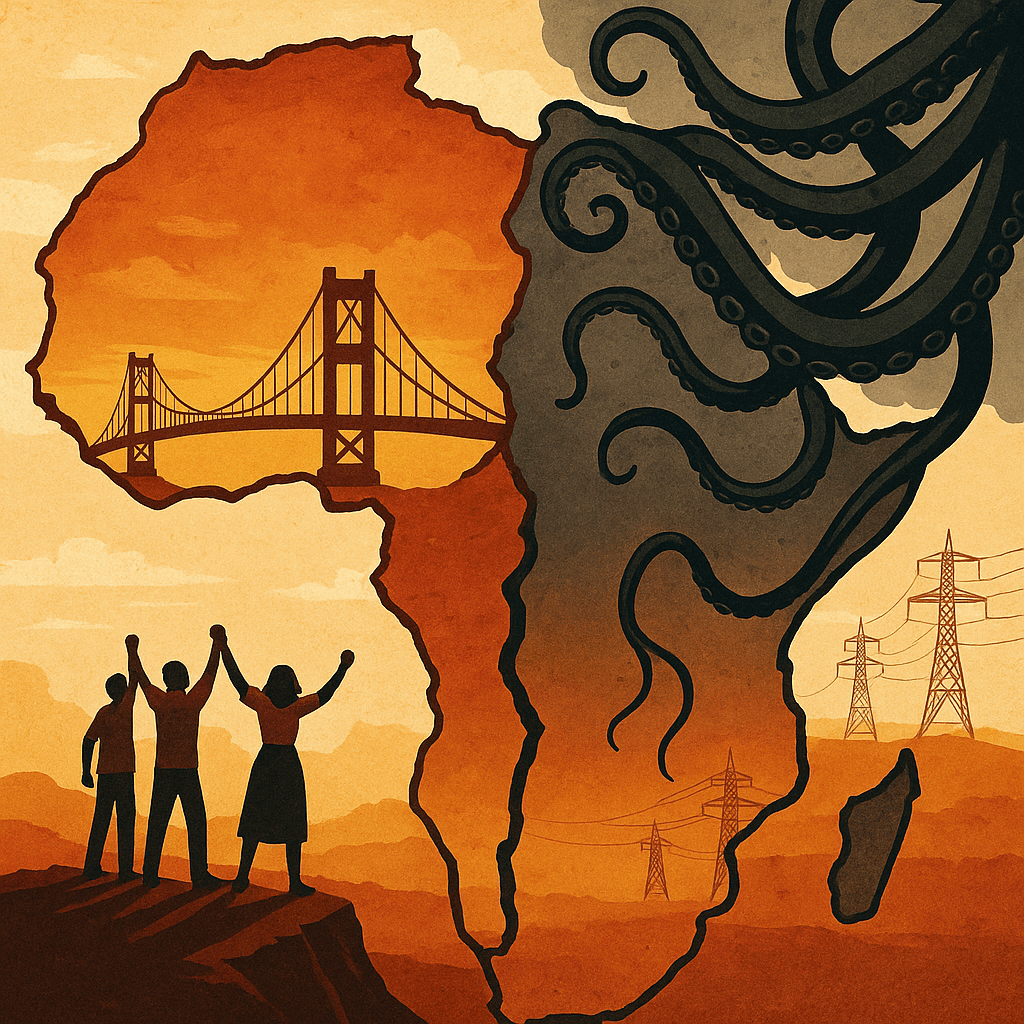
As imperial technocrats celebrate elite-led intra-African trade under AfCFTA, a deeper integration is rising from below—
led by the workers and peasants of the Sahel. This is not just a trade debate. It’s a class war for the soul of the continent— and a call to build concrete bridges of solidarity with the multipolar world.
By Prince Kapone | Weaponized Information | June 27, 2025
Trade Without Transformation: The Technocrats Celebrate, But the Masses Stay Locked Out
The June 26th Business Insider Africa article by Adekunle Agbetiloye is a masterclass in bourgeois celebration—polished, professional, and utterly detached from the lives of Africa’s working classes and peasantry. Titled as a cheerful listing of “Top 10 African countries leading in intra-African trade,” the piece gushes over a 12.4% increase in intra-African trade in 2024. South Africa, Nigeria, Morocco—names of regional giants parade across the page like victorious flags on a battlefield. But what’s missing isn’t just nuance—it’s class.
This is integration from above, for the few, against the many. The journalist, Agbetiloye, is no villain—he’s a market analyst in the uniform of journalism, trained to track GDP blips and investor mood swings. His job, like so many others in the media appendage of capital, is not to question who owns the trade corridors, who extracts the profits, or why, decade after decade, so many Africans remain poor in a continent so rich. His prose is clean, his figures accurate—but his analysis serves the technocrats, not the toilers. There’s no trace of the workers in Congolese copper pits or Ghanaian ports, no glimpse of the landless peasants displaced to make way for export-oriented logistics infrastructure. Their labor built this system. Their silence haunts it.
Business Insider Africa is itself a shell within a shell—ostensibly an African media outfit, but in reality a branded extension of Insider Inc., which is owned by German capitalist juggernaut Axel Springer SE. That’s right—an African integration story delivered by a Swiss-financed franchise of a U.S.-based media property owned by a German conglomerate. Call it informational outsourcing under neocolonial globalization. The article may wear African colors, but it plays a foreign tune. Its ideological mission is to normalize AfCFTA’s elite vision: that opening borders for capital is enough to constitute Pan-Africanism, that foreign direct investment is the same as sovereignty, and that billion-dollar trade volumes tell us something about justice.
This is not hardline imperial propaganda. It is something slipperier: technocratic liberalism disguised as common sense. The article doesn’t lie—it simply frames, selects, and omits with surgical discipline. Every data point—trade volume, top exporters, percent increases—is positioned to evoke linear progress, economic health, and regional uplift. Yet nowhere is there mention of what’s being traded, who controls the infrastructure, or what class controls the surplus. This is what we call cognitive fog: burying contradictions under the weight of optimistic statistics.
Euphemisms are deployed as ideology. “Integration” is the buzzword of the day—but it’s stripped of content. Integration into what? A trade regime dominated by South African capital, Nigerian petro-exports, and elite investor corridors? “Refined goods” sounds impressive until you realize they’re produced in foreign-financed enclaves, often using imported machinery, with little to no sovereign value-chain control. Even the phrase “comeback” masks the real dynamics—it’s a rebound for financiers and commodity brokers, not for hungry families or unemployed youth. Words like “resilience” and “growth” are deployed with zero reference to class composition, popular power, or political economy. That’s not neutrality—it’s ideological laundering.
The greatest trick of this genre of reporting is its use of omission as consensus. There is no room in the article for dissent, no quote from a labor federation, peasant movement, or even a critical economist. The logic is airtight because the counterpoints have been preemptively excluded. It presents AfCFTA as a natural good—a regional inevitability—rather than a contested site of political struggle. This is the hallmark of vacillator propaganda: it doesn’t assault with falsehood, it seduces with half-truths. It performs the function of propaganda by rendering elite-led capitalist integration as the only imaginable path forward, while quietly dismissing or ignoring the revolutionary projects unfolding elsewhere on the continent.
Facts in Isolation, Context in Chains: What the Numbers Don’t Say
The numbers in the article are technically accurate. In 2024, intra-African trade grew by 12.4%, reaching over $220 billion. South Africa led with $42.1 billion—nearly 20% of the total. Nigeria followed at $18.4 billion, with countries like Morocco, Côte d’Ivoire, and Mali rounding out the top 10. The article highlights a regional rebound from the trade contraction of 2023 and casts the African Continental Free Trade Area (AfCFTA) as the driving force. These facts, while not fabricated, are presented as self-explanatory. They are not. They float above the surface of a sea of contradiction.
What the article doesn’t say—what it refuses to say—is that most of this intra-African trade is structurally uneven and remains locked in the logic of neocolonial extraction. It doesn’t ask what’s being traded or under what relations of ownership. The reality is stark: raw materials and unprocessed agricultural goods still make up the bulk of trade for many countries. Industrial exports remain WTOconcentrated in a handful of semi-core economie, especially South Africa, whose inherited manufacturing base—built during apartheid—has been modernized for export-led profit, not regional redistribution. Nigeria’s exports are largely oil-derivatives and petrochemicals, funneled through vertically integrated monopolies tied to transnational finance. Côte d’Ivoire’s so-called “manufactured exports” often refer to marginal refining processes—raw materials passing through foreign-owned processing facilities en route to ports. The form is intra-African; the content is imperialist.
AfCFTA is hailed as the catalyst for this uptick, but the structure of the agreement reflects the a href=”https://www.brettonwoodsproject.org/2019/06/what-are-the-main-criticisms-of-the-world-bank-and-the-imf/?utm_source=chatgpt.com” target=”_blank”>logic of the World Bank, the IMF, and the African Development Bank: reduce barriers to capital flows, harmonize customs regimes, expand logistics corridors—but do so in a way that preserves elite accumulation and investor dominance.
The article mentions Afreximbank but not its class function. This bank is a multilateral institution designed to lubricate capital mobility under a regional framework, offering sovereign debt and credit to states not to build socialism, but to build roadways, rail lines, and data corridors that facilitate export profitability. It funds “integration” projects that shuttle minerals from Mali to Abidjan, oil from Nigeria to Dakar, lithium from Zimbabwe to South Africa. This is not Pan-Africanism—it’s logistical imperialism wrapped in regional branding.
There is no mention of the political economy of debt. No mention that many of these states are still trapped in repayment schemes imposed during the SAP era, now repackaged through PPPs, blended finance, and ESG-marketed development loans. No mention that African infrastructure is being built with foreign capital, under foreign legal frameworks, and often with foreign materials and labor. Integration without sovereignty is consolidation of dependence. The working class and peasantry remain structurally excluded from the benefits of this so-called trade resurgence. The ports grow, the GDP ticks upward, but wages stagnate, land is expropriated, and basic goods remain priced out of reach.
Most importantly, the article ignores the other Africa rising—a very different model of integration now taking root in the heart of the Sahel. There is not a single mention of the Alliance of Sahel States (AES)—Mali, Niger and Burkina Faso—whose coordinated delinking from ECOWAS, the CFA franc, and French imperialism represents the most profound shift in African regionalism since the Bandung era. While AfCFTA accelerates capital mobility under technocratic rule, AES offers something far more dangerous to imperialism: bloc sovereignty. It is building integration not through capital flows and customs harmonization, but through shared grain reserves, military cooperation, currency independence, and the nationalization of vital infrastructure. It is, in essence, pursuing integration through delinking.
That absence is not incidental—it is ideological. To mention the AES would be to admit that African unity is possible without the permission of the IMF, without European mediation, and without elite technocrats at the helm. It would force the reader to confront the fact that two integrationist paths are forming on the continent—one rooted in neocolonialism with regional flavor, and the other in revolutionary sovereignty. The article, in burying that contradiction, becomes more than reportage. It becomes a quiet defense of the status quo.
Two Africas, Two Integrations: Class Against Class on a Continental Scale
There is no neutral ground in history. Either a process moves in the direction of liberation or in the direction of deeper domination. What we are witnessing today in Africa is not one unified integration project—but two competing models of integration, two contradictory historical tendencies, and two irreconcilable class camps locked in struggle. On the one side: the AfCFTA, celebrated by Business Insider Africa and promoted by the African Union’s technocratic wing. On the other: the Alliance of Sahel States (AES), derided by the West but embraced by the masses of Mali, Burkina Faso, and Niger. Both are integrating. Only one is liberating.
The AfCFTA represents the integration of Africa into a multipolar world still dominated by capital. It lowers trade barriers, harmonizes legal codes, and connects infrastructure—not to fulfill the social and economic rights of the African people, but to increase the velocity of capital across borders. This is integration without transformation: a neocolonial circuitry of logistics, extractivism, and export enclaves disguised as development. It is Pan-Africanism in the language of donors. It is unity without socialism. And as the numbers show, it is a unity that works well—for South African manufacturers, Nigerian refiners, Moroccan conglomerates, and foreign investors. It is the logical outcome of a continental vision managed by liberal economists, public-private partnerships, and recycled structural adjustment technocrats.
The AES is something else entirely. It is the refusal to build prosperity on the backs of imperialist pipelines and debt-financed trade corridors. It is the beginning of bloc sovereignty, forged not in seminar rooms but through revolution, military defiance, and grassroots legitimacy. These are countries that have expelled French troops, nationalized their telecommunications and energy sectors, and launched collective infrastructure and food sovereignty programs independent of Washington, Paris, or Brussels. Where AfCFTA paves roads for mining trucks, AES builds grain reserves and commissions joint agricultural projects. Where AfCFTA protects investor rights, AES protects peasant land. Where AfCFTA speaks of “shared prosperity” through GDP growth, AES speaks of the right to live without foreign chains.
These are not abstract differences—they are class contradictions made visible in continental form. AfCFTA is guided by a comprador class: a coalition of elites who inherited the borders and business models of colonialism and now manage them under neoliberal conditions. AES is being constructed—painfully, unevenly, and urgently—by a revolutionary alliance of military-nationalist leadership, popular organizations, and the rural poor. One offers mobile banking, fintech corridors, and a place in the World Economic Forum’s dinner rotation. The other offers fertilizer, rifles, and schools where children are no longer taught to worship the French flag.
This is not to say that the AES is a finished project or a utopia in waiting. It faces sabotage, sanctions, sabotage, and isolation. But it is moving. It is building. It is attempting—against all odds and in real time—to realize what AfCFTA only pretends to: African sovereignty through integration. And it is doing so not by inviting more capital in, but by pushing empire out. That is the line of demarcation we must draw. The future of African unity does not depend on trade volume. It depends on which class controls the integration. On which direction history flows. On whether Africa integrates upward into sovereignty—or downward into dependency dressed in continental robes.
Break the Chain, Build the Bridge: The North Has a Role—But Not the Lead
From where I sit—in the belly of the beast—it is easy to become an observer. To analyze, critique, even empathize, while the imperial machine I was born into continues to grind the world beneath its gears. But the time for observation is over. The AES is not simply a regional development. It is a rupture—a declaration that another Africa is not only possible, but in motion. And for those of us in the imperial core, especially those no longer willing to be silent beneficiaries of global theft, the question is not “Will you support it?” but “What will you do to defend it?”
Mali, Burkina Faso, and Niger are showing us the way—not because they are perfect, but because they are brave. They are not waiting for permission from Washington, Brussels, or the IMF. They are delinking. They are coordinating. They are fighting. And they are doing so under siege: economic sanctions, diplomatic isolation, psychological warfare, and the threat of armed retaliation. This is what empire does to those who step out of line. It disciplines with hunger. It punishes with silence. And it counts on those of us in the North to look the other way.
But what if we didn’t? What if workers in Europe and North America refused to load the weapons, ship the tech, or enforce the sanctions? What if we built popular education campaigns exposing how our consumer goods are subsidized by the extraction of Sahelian gold, lithium, and uranium? What if we joined forces with the international peasantry—landless farmers in Brazil, Indigenous land defenders in Canada, urban gardeners in Detroit—to build a common front for food sovereignty and land back? What if we organized not to reform empire, but to disrupt it—blockade its flows, sabotage its narratives, and break its ideological hold on our own class?
The AES cannot win alone. It is laying the groundwork for bloc sovereignty in Africa—but it needs breathing room, logistical support, and global agitation to survive the imperial backlash. That responsibility falls on us—not to lead, not to dictate, but to flank. To open second fronts in the global North that weaken the enemy at home and embolden the movement abroad. To build dual and contending power—not just where the bombs fall or the minerals lie, but where the empire launders its legitimacy and extracts its surplus: in our own cities, institutions, and economies.
This is not an appeal to charity. It is a call to alignment. The working class in the North, stripped of job security, health care, and dignity, is being disciplined too—more slowly, more softly, but toward the same end: obedience and despair. The peasantry has long since been liquidated or criminalized. What remains is a managed precariat, fed propaganda and Uber jobs while empire rots from within. To stand with the AES is to stand with the majority of humanity. But more than that—it is to reject our assigned role as middle managers of global misery. It is to defect. Not just ideologically, but practically. The AES has lit a match. Our task now is to spread the fire.
 Weaponized Information
Leave a comment