By Prince Kapone, Weaponized Information
Reclaiming the Future from Below
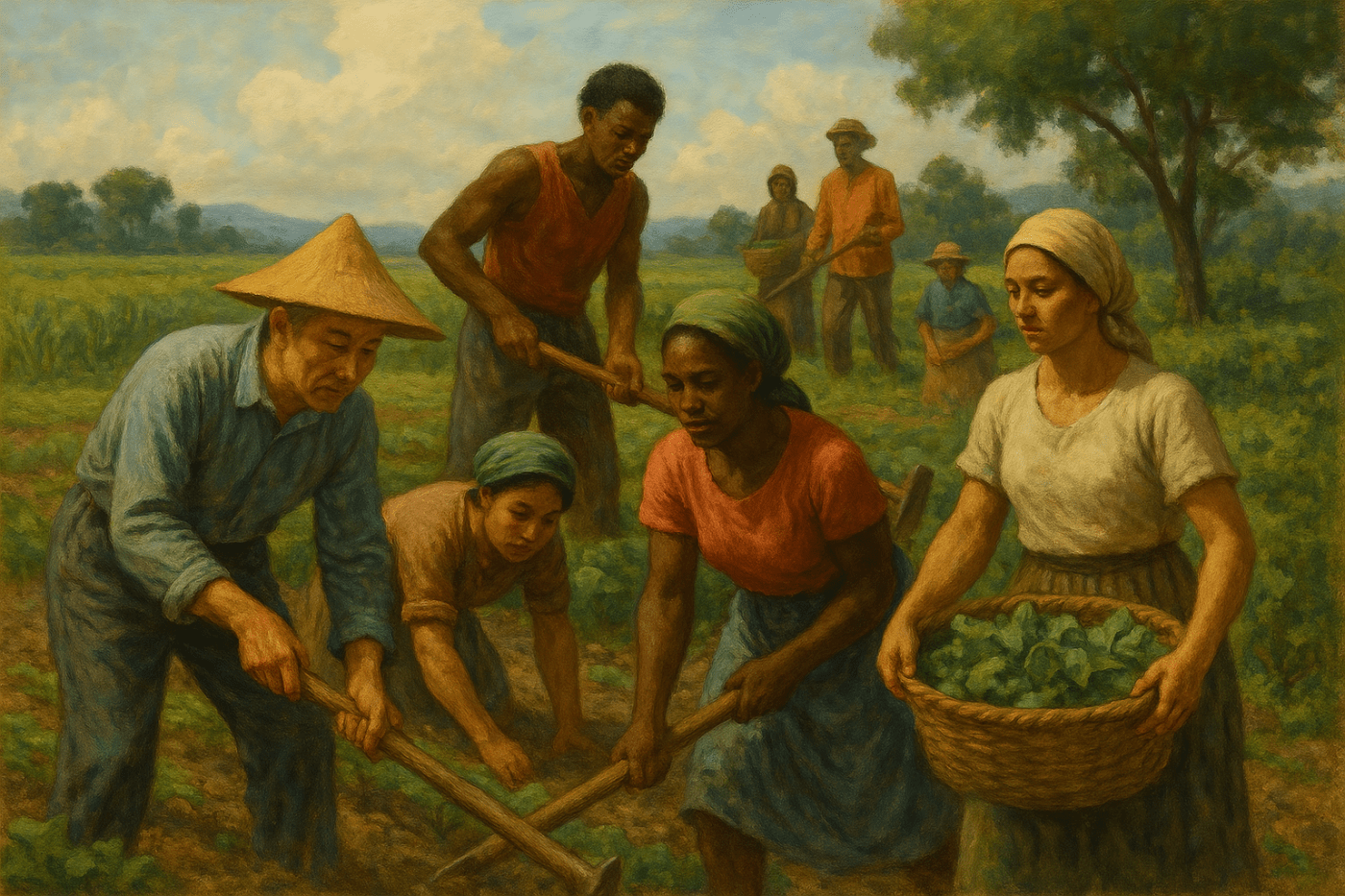
As capitalist modernity collapses under the weight of its own contradictions—ecological breakdown, mass displacement, monopolized food systems, and imperial overreach—the world finds itself at a crossroads. On one path: technofascist dystopia, ruled by billionaire climate bunkers and digitized scarcity. On the other: the slow, stubborn re-emergence of communal forms of life rooted in the land, in collective labor, and in care for people and planet.
This fifth installment explores the commune and the collective not as nostalgic relics, but as the living foundation of an ecosocialist horizon—the counter-current to capitalist ruin, the embryo of a post-imperialist, post-exploitative world system.
The Commune: From Paris to Petrograd to Pachamama
Marx called the Paris Commune “the finally discovered form” of working-class rule—not a replica of the bourgeois state, but a radical dismantling of it. In the 20th century, revolutionary communes were not limited to Europe:
- The Zapatista communities in Chiapas practiced Indigenous autonomy, food self-sufficiency, and feminist politics while resisting the Mexican state and neoliberal globalization.
- Cuban agricultural collectives following the Revolution implemented cooperative land ownership and agroecological farming rooted in popular education and solidarity.
- The People’s Communes of Maoist China—though uneven and contested—represented a serious attempt to collectivize land, build local self-reliance, and uproot feudalism.
- The Sandinistas in Nicaragua, the Kurdish communes of Rojava, and Venezuelan Bolivarian collectives all represent variants of the revolutionary commune adapted to local struggles and conditions.
These communes were not perfect. But they were—and are—serious experiments in decommodifying land, decentering capital, and centering communal life.
Collective Agriculture and the Logic of Ecosocialism
Capitalist agriculture treats land as a commodity, labor as an input, and nature as an externality. Ecosocialism begins by reversing all three:
- Land becomes a commons—used, not owned; stewarded, not speculated upon.
- Labor becomes collective, not alienated—rooted in community need, not profit motive.
- Nature is re-integrated into human planning—as a living system, not an exploitable resource.
In places like Cuba, Venezuela, the MST in Brazil, and Indigenous-led agroecological projects across the Global South, ecosocialist collectives are already feeding thousands while restoring degraded soil, reviving ancestral knowledge, and building dual power in the shadow of imperialism.
This is not utopian. It is empirical. It is happening. It must be scaled—not through IMF loans or NGO grants, but through revolutionary organization, land reclamation, and political education.
Against Technocratic Solutions: The Commune as Counter-Power
What Silicon Valley and Davos call “solutions”—vertical farms, synthetic food, lab meat, and blockchain land registries—are attempts to further enclose the future. The commune offers the opposite: a way to break from capitalist time, capitalist space, and capitalist life.
Communes cannot be managed from above. They must be built from below. They are schools of self-governance. They develop new relations between city and countryside. They repurpose infrastructure for the common good. They fuse ecological regeneration with popular power.
Where capitalist agriculture demands obedience to algorithms, the commune demands participation. Where finance capital seeks rent, the commune seeks reciprocity. Where technofascism atomizes, the commune organizes.
From Scattered Seeds to a Global Tapestry
As the imperial world system reels from collapse, fragments of the new world are already emerging—patches of red and green in a dying gray landscape. They are communes, collectives, cooperatives, liberated zones, and rural assemblies. They are the insurgent infrastructure of a future worth living in.
The ecosocialist horizon is not merely about emissions targets or “green” investment portfolios. It is about land, labor, and life itself.
It is time to scatter the seeds of revolution—into soil, into strategy, into solidarity.
Part VI Coming Soon: “Revolutionary Agrarian Strategy in the 21st Century: Programmatic Theses for the Global South and Beyond”
 Weaponized Information
Great article. This movement to the Ecosocialist Horizon must also contribute to the near future defeat of global fossil capital and its political instruments to have any chance to prevent a climate hell much worse than we now witness. We owe this commitment to all the children of the world, to have a future to thrive. Solarization of global energy, agroecologies, demilitarization with the defeat of militarized fossil capital. See my recent articles:
https://jwsr.pitt.edu/ojs/jwsr/article/view/1323/1668 A Science-Based Ecosocialist Strategy for Climate Security, Journal of World Systems Research (Errata link: http://www.theearthisnotforsale.org/errata_dschwartzman_2025.pdf)
https://www.historicalmaterialism.org/overshoot-and-the-1-5-degree-celsius-warming-target/
LikeLiked by 1 person
I unite with your analysis! Thanks for sharing your work. I will try to use it in our future eco-socialist articles. Salute 🫡
LikeLike