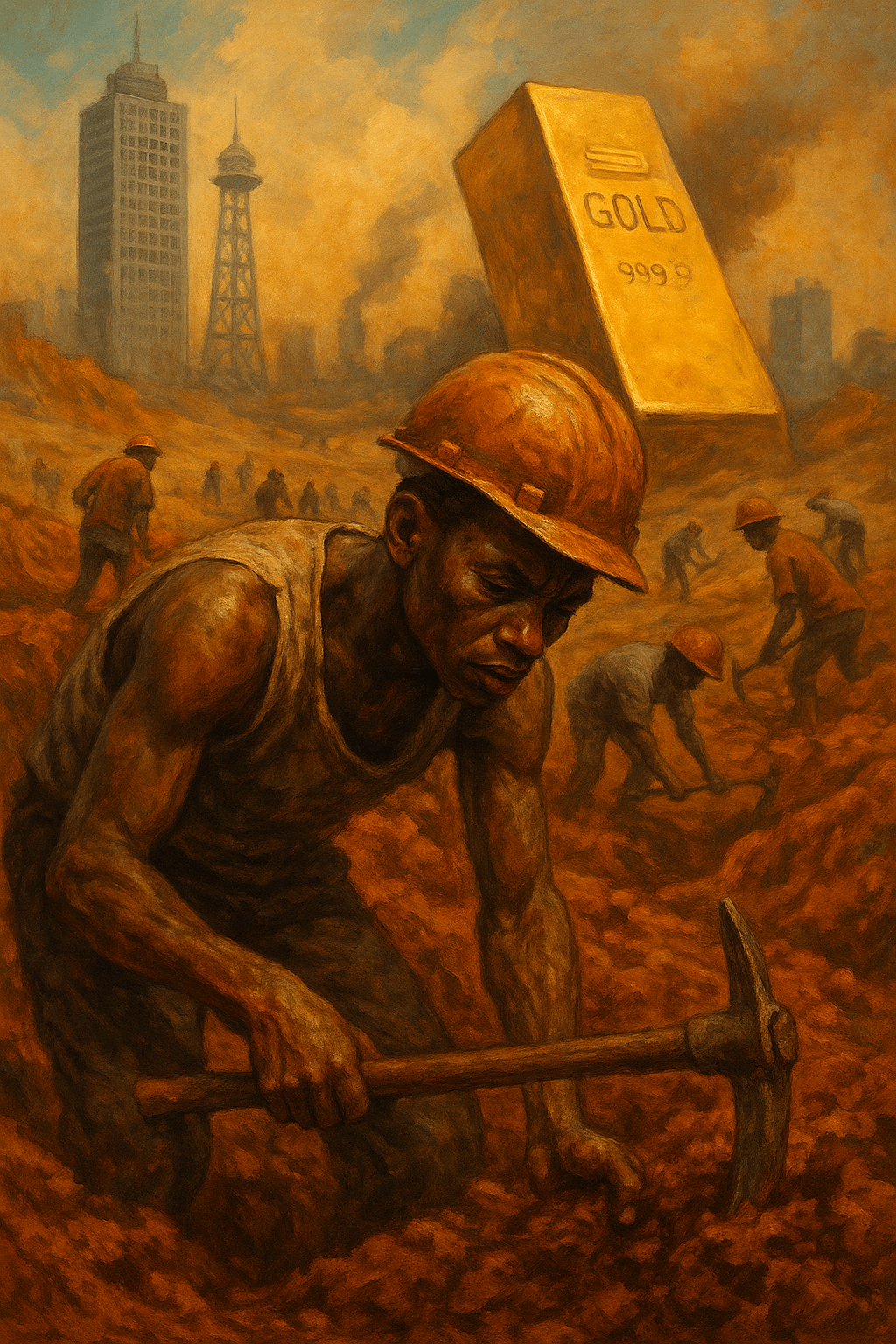
How imperial finance, comprador elites, and digital mining operations keep Africa’s wealth flowing north—while the people below keep digging graves, not gold vaults
By Prince Kapone | Weaponized Information | June 6, 2025
Colonial Crimes Rebranded: When Looting Becomes “Illicit Flow”
On June 5, Ghana Business News ran a story with a headline that should’ve been an alarm bell: “Africa is losing $40 billion a year to illicit financial flows in the extractive sector.” But what should’ve been a call to arms reads more like a bureaucrat’s internal memo. Instead of naming names, exposing thieves, or calling for justice, the article quotes United Nations official Antonio Pedro talking about “reforms,” “frameworks,” and “dialogue” at a UN-backed event on reparations. On the surface, it looks like concern. But underneath, it’s a familiar trick: dress up a robbery in the language of development, and hope nobody asks who’s holding the gun.
The report comes unsigned, written in the voice of nobody and everybody. That’s by design. Ghana Business News, though based in West Africa, reads here like an outlet embedded in what we call the imperialist media apparatus—that global chorus of polite stenographers who exist to make empire sound like a think tank. This article isn’t journalism—it’s cover fire. Instead of exposing the system bleeding Africa dry, it hides it behind acronyms and institutional etiquette. The class position is clear: this is media written by and for the petty bourgeoisie managing the neocolonial order, not the working class suffering under it.
The narrative is anchored by Antonio Pedro, a senior UNECA bureaucrat fluent in donor-speak, and backed by the African Union, the UN Office of the Special Adviser on Africa, and other global “stakeholders.” The actual looters—mining firms like Glencore and AngloGold Ashanti, or legal rackets like ICSID and the World Bank—remain unnamed, safely tucked behind the curtain of multilateral diplomacy.
Let’s start with their favorite euphemism: “illicit financial flows.” Sounds criminal, right? Sounds underground. But here’s the trick—most of these so-called illicit flows aren’t even illegal. They’re legal by design. Multinational corporations underprice exports, inflate costs, and shift profits to tax havens through techniques like transfer pricing. The UN’s own data shows 64% of Africa’s IFFs come from this kind of legalized theft. Calling it “illicit” makes it sound like a few bad apples are sneaking money out. In reality, this is financial piracy built into the system, protected by treaties and reinforced by courts. It’s not a bug—it’s the business model.
And that’s just the first layer of deception. The article talks about “development,” “job creation,” and “reparatory justice,” but only in the vaguest possible terms. It never asks the most basic question: who owns the mines? Who gets the profits? Who controls the rules? Instead, we’re told that Africa should “operationalize strategic frameworks” and “build coherent policy platforms”—a fancy way of saying: play the same rigged game, but try harder this time.
This is what we call cognitive warfare: when language is used not to inform, but to disarm. When the violence of extraction is scrubbed clean and rebranded as a policy challenge. The piece never questions the fact that most of Africa’s minerals are exported raw, that structural adjustment programs gutted national industries, or that bilateral investment treaties let foreign companies sue African governments for trying to tax them. All of that is erased, and in its place we get soft phrases about “capacity gaps” and “inclusive dialogue.”
And let’s not ignore the quiet ideology humming underneath: the assumption that Africa’s job is to supply the world with raw materials, while the real value is added somewhere else. That’s the colonial contradiction at the heart of this whole setup. Until that contradiction is resolved—until land, labor, and resources are under the democratic control of the people who produce them—there is no justice. There is only management of the loot.
In the end, this article doesn’t expose a crisis—it manages one. It doesn’t confront the system—it consults it. And it doesn’t speak for Africa—it speaks for the accountants of empire, wrapping the theft of a continent in the language of fiscal responsibility.
What They Call Flows, We Call Loot: Tracing the Drain of Empire
The numbers are staggering. According to the United Nations Economic Commission for Africa, Africa is losing between $40 and $90 billion every year through what they call “illicit financial flows” from the extractive sector. That’s up to 7% of the continent’s entire GDP, vanishing offshore while communities go without electricity, healthcare, or clean water. Over the past 30 years, these losses have totaled more than $1.4 trillion—a figure nearly equal to Africa’s entire GDP today.
But these aren’t “leaks.” They are engineered exits. Up to 64% of these outflows stem from trade misinvoicing, transfer pricing, and internal debt manipulation—tactics where multinational corporations, often through shell companies and subsidiaries, underprice African exports and inflate import costs to shift profits into tax havens like Switzerland or Luxembourg. In the Democratic Republic of Congo, $1.35 billion was siphoned through rigged mining asset sales to offshore firms. In Ghana, $6.3 billion in gold profits disappeared offshore between 2010 and 2020 through transfer pricing by corporations like Newmont and AngloGold Ashanti.
These are not isolated incidents. They are part of a global system of neocolonial extraction, maintained not by gunboats but by legal contracts, debt, and arbitration courts. The colonial model of shipping raw minerals out of Africa with no local value addition still dominates today. 90% of mineral exports leave the continent unprocessed. The labor practices haven’t changed much either: in DRC’s cobalt mines, some workers earn as little as $2 a day, in conditions that echo the brutality of the concessionary regimes of King Leopold’s Congo.
How did this become normalized? The answer lies in the architecture built during and after colonialism. Under the guidance of the IMF and World Bank, many African nations were forced to privatize their mining sectors in the 1990s as part of Structural Adjustment Programs (SAPs). State-owned companies were dismantled. Foreign capital was invited in. Tax holidays, royalty waivers, and sweetheart deals became standard. Meanwhile, bilateral investment treaties (BITs) allowed multinational firms to sue governments in tribunals like ICSID for threatening profits through nationalization or regulatory changes.
These treaties are not just economic—they are legal counterinsurgency. In Zambia and Ghana, mining firms have used BITs to block legislation that would have increased taxes on their operations. In effect, African governments are punished for attempting to reclaim sovereignty over their own resources. As the African Union’s own report acknowledges, IFFs are draining state capacity and undermining public services. But even that language masks the political essence of the problem: this isn’t “capital flight”—it’s reparations in reverse.
The historical continuity is blatant. Under British colonial law, Ghana’s Minerals Ordinance of 1936 handed all mineral rights to the Crown. That same structure, slightly rewritten, governs today’s mining concessions—just with corporate boards in place of colonial governors. The Brookings Institution itself admits the truth: “Africa remains trapped in a colonial development model centered around extraction and export of raw materials.”
While global institutions talk endlessly about “governance gaps” and “capacity building,” they quietly benefit from the very asymmetries they refuse to dismantle. The National Geographic curriculum will teach schoolchildren about “natural resource wealth” but will never mention the ICSID tribunal in Washington D.C. or the transfer-pricing shell companies in Mauritius. That’s not education. That’s imperial narrative control.
Even supposed reform mechanisms—like the UN’s “reparatory justice” platform—are designed to manage, not end, the bleeding. These institutions call for “transparency,” but never for the expropriation of looters. They recommend “frameworks,” but never rupture. Their goal is not to stop the theft, but to regulate it just enough to keep the system intact.
In short: this isn’t a crisis of oversight. It’s a crisis of ownership. And the longer we let the colonial pipeline run, the deeper the blood debt becomes.
From Extraction to Expropriation: Reframing the Debate on African Minerals
Let’s be clear: the term “illicit financial flows” is a public relations masterpiece. It makes theft sound technical, as if the problem were merely one of bad paperwork. But what we’re dealing with isn’t a regulatory glitch—it’s a global system of imperial plunder, carried out through boardrooms, trade treaties, offshore accounts, and investment courts. This isn’t about capital flowing—it’s about colonialism mutating.
In reality, Africa is not “developing.” It is being systematically underdeveloped. As Walter Rodney taught us, the very mechanisms that claim to support Africa’s “growth”—foreign investment, debt-based development, export-led growth—are the ones designed to extract its surplus and stifle its sovereignty. The World Bank didn’t end colonialism; it rebranded it in a pinstripe suit.
The so-called solutions being proposed—more transparency, better governance, refined accounting practices—are not solutions at all. They are attempts to rescue the credibility of a dying system. The OECD’s tax guidelines won’t stop AngloGold Ashanti from gaming the system. The IMF’s “reform packages” won’t stop Glencore from draining Zambia dry. These are the same institutions that built the extraction machine in the first place.
We must stop talking about “leakages” and start talking about reparations. The wealth being stolen from Africa today is not just a present-day crime—it is part of a 500-year continuum of expropriation that began with the transatlantic slave trade, intensified through settler colonialism, and continues under neoliberal globalization. What we are seeing now is the financialization of the plantation economy, digitized and automated through algorithms, tax treaties, and trade protocols.
The framework we need is not “development” but decolonization. And decolonization doesn’t mean waving flags or signing UN resolutions. It means seizing the commanding heights of the economy: nationalizing the mines, ending BITs and ICSID jurisdiction, taxing capital flight, and asserting democratic control over land, labor, and resources. It means recognizing that data, like gold and cobalt, is being mined—without consent, without regulation, and without return—and must also be reclaimed.
Across the Global South, this resistance is already brewing. Indonesia is restricting nickel exports. Bolivia is fighting for lithium sovereignty. Tanzania rewrote its mining laws to claim equity in extractive operations. Botswana shows that it is possible to capture value by insisting on domestic beneficiation. These aren’t “policy experiments.” They are revolutionary ruptures—attempts to cut the colonial pipeline once and for all.
And yet, every time an African nation tries to do the same, it is threatened with sanctions, lawsuits, and capital flight. This is not accidental—it is what the imperialist recalibration looks like. As U.S. hegemony wanes, the empire is outsourcing economic enforcement to the financial system, corporate courts, and digital infrastructure. This is what we call hyper-imperialism: a phase where empire governs not through occupation, but through algorithms, arbitration, and austerity.
The path forward is not more dialogue with the looters. It is more solidarity with the looted. African workers, peasant cooperatives, national liberation movements, and revolutionary states must build a new political economy based on sovereignty, planning, and social ownership. This is not just an African struggle. It is a frontline in the global class war.
Sabotage the Pipeline, Build the Frontlines: Revolutionary Tasks in the Core and Periphery
What we call “illicit flows” are in fact imperialist supply chains. These chains don’t just stretch from African mines to Swiss banks—they run through the tech devices in our homes, the fuel in our cars, the financial systems that prop up our wages, rent, and credit. The plunder of Africa props up the so-called “developed world.” The mines of the Congo subsidize comfort in London. The gold of Ghana sustains Wall Street. This isn’t an accidental side effect—it’s the structural foundation of the imperial core.
That means the struggle for African mineral sovereignty is not someone else’s fight. It is our front too. But solidarity cannot be symbolic. It must be material, organized, and insurgent. Our job in the core is not to “support” from afar—it is to disrupt the systems that enable extraction, to break the mechanisms that allow capital to flow freely while the Global South remains chained, and to build power where we stand that undermines empire’s ability to rule.
That means exposing how our own governments, media, and institutions serve as instruments of looting. It means sabotaging the ideological infrastructure that normalizes pillage—schools that teach “development,” NGOs that launder capital, journalism that blames poverty on “governance gaps.” It means naming and confronting the corporations—Glencore, AngloGold, Total, Barrick, Freeport-McMoRan—and the investment banks, hedge funds, and trade courts that back them.
Most of all, it means building revolutionary forces that are accountable to the oppressed, not to the imperial state. The most dangerous thing we can do in the core is retreat into commentary or charity. This is a moment that demands organization, confrontation, and rupture. Just as Bolivia nationalized lithium and Tanzania rewrote its mining laws, just as Mali expelled France and Cuba survived a blockade—we must act where we are positioned to accelerate the defeat of empire.
The line is global. On one side: the corporations, financiers, and comprador elites draining the South dry. On the other: the workers, peasants, and revolutionaries struggling to reclaim land, labor, and life. Our allegiance is not to flag or nation—it is to this fight. The looting will not end until we force it to. And that begins by recognizing: every pipeline can be severed, every mine reclaimed, every treaty broken.
We are not here to reform extraction. We are here to help bury it. This is not about making capitalism “fair.” It’s about smashing the colonial structures that make capitalism possible. Because as long as Africa’s minerals fuel empire, revolution is not just necessary—it’s non-negotiable.
 Weaponized Information
Leave a comment