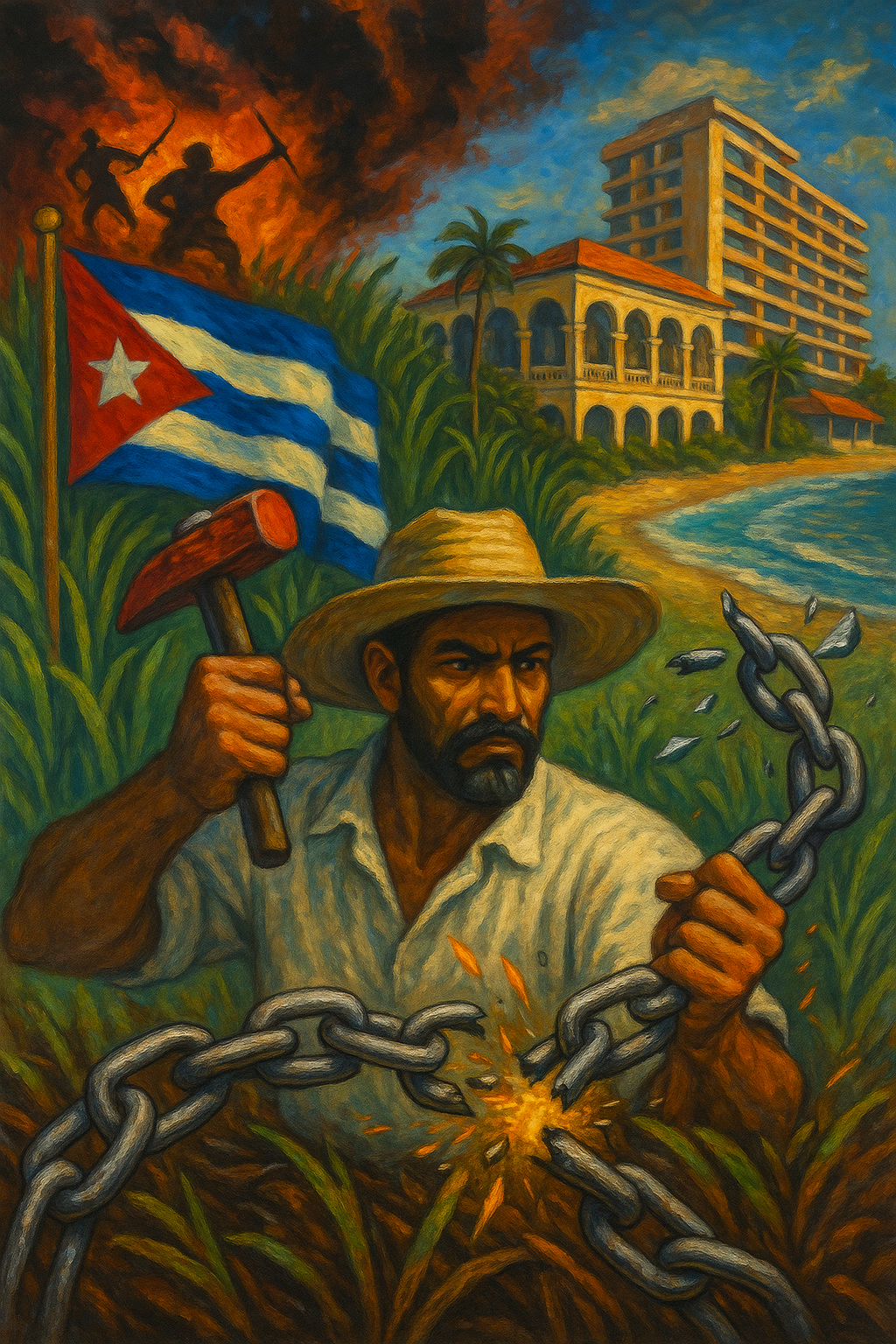
A revolutionary dissection of imperial lawfare, technofascism, and the weaponized narrative machinery deployed to recolonize Cuban sovereignty
By Prince Kapone | Weaponized Information
May 5, 2025
The Journalist as Bailiff: How the Miami Herald Deputizes the Media to Enforce Imperial Property Claims Against Cuba
The story begins, as imperial propaganda often does, in the pages of the Miami Herald. A headline, polished for liberal respectability: “Miami man wins $30M verdict against Expedia over confiscated property in Cuba.” Beneath the headline, the byline: Nora Gámez Torres. At first glance, it’s just another piece of reporting from a familiar figure in U.S.-Cuba coverage. But under the veneer of journalism lies something deeper: an ideological operation, a narrative weapon calibrated to launder imperial lawfare as righteous justice.
Let’s start with the author. Nora Gámez Torres is not a neutral chronicler of events. Her biography reads like a transnational arc through elite ideological institutions: born in Havana, trained in journalism and communications in both Havana and London, holder of a PhD in sociology from City, University of London. Since 2014 she has been the Cuba and U.S.-Latin America policy reporter for both el Nuevo Herald and the Miami Herald. Her bylines have won awards from the Florida Society of News Editors and the Society for Professional Journalists—accolades from the very professional networks tasked with enforcing the ideological discipline of capitalist journalism.
But it’s not the credentials that matter; it’s the class position they conceal. Gámez Torres operates as a narrative conduit for a specific formation of exile capitalist ideology. Her coverage has consistently framed the Cuban Revolution not as a rupture from colonial exploitation, but as an aberration of “communist tyranny.” Her articles, whether explicitly or implicitly, align with the interests of the Miami exile oligarchy: a comprador class whose wealth was tied to pre-revolutionary sugar estates, casinos, and U.S. mafia-linked plantations. Her journalistic beat is not merely Cuba—it is the ideological maintenance of a neocolonial narrative that imagines Cuba as a stolen inheritance waiting to be reclaimed by its rightful capitalist owners.
And the platform she writes for? The Miami Herald, flagship of McClatchy, long embedded in the ideological machinery of U.S. imperialism’s Latin America project. For decades, the Herald has been a megaphone for anti-communist exile propaganda, CIA-aligned narratives, and Cold War revisionism. Its Spanish-language sibling, el Nuevo Herald, serves as a parallel track—disseminating the same imperial scripts in the language of the colonized. Both outlets function not as spaces of “free press” but as ideological state apparatuses in Althusser’s sense: disciplining public perception to align with U.S. imperial interests while masquerading as independent journalism.
Read the article closely and you’ll see the ideological fingerprints. The $30 million jury verdict against Expedia is presented as a triumph of legal justice, a vindication of a family “wronged” by the Cuban government’s expropriation. But what’s omitted speaks louder than what’s said. Nowhere does the article tell you that the “property” in question was itself secured under colonial violence, on land stolen from Indigenous peoples, under a neocolonial regime where U.S. monopolies and Cuban oligarchs feasted on plantation profits while workers toiled in misery. Nowhere does the article contextualize the 1959 Revolution’s nationalizations as acts of anti-colonial sovereignty, reclaiming the stolen wealth of the nation from foreign and comprador elites.
Instead, the framing is surgical: a family of “victims,” a “confiscated property,” a noble quest for restitution. The very verbs—“confiscated,” “taken,” “stolen”—are deployed as weapons, rewriting history by reversing victim and perpetrator. The Cuban state becomes the thief; the expropriated oligarch becomes the injured party. This is imperial ideology at its most effective: not through outright lies, but through the careful omission of context, the erasure of history, the construction of a moral fable atop the wreckage of colonial truth.
The article’s ideological work is subtle but precise. By casting the Helms-Burton verdict as a legal victory for individual rights, it launders imperial lawfare into the liberal grammar of “property rights” and “justice.” It invites the reader to sympathize with the Miami exile as a David against the Goliath of “communist expropriation.” It makes no mention of the Helms-Burton Act’s origins as an imperial economic siege weapon, nor of its function as juridical counterinsurgency designed to suffocate Cuba’s sovereignty by criminalizing foreign investment and perpetuating colonial property claims across time.
And while the immediate producers are Gámez Torres and the Herald’s editorial machinery, the amplifiers and beneficiaries hum in the background: the Miami exile political machine, the lobbyists of the Cuban-American National Foundation, the imperial state apparatus that has weaponized every lever of finance, law, and diplomacy to bleed Cuba dry since 1960. The story is written by a journalist, published by a newspaper, but orchestrated by a class structure intent on reversing the gains of the Cuban Revolution through every available instrument of imperial power.
In the hands of bourgeois journalism, the verdict is just a news story. In the hands of empire, it’s a legal battering ram. And every article like this is part of the siege—a narrative artillery shell fired into public consciousness to naturalize the theft of sovereignty as the restoration of “rights.” This is not reporting. This is ideological warfare.
Confiscation or Liberation? Extracting the Truth from the Wreckage of Imperial Property Claims
Strip away the headlines, the courtroom theatrics, the legal jargon, and what remains beneath this story is a class struggle encoded in property law. The objective facts are these: a Miami federal jury awarded nearly $30 million to Mario Echevarría, heir to a Cuban family claiming ownership of Cayo Coco, against Expedia for “trafficking” in confiscated property under the Helms-Burton Act. The property was nationalized by the revolutionary Cuban state in 1960, part of the sweeping expropriations aimed at dismantling the colonial oligarchies that had ruled the island under U.S. tutelage. Expedia sold bookings for hotels built on that land; the U.S. court found them liable under Helms-Burton’s Title III provisions.
But these bare facts, divorced from history, risk reproducing imperial ideology. To understand the verdict materially, we must place it in the arc of imperial counterrevolution. The Cuban Revolution’s nationalizations were not random seizures; they were a structural assault on the foundations of U.S. colonial domination. U.S. corporations controlled over 60% of Cuban sugar production, 90% of its telecommunications, two-thirds of its railroads, and vast tracts of land. The revolutionary government, confronting a neocolonial economy built to extract wealth for the imperial core, expropriated these holdings to reclaim sovereignty and redirect the fruits of labor to the Cuban people.
From the standpoint of imperial capital, this was theft. From the standpoint of the colonized, it was liberation. The Helms-Burton Act—passed in 1996, deep into the Special Period crisis induced by the U.S. blockade—was an attempt to turn the clock back. It codified imperial revanchism into law, granting legal standing to descendants of expropriated elites to sue anyone who “trafficked” in their former holdings. In material terms, it was an effort to chill foreign investment, weaponize U.S. courts against Cuba’s trading partners, and entrench the imperial siege through juridical warfare.
The article fails to situate this law in the broader imperial playbook. Helms-Burton is not an anomaly; it is part of a continuum of imperial strategies designed to enforce what David Harvey calls the “accumulation by dispossession” logic of global capitalism. Just as the IMF imposes structural adjustment to recolonize postcolonial economies, just as U.S. sanctions weaponize financial systems to strangle sovereignty, Helms-Burton extends the colonial property regime into eternity—demanding compensation for land seized from peasants, estates built on stolen Indigenous soil, plantations fertilized with Afro-Cuban slave labor.
Expedia’s role is not incidental; it is structural. As a digital intermediary in global tourism capital, Expedia profits from the commodification of Cuban land and labor under the conditions of blockade-induced dependency. The company’s algorithms commodify Cuba’s beaches while courts enforce colonial claims—technofascism’s marriage of digital capitalism and legal piracy. Yet in the imperial court, Expedia becomes the “trafficker”—not the exile plaintiffs whose claims rest on colonial extraction, nor the imperial state enforcing a blockade violating international law. The irony is total: capital profits from dependency, then sues itself under imperial law for profiting from the dependency it created.
This case is not a rogue episode; it is a signal. The U.S. ruling class has shifted from direct military invasions to hybrid war: lawfare, sanctions, trade embargoes, information warfare, and the juridical extension of imperial sovereignty into the courts of the metropole. The Helms-Burton verdict is an act of juridical piracy, a legal raid on Cuban sovereignty using property claims as the boarding axe. Every headline celebrating this verdict is an ideological victory for imperialism: it normalizes the colonial premise that the wealth of the Global South belongs to the descendants of the colonizers.
But no court can erase the material relations beneath these claims. Every acre of Cayo Coco carries the sediment of history: from Indigenous Arawak dispossession, to Spanish colonial enclosure, to U.S. neocolonial plantation, to revolutionary reclamation. Every step of ownership was forged in blood, coercion, and exploitation. The Cuban Revolution’s expropriations did not steal property; they abolished colonial property and replaced it with national sovereignty. This is the truth the Miami Herald’s narrative machinery cannot speak: that in the eyes of the oppressed, the Revolution was not theft—it was justice.
Revolutionary Land vs. Imperial Deeds: Reclaiming the Verdict
Let’s flip the lens. If the Miami Herald article frames this as a “victory” for Cuban exile property claims, a righteous vindication of stolen wealth, then we tell the story as it truly is: a juridical extension of imperial war against a sovereign, socialist nation. The U.S. court did not merely side with a dispossessed family; it sided with a class, a colonial caste of absentee landlords who lost not just land but their parasitic extraction rights when the Cuban people reclaimed their homeland.
The lawsuit isn’t about a patch of beach on Cayo Coco. It’s about the imperial right to profit forever from colonial extraction. Helms-Burton isn’t a relic of 1990s post-Cold War arrogance; it is imperial recalibration, technofascist legal warfare designed to reimpose settler property claims across space and time. The law renders the Revolution’s victories provisional—revocable by imperial fiat—unless those victories are defended materially, politically, and ideologically by the revolutionary masses themselves.
This case, and the broader deployment of Title III lawsuits, is a warning: that in the declining phase of U.S. hegemony, imperialism turns increasingly to juridical sabotage, economic strangulation, and extraterritorial coercion to claw back its crumbling control. Unable to overthrow Cuba through military invasion or CIA terror, it seeks to destabilize sovereignty through the courts, the sanctions office, the banking system. It weaponizes “property rights” as a battering ram against anti-imperialist sovereignty.
But no imperial court can adjudicate the morality of a revolution. The Revolution’s expropriations were not violations of law; they were abolitions of colonial law. The Cuban state didn’t “steal” Cayo Coco; it liberated it—from absentee landlords who inherited their wealth through colonial conquest, from corporate monopolies that turned the island into a U.S. plantation. Every expropriated acre was a blow against racial capitalism, a strike for national dignity.
The Herald article can’t speak this truth because to admit it would unravel the whole imperial narrative. If the Cuban Revolution’s land reform was just, then every plantation in the Americas sits on stolen soil. If Cuba’s nationalizations were necessary, then every multinational corporation exploiting the Global South stands on a moral fraud. If a sovereign people can abolish colonial property, then imperialism’s entire juridical architecture—its trade rules, investment treaties, “intellectual property” regimes—is nothing but legalized theft.
This is why the ruling class must frame the verdict as a “victory for justice.” But justice for whom? For a family that once held title to an island their ancestors never rightfully owned? For Expedia, which profits from marketing stolen land but pleads ignorance in court? For an empire that blockades an island nation while suing it for surviving the blockade?
We call it by its name: legalized piracy under technofascism. A system where monopoly capital fuses with state power, not only through war and sanctions but through weaponized lawfare. Where property rights are retroactively enforced to strangle sovereignty, where multinational corporations act as both violators and victims under imperial adjudication. This is imperialism in the era of recalibration: fighting not to expand new territories, but to claw back sovereignty wherever it emerged.
The real victory isn’t in a Miami courtroom. It’s in every Cuban farmer who tills expropriated land for the collective good. It’s in every Cuban student educated in schools built on reclaimed estates. It’s in every Cuban doctor who walks a hospital corridor built on land once hoarded by a plantation elite. The Revolution didn’t just redistribute property; it redefined the meaning of property itself—not as a right to exclude, but as a right to belong, to share, to build collectively. [UNESCO: Cuba’s achievements in education and health]
That’s why this verdict is not a defeat for Cuba—it’s a confirmation of how dangerous Cuba remains to imperialism. More than sixty years after the Revolution, the U.S. ruling class is still terrified by the possibility that the colonized might keep what they’ve won. And every dollar awarded in that Miami courtroom is not a symbol of victory, but an admission: that despite six decades of blockade, sabotage, terrorism, and lawfare, the empire has never succeeded in breaking the Revolution.
From Courtrooms to Class Struggle: Turning the Verdict into Revolutionary Fire
So where do we go from here? The empire calls it justice. We call it an imperial stick-up. The verdict against Expedia isn’t a legal technicality—it’s a signal. A signal that U.S. imperialism is expanding its toolkit of aggression: not just bombs, blockades, and sanctions, but lawsuits, liens, and legal chains meant to repossess the fruits of anti-colonial revolution.
This moment demands clarity. We don’t win by begging imperial courts to reverse the ruling. We don’t win by asking U.S. corporations to “do the right thing.” We win by recognizing the systemic character of this assault: that the verdict is not a rogue act of a jury, but a calibrated tactic of imperialist recalibration. In the age of multipolarity, imperialism knows it cannot conquer Cuba with tanks—so it tries to litigate Cuba back into colonial dependency.
Our call, then, is simple but uncompromising: defend the Revolution, defend sovereignty, escalate solidarity. We must treat every legal verdict like this one not as isolated news, but as a node in the broader technofascist war machine—a machine that fuses legal warfare, economic strangulation, and ideological attack into a seamless matrix of imperial coercion.
This means amplifying and materially supporting Cuba’s struggle for sovereignty. It means breaking the narrative stranglehold of imperial media by flooding every social platform, every community forum, every organizational meeting with the truth: that this verdict is an attack on all anti-colonial movements, not just Cuba. That every acre expropriated in 1959 was part of a global struggle to liberate the land from colonial landlords, capitalists, and corporations.
And it means escalating the concrete work of solidarity. Here are three immediate fronts of struggle:
- 1. Defend Cuba’s sovereignty against juridical imperialism. Organize teach-ins, forums, and campaigns exposing the Helms-Burton Act and its weaponization of U.S. courts. Build pressure campaigns targeting corporations complicit in these lawsuits, forcing divestment, boycott, and reputational damage against those who profit from imperial lawfare.
- 2. Confront imperialist lawfare wherever it rears its head. Every verdict like this one sets precedent—not just for Cuba, but for Venezuela, Zimbabwe, and any nation that expropriates colonial or imperialist property. We must build international solidarity networks capable of exposing, resisting, and sabotaging the machinery of legal imperialism wherever it targets sovereign nations.
- 3. Mobilize diasporic solidarity beyond counter-revolutionary exile elites. We must reclaim diasporic spaces from reactionary narratives. Not all Cuban-Americans unite with the Miami exile elite; many reject the plantation nostalgia, the counter-revolutionary vendettas, the weaponization of their identities by U.S. imperialism. We need grassroots organizing among working-class, anti-imperialist, and socialist sectors of the diaspora to fracture the imperial consensus and build revolutionary diasporic solidarity with Cuba’s people.
And beyond these tactics, we must never forget the lesson: every imperial verdict is fragile if it is not backed by material power. The courts of empire can issue fines, liens, penalties—but they cannot repossess the revolutionary will of a sovereign people. The Revolution’s power does not lie in recognition by imperial institutions. It lies in the collective defense mounted by workers, farmers, teachers, doctors, artists, and soldiers who refuse to surrender the land their struggle liberated.
We don’t mourn this verdict. We weaponize it. We hold it up as proof that the empire still dreams of undoing the Revolution—and that every imperial dream is a nightmare waiting to be shattered by the organized power of the oppressed. The lawsuit against Expedia is not the last attack. But it is a sign that imperialism is running out of moves. Sixty years of blockade, sabotage, and coercion have failed. And now, the empire clutches at courtroom rulings like a drowning man grabbing driftwood.
But no court ruling can stop a people in motion. No lien can reverse six decades of revolutionary construction. No imperial verdict can erase the truth that the land of Cuba belongs not to a Miami courtroom, but to the people who fought, bled, and died to reclaim it. And until the last imperial institution crumbles, our task remains: to defend every inch of liberated land, every grain of revolutionary dignity, every banner of anti-colonial sovereignty—until victory.
Because as long as the Revolution lives, every imperial verdict against it is already overturned in practice. And no Miami jury, no U.S. judge, no imperial statute can defeat a people who refuse to be conquered.
 Weaponized Information
Leave a comment