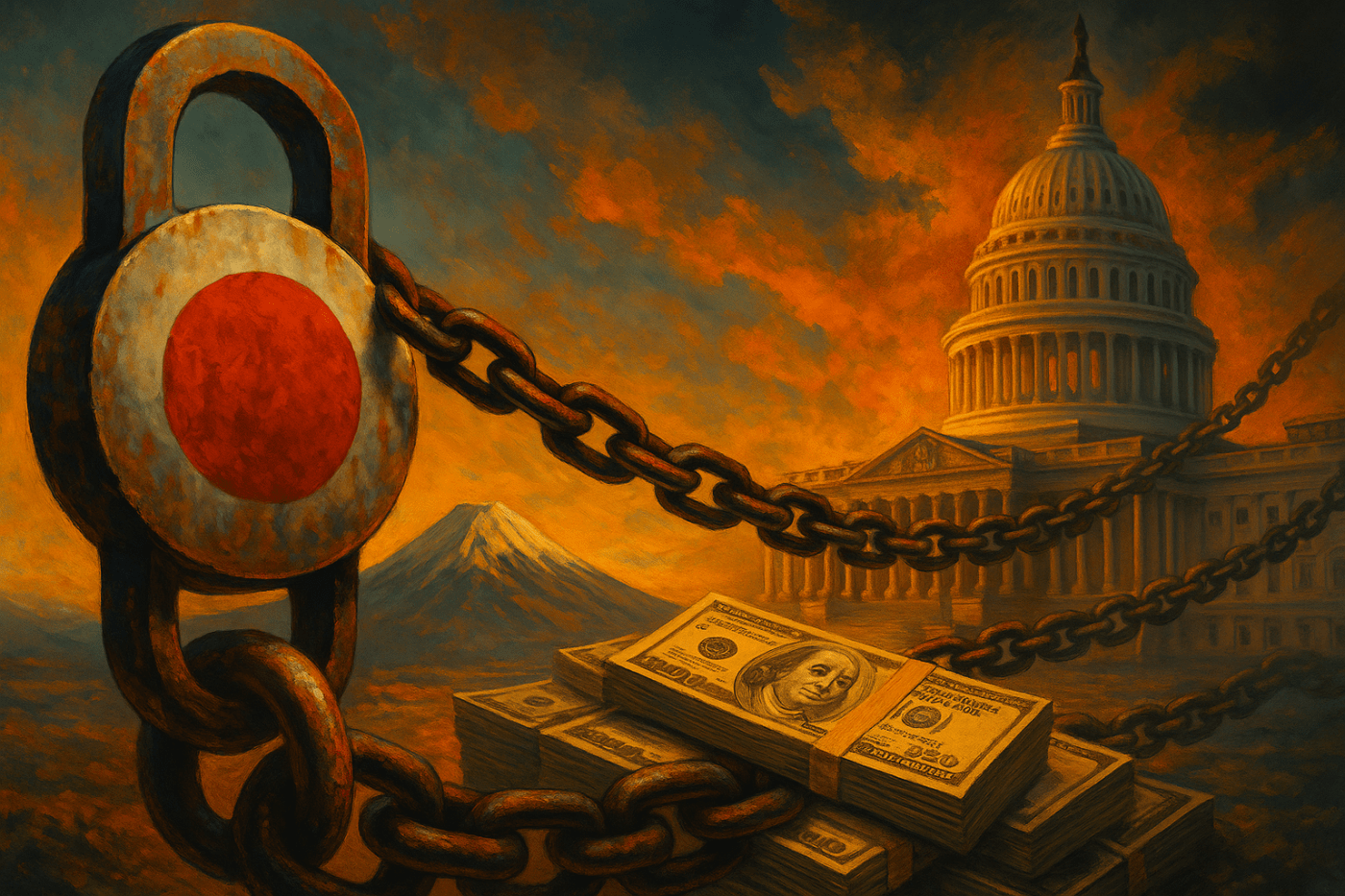
Excavating the Empire’s Bonds: A Revolutionary Analysis of Japan’s Treasury Trap and the Global Dollar Order
By Prince Kapone | Weaponized Information | May 5, 2025
They want you to believe it’s all a misunderstanding. That Japan’s finance minister “clarified” his earlier comments. That nobody’s threatening to sell U.S. Treasuries. Just a slip of the tongue, an innocent remark, walked back politely. The empire’s financial house, they assure us, is still in order.
But look closer, comrades. The article by Makiko Yamazaki in Reuters isn’t just reporting on Japan’s finance minister—it’s doing damage control for the imperial system itself. The story pretends to be about a technical clarification, but it’s really a subtle exercise in managing panic, policing the narrative, and keeping the contradictions of imperial finance hidden from public view.
Let’s start with the author and platform. Makiko Yamazaki is a veteran financial journalist for Reuters, a wire service that bills itself as objective and global, but functions as a stenographer for finance capital. Reuters is owned by Thomson Reuters Corporation, a Canadian conglomerate rooted in corporate legal, tax, and financial information systems. This isn’t just a news agency—it’s an institutional mouthpiece for monopoly-finance capital. Its clients aren’t the working masses; they’re the banks, hedge funds, law firms, and government ministries that make up the imperial core’s management class. When Reuters “reports,” it’s not informing the people—it’s briefing the bosses.
The article’s headline is mild: “Japan says no plan to threaten Treasuries sale in U.S. trade talks.” Already we see the ideological sleight of hand: the question isn’t why Japan holds over a trillion dollars in U.S. government debt, or what structural power relations that represents. No, the headline narrows the story to a single talking point: Japan “clarifying” that it won’t sell those bonds as a “threat.” This framing takes a potential act of financial rebellion and recasts it as a misunderstanding at best, an empty bluff at worst. The empire’s treasury is safe, nothing to see here.
Inside the article, Yamazaki quotes Finance Minister Katsunobu Kato at length, letting him set the terms of debate. Kato insists his earlier remarks were misunderstood: he wasn’t suggesting Japan would sell its U.S. Treasury holdings as leverage in trade talks, merely that such holdings were meant for “liquidity” in case of yen intervention. Reuters lets him speak unchallenged, reproducing his explanation verbatim. No counter-voices, no critical economic analysts, no questioning of the underlying power dynamics. Just Kato’s words, handed to us as settled fact.
What does Reuters omit? Everything structural, everything historical, everything imperial. Nowhere in the article will you find mention of Japan’s status as the largest foreign holder of U.S. Treasuries—a position not born of free market choice but of postwar dependency, military occupation, and systemic dollar subordination. Nowhere does Yamazaki explain the “dollar trap”—how Japan and other U.S. client states are compelled to recycle their trade surpluses into U.S. debt, financing Washington’s deficits while remaining locked into the imperial monetary system. Nowhere does the article explore the underlying geopolitical stakes: that threatening to dump Treasuries isn’t just an economic act but a political blow against U.S. hegemony.
Instead, Reuters performs its ideological role: to narrow the scope of discourse, to reduce political economy to policy nuance, to obscure the imperial relations embedded in global finance. Kato’s “clarification” is framed as normal, responsible, prudent—what any good ally should say to keep the imperial financial machine humming. The possibility that Japan’s trillion-dollar holdings are a chain around its neck? That’s unspeakable in this register.
Look also at the language sprinkled throughout the piece: “reassure Washington,” “leverage,” “bargaining tool,” “liquidity.” Each phrase works to depoliticize the issue, to frame Japan’s position as technical rather than geopolitical, managerial rather than structural. The idea that Japan’s economy might be shackled by imperial finance? That selling Treasuries could be an act of defiance rather than a mere “tool”? The article won’t go there. It can’t go there. Its function is precisely to wall off that line of thought, to inoculate the imperial brain trust against such dangerous ideas spreading among the masses.
Even the placement of the story matters. This wasn’t a front-page crisis. It wasn’t blasted across headlines as a geopolitical bombshell. It ran quietly, tucked away in the “markets” section, a newswire blip for the financial class. That’s because the real audience here wasn’t the Japanese public or the global working class—it was investors, policymakers, imperial administrators. This article was written to reassure them that the system is still under control, that Japan is still playing its subordinate role, that no domino is wobbling toward collapse.
But behind this theater of reassurance lies a deeper unease. Why did Kato even mention using Treasury holdings as a “card” in trade negotiations? Why did that thought cross his mind, let alone his lips? Because beneath the smooth facade of empire’s financial order, cracks are spreading. The contradictions are sharpening. The global south is de-dollarizing. Even imperial semi-periphery states like Japan feel the suffocation of dollar dependency. And once a subordinate power starts wondering aloud about its chains, even if it denies wanting to break them, the ruling class hears an alarm bell.
Reuters won’t tell you this. Yamazaki won’t tell you this. Their job is to close the file, to call it “clarified,” to move on. But we know better. We see the confession buried inside the clarification. We hear the tremor inside the denial. And we know that when an imperial debt system depends on the obedience of its creditors, every whispered doubt is a revolutionary spark waiting for oxygen.
And so, comrades, our excavation of this article reveals not just its surface omissions, but its ideological labor: to protect the imperial financial order from scrutiny, to veil Japan’s subordination behind bureaucratic jargon, to keep the working masses from seeing the chains that bind entire nations to the empire of capital.
“A Trillion-Dollar Chain”: Contextualizing Japan’s Treasury Holdings within U.S. Financial Imperialism
To understand why Japan holds over $1 trillion in U.S. Treasury bonds—and why its finance minister felt compelled to clarify that these holdings won’t be used as a bargaining chip—we have to start not with Tokyo, but with Washington. Specifically, with the long arc of dollar hegemony, the postwar imperial order, and the mechanics of financial dependency that bind subordinate economies to the imperial core.
After World War II, Japan’s reconstruction was not an independent process. It was steered under U.S. occupation, with American planners remaking Japan as a bulwark of Cold War containment. Economic policy, trade structures, industrial priorities—everything was wired into the architecture of U.S. imperialist strategy. Japan’s export boom wasn’t just a national miracle; it was a function of integration into an imperial supply chain, with privileged access to U.S. markets in exchange for geopolitical loyalty.
That loyalty took institutional form. Japan’s foreign reserves accumulated in dollars. Its trade surplus recycled back into U.S. Treasury securities. This wasn’t some voluntary financial arrangement born of mutual trust—it was a structural obligation under dollar hegemony. Every dollar earned abroad had to be held, recycled, or reinvested in U.S. financial instruments, sustaining imperial liquidity while binding Japan’s fate to Washington’s fiscal stability.
Thus began the Treasury trap. Every year Japan exported cars, electronics, and machinery, its surplus poured back into U.S. debt. Each bond purchased didn’t just represent an investment—it represented a tether. A tether tying Japan’s financial system to the solvency of its imperial patron. A tether ensuring that no matter how big the surplus, no matter how competitive the industry, Japan remained subordinate in monetary sovereignty.
Fast forward to the 1980s. The Plaza Accord of 1985—the coordinated effort to devalue the U.S. dollar and reduce the trade deficit—forced Japan to appreciate the yen. This eroded export competitiveness and inflated asset bubbles at home. The resulting crash in the early 1990s—Japan’s so-called “lost decade”—wasn’t just a domestic miscalculation; it was an externally induced adjustment to preserve the imperial trade hierarchy.
Throughout this period, Japan’s U.S. Treasury holdings expanded. And with every purchase, Japan’s margin of policy autonomy narrowed. Selling those bonds wasn’t just an economic decision—it was a geopolitical line Japan couldn’t cross without risking confrontation with its imperial sponsor. Treasury bonds became a reserve of enforced loyalty, not a reserve of strategic leverage.
This historical trajectory explains why Finance Minister Kato’s “clarification” matters. When he initially suggested that Japan’s Treasury holdings “could be used as a card” in trade talks, he was invoking a theoretical possibility that cuts against decades of imperial discipline. His walk-back wasn’t just a PR correction—it was an affirmation that Japan’s ruling class remains unwilling or unable to break ranks with the U.S. dollar order, even as that order shows deepening fractures under the weight of global multipolarity.
Indeed, this is where the present contradiction sharpens. On one side, the crisis of imperialism deepens. U.S. deficits grow larger. Its fiscal base erodes under tax cuts, military overreach, and stagnant productivity. Dollar hegemony faces rising challenges from BRICS+, bilateral currency swaps, and efforts at regional de-dollarization. On the other side, client states like Japan are caught between loyalty to a declining unipolar empire and the gravitational pull of an emerging multipolar world.
Japan’s finance ministry knows this dilemma. But knowing and acting are not the same. As long as Japan’s reserves remain locked in U.S. Treasuries, its room to maneuver is structurally constrained. Any large-scale selloff would trigger market turmoil, provoke political retaliation, and jeopardize Japan’s export-dependent economy. In effect, the very assets that could theoretically serve as leverage function in practice as handcuffs.
This is the material reality beneath the diplomatic language of “clarification.” Kato’s statement wasn’t a reassurance to Washington—it was a confirmation that Japan’s political economy remains structurally subordinate to imperial finance. And that subordination isn’t merely bilateral; it’s systemic, embedded in global financial architectures that enforce compliance through dependence on dollar liquidity, SWIFT transactions, and access to U.S.-controlled credit flows.
We can trace this pattern beyond Japan. Across the imperial periphery, states accumulate dollar reserves not as sovereign choice but as hedge against dollar volatility, capital flight, and IMF conditionality. China holds over $800 billion in Treasuries. Saudi Arabia holds hundreds of billions more. Germany, South Korea, Taiwan—each a creditor nation tied to the imperial center through financial instruments that both fund U.S. deficits and perpetuate their own economic dependency.
In this sense, Japan’s Treasury portfolio is not an anomaly—it’s a textbook case of hyper-imperialist financial architecture. An arrangement where imperialist decay compels ever-greater reliance on financial extraction, while subordinate economies are conscripted to bankroll that extraction through enforced lending. The Treasury bond is thus more than a debt instrument—it is a mechanism of imperialist recalibration, continuously adjusting the relationship between core and periphery to sustain a crumbling hegemonic order.
This system doesn’t just produce financial asymmetry—it locks in political asymmetry. Japan’s military alignment with U.S. Indo-Pacific strategy, its hosting of U.S. bases, its participation in anti-China military drills—these aren’t simply security agreements. They are embedded in the same imperial matrix that governs its monetary policy. Dollar subordination funds military subordination. Financial dependency underwrites geopolitical dependency. The imperialist media apparatus sanitizes this reality by framing Treasury holdings as “prudent reserves” rather than as tribute paid by an occupied client state.
Thus, when mainstream analysis debates whether Japan “might” use its Treasury holdings as leverage, it misses the deeper point. The point isn’t whether Japan would choose to weaponize its reserves. The point is that Japan was never structurally positioned to do so. The accumulation of U.S. debt was never designed as a shield—it was engineered as a chain. The chain cannot be wielded without breaking itself.
And herein lies the trap. As U.S. deficits climb, interest payments balloon, and de-dollarization efforts spread across the Global South, the burden of financing empire grows heavier on its creditor vassals. Japan must keep buying bonds to stabilize the very system that disempowers it. Selling would be an act of rupture. Holding is an act of complicity. Neither path offers liberation within the system’s own terms.
But outside those terms, a different horizon emerges. The multipolar push for alternative reserve currencies, for BRICS+ financial mechanisms, for de-dollarized trade agreements—these are not abstract policy proposals. They are collective attempts by the Global South to exit the Treasury trap by building parallel infrastructures of monetary sovereignty. The fact that Japan has so far abstained from these efforts speaks to the enduring grip of U.S. financial empire—but also to the limits of that grip as its contradictions sharpen under the weight of systemic decay.
In the end, Japan’s Treasury holdings are not just a national economic statistic. They are a mirror of imperial relations, a ledger of subordination inscribed in debt. Kato’s clarification signals continuity, not rupture. But the conditions driving the trap—imperial overaccumulation, fiscal insolvency, geopolitical overreach—cannot be indefinitely stabilized by recycled surplus. The balance sheet of empire is moving toward its reckoning. And in that reckoning, the subordination encoded in Japan’s bonds will be revealed not as prudent stewardship, but as collateral damage in a declining system clinging to its vanishing privileges.
“Chains of the Bond Market”: Reframing the Treasury Trap from the Standpoint of the Global Working Class
To reframe Japan’s Treasury holdings ideologically, we have to shift from the narrow lens of elite finance to the broad terrain of global class struggle. The mainstream narrative treats these bonds as neutral financial instruments. Even critical economists frame them as tools of monetary policy, interest-rate stabilization, or capital safety. But for the global working class, these bonds are neither neutral nor technical—they are the IOUs of an empire financed by the unpaid labor and stolen wealth of colonized and semi-colonized peoples.
Every U.S. Treasury bond Japan holds represents a lien on future imperial extraction. The coupon payments are serviced not by some abstract economy, but by the real global infrastructure of imperialist value transfer: the cheap labor of Bangladeshi garment workers, the underpriced resources of Congolese mines, the suppressed wages of Mexican maquiladoras, the low-cost manufacturing of Chinese factories. Each dollar recycled into Treasuries is a dollar leveraged by empire to underpay, underdevelop, and overexploit the Global South. The surplus Japan earns from its exports doesn’t just disappear into a vault—it is forcibly rerouted into the debt machinery that props up an imperialist system collapsing under its own contradictions.
From this standpoint, Kato’s “clarification” is not a reassurance to U.S. markets. It is a message of compliance to the imperial command structure. It signals that Japan’s comprador class—its finance ministry, its corporate elites, its policy technocrats—remain embedded in the political economy of imperialist recalibration. They are not adversaries to Washington’s financial hegemony; they are operational nodes sustaining it, even as that hegemony decays under the weight of multipolar resistance.
This complicity is not unique to Japan. The U.S. Treasury bond is not just a financial instrument—it is a global chain linking creditor vassals to the imperial core. China, Saudi Arabia, Germany, South Korea: each holds hundreds of billions in U.S. debt, and each must balance the contradiction of subsidizing the empire that militarizes their regions, imposes sanctions on their partners, and threatens their sovereignty. This is not a free market; it is financial imperialism enforced by the architecture of dollar liquidity, SWIFT control, IMF conditionality, and militarized imperialism. To hold Treasuries is to underwrite empire’s deficits; to sell them is to risk financial retaliation and geopolitical destabilization. Either way, the creditor remains subordinated.
For the global proletariat, the stakes are clear. The bonds Japan holds are not passive assets—they are active levers of global financial piracy. Every dollar used to buy U.S. debt is a dollar extracted from wages that could have raised living standards, from public budgets that could have funded healthcare and education, from sovereign reserves that could have financed independent development. Imperialism siphons value twice: first by underpaying labor at the point of production, and then by coercing surplus nations to lend their earnings back to the imperial core at low interest, financing military budgets, war machines, and counterinsurgency operations that suppress rebellion across the Global South.
This double theft—first in production, then in circulation—is the operational core of hyper-imperialism. Japan’s $1 trillion in Treasuries is not a symbol of financial strength; it is a record of imperial tribute. The empire borrows from its vassals to pay for its own decline. Its deficits are not signals of weakness, but mechanisms of extraction, forcing surplus nations to bankroll imperial overstretch while denying them the monetary sovereignty to escape its orbit. The global working class pays for empire’s deficits with austerity, wage suppression, and neocolonial extraction enforced by financial blackmail.
In this context, the idea that Japan could “use Treasuries as leverage” is an illusion built on imperial ideology. The chain cannot be wielded by the shackled. Any attempt by Japan to liquidate a significant portion of its holdings would trigger U.S. retaliation through currency sabotage, financial sanctions, or political pressure. Washington’s control over the financial system—anchored in dollar clearinghouses, banking sanctions, and lawfare mechanisms like OFAC—is precisely what prevents creditor nations from exercising independent leverage. The power asymmetry is not an accident; it is structurally baked into the imperialist architecture of financial dependency.
Yet cracks are forming. The rise of BRICS+, the expansion of bilateral currency swaps, the slow but steady proliferation of de-dollarized trade agreements—all signal a world struggling to break free from the Treasury trap. But Japan, tethered by U.S. military alliances, occupation bases, and corporate entanglements, has so far refused to step into the multipolar current. Its comprador class clings to dollar hegemony not because it is sustainable, but because their institutional power is tied to its maintenance.
For revolutionary forces, the lesson is clear: the Treasury trap is not a technical problem to be managed; it is an imperialist relation to be ruptured. No reform of monetary policy, no technocratic hedge, no portfolio diversification will untangle the structural subordination of client states under dollar imperialism. Only a revolutionary rupture—a political break from imperialist finance, military alignment, and comprador governance—can lay the foundation for true anti-imperialist sovereignty.
This rupture must be built not by finance ministries, but by workers, farmers, and oppressed communities mobilizing against the class that collaborates with imperial extraction. The struggle for monetary sovereignty is inseparable from the struggle for workers’ power, anti-imperialist solidarity, and global decolonization. Every Treasury bond Japan holds is a reminder that liberation will not come from policy papers or central bank statements, but from the organized power of the working class confronting the chains of imperialist finance.
In the end, Japan’s $1 trillion in Treasuries is not a card to be played—it is a chain to be broken. The longer the chain is worn, the deeper the dependency becomes. But the global working class is not bound by the logic of bonds and balances. Its horizon is not yield curves, but emancipation. And when the day comes that the empire’s balance sheet collapses under the weight of its own contradictions, those bonds will not save it. They will become its epitaph.
“From Bonds to Battle: Toward a Revolutionary Response to Financial Imperialism”
Having excavated, contextualized, and reframed the narrative, we turn to the necessary question: what is to be done? How should the global working class, revolutionary movements, and anti-imperialist forces respond to the chains of financial imperialism exposed by Japan’s Treasury holdings?
First, we must reject the fatalism embedded in the dominant discourse. The mainstream narrative implies inevitability: Japan will hold Treasuries because it “has no choice.” This ideological trap presents imperialist dependency as natural, permanent, or too technically complex to challenge. But from the standpoint of the oppressed, nothing about imperialist finance is inevitable. It is imposed. And what is imposed by force can be broken by force.
The contradiction between creditor nations and the imperial core cannot be resolved by technocratic adjustment. It demands revolutionary rupture. Therefore, our response must be twofold: (1) ideological struggle to delegitimize imperial finance in the consciousness of the working class, and (2) material struggle to build concrete institutions of anti-imperialist economic power.
On the ideological front, revolutionary media like Weaponized Information must intensify propaganda work that exposes the Treasury trap for what it is: a mechanism of financial piracy, imperialist recalibration, and hyper-imperialist coercion. Every headline about Japan’s “safe holdings” must be countered with an analysis that unmasks these bonds as chains. Every report on “market stability” must be reframed as imperial extortion. We must arm workers with the analytical weapons to see through the smoke of financial technocracy and recognize the class forces at play.
Simultaneously, revolutionary organizations must highlight global examples of resistance to dollar hegemony: BRICS+ currency swaps, de-dollarized trade agreements between Russia and Iran, South-South payment systems, local barter economies resisting IMF-dictated austerity. These are not yet victories, but embryonic ruptures. Each must be studied, publicized, and expanded as proof that the empire’s grip is not absolute.
On the material front, revolutionary forces inside and outside Japan face a different set of tactical questions. The Japanese working class—long suppressed by neoliberal reforms, austerity, and declining real wages—must recognize that its interests do not align with the comprador class managing the Treasury stockpile. Every yen recycled into U.S. debt is a yen stolen from pensions, healthcare, public infrastructure, and wages. Anti-imperialist labor organizing must make the case that financial sovereignty is not an abstract nationalist goal, but a precondition for rebuilding working-class power within Japan itself.
Internationally, anti-imperialist movements should forge alliances with workers’ organizations in creditor nations similarly trapped in the Treasury chain: China, South Korea, Saudi Arabia, Germany. A global campaign of solidarity and education must be launched to challenge the architecture of dollar dependency not only at the level of governments, but at the level of mass consciousness. “Your pension funds are financing imperialism” must become a rallying cry linking personal economic precarity to the global structures of exploitation.
Moreover, revolutionary political parties in the Global South should develop concrete demands around debt cancellation, asset repatriation, and the abolition of imperialist legal structures enforcing financial dependency (such as ISDS courts, OFAC sanctions, and SWIFT exclusion regimes). The struggle against financial imperialism cannot remain academic—it must be codified in programs for revolutionary government and mass mobilization.
Finally, we must recognize that breaking the Treasury trap requires building dual and contending power on the terrain of finance itself. Revolutionary economic institutions—mutual credit cooperatives, workers’ banks, solidarity finance networks, land banks for peasant associations—must be nurtured as embryonic alternatives to the imperialist financial order. Each successful institution operating outside the orbit of dollar dependency is a crack in the edifice of imperial control. These cracks must multiply, coordinate, and converge toward rupture.
The Treasury trap is not just an economic relationship—it is a political relationship enforced by military occupation, ideological subjugation, and comprador collaboration. Therefore, the revolutionary struggle against financial imperialism must be integrated with the struggle against militarized imperialism, settler-colonial pacification, and technofascism. It is one front of a global war for liberation.
We do not underestimate the power of the empire’s bonds. But neither should we underestimate the power of a working class awakened to its chains. Japan’s $1 trillion in Treasuries is not only a symbol of subjugation; it is also a strategic vulnerability in the imperialist system. When the day comes that workers, peasants, and colonized nations no longer consent to underwrite empire’s deficits, the bond market will not hold. The chains will snap. And in that rupture, a new world can emerge.
We end with the words of Walter Rodney: “A people’s power lies not in the signatures of finance ministers, but in the hands of the masses who no longer obey the empire’s commands.”
 Weaponized Information
Leave a comment