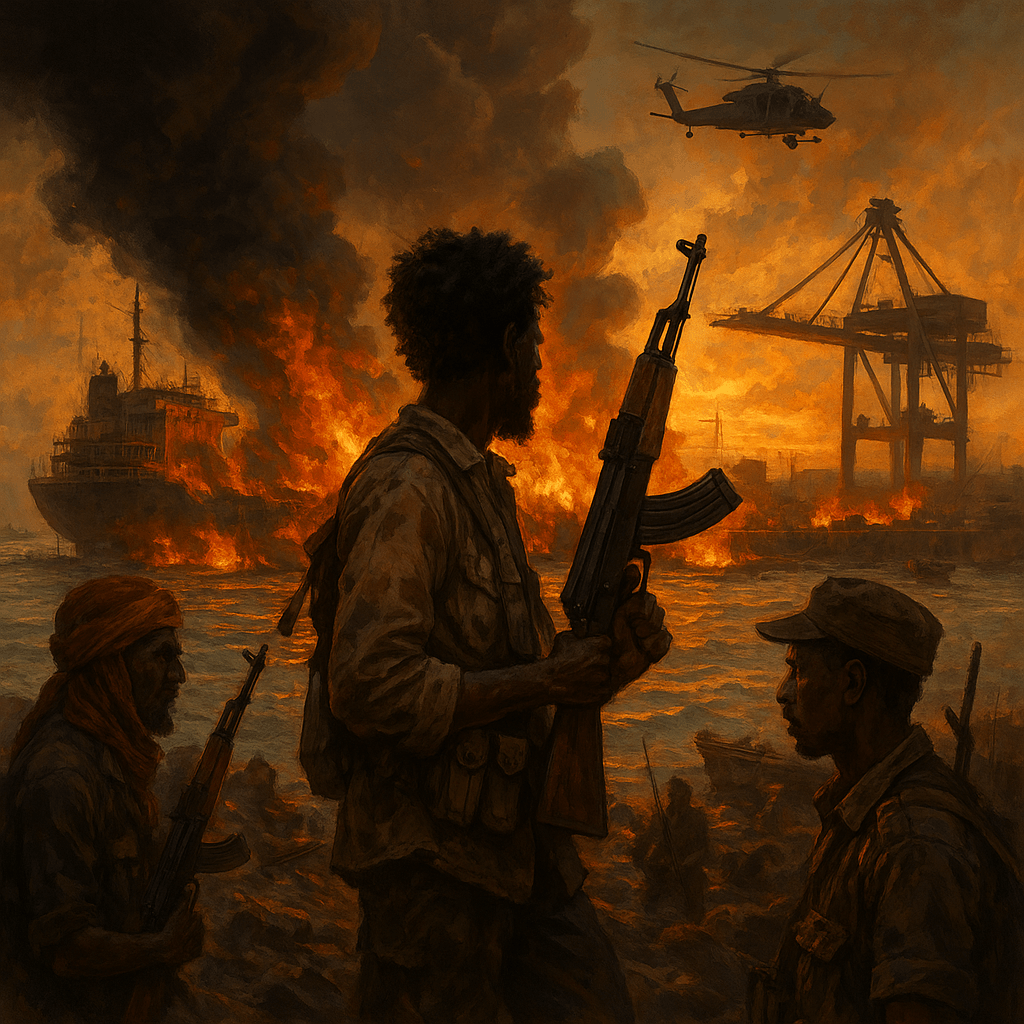
Cutting through the empire’s narrative fog to expose how global capital, Gulf proxies, and colonial cartographies have turned Sudan’s Red Sea into a frontline in the long war against the oppressed.
By Prince Kapone | Weaponized Information | May 6, 2025
1. The Port Attack Isn’t “Paramilitary Chaos”—It’s Empire’s Logistics War
The headline reads like a telegram from the imperial war desk:
“Paramilitaries Launch First Attack on Port in Sudan’s Red Sea Region.”
It appeared on Yahoo News, one of the biggest American media aggregation platforms, recycling Associated Press feeds without analysis, without context, without accountability. A corporate newswire turned megaphone for empire’s narrative factory.
Who wrote it? A quick search shows no byline. That’s not an accident—it’s policy. Anonymous journalism is a hallmark of the imperial press, especially when covering Africa. It’s a way of stripping responsibility from reporting, reducing history to soundbites, flattening contradictions into a lazy narrative: “paramilitaries bad, port under attack, Sudan unstable.” No names, no ownership, no class position to interrogate. Just a faceless imperial chorus humming the same old hymn.
Yahoo News itself is part of Apollo Global Management’s vast financial portfolio, a private equity giant with deep ties to U.S. finance capital, hedge funds, and the military-industrial complex. This isn’t a neutral platform—it’s a pipeline for bourgeois ideology. Every article filtered through its servers serves a class interest, whether through omission, framing, or outright disinformation.
Let’s break it down. The headline centers “paramilitaries”—as if these armed groups are independent actors, springing up like weeds from Sudanese soil. But where are their paymasters? Where are their weapons suppliers? Where are the financiers who built the pipeline of guns, gold, and dollars flowing through Sudan’s war economy? Absent. Invisible. Erased.
The article tells us “the attack occurred at Sudan’s strategic Red Sea port.” Strategic—for whom? The Sudanese people? Or the foreign investors, Gulf monarchies, Israeli intelligence, and U.S. military planners who see the Red Sea not as a waterway but as a global logistics chokepoint? The article doesn’t ask. It can’t. Because its job isn’t to analyze—it’s to anesthetize.
Notice the framing: “attack on port” evokes chaos, criminality, disorder. It invites a moral panic: who will secure trade? Who will protect commerce? Who will stabilize the market? The reader is primed to think not as a worker, not as a Sudanese citizen, but as a shareholder, a stakeholder, an imperial subject worried about “stability.”
And who owns that port? How did it become “strategic”? What treaties, what privatization deals, what IMF structural adjustment packages sold off the commons to foreign interests? Silent. The article says nothing. It acts as if ports fall from the sky, neutral nodes of logistics, instead of contested spaces of labor, sovereignty, and imperial theft.
Even the term “paramilitary” is a smokescreen. These aren’t rogue gangs—they’re imperial subcontractors. The Rapid Support Forces (RSF) didn’t emerge from the ether; they were trained, armed, and financed by Gulf monarchies, Israel, and indirectly blessed by U.S. counterterrorism policy. Calling them “paramilitaries” hides their function: privatized counterinsurgency, designed to suppress popular movements, guard gold mines for Emirati investors, and secure imperial trade routes across the Sahel and Red Sea.
And yet, no mention of the RSF’s business empire. No mention of their war crimes in Darfur. No mention of the UAE’s deep ties to Hemeti. The article flattens complexity into caricature: armed men, chaos, danger, insecurity. The only solution implied? More “stability.” Translation: more military aid, more foreign intervention, more imperial oversight.
Omissions abound. Where is the Sudanese working class? The port unions? The dockworkers? The displaced farmers turned lumpen foot soldiers? Invisible. They do not fit empire’s storyline. The Sudanese people vanish from the narrative, replaced by abstract “forces” battling over an abstract “port” in an abstract “region.”
But we know better. Every port has a history. Every militia has a sponsor. Every headline has an agenda.
The article is not journalism—it’s propaganda by omission. It’s a narrative shell protecting empire’s real interest: the uninterrupted flow of capital through Sudan’s Red Sea gateway. What’s under attack is not “stability.” It’s imperial logistics, imperial chokeholds, imperial profits. And what’s at stake is not a port—it’s Sudan’s sovereignty, Sudan’s working class, and the future of a region caught in the crosshairs of global counterinsurgency.
We will not let them erase the people from the story.
2. From Red Sea Crossroads to Colonial Killing Fields: A History of Plunder and Partition
The imperial press wants you to see the Red Sea port attack as a “new crisis.” But comrades, there’s nothing new here. This is history unfolding in real time—history written in blood and gold, mapped by empire, and policed by capital. To understand the battle for Port Sudan, we must trace the long arc of imperial designs on this region, not as footnotes in “African instability,” but as frontlines of capitalist extraction and global logistics.
Let’s start with geography. The Red Sea isn’t just a sea. It’s a chokepoint. A corridor connecting the Suez Canal to the Indian Ocean, carrying 10% of global trade. Oil tankers, cargo ships, warships—everything imperialism needs to circulate value passes through this narrow artery. Control the ports, and you control the artery. Control the artery, and you can squeeze every nation along the route. That’s why Britain’s colonial strategy carved Sudan into a transit colony: not just for cotton or gold, but for logistics dominance. And that’s why today’s imperialists—from the Pentagon to the UAE—are scrambling to secure Sudan’s coasts.
When the British stormed Omdurman in 1898, they didn’t just crush the Mahdist state—they established a logistics base for empire’s march south. The railways, ports, and administrative zones built under the Anglo-Egyptian Condominium weren’t for Sudanese development; they were pipelines for extracting wealth and moving imperial armies. Port Sudan, built in 1909, was explicitly designed to bypass Egypt’s nationalist movements by shipping cotton and gum arabic directly from Sudan to British markets. Infrastructure as insurgency? No—infrastructure as imperial subjugation.
Fast forward to “independence” in 1956. Did the Sudanese people inherit these ports? No—they inherited debts, comprador elites, and structural underdevelopment. The ports remained nodes in imperial supply chains, controlled by multinational shipping companies, leveraged by IMF policy dictates, and tied to trade routes dominated by Euro-American capital. Any attempt to nationalize or reorganize them faced immediate sabotage: financial sanctions, embargoes, and covert destabilization.
In the 1970s and 1980s, Port Sudan became a key pawn in Cold War geopolitics. As the U.S. and Soviet Union maneuvered across the Horn of Africa, Sudan’s coastal facilities were militarized by both superpowers. The port wasn’t a Sudanese asset—it was a bargaining chip in imperial rivalries, a staging ground for proxy wars from Eritrea to Yemen. Every dock crane carried not just goods, but geopolitical leverage.
Enter the neoliberal era. The IMF’s structural adjustment programs of the 1980s and 1990s imposed privatization mandates on Sudan, forcing state assets—including port operations—into the hands of foreign investors. Western shipping firms, Gulf state logistics conglomerates, and Israeli-linked contractors carved up Sudan’s maritime economy. Public sector workers were laid off. Union power was crushed. The port shifted from public infrastructure to privatized chokepoint. Any labor disruption threatened not just Sudanese commerce but imperial supply chains—inviting “security” interventions from abroad.
And then came the gold rush. As global commodity prices soared, Sudan’s hinterlands became zones of extractive frenzy. The RSF—the very “paramilitary” accused of attacking the port today—emerged not as a rogue militia, but as a privatized security force guarding gold mines, protecting smuggling routes, and laundering resources into Gulf and Israeli markets. Their assault on the port isn’t just a military tactic—it’s a business move. Whoever holds the port holds the customs revenue, the export licenses, the shipping manifests. In other words: control the port, control the loot.
Meanwhile, foreign actors circle like vultures. The UAE has long sought to turn Port Sudan into a Gulf-controlled logistics hub, a rival to Djibouti’s dominance. Israel, through covert security partnerships with Hemeti’s RSF, sees Sudan’s coast as a backdoor into Red Sea naval operations. Egypt, terrified of losing its Suez monopoly, supports Burhan’s SAF to keep the port under Cairo’s shadow. And the U.S., under the banner of “counterterrorism,” runs surveillance and drone operations from bases just across the water. Sudan’s port isn’t a local prize—it’s a global node in imperial supply chains.
The AP’s article tells us there’s “fighting.” But fighting for what? For whom? Against whom? Sudan’s working class knows the answer: they’re caught in a battle between imperial puppets over imperial prizes. The RSF doesn’t fight for Sudan’s sovereignty. Neither does the SAF. They fight for their foreign sponsors’ stake in the global extraction and logistics economy. The people—the dockworkers, the urban poor, the displaced farmers—are trapped in the crossfire, their labor and land turned into bargaining chips.
This is why every headline about “instability” and “paramilitaries” must be flipped on its head. The real instability isn’t that Sudan is fighting—it’s that Sudan refuses to bow. The real crisis isn’t chaos—it’s the empire losing its grip on a chokepoint it thought was secured. And the real violence isn’t just the bullets—it’s the economic strangulation imposed by debt, privatization, and imperial sabotage.
Walter Rodney warned us: underdevelopment isn’t natural; it’s engineered. Sudan’s port didn’t “fail”—it was made to fail. Not by the Sudanese people, but by the global system of imperialism that needs poor nations weak, ports privatized, and logistics corridors militarized. And every time the Sudanese rise up—whether in 1881 or 2019—the empire unleashes new waves of counterinsurgency, sometimes in uniform, sometimes in suits, always waving the flag of “stability.”
The struggle for Port Sudan is the struggle against the imperial chokehold. It is the struggle to reclaim infrastructure for people’s needs, not imperial profits. And until that struggle is won, every crane, every dock, every cargo manifest will remain a battlefield—not just for goods, but for the soul of a nation.
To understand the present, comrades, we must study the past—not as static history, but as a living process. Because the same hands gripping the port today are the descendants of the hands that drew the colonial maps and signed the IMF contracts. And those hands must be broken by the collective force of the people.
3. The Guns Behind the Gates: How Empire Weaponized Sudan’s Ports, Militias, and Gold
What are we really looking at, comrades? The AP calls it a “paramilitary attack.” But under the cold steel of those words lies a brutal reality: this isn’t a battle between two rival gangs, or a random eruption of chaos. This is imperial subcontracting in motion. This is empire outsourcing its violence to local agents. This is the latest chapter in a long war waged against the Sudanese people by capitalism’s permanent need to control the global South’s chokepoints.
When the bullets fly at Port Sudan, they are not just aimed at soldiers. They are aimed at the proletariat—the dockworkers who move the cargo but never own it, the fishers pushed out by port expansion, the migrants turned into cheap labor pools and human shields. The RSF and SAF aren’t proxies of Sudanese power—they are managerial arms of international monopoly capital. Every faction is tied to a foreign patron: the UAE, Egypt, Israel, the United States. This is not a Sudanese civil war. This is a competitive privatization of counterinsurgency.
In Marx’s day, primitive accumulation meant enclosure of commons and the whip of colonial plantations. Today, it means turning ports into securitized assets, guarded by militias for foreign financiers, while the global poor are locked out from the very circuits of value they create. The empire doesn’t just extract oil or gold—it extracts control of logistics. And logistics, comrades, is the bloodline of imperial power in the 21st century.
The AP’s language erases all this. It frames the port battle as an unfortunate obstacle to “shipping stability.” It mourns for the ships, not the workers. It weeps for delayed cargo, not for displaced families. Its allegiance is clear: not to Sudan, but to capital. Not to sovereignty, but to supply chain sovereignty—the empire’s right to move commodities across continents without interference from those who live where the commodities are stolen.
We must reject every framing that casts Sudan as the problem and empire as the solution. We must flip the narrative: the crisis is not that Sudan is “unstable”—it’s that imperialism demands its stability on imperial terms. The crisis is not that ports are contested—it’s that ports should be contested, because they are the veins of capitalist extraction. To secure them for the people is not chaos—it is liberation.
Walter Rodney taught us that underdevelopment is not a natural condition but a violent process imposed from outside. What we see in Port Sudan is the physical infrastructure of that process: fences, private security, customs terminals operated by foreign contractors. The RSF’s attack on the port is not an aberration—it’s a symptom of a deeper contradiction: that no comprador elite can ever control a chokepoint without either brutalizing the people or inviting foreign domination.
To stand with Sudan, then, is not to pick a side between the generals. It is to stand with the workers who load the ships but never see the profits. With the youth who demand bread and end up buried in mass graves. With the mothers who watch foreign soldiers walk past their homes guarding pipelines they cannot tap. With the organized labor that has struck, rebelled, and fought every time empire tried to privatize their lives.
The question is not “which faction will win the port?” The question is: how do the Sudanese people reclaim the port for their own sovereignty, their own liberation, their own collective needs? How do they transform the port from a node in imperial extraction into a lifeline for people’s survival, people’s trade, people’s power?
It means rejecting imperial development models that turn ports into free trade zones run by multinational corporations. It means defending the right of labor to control the docks, to set priorities based on feeding the hungry and rebuilding communities—not maximizing shipping flows for Wall Street. It means seeing infrastructure as a battlefield, where every crane, every warehouse, every customs booth is a contested terrain between capital’s logic and the people’s needs.
The ideological task before us is not simply to denounce the RSF or the SAF or the UAE’s schemes. It is to expose the deeper war: a war of logistics, of extraction, of sovereignty. The struggle for Port Sudan is the struggle for logistics liberation: the fight to tear the arteries of global trade out of monopoly capital’s hands and return them to the service of humanity.
Comrades, we are not watching Sudan “fall apart.” We are watching Sudan refuse to fall in line. Every shot fired at the port is a sign that imperialism’s grip is not absolute. Every breakdown in the supply chain is an opening for a different future. But for that future to be seized, it must be named, envisioned, and fought for—not in the boardrooms of foreign capitals, but in the streets, the docks, the occupied spaces of Sudanese struggle.
This is why our solidarity must not be charity. It must be militant, material, organized. It must not seek to “save Sudan from itself.” It must unite with Sudan’s working class, its farmers, its displaced peoples, to demand reparations for centuries of theft, dismantling of imperial control over ports and trade routes, and the restoration of popular sovereignty over the infrastructure of life.
Because empire doesn’t just own Sudan’s resources. It owns the maps, the ports, the corridors, the customs laws, the shipping schedules. To break empire’s hold on Sudan is to break the chains binding the whole global South to imperial logistics. And that, comrades, is a battle worth fighting.
4. The Struggle Must Move: Building Revolutionary Solidarity from the Docks to the Streets
Comrades, what does it mean to mobilize from this moment? The battle at Port Sudan is not just theirs—it’s ours. It’s a frontline in the global war over who controls the arteries of the world economy. And every drop of blood spilled on that dock, every shipment delayed, every crane set ablaze, is a spark in the empire’s fuel line.
But solidarity cannot remain symbolic. It must be material. It must move beyond hashtags and statements and find its way into our organizing, our campaigns, our practical alliances. Because while the empire bombs from drones and pays warlords to blockade ports, it also relies on the quiet obedience of our ports, our unions, our supply chains here to move its loot. If empire’s logistics are global, then so must be our disruption.
We must look to the history of the International Longshore and Warehouse Union (ILWU) refusing to load apartheid cargo in the 1980s. To the dockworkers who boycotted ships bound for Pinochet’s Chile. To the Yemeni port workers who walked off the job in protest of Saudi bombings. Every port blockade is an act of anti-imperialist sabotage. Every refusal to move imperial cargo is a crack in the empire’s armor.
Right now, Sudanese refugees are being turned into disposable labor across Europe and the Middle East. Right now, Sudanese workers in the diaspora are feeding imperial economies while their homeland is bled dry. What if we organized with them—not as victims to be pitied, but as comrades in a shared struggle against global monopoly capital?
What if every port where Sudanese goods flow became a site of agitation? What if every global South solidarity organization raised funds not for NGOs, but for strike funds, food collectives, independent media, and underground resistance networks inside Sudan? What if every student movement fighting colonial curricula connected their struggle to the sabotage of Sudanese sovereignty through imperial think tanks and foreign consultants?
To mobilize is not simply to sympathize. It is to link our fights. To recognize that the same corporations financing RSF militias are the ones automating our warehouses. That the same Gulf investors gobbling Sudan’s gold are buying up Black neighborhoods in Atlanta and Detroit. That the same surveillance tech tested in Khartoum is used by ICE and police in El Paso and Chicago.
Sudan’s struggle is not an African tragedy—it is a mirror of imperialism’s world system. And to stand with Sudan is to stand against that system everywhere it operates.
We call on unions, student groups, community organizers, abolitionist collectives, and internationalist networks to:
- Organize teach-ins and political education sessions linking Sudan’s struggle to global anti-imperialist movements.
- Identify corporate and military ties to the conflict (e.g., UAE shipping companies, arms contractors) and develop boycott, divestment, and disruption campaigns.
- Support Sudanese diaspora-led organizing, centering the leadership of Sudanese workers, students, and refugees in building solidarity actions.
- Pressure governments, especially in the Global North, to cut military aid, stop weapons sales, and lift economic strangulation tactics against Sudanese popular movements.
- Coordinate with African and Arab leftist formations working to build a pan-African, pan-Arab anti-imperialist bloc against Gulf, Western, and Israeli imperialism.
- Use every imperial supply chain bottleneck as an opportunity for disruption, from ports to railroads to energy infrastructure, recognizing that logistics is an imperial weak point.
We cannot wait for the empire’s collapse to act. The empire is collapsing on top of us. The question is whether we will be buried beneath it, or whether we will build power amidst its wreckage.
In Port Sudan, the guns are pointed at the docks. But the war over the docks is the war over the future. A future where infrastructure serves life, not profit. Where ports feed communities, not markets. Where trade routes connect peoples, not plunderers.
It will not be given. It must be seized. And for that, we need more than sympathy. We need solidarity forged in struggle, in action, in shared risk, in revolutionary clarity.
Sudan’s port is a microcosm of the world’s fight. It is a site of extraction, repression, and resistance. It reminds us, as Walter Rodney taught, that the underdevelopment of the South is the necessary condition for the wealth of the North. And that underdevelopment will not be reversed by policy tweaks or humanitarian aid—it will be reversed only through organized, militant, internationalist struggle.
The port is on fire. The empire is bleeding. And the world’s oppressed are watching, waiting, organizing.
As always, comrades: solidarity is a verb.
 Weaponized Information
Leave a comment