Deconstructing CNN’s propaganda to reveal Yemen’s role in the Axis of Resistance and the unraveling of U.S.-Israeli military hegemony
By Prince Kapone Weaponized Information | May 5, 2025
Why CNN Won’t Tell You That Ansarallah’s Strike Was a Blow Against Empire
CNN’s article on Yemen’s missile strike against Israel is not just an attempt at reporting—it’s a carefully constructed ideological weapon. It follows the same familiar patterns of imperial propaganda, an artful distortion of reality that seeks to reframe the world’s injustices in a way that favors the empire. Yemen, a country that has been subjected to relentless aggression, blockade, and devastation, is depicted in CNN’s account not as a nation resisting occupation but as an inexplicable threat to international stability. It is portrayed as a faceless antagonist—backed by Iran and threatening global security—while the actual aggressors, Israel and its imperial backers, remain unexamined, their actions obscured beneath the veneer of ‘security’ and ‘legitimacy.’
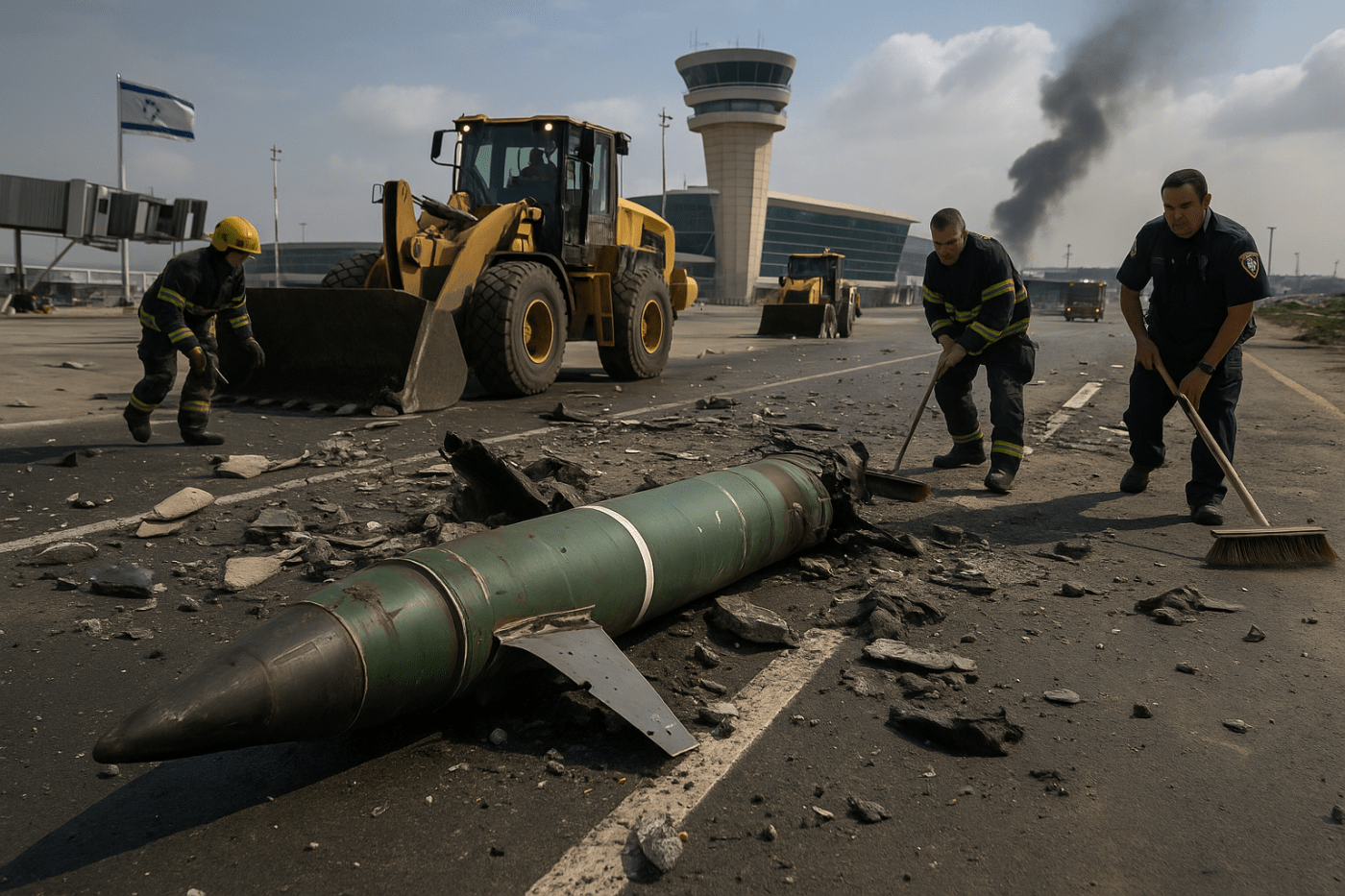
In the CNN narrative, the story unfolds with Israel’s defense systems failing to intercept a missile fired by the “Houthi rebels” in Yemen, striking near Ben Gurion Airport in Tel Aviv. This technical failure is framed as a breach of Israel’s impenetrable security, an event that shakes the foundations of its defense narrative. But what is deliberately omitted here is the reason behind Yemen’s missile strike: solidarity with the Palestinian people, a rejection of the Zionist genocide unfolding in Gaza. The missile is not a random attack; it is a direct response to Israel’s brutality. The Houthis – or Ansarallah as they define themselves – claim responsibility, stating clearly that the missile was fired in retaliation against Israel’s actions in Gaza, a fact CNN conveniently omits, opting instead for a sanitized account of “failed interception” and “security breaches.”
CNN’s omission of this key context is not a simple oversight but a deliberate act of ideological erasure. It is an attempt to obscure the true motivations behind Yemen’s resistance. By focusing on the technological failure of Israel’s air defense systems, CNN shifts the narrative away from the political and moral dimensions of the attack. The missile is presented not as an act of solidarity but as an ‘irrational’ act of violence—one that is framed as a threat to international security. Ansarallah, in this narrative, are not freedom fighters resisting imperialism; they are merely “Iran-backed rebels” engaging in terrorism. This is a typical imperialist tactic: reframe resistance as irrational aggression and obscure its roots in a legitimate struggle for sovereignty and justice.
But beneath the surface of CNN’s narrative, we see the cracks of imperial contradictions. The missile strike on Ben Gurion Airport was not simply an isolated incident; it is part of a broader, ongoing campaign of resistance by Yemen. Ansarallahs’ ability to launch such strikes despite U.S. and Israeli airstrikes and military intervention is a testament to their resilience and determination. It also highlights a deeper geopolitical reality that CNN is keen to avoid: Yemen’s place in the axis of resistance against Zionism and U.S. imperialism. While the West has repeatedly tried to isolate and weaken Yemen through sanctions, airstrikes, and military blockades, Ansarallah has demonstrated an ability to strike back at the heart of empire, targeting the symbolic and strategic points of Israeli and U.S. power.
Yemen’s actions in the Red Sea—its naval blockade of Zionist shipping—are an extension of this resistance. Ansarallahs’ blockade is not an act of aggression; it is a legitimate exercise of Yemen’s right to defend itself and to intervene in the larger geopolitical struggle against Israeli colonialism and imperialist hegemony. Yemen is the only country in the world today that is actively enforcing international law in a tangible way by blocking Zionist military and trade routes, directly countering the economic and military lifelines that sustain the Zionist genocide in Gaza. But again, this critical fact is omitted in CNN’s framing of the situation. Instead of acknowledging Yemen’s blockade as a form of international law enforcement, CNN paints it as a destabilizing act—further isolating Yemen in the eyes of global audiences.
This erasure is not accidental. CNN is not merely reporting on the facts; it is constructing a reality that serves the interests of empire. The missile strike, the blockade, the ongoing suffering in Gaza—all of these are woven into a narrative that seeks to obscure the true nature of the conflict. By reducing Yemen to a proxy of Iran and focusing on the ‘threat’ to Israeli airspace, CNN shifts the focus away from the systemic violence of settler-colonialism and imperialism. The real story—the one that CNN refuses to tell—is about the resistance of oppressed nations in the face of overwhelming military might. It is about the ability of countries like Yemen to stand up to the imperialist order and demand sovereignty, justice, and dignity for their people.
The imperial script, as written by CNN, requires the erasure of this resistance. Ansarallah is not allowed to be seen as legitimate actors in their own right; their struggle is reinterpreted as a symptom of Iranian influence rather than as a legitimate response to the Zionist and imperialist threat. The missile strike, CNN tells us, is merely a “failed interception”—a technical malfunction in the face of an unpredictable enemy. But in reality, what we are witnessing is the unfolding of a new kind of warfare: one in which the oppressed are no longer content to be passive victims, but actively engage in the global struggle for justice and liberation.
Next, we will shift focus to the deeper material and historical context of Yemen’s missile strike, placing it within the larger geopolitical dynamics of resistance to Zionist imperialism. We will examine how the actions of Ansarallah—militarily, diplomatically, and economically—are part of a broader anti-imperialist struggle that spans the Middle East, from Gaza to Tehran. Through this lens, we will show how Yemen’s resistance is not just a local struggle, but a vital front in the global fight against imperialism, one that continues to challenge the very structures of power that sustain the Zionist regime and its imperial backers.
The Long Shadow of Empire: Missiles, Blockades, and the Struggle for Sovereignty
The CNN article buries the larger geopolitical story under the rubble of sensationalized military spectacle. While it fixates on the technical failure of Israel’s missile defense system and casts the Ansarallah strike as a rogue provocation, it deliberately omits the historical and structural forces that produced this moment. The missile fired from Yemen wasn’t simply a ballistic projectile—it was a political declaration, a material extension of a war that stretches from Gaza’s ruins to the corridors of Washington and Riyadh. To understand this strike is to excavate the architecture of imperialist war that has encircled Yemen, Palestine, and the entire region.
What CNN won’t acknowledge is that Ansarallah’s missile represents the continuation of a struggle against a decade-long U.S.-Saudi-Emirati siege. Since 2015, Yemen has been bombed, starved, blockaded, and economically strangled by a coalition of imperialist and comprador forces attempting to crush its independent trajectory. The so-called Saudi-led coalition’s war, fully backed by U.S. weapons, logistics, and intelligence, aimed to reinstall a puppet government willing to surrender Yemen’s sovereignty to Gulf capital and Western extraction. But Ansarallah didn’t collapse; it consolidated control, not just militarily but politically—organizing popular committees, reviving local governance, and building what many Yemenis see as a revolutionary alternative to the comprador state that preceded it.
The CNN article never uses the word “blockade” to describe Israel’s actions in Gaza, yet is quick to frame Ansarallah’s naval interdictions in the Red Sea as destabilizing attacks. But here lies the imperialist hypocrisy: under international law, the collective punishment of Gaza’s population—denying food, fuel, and medicine—is a war crime. Ansarallah’s naval blockade, targeting Israeli-linked shipping, is not an indiscriminate campaign but a strategic attempt to enforce the very international law the so-called “rules-based order” refuses to uphold. In fact, it is arguably the only military action on Earth attempting to materially disrupt a genocide in progress. This context is completely erased by CNN’s narrative machinery.
The missile strike near Ben Gurion Airport must be situated not only within Yemen’s war, but within the broader geopolitical arc of the Axis of Resistance—the loose coalition of Iran, Hezbollah, Ansarallah, Iraqi Popular Mobilization Forces, and Palestinian armed movements resisting U.S.-Zionist hegemony in West Asia. By targeting Israel’s primary airport, Ansarallah signals its willingness and capacity to expand the battlefield in solidarity with Gaza. This wasn’t a random escalation; it was an intentional act aligning Yemen’s struggle with the Palestinian cause, situating their fight within a shared anti-imperialist front. That is the very connection CNN’s coverage must sever to preserve the fiction of isolated “terrorist” threats rather than regional resistance to imperial domination.
The article also cloaks the U.S. role in near silence, framing American strikes in Yemen as routine “efforts to weaken the group.” But these are acts of war—hundreds of airstrikes, cruise missiles, stealth bombers deployed against one of the poorest nations on Earth. The scale of U.S. imperial violence against Yemen is rendered invisible, reduced to technical operations against a faceless militant threat. No mention of the cholera outbreaks, famine, or collapsed hospitals inflicted by the blockade and bombing. No mention of how every U.S. administration since Obama has treated Yemen’s destruction as bipartisan policy. No mention of the billions in U.S. arms contracts fueling the war machine pounding Yemen’s people. CNN presents imperialism as background noise, the natural hum of power, not the central engine of violence driving the region’s crisis.
By focusing on the missile’s trajectory rather than its cause, CNN’s coverage decontextualizes the attack from the material realities of occupation, siege, and resistance. The missile is divorced from the siege of Gaza, the blockade of Yemen, the encirclement of Iran, and the permanent war machine strangling West Asia. The article pretends Israel’s vulnerability is a product of a missile malfunction rather than a symptom of empire’s declining ability to impose its will uncontested. Ansarallah’s strike exposed not just the limits of Israel’s missile defense, but the political fragility of an apartheid state increasingly isolated on the global stage.
In reality, Ansarallah’s action was a convergence point: a material blow against Zionist logistics, a geopolitical signal to the Axis of Resistance, and a narrative rupture in the illusion of Israeli military invincibility. CNN’s refusal to name these dynamics isn’t a failure of journalism—it’s the function of an imperialist media apparatus tasked with preserving U.S. hegemony’s ideological scaffolding. The missile didn’t just slip past the Arrow system; it tore a hole in the myth of unassailable empire, and the job of the imperialist press is to stitch that myth back together as quickly as possible.
Resistance Beyond the Interceptor: Strategic Lessons from a Missile’s Trajectory
The CNN article ends where our analysis begins: with the unanswered question of what the missile’s successful penetration actually signifies. In imperialist media logic, this event is framed as a glitch, a momentary technical failure in an otherwise unassailable defense system. But every breach of the imperial shield is also a revelation—one that cracks open deeper truths about power, vulnerability, and the evolving geometry of resistance. For Ansarallah, the missile was never just a projectile—it was a message inscribed in steel and fire: that no fortress of apartheid, no dome of imperial technology, can insulate an occupier from the political consequences of genocide.
By reaching the outskirts of Ben Gurion Airport, Ansarallah redefined the geography of confrontation. Tel Aviv is no longer insulated from the war crimes in Gaza; it is materially tethered to the violence it enables. This is a transformation of both terrain and narrative. The missile collapses the artificial distance between the siege of Gaza and the civilian comfort of Israeli metropoles. Every flight diverted, every train halted, every plume of smoke at the airport is a reminder: imperial logistics are not neutral; they are the infrastructure of occupation. CNN’s framing, lamenting the “interrupted travel” and “breach of security,” erases the fact that the airport itself functions as a node in the occupation’s global supply chain—moving arms, personnel, and capital to sustain apartheid. Ansarallah’s strike was not random terror; it was a disruption of that logistical artery.
Imperialist media portrays Israel’s missile defense systems—Iron Dome, David’s Sling, Arrow—as apolitical shields, protective technologies safeguarding “civilians.” But these are not neutral walls; they are integral to a military apparatus enforcing colonial domination from the river to the sea. Every interception is part of the machinery of occupation, preserving the conditions that enable Gaza’s starvation and bombardment. When CNN laments the “vulnerability” of Ben Gurion Airport, it frames imperial vulnerability as an aberration, a failure of defense, rather than as the inevitable consequence of a system built on theft, exclusion, and violence. But Ansarallah’s missile renders this vulnerability structural: there is no technological solution to a political contradiction. No dome can permanently separate the occupier from the resistance of the occupied.
Strategically, the missile’s arrival at Ben Gurion signals a shift in the balance of initiative. For decades, Israel, backed by U.S. imperial power, projected force outward—bombing Beirut, Damascus, Baghdad, Sanaa—with impunity. But the missile from Yemen reverses the trajectory: from the south, from over 2,000 kilometers away, a material force traverses imperial airspace to reach the heart of the Zionist settler state. This is not mere symbolism. It’s a demonstration of range, precision, and geopolitical alignment across the Axis of Resistance. CNN frames Iran as the puppeteer, but what terrifies imperial strategists is not Iranian control—it’s the growing autonomy and technological capacity of movements like Ansarallah, Hezbollah, and Hamas to develop indigenous deterrence beyond Tehran’s direct command.
We should understand this not as the isolated advancement of missile tech, but as a broader transformation of anti-imperialist warfare. Ansarallah’s capacity to strike Israel is inseparable from its capacity to impose a de facto naval blockade on Zionist-linked shipping in the Red Sea—a blockade that, contrary to CNN’s framing, represents the only current enforcement of international law against genocide. The imperialist “rules-based order” has sanctioned no embargo, no interdiction, no penalties on Israel’s starvation of Gaza. Only Ansarallah’s blockade operationalizes the principle that genocide must be materially disrupted, not merely condemned in UN speeches. The missile and the blockade are two arms of the same strategy: to widen the battlefield, to force material costs on the perpetrators of colonial violence.
Imperialist analysts scramble to interpret the missile’s implications for air defense procurement, for U.S.-Israeli military coordination, for “regional stability.” But they cannot name the deeper crisis: the slow unraveling of imperial impunity in West Asia. Each failed interception, each blocked shipping lane, each unsanctioned act of solidarity from Yemen to Lebanon, chips away at the architecture of hyper-imperial control. This is the deeper lesson CNN cannot tell: that the empire’s military preeminence is eroding not from a single blow, but from a thousand converging fractures, driven by peoples who refuse to die quietly under bombs, blockades, and occupation.
We end this excavation with the words of Ansarallah itself—ignored entirely by CNN but central to the political meaning of this missile. “We stand with Palestine,” their statement declared. “We will continue striking until the aggression ends.” In these words, we glimpse not fanaticism, but fidelity—to a struggle that links Yemen’s battered mountains with Gaza’s bombed alleys, with Lebanon’s refugee camps, with Iraq’s battered towns. It is the fidelity of a people refusing to submit to imperial siege, refusing to decouple their liberation from the liberation of Palestine.
And in that refusal lies a political challenge far beyond missile trajectories: the question of whether the world’s oppressed will remain spectators to genocide, or whether they will, like Ansarallah, turn solidarity into disruption, and declarations into material force. This is the message that soared past the Arrow system. This is the message the empire fears most.
The Missile as Message: Toward a Politics of Material Solidarity
When the dust cleared at Ben Gurion Airport, imperial media rushed to reassert the narrative of inevitability: that the missile was an anomaly, the breach an accident, the defense system fundamentally sound. But for those who understand history from below, the debris scattered on the tarmac spoke a different truth. Every fragment of shrapnel was a fragment of imperial certainty shattered. Every diverted flight was a quiet admission: the fortress is not invincible. The sky is no longer theirs alone.
CNN’s article, like the broader imperialist media apparatus, cannot name this truth. It can catalogue technical failures, quote military analysts, recite official statements. But it cannot account for the deeper crisis exposed by the missile: that empire’s monopoly on violence is eroding, that the machinery of occupation is vulnerable, that resistance—armed, organized, and internationalist—is not only surviving but adapting. This is not merely a military development. It is a political rupture.
Ansarallah’s strike was not a gesture of despair, nor a provocation for its own sake. It was an intervention in a genocidal status quo—a material disruption of a global supply chain that fuels Israeli apartheid. While the “international community” mouths platitudes and dithers in diplomatic paralysis, Ansarallah acted. In doing so, they exposed the bankruptcy of international law as an instrument of justice under imperial rule. They forced a material consequence where the UN imposed only speeches. They turned solidarity from sentiment into sabotage. In a world where genocide is televised in real time, the missile declared: we will not be complicit by silence or inaction.
This is why CNN erases the blockade in the Red Sea, reduces Ansarallah to Iranian proxies, frames the strike as irrational escalation. To name it truthfully would be to acknowledge its legitimacy. To recognize that Yemen’s blockade is, in fact, the only enforcement of international law currently operating to obstruct the machinery of genocide. To admit that Ansarallah’s missile is not terrorism but a radical fidelity to the Palestinian cause—a fidelity that demands we ask ourselves: what material price are we willing to impose on imperial power? What material risks are we prepared to take to stop a genocide?
For the global proletariat, for colonized peoples everywhere, this missile is not simply an event in a distant war. It is a summons. A reminder that solidarity is not an emoji, not a hashtag, not a performative stance. Solidarity is material force. Solidarity is rupturing the circuits of imperial reproduction. Solidarity is refusing the comfort of abstraction, and instead standing where the oppressed stand: on the terrain of struggle, with all its risks and consequences.
From Yemen’s mountains to Gaza’s ruins, from Beirut’s streets to Oakland’s ports, the path forward is not mediated by imperial legality or NGO-managed solutions. It is carved by those willing to interrupt, to blockade, to sabotage, to expose, to strike. Ansarallah’s missile traversed 2,000 kilometers not just to hit an airport, but to deliver a message across borders and oceans: that liberation is possible, that imperial fortresses can be breached, that the long night of Zionist and imperial domination is not destiny but a system that can—and must—be dismantled.
We conclude this excavation not with a bow to the spectacle of military technology, but with an affirmation of political clarity. Every intercepted shipment, every diverted flight, every breached defense system is a crack in the armor of empire. Every act of material solidarity expands the space in which resistance can breathe. And every refusal to normalize genocide deepens the possibility of a future liberated from the chains of colonial violence.
In this moment, as bombs fall on Gaza, as ships sail with weapons, as airports serve as conduits of occupation, the question before us is not whether the missile will come again. The question is: will we stand as passive spectators behind imperial walls—or will we, too, find ways to turn solidarity into rupture, words into weapons, and history into revolution?
 Weaponized Information
Leave a comment