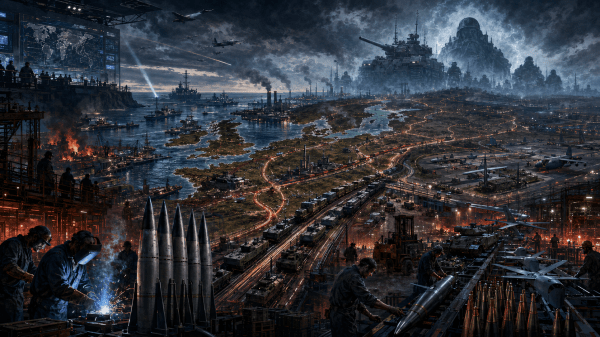
CNN warns that Russia could someday “test” NATO, but the military transformation supposedly justified by that future threat is already underway. Europe is being rearmed, civilian infrastructure reorganized for military mobility, and productive capacity redirected toward an expanding war economy as U.S. weapons stocks strain under commitments spanning Ukraine, Iran, Russia, and China. The deeper story is not a proven Russian timetable for invasion, but an American-centered imperial bloc confronting the rising cost of reproducing its military reach and hardening Europe as a Western Rear. What Russia could do tomorrow becomes the argument for what Europe must militarize today.
Surrender as Relief: Rubio’s War on Cuba’s Means of Survival
Marco Rubio’s new sanctions do not merely target Cuban military procurement. They strike the institutions, banking channels, suppliers, repair systems, and foreign relationships through which Cuba survives a blockade designed to manufacture deprivation and political surrender. Washington restricts fuel, finance, technology, and trade, then presents the resulting hardship as proof of socialist failure. As Cuba turns toward China, Russia, and other partners to preserve its sovereignty, those lifelines are recast as threats. Behind the language of security lies the old imperial objective: isolate the island, weaken its defenses, deepen popular suffering, and force the Cuban Revolution to kneel.
Factories for the Fortress, Austerity for the People: America’s Imperial Reconstruction
The so-called manufacturing rebound lauded by CNBC is a deceptive mirage masking an imperial crisis. Beneath flashy growth numbers lie the ruins of a deindustrialized America, where financial extraction and reliance on foreign inputs have left vital sectors like semiconductors and military production at risk. Tariffs inflate costs, wars disrupt essential supply chains, and the resulting economic strain is shifted onto workers and marginalized communities. Capital demands industry without meaningful investment in labor or infrastructure, turning factories into fortresses of control rather than engines of prosperity. This isn't a renaissance; it's an imperial scramble desperately attempting to reclaim dominance amid its own financial decay.
The Crime of Making Too Much: China and the Empire’s Monopoly on Abundance
The Economist's recent critique of China's industrial prowess reveals a deeper hypocrisy within Western narratives. While it acknowledges China's efficiency, it vilifies state-driven competition when it disrupts Western hegemony. The real issue is not overproduction but an imbalance of purchasing power, presenting an ugly tableau of warehouses filled with goods while people lack access. As China strives for self-reliance, the West's response is to impose tariffs and sanctions, prioritizing monopoly over equitable distribution. This conflict isn’t a mere economic dispute; it’s a struggle for who controls productive capacity. The question is whether to align production with human need or maintain the status quo of inequality.
The Birth of Weaponized Information: How the Empire Lost Its Monopoly Over Truth
For a generation the American empire dominated not only the battlefield but the global narrative. Corporate media framed wars, justified sanctions, and explained imperial power to the world. But leaks, whistleblowers, digital networks, and rival media systems shattered that monopoly over reality. This essay traces the historical collapse of the imperial information order and the... Continue Reading →