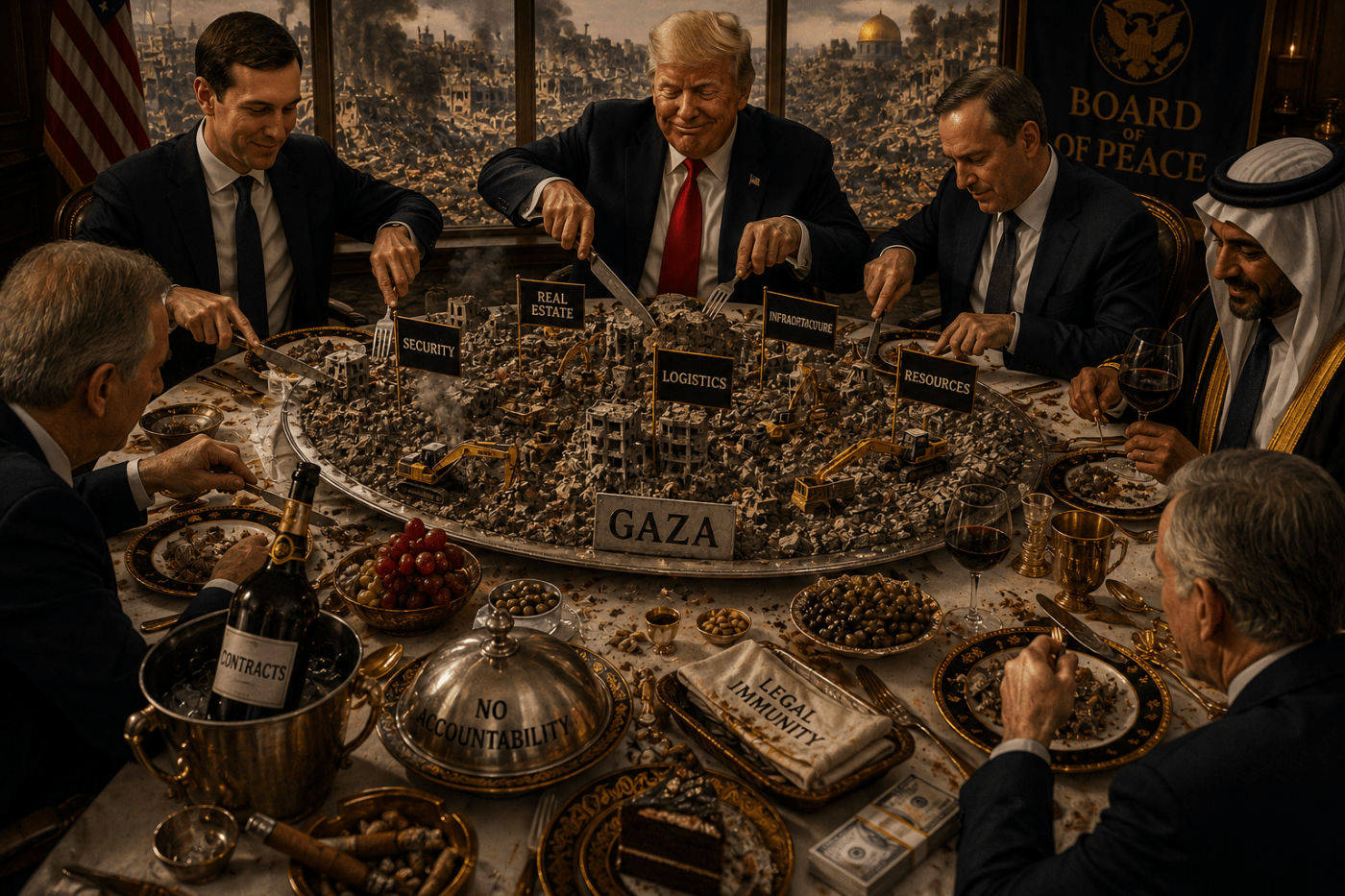
The Guardian exposed a leaked immunity draft, but the deeper scandal is the foreign board being positioned over Gaza in the name of peace. Behind the legal language sits a machinery of U.S. executive power, Israeli security demands, technocratic administration, contractor profit, public-property seizure, and reconstruction capital. This is occupation rebuilt as management: hyper-imperialism wearing the mask of peace and technofascism writing itself a liability waiver. The task is not charity for Gaza under foreign rule, but organized solidarity against the board, the bankers, the builders, the lawyers, and the whole colonial architecture of reconstruction without sovereignty.
Prince Kapone | Weaponized Information | June 29, 2026
The Scandal Inside the Scandal
The Guardian’s “Trump’s Board of Peace plans to grant itself sweeping immunity, documents show”, written by Cate Brown and Aram Roston and published on June 27, 2026, reports that the UN-sanctioned Board of Peace announced by Donald Trump to rule Gaza is preparing a draft resolution that would shield its own members, affiliated officials, international forces, Palestinian technocrats, and nonresident contractors from arrest, detention, or legal proceedings in Gaza. The article also reports that the draft would allow the Board and its security apparatus to obtain public premises and facilities in Gaza “free of charge,” while creating an internal claims process for property loss, injury, illness, or death caused by its operations. In plain English, the proposed rulers of Gaza want the right to govern, police, contract, occupy facilities, and adjudicate their own damage without being dragged before the people whose land and lives they are preparing to administer.
The Guardian deserves credit for exposing the draft. But credit is not surrender. The article opens the door and then hesitates at the threshold. It treats the proposed immunity regime as a legal-accountability scandal, which it certainly is, but does not fully excavate the deeper political crime buried underneath it. The question is not only whether the Board of Peace can be sued, prosecuted, arrested, or restrained. The larger question is why Gaza, a colonized Palestinian territory devastated by U.S.-armed Israeli violence, is being placed under an unelected foreign governing mechanism in the first place. The scandal is not merely that the jailer wants immunity. The scandal is that the jailer has been handed the keys and introduced to the world as a peacekeeper.
This is where the article’s liberal frame does its quiet work. Its source hierarchy is crowded with lawyers, contractors, diplomats, and legal specialists. That produces useful facts, but it also narrows the field of vision. The reader is invited to ask whether the Board has “external oversight,” whether contractors have “liability clarity,” and whether a proper status-of-forces agreement exists. These are not meaningless questions. They are real questions. But they are not the root question. A colonized people does not need a better complaints department for foreign rule. It needs sovereignty, return, reconstruction under its own authority, and justice for what has been done to it.
The article also exposes the language of policy laundering without fully naming it. “Peace,” “stabilization,” “technocratic governance,” “international force,” and “reconstruction” are the perfumes sprayed over the corpse of colonial administration. The old empire said protectorate. The new empire says Board. The old empire said mandate. The new empire says transitional mechanism. The old empire seized land with rifles and charters. The new empire writes “free of charge” into a draft resolution and calls it logistics. History does enjoy repeating itself, but under capitalism it usually returns with a consultant, a contractor, and a liability waiver.
So the Guardian article gives us a necessary document, but not yet the necessary theory. It shows us the legal smoke, but not the full machinery of the fire. Its own reporting points beyond its own frame: immunity, contractors, public facilities, security forces, internal claims, Trump family networks, reconstruction bids, and a foreign board positioned over Gaza. That is not merely an accountability problem. That is the outline of a colonial administration trying to immunize itself before the people of Gaza can even breathe under the rubble. The task, then, is to take the facts the article surfaces, recover the facts it leaves scattered or buried, and name the system plainly: not peace, but imperial management; not reconstruction, but rule over ruins.
The Machinery Behind the Immunity Clause
The Guardian’s report begins with the leaked immunity draft, but the machinery behind that draft was already assembled before the lawyers began arguing over liability. On November 17, 2025, the UN Security Council adopted Resolution 2803, endorsing Trump’s Gaza plan, welcoming the Board of Peace, and authorizing an International Stabilization Force. This is the formal shell. The Board did not fall from the sky like a humanitarian angel with a clipboard. It came through the old imperial ritual: destruction first, international authorization second, security administration third, contracts after that.
The Board’s own framework lays out the political architecture with bureaucratic calm. Gaza is to be demilitarized, “deradicalized,” redeveloped, and governed through a Palestinian technocratic committee under Board oversight. That phrase “technocratic committee” does a lot of work. It sounds clean, modern, competent, and apolitical. But in a colonized territory, “apolitical” usually means politics has been removed from the people and handed to managers selected by somebody else. The Palestinian masses are not invited to rule. They are to be administered.
This is why the legal immunity question matters. The leaked draft reportedly grants protection from “arrest, detention or legal proceedings” in Gaza to Board officials, OHR personnel, Palestinian technocrats, international forces, and nonresident contractors. It also creates an internal process for claims involving property loss, personal injury, illness, or death arising from Board operations. In practical terms, the same apparatus that governs, polices, contracts, and occupies facilities would also position itself to process complaints against itself. A claims desk is not justice. It is paperwork after harm.
The same draft reportedly allows the Board, the Office of the High Representative, and the International Stabilization Force to receive public premises and facilities in Gaza “free of charge”. This is not a minor administrative phrase. Gaza is a devastated territory where public buildings, land, hospitals, schools, roads, utilities, warehouses, crossings, ports, water systems, and municipal facilities are not abstractions. They are the material basis of collective life. To make them available to a foreign governing and security apparatus without clear Palestinian sovereign authority is to turn public property into operational infrastructure for outside rule.
The Palestinian and anti-colonial criticism of this framework has been direct. Al-Haq warned that the U.S. plan made any suspension of Israeli attacks conditional on unilateral U.S.-Israeli terms, subordinating Palestinian self-determination to externally imposed demands. FIDH and Palestinian rights groups argued that Resolution 2803 hands Gaza governance to a de facto foreign-controlled administration while failing to provide accountability for crimes committed against Palestinians. UN Special Rapporteur Francesca Albanese condemned the resolution as a “security-first, capital-driven model” of foreign control. Strip away the polite institutional language and the objection is simple: Palestinians are being asked to accept supervision instead of sovereignty.
The political economy underneath this scheme is not hidden if one knows where to look. Security in Context describes Trump’s Gaza plan as a fusion of colonial administration, counterinsurgency pacification, and disaster capitalism. Electronic Intifada characterizes the Board as humanitarian branding for a structure loaded with billionaires, Trump cronies, ultra-Zionists, financiers, and figures tied to Israeli state power. This is not the Red Crescent showing up with blankets. This is the imperial boardroom showing up after the bombs, talking softly about reconstruction while the contractors measure the rubble.
The contractor logic had already begun to surface before the immunity draft became public. Responsible Statecraft reported that a U.S. disaster-response firm sought a seven-year trucking and logistics monopoly in Gaza with projected profits up to 300%. Democracy Now also reported the proposed monopoly over Gaza trucking and logistics. That is the material clue. Reconstruction is not only about cement, steel, pipes, roads, and housing. It is about who controls the routes, contracts, permits, warehouses, security perimeters, insurance frameworks, and legal protections through which rebuilding becomes accumulation.
The historical baseline is occupation. The ICJ’s July 2024 advisory opinion found Israel’s continued presence in the occupied Palestinian territory unlawful and affirmed that the Palestinian people possess the right to self-determination. Amnesty’s summary of the ruling notes that the Court found Israel’s occupation unlawful and called for it to end as rapidly as possible. Any postwar arrangement that places Gaza under foreign administration must be judged against that baseline. The question is not whether the Board can be made more accountable inside the existing arrangement. The question is whether the arrangement continues the denial of Palestinian self-rule under a new institutional costume.
That is why the Guardian’s leaked draft is not an isolated legal curiosity. It sits inside a broader structure: Security Council authorization, U.S. executive leadership, Israeli security demands, international stabilization forces, technocratic Palestinian administration, contractor profit opportunities, public property access, and legal insulation. The facts do not point to reconstruction as neutral humanitarian repair. They point to a postwar governance economy in which Gaza’s destruction becomes the terrain for administration, pacification, and accumulation.
Occupation Rebuilt as Peace
The real story is not that a peace board may have gone too far with legal immunity. That is the liberal reading, the lawyer’s doorway into the crime scene. The real story is that Gaza is being moved from open destruction into managed administration, from bombardment into bureaucracy, from the violence of the missile to the violence of the memorandum. The bomb tears down the home. The board arrives to decide who may rebuild, who may move, who may govern, who may profit, who may complain, and who must submit. This is not the end of war. It is war reorganized as management.
The Board of Peace is where hyper-imperialism becomes institutional flesh. It is not simply the United States acting alone, nor Israel acting alone, nor the United Nations acting as some neutral angel in blue. It is the whole machinery moving together: U.S. executive power, Israeli security demands, international legal cover, stabilization forces, technocratic administration, contractors, financiers, and donors. Each piece performs its own clean little function. One authorizes. One supervises. One secures. One administers. One profits. One denies responsibility. Together they form the modern imperial organism: no single hand seems to hold the knife, yet the wound appears exactly where empire needs it.
This is hyper-imperialism after the age of naked colonial confession. It does not need to announce a governor-general with a feathered hat and a cavalry escort. It produces a resolution, a board, an office, a force, a claims process, a reconstruction plan, and a vocabulary of peace so sterile it could disinfect a massacre. The old empire seized territory and called it civilization. The new empire administers ruins and calls it stabilization. The political content is not abolished. It is laundered through procedure.
Technofascism names the governing method. Gaza is not treated as a living society with a people, a history, a resistance, and a right to determine its future. Gaza is treated as a problem set: demilitarization, deradicalization, redevelopment, logistics, claims, facilities, security, contracts. The human being disappears into the administrative category. The people become a population. The population becomes a risk. The risk becomes a management question. The management question becomes a security mandate. The security mandate becomes a contract. The contract becomes profit. Somewhere under all that language, a child is still waiting for water.
The immunity clause is therefore not an excess. It is the skeleton key. Any regime that intends to rule over a people without the people must first protect itself from the people. Immunity is the precondition of foreign administration. It tells us that the architects of this project understand perfectly well what they are building. They are not innocent humanitarians wandering into Gaza with sacks of flour and bad legal advice. They are constructing a system in which authority flows downward, complaints flow inward, money flows outward, and accountability evaporates upward into the institutional fog.
That is why the internal claims mechanism is so obscene. It turns injury, death, and property loss into administrative events. The colonized are not asked what justice requires. They are offered a process. The same structure that organizes the operation prepares to judge the damage caused by the operation. The fox will not merely guard the henhouse; it will also chair the poultry compensation tribunal. This is how lawfare works when dressed as humanitarian governance. Law is not abolished. Law is reorganized so power can move through it without being stopped by it.
Public premises “free of charge” carries the same logic. The phrase sounds technical only to those trained not to hear history. Public property in Gaza is not empty space on an imperial spreadsheet. It is the material skeleton of collective life: the places through which a people educates children, heals wounds, stores food, moves goods, organizes water, shelters families, and governs itself. To make those facilities available to an external board and its security apparatus is to convert the infrastructure of Palestinian social life into the operating base of foreign command.
This is accumulation through destruction. First Gaza is shattered. Then the shattering becomes the justification for outside management. Then outside management becomes the condition for reconstruction. Then reconstruction becomes the field of logistics monopolies, security contracts, donor flows, claims systems, redevelopment fantasies, and legal immunities. Capital loves nothing more than a devastated landscape with a captive population and a guaranteed security architecture. It calls that tragedy. Then it calls that opportunity. Then it calls the invoice.
Here the colonial contradiction stands naked. Gaza needs reconstruction, but not reconstruction as receivership. Gaza needs security, but not security as disarmament under foreign command. Gaza needs public facilities, but not public facilities converted into the premises of the administrators. Gaza needs justice, but not claims processing by the same apparatus seeking immunity. Gaza needs governance, but not technocratic rule beneath imperial supervision. Gaza needs peace, but not peace defined as Palestinian surrender to the polite machinery of those who presided over devastation.
The Board of Peace is occupation redesigned for the age of managerial empire. It is not old colonialism copied badly. It is colonialism updated. Instead of conquest announced as conquest, we get rule announced as transition. Instead of plunder announced as plunder, we get reconstruction contracts. Instead of martial law announced as martial law, we get stabilization forces. Instead of colonial courts, we get internal claims mechanisms. Instead of direct annexation, we get supervised administration. Empire has learned to speak in acronyms because flags became too obvious.
The article under excavation glimpses the scandal but cannot name the system. It sees immunity and asks whether there will be oversight. The people of Gaza, and all who stand with them, must ask a more serious question: who gave these people the right to rule at all? The answer is not law. The answer is power. And the task is not to beg the imperial board for better manners. The task is to expose the board as one more instrument in the long war against Palestinian sovereignty, dressed in the language of peace because naked domination has become inconvenient public relations.
No Charity for Colonial Receivership
The line of struggle is clear: solidarity with Palestine cannot stop at mourning, charity, or ritual outrage. Gaza does not need the empire’s pity while the empire writes the terms of its captivity. It needs organized resistance to the entire machinery now being assembled in the name of peace: the Board of Peace, the International Stabilization Force, the immunity framework, the contractor pipeline, the logistics monopolies, the public-property grab, and every polite document that tries to turn Palestinian self-determination into a problem for foreign administrators to manage.
The first anchor must be the Palestinian-led movement itself. The BDS Movement identifies the Palestinian BDS National Committee as the coalition of Palestinian organizations leading the global BDS movement, and that movement has already condemned Resolution 2803 as an illegal colonial Trump-Netanyahu plan for Gaza. That matters because the task is not to invent politics over the heads of Palestinians, but to align disciplined solidarity with the demands already coming from the Palestinian struggle: boycott, divestment, sanctions, isolation of apartheid, and refusal of every scheme that replaces liberation with supervised survival.
Inside the United States, the antiwar lane must sharpen its teeth. The ANSWER Coalition has organized mass Palestine mobilizations against U.S. support for Israel, and its donation structure is routed through the Progress Unity Fund, whose nonprofit filings are publicly available through ProPublica’s nonprofit explorer. This is the terrain where demonstrations must move from symbolic protest to political education and pressure: not only “ceasefire now,” but no U.S.-chaired colonial board, no contractor occupation, no stabilization force, no immunity for those preparing to govern Gaza’s ruins.
The national campaign infrastructure also exists. The U.S. Campaign for Palestinian Rights publishes its financial information, EIN, and public tax documentation, and its network can be used to direct pressure toward Congress, campuses, churches, city councils, unions, and community institutions. These bodies must be pushed to reject every partnership, investment, pension holding, procurement relationship, or public silence that normalizes the Gaza reconstruction-security apparatus. The demand cannot be reduced to humanitarian aid with a guilty conscience. The demand must be political: no reconstruction without Palestinian sovereignty, no contracts over ruins, no foreign board over Gaza, no immunity for colonial administration.
The tactical work must follow the money, the contracts, and the infrastructure. The AFSC database tracking companies profiting from the Gaza genocide can serve as a practical research tool for identifying corporate targets tied to weapons, surveillance, technology, logistics, and military infrastructure. Workers, students, tenants, church members, and union locals should use tools like this to map the institutions around them: which pension funds hold the companies, which universities contract with them, which city governments buy from them, which churches bank with them, which unions invest in them, and which local politicians protect them. Empire hides in supply chains because supply chains look boring. Boring is where the bodies are buried.
The same method must be applied to Gaza’s reconstruction contractors. Any firm seeking contracts for rubble removal, trucking, logistics hubs, aid distribution, security, surveillance, housing compounds, port facilities, border management, or redevelopment must be treated as part of the occupation economy until proven otherwise. The fight is not against rebuilding Gaza. Gaza must be rebuilt by and for Palestinians. The fight is against reconstruction as colonial receivership, where contractors arrive under foreign legal protection to profit from the devastation Palestinians were forced to endure.
This also means connecting Palestine solidarity to the domestic security state. The forces being organized over Gaza are not alien to life inside the United States. The same world of contractors, surveillance firms, police trainers, prison profiteers, border militarists, and counterinsurgency experts moves between empire abroad and repression at home. A city council vote, a university divestment campaign, a union resolution, a church boycott, a pension-fund challenge, a campus teach-in, and a street mobilization are not separate symbolic gestures. Properly organized, they are pressure points against the same machinery.
The political warning is simple: do not let Gaza be converted into a humanitarian brand while foreign rule remains intact. Do not let NGOs replace struggle with managed compassion. Do not let “reconstruction” become the new word for occupation. Do not let “peace” become the smiling mask of the contractor state. Stand with the Palestinian people against the entire colonial architecture: the bombs, the board, the bankers, the builders, the lawyers, and the liars who call this freedom while writing immunity for themselves before the dust has settled.


Leave a comment