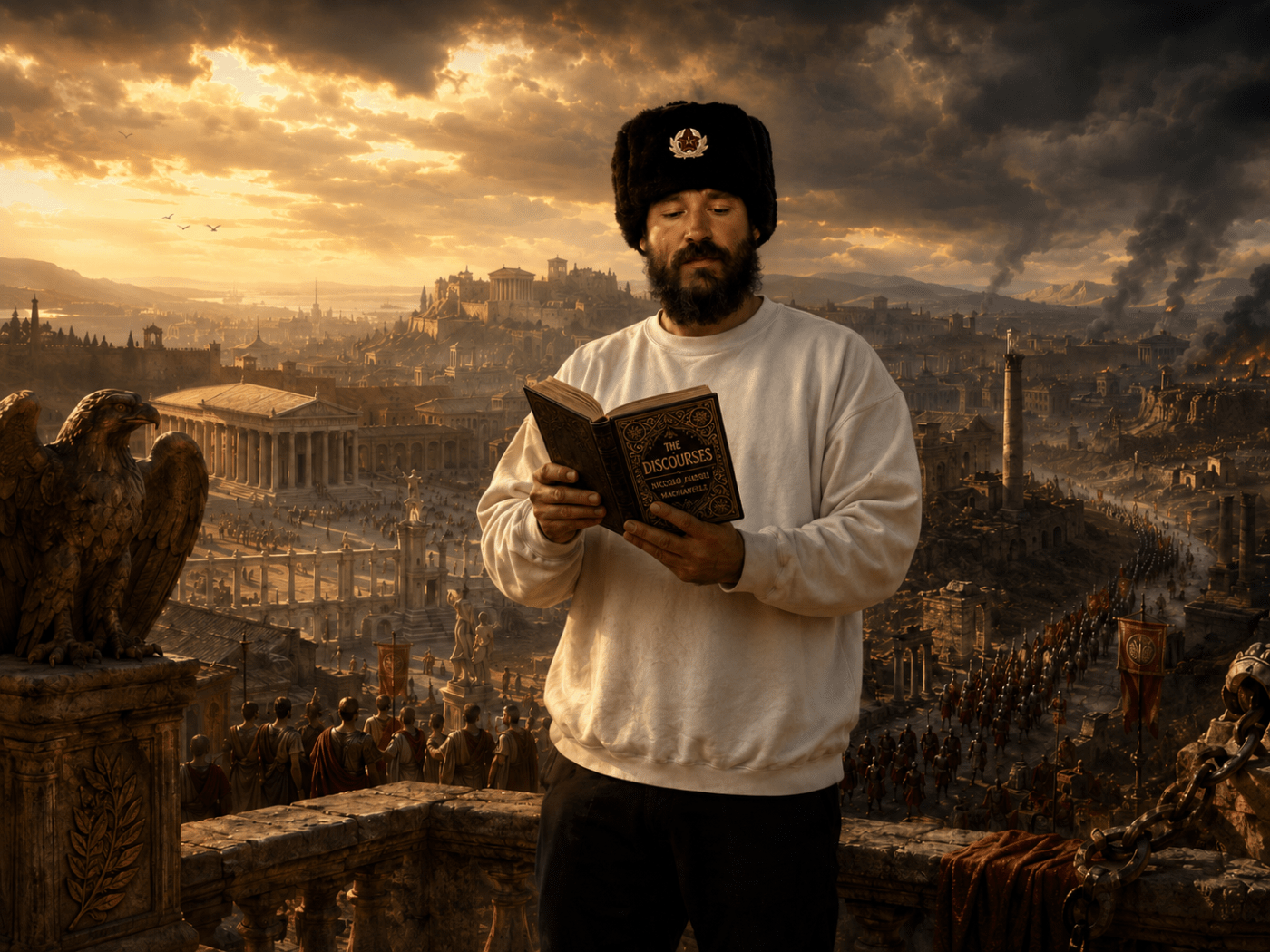
Machiavelli’s The Discourses is not a polite artifact of republican theory but a manual of power written from defeat, exile, and the wreckage of a republic that could not save itself. The book’s great weapon is its refusal of liberal innocence: freedom is not born from manners, consensus, or elite virtue, but from organized conflict, disciplined institutions, force, law, arms, and the pressure of the people against those who hunger to dominate. Yet Machiavelli’s Rome carries poison in the blade, because its internal liberty rests beside conquest, patriarchy, slavery, exclusion, and the ruin of other peoples. This review enters Machiavelli’s armory to seize what revolutionaries can use, expose the imperial frame that cages his thought, and ask what it means to build power for the exploited and colonized rather than another republic standing over ruins.
By Prince Kapone | Weaponized Information | June 28, 2026
A Defeated Republican Writes a Manual of Power
Niccolò Machiavelli did not write The Discourses from the clean desk of a harmless scholar. He wrote from political defeat. Florence had been broken, the Medici had returned, and the man who had served the republic found himself thrown out of public life, imprisoned, tortured, and pushed into that special exile reserved for dangerous servants of failed states: alive, humiliated, unemployed, and thinking too much. The result was not a lament. It was not a confession. It was not a pious little book about virtue for gentlemen who like their politics without blood, hunger, class hatred, or soldiers. The Discourses is a manual written by a man who had watched power move, watched it crush, watched it return wearing old names and new knives, and then asked the only serious question left to a defeated republican: why do some political orders endure while others rot, collapse, or get eaten?
That is why the Dedication matters. Machiavelli tells Zanobi Buondelmonti and Cosimo Rucellai that he has given them what he has: “all that I know and have learnt from a long experience of, and from constantly reading about, political affairs.” This is not the method of the cloister, the sermon, or the university lecture hall where dead republics become safe objects for clever men to rearrange. It is practice joined to study, experience sharpened by history, defeat forced to become instruction. Machiavelli does not pretend to possess purity. He claims a harder possession: knowledge won from office, war, diplomacy, collapse, and reading. That combination gives the book its peculiar heat. He writes as a functionary who has seen the machinery from the inside, then lost access to the machine, then turned to Rome to understand why the machine broke.
From the beginning, then, The Discourses refuses to treat history as museum property. Machiavelli opens Book I by announcing that he has “decided to enter upon a new way, as yet untrodden by anyone else.” There is some Renaissance bravado in that sentence, of course. Every writer who discovers a door thinks no one has ever noticed the hinges before. But beneath the flourish sits a real political rupture. Machiavelli is not trying to decorate the present with ancient examples. He wants to make ancient experience operational. He is not interested in Rome as costume, nostalgia, or marble. He is interested in Rome as a laboratory of force: how laws emerge, how classes collide, how armies hold, how religion disciplines, how republics expand, how liberty survives, and how corruption creeps through institutions like mold through damp walls.
This is where Machiavelli cuts directly against the liberal habit of admiration without imitation. He says ancient acts are “rather admired than imitated.” There is the whole educated class in one phrase, dressed up in Latin, bowing before ruins, praising courage in dead men while fearing it in the living. They love old statues, old laws, old speeches, old wars, old martyrs, old republics, so long as nobody asks them to draw a lesson sharp enough to use. Machiavelli has no patience for that kind of harmless reverence. He looks at the readers who honor antiquity the way property owners honor revolutionaries after the danger has passed, and he says: you admire the deed because you have no intention of repeating it. You praise the ancients in order to bury them properly.
Against that burial, Machiavelli wants history to become a weapon of instruction. He says his work should help readers draw “those practical lessons which one should seek to obtain from the study of history.” The phrase is plain, almost modest, but the implications are severe. Practical lessons for what? Not personal improvement. Not moral refinement. Not the cultivation of a more elegant soul. Practical lessons for constituting republics, maintaining states, governing kingdoms, forming armies, conducting war, handling subjects, extending power, and surviving the storms that tear weak political orders apart. Machiavelli drags history out of the library and puts it in the armory. He does not ask whether the past is inspiring. He asks whether it teaches action.
That is the first reason revolutionaries should read him seriously. Machiavelli understands that politics is not a mood. It is not an identity performance. It is not the art of saying the correct thing in the correct tone before the correct audience while history burns outside the meeting room. Politics is organized capacity. It is the ability to found, defend, discipline, adapt, punish, reward, mobilize, deceive, preserve, and renew. The ruling classes understand this perfectly, which is why they prefer the oppressed to confuse politics with moral witness. They will happily allow the people to speak truth to power, provided power remains power and truth remains speech. Machiavelli is useful because he has no interest in that theater. He wants to know how power is built and why it fails.
But usefulness is not innocence. The Discourses is a contradictory text, not a revolutionary one. Machiavelli’s horizon is Rome, and Rome is not a school of liberation for the colonized. It is a republic that arms citizens, disciplines conflict, defeats rivals, incorporates outsiders, and expands through conquest. Its internal freedom does not abolish domination; it organizes one form of freedom alongside another form of subjection. That contradiction cannot be softened. The same Rome that teaches Machiavelli how conflict can strengthen liberty also teaches him how republics grow by breaking neighboring peoples. The same political realism that helps him expose elite hypocrisy also leads him to admire imperial expansion as greatness. The knife cuts both ways because it was forged in a world before proletarian revolution, before Marxism, before anti-colonial national liberation, before the enslaved and colonized enter history as conscious makers of a new world rather than raw material for somebody else’s republic.
So the task is not to kneel before Machiavelli or to throw him into the furnace with the other old European men whose names frighten people who have read too little and branded too much. The task is to seize what is useful, expose what is rotten, and refuse the lazy comfort of either worship or cancellation. Machiavelli gives us no theory of capitalism, no account of colonial plunder as world system, no proletariat, no dictatorship of the working class, no socialist construction, no mass line, no theory of racial domination, no serious account of women’s labor or social reproduction, no standpoint of the conquered. Fine. Let the record show the absence. But he does give us a ruthless recovery of politics as force, institution, conflict, law, arms, necessity, and historical memory. That is not enough for revolution. It is too much to ignore.
This matters because liberalism trains people to fear power in the hands of the oppressed while accepting it everywhere else. The state may police, imprison, sanction, bomb, starve, surveil, foreclose, deport, and lie, and the liberal will still call for “norms.” A revolutionary organization raises the question of discipline and suddenly the same liberal discovers a delicate concern for freedom. This is the political nursery where empire raises its housebroken radicals. Machiavelli, for all his limits, burns that nursery down. He forces the reader to confront the scandal at the center of every serious politics: if your people cannot organize power, another class will organize power over them.
That is the opening value of The Discourses. It begins not with fantasy but with defeat, not with innocence but with experience, not with the worship of history but with the demand that history teach. Machiavelli writes from the wound of a republic that could not save itself. His answer is not yet ours. His Rome cannot be ours. His citizen body excludes too much, conquers too much, and mistakes imperial capacity for political greatness. But his question still stands at the door of every revolutionary project: what kind of organization can preserve freedom under pressure, defeat the forces that want to restore domination, and renew itself before corruption turns victory into another road back to servitude?
That is where this review begins. Not with the cartoon Machiavelli, the sneering devil of liberal civics classes, whispering wicked advice to princes. Not with the domesticated Machiavelli, cleaned up by professors until he becomes a polite contributor to “republican thought.” We begin with the defeated republican who knew that history without use is decoration, morality without power is surrender, and politics without organization is a corpse waiting for the undertaker. We read him because the enemy has always studied power. The oppressed cannot afford to study only virtue.
Liberty Is Born from Class Conflict
Machiavelli begins his republican argument with an insult to every soft theory of politics that imagines freedom as the child of good manners. Rome does not become free because its upper class discovers generosity. It does not become powerful because rich men politely make room for the poor. It does not stabilize itself because everybody gathers under the warm blanket of civic unity and agrees to disagree like members of a foundation board. Rome becomes Rome because its social antagonisms are forced into political form. The plebs press. The nobles resist. The republic does not eliminate the contradiction. It institutionalizes it.
That is why Machiavelli first strips politics of innocence. In Book I.3 he says that anyone who legislates for a commonwealth must assume “all men are wicked.” Taken lazily, this sounds like a cheap cynicism, the kind of thing uttered by men who mistake their own corruption for wisdom. But Machiavelli is doing something more precise. He is not writing a sermon on human depravity. He is telling us that institutions cannot be built on flattering assumptions about the ruling class, the citizen body, or the prince. If a political order depends on powerful people voluntarily restraining themselves, it has already signed its own death certificate. Law exists because appetite exists. Public accusation exists because slander and conspiracy exist. Tribunes exist because nobles exist. Institutions do not decorate virtue; they discipline conflict.
This realism hardens like a hammer striking iron: “Men never do good unless necessity drives them to it.” Here Machiavelli gives us a theory of political pressure. People may speak of honor, duty, patriotism, religion, and the common good, but left without constraint, they move according to interest, fear, ambition, revenge, and advantage. The point is not that human beings are incapable of solidarity. The point is that political structures cannot rely on sentiment where power is at stake. The noble who treats the plebs gently while the Tarquins still threaten return does not become a friend of the people; he becomes temporarily prudent. Once the danger passes, the old appetite comes back wearing its family crest.
Machiavelli’s description of the Roman nobility after the Tarquins is one of the sharpest class passages in the book. The nobles, once freed from fear, “began to vomit forth against the plebs the poison hid in their hearts.” There is no sociology department fog here. He does not say the elite experienced a tension between competing civic obligations. He says poison. The image matters because it identifies class moderation as a condition, not a character trait. The ruling stratum behaves well when forced to behave well. Remove the counterweight, and what was hidden becomes policy. The poison was not produced by crisis; crisis merely revealed what had been stored.
This is why the tribunes matter. They are not a charitable gift from enlightened nobles. They are the institutional residue of struggle. The plebs, pressed by debt, arrogance, and domination, produce enough disturbance that the republic must create an office through which popular force can check aristocratic power. In liberal mythology, this kind of disorder is treated as a threat to freedom. Machiavelli flips the whole table. In Book I.4 he says that those who condemn the quarrels between nobles and plebs condemn “the primary cause of Rome’s retaining her freedom.” This is not a side remark. It is the backbone of the republican argument. The noise, the clamour, the tumults, the whole undignified spectacle that respectable opinion despises — that is where liberty is born.
Here Machiavelli becomes dangerous in the best sense. He does not confuse order with freedom. He knows that the peace of a city may be nothing more than the silence of the dominated. He knows that when the upper class praises tranquillity, it often means only this: the poor are quiet, the debts are being paid, the soldiers obey, the landlords collect, the courts function, and nobody has yet thrown a chair through the window of power. Every ruling class loves social peace when peace means its own uninterrupted command. Machiavelli does not let that fraud pass. Rome’s liberty grows because the plebs disrupt the comfort of the nobles enough to force new law into being.
Then comes the line that should be nailed to the door of every organization that still thinks politics can be reduced to dialogue with power: “all legislation favourable to liberty is brought about by the clash between them.” Not consultation. Not shared values. Not elite benevolence. Clash. Machiavelli is not yet Marx. He does not have a theory of mode of production, surplus value, racial capitalism, colonial extraction, or proletarian revolution. But he sees something fundamental: liberty is not handed down from above; it is forced upward from below through conflict. The law that protects the people appears because the people make their domination politically expensive.
This is the great anti-liberal force of The Discourses. Liberalism teaches the oppressed to fear conflict more than domination. It tells workers to avoid polarization while bosses polarize the whole economy around profit. It tells colonized people to reject violence while empire organizes violence into treaties, bases, sanctions, police, prisons, and debt. It tells the poor that anger is dangerous while the rich turn greed into law. Machiavelli is no friend of the modern oppressed in any simple sense, but he understands what liberalism works so hard to conceal: conflict is not the interruption of politics. Conflict is politics with its mask removed.
The deeper brilliance appears when Machiavelli distinguishes the ambitions of the upper class from the desire of the people. He says that among the great there is “a great desire to dominate,” while among the people there is “merely the desire not to be dominated.” This distinction carries enormous weight. The nobles disturb the republic because they want command. The people disturb it because they want protection from command. These are not equivalent impulses. The elite wants the freedom to rule; the people want freedom from being ruled over. A politics that treats those two desires as morally equal has already sided with the oppressor while pretending to referee the game.
This is where Machiavelli’s republicanism cuts through the fog of “extremism” talk. Every age has its guardians of balance who look upon the struggle between exploiter and exploited, occupier and occupied, landlord and tenant, boss and worker, jailer and prisoner, and solemnly declare that both sides must calm down. Very profound. The wolf and the sheep must lower the temperature. The slaveholder and the enslaved must reject polarization. The empire and the bombed must rediscover civility. Machiavelli would recognize the stupidity immediately. The appetite to dominate and the desire not to be dominated do not stand on the same moral or political ground. One produces servitude; the other produces liberty.
That does not mean Machiavelli romanticizes the people. He is too sober for that. He knows the populace can be deceived, inflamed, misled by appearances, dragged by hopes, used by ambitious men, and scattered without leadership. His defense of the people is not sentimental. It is structural. The people are better guardians of liberty because their ordinary interest is not to monopolize power but to prevent domination by those who do. That makes them safer, not saintly. Machiavelli’s people are not angels in sandals. They are a social force whose desire, when organized, can restrain the upper class and preserve the republic.
The distinction matters because it prevents a childish reading of popular power. Machiavelli does not tell us that whatever the people want at any moment is correct. He says the people, placed within institutions that give their grievances political form, become a necessary force against oligarchic domination. The tribunes do not abolish class conflict; they give the plebs a weapon inside the republic. Public accusation does not abolish elite ambition; it channels conflict through procedures that prevent private vengeance and calumny from eating the state alive. Law does not end antagonism; it organizes antagonism so liberty can survive the struggle.
Here the mixed constitution becomes more than a formal arrangement of offices. The consuls, senate, and tribunes are not just pieces on a constitutional diagram. They are political forms taken by social forces. Princely authority gives the republic capacity for decision. Aristocratic counsel concentrates experience and continuity. Popular authority checks domination and injects the fear of the many into the calculations of the few. Rome becomes durable because no single element is allowed to swallow the whole. This is not moderation in the liberal sense. It is structured tension. The republic lives because its contradictions are not denied; they are forced to work.
That lesson is still alive, but it must be lifted out of Machiavelli’s Roman frame. For revolutionaries, the point is not to reproduce Rome’s mixed republic, with its citizen body standing above women, slaves, conquered peoples, and the exploited labor that made elite leisure possible. The point is to understand that durable freedom requires organized counter-power. A class that possesses property, command, police, courts, media, schools, armies, and divine permission will never be reasoned out of domination by the sweetness of our pamphlets. It must be confronted by institutions and movements strong enough to impose a new reality.
Machiavelli’s breakthrough is that he makes liberty material. Freedom does not float above society as a moral slogan. It appears through conflict, law, arms, offices, pressure, and fear. The plebs win tribunes because they disturb the city. The nobles retreat because the people become dangerous enough to require accommodation. Rome retains liberty because antagonism is not smothered in the name of unity. Against every politics that worships social peace while leaving domination intact, Machiavelli says what the oppressed already know in their bones: the rights that matter are not granted to quiet people. They are forced from frightened rulers.
But this is only the first movement. Once Machiavelli shows that liberty comes from conflict, he must show what kind of knowledge allows a republic to manage that conflict without being destroyed by it. The next layer beneath the argument is method: necessity, religion, force, arms, equality, and adaptation. That is where his realism becomes sharper, colder, and more dangerous.
The Method Beneath the Argument
Machiavelli’s method begins with a cold refusal of political innocence. He does not ask how states should look in the imagination of moralists. He asks what they require in motion, under pressure, among ambitious classes, frightened peoples, armed enemies, corrupt institutions, and changing times. That is why The Discourses keeps returning to the same hard materials: law, religion, force, arms, leadership, fear, custom, necessity, and renewal. He does not build politics out of wishes. He builds it out of conditions.
This is where Machiavelli becomes most useful against the whole fog machine of liberal political thought. Liberalism loves to speak as if laws govern because they are reasonable, states endure because citizens consent, institutions command loyalty because they are legitimate, and ruling classes restrain themselves because norms have whispered sweetly in their ears. Machiavelli has no patience for that perfume. He asks what produces obedience, what restrains appetite, what channels conflict, what prepares a republic before the emergency arrives, and what happens when a political order mistakes its paper forms for real power.
Religion is one of the first places where his method shows itself. In Book I, he calls religion “the instrument necessary above all others for the maintenance of a civilized state.” The word instrument does the work. Machiavelli is not writing theology. He is not trying to save souls. He is examining religion as civic machinery. It disciplines armies, binds oaths, restrains disorder, gives public acts a sacred weight, and teaches people to obey commands that might otherwise look like mere commands. Religion becomes part of the state’s nervous system. It helps convert fear, reverence, memory, and ritual into political cohesion.
That insight should not be reduced to cheap atheistic sneering. The people’s spiritual life is not the same thing as ruling-class religious management. Workers pray over graves, mothers pray over hungry children, prisoners pray inside cages, oppressed peoples carry sacred memory through fire and exile. Machiavelli is not concerned with that life from below. He studies the use of religion from above and inside the political order. That limitation matters. But the insight still cuts. Rulers rarely care first whether an ideology is true. They care whether it works. They care whether it produces obedience, courage, sacrifice, patience, guilt, fear, and unity at the needed time.
Machiavelli states the matter with a bluntness that would make today’s respectable propagandists blush, assuming they had any blood left in their faces. He says that everything favoring religion should be encouraged “even though they be convinced that it is quite fallacious.” There it is: ideology as conscious administration. The ruler does not need to believe the story if the story helps rule. This is not a medieval curiosity. It is a permanent feature of class society. Every ruling order has its sacred language, whether it calls itself Christian civilization, democracy, development, human rights, national security, color-blind law, free markets, humanitarian intervention, or the rules-based order — that magnificent phrase meaning rules for you, waivers for us, bombs for anyone who asks who wrote the rules.
Machiavelli’s method therefore exposes ideology before ideology has a modern name. He does not say every belief is false. He says beliefs have political functions. They bind, frighten, mobilize, pacify, excuse, and authorize. This is exactly why revolutionaries must study ideology materially. A slogan is not innocent because it sounds noble. A flag is not innocent because it waves above a courthouse. A prayer is not innocent when it is placed in the mouth of empire. The question is always: what social force does this language organize, what conduct does it demand, what domination does it hide, and what sacrifice does it extract?
The same method governs his treatment of law. Machiavelli does not worship legality. He respects law when law has teeth, roots, timing, and force behind it. In Book I.34, he writes that “it is easy for force to acquire a title, but not for a title to acquire force.” That sentence should be enough to ruin a whole library of constitutional fairy tales. Legal authority does not become real because it is written down. The title, the office, the seal, the parchment, the procedure — all of it remains fragile unless backed by organized capacity. Power can dress itself in legality after victory. Legality cannot magically summon power when the decisive forces have moved elsewhere.
This does not mean law is meaningless. It means law is a relation of force stabilized into form. The liberal sees a court and thinks justice. Machiavelli sees an institution and asks what army, class, custom, fear, wealth, and habit make its judgments matter. The radical who fails to understand this ends up begging dead institutions to act against the living class that controls them. The state says “petition properly,” “file the appeal,” “respect the process,” “trust the investigation,” and meanwhile the police reload, the landlords collect, the banks foreclose, the prisons fill, the sanctions tighten, and the bombs are shipped with bipartisan concern.
Machiavelli’s answer is not contempt for form, but preparation before crisis. “No republic is ever perfect,” he writes, “unless by its laws it has provided for all contingencies.” This is the opposite of improvisational politics. A republic that waits until danger appears to invent emergency powers has already allowed fear to write the constitution. A movement that waits until repression arrives to build discipline has already surrendered initiative to the enemy. Institutions must be designed with danger in mind, because danger is not an accident in politics. It is one of politics’ regular seasons.
Here Machiavelli gives us a hard lesson for revolutionary organization. Crisis does not create capacity from nothing. It reveals what has been built. The organization that has not trained its members, clarified its line, developed discipline, studied the enemy, rooted itself among the people, built trust, and prepared for pressure will not suddenly become serious when the state bares its teeth. It will panic, split, posture, denounce, or beg. The enemy prepares every day. The ruling class does not improvise prisons after rebellion; it maintains them. It does not invent surveillance after dissent; it expands it. It does not discover propaganda after war; it funds it in peace. To pretend that oppressed people can answer organized domination with beautiful spontaneity is not romantic. It is criminally unserious.
Machiavelli’s contempt for headless mass action flows from the same method. In Book I.44, he says, “A crowd is useless without a head.” The phrase will offend those who confuse organization with elitism and leadership with betrayal. Let them be offended. The point is not that the people are stupid. The point is that power requires coordination. A crowd may contain courage, grievance, rage, memory, numbers, and sacrifice. Without direction, it can still be dispersed, manipulated, exhausted, or led by the nearest ambitious fool with a loud voice and no plan. The ruling class knows this, which is why it fears organized people far more than angry people.
This is one of Machiavelli’s great anti-spontaneist lessons. The people are not weak because they lack virtue. They are weakened when their force remains unorganized. A crowd becomes a political force when it gains leadership, discipline, strategy, and institutions capable of transforming anger into durable pressure. This is the difference between an explosion and a campaign, between a riot and a revolt, between revolt and revolution, between revolution and a new state capable of defending what the people have won. Fire matters. So does a furnace.
Yet Machiavelli does not turn organization into rigid formula. He knows that political forms decay when they fail to move with conditions. In Book III.9, he says “it behoves one to adapt oneself to the times.” This is not opportunism dressed as wisdom. Opportunism adapts by abandoning principle whenever pressure arrives. Machiavelli is describing something harder: the capacity to recognize when the terrain has changed, when old methods no longer produce old results, when caution becomes paralysis, when boldness becomes suicide, when yesterday’s discipline becomes today’s dead ritual. Strategy without adaptation becomes superstition. Adaptation without principle becomes liquidation.
This is why his method cannot be reduced to cruelty, deception, or the little devilish maxims that bourgeois civics classes love to pin on his coat. He is trying to understand the relation between form and motion. Religion works until it rots into corruption or division. Law works when backed by force and fitted to danger. Emergency authority preserves a republic when bounded and prepared; it destroys the republic when seized privately and prolonged. The people are powerful when organized and vulnerable when misled. Leaders succeed when their habits fit the times and fail when they cannot change. Political knowledge, for Machiavelli, means recognizing these relations before they become fatal.
The method is therefore material in pressure, though not materialist in the Marxist sense. Machiavelli sees classes, but not class exploitation as a mode of production. He sees civic equality, but not the laboring majority as the maker of history. He sees conquered peoples as objects in Rome’s expansion, not as subjects of liberation. He sees religion as political technology, but not the full machinery of ideology under capitalism and empire. He sees force beneath legality, but not the modern capitalist state as the organized power of the ruling class. His insight runs deep, but it stops before the mine reaches the seam of modern class society.
For WI, that is exactly how he must be handled. We do not read Machiavelli to borrow his republic whole. We read him to sharpen the science of political reality against every force that tells the oppressed to remain morally impressive and strategically helpless. He teaches that belief has function, law needs force, power requires organization, crisis demands preparation, and strategy must adapt to time. Those lessons do not make him ours. They make him useful. The next task is to confront the rot inside the usefulness: the Roman contradiction, where republican liberty arms itself, disciplines itself, and then marches outward over the ruins of others.
The Roman Contradiction: Republic, Class, Empire
The great strength of The Discourses is also the place where the poison enters. Machiavelli understands that republics are not preserved by purity. They are built out of conflict, discipline, arms, law, fear, memory, and renewal. He sees that the upper classes do not naturally surrender domination. He sees that political forms depend on social composition. He sees that a people without organized force can be governed, deceived, frightened, and scattered. Then he turns toward Rome and mistakes its greatness for the highest political lesson. That is the Roman contradiction: a republic can become free inside its own citizen body while becoming a machine of domination over others.
This contradiction does not cancel Machiavelli’s usefulness. It reveals how carefully revolutionaries must read him. A dull reader either worships Rome or denounces Machiavelli as wicked and goes home feeling morally refreshed, which is the cheapest form of political hygiene. A serious reader asks what the text discovers, what it cannot see, and where its own evidence points beyond its framework. Machiavelli gives us real weapons against liberal softness, aristocratic deceit, legal fetishism, and anti-political innocence. But he does not give us the standpoint of the enslaved, the colonized, the landless, the women whose labor reproduces the city, or the conquered peoples whose ruin becomes Roman glory. Those absences are not footnotes. They are structural.
The class insight comes first. Machiavelli sees that property is not passive. Wealth does not sit quietly in the corner waiting to be taxed politely. Possession creates fear, fear creates aggression, and aggression demands political protection. In his discussion of the agrarian conflicts, he writes that “such disturbances are more often caused by the ‘haves.’” This is a remarkable sentence because it reverses the usual ruling-class mythology. The rich always describe themselves as the stable element and the poor as the disorderly element. The landlord is order; the tenant is unrest. The creditor is responsibility; the debtor is chaos. The slaveholder is civilization; the slave revolt is savagery. Machiavelli, for a moment, slices through that fraud. The possessing class causes disturbances because it wants to keep what it has, recover what it lost, and prevent the lower orders from touching the sacred fence around property.
Here Machiavelli gets close to a materialist truth without having the instruments to complete it. The “haves” are not merely greedy individuals. They are a social force organized around possession. Their fear of loss makes them expansive, punitive, suspicious, and politically dangerous. They call their appetite prudence. They call their hoarding civilization. They call any challenge to their property an attack on order itself. We know this animal well. It wears different costumes across the centuries, but the teeth remain familiar: the planter, the landlord, the banker, the monopoly capitalist, the settler, the prison contractor, the tech lord, the comprador minister guarding foreign capital as if it were the national flag.
Machiavelli sharpens the same point in his attack on the gentry. He says that those who live idly from estates, without cultivating them or performing other necessary labor, “are a pest in any republic.” There is no velvet glove in that line. He does not say they are an unfortunate imbalance in civic representation. He calls them a pest. The idle landed class poisons republican life because it lives from command without contribution, revenue without labor, authority without civic dependence. It stands above the common discipline required of a free city. It breeds hierarchy in a form that cannot be harmonized with republican equality.
This is one of the passages where Machiavelli becomes most useful for a revolutionary reading, even though he is not yet revolutionary in our sense. He sees that a republic cannot be built on top of a parasitic class whose whole existence depends on extracting life from land and people while remaining socially superior to both. That is not a moral complaint. It is a structural argument. The gentry cannot simply be educated into republican virtue, because their material position trains them against it. The class that lives above labor cannot become the stable foundation of a political order that requires civic equality among those who bear obligation.
Then Machiavelli gives the formula that exposes the social basis of political form: “Where equality exists, it is impossible to set up a principality, and, where it does not exist, impossible to set up a republic.” This is one of the most important sentences in The Discourses. It says that constitutions do not float above class structure like angels over a battlefield. A republic requires a certain social material. If inequality is too deep, if gentry dominate, if wealth concentrates into private command, if the people are habituated to dependence, republican forms become masks. You may keep the offices, assemblies, ceremonies, elections, flags, and speeches, but the thing itself is gone.
There is a direct line from that insight to the modern fraud of bourgeois democracy, though Machiavelli could not draw it. What does “republic” mean where capital owns the press, funds the parties, disciplines labor, writes legislation through lobbyists, buys expertise, commands police, and moves money faster than any public assembly can move law? What does consent mean when the people choose between managers of the same property regime? What does equality before law mean when one class arrives with lawyers and foundations and the other arrives with an eviction notice? Machiavelli’s sentence pushes beyond his own world. If equality is the condition for a republic, then every capitalist republic is already a contradiction wearing a flag pin.
But this is also where we hit Machiavelli’s limit. His equality is civic, not social in the full revolutionary sense. It does not abolish exploitation. It does not include everyone whose labor makes the city possible. It does not break the Roman household, the slave relation, the patriarchal order, the conquered province, or the imperial road. He sees the danger of gentry but not the full structure of class society. He sees that a citizen body must have relative equality to govern itself, but he does not ask who is excluded so that this citizen body can appear equal. This is the old republican trick: equality among the included, domination over the excluded, and a statue in the square to make everyone feel noble about it.
Book II brings that trick into the open. Machiavelli says “Rome became a great city by ruining the cities round about her.” There is no way to domesticate that sentence. It is not a metaphor. Roman greatness is built on the destruction and absorption of others. The republic that produces liberty through internal conflict produces empire through external conquest. Its citizens gain discipline, arms, institutions, honors, and identity; neighboring peoples gain ruin. Here the republican machine reveals its imperial motor. Rome does not merely defend itself. It grows by breaking others and making their defeat part of its own vitality.
This is the center of the indictment. Machiavelli studies Rome because Rome lasted, expanded, mobilized citizens, managed conflict, and defeated enemies. But he does not place the conquered at the center of the analysis. They appear as material in the story of Roman greatness. The ruin of Alba, the incorporation of foreigners, the distribution of colonies, the destruction of rivals — all become evidence of Rome’s political genius. The standpoint is imperial because the suffering of the defeated enters the text as a lesson for the victor. That is not a small flaw. It is the horizon of the book.
Here revolutionaries must refuse the old European seduction: to confuse state capacity with liberation. A republic can arm its citizens and still be a predator. A people can win internal rights while participating in the domination of another people. A constitution can restrain elites at home while organizing plunder abroad. Rome is not the last empire to discover this arrangement. The United States would later perfect its own obscene version: liberty talk in the chamber, slave labor in the field, Indigenous land under the boot, colonies and bases abroad, and schoolchildren taught to call the whole arrangement democracy. Rome gives Machiavelli his science of republican strength, but also his blindness to republican empire.
Book III shows how the internal danger develops from another direction: command, once prolonged, becomes personal power. Machiavelli writes that “the prolongation of military commands made Rome a servile state.” This is one of the moments where his Roman admiration turns into diagnosis. The same military capacity that helps defend and expand the republic begins to generate men whose loyalty networks exceed the republic itself. Commands become careers. Armies become personal instruments. Public authority becomes private force with public clothing. The road from citizen arms to Caesar is not an accident. It is a danger inside the structure.
The lesson is not that armed power is bad. That is liberal nursery talk again. The lesson is that armed power must remain politically subordinated to the collective project it claims to defend. Once command detaches from the people, the party, the republic, the revolutionary process, or the class it serves, it becomes a ladder for domination. Machiavelli sees this in Roman terms. We must read it in revolutionary terms. Every emancipatory project has to solve the problem of coercive power without pretending that coercion can be wished away. The state must defend the revolution, but the instruments of defense can also become the embryo of a new ruling stratum if the masses are pushed aside and command begins to answer only to itself.
Then comes one of the ugliest limits of Machiavelli’s framework. In Book III.26, the discourse heading itself declares: “How Women have brought about the Downfall of States.” Even before the argument begins, the patriarchal reflex has entered the room wearing Roman armor. Social crisis, elite rivalry, sexual violence, succession conflict, family power, male honor, property, and political instability are condensed into “women” as cause. Here Machiavelli does what ruling-class political thought has done across centuries: it displaces contradictions produced by male power, property, and state violence onto women’s bodies. The woman becomes the excuse, the symbol, the spark, the temptation, the scandal — anything but a full political subject in the structure itself.
This matters because no revolutionary reading can leave patriarchy untouched as if it were merely an unfortunate old prejudice in an otherwise useful manual. Machiavelli’s silence on women’s labor and social reproduction is not incidental. The city he analyzes is reproduced somewhere. Soldiers are born somewhere. Citizens are fed somewhere. Households discipline bodies before armies do. Kinship, marriage, inheritance, sexual control, and gendered labor all help make the political order possible. But Machiavelli sees politics most clearly where men confront men in councils, camps, conspiracies, and streets. The reproductive ground beneath that masculine theater remains largely untheorized. That is a major silence under pressure.
Still, the text sometimes exposes more than it understands. When Machiavelli shows that the haves cause disorder, that gentry are pests, that equality conditions republican life, that Rome grows by ruining others, that military command can make a republic servile, and that women are blamed for crises produced by male power, he gives us not a finished theory but a battlefield of contradictions. His evidence points toward a more radical conclusion than he can reach. Class structure shapes political form. Empire corrupts republican liberty. Command threatens collective freedom. Patriarchy hides social reproduction behind scandal. Ideology turns domination into civic necessity. The book opens all these doors and then stops before entering the rooms where modern revolutionary theory must go.
That is why Machiavelli cannot be our destination. He is a passage. He teaches us to despise politics as moral decoration and to examine power as organized relation. But his republic remains trapped inside the Roman frame: citizens over subjects, men over women, armed civic virtue over conquered peoples, internal liberty alongside external domination. We take from him the weapon of political realism and turn it against the imperial romance that still clings to his model. The republic worth fighting for is not Rome with better manners. It is not the citizen empire cleaned of its more embarrassing bloodstains. It is a revolutionary order rooted in the workers, the colonized, the dispossessed, the incarcerated, the exploited, and the peoples who have always appeared in ruling-class manuals as obstacles, mobs, auxiliaries, subjects, or ruins.
So Section IV lands here: Machiavelli breaks liberalism by showing that freedom requires organized power, but he cannot break Rome. That is his greatness and his cage. The tool is sharp, but the frame is rotten. The next test is whether those tools can be turned against the modern empire that still calls dependency security and domination freedom.
Stress Test: Proxy Power, Fortresses, and the Empire That Calls Itself Free
Machiavelli becomes most useful to the present when he stops sounding ancient. The names change, the weapons change, the costumes change, the imperial bureaucrats exchange Latin for acronyms, but the old problems remain: who has arms, who depends on another’s arms, who mistakes money for force, who hides weakness behind walls, who purchases alliances instead of building power, and who calls subordination security because the contract arrived with a seal and a smiling advisor. Book II and the military passages across The Discourses put the modern world on trial without knowing its name. That is why this section must read Machiavelli against proxy power, security infrastructure, and the empire that praises freedom while organizing dependency.
The first lesson is sovereignty. In Book I.21, Machiavelli says that “present-day princes and modern republics which have not their own troops… ought to be ashamed of themselves.” The shame is not theatrical. It is structural. A state without its own organized force does not merely lack a military instrument; it lacks the material basis of independent political decision. It may have flags, ministers, speeches, an anthem, a constitution, and a respectable chair at international meetings. Fine decorations. But if its security depends on another power’s soldiers, contractors, intelligence systems, bases, weapons pipelines, and strategic permission, then its sovereignty has a foreign keyhole.
This applies far beyond the battlefield. Dependency is never only military. The state that cannot feed itself, finance itself, defend itself, produce essential goods, control its infrastructure, educate its cadre, or maintain its own technological systems becomes available for command. The foreign army may not need to occupy the capital when debt, logistics, software, shipping, energy, food systems, and military doctrine already do the job. Machiavelli speaks in the language of troops because his world was organized by swords, cities, mercenaries, fortresses, and princes. The principle travels. A people that does not build its own capacity will be governed by the capacity of another.
He makes the point sharper in the warning that one should not “stake the whole of one’s fortune except on the whole of one’s forces.” This is not just advice for a general deciding whether to defend a pass. It is a law of political seriousness. Do not enter decisive struggle with borrowed strength, partial commitment, fake capacity, ceremonial institutions, or plans that depend on the mercy of those who profit from your defeat. Half-power invites full catastrophe. A state, party, movement, or people that stakes its survival on forces it does not command has confused hope with strategy.
This is where Machiavelli slaps the fantasy out of respectable politics. The weak always invent a language to make weakness sound like prudence. They call dependency partnership. They call foreign tutelage modernization. They call bases cooperation. They call proxy war defense. They call austerity reform. They call surrender realism. Then, when the patron changes policy, the market moves, the supply line closes, the sanction tightens, or the foreign advisor departs, the whole paper sovereignty catches fire. Machiavelli would not be impressed by the ceremony. He would ask the only question that matters: where are your forces, and do they belong to you?
Book II tears into another illusion: the belief that money itself is power. Machiavelli’s discourse heading says “Money is not the sinews of war,” and the sharper formulation follows: “war is made with steel, not gold.” This is one of those sentences that should be mailed, without postage, to every financier who thinks the world is moved by digits alone. Money matters. Machiavelli is not a fool. But money that cannot become organized force, disciplined production, loyal troops, material logistics, trained people, and political will is only a shiny confession of helplessness. Gold can buy a sword, but it cannot by itself make a soldier stand, a people endure, or an army obey.
The modern ruling class understands this better in practice than in ideology. It preaches markets while building bases. It praises contracts while funding police. It celebrates innovation while protecting patents with courts, sanctions, intelligence agencies, and warships. It says capital is free, then builds the cage around everyone who refuses the terms of that freedom. Machiavelli’s steel is not merely metal. It is organized coercive capacity. Behind every market order stands somebody’s steel: the sheriff at the eviction, the riot squad at the strike, the navy near the shipping lane, the prison behind the law, the sanction behind the loan, the drone behind the diplomatic phrase.
For revolutionaries, the lesson is not to worship arms. The gun without politics is banditry. The army without the people is a machine waiting for a master. The state without a liberatory class project is organized domination. But the inverse is just as true: politics that refuses to confront force leaves the oppressed with slogans against institutions that own batons, prisons, courts, banks, and borders. Machiavelli’s “steel” forces the question every serious movement must answer: how does moral conviction become organized capacity powerful enough to survive contact with the enemy?
His attack on dependency becomes even clearer in the passages on mercenary and auxiliary troops. The heading itself warns of “the dangers which accrue to the prince or the republic that employs auxiliary or mercenary troops.” The exact historical forms differ from the present, but the principle is alive and venomous. Mercenaries fight for pay. Auxiliaries fight under another power’s command. In both cases, the political subject loses control over the force that supposedly protects it. Protection becomes leverage. Help becomes command. Assistance becomes occupation by contract.
This is the old sickness of client politics. A comprador government invites foreign force to secure itself against its own people, then discovers that the invited force has its own interests. A weak ruling class borrows military capacity to survive domestic contradiction, then finds that survival now requires obedience to the lender. A movement relies on external sponsors to compensate for lack of rooted power, then watches its line bend toward the sponsor’s map. Machiavelli’s world knew the mercenary captain. Ours knows the security contractor, the foreign-trained officer corps, the intelligence liaison, the proxy militia, the consultant, the aid regime, the weapons package with political conditions folded inside like a knife in cloth.
The danger is not only betrayal in battle. The deeper danger is deformation before battle. Dependency changes the dependent. It trains leaders to look upward to patrons rather than downward to the people. It makes strategy answer to supply. It turns political imagination into grant compliance, military planning into interoperability, and national survival into alignment. By the time the foreign force openly dictates terms, the internal organs have already adjusted to subordination. Machiavelli gives us the early anatomy of that disease.
Then there are the fortresses. In Book II.24, Machiavelli’s heading states that “fortresses in general are much more harmful than useful.” He is not saying defenses never matter. He is attacking the ruler’s fantasy that walls can substitute for political legitimacy. A fortress may protect a prince from an enemy. It may also separate him from the people, encourage arrogance, and make him believe coercion can solve contradictions that only just rule, popular support, and real strength can solve. The fortress becomes not merely a structure but a mentality: rule from behind walls, watch the people as danger, confuse distance with safety.
The modern fortress does not always look like stone. It looks like a prison complex, a border regime, a surveillance grid, a militarized police zone, a gated district, a hardened capital, a data center, a biometric checkpoint, a campus security apparatus, an emergency operations bunker, a digital wall around information, a financial firewall around property. The fortress logic tells rulers that if they can monitor enough, cage enough, classify enough, and fortify enough, they can avoid the political reckoning produced by exploitation. It is the dream of domination without consent and security without justice.
Machiavelli sees why that dream corrupts the ruler. Fortresses make rulers more likely to rely on harsh measures because they imagine themselves protected from the consequences. The wall does not only keep enemies out; it keeps reality out. It teaches the ruler to mistake the people’s fear for stability. This is why every security state grows stupid in proportion to its instruments. It gathers more information and understands less. It watches the people more closely and knows them less deeply. It counts threats, maps networks, builds cages, expands patrols, hardens facilities, and then acts surprised when hatred grows under the concrete.
This is the direct bridge to technofascism. The fortress has become digital, predictive, automated, privatized, and networked, but its class function remains familiar. It protects property from the people whose labor produces it. It protects borders built from theft. It protects police from accountability. It protects capital from democratic seizure. It protects empire from the displaced populations empire created. Machiavelli helps us see that the fortress is not neutral infrastructure. It is political pedagogy for rulers. It teaches them to govern as if the people are a permanent threat.
Finally, Machiavelli warns against purchased loyalty. “Really powerful republics and princes do not purchase alliances with money.” This is not because money has no diplomatic use. It is because bought allegiance measures weakness. A durable alliance rests on shared interest, common danger, mutual respect, political credibility, and demonstrated capacity. A purchased alliance lasts until a higher bidder appears, fear changes direction, or the balance of force shifts. Gold buys attendance. It does not buy history.
The present is full of purchased alliances masquerading as values. States are pulled into blocs through aid, weapons, debt relief, market access, elite training, diplomatic favors, media legitimacy, and protection guarantees. The language is noble. The mechanism is crude. “Shared values” often means shared dependency on the same patron. “Security cooperation” means alignment under another’s command. “Development partnership” means doors opened for capital and closed against sovereignty. Machiavelli would recognize the weakness immediately. If an alliance has to be purchased indefinitely, it is not loyalty. It is rental.
Here the analysis turns back on Machiavelli himself. He helps expose dependency, but his own Roman model turns independence into expansion. He warns republics not to rely on foreign arms, but he admires a republic that extends its power over others. He understands that fortresses cannot replace popular support, but his highest example remains a state that subordinates neighboring peoples. This is the double movement of The Discourses: it teaches oppressed and revolutionary forces to despise dependency, yet it also teaches rulers how to become more capable predators. The weapon must be seized from the imperial hand.
For WI, the conclusion is clear. A revolutionary people must build its own capacity: political, economic, military, cultural, technological, organizational, and ideological. It cannot outsource liberation. It cannot rent sovereignty. It cannot confuse money with power, walls with security, sponsors with comrades, or purchased alliances with internationalism. The oppressed need friends, alliances, trade, solidarity, and coordination; only fools preach isolation as purity. But every alliance must strengthen independent capacity, not replace it. Every instrument borrowed from outside must be subordinated to the people’s project, not allowed to rewrite it.
Machiavelli’s view is harsh because reality is harsh. Dependency kills freedom softly before it kills it openly. Fortresses harden rulers before they protect states. Money dazzles those who have forgotten production and force. Purchased alliances rot when danger arrives. The republic that calls itself free but survives through proxy power, coercive walls, and imperial sponsorship is already halfway to servitude. The revolutionary task is not to admire Machiavelli’s Rome, but to learn from the machinery and break the imperial circuit. The question now becomes final: what do we do with Machiavelli after we have stripped him of Rome?
Strategic Verdict: Steal the Weapon, Break the Roman Frame
Machiavelli should not be read like scripture and should not be thrown away like contraband. He is more useful than the liberals who fear him and more dangerous than the professors who domesticate him. The revolutionary task is not to become Machiavellian in the cheap sense, as if politics were merely deceit with better posture. The task is to take from The Discourses what the struggle can use: the hatred of political innocence, the discipline of historical study, the understanding that freedom requires organized power, the insistence that states decay, the warning that dependency breeds servitude, and the hard lesson that the enemies of liberty do not retire because they lost one vote, one office, one battle, or one historical round.
The final teaching of the book is renewal. In Book III, Machiavelli writes that “without renovation, these bodies do not last.” He means religious bodies and republics, but the lesson reaches every political organization that imagines past victories can substitute for present struggle. No institution preserves itself by memory alone. No party, state, union, movement, army, school, or revolutionary tradition survives because the founding moment was pure, heroic, or drenched in sacrifice. The dead cannot organize the living by reputation. Every body rots when it stops renewing its purpose, discipline, connection to the people, and capacity to meet new conditions.
This is a brutal lesson for movements that confuse inheritance with vitality. A banner can become a curtain. A slogan can become a lullaby. A party office can become a shelter for functionaries who speak fluent revolution and fear the masses in every language. Machiavelli’s warning cuts through that decay. Organizations do not fail only because enemies attack them. They fail because success produces habits, offices produce comfort, comfort produces cowardice, and cowardice learns to call itself prudence. The first enemy is outside the wall; the second is inside the routine.
Machiavelli’s remedy is a return to origins, but this is where revolutionaries must both learn from him and go beyond him. He says that “those changes make for their conservation which lead them back to their origins.” For a Roman republican, that means a restoration of founding principles, civic discipline, old severity, ancestral virtue, the memory of the beginning. There is power in this. Every revolutionary process needs rectification. It must return to the masses when bureaucracy thickens. It must return to the class struggle when careerism softens the line. It must return to anti-imperialism when comfort invites compromise. It must return to political education when slogans become empty shells.
But return is not enough. The exploited do not fight to restore an old republic with cleaner officers and sharper laws. They fight to move history forward. Revolutionary renewal cannot mean worship of origin. It must mean living fidelity to purpose under changed conditions. The return is not archaeological. It is dialectical. Go back to the source in order to advance beyond the form. Return to the people, not to nostalgia. Return to the class struggle, not to museum politics. Return to the revolutionary promise, not to the frozen costume of its first appearance.
This is where Machiavelli’s Roman frame must be broken. His republic preserves freedom for a bounded citizen body and mistakes expansion for greatness. Our horizon cannot be the armed city dominating its neighbors. It cannot be citizen virtue built on excluded labor, conquered peoples, disciplined women, and imperial roads. The revolutionary horizon is the organized power of workers, peasants, colonized nations, oppressed communities, prisoners, migrants, and all those whose lives ruling classes have treated as raw material for someone else’s civilization. Machiavelli teaches how political bodies endure. Marxism-Leninism and anti-colonial struggle teach for whom they must endure, against which class enemy, and toward what social transformation.
He also teaches that crisis reveals the difference between appearance and substance. Book III.16 declares that “Genuine Virtue counts in Difficult Times.” This sounds simple until history applies pressure. Easy times produce talkers, heirs, celebrities, patrons, experts, grant managers, social climbers, and men with clean hands because they have never touched anything real. Difficult times test whether a person, party, or state possesses actual capacity. Can it feed people under blockade? Can it hold discipline under repression? Can it tell the truth when lies are profitable? Can it retreat without dissolving and advance without hallucinating? Can it keep faith with the masses when defeat makes betrayal look sensible?
This is the test bourgeois politics avoids. It is why ruling classes love credentialed mediocrity. In calm weather, inherited position can dress itself as competence. Wealth can imitate wisdom. Polished speech can impersonate strategy. But when the storm arrives, the ornamental people panic because their authority came from a room, not a struggle. Machiavelli’s difficult times strip titles down to conduct. The question becomes not who sounds capable, not who has rank, not who owns the institution, not who has the donor list, but who can act.
That brings us to leadership. In Book III.38, Machiavelli gives a line that should embarrass every speechmaker who thinks rhetoric is a substitute for example: “go by my actions, not my words.” There is the old science of leadership in its shortest form. People learn courage from conduct. They learn discipline from conduct. They learn sacrifice from conduct. They learn whether an organization is serious by watching what its cadre do when nobody is applauding. A leader who asks the people to risk what he will not risk is not a leader. A party that preaches discipline but practices convenience is not a party. A movement that speaks of sacrifice while organizing itself around individual visibility has already been spiritually purchased.
Machiavelli’s leadership lesson is not cult worship. It is the opposite. Real leadership proves itself by service to the collective task. The revolutionary does not need theatrical humility, the little performance where ambitious people pretend not to enjoy being seen. The revolutionary needs accountable example. Leadership must concentrate responsibility, not privilege. It must turn knowledge into practice, courage into discipline, discipline into organization, organization into power, and power into the defense and advancement of the people’s struggle. Words matter only when conduct gives them weight.
Finally, Machiavelli closes the circle with the lesson that freedom requires daily maintenance. A republic that would preserve freedom, he says, “ought daily to make fresh provisions.” This is the sentence that carries the strategic verdict. Freedom is not a possession locked in a constitutional chest. It is not secured once and for all by founding documents, heroic myths, sacred martyrs, or glorious anniversaries. Freedom is provision: renewed law, renewed organization, renewed education, renewed vigilance, renewed discipline, renewed mass participation, renewed defense against those who want to restore domination.
For revolutionaries, this means there is no final safe resting place inside struggle. The old ruling classes regroup. Empire recalibrates. Capital migrates, mutates, digitizes, privatizes, militarizes, and returns through whatever door was left unguarded. Bureaucracy grows where mass supervision weakens. Opportunism grows where theory detaches from practice. Sectarianism grows where organization loses contact with real people. Repression grows where ruling classes fear losing command. A movement that does not make fresh provisions becomes a memory committee for its own defeat.
So the verdict is neither praise nor dismissal. Machiavelli is a weapon recovered from the arsenal of a contradictory past. His blade is sharp against liberalism, moral passivity, anti-political innocence, dependency, legal fetishism, elite softness, and organizational decay. But the handle is Roman, and Rome cuts the wrong people. We do not carry that handle forward. We strip the blade, reforge it, and place it in the hands of those Machiavelli could not center: the exploited, the colonized, the racialized, the incarcerated, the dispossessed, the workers whose labor makes every republic possible and whose exclusion exposes every republic’s lie.
Read Machiavelli, then, but read him like a revolutionary entering an enemy armory after the guards have fled. Do not admire the weapons. Inventory them. Test them. Break what cannot serve the people. Melt down what carries the old master’s seal. Keep what cuts through illusion. The Discourses teaches that power must be organized, liberty must be defended, institutions must be renewed, and political forms must be judged by whether they survive real struggle. We add what Machiavelli could not: power must belong to the oppressed majority, liberty must mean liberation from exploitation and empire, renewal must be socialist and anti-colonial, and the republic worth preserving is not the one that grows over ruins, but the one that ends the production of ruins altogether.


Leave a comment