The Trump regime's assault on federal datasets is a calculated effort to erase reality, obscuring critical information on hunger, pollution, maternal health, and climate disasters. By dismantling public data, the ruling class suppresses the very tools citizens need to challenge systemic failures. Expert narratives dominate discourse, overshadowing the voices of the oppressed who suffer and resist. This isn't just bureaucratic negligence; it's a deliberate strategy to manage perception amidst a crumbling empire. As the regime erases statistics, communities are disarmed and rendered invisible, making the struggle for public knowledge essential to resistance against state control. The battle for data is a battle for truth.
The Corridors of Defiance: How the War on Iran Accelerated the Multipolar Reorganization of Western Asia
The 2026 U.S.-Israeli assault on Iran was a strategic miscalculation, intended to reassert imperial dominance in Western Asia but instead revealing the fragility of Atlantic hegemony. As the old security architecture eroded, alternative infrastructures and regional alliances emerged, facilitating trade and cooperation beyond Western control. The ongoing crises connected Gaza, Yemen, and the vital sea lanes, illustrating that military aggression has backfired, prompting regional states to recalibrate and seek resilience against imperialism. This war exposed a transformative geopolitical landscape, where logistics and diplomatic maneuvers are increasingly driven by necessity, carving out a multipolar future and undermining the sheer authority once held by the empire.
Technofascism: The Digital Leviathan and the War on Humanity
The United States isn’t gracefully unraveling; it’s morphing into a technofascist apparatus of control that leverages financial dominance, digital surveillance, and labor discipline. While the elite tout "innovation," they're repackaging colonial exploitation under the guise of progress, tightening their hold domestically and globally. Liberal analyses miss the subtleties of this shift, mistaking procedural forms for genuine democracy, while real power redistributes into unaccountable systems. As public trust wanes and crises mount, this infrastructure of power rapidly transforms governance into an invisible web of control, inching toward collective consciousness and organized resistance that could eventually dismantle the machinery of oppression.
Palantir and the Digital Leviathan: Silicon Power, State Violence, and the Technofascist War on Humanity
Palantir's recent manifesto is more than corporate bravado; it reveals an unsettling convergence of warfare, surveillance, and governance. The media's alarmism obscures a deeper truth: Palantir stands as a linchpin in an expansive control apparatus, integrating deportation, military actions, and state surveillance into a seamless framework of power. Critics timidly label this brewing authoritarianism but fail to pinpoint the machinery at work. As anti-immigrant systems and military strategies fuse, resistance is evolving. It’s time to unite disparate struggles against this creeping technofascism, transforming scattered dissent into a powerful, coordinated force ready to dismantle the system that seeks to dominate us all.
Petrodollars and Missiles: U.S.–Israel War, Iran’s Retaliation, and the Gulf’s $6 Trillion Imperial Contradiction
The Economist laments over the Gulf's $6 trillion sovereign wealth as war disrupts its financial stability, but this narrative is a smokescreen. The real story lies in the imperial dynamics that intertwine U.S.-Israeli aggression with Gulf fortunes. Rather than a neutral financial assessment, it presents war as a minor nuisance to elites banking on oil rents. The article flattens the human cost, sidelining migrant laborers and ignoring the root causes of conflict shaped by imperial agendas. Ultimately, this crisis reveals the Gulf's wealth is a tool of empire, not liberation—a stark reminder that war and capital are inexorably linked.
Gold, Lithium, and the Chains of Empire: Zimbabwe, China, and the Battle to Break the Colonial Economy
The imperial press calls Zimbabwe’s recovery “bizarre,” revealing more about empire’s ideology than Africa’s reality. Beneath the headlines lies a material transformation driven by gold, lithium, labor, and survival within a system built to constrain it. As Zimbabwe pushes toward beneficiation and partners with China, it enters a global struggle over who controls resources, industry,... Continue Reading →
Apples to Apples: Superexploitation from Orchards to iPhones
What appears to be a comparison between two unrelated commodities—apples picked in U.S. orchards and Apple devices assembled across the Global South—is in fact a comparison between two forms of the same capitalist-imperialist labor regime. In U.S. agriculture, superexploitation is organized through settler-colonial land relations, racialized migrant labor, H-2A dependency, deportability, and the broader coercive... Continue Reading →
Leverage for Whom?: Bangladesh, Multipolarity, and the Managed Art of Dependence
Asia Times doesn’t just argue for strategy—it reframes dependency as sophistication, urging Bangladesh to negotiate its place in a system it does not control. Beneath the language of leverage lies a material reality of export concentration, external inputs, financial discipline, and geopolitical pressure shaping every move. Multipolarity opens space—but only within limits, where new alignments... Continue Reading →
Africa Against the World Market: Hosea Jaffe, Imperialism, and the Long Struggle for Liberation
A Weaponized Intellects review of A History of Africa that excavates Hosea Jaffe’s uncompromising analysis of colonialism, class formation, and imperial domination—situating his intervention within the liberation struggles of his time and assessing its enduring relevance for understanding Africa, the world system, and the unfinished project of revolutionary transformation today. By Prince Kapone | Weaponized... Continue Reading →
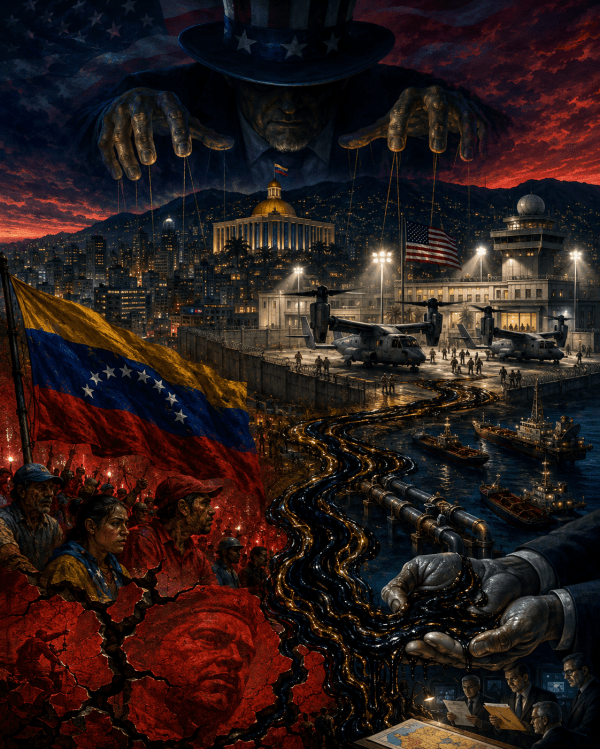
Reopening the Cage: Bretton Woods Returns to a Country That Refused to Kneel
The article presents IMF and World Bank re-engagement as routine normalization, masking a political event shaped by years of institutional blockade and external pressure. Beneath that surface lies a struggle over sovereignty, where constitutional legitimacy, sanctions, and anti-neoliberal memory redefine what “recognition” actually means. The return of global finance collides with a still-living project of... Continue Reading →