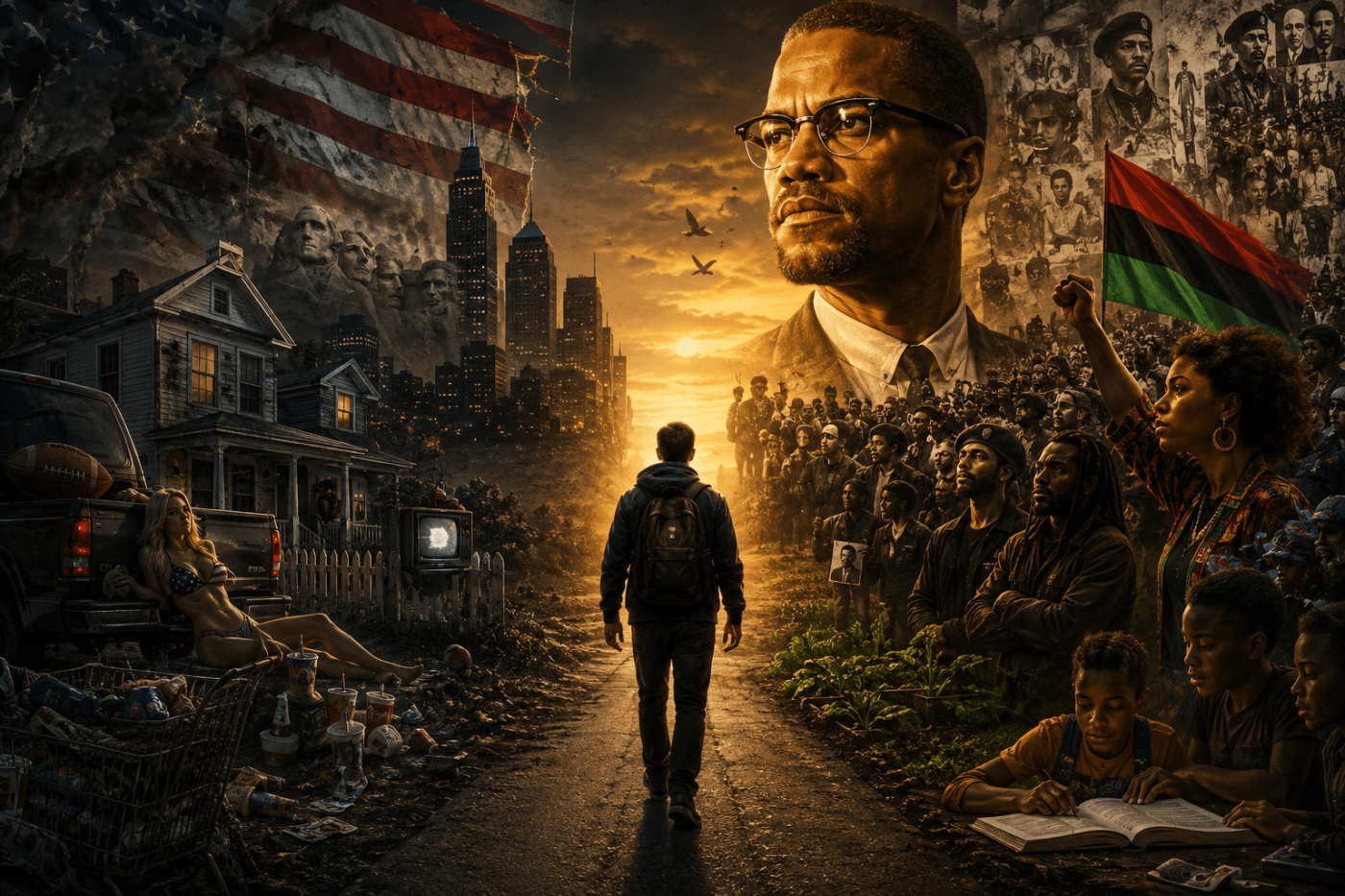
Malcolm X did not simply radicalize my understanding of race in America; he forced me to confront the deeper colonial architecture beneath the settler empire itself. Through his analysis of Black captivity, anti-colonial struggle, imperialism, propaganda, and revolutionary transformation, I came to understand that the United States was not a flawed democracy corrupted by racism, but a settler-colonial project built through conquest, slavery, dispossession, and global domination. In wrestling with Malcolm’s words, I was ultimately forced to confront my own Euro-American position inside that history and the contradiction between the settler order and the liberation struggles of the colonized. What began as political admiration gradually became something far more dangerous: a long journey away from the mythology of white America and toward the revolutionary possibility of becoming human through struggle alongside humanity itself.
By Prince Kapone | Weaponized Information | May 19, 2026
From Malcolm to Marx
My revolutionary baptism into Marxism did not come by the usual road traveled by much of the conventional white left. There was no campus reading circle waiting for me with coffee, footnotes, and some anxious graduate student explaining the proletariat like he had personally invented it last Tuesday. I did not first arrive at revolutionary politics through the clean European hallway that runs from the Communist Manifesto to Capital, from 1848 to 1917, from the factory floor to the party congress. My road was more crooked than that, more American in the ugliest sense, and therefore more honest. It came through the music of Tupac Shakur, through the voice of a young Black revolutionary poet carrying the memory of the Black Panther Party, the wound of the ghetto, the rage of the prison, and the ghost of Malcolm X in his chest.
Tupac was not the final destination. He was the door. Through Tupac, I found Malcolm. Through Malcolm, I found the Panthers. Through the Panthers, I found a buried revolutionary tradition this country had tried to kill twice: first with bullets, prisons, surveillance, exile, poverty, and police raids, and then again with museums, textbooks, documentaries, T-shirts, and the whole miserable machinery of capitalist digestion. America has a talent for murdering revolutionaries and later selling their faces back to the children of the poor. Capitalism can turn anything into merchandise except its own grave, though Lord knows it keeps trying.
I read The Autobiography of Malcolm X long before I read Marx and Engels. I studied the Black Panther Party’s Ten-Point Program before I studied the October Revolution. Before I could explain surplus value with any real precision, I already understood that this country had been built from stolen land, stolen labor, police terror, prison cages, imperial war, and a schoolhouse mythology designed to make the oppressed apologize for their own oppression. Before I had the language of historical materialism, I had already been introduced to history as a crime scene.
That mattered. It shaped everything that came after. By the time I finally arrived at Marx, I did not encounter class struggle as an abstract European formula floating politely above the blood and dirt of the modern world. I encountered it through my understanding of slavery, conquest, colonialism, racialized labor, national oppression, and imperial plunder. I did not have to be convinced that race and class were connected. Malcolm and the Panthers had already made it impossible for me to separate them. The question was never whether class mattered. The question was why so many white Marxists could only recognize class after washing the plantation, the reservation, the prison, and the colony out of the picture.
That early encounter with the Black radical tradition gave me an unusual appreciation for the colonial contradiction as it manifests here in the United States. It helped me avoid the stale class reductionism of the traditional white left, that peculiar metropolitan sickness where men raised inside empire discover Marxism and immediately begin lecturing the colonized about why national oppression is a distraction from the “real” struggle. But in the United States, race has never been a decorative surface laid over class. It has been one of the historical forms through which class rule was organized. The worker did not appear here in some pure European abstraction. The worker appeared through the slave ship, the plantation, the reservation, the border, the prison, the sweatshop, the migrant camp, the occupied ghetto, and the imperial army.
So my Marxism developed differently. It was never rooted primarily in the anxieties of the Western academic left. It grew through world-systems analysis, underdevelopment theory, the national question, anti-colonial struggle, and the dialectic between class and nation. In settler-colonial formations like the United States, that dialectic takes the perverted form of the race/class contradiction, where the colonial ordering of people becomes inseparable from the organization of labor, land, citizenship, policing, wealth, and political power. To miss that is not revolutionary sophistication. It is economism with settler manners.
I understand why it may seem strange to some people that I, a Euro-American, would identify so deeply with the Black radical tradition and the Marxist traditions of the Global South. But I never experienced that identification as some exotic political preference, some liberal guilt ritual, or some desperate attempt to borrow oppression like a costume. It was a matter of historical alignment. I was born inside the imperial core, inside the settler formation, inside a society that teaches people who look like me to identify upward with empire rather than downward with humanity. That is the inheritance. But inheritance is not destiny. At some point, every person produced by this machine has to decide whether they will defend the house that trained them or defect from it.
That is what Malcolm helped teach me. To become a defector from empire is not to imagine oneself pure, innocent, or standing magically outside history. That would be childish, and empire already produces enough children in adult bodies. It means making a conscious political rupture with the identity this society tries to manufacture in you. It means refusing the wages of whiteness as a worldview. It means learning to see the United States not as the innocent center of civilization, but as a settler-colonial and imperial structure whose wealth was accumulated through the blood, labor, land, and resources of the colonized. It means choosing sides in the world struggle without pretending that choice abolishes contradiction overnight.
Malcolm was not a Marxist in the formal doctrinal sense. He was not walking around quoting volume three of Capital or arguing with some European professor about the transformation problem. But his method of analysis was historical, material, international, and constantly in motion. He studied power by studying the world. He watched empires, revolutions, betrayals, resources, religions, nations, leaders, masses, and movements. He was not frozen. He changed because reality changed, and because he had the discipline to let reality educate him. That is more dialectical than many people who can define dialectics but cannot recognize a contradiction if it knocks on their door with a warrant.
The more I read Malcolm over the years, the more I realized he had shaped not simply my political sympathies, but my method of interpretation. He taught me to look beyond America’s borders before I fully understood why that mattered. He taught me that Mississippi and the Congo lived inside the same historical structure. He taught me that the media was not merely biased, but weaponized. He taught me that capitalism was not merely an economy, but a bloodsucking relationship between classes, nations, continents, and peoples. He taught me that the oppressed must understand themselves internationally or remain trapped inside the mental prison of the oppressor’s map.
This essay is not an attempt to turn Malcolm into something he was not. It is not a cheap effort to paste my own framework backward onto his life and call it prophecy. It is a tribute to the way his words kept unfolding inside my own political development. Some things he said hit me immediately. Others did not reveal their full force until years later, after I had studied Marx, Lenin, Fanon, Rodney, Amin, Nkrumah, Du Bois, the Panthers, the Tricontinental tradition, and the long bloody archive of U.S. empire. Still other passages only became clear when the world itself began catching up to Malcolm: the rise of China, the crisis of dollar power, the scramble over Africa, the wars over chokepoints, the collapse of liberal legitimacy, the return of open imperial gangsterism dressed up as policy.
Long before I had names for every concept, Malcolm had already given me the direction of travel. He pointed outward from America toward the world, downward toward the exploited, backward toward the crimes of history, and forward toward liberation. That is where my political education began: not in the seminar room of empire, but in the insurgent memory of those empire tried to bury.
The World Outside the Imperial Mirror
It’s impossible for you and me to know where we stand until we look around on this entire earth. Not just look around in Harlem or New York, or Mississippi, or America—we have got to look all around this earth. We don’t know where we stand until we know where America stands. You don’t know where you stand in America until you know where America stands in the world. We don’t know where you and I stand in this context, known to us as America, until we know where America stands in the world context.
That passage did not hit me all at once. Some lines enter you like lightning. Others sit in the back of your mind for years, waiting for history to ripen enough for you to hear them properly. Malcolm’s insistence that we had to look “all around this earth” was one of those lines. At first, I understood it simply as internationalism, as a call for Black people in America to identify with Africa and the colonized world. That was already powerful enough. But over time, as I read more, lived more, struggled more, and watched the empire expose itself like a drunk landlord waving eviction papers at the whole planet, I realized Malcolm was doing something deeper. He was attacking the very geography of American consciousness.
America teaches people to think from inside its own mirror. The country appears large, eternal, innocent, generous, complicated perhaps, but always redeemable. The rest of the world appears only when it is useful to American mythology: as threat, charity case, battlefield, market, jungle, dictatorship, migrant source, terrorist nest, or cheap labor pool. The planet is reduced to scenery surrounding the main character. That is how imperial consciousness works. It shrinks the world while enlarging the empire. It teaches the population to mistake American interests for human interests and then calls this confusion patriotism.
Malcolm broke that spell for me. He did not allow the United States to remain the center of moral reality. He forced the question outward. Where does America stand in the world? What does it do there? Who benefits from its power? Who bleeds beneath its policies? Who mines, harvests, sews, ships, cleans, cooks, migrates, dies, and disappears so that this empire can continue describing itself as freedom with a flag on top? Once those questions enter your political bloodstream, there is no going back to the civics textbook version of reality. The little classroom map starts looking like evidence.
This is where Malcolm began changing the way I understood Marxism before I even had the vocabulary for it. He taught me that class struggle inside the United States could not be interpreted as if the country were floating alone in space, having a domestic argument with itself. The American working class, the Black colony, Indigenous nations, migrant labor, prisons, police, factories, suburbs, welfare offices, military bases, and corporate boardrooms all existed inside a world system. The wages paid here, the poverty imposed there, the jobs exported elsewhere, the resources extracted from somewhere else, the coups funded in one region and the prisons expanded in another — these were not disconnected facts. They were parts of a single imperial metabolism.
That realization separated me early from much of the white left. Too many white radicals wanted to discuss class like America was Sweden with bad manners. They spoke of workers, bosses, wages, and elections while barely touching the colonial machinery that made the country what it is. Malcolm made that impossible for me. He showed that the Black struggle in the United States was not a minority pleading session inside the world’s greatest democracy. It was part of the same historical process shaking Africa, Asia, Latin America, and the colonized world. Once I saw that, liberal integrationism looked too small, and white economism looked even smaller. One begged America to live up to its ideals. The other forgot to ask where those ideals got their funding.
I began to understand that the domestic and the international were not two separate arenas. They were two sides of the same imperial structure. The police officer in the ghetto and the marine overseas did not perform identical functions, but they belonged to the same historical order. The border agent, the prison guard, the sanctions official, the intelligence analyst, the banker, the landlord, the defense contractor, the foundation liberal, the respectable politician — each occupied a different station in a vast system of management. Malcolm did not give me that full map all at once. He gave me the first instruction: stop looking at America from inside America.
That instruction changed my political instincts permanently. Whenever I studied a domestic contradiction, I began looking for its international root. Poverty in the imperial core could not be separated from superexploitation in the periphery. Migration could not be separated from underdevelopment, war, sanctions, and land theft. Police militarization could not be separated from colonial occupation and counterinsurgency abroad. Racism could not be separated from the world history of conquest and labor control. Even the so-called “middle class” comforts of the imperial core began to appear less like national achievement and more like the domestic distribution of global plunder, trimmed with a mortgage and called the American Dream.
This did not make Marxism less scientific to me. It made Marxism more concrete. By the time I reached Lenin, Mao, Fanon, Nkrumah, Cabral, Sankara, Du Bois, and later the Tricontinental tradition, I was not discovering a new planet. I was finding language for a world Malcolm had already forced me to recognize. Theories of imperialism, dependency, underdevelopment, and world-systems analysis did not arrive as academic decorations. They arrived as explanations for questions Malcolm had already planted. Why is America rich and the colonized world poor? Why does freedom come wrapped in bombs? Why does democracy need so many military bases? Why are the oppressed always told to be patient by people living off the results of their impatience?
What made Malcolm so powerful was that he did not internationalize consciousness as an intellectual hobby. He did it as a matter of survival. If the working class only sees itself inside the borders drawn by their exploiters, they will misread their own strength. They will think they are alone. They will mistake isolation for weakness. They will believe the empire is bigger than history itself. Malcolm’s whole point was that once you fit America into the world, America begins to shrink. Not disappear. Not become harmless. But shrink back into historical proportion. It becomes a power structure, not God. A state, not destiny. An empire, not humanity.
That was one of the first steps in my own defection from empire. I could not keep identifying with the United States as my natural political home once I began seeing it from the standpoint of the people it dominated. The center moved. The map turned. Humanity was no longer located in Washington, Wall Street, Hollywood, Silicon Valley, or the white suburbs where empire teaches its citizens to confuse comfort with innocence. Humanity was in the fields, mines, ports, prisons, barrios, townships, refugee camps, villages, factories, and occupied streets of the world. Malcolm did not merely tell me to care about those places. He taught me that they were central to understanding the place I came from.
That is why this passage remains foundational to everything I have tried to develop politically since. Malcolm was not just telling us to look abroad. He was teaching us that consciousness itself has to be relocated. You cannot understand the belly of the beast from the belly alone. You have to see the beast from the wounds it leaves across the earth. Only then does America become legible. Only then does class become global. Only then does race become historical. Only then does revolution stop being a slogan and become a world process.
The Colony Inside the Empire
“So thoroughly has this been done to us that now we don’t even know that there is somebody else that looks like we do. When we see them, we look at them like they’re strangers. And when we see somebody that doesn’t look anything like us, we call them our friends. That’s a shame. It shows you what has been done to us… We were separated from our people, and have been isolated here for a long time.”
Once Malcolm forced me to look at America from the world, the next question became unavoidable: what kind of thing is America itself? Not what does it say it is. Not what does it print on money, pledge in classrooms, or mumble through the mouth of politicians standing in front of flags like overdressed salesmen for a stolen house. What is it historically? What relations produced it? Whose land was taken? Whose labor was chained? Whose memory had to be broken so this country could call itself free?
This is where Malcolm’s language of separation and isolation cut deeper than any liberal discussion of racism ever could. He was not merely saying Black people had been mistreated. He was describing the destruction of historical continuity. A people torn from Africa, stripped of language, kinship, nationhood, names, land, and memory, then forced into a new world where their labor became capital and their captivity became civilization. That is not “prejudice.” That is not a bad attitude problem. That is colonial violence organized into a social order.
The phrase “we were separated from our people” stayed with me because it named something more fundamental than discrimination. It named the wound beneath the category. Black people in the United States were not simply one minority group among others, waiting politely for America to correct its manners. They were an oppressed people produced through slavery, colonial rupture, racial terror, labor extraction, and political containment inside a settler empire. Once I understood that, the whole liberal grammar of race began to sound too small, like trying to describe a house fire by complaining about the wallpaper.
For us Euro-Americans, for white people like myself, America existed in a profoundly different historical relationship than it did for the Black people Malcolm was describing. Black existence here began through capture, forced transportation, slavery, and generations of colonial domination organized around captive labor. But Europeans, for the most part, entered the Western hemisphere voluntarily, even when they arrived fleeing famine, enclosure, religious persecution, peasant misery, war, or the brutal class stratification of the old world. They entered not onto neutral ground, but into an expanding settler society already built through Indigenous dispossession and African slavery. This did not mean every white person became rich or powerful. Most remained workers, laborers, miners, tenants, immigrants, factory hands, and eventually debtors to capital like everyone else beneath the bourgeoisie. But their relationship to the developing society was still fundamentally different from that of a people brought in chains and held through slavery and colonial repression. Europeans were gradually incorporated into the political, social, and psychological architecture of the settler nation itself, however unevenly and contradictorily. Access to land, citizenship, mobility, legal recognition, wages, neighborhoods, unions, education, and political legitimacy was distributed through the racial structure of the colony. The white worker was exploited, but also incorporated into the expanding settler order. The Black worker was exploited through exclusion, containment, superexploitation, and internal colonial domination. Once I began understanding that distinction historically, the whole structure of the United States started appearing differently to me. Whiteness ceased looking merely like an identity or prejudice and began revealing itself as a historical relationship to conquest, labor, land, and state power inside a settler-colonial empire.
This changed the way I approached the race/class question forever. Race was not some floating identity category hovering above the “real” economic structure. Nor was it merely a trick invented to divide workers who otherwise lived in the same historical position. Race was one of the ways class rule had been built here. It organized land, labor, citizenship, policing, housing, education, mobility, punishment, and belonging. It determined who could be incorporated into the settler project and who would remain marked for extraction, containment, or removal. In the United States, class did not develop in spite of colonialism. It developed through it.
That is why so much white-left economism felt dead to me even before I had all the theoretical weapons to explain why. Malcolm had already made the abstraction impossible. You could not talk seriously about the American working class while skipping over the slave ship, the plantation, Indigenous genocide, the Mexican borderlands, the prison system, and the racial state. You could not invoke “unity” while refusing to examine the historical terms on which one population had been invited into settler citizenship and another had been chained, segregated, surveilled, and caged. That is not unity. That is amnesia wearing a red button.
Malcolm helped me see that colonialism works not only by dominating bodies, but by reorganizing consciousness. “When we see somebody that doesn’t look anything like us, we call them our friends.” That line is brutal because it exposes the psychological surgery of empire. The colonized are taught to see themselves through the eyes of the colonizer, to distrust their own historical kin, to seek approval from the very structures that degrade them, to measure humanity by proximity to whiteness, wealth, and imperial legitimacy. Colonialism does not stop at the plantation gate or the police precinct. It enters the mind and rearranges the furniture.
As a Euro-American trying to understand my own location inside this history, that mattered. Malcolm did not allow me the cheap comfort of innocence. But he also did not push me toward liberal guilt, that useless moral theater where white people discover racism and then perform sadness as if sadness ever liberated anybody. The question was not whether I could feel bad enough to be good. The question was whether I could understand whiteness historically as a relation to power and then break politically with the empire that produced it.
That is where the idea of becoming a defector from empire began to take shape for me. Not as purity. Not as self-absolution. Not as some heroic fantasy where the white radical crowns himself John Brown because he read three books and made a Facebook post. It meant recognizing that settler society manufactures loyalty materially and psychologically. It offers identity, status, security, fear, mythology, and sometimes a small cut of stolen comfort in exchange for allegiance to the house of plunder. To defect means refusing that bargain as a political orientation, while understanding that refusal must be proven in practice, not announced like a branding campaign.
Malcolm’s analysis of colonial separation helped me understand why the national question could not be dismissed as secondary to class struggle. For the colonized, nation is not simply a flag or bourgeois sentiment. It can become the form through which a people struggles to recover historical agency after conquest. This is why the Black radical tradition, the Panthers, Fanon, Rodney, Nkrumah, Du Bois, Harry Haywood, and Omali Yeshitela all became so important to my later development. They helped clarify what Malcolm had already opened: that the struggle against capitalism in a settler empire must confront the colonial organization of the society itself.
And once that becomes clear, America’s innocence dies permanently. The country no longer appears as a democracy interrupted by racism, but as a settler-capitalist order whose democracy was always structured by conquest and exclusion. Its freedoms were distributed through colonial hierarchy. Its wealth was accumulated through forced labor and imperial extraction. Its “law and order” was built from slave patrols, militias, colonial armies, border regimes, prisons, and police. The respectable civic portrait begins to peel, and underneath it you find the empire’s real family photo: the settler, the banker, the sheriff, the soldier, the warden, and the missionary, all smiling like thieves at a baptism.
This is the point where Malcolm’s influence on me became irreversible. He did not merely teach me that racism existed. He taught me to look for the colonial relation underneath the American surface. He taught me to ask who had been separated, who had been incorporated, who had been dispossessed, who had been made disposable, and who had been taught to confuse their place inside empire with freedom. That question became one of the foundations of my entire political framework. Because once you understand the colony inside the empire, you can no longer mistake reform for liberation, representation for power, or inclusion into a criminal structure for justice.
When the Colonized World Entered History
“Look at the continent of Africa today and see what position it occupies on this earth, and you realize that there’s a tussle going on between East and West. It used to be between America and the West and Russia, but they’re not tussling with each other any more. Kennedy made a satellite out of Russia. He put Khrushchev in his pocket. The tussle now is between America and China.
In the camp of the West, America is foremost. Most other Western nations are satellites to America… But in Asia, China is the center of power.”
Once America stopped appearing innocent, the rest of the world also stopped appearing peripheral. That was the next great shift Malcolm forced in me. The colony inside the empire could not be understood apart from the colonies outside it. The same historical system that chained Black labor, stole Indigenous land, and built a continental settler empire had also carved up Africa, strangled Asia, looted Latin America, and called the whole bloody business civilization. So when Malcolm turned toward Africa and Asia, he was not changing subjects. He was widening the frame until the domestic crime scene became part of a world system.
This is why his remarks about China hit differently the older I became. At first, I probably read them too quickly. “The tussle now is between America and China” sounded interesting, maybe even sharp, but not yet earth-shaking. I did not yet have the historical equipment to feel the full weight of it. China still lived in my imagination partly through the Cold War junk America feeds its people from childhood: mystery, menace, communism, authoritarianism, cheap goods, yellow peril with a barcode. The empire does not educate its citizens about China. It vaccinates them against understanding it.
Years later, after the Iraq War, the 2008 crash, the destruction of Libya, the Pivot to Asia, the sanctions wars, the technology blockades, the panic over Huawei, the rise of BRICS, and the increasingly hysterical sermons about “democracy” from people who cannot run a clean election or a train system, Malcolm’s line began to sound almost prophetic. He was looking at the world in 1964 and already sensing that the center of gravity was shifting. Europe was no longer the uncontested master of history. The United States had become the commander of the Western camp. Asia was rising. China was becoming a pole of world power. The colonized world was no longer merely scenery in the imperial drama.
That mattered deeply for my own development because Malcolm helped break the old Eurocentric timetable of politics. The West teaches us that history moves from Europe outward, like light from a holy lamp, while the rest of humanity stumbles behind waiting to be modernized, civilized, developed, or bombed into democracy. Malcolm saw something else. He saw motion from below and outside. He saw anti-colonial peoples entering history as subjects. He saw Africa and Asia not as backward zones to be pitied, but as strategic terrains of struggle, thought, power, and future possibility.
This helped prepare me to take the Global South seriously as a producer of theory, not merely as a victim of history. That may sound obvious, but inside the imperial core it is not obvious at all. One can go through years of American schooling and political discussion without ever being taught that colonized peoples have generated some of the most advanced understandings of capitalism, imperialism, race, nation, development, and liberation. The academy will assign Europe as theory and the rest of the world as case study. Malcolm reversed the arrangement. He made the colonized world legible as a thinking world.
His analysis of Africa was especially decisive. Malcolm did not speak of Africa as a sentimental homeland floating above material reality. He spoke of its location, resources, minerals, waterways, political weight, and strategic power. He saw that Africa’s so-called poverty had to be understood alongside its immense value to world capitalism. The continent was not colonized because it lacked importance. It was colonized because it was indispensable. The colonizer did not come for a safari. He came for land, labor, gold, diamonds, uranium, cobalt, oil, timber, routes, ports, and markets — and then had the arrogance to write anthropology about the people he robbed.
That was one of Malcolm’s great gifts to my thinking: he made anti-colonialism material. He did not let it dissolve into moral sympathy. He showed that European power rested upon African wealth, that Western industry depended upon colonized resources, that the prosperity of the imperial center was inseparable from the forced underdevelopment of the periphery. Later, when I encountered Walter Rodney, Samir Amin, dependency theory, world-systems analysis, and Marxist theories of imperialism, I was not starting from scratch. Malcolm had already made the basic truth plain: the West did not become rich because it was uniquely brilliant. It became rich because it learned how to organize theft scientifically and call the invoice progress.
This is also why Malcolm’s emphasis on decolonization mattered so much. He understood that independence movements were not merely symbolic flag-raising ceremonies. They threatened the whole structure of Western accumulation. If African and Asian nations began controlling their resources, directing their own development, choosing their own alliances, and speaking in international forums with collective weight, then the imperial order would begin to tremble. Not because the colonized suddenly became “anti-Western,” but because they were becoming pro-themselves. For empire, that is always the unforgivable crime.
Reading Malcolm through the later history of the twentieth and twenty-first centuries, I came to see how much of my own framework had been foreshadowed in his instincts. Multipolarity, anti-hegemonic alignment, South-South cooperation, developmental sovereignty, the rise of Asia, the strategic centrality of Africa, the crisis of Atlantic monopoly power — I did not first encounter these as cold geopolitical categories. Malcolm had already pointed me toward their living roots in anti-colonial struggle. He taught me to watch where the colonized world was moving, not merely where the imperial press told me danger was coming from.
And this was not romanticism. Malcolm was too serious for that. He knew the newly independent world was full of contradictions: weak states, comprador elites, external pressures, internal divisions, and imperial sabotage. But he also understood that contradiction is not the same thing as insignificance. The colonized world was uneven, wounded, and embattled, but it was moving. It was asserting itself. It was producing new alignments, new institutions, new ambitions, new forms of struggle. History was no longer the private property of Europe and America.
That realization became central to my own political orientation. I could no longer look at the Global South as an afterthought to the “real” politics of the imperial core. The real politics was already global. The workers and peasants of Africa, Asia, Latin America, and the internally colonized populations of the United States were not standing outside history waiting for permission to enter. They were the majority of humanity, and their struggles were increasingly forcing the old imperial world to reveal its fear. Malcolm saw that before many of us had the words. He saw the colonized world entering history, and once I learned to see it too, the West no longer looked like the future. It looked like a landlord with a shotgun guarding a house built on stolen ground.
Freedom Needs Power
“So the Aswan Dam creates enough additional power to make it possible to step up or speed up the industrialization of that particular African nation. And as their industrialization is stepped up, it means that they can produce their own cars, their own tractors, their own tools, their own machinery, plus a lot of other things.
Now the raw materials are taken from Africa, shipped all the way to Europe, used to feed the machines of the Europeans, and make jobs for them, and then turned around and sold back to the Africans as finished products. But when the African nations become industrialized, they can take their own products and stick them in the machines and finish them into whatever they want.”
Once Malcolm taught me to read the map as a confession, the next question was obvious: how does the colonized world break the routes that keep it dependent? It is one thing to know that empire feeds through canals, ports, mines, shipping lanes, and markets. It is another thing to build the power necessary to stop being food. That is why Malcolm’s discussion of the Aswan Dam stayed with me. He was not dazzled by concrete for the sake of concrete. He was not writing a brochure for engineers. He was showing that liberation has a material foundation. A people cannot eat a flag. They cannot light homes with an anthem. They cannot build tractors out of diplomatic recognition.
This was where Malcolm pushed me beyond the sentimental language of independence. In the schoolbook version, a nation becomes free when the colonial flag comes down and a new one rises. The band plays, the president speaks, the diplomats clap, and somewhere in London, Paris, Brussels, or Washington, a banker quietly asks who owns the mine. Malcolm understood the difference between formal independence and actual sovereignty. Political freedom without productive power leaves the old colonial relation breathing under new clothes. A government may have a seat at the United Nations and still be begging for machinery, loans, grain, medicine, spare parts, and permission.
The Aswan Dam mattered because it represented power in the most literal and political sense. Electricity. Irrigation. Industry. Planning. Social transformation. The ability to move water, generate energy, expand agriculture, and build factories was not a technical side issue. It was the infrastructure of independence. Malcolm saw that clearly. If Egypt could generate more power, it could industrialize more rapidly. If it could industrialize, it could produce tools, tractors, machinery, and the basic equipment of modern development. Suddenly freedom was not an abstract noun. It had turbines in it.
That changed how I came to understand political economy. As a matter of course, imperial ideology trains people to think of poverty as a condition caused by the poor themselves. Poor countries are poor because they are corrupt, backward, undisciplined, tribal, overpopulated, insufficiently entrepreneurial, or suffering from some mysterious shortage of Western manners. This is the bedtime story capitalism tells itself after a long day of looting. Malcolm stripped it bare. Raw materials were taken from Africa, shipped to Europe, processed by European industry, and sold back to Africans as finished goods. In that simple description, he exposed the whole criminal arrangement.
That insight prepared me for underdevelopment theory before I ever knew the term. Poverty was not the absence of development. It was often the result of development elsewhere. Europe did not simply develop while Africa failed to develop. Europe developed through a global arrangement that blocked, distorted, and subordinated African development. The colonized world supplied cheap raw materials and bought back expensive finished products. The imperial center accumulated industry, technology, jobs, infrastructure, and capital. The periphery accumulated debt, dependency, extraction, and lectures from the same thieves who emptied the house.
This is why Malcolm’s emphasis on producing “their own cars, their own tractors, their own tools” hit me so hard later. He was talking about the right of a people to climb the ladder of production denied to them by colonialism. A nation that only exports raw materials remains trapped at the bottom of the world economy, no matter how beautiful its speeches about sovereignty sound. The real question is whether a people can transform what they have into what they need. Can they process their own minerals? Feed their own population? build their own machines? train their own engineers? organize their own development? defend their own future from the smiling vampires of international finance?
This helped me understand why every serious revolutionary project eventually runs into the question of industrialization. Not because factories are magic, and not because development should copy the wasteful, ecocidal path of Western capitalism. The planet cannot survive every nation being forced to imitate the American suburb, that sacred parking lot with bedrooms attached. But the oppressed cannot remain dependent on imperial supply chains and call that liberation either. They need productive capacity, scientific education, energy systems, agricultural transformation, public health infrastructure, transportation, housing, and the ability to plan development around human need rather than foreign profit.
Malcolm’s discussion also clarified why empire fears state-led development so much. The imperial powers do not panic when poor nations hold elections under conditions they can manage. They panic when those nations build dams, nationalize resources, train technicians, control banks, plan industry, educate peasants, and begin reducing dependency. That is when development stops being charity and becomes a threat. A hungry country can be lectured. A dependent country can be disciplined. But a country building the means to stand on its own feet becomes dangerous to the whole rotten architecture of imperial extraction.
This is part of why I later became so interested in socialist construction, developmental states, public ownership, and infrastructure-led sovereignty. Malcolm gave me the instinct before I had the full framework. He made me suspicious of any politics that spoke beautifully about freedom while ignoring production. He made me equally suspicious of any “development” that left foreign capital in command, the people dispossessed, and the economy organized around export dependency. Real development could not mean turning a country into a plantation with Wi-Fi and a stock exchange. It had to mean expanding the capacity of the people to collectively reproduce life with dignity.
There was another lesson buried in Malcolm’s analysis that took me longer to appreciate: infrastructure carries class content. A dam can serve the people or serve foreign capital. A factory can liberate labor or exploit it more efficiently. A railroad can integrate a national economy or strip a hinterland bare for export. Technology is never neutral when ownership, planning, and power remain unequal. Malcolm’s point was not that machines automatically emancipate. His point was that without control over the means of development, the colonized remain trapped in a world where someone else owns the machines and sends back the bill.
That insight later helped me think more clearly about the difference between dependency and sovereignty in our own time. Every discussion about energy, industry, technology, agriculture, supply chains, and infrastructure is also a discussion about power. Who owns it? Who plans it? Who benefits? Who pays? Who becomes disposable? Who gets development and who gets sacrifice zones? The bourgeois economist looks at a dam and sees investment. Malcolm looked at the Aswan Dam and saw a colonized people trying to manufacture the material basis of their own independence.
This is why his insight on industrialization remains so important to me. It made freedom concrete. It made anti-imperialism productive. It showed that liberation is not only a matter of exposing the thief, but of building a world where the thief is no longer needed. The colonized cannot merely demand a better price for their stolen raw materials. They must fight for the power to transform those materials themselves, under their own direction, for their own social needs. Malcolm helped me understand that sovereignty without production is a ceremony. Real freedom needs power — electrical power, industrial power, political power, and above all the organized power of the people to decide what development is for.
The Bloodsuckers and the Colonized World
“Almost every one of the countries that has gotten independence has devised some kind of socialistic system, and this is no accident. None of them are adopting the capitalistic system because they realize they can’t. You can’t operate a capitalistic system unless you are vulturistic; you have to have someone else’s blood to suck to be a capitalist. You show me a capitalist, I’ll show you a bloodsucker.”
One of the reasons Malcolm affected me so profoundly politically is because he introduced me to socialism through the experience of the colonized world rather than through the conventional mythology of the Western left. My first encounter with anti-capitalism was not through European factory imagery, old Soviet posters, or white graduate students arguing over footnotes in coffee shops decorated like failed revolutions. It came through Malcolm talking about housing, food, land, education, sovereignty, industrialization, and the material conditions of formerly colonized peoples trying to survive after centuries of imperial domination.
That distinction mattered enormously because it rooted my understanding of capitalism historically rather than morally. Malcolm was not simply saying capitalism was unfair or greedy. Plenty of liberals say that between stock purchases. He was describing capitalism as a world structure that required dependency, extraction, and underdevelopment in order to function. “You can’t operate a capitalistic system unless you are vulturistic.” Behind the sharpness of Malcolm’s language was a serious historical insight: capitalism did not become wealthy through isolated hard work occurring naturally inside Europe and America. It expanded through conquest, slavery, colonial extraction, racial hierarchy, land theft, unequal exchange, and the monopolization of industrial power.
That line — “you have to have someone else’s blood to suck” — stayed with me for years because the older I got, the more materially true it appeared. America’s prosperity began looking different once viewed from outside the mythology of the empire. The suburbs, the highways, the shopping centers, the corporate towers, the technological infrastructure, the consumer abundance — none of it appeared self-generated anymore. Behind it stood plantations, mines, sanctions, wars, oil fields, shipping lanes, cheap labor regimes, military bases, financial coercion, and entire continents historically organized around feeding the accumulation needs of the Atlantic powers.
Malcolm helped me understand this before I had the theoretical vocabulary to explain it fully. Later I would encounter dependency theory, world-systems analysis, Rodney, Samir Amin, monopoly capital theory, and anti-colonial Marxism. But Malcolm had already planted the basic material instinct: there was a relationship between the wealth of the imperial core and the impoverishment of the colonized world. Europe was not simply developed while Africa “failed” to develop. The development of one was historically tied to the underdevelopment of the other.
This is why Malcolm’s observation about newly independent nations turning toward socialism hit me so hard politically. “This is no accident.” That sentence carried enormous weight because it forced a deeper question rarely confronted honestly inside the United States: why did so many anti-colonial movements repeatedly arrive at anti-capitalist conclusions after independence?
The American political imagination presents socialism as some strange foreign ideology artificially imposed upon otherwise healthy societies by dictators, intellectuals, or outside agitators. Malcolm flipped the entire framework upside down. The colonized world was not moving toward socialism accidentally or irrationally. Many newly independent nations concluded through historical experience that capitalism and colonial dependency had become inseparable. Their resources had been externally controlled. Their labor had been externally exploited. Their development had been externally subordinated. Their economies had been organized around export dependency rather than human need. Under those conditions, socialism increasingly appeared not merely as ideology, but as survival.
That was one of the most important breakthroughs Malcolm gave me intellectually. He made me understand why anti-colonial struggle so often generated demands for nationalization, land reform, public industry, sovereign banking, electrification, infrastructure, literacy campaigns, state planning, and control over natural resources. These were not abstract doctrinal obsessions. They were attempts by formerly colonized nations to break the economic structure that had kept them subordinate to Atlantic accumulation for generations.
This also prevented me from approaching socialism narrowly through the framework of the white Western left, where capitalism is often reduced primarily to the immediate relationship between worker and employer inside the imperial core. Malcolm pushed me toward a much wider understanding. Capitalism appeared not simply as a national labor arrangement, but as a global hierarchy organized through imperial power. Race, colonialism, slavery, extraction, finance, military force, and industrial monopolization were not side effects of capitalism. They were deeply entangled with its historical expansion across the world.
That distinction profoundly shaped my later understanding of race and class inside the United States itself. Because I came toward Marxism through Malcolm and the Black radical tradition, I encountered capitalism first through the colonial contradiction rather than through economistic abstractions. I understood early that race was not merely a distraction from class struggle, but one of the historical mechanisms through which labor, land, citizenship, and global accumulation had been organized under settler capitalism. Malcolm’s anti-capitalism was inseparable from anti-colonialism because the system he was confronting materially had been built through colonial domination from the beginning.
The more I studied American history later, the more Malcolm’s “bloodsucker” formulation stopped sounding rhetorical and started sounding descriptive. The transatlantic slave trade, Indigenous dispossession, Caribbean plantation economies, colonial mining systems, IMF dependency, sanctions warfare, cheap labor regimes, global debt structures, resource extraction, and military enforcement all began appearing as interconnected parts of a world-system organized around concentrated accumulation in the imperial core. Capitalism did not merely produce inequality accidentally. Uneven development was built directly into its historical architecture.
This is also why the empire became so hostile toward sovereign development projects throughout the Global South. Malcolm understood that anti-communism was often a mask for something deeper: the fear of independent development outside Western control. Any nation attempting to nationalize resources, industrialize independently, control finance, expand public ownership, or direct development internally rather than externally quickly became treated as a threat. The issue was never simply ideology. The issue was whether the colonized world would continue functioning as a subordinate appendage to Atlantic accumulation.
Over time, this became one of the foundations of my own theoretical framework. Capitalism could not be understood separately from imperialism because capitalism historically expanded through imperial structures. The wealth of the imperial core and the dependency of the periphery were historically connected processes. Malcolm helped me understand this materially before I understood it theoretically. He taught me to look at capitalism geographically: who extracts, who manufactures, who finances, who consumes, who starves, who sanctions, who labors, who accumulates, and who pays the human cost for the comfort of empire.
That is why this section of Malcolm’s speech remained so politically formative for me. He was not simply condemning capitalism morally. He was explaining why the colonized world repeatedly searched for alternatives to it after independence. He was explaining why anti-colonial struggle and anti-capitalism so often converged historically. And he was explaining why the Atlantic powers feared sovereign socialist development across Africa, Asia, and Latin America so intensely: because every successful break from dependency threatened the global structure that had enriched the empire for centuries.
The Puppet Strings of Independence
“The strategy of America is to keep the leaders that have been elected by the people under her control. This is what she has done in South Vietnam. This is what she has done in the Congo. This is what she has done in South America. This is what she has done all over the world… As long as she can control the leaders, then she can exploit the people. But when the people begin to wake up and throw out the leaders that are controlled by outsiders, then she has to use another strategy.”
If real freedom needs power, then empire has to make sure the wrong people never control it. That is the next lesson Malcolm forced into view. It is not enough for imperialism to dominate territory openly, the old style, with a flag planted in stolen soil and some colonial officer sweating through his uniform while explaining civilization to the people he came to rob. Once formal colonialism became too costly, too exposed, too hated by the peoples of the world, empire learned to govern through distance. It kept the structures of dependency alive while allowing the ceremony of independence to proceed. The anthem changed. The extraction remained.
This is where Malcolm’s analysis of controlled leadership became essential for me. “As long as she can control the leaders, then she can exploit the people.” That sentence is so plain it almost disguises its depth. Malcolm was describing the political machinery of neo-colonialism before most Americans had any serious language for it. A country can have presidents, parliaments, courts, flags, embassies, and elections, yet still have its development strangled by foreign capital, military pressure, aid dependency, diplomatic blackmail, debt, intelligence operations, and local elites whose survival depends on keeping the imperial pipeline open.
This changed how I understood political independence. I stopped mistaking statehood for sovereignty. There are governments that administer their own dependency like a clerk manages someone else’s store. There are leaders who speak the language of nationhood while guarding the property relations of empire. There are comprador classes that inherit the colonial office after the colonizer leaves, repaint the walls, hang a national portrait, and continue sending the wealth outward through the same old doors. The empire loves this arrangement because it gets obedience without the bad optics of direct rule. Very democratic. Very modern. A plantation with a press secretary.
Malcolm’s examples mattered because he did not treat these cases as isolated tragedies. South Vietnam, the Congo, South America — he saw the pattern. The United States did not simply intervene here and there because of unfortunate misunderstandings or excessive enthusiasm for freedom. It built a global system of managed sovereignty. Leaders useful to imperial interests were protected, armed, financed, praised, and photographed. Leaders who tried to break dependency were isolated, destabilized, overthrown, murdered, or turned into cautionary tales by the same press that calls theft “stability.”
The Congo became one of the clearest lessons. A genuinely independent Congo threatened far more than Belgian nostalgia. It threatened the control of minerals, territory, strategic depth, and the entire colonial arrangement in Central and Southern Africa. Patrice Lumumba had to be destroyed not because he was perfect, but because he represented the possibility that African sovereignty could become real instead of decorative. Malcolm understood that a leader rooted in the people and committed to actual independence becomes dangerous precisely because he may help the masses see that the old arrangement can be broken.
This is where I began to understand the difference between corruption as morality tale and compradorism as structure. Liberal commentary loves corruption because it individualizes the problem. A bad leader steals. A greedy minister takes bribes. A dictator mismanages. All true enough in many cases, but too shallow. The deeper issue is the structure that rewards certain elites for managing dependency. Empire does not require every local ruler to be personally wicked. It only requires that their interests, fears, ambitions, and institutions become tied to the continuation of external domination. The bribe is useful. The loan is useful. The military training is useful. The foundation grant is useful. But the real victory is when dependency becomes common sense.
This shaped the way I later understood politics inside the imperial core as well. The same principle operates differently but recognizably. Power prefers intermediaries. It prefers acceptable spokespeople, respectable negotiators, reform managers, and professional representatives who can translate mass anger into safe institutional language. Malcolm saw this too when he said leaders are often “shot into the situation and told to control things.” The line is devastating because it describes a whole class of political management. When the people move, the system looks for someone to stand in front of them, calm them down, redirect them, negotiate their rage into a committee, and call the burial a victory.
This does not mean every leader is fake or every negotiation is betrayal. That would be childish and mechanically cynical. Malcolm’s point was sharper than that. Leadership must be judged by its relationship to the masses and to power. Does it deepen struggle or contain it? Does it clarify the enemy or blur the lines? Does it build independent capacity or dependency on institutions controlled by the very forces being challenged? Does it raise political consciousness or lower expectations until survival itself is marketed as progress?
This is one reason the national liberation tradition became so important to my own framework. It understood that the state question could not be separated from the class question, and that both could be hollowed out by neo-colonial arrangements. Formal independence without economic sovereignty produces a flag over dependency. Electoral representation without mass power produces politicians who manage misery with better vocabulary. Development without control over finance, land, resources, and production produces growth statistics for investors and empty pots for the people.
Malcolm also made me suspicious of the language of moderation when spoken by those funded, praised, or protected by power. Empire rarely announces its servants as servants. It calls them responsible, pragmatic, realistic, democratic, serious, stable, pro-business, or committed to reform. Meanwhile, those who refuse dependency become extremists, demagogues, radicals, threats, authoritarians, terrorists, or “controversial figures,” which is journalism’s polite way of saying the ruling class has not yet decided whether to sanction them, shoot them, or invite them to a panel.
Over time, this became foundational to how I understood comprador politics in every form: the postcolonial elite who sells the country by contract, the NGO functionary who translates imperial priorities into local language, the media intellectual who launders empire as common sense, the elected official who speaks for the people while governing for capital, the activist manager who fears mass action more than oppression itself. Malcolm did not give me all those categories fully formed. He gave me the instinct to ask: who controls the leader, and what happens to the people when leadership is controlled?
That question remains central. Because empire does not survive by force alone, or even by propaganda alone. It survives by arranging relationships of dependency through which the oppressed are governed by those who look familiar, speak familiar languages, invoke familiar symbols, and yet remain materially tied to external power. The genius of neo-colonialism, if such a rotten thing deserves the word genius, is that it allows domination to wear a local face.
Malcolm helped me understand that liberation therefore requires more than replacing one set of rulers with another. It requires breaking the strings themselves. The people must develop independent organization, independent political consciousness, independent economic capacity, and leadership accountable downward to the masses rather than upward to empire. Otherwise, independence becomes theater, sovereignty becomes paperwork, and the same old thieves keep eating through a new set of hands.
The Press Room of the Plantation
“The press is so powerful in its image-making role, it can make the criminal look like he’s the victim and make the victim look like he’s the criminal. If you aren’t careful, the newspapers will have you hating the people who are being oppressed and loving the people who are doing the oppressing.
They use the press to create images that will make the people think in the direction they want them to think.”
If empire needs controlled leaders, it also needs controlled reality. A puppet is useful, but even puppets need a stage, lighting, music, and a crowd trained to applaud at the right time. This is where Malcolm’s analysis of the press became inseparable from everything else he helped me understand. The same system that manages dependency through leaders also manages perception through images. It does not simply govern territory or economies. It governs what people think they are seeing.
Malcolm’s words about the press did not strike me as an abstract media critique. They sounded like a warning. The press could make “the criminal look like he’s the victim” and “the victim look like he’s the criminal.” That is not bias in the shallow liberal sense, as if the problem were merely a few unfair headlines or insufficient diversity in the newsroom. Malcolm was describing an ideological weapon. He was saying that power has institutions dedicated to rearranging reality until domination appears reasonable and resistance appears insane.
Once I understood that, I could never look at media the same way again. The evening news stopped looking like information and started looking like management. The newspaper stopped looking like a neutral record of events and started looking like a daily bulletin from the ruling order. The language itself became suspicious. Stability. Security. Extremism. Moderation. Reform. Democracy. Terrorism. Human rights. National interest. Law and order. These words did not float innocently in the air. They were deployed like police formations across consciousness.
This is what later became one of the deepest roots of Weaponized Information. Malcolm taught me that propaganda is not merely the lie told by an enemy government somewhere else. That is the kindergarten version sold by the empire that gave the world public relations, psychological warfare, Hollywood militarism, intelligence leaks, corporate news, and press conferences where war criminals speak softly into microphones. Propaganda is the organized production of political common sense. It is the process by which the ruling class teaches people whom to fear, whom to pity, whom to hate, whom to ignore, and whom to call free.
The brilliance of Malcolm’s formulation is that it begins with inversion. The criminal becomes the victim. The victim becomes the criminal. Once you see that mechanism, you see it everywhere. The colonized resist and are branded violent. The occupier bombs and is exonerated as defensive. The worker strikes and is condemned as greedy. The landlord evicts and is praised as a property owner. The prisoner rebels and becomes a savage. The police kill and become afraid for their lives. The empire sanctions a country into hunger and then calls the suffering proof of failed governance. Capitalism creates the wound and then sells the bandage at interest.
This is why media could never be separated from colonialism in my thinking. Colonial rule always required stories. The colonizer had to become civilized, rational, burdened, developed, democratic, modern. The colonized had to become primitive, corrupt, emotional, violent, tribal, unready, irrational, in need of supervision. Without that story, conquest looks too much like robbery, and robbery is bad for the self-esteem of thieves. So the press room becomes an extension of the plantation, the colonial office, the police precinct, the military command center, and the bank. It gives moral language to material domination.
Malcolm also helped me understand that propaganda works best when people do not recognize it as propaganda. It does not always arrive screaming in uniform. Sometimes it arrives as professionalism. Objectivity. Balanced coverage. Expert consensus. Concern. Humanitarian urgency. A solemn anchor face. A think-tank fellow with a clean haircut explaining why another country’s resources would be much safer under the guardianship of foreign investors and missiles. The tone is calm because the violence has already been made respectable.
This shaped how I came to read every major imperial narrative. Before every war, the target becomes irrational. Before every coup, the elected leader becomes unstable. Before every sanction, the population disappears behind the government. Before every police crackdown, the community becomes disorderly. Before every attack on a revolutionary movement, the movement becomes extremist, irresponsible, foreign-influenced, criminal, or dangerous to democracy. The machinery does not simply report the assault. It prepares the moral atmosphere in which the assault becomes acceptable.
There was also a personal dimension to this. As someone that was born and conditioned in the imperial core, I had to confront how much of what I thought I knew had been arranged for me before I ever touched a serious book. School arranged some of it. Television arranged some of it. Movies arranged some of it. The news arranged some of it. Even common sense itself arrived preloaded with empire’s assumptions. Malcolm gave me the discipline to distrust the first explanation offered by power. Not because every official statement is automatically false in every detail, but because ruling classes do not build billion-dollar information systems to help the oppressed understand the truth.
That is why Malcolm’s phrase “image-making role” mattered so much. Images are not decorative. They organize feeling. They train the nervous system politically. They decide whose tears become universal and whose grief remains local. They decide which dead children are angels and which dead children are collateral damage. They decide which mothers are mourned and which mothers are interviewed only when the camera needs proof of savagery. A society ruled through images can be made to love its oppressor and fear its own liberation.
This connected directly to Malcolm’s warnings about leadership and containment. If leaders can be managed, they also have to be represented correctly. The acceptable leader is framed as responsible, peaceful, mature, reasonable, respectable. The dangerous one is depicted as bitter, hateful, divisive, violent, unrealistic. The system does not merely repress revolutionary leadership; it narrates it into isolation first. By the time the police, courts, prisons, or assassins arrive, the public has already been taught that something had to be done. The press writes the weather report before the storm troopers move.
Over time, this became central to how I understood ideological struggle. The fight over information is not separate from the fight over land, labor, wages, housing, policing, war, or sovereignty. It is one of the terrains on which all those fights are interpreted. A people who cannot name their enemy clearly will be handed a false enemy. A people who cannot remember their history will be given a myth. A people who cannot interpret their own suffering will be sold an explanation that protects the system producing it.
Malcolm did not give me a digital-age theory of propaganda. He did something more foundational. He gave me the analog skeleton. Long before algorithms, social media platforms, artificial intelligence, and surveillance capitalism, he identified the basic operation: control the image, control the feeling; control the feeling, control the interpretation; control the interpretation, control the political horizon. The technology changes. The class function remains.
That is why his words still sit at the foundation of my work. Weaponized Information did not come from a desire to be clever on the internet. It came from the recognition that empire manufactures reality in order to manufacture obedience. Malcolm taught me that truth is not neutral under conditions of domination. To expose the inversion, to restore the context, to name the criminal and defend the victim from narrative assassination — that is already part of the struggle. Not the whole struggle, but a necessary front. Because before a people can move clearly, they must first learn to see clearly.
When Resistance Becomes a Crime
“Our objective is complete freedom, complete justice and complete equality by any means necessary.
I’m nonviolent with those who are nonviolent with me. But when you drop that violence on me, then you’ve made me go insane, and I’m not responsible for what I do.”
After Malcolm taught me to watch how the press turns victims into criminals, his language about resistance began to make much more sense. “By any means necessary” is one of those phrases America has worked very hard to drain of meaning. They put it on posters, isolate it from history, frame it as menace, and then pretend Malcolm was simply intoxicated with violence. That is the empire’s old trick. First it produces the conditions of rebellion. Then it photographs the rebellion without the conditions. Then it asks the public to condemn the photograph.
For a long time, I had to unlearn the way liberal society trained me to think about violence. In the official story, violence begins when the oppressed respond. Everything before that is called policy, law, order, development, national security, property rights, urban planning, border enforcement, or foreign affairs. The plantation was administration. The reservation was management. The prison is justice. The bomb is defense. The sanction is diplomacy. The police raid is public safety. But when the people finally rise up and break a window, suddenly civilization itself is in danger. Apparently, empire is very delicate when the oppressed stop bleeding quietly.
Malcolm refused that moral fraud. When he said the objective was “complete freedom, complete justice and complete equality by any means necessary,” he was not offering some childish worship of violence. He was refusing to let the oppressor dictate the moral limits of liberation. That distinction mattered deeply to me. There is a world of difference between glorifying violence and recognizing that systems built through violence will not be dismantled by asking politely for permission to survive.
His line — “I’m nonviolent with those who are nonviolent with me” — cut through years of liberal fog. It forced the question back where it belonged: who initiated the violence? Who organized it into institutions? Who gave it uniforms, courts, budgets, flags, textbooks, and holidays? Who made domination appear peaceful and resistance appear pathological? Malcolm understood that the demand for absolute nonviolence from the oppressed often functions as a demand for unilateral surrender. The state keeps every weapon. The colonizer keeps every advantage. The oppressed are told to bring patience to a gunfight and call it moral superiority.
That does not mean revolutionary politics should romanticize violence. I have no use for people who confuse militancy with performance, or who treat bloodshed like a slogan because they have never had to bury anybody. Malcolm’s seriousness was never that cheap. His point was dignity, not spectacle. Self-defense was not a costume. It was a political insistence that oppressed people are human beings, not punching bags for history. The colonized have the right to protect themselves, organize themselves, and refuse the spiritual degradation of permanent submission.
This is where Malcolm reshaped my understanding of revolutionary ethics. Liberal morality often begins too late. It arrives after conquest, after slavery, after the police killing, after the eviction, after the bombing, after the children are hungry, after the people have been humiliated for generations. Then it places a microphone in front of the oppressed and asks them to behave responsibly. Malcolm dragged the whole buried history back into the room. He made it impossible to discuss resistance without discussing the structures that made resistance necessary.
That lesson became central to how I interpreted both domestic rebellion and anti-colonial struggle. A riot is never just a riot. A revolt is never just disorder. A liberation war is never simply “violence.” These are historical eruptions produced by accumulated pressure. They may be contradictory, uneven, even tragic in form, but they are not unintelligible. The ruling class wants every eruption judged in isolation because isolation protects the system. Malcolm forced context back into the frame, and context is deadly to imperial innocence.
His famous warning about the knife in the back sharpened this even further: “You don’t stick a knife in a man’s back nine inches and then pull it out six inches and call it progress.” That line taught me more about liberal reform than a library of foundation-funded policy papers. Power injures the people, offers partial relief, demands gratitude, and then scolds them for noticing the blade is still there. It calls this progress. The oppressed are expected to celebrate the reduction of their suffering while the structure that produced it remains untouched.
This is why Malcolm was so threatening. He rejected the politics of managed gratitude. He refused to confuse concessions with liberation. He understood that power concedes only when it must, and even then it tries to take back with one hand what it gave with the other. This shaped my later distrust of symbolic victories that leave the machinery intact: representation without power, reform without transformation, diversity inside empire, inclusion into institutions built to dominate, a Black face on the drone program, a rainbow sticker on the bomb, a land acknowledgment before the eviction notice.
Malcolm also clarified the relationship between fear and domination. Colonial systems do not merely hurt people. They train people to anticipate pain before acting. They make resistance feel impossible, irresponsible, dangerous, or socially shameful. They manufacture respectability as a cage. They reward obedience with temporary safety and punish defiance as extremism. Malcolm’s courage was not merely rhetorical. He broke the fear discipline publicly. He spoke as if the empire had no divine right to be obeyed, which is why the empire and its house servants could never forgive him.
For me, this became part of learning to think about power materially. Liberation is not a mood. It is not moral appeal alone. It is not the hope that the oppressor will develop a conscience after one more march, one more petition, one more beautiful speech, one more body in the street. Moral clarity matters, but without organized power it becomes a sermon delivered to a locked door. Malcolm’s “by any means necessary” forced me to understand freedom as a struggle over capacity: the capacity to defend, organize, educate, feed, protect, govern, build, and make domination too costly to continue.
This does not eliminate the ethical burden of struggle. It deepens it. Revolutionary politics has to be disciplined precisely because the stakes are human life. But discipline is not passivity, and ethics is not obedience to the moral code of the oppressor. The oppressed are not obligated to accept a definition of peace written by those who profit from their suffering. A graveyard can be peaceful. A prison tier can be orderly. A plantation can be quiet at night. None of that is justice.
What Malcolm gave me, then, was not a license for rage but a framework for dignity. He taught me that the oppressed have the right to resist the violence already organized against them. He taught me that empire normalizes its own brutality by hiding it inside institutions and then criminalizes those who expose it through struggle. He taught me that liberation cannot be reduced to good manners in the face of organized degradation. Sometimes the first step toward freedom is simply refusing to let the master define what counts as violence.
When the Empire Began to Tremble
“The same rebellion, the same impatience, the same frustration that exists in the hearts of the dark people in Africa and Asia is existing in the hearts and minds of 22 million Afro-Americans in this country… And just as the people in Africa are seeing that it is impossible for colonialism and all other forms of oppression and exploitation to exist in this day and age, twenty-two million Afro-Americans are beginning to see the same thing.”
Once Malcolm stripped away the moral fog around resistance, rebellion stopped looking like a mysterious eruption from nowhere. It began to look like history pressing upward through cracks in the floor. This was another place where his words kept returning to me over the years, especially whenever America performed its favorite ritual: express shock at explosions it spent decades manufacturing. The empire builds ghettos, cages generations, exports factories, imports drugs, funds police armies, bombs the world, starves nations through sanctions, then looks astonished when people somewhere finally say enough. The arsonist arrives at the fire with a microphone and asks who could have done such a thing.
Malcolm, like Dr. Martin Luther King, Jr., understood rebellion as a historical signal. Not automatically pure. Not automatically revolutionary in its final form. Not something to romanticize like a spectator cheering from a safe distance. But also not something to dismiss as irrational disorder. Rebellion revealed that the old arrangements were losing their grip. It showed that patience had been exhausted, that legitimacy had thinned, that the oppressed were beginning to draw conclusions from their own conditions. “The same rebellion,” he said, the same impatience, the same frustration moving through Africa and Asia was also moving through Black America. That was not metaphor. It was diagnosis.
This is where Malcolm helped me understand the United States as both empire and internal colonial formation in crisis. The Black struggle was not merely a domestic civil rights problem. It was the internal expression of a world revolt against colonialism. The same historical tide that moved through Algeria, Ghana, Kenya, Congo, Vietnam, Cuba, and the rest of the colonized world also moved through Harlem, Birmingham, Watts, Detroit, Oakland, and Mississippi. The forms differed. The terrain differed. But the underlying question was the same: how long can a system built on domination continue demanding obedience from those it dominates?
That question became central to my own understanding of imperial decline. Empires rarely collapse because they suddenly become stupid, though the American ruling class has done heroic work in that department. They decline because contradictions accumulate. The costs of domination rise. The lies become harder to maintain. The oppressed become harder to pacify. Rival powers emerge. Internal cohesion weakens. The moral language of the system begins to rot in public. What once looked like strength starts revealing itself as overextension, desperation, and fear dressed in military spending.
Malcolm saw the legitimacy crisis before it had fully matured. The United States preached freedom while Black people were beaten, jailed, murdered, segregated, impoverished, and politically contained. It denounced colonialism when convenient while backing colonial and neo-colonial arrangements across the world. It lectured humanity on democracy while maintaining a racial dictatorship inside its own borders. Malcolm’s simple observation that America “doesn’t practice what it preaches” was not just moral criticism. It was a theory of crisis. A system that depends on universal claims while practicing selective humanity eventually produces disbelief among those it excludes.
This shaped how I later read every crisis of American liberalism. The problem was never simply hypocrisy as a matter of bad character. Hypocrisy was structural. The empire needed democratic language because naked domination is hard to sell forever. But the deeper the gap between the language and reality, the more unstable the ideology becomes. Every police killing, every war, every prison expansion, every coup, every austerity program, every border death, every starving child beneath sanctions tears another hole in the imperial costume. Eventually even the costume starts looking tired.
Malcolm also helped me understand that global events change domestic consciousness. Anti-colonial victories abroad were not distant inspirational stories. They altered what oppressed people inside the United States could imagine. When colonized peoples defeated European empires, seized independence, built movements, raised new flags, and spoke in the language of self-determination, the old mythology of white invincibility began to crack. If the colonized world could rise against empire abroad, then why should the colonized inside America remain satisfied with crumbs, committee hearings, and sermons about patience?
This is why Malcolm’s internationalism was never decorative. It was strategic consciousness. He understood that oppressed peoples draw strength from seeing one another move. The rebellion of one people becomes evidence for another that the world is not fixed. This is how revolutionary imagination travels. Not always cleanly. Not always consciously. But it travels. A victory in one place becomes a rumor of possibility somewhere else. A flag raised in Africa changes the posture of a child in Harlem. A guerrilla victory in Asia disturbs the sleep of a police chief in America. History moves through people before it moves through institutions.
That lesson became important for how I interpreted unrest inside the belly of the beast. The ruling class wants every uprising treated as an isolated breakdown: bad actors, outside agitators, criminals, extremists, irresponsible youth, foreign influence, social media hysteria, fatherless homes, cultural decay — anything except the structure itself. Malcolm taught me to reverse the question. What conditions made this explosion inevitable? What pressures were contained until they could no longer be contained? What truths did the official order refuse to hear until they arrived in smoke?
This is not the same as pretending every spontaneous eruption carries a fully developed revolutionary program. Malcolm was sharper than that, and we should be too. Rebellion can be captured, redirected, criminalized, exhausted, or drowned in spectacle. But it still tells us something real. It tells us that the mechanisms of consent are failing somewhere. It tells us that people are no longer experiencing domination as normal in the same way. It tells us that a crack has opened between what the system says and what the people live.
Over time, this helped me develop a more dialectical view of crisis. Crisis is not only collapse. It is revelation. It exposes relationships that stability hides. It shows who owns the state, who commands the police, who controls the media, who fears the masses, who calls for order, who profits from disorder, and who suddenly remembers nonviolence after supporting every war the empire ever launched. Crisis tears the curtain, and behind it stands the ruling class looking much smaller than advertised.
Malcolm’s insistence that colonialism and oppression had become impossible to sustain “in this day and age” also stayed with me because it captured the historical arrogance of every ruling system nearing danger. The masters always believe the present arrangement can last forever. Kings believed it. Slaveholders believed it. Colonial governors believed it. Apartheid believed it. The American empire believes it too, though lately with the nervous confidence of a man checking the locks every five minutes. Malcolm understood that no system of domination is eternal. It only appears eternal to those who mistake temporary power for destiny.
This shaped the way I later understood the present crisis of the United States. The decay did not begin yesterday. It has roots in the very foundations of the settler-colonial order and the imperial system it built. But Malcolm helped me see how internal and external contradictions speak to each other. Defeat abroad produces paranoia at home. Rebellion at home weakens imperial confidence abroad. Economic crisis sharpens racial antagonisms. Imperial overstretch feeds domestic austerity. The same ruling class that bombs the world also disciplines the poor inside its own borders. The empire has no foreign policy separate from its domestic class war. It only has different departments.
What Malcolm gave me, finally, was a way to understand rebellion as movement inside history. Not chaos alone. Not salvation by itself. Movement. Evidence that the old order is being contested, that consciousness is changing, that the oppressed are refusing the role assigned to them. Once you see that, the empire’s panic becomes intelligible. It is not afraid merely of broken windows, burning precincts, militant speeches, or rebellious youth. It is afraid that people will begin connecting their suffering to the structure that produces it. It is afraid that rebellion will become analysis, and analysis will become organization.
That is the danger Malcolm represented, and it is why his words still carry such force. He understood that when the oppressed begin to see their struggle as part of a world-historical process, the empire begins to tremble. Not because liberation is automatic. It never is. But because the spell of permanence has been broken. And once people understand that the world was made by human beings, they can also begin to understand that it can be remade by them.
The Revolutionary Discipline of Becoming
“I am for truth, no matter who tells it. I’m for justice, no matter who it is for or against. I’m a human being first and foremost, and as such I’m for whoever and whatever benefits humanity as a whole.”
After all the passages, all the speeches, all the sharp turns through empire, colonialism, media, violence, geography, development, and rebellion, I always return to this side of Malcolm: the man in motion. Not the frozen icon. Not the postage-stamp Malcolm. Not the harmless schoolbook version stripped of teeth and placed safely behind glass. The real Malcolm was dangerous not only because of what he believed, but because he refused to stop becoming. He studied, traveled, listened, argued, revised, broke with old limits, and kept moving toward a wider horizon of struggle. That may be the most revolutionary thing about him.
A lot of people want revolutionaries to remain still after death because stillness is easier to manage. The system prefers its radicals embalmed. It wants Martin without the anti-imperialism, Malcolm without the militancy, the Panthers without the socialism, Mandela without the armed struggle, Fanon without the violence of colonialism, Marx without class war, and Jesus with a mortgage and a flag pin. Once a revolutionary is dead, the ruling class begins the second assassination: interpretation. It cuts out the parts that still threaten property and power, then hands the cleaned-up corpse to the public as heritage.
But Malcolm resists that treatment because his life itself was unfinished motion. He was not a statue. He was a process. His politics developed in public under enormous pressure. He moved from street hustler to prisoner, from prisoner to minister, from minister to Black nationalist, from Black nationalist toward revolutionary internationalist, from narrow racial categories toward a broader anti-colonial humanism rooted in struggle. He did not become less militant as he grew. He became more precise. More global. More dangerous. More difficult for the empire to contain.
That mattered deeply to me because I have never trusted political traditions that punish growth as betrayal. Too much of the left confuses consistency with rigidity. People learn a few correct phrases and then build a little ideological prison around themselves, complete with citations on the wall. They mistake repetition for discipline. They defend old formulas long after conditions have changed, as if history were obligated to remain still out of respect for their pamphlet collection. Malcolm showed another way. Principle did not mean freezing oneself in yesterday’s form. Principle meant following truth deeper into the contradictions of the world.
“I am for truth, no matter who tells it.” That line has haunted and guided me because it cuts against every form of political vanity. It is easy to be for truth when truth flatters your camp, confirms your previous position, or defeats your enemy. It is harder when truth forces you to revise yourself. Malcolm’s greatness was not that he began with a finished system. He did not. His greatness was that he kept allowing reality to educate him. He was loyal to liberation before he was loyal to any formula explaining it.
That helped shape the way I came to Marxism. I did not want Marxism as a museum religion. I wanted it as a weapon of analysis, a method for understanding motion, contradiction, class struggle, imperialism, and the historical production of human misery. Malcolm helped me understand that theory must breathe. It must be tested against the world. It must be sharpened by history, not protected from it. A theory that cannot survive contact with reality is not a theory. It is a security blanket with footnotes.
This is why Malcolm’s method always felt close to historical materialism even though he was not a formal Marxist. He looked at conditions. He studied power. He followed resources, states, nations, alliances, movements, propaganda, and violence. He watched the world change and changed his analysis accordingly. He did not treat consciousness as something dropped from heaven fully formed. He understood that people are shaped by history, and that struggle can reshape them in turn. That is dialectics without the scholastic perfume.
His statement that he was “a human being first and foremost” also became important to me, especially as a Euro-American trying to break politically from empire. Malcolm’s humanism was not the soft liberal kind, where everyone holds hands while the bombs keep falling and the bankers keep collecting. His humanism was sharpened by colonial reality. He did not pretend all suffering was equal or that oppressor and oppressed stood in the same historical position. He understood sides. He understood power. But he also understood that the struggle against racism, colonialism, and exploitation was ultimately a struggle to restore humanity from the systems that mutilate it.
That is the only kind of humanism worth anything to me: not abstract humanity, but humanity through struggle. Not the humanity of imperial NGOs, diplomatic speeches, and corporate diversity brochures, but the humanity of the worker, the peasant, the prisoner, the colonized, the displaced, the bombed, the hungry, the people who make the world and are told to be grateful for leftovers. Malcolm helped me understand that identifying with humanity means breaking with the empire that defines most of humanity as disposable.
This is where his influence on my own self-understanding as a defector from empire deepened. Defection is not a single declaration made once and preserved forever like a framed certificate of righteousness. It is a discipline. It requires constant struggle against the habits, assumptions, fears, comforts, and reflexes produced by the society that formed you. It requires study. It requires humility. It requires being corrected by reality. It requires refusing to turn solidarity into self-display. Malcolm’s own evolution reminded me that political consciousness is not a possession. It is a practice.
The more I developed my own framework — around settler colonialism, race and class, world-systems analysis, propaganda, technofascism, imperial decline, and the rise of the multipolar world — the more I realized that Malcolm had not simply given me a set of conclusions. He had given me a way of moving. Look internationally. Study materially. Distrust the oppressor’s language. Follow the money, the guns, the minerals, the ports, the newspapers, the leaders, the prisons, the police. Ask who benefits. Ask who suffers. Ask whose humanity is being denied and whose comfort depends on that denial.
That method is why Malcolm still feels alive. Not because every statement he made was final. Not because he solved every contradiction. No revolutionary does. The dead who are made perfect are usually being made useless. Malcolm matters because his thought was alive enough to keep developing, and because his unfinished motion continues to educate those of us still trying to understand this collapsing empire and the world struggling to be born beyond it.
So when I say Malcolm shaped my political framework, I do not mean that I copied him mechanically. I mean that his words became part of the route by which I learned how to see. He helped me pass from America to the world, from race as identity to race as colonial relation, from class as abstraction to class as global exploitation, from media as information to media as weapon, from sovereignty as symbol to sovereignty as material power, from rebellion as disorder to rebellion as historical signal. Above all, he taught me that revolutionary consciousness must remain in motion because history itself is in motion.
That is the Malcolm I carry with me: not a monument, but a method; not a saint, but a comrade in thought; not a frozen image, but a living challenge. He still asks the question every serious revolutionary must answer again and again: are you loyal to the comfort of your inherited worldview, or are you loyal to the truth that can help set humanity free?
The Bandung Horizon
“When these countries came together at Bandung, they discovered they had one thing in common — they were oppressed, they were exploited, they were colonized by the same European power structure. And once they discovered they had something in common, they began to see that they didn’t have to depend upon Europe, they didn’t have to depend upon America. They could unite among themselves.”
One of the things that struck me most as I got older and continued studying Malcolm was how often he spoke about events the average American had never even heard of. The Bandung Conference was one of them. I was raised in the afterlife of the Cold War, inside a country where world history was taught like a private family album belonging to Europe and the United States. We learned the names of presidents, wars, treaties, and founding fathers, but almost nothing about the moments when the colonized world began thinking and acting for itself on a planetary scale. Bandung barely existed in that curriculum. And that absence itself told a story.
The more I reflected on Malcolm’s references to Bandung over the years, the more I realized he was pointing toward something much larger than a diplomatic meeting in Indonesia. He was describing a historical rupture. For the first time in modern history, formerly colonized nations from Africa and Asia gathered together not as subjects petitioning Europe for recognition, but as political actors attempting to shape the future on their own terms. That mattered enormously to Malcolm because he understood that colonialism did not merely dominate territory. It monopolized historical legitimacy. Europe had trained the world to believe that humanity only moved when the West moved, thought when the West thought, modernized when the West permitted modernization, and entered history only when recognized by imperial power.
Bandung shattered that psychological arrangement. The colonized world began speaking to itself instead of through Europe. That may sound simple, but it was revolutionary. The conference represented a refusal of the old imperial geography where all roads led through London, Paris, Washington, or Brussels. Suddenly there emerged the possibility of another historical alignment altogether: Africa speaking with Asia, anti-colonial movements coordinating beyond Atlantic supervision, newly independent nations imagining development outside direct Western management, and oppressed peoples recognizing one another as part of a shared historical struggle rather than isolated local tragedies.
Malcolm immediately grasped the significance of that shift. That is one of the reasons he still feels so contemporary to me. He was mentally escaping the Atlantic worldview long before many people around him even realized they were trapped inside it. America still imagined itself as the unquestioned center of civilization, yet Malcolm was already looking outward toward a world being reorganized by anti-colonial struggle, Afro-Asian solidarity, and the gradual weakening of European supremacy. He understood that the rise of the colonized world was not some temporary disturbance inside Western history. It was the beginning of history escaping Western monopoly altogether.
That realization profoundly shaped my own political development. Malcolm introduced me to the idea that humanity existed politically beyond the West. That may seem obvious now, but inside the imperial core it is not obvious at all. The American worldview trains people to interpret the rest of the planet through the emotional needs of empire. Nations become allies, enemies, markets, threats, labor pools, humanitarian disasters, strategic partners, or targets. Rarely are they presented as historical subjects with their own civilizational trajectories, developmental visions, political traditions, and aspirations independent of Atlantic approval.
Bandung helped rupture that mental prison for me. Through Malcolm, I began seeing the twentieth century not simply as the story of American ascent or Soviet-American rivalry, but as the century in which the colonized world increasingly refused European domination. The more I later studied anti-colonial movements, Third World Marxism, dependency theory, the Non-Aligned Movement, African liberation struggles, Chinese development, Latin American sovereignty projects, and the Tricontinental tradition, the more I realized Bandung represented a kind of historical opening shot for much of what followed.
This is also why Malcolm’s references to non-alignment mattered so much. In the American imagination, every country was expected to arrange itself obediently inside the architecture of the Cold War. One either stood with the “Free World” led by Washington or behind the Iron Curtain. But Bandung represented something far more dangerous to empire than simple alignment with the Soviet bloc. It represented independent political motion. The newly decolonizing world was beginning to assert that it did not exist merely as terrain upon which the great powers competed. It possessed its own interests, its own contradictions, and its own historical agency.
That distinction became foundational to how I later understood multipolarity. For me, multipolarity was never merely about great powers rearranging themselves around a geopolitical chessboard. That is how imperial strategists discuss it because they cannot imagine humanity outside competition between empires. But Malcolm’s Bandung horizon pointed toward something deeper: the uneven historical return of the colonized world after centuries of subordination to Atlantic power. Multipolarity, in that sense, is not simply the rise of new states. It is the erosion of the West’s monopoly over world development, political legitimacy, and historical direction.
This is one reason contemporary American panic makes so much more sense to me now. The hysteria surrounding China, BRICS, de-dollarization, South-South cooperation, African sovereignty, Eurasian integration, and the weakening of U.S. hegemony is not merely anxiety about competition. It is anxiety about losing historical centrality. The empire can tolerate rivals more easily than it can tolerate a world no longer psychologically organized around the West. That is why every independent development project, every alternative financial institution, every anti-sanctions alliance, every attempt at sovereign modernization becomes treated as a civilizational threat rather than simply another policy disagreement.
Malcolm helped prepare me to recognize this before I fully possessed the language to explain it theoretically. He taught me to see that the West was historically powerful, but not historically permanent. Europe and America were not humanity itself. They were specific historical formations built through conquest, slavery, extraction, industrial accumulation, colonial domination, and imperial expansion. Once that became clear, history itself started looking different. The rise of Asia no longer appeared unnatural. The assertion of Africa no longer appeared impossible. Latin American sovereignty struggles no longer looked like regional disturbances. The world was rebalancing unevenly after centuries of violently imposed imbalance.
This did not make me naive about the contradictions of the emerging multipolar world. Malcolm himself was too serious for romantic illusions. The postcolonial world contained comprador elites, internal class struggle, corruption, dependency, nationalism, uneven development, and continuing capitalist domination. Multipolarity does not magically abolish exploitation. A world with several centers of power can still contain profound injustice. But it nevertheless opens historical space. It weakens the absolute monopoly once exercised by Atlantic imperialism over finance, development, information, diplomacy, and military power. It creates fractures through which oppressed nations and peoples can maneuver more independently.
That distinction became central to my own framework. I do not see multipolarity as salvation descending automatically from new state alignments. I see it as terrain — contradictory terrain shaped by anti-colonial historical motion. Bandung mattered because it represented the moment the colonized world began imagining itself collectively outside the command structure of the West. The forms have changed since 1955. The institutions have changed. The balance of forces has changed. But the underlying contradiction remains remarkably similar: whether humanity will continue existing under a world system monopolized by Atlantic imperial power, or whether new historical configurations can emerge from the struggles of the Global South and the oppressed of the earth.
That is why Malcolm’s discussion of Bandung ultimately shaped me so profoundly. It was not merely geopolitical education. It was psychological decolonization. He helped me escape the provincial arrogance of American consciousness without replacing it with another chauvinism. He taught me to see the world historically from the standpoint of the colonized and exploited rather than from the summit of empire. And once that shift occurs internally, the entire architecture of imperial common sense begins collapsing. America stops looking eternal. The West stops looking universal. Capitalism stops looking inevitable. History opens again.
Looking back now, I realize Bandung was one of the first moments in Malcolm’s speeches where I encountered the early outline of the world we are entering today. Not fully formed. Not mechanically predictive. But visible in embryo. A world where Atlantic supremacy is increasingly contested, where the Global South is asserting itself more forcefully, where the empire grows more paranoid as it loses uncontested dominance, and where humanity is once again struggling to imagine development, sovereignty, and historical movement outside the old colonial hierarchy. Malcolm saw that horizon long before most Americans even knew such a horizon existed.
Malcolm X and the New Human Being
“At the risk of seeming ridiculous, let me say that the true revolutionary is guided by a great feeling of love. It is impossible to think of a genuine revolutionary lacking this quality… We must strive every day so that this love of living humanity will be transformed into actual deeds, into acts that serve as examples, as a moving force.”
— Che Guevara
I keep coming back to this quote from Che Guevara because it captures something essential about Malcolm X that the empire has spent decades trying to erase. America prefers Malcolm angry but not loving, militant but not human, dangerous but emotionally hollow. It wants him reduced to rage because rage without love can be dismissed as pathology. But Malcolm’s entire political evolution moved in the opposite direction. The deeper his understanding of the world became, the larger his humanity became with it. His love expanded outward: from Black people in America, to Africa, to the colonized world, to humanity itself struggling beneath imperialism, capitalism, racism, and exploitation.
That is why I increasingly came to understand Malcolm through the same revolutionary horizon Che was describing when he spoke of the “new human being.” Not a perfect person floating above contradiction. Not some polished saint manufactured for posters and student T-shirts. Che meant a human being transformed through revolutionary struggle itself — someone breaking out of the selfishness, fear, competition, alienation, and spiritual mutilation produced by capitalism and empire. Malcolm embodied that process in profoundly American conditions: the colony inside the empire, the prison, the street economy, racial terror, political awakening, anti-colonial consciousness, and revolutionary transformation unfolding inside the belly of the beast itself.
This is what makes Malcolm so much larger than the simplified image taught in schools. His life was not merely about protest. It was about becoming. The system tried to turn him into disposable labor, then into a criminal, then into a manageable spokesman, then finally into a dead warning. Instead, he became a revolutionary intellectual forged through struggle. He transformed prison into study, pain into discipline, humiliation into clarity, and political consciousness into commitment to humanity on a world scale. That is not self-help. That is revolutionary remaking.
And this is why Malcolm shaped me so deeply. Not because he gave me a finished doctrine to memorize mechanically, but because he demonstrated what it means to struggle toward a different kind of human being entirely. He showed that political consciousness is not simply about acquiring information. It is about transforming one’s relationship to the world. The map changes. The people change. The meaning of solidarity changes. Even the self changes. One begins to see humanity differently once one stops identifying upward with empire and begins identifying downward with the oppressed and exploited of the earth.
That was one of the deepest ruptures Malcolm forced inside me as a Euro-American raised within the ideological machinery of the United States. America trains people who look like me to experience the empire as civilization itself. The comforts of imperial society become naturalized. The violence sustaining those comforts becomes invisible. One is taught to identify with power instinctively, even while being exploited by it in different ways. Malcolm shattered that identification. He forced me to confront the colonial foundations beneath the American story and ask where my loyalties actually belonged.
This is where Malcolm’s evolution and Che’s idea of revolutionary love converge so powerfully for me. Revolutionary love is not sentimental. It is not branding, performance, guilt, or moral vanity. It is the disciplined decision to place humanity above the privileges, myths, and identities empire offers in exchange for obedience. It means refusing to accept a world where entire peoples are sacrificed so a minority can live in artificial abundance insulated from the suffering that sustains it. It means developing the capacity to recognize oneself in the struggles of people one has been taught are foreign, threatening, backward, or disposable.
Malcolm arrived at that understanding through anti-colonial struggle. The more internationalist he became, the more humanist he became. Not in the liberal sense where everyone dissolves into abstract sameness while structures of domination remain intact. Malcolm never abandoned the reality of power, colonialism, race, class, or imperial violence. His humanism was sharpened by those realities. He understood that humanity itself had been fractured by capitalism and empire, divided into rulers and ruled, colonizers and colonized, exploited and exploiters. To fight for humanity therefore meant fighting against the systems deforming it materially and spiritually.
This became central to my own theoretical development. Over time, all the different threads Malcolm helped awaken in me — imperialism, colonialism, race, class, media, sovereignty, development, propaganda, resistance, global struggle — increasingly fused together into a larger question: what kind of human beings does this system produce, and what kind of human beings must emerge to overcome it? Capitalism does not merely exploit labor. It manufactures personalities suited to exploitation: competitive, alienated, fearful, narcissistic, hyper-individualized, politically fragmented, historically disconnected. Empire trains populations to normalize hierarchy and distance themselves psychologically from the suffering underwriting their comforts.
Malcolm represented the opposite movement. He became more dangerous to the system precisely because he became more human. His consciousness expanded beyond the narrow categories America tried to imprison him within. He refused to remain what the empire made him. That is why he still feels alive politically. Not because every statement he made was final, but because his life itself became evidence that transformation is possible even under brutal historical conditions.
Che’s words about love becoming “actual deeds” also matter profoundly here because Malcolm never treated consciousness as passive reflection alone. Knowledge had to become action. Analysis had to become commitment. Internationalism had to become solidarity. Truth had to become struggle. One of the greatest weaknesses of so much contemporary political culture is that people consume radical language the same way capitalism teaches them to consume everything else: as identity performance detached from disciplined practice. Malcolm’s life cut violently against that tendency. He studied relentlessly because liberation demanded seriousness. He changed because the world required deeper understanding. He organized because ideas without movement become decoration.
This is one reason Malcolm remains indispensable to me intellectually and politically. He helps prevent revolutionary thought from becoming sterile. He reminds me constantly that theory must remain connected to living humanity. The worker, the prisoner, the colonized, the displaced, the poor, the bombed, the hungry — these are not abstractions inside a conceptual framework. They are human beings struggling to live beneath structures organized against them. Revolutionary politics that loses sight of that becomes just another performance of ego.
The more I developed my own framework around settler colonialism, imperial crisis, technofascism, propaganda, global capitalism, and the multipolar transition, the more I realized Malcolm had not simply shaped my conclusions. He shaped the moral direction of my analysis itself. He taught me to begin from the standpoint of the oppressed rather than the empire. He taught me to distrust the official map of reality. He taught me to see the world historically and internationally. Most importantly, he taught me that revolutionary consciousness must remain alive, unfinished, self-critical, and in motion.
That is why I think Malcolm stands so close to Che’s idea of the new human being. He was not born outside the violence of capitalism and empire. He was forged inside it and struggled consciously against becoming its product. His life demonstrated that people are not fixed permanently by the conditions that produced them. Human beings can transform themselves through struggle, discipline, study, solidarity, and commitment to collective liberation. The revolutionary is not a naturally pure figure descending from heaven untouched by contradiction. The revolutionary is a person fighting to become human inside a world organized to deform humanity itself.
That is the Malcolm I carry with me now. Not the frozen icon sold back to us by the same society that murdered him, but Malcolm as movement, Malcolm as transformation, Malcolm as revolutionary becoming. And if his words still resonate so powerfully in this age of imperial crisis and global upheaval, it is because they continue asking the same question Che asked in his own way: what does it mean to love humanity enough to fight for its liberation, and what kind of human being must one become in order to do so honestly?


Leave a comment