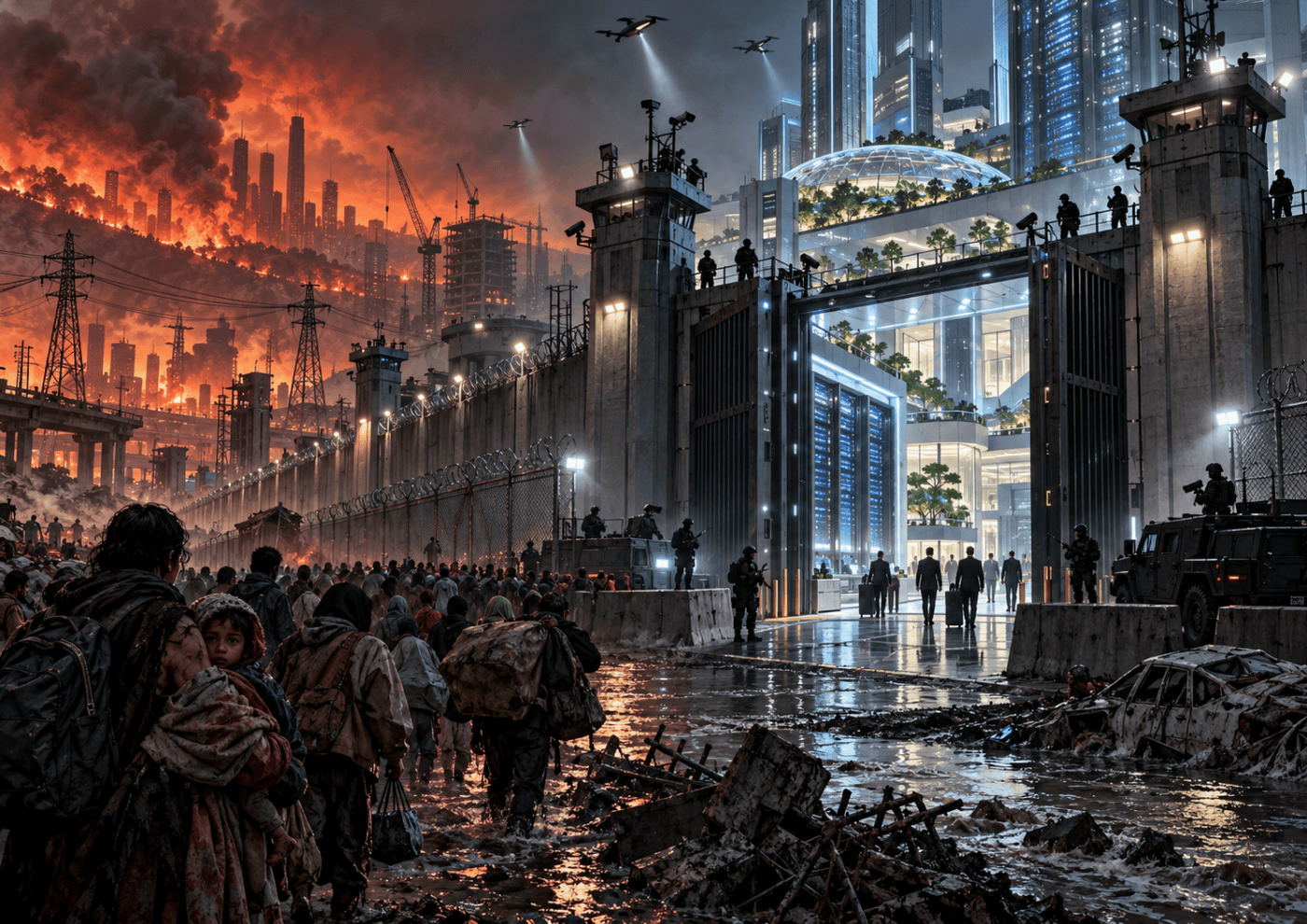
Naomi Klein and Astra Taylor make a powerful discovery in the politics of the bunker: a ruling-class imagination increasingly willing to accept catastrophe so long as the chosen can buy, border, or blast their way to safety. Following that insight downward reveals the material world beneath the fantasy—data centers, energy systems, automation, labor displacement, borders, surveillance, military technology, private ownership, and a capitalist state that does far more than stand guard while oligarchs loot it. Where End Times Fascism names the ideology of selective salvation, Weaponized Information pushes toward the machinery that can make unequal survival administratively and coercively real: the developing convergence of monopoly capital, Big Tech, and state power that WI calls technofascist consolidation. The alternative cannot stop at defending a common world in words; it demands organized working-class and anti-colonial power capable of taking humanity’s productive and technological capacities out of private hands and making the future common property.
Prince Kapone | Weaponized Information | Weaponized Intellects Book Review | October 4, 2026
Three Bunkers and a Real Discovery
Naomi Klein and Astra Taylor begin with an image almost too perfect for the age: the bunker. One version points upward toward heaven, another toward the cloud, another toward the fortified nation. They name the alliance’s three principal currents as “the religious end timers, the tech end timers, and the ethno-nationalist end timers” (p. 18). The factions quarrel over God, artificial intelligence, nation, race and even whether the nation-state itself should survive. Their unity lies deeper than doctrine. Each has abandoned the old promise that humanity as a whole can be carried safely into the future. Each imagines catastrophe with an escape hatch reserved for somebody.
That is the first real discovery of End Times Fascism. The bunker isn’t merely a concrete panic room for billionaires, and it isn’t only a metaphor for borders. It is a political imagination of survival divided by rank. Somebody ascends while somebody burns. Somebody gets through the checkpoint while somebody is turned back. Somebody’s children inherit the future while somebody else becomes a regrettable demographic fact to be managed on the way there. Klein and Taylor’s strongest insight is that contemporary reaction increasingly makes peace with catastrophe itself. The promise is no longer always that disaster can be prevented. More and more, it is that our people, however defined, will be protected when it arrives.
Their first chapter is strongest when it refuses the comfortable fairy tale in which fascism suddenly appeared in Europe as an inexplicable breakdown of an otherwise civilized liberal order. “The Spiral of History” reaches backward through colonial conquest, slavery, settler rule and racial terror to recover antifascist traditions that understood Europe’s catastrophe as inseparable from violence Europeans had already practiced elsewhere. That matters because fascism looks very different once colonialism is allowed into the room. Liberal states could speak of rights in the metropole while ruling colonized peoples through surveillance, forced movement, collective punishment and armed administration. Freedom for some and organized terror for others were never the clean opposites the civics textbooks pretended.
Three histories in particular sharpen that point. Simone Browne traces racial surveillance through slavery, fugitive control and regulated movement; Alfred McCoy shows U.S. colonial intelligence and policing in the Philippines feeding later domestic security institutions; Stuart Schrader follows Cold War police modernization through a transnational circuit joining counterinsurgency abroad to policing at home. Their combined lesson deepens Klein and Taylor’s spiral: imperial rule didn’t simply commit atrocities “over there.” It helped develop portable ways of knowing, sorting and governing populations.
Klein and Taylor therefore warn against waiting for history to return in costume. “Fascism today doesn’t look like the ordered and industrial past,” they write (p. 31). This is more serious than saying fascists have discovered social media. Capitalism itself has changed. The billionaire with a cult following, the venture capitalist financing autonomous weapons, the influencer selling reaction between advertisements and the politician governing through meme warfare belong to a social world Mussolini could not have imagined. Waiting for a carbon copy of 1933 is a fine way to miss what the twenty-first century is actually producing.
The book becomes more powerful still when it moves from style to class. Fascism, Klein and Taylor argue, is capitalism’s “most ferocious threat response,” redirecting anger generated by crisis “downward at the vulnerable rather than upward at the system itself” (p. 32). That formulation does more explanatory work than endless liberal speculation about authoritarian personality. Migrants replace bankers. Queer people replace landlords. The poor are told that another poor person stole what capital never intended to give either of them. The old trick survives because it remains useful: turn the exploited against the excluded and leave the owner counting receipts.
Their use of Ignazio Silone’s phrase, a “counter-revolution against a revolution that never took place” (p. 32), then allows them to read the present without pretending a Bolshevik seizure of power is around the corner. They describe elites who experienced Occupy, Black Lives Matter, climate organizing, antimonopoly pressure, feminist revolt, workplace organizing and renewed socialist politics as intolerable breaches in the impunity wealth was supposed to purchase. Those movements didn’t seize the commanding heights of the economy. Yet even limited accountability can feel like expropriation to people accustomed to treating money as exemption from consequence. A ruling class doesn’t need Petrograd outside the window before some of its members start screaming that the peasants are at the gate.
That is why another sentence in the introduction matters so much. Klein and Taylor finally name end-times fascism as “a crisis of rampant impunity born of concentrated power and wealth” (p. 24). The bunker is no longer eccentric billionaire sociology. It rests on vastly unequal command over land, technology, information, weapons and other people’s labor. The fantasy of escaping society depends on an extraordinarily social power: fortunes accumulated through institutions, workers, infrastructure and states while their owners imagine themselves self-created.
Here, however, the first crack in the analysis opens. Klein and Taylor can see the bunker, the oligarch inside it and the people being pushed beyond its walls. They can see colonial history, capital and state power circling the same terrain. But those relations remain more assembled than reconstructed. Concentrated wealth explains who can purchase an escape route. It doesn’t yet explain the full machinery that produces the road, the checkpoint, the database, the energy grid, the military contract and the armed guard. They have identified a politics of selective salvation. The harder task is to explain how an idea about who deserves a future becomes a material capacity to distribute that future unequally.
That problem is exactly what makes their discovery worth preserving. If the three bunkers were merely three varieties of lunacy, psychoanalysis might be enough. But Klein and Taylor insist that reaction feeds on real wounds: economic insecurity, ecological breakdown, war, social dislocation, loneliness and the wreckage left when emancipatory movements fail to build durable alternatives. The storm outside the bunker is not imaginary. What has to be explained is how a real crisis becomes permission to abandon common survival, and how frustrated hopes that once pointed toward liberation can be taught to seek salvation behind somebody else’s wall.
When Catastrophe Becomes Permission
Klein and Taylor find the purest form of their argument in a theology that doesn’t merely predict catastrophe but converts catastrophe into promise. Writing about the apocalyptic currents that surged after Israel’s 1967 war, they distill the logic with brutal simplicity: “world-ending horrors are imminent, but they should be embraced, even actively accelerated.” Why? “Because you are among the chosen” (p. 43). The suffering of millions becomes somebody else’s road sign to paradise. Destruction stops being evidence that a social order has failed and becomes confirmation that prophecy is unfolding correctly. The bunker has moved into heaven, but its door still has a guest list.
This is where selective salvation begins to acquire political force. The danger isn’t simply that people believe the world may end. Human beings have imagined endings, judgments and rebirths for thousands of years. The danger comes when catastrophe is divided between people whose suffering can be accepted and people whose deliverance makes that suffering meaningful. Once misery becomes proof that history is moving in the right direction, preventing misery can look like interference with destiny. The victim becomes scenery in somebody else’s redemption story.
Klein and Taylor are especially sharp when they trace the movement from denial to celebration. For decades, much of the right met warnings about ecological limits and social breakdown with the same cheerful sermon: the market would provide, technology would rescue us, growth could continue forever. But denial becomes harder when the smoke reaches the dining room. End-times fascism, they write, is the “natural, if brutal, evolution” of those decades of denial (p. 73). The catastrophe no longer has to be rejected. It can be accepted and given another meaning.
The hurricane is real. The wildfire is real. The impossible rent, precarious job, war, displacement and exhausted landscape are real. Klein and Taylor themselves insist that “supremacist ideologies and apocalyptic fervor are intimately entangled with the presence of very real crisis” (p. 70). The ideological work begins in explaining that crisis. The migrant did it. The queer kid did it. The godless city did it. Or perhaps none of them caused the catastrophe, but their existence proves that divine protection has been withdrawn and the cleansing fire is approaching. Capitalism slips out the back door while the tenants fight over who left the stove on.
The book’s deepest explanation, however, appears when it leaves prophecy and enters the history of defeated hope. Klein and Taylor trace Latin American liberation theology as a mass religious politics in which faith became a language of land, dignity, collective struggle and material emancipation. They follow its battering through dictatorship, counterrevolution, U.S. Cold War intervention, church repression and the destruction of organizations through which poor people had learned to imagine another earthly future. Their devastating conclusion is only four words long: “The longings remain, homeless” (p. 90).
That sentence carries more historical weight than any theory in which reaction spreads because millions of people simply catch bad ideas. If movements are crushed, the needs those movements organized don’t disappear. People still want belonging, dignity, explanation and some reason to believe tomorrow can be less punishing than today. They still need institutions capable of turning private suffering into a common story. Destroy those institutions and the longing survives without its old political home. Reaction can then offer one.
Research from Historical Materialism sharpens the same problem from another direction. Peter Bratsis situates Trumpism inside decades of privatization, consumerization, suburbanization and atomized social life that weakened collective institutions through which people once encountered shared interests. Tricontinental’s analysis likewise locates the contemporary far right amid austerity, declining public provision, oligarchic power and weakened working-class organization. Dry timber does not explain the spark, but it tells us why the fire can travel.
Klein and Taylor’s treatment of religion protects the argument from a crude materialism. Liberation theology and reactionary eschatology arise from the same broad religious field yet move toward opposite political destinations. One tells the poor that faith demands transforming the conditions producing misery. The other can tell them that the world is already doomed, suffering is prophecy and salvation lies beyond it. Religion is neither an automatic revolutionary force nor an automatic reactionary one. Its politics depends on the social struggle carried through it: which institutions organize belief, whose interests they confront and what kind of future they teach people to build.
Nor does reactionary ideology have to be a lie consciously manufactured by elites. A worker can sincerely believe that migrants threaten his livelihood. A billionaire can sincerely believe his fortune proves superior intelligence. A pastor can sincerely read war as prophecy. Sincerity doesn’t make any of these beliefs politically innocent. Ideology works because people can inhabit it as common sense while powerful institutions amplify interpretations that redirect anger away from property, exploitation and empire.
The distinction becomes clearer when the language of prophecy is set beside the language through which the state describes its own work. The 2025 National Security Strategy organizes its program around industrial capacity, energy, technological leadership, supply chains, military power and geopolitical competition. Revelation may animate parts of the political coalition, but the state still needs factories, electricity, minerals, weapons and command over production. Apocalypse helps explain how crisis can be made meaningful. It doesn’t explain the entire machinery assembled to govern through crisis.
That is the limit that has to be placed around the end-times concept. Klein and Taylor have identified something real and dangerous: catastrophe becoming permission. Their fascist doesn’t always deny the flood. He builds a wall and decides who gets the boat. But the flood, the wall and the boat are produced inside definite relations of property, production and state power. Apocalyptic belief can make abandonment righteous. It can make domination feel like survival and sacrifice feel necessary. It cannot, by itself, build the material infrastructure through which some people are protected and others exposed.
Klein and Taylor themselves cross that threshold at the end of the chapter. “You don’t need to believe in the supernatural,” they write, “to see yourself in distinctly messianic terms, capable of simultaneously ending the world and saving it” (p. 94). Then they point toward the “god-men of Silicon Valley.” The celestial bunker is about to descend into the world of property. Once salvation comes down from heaven, it needs land, servers, electricity, workers, pipelines, contracts and capital. The cloud needs a power plant.
The Cloud Has a Power Plant
Klein and Taylor are at their strongest when they drag artificial intelligence down from the heavens and make it answer for its electric bill. After pages of digital gods, superintelligence and Silicon Valley prophecy, they turn toward what machines are actually “capable of doing—for us and to us.” The change of altitude matters. The discussion leaves the terrain preferred by the tech barons, where every conversation begins with whether their machines will become conscious and ends with humanity kneeling before an electronic Zeus. AI returns to earth. Here it needs chips, copper, concrete, water, electricity, land, workers, transmission lines and enormous concentrations of capital. The cloud, it turns out, has plumbing.
That demystification matters because AI mythology performs economic work before any digital god arrives. The promise of artificial general intelligence helps draw capital toward an industry whose valuations depend heavily on expectations of future transformation. John Bellamy Foster’s political economy of AI places that boom inside the concentration of monopoly-finance capital. Klein and Taylor arrive at the same terrain from another direction. The supposedly autonomous machine turns out to rest on appropriated human knowledge, massive fixed investment, energy infrastructure and workers scattered across mines, fabs, construction sites, warehouses and data centers. What appears as intelligence floating in the cloud is built through very earthly relations of ownership and labor.
The authors also preserve the contradiction inside the technology. Martin Luther King Jr. enters their Memphis chapter because he had already watched automation strike Black workers first and then spread through the working class. “Black and white, we will all be harmed unless something grand and imaginative is done,” he warned. Yet King wasn’t an enemy of machinery. He wrote that automation could give working people “undreamed-of amounts of leisure time.” The contradiction was never machine versus human being. Machinery could reduce necessary labor and enlarge human freedom. Under capitalist ownership, however, liberation from labor arrives for the owner as lower costs while it arrives for the worker as a vanished paycheck.
Klein and Taylor make that contradiction visible through what they call the “AI factory.” The term itself is revealing. These enormous data centers increasingly supply computation to design, logistics, administration, media and warfare, yet “the humans in AI factories are eerily missing.” Their Memphis reporting gives the abstraction a landscape: gigantic buildings, staggering electricity demand, industrial pollution and relatively little permanent employment once construction ends. The old factory concentrated machinery and large bodies of workers in the same place. The computational plant can concentrate billions in fixed capital while keeping the permanent workforce comparatively thin.
The authors call this the “anti-human math,” but their own evidence requires a more precise determination. AI doesn’t eliminate labor. Workers mine minerals, fabricate chips, pour foundations, wire substations, build transmission systems, cool servers and maintain the machines. Data-center construction can create substantial skilled employment, including union work. What changes is the relationship between the scale of investment and the stable workforce reproduced around it. A billion dollars of industrial spending no longer carries any necessary promise of thousands of permanent jobs or renewed working-class leverage. This is better understood as reindustrialization without Fordism: enormous capital expenditure without any automatic restoration of the mass employment, union density and social incorporation once associated with industrial expansion.
That makes Klein and Taylor’s warning about a business model “destroying the employment prospects of entire classes of people” more serious than a prediction about robots stealing jobs. Capital has always sought to reduce the living labor required for production. The explosive contradiction appears because workers remain dependent on wages even as owners invest in technologies meant to reduce their dependence on workers. Society develops the capacity to produce more with less human toil, then capitalism hands the resulting freedom to the employer and the resulting insecurity to the employee. The machine promises humanity release from drudgery while private property sends the invoice to the people it has made redundant.
The physical infrastructure behind the boom also wrecks Silicon Valley’s old fantasy of a weightless digital economy. Klein and Taylor call the emerging relationship between computational expansion and fossil energy “Fossil Tech,” arguing that Big Tech and Big Oil have “effectively fused.” The word fused pushes too far if taken literally: the energy system feeding AI also includes nuclear generation, grid expansion and renewable power. But the material relationship they identify is undeniable. Artificial intelligence needs enormous quantities of electricity, and companies supplying gas, power equipment, generation and transmission have discovered a new field of accumulation in the race to expand compute.
The state is not standing outside that process. In April 2026, the White House invoked Defense Production Act authority for large-scale energy and energy-related infrastructure, declaring such capacity essential to national defense and explicitly finding that financing risks, regulatory delays and market barriers prevented private industry from supplying it quickly enough on existing terms. The determination authorized purchases, commitments and financial support to expand that capacity. That doesn’t mean Washington built the AI boom by decree. It establishes something more concrete: when strategic accumulation runs against the limits of the market, the capitalist state can step in to organize the conditions the market fails to provide.
Klein and Taylor begin to glimpse this larger relation when they quote Francesca Bria’s description of an “authoritarian stack” embedded through “personnel pipelines, procurement loops, and technical architectures.” Alex Karp and Nicholas Zamiska make the same movement visible from inside the national-security technology sector. In The Technological Republic, they openly call for the software industry to rebuild its relationship with government, participate in a national project and direct technological capacity toward preserving U.S. geopolitical power. The language is useful precisely because it isn’t a confession. It is a program. Private technological capital is asking for markets, missions and strategic purpose that only the state can provide.
This is where Klein and Taylor’s metaphor of the state as “the mine—and the muscle” reaches its limit. They are right that states are “essential sites of extraction,” packed with public money, contracts and valuable data that corporations want to seize. But a mine sits there waiting to be dug. The state does more. It finances research, guarantees demand, builds infrastructure, secures energy and supply chains, procures military systems and defines the national-security priorities around which whole markets grow. Capital mines the state, certainly, but the state also clears the mine, lays the railroad, buys the ore and stations armed men around the entrance.
That active role is what makes Klein and Taylor’s final demystification so important. “AGI doesn’t have to go rogue” to become dangerous. The machine doesn’t need consciousness, hatred or a secret extermination plan. A perfectly obedient system can intensify exploitation, pollution, surveillance and warfare because human institutions already supply the purpose. The computer can remain dumb as a brick and still become useful to very intelligent people with very ugly interests.
The deeper contradiction is humanity’s collective productive power confronting us as somebody else’s property. Knowledge accumulated by generations becomes proprietary training material. Public infrastructure feeds private compute. Workers create technologies capable of reducing necessary labor, then meet those technologies as threats to their own survival. And as corporations and states pour resources into systems that increasingly mediate production, administration and war, another problem rises from beneath the server racks: once human beings become more legible to these systems, who gets classified as necessary, valuable, eligible, dangerous or expendable?
Who Gets Carried Into the Future?
When Klein and Taylor write that the tech right is engaged in “human sorting,” they put their finger on one of the most important relations in the book. The phrase appears after their journey through billionaire bunkers, longevity schemes, cognitive supremacy and dreams of technologically enhanced escape. By then the meaning of “I will be saved” has begun to harden. Salvation can’t remain a private conviction. Once the chosen intend to preserve their advantages through catastrophe, somebody has to identify who belongs inside the protected circle and who doesn’t. The bunker needs a gate, and the gate needs a list.
This is where selective salvation becomes administration. Governments, corporations and other institutions already sort people every day: citizen or deportable, eligible or ineligible, low risk or high risk, employable or redundant, cleared or flagged. Oscar Gandy gave this process a durable political grammar in The Panoptic Sort: institutions gather information to identify people, classify them, evaluate them and then decide how to treat them. The decisive issue isn’t simply that somebody knows something about you. Power enters when the classification determines whether you get credit, work, medical treatment, parole, public assistance, mobility or police attention. Information becomes material when a category authorizes an action.
Virginia Eubanks shows the same relation from inside the welfare office. In Automating Inequality, computers don’t invent poverty and databases don’t create austerity. Legislatures and administrators establish scarcity, eligibility rules and suspicion toward poor people; information systems can then enforce those decisions at scale. Her Indiana case shows an automated system acting less like a doorway to assistance than a gatekeeper, multiplying the administrative obstacles through which poor families had to pass. The political choice comes first. Technology can make that choice harder to escape.
That distinction matters because the same information system could be designed to find every benefit a household qualifies for and deliver it automatically. There is nothing inherently fascist about a database. Under a regime organized around denial, however, the database can make denial faster, cheaper and more comprehensive. The machine doesn’t wake up one morning and decide who deserves dinner. Legislators write the rules, agencies enforce them, contractors build the systems, and poor people live with the consequences.
Klein and Taylor approach the same problem through what they call the “perpetually bunkered nation.” Their national bunker promises intensified protection from designated enemies while offering less material security to many people already inside. The border hardens while housing, healthcare and public provision remain insecure. A worker can receive less assistance and more scrutiny at the same time. The state retreats from one relation to the population while becoming violently intimate in another.
The authors are especially sharp when they describe the “substitution of migrants for bankers.” After the 2008 crash, workers across Europe lived through austerity, unemployment, stagnant wages and weakened public services. The institutions that caused and managed the crisis directed the bill downward. Then the far right supplied a counterfeit invoice. Your rent is high? Blame the refugee. Your hospital is overcrowded? Blame the migrant. Your wage is miserable? Blame the foreign worker. The financiers disappear from the crime scene while two groups wounded by the same order are encouraged to fight over the bandages.
But the border does more than exclude. Capital often needs migrant labor precisely because legal insecurity can weaken workers’ power. Agriculture, construction, logistics, domestic work and care can depend heavily on migrants while immigration law keeps many of those workers vulnerable to dismissal, detention or deportation. The bunker therefore doesn’t simply divide those who enter from those who remain outside. It creates different terms of entry. A worker may be necessary enough to harvest the crop, clean the hotel or pour the concrete and still be treated as removable. Labor crosses while rights do not.
That is why Simone Browne’s Dark Matters belongs inside this discussion. Long before biometric checkpoints and predictive analytics, slave passes, fugitive notices, lantern laws and other techniques of racial surveillance made movement itself something authorities could authorize, monitor and punish. Racial domination didn’t merely produce surveillance after the fact. Surveillance helped make racial boundaries governable. The modern database therefore lands on old terrain. Digital systems change the speed, reach and interoperability of classification, but they inherit political categories formed through slavery, colonialism, policing and border rule.
Sarah Brayne follows that relation into contemporary policing. Data-driven systems can pull information from many domains and widen scrutiny beyond the person originally targeted. Addresses, vehicles, relatives, associates and shared records become threads in a relational map. Brendan McQuade’s Pacifying the Homeland pushes the problem beyond the prison itself: poor people, racialized populations and formerly incarcerated people can remain formally free while living under repeated verification, supervision and institutional judgment. The old cell is no longer the only architecture of control. The checkpoint can follow you home.
This gives Klein and Taylor’s “human sorting” a harder material form. No central database needs a column labeled disposable. A welfare agency can deny food assistance. An employer can classify a worker as replaceable. An immigration authority can make a person deportable. A police department can mark a network as suspicious. A landlord can price a family out of a neighborhood. An insurer can determine what treatment gets paid for. These institutions remain different, and their decisions arise from different laws and interests. But their judgments can accumulate on the same people, shaping who reaches the next crisis with savings, healthcare, legal status, mobility and a roof overhead.
This is what differential survivability names. People don’t encounter catastrophe from equal ground. Landlords ration shelter through price. Employers ration income through wages and hiring. Insurers and healthcare systems ration treatment. Welfare agencies condition subsistence through eligibility. Border authorities ration mobility and legal presence. Police and courts distribute surveillance, confinement and exposure to violence. Wealth can purchase distance from many of these pressures, while poverty leaves people pressed against all of them at once.
Klein and Taylor reach the political core when they write, “This is a war over who survives the future.” Their formulation becomes stronger once survival is understood as something organized long before the hurricane, wildfire or social breakdown arrives. The future is rationed in the present through wages, housing, healthcare, citizenship, environmental exposure, policing and infrastructure. The bunker begins wherever protection stops being treated as something people should share and becomes a privilege whose boundaries somebody must enforce.
Even membership among the protected remains unstable. Klein and Taylor later observe that “being part of the in-group is never guaranteed.” Fascist belonging can be revoked. Yesterday’s useful ally becomes tomorrow’s contaminant. A racialized supporter can discover that patriotism doesn’t erase race. A woman celebrated as a guardian of tradition can discover that tradition requires her subordination. A religious minority welcomed into one coalition can become its next target when the line shifts. The insecurity is not accidental. A hierarchy whose boundaries can move keeps people proving their loyalty by pointing toward someone lower.
At this point Klein and Taylor have carried the bunker much farther than architecture. They have reached eligibility systems, borders, surveillance networks, policing, labor markets and institutions capable of translating social categories into different material outcomes. The argument has therefore produced a problem larger than individual prejudice or billionaire psychology. Somebody builds these categories. Somebody owns the systems that process them. Somebody writes the rules that give them force. Somebody possesses the authority to turn classification into deprivation, detention or protection. The question of who is chosen has become a question of organized power.
The Missing Machinery: Where End Times Fascism Becomes Technofascism
Klein and Taylor come closest to the machinery beneath their own theory when they describe an emerging “authoritarian stack” held together through “personnel pipelines, procurement loops, and technical architectures.” That phrase carries the argument beyond bunker psychology. Power now moves through contracts, software, government agencies, corporate vendors, military procurement, databases and people who circulate between them. The authors have followed the fantasy of selective salvation down into institutions. The question is what kind of social order those institutions are becoming capable of producing together.
The answer cannot simply be that corporations have captured the state. Klein and Taylor themselves call governments “essential sites of extraction,” packed with money, contracts and data that technology firms want to mine. Section III already showed why that metaphor only goes so far. The state doesn’t merely sit beneath capital waiting to be excavated. It organizes markets, guarantees demand, finances strategic infrastructure and gives private technology firms missions that individual consumers never could. Alex Karp’s call for Silicon Valley to rebuild its relationship with government is useful precisely because it comes from inside this emerging national-security technology fraction. He isn’t describing the disappearance of the state. He is asking technological capital to bind itself more tightly to state power.
Chapter 7 makes clear that Klein and Taylor have already moved well beyond a simple billionaire-conspiracy story. Looking across firms selling surveillance, detention, border technology, media infrastructure and other services to the state, they coin the phrase “Armageddon-industrial complex.” Then, drawing on John Ganz, they confront what he calls the “material basis” of the current MAGA coalition: fractions of regional capital, a reactionary wing of the technology sector concentrated around defense and security, parts of the immigration-enforcement apparatus and an influencer economy that turns political rage into revenue. This is a serious class analysis. It recognizes that end-times politics is reproduced through industries, jobs, contracts, platforms and profits, not merely through bad ideas circulating in poisoned minds.
But this is also where the book stops one relation too early. A coalition of capitalist fractions tells us who profits. An industrial complex tells us where accumulation occurs. Neither by itself explains how those interests become durable capacities of rule. The missing relation is the capitalist state as organizer: the institution that writes legal categories, directs procurement, commands police and military force, structures markets, controls borders, administers benefits, accumulates population data and translates private technological capacity into public authority. Once that relation is brought into view, Klein and Taylor’s separate discoveries begin to form a larger pattern.
Within Weaponized Information’s framework, technofascism names this developing crisis-state tendency: the increasing compatibility of monopoly-finance and industrial capital, Big Tech capital and the administrative and coercive institutions of the capitalist state under conditions of weakened mass incorporation and imperial strain. The concept begins with ownership and class power, not gadgets. Technology matters because privately controlled systems of production, communication, classification and warfare can be joined to institutions that possess powers corporations do not: taxation, legal compulsion, detention, deportation, incarceration and organized armed force.
This is why Klein and Taylor’s phrase “human sorting” is more explosive than it first appears. Section IV followed the path from classification to material consequence: eligibility, mobility, employment, policing, legal status and unequal access to the means of survival. Commercial data systems can identify, rank, predict and profile. State institutions can make those classifications actionable. A platform can reduce someone’s visibility. An employer can fire them. A benefits agency can deny a claim. Immigration authorities can revoke legal presence or remove a person. Police can investigate, detain and use force. The distinction is not one of technological sophistication. It is one of organized power.
Oscar Gandy, Virginia Eubanks, Simone Browne, Sarah Brayne and Brendan McQuade approach different parts of this relation from different histories. Gandy follows information from identification through classification toward treatment. Eubanks shows administrative systems governing access to subsistence inside institutions already structured by scarcity and suspicion. Browne reconstructs racial surveillance through slavery and regulated movement. Brayne shows networked policing extending scrutiny across social relationships. McQuade follows intelligence and supervision beyond the prison wall. None of these histories demonstrates a single integrated command system. Taken together, they show the building blocks through which populations become increasingly legible to institutions empowered to treat different categories of people differently.
The coercive side of that capacity has its own genealogy. Alfred McCoy’s Policing America’s Empire reconstructs colonial intelligence and police administration in the U.S.-occupied Philippines and traces parts of that repertoire back into domestic security institutions. Stuart Schrader’s Badges Without Borders follows another route, showing Cold War police assistance abroad and police modernization at home developing through overlapping personnel, institutions and doctrines. Elizabeth Hinton then shows federal law-enforcement expansion emerging inside the Great Society itself, rather than neatly replacing social provision after liberalism had already died. The history refuses an easy sequence from welfare state to police state. Provision and coercion can grow together, then be reorganized unevenly as class relations change.
Counterinsurgency gives this history a political object. Bernard Harcourt reduces its classic grammar to identifying a dangerous minority, separating it from the wider population and securing the allegiance or passivity of the rest. But the longer history in McCoy, Schrader, Hinton and Orisanmi Burton prevents that grammar from floating free of struggle. Colonial subjects, Black liberation movements, communists, radical workers, Indigenous nations and rebellious prisoners were not statistical abstractions invented by security bureaucrats. They represented real conflicts over land, labor, empire, racial power and state authority. Counterinsurgency developed as a way of governing populations precisely because those populations could organize.
Technofascism, in WI’s usage, therefore cannot be reduced to a surveillance state. Its deeper problem is the convergence of accumulation and governability. Capital seeks labor-saving production, new strategic markets and tighter control over technological infrastructure. The state seeks industrial capacity, military advantage, population legibility and political order. Big Tech supplies systems increasingly useful across all four terrains. Their institutions remain distinct, their interests can conflict and resistance can interrupt the process. Yet the same firms, technical standards, cloud systems, analytics, personnel and procurement relationships can travel between commercial, administrative and military worlds. No single command room is required for those worlds to become increasingly interoperable.
Klein and Taylor’s strongest Chapter 7 evidence points in exactly this direction. Their “Armageddon-industrial complex” is profitable because coercion itself has become a field of accumulation. Border enforcement creates contracts. Detention creates contracts. Surveillance creates contracts. Propaganda and platform circulation create revenue. Defense and security technology attract capital because the state can guarantee enormous demand. The important step beyond the authors’ formulation is to see that these aren’t merely businesses feeding around government. Through procurement, infrastructure, law and strategic planning, the state helps constitute the markets in which those businesses grow.
The imperial relation deepens the problem. The technology-state convergence Klein and Taylor document is unfolding while U.S. power faces sharper competition over semiconductors, artificial intelligence, minerals, energy, industrial capacity and military technology. WI’s framework treats this as part of an imperial recalibration rather than a simple retreat from globalization. The ruling class has powerful incentives to reconstruct strategic production and military capacity without surrendering private ownership or restoring the social bargain that once accompanied mass industrial employment. Reindustrialization can therefore proceed alongside weakened working-class incorporation: factories, data centers and weapons systems return without returning power to the workers who build them.
This gives a harder meaning to Klein and Taylor’s declaration that “This is a war over who survives the future.” Survival is not administered only at the bunker door. It is structured through production, property, citizenship, energy, housing, labor markets, welfare institutions, borders, policing and military power. The same capitalist state can mobilize immense resources for strategic technology while leaving social reproduction precarious and conditional. Its strength and weakness are distributed by class function. It can be technologically advanced where capital and imperial command require capacity while remaining miserably inadequate where ordinary people require care.
That is the machinery Klein and Taylor nearly reach. Near the end of the book they describe the power confronting popular movements as a combination of “wealth, technological power, and military might.” The phrase gets closer to the heart of their own argument than any billionaire’s bunker. Wealth supplies command over productive resources. Technological power expands the ability to calculate, coordinate and classify. Military and police power give hierarchy organized force. The decisive issue is not that the three have become one seamless apparatus. It is that capitalist crisis can make their deeper alignment increasingly useful to ruling-class reproduction.
Klein and Taylor discovered the bunker. WI’s theory of technofascism excavates the machinery underneath it: private ownership joined to strategic state reconstruction, technological systems joined to population administration, and accumulation joined to inherited capacities of counterinsurgency and coercion. That machinery is developing unevenly and remains contested. The harder question is what kind of political transformation it represents. If these capacities are growing inside institutions that still retain much of liberal capitalism’s formal shell, then calling the process fascist cannot rest on mood, imagery or technological menace alone. The category itself has to survive historical scrutiny.
Fascism After Fordism?
Klein and Taylor know the obvious trap. “Fascism today doesn’t look like the ordered and industrial past,” they write, warning readers who keep searching history for a rerun. They are right. Capitalism itself has changed too much for reaction to return wearing exactly the same uniform. The mass factory has been broken apart, unions weakened, public life privatized, political communication commercialized and everyday existence pushed through platforms built to monetize attention. A twenty-first-century fascist formation would emerge from that world, not from an embalmed reconstruction of Rome in 1922 or Berlin in 1933.
But the strength of that insight creates a problem the book never completely resolves. If fascism can lose the disciplined party, the mass paramilitary organization, the corporatist institutions, the stable boundaries of the in-group and even the decisive revolutionary challenge from below that marked many of its classical forms, what keeps the category from expanding until every savage authoritarian mutation of capitalism fits inside it?
The question matters because Klein and Taylor themselves give fascism a demanding historical definition. They call it capitalism’s “most ferocious threat response,” a way of redirecting rage produced by social crisis downward toward vulnerable populations rather than upward toward the property system and its beneficiaries. In the classical cases they invoke, that response arose when capitalist crisis coincided with powerful movements from below. Communist parties, socialist organizations, militant unions, anticolonial forces and newly enfranchised populations threatened existing relations of property or racial rule. Fascism didn’t merely produce cruelty. It smashed organized counterpower.
The present conjuncture is different. Klein and Taylor acknowledge as much. The contemporary ruling class may experience climate movements, Occupy, Black Lives Matter, union drives, socialist campaigns and demands for redistribution as intolerable threats, but none has yet constituted an equivalent revolutionary challenge to capitalist property. The political move in End Times Fascism is therefore subtle but consequential: counterrevolution no longer requires a revolution already capable of taking power. It can become preventive, aimed at shutting down reforms, movements and institutions that might grow into a more serious challenge later.
That extension deserves to be taken seriously, but not granted without a fight. Forrest Gordon and Charlie Post make the strongest opposing case in their Historical Materialism intervention. For them, classical fascism involved a severe crisis of capitalist rule in which ordinary repression no longer sufficed, a mass reactionary movement mobilized outside the conventional state apparatus, organized working-class power faced physical destruction, major sections of capital backed the counterrevolution, and the state itself underwent qualitative transformation. Their point isn’t that racism, political repression or executive authoritarianism should be shrugged off until a man in a funny uniform marches past the window. It is that fascism names a specific solution to a specific crisis of capitalist order.
Klein and Taylor respond through historical mutation. Contemporary reaction, they argue, is “not led by disciplined and buttoned-up generals” but by CEOs, politicians and attention merchants shaped by a fragmented digital economy. Where twentieth-century fascisms organized followers through parties, youth organizations, unions subordinated to the regime and paramilitary formations, today’s reactionaries can gather people through platforms, podcasts, influencer networks and monetized outrage. The comparison is illuminating because neoliberal capitalism has spent decades dismantling many of the collective institutions from which both revolutionary and counterrevolutionary mass politics once grew.
Peter Bratsis’s account of Trumpism’s social terrain helps explain why. Privatization, suburbanization, weakened unions, fragmented workplaces and consumer culture didn’t simply change policy. They changed the social ground on which people organize political life. Reaction formed in that landscape will not necessarily resemble a regimented movement built around the factory gate and party branch. The livestream, megachurch, private militia, billionaire-funded network and algorithmic subculture can assemble anger without reproducing the old fascist party form.
Still, mutation can’t become a magic eraser. If the revolutionary threat can disappear, the disciplined mass movement can disappear and the transformed state can disappear while the category remains unchanged, fascism becomes impossible to falsify. The word then stops distinguishing one form of capitalist reaction from another and becomes a political weather report: very bad, getting worse.
This is why the Tricontinental Institute formulation of a “far right of a special type” is useful, and why John Bellamy Foster’s language of neofascism carries its own caution. Both attempt to preserve historical continuity while admitting that the present may be producing something neither identical to classical fascism nor comfortably contained within liberal capitalism. The category has to describe a process in motion, not declare the destination before the train arrives.
The United States makes that discipline especially necessary because its liberal order has always carried authoritarian weapons inside it. The FBI’s own COINTELPRO records document surveillance, infiltration and disruption directed against communists, Black liberation organizations, antiwar activists and other movements while constitutional institutions remained formally intact. The country also passed through Jim Crow, colonial occupation, Red Scares, strikebreaking, mass incarceration and political policing without requiring us to flatten every period into one uninterrupted fascist regime.
The distinction lies in transformation. Repression becomes evidence of a different state form when its class function, institutional scale and relationship to organized counterpower change together: when exceptional powers become routine, coercive and administrative systems become more tightly integrated, executive command increasingly escapes popular constraint, ruling-class strategy hardens around repression, and the institutions through which workers and oppressed peoples can resist are systematically broken or subordinated. The existence of police files proves police repression. It does not, by itself, prove fascism.
This is the advantage of speaking about technofascist consolidation as a developing tendency rather than announcing a completed regime. The concept can identify real movement toward a more integrated crisis state without pretending every contradiction has already been resolved. Courts can obstruct executive action. Workers can organize. agencies can conflict. corporations can divide over strategy. states, cities, Indigenous nations and social movements can interfere with projects imposed from above. These are not footnotes to the theory. They help determine whether consolidation succeeds.
Klein and Taylor’s “end times fascism” is therefore most convincing when treated as a political formation fighting to become durable rather than a finished constitutional description. Its apocalyptic stories teach people to accept selective survival. Its class coalition gives those stories money, infrastructure and institutional access. Technofascist tendencies can make some of those divisions increasingly actionable. But none of this eliminates contingency. Fascism is not a spirit descending from the cloud once enough ugly opinions accumulate. It is a struggle over the reorganization of class rule.
That leaves the book with a harder task than diagnosing the enemy. If the outcome remains contested, then the alternative must become more than refusal. Klein and Taylor call that alternative Hereness: staying with one another, defending the living world and rejecting the bunker’s promise of salvation for the few. The impulse is right. But if the forces constructing the bunker command property, technology and state power, then belonging itself has to learn how to command something too.
Hereness Is Not Yet Power
Klein and Taylor give their answer to the bunker a beautiful name: Hereness. Drawing on the Jewish Labor Bund’s concept of doikayt, they describe it as “a fierce commitment to place and community that was not based on bloodlines.” The distinction matters. Fascist belonging asks whose ancestors are buried beneath the soil and whose blood supposedly grants the right to remain. Hereness asks whether people are willing to live together, defend one another and make the place they inhabit fit for human beings. Belonging becomes something practiced rather than inherited. The migrant who joins the picket line may belong more deeply than the billionaire threatening to leave the moment the city asks him to pay taxes.
This is one of the book’s finest reversals. Against the people building celestial, digital and national escape routes, Klein and Taylor place those with “no escape plan, no bunker” who must make a life together on the damaged earth they actually inhabit. Their examples move through Indigenous land defense, immigrant protection, ecological struggle and the everyday labor of people keeping neighbors alive. Hereness restores something capitalism spends enormous energy destroying: the knowledge that a community is more than a market and the earth is more than a warehouse of resources waiting for an owner.
The Bundist inheritance gives this politics harder edges than a sentimental celebration of localism. Doikayt joined rootedness to working-class solidarity across difference. Its test was action: will you struggle alongside people of another religion, ethnicity or nationality to make the place where you live “fairer and freer for all working people”? That puts Hereness against both the billionaire cosmopolitan who treats cities as interchangeable investment zones and the blood-and-soil nationalist who claims exclusive possession of one. The first says a place belongs to whoever can buy it. The second says it belongs to whoever supposedly inherited it. The Bundists answered that people make places together through labor, memory, culture and struggle.
Klein and Taylor deepen the argument when they write that “economic austerity has emotional consequences.” A closed clinic or gutted bus line does more than subtract a service from a ledger. It changes the conditions under which people meet one another. Scarcity gets inside social life. When housing, wages, healthcare and schools become permanently insecure, another poor family can be made to look like a competitor reaching for the same shrinking loaf. Their conclusion is simple and correct: “the best way to help people be their best selves is to make their lives better in the here and now.” Antifascism therefore has a material floor. People need homes, childcare, wages, transit and healthcare before sermons about tolerance can carry much weight.
Chapter 9 is where the authors make their strongest attempt to turn that ethic into political practice. Their Mamdani case is not just neighborliness with campaign literature. They describe more than one hundred thousand volunteers knocking millions of doors around a concrete demand: New Yorkers should be able to afford to remain in the city they built. Rent freezes, fast and free buses and universal childcare gave Hereness a material program. The campaign joined love of place to an attack on the forces pushing working people out of it, while its mass canvassing rebuilt social relationships that decades of atomized city life had worn thin. Mamdani’s formulation—“we can not only fight back against authoritarianism, but we can also fight for working people”—is the book’s clearest recognition that antifascism has to offer more than resistance.
Klein and Taylor are particularly sharp about the class confrontation that followed. When wealthy New Yorkers threatened flight rather than higher taxes, their mobility exposed the hollowness of their own attachment to the city. Workers, tenants and immigrant families were fighting to stay; sections of the billionaire class advertised their readiness to leave if New York ceased meeting their preferred terms. Hereness acquired a class content. One side needed the city as a place to live. The other could treat it as an asset among assets.
But that discovery pushes the argument beyond what municipal reform alone can settle. Somebody owns the apartment building. Somebody owns the data center. Somebody owns the platform, the patents and much of the energy infrastructure. Somebody decides where investment goes, whose labor is hired, what gets automated and whether wealth produced in a city returns to its people or leaves as rent, interest and profit. A mayor can regulate parts of those relations, tax some wealth and expand public goods. Yet capital retains powers of its own: ownership, investment strikes, price setting, relocation and control over production. The threat to leave that Klein and Taylor describe is not merely bad civic character. It is economic power.
That is where the history reconstructed by Elizabeth Hinton and Orisanmi Burton becomes indispensable. Hinton shows that expanded social provision and expanded coercion can grow inside the same state. Burton shows something even more uncomfortable: reform can relieve suffering while strengthening an institution’s capacity to pacify resistance. Neither lesson makes reforms trivial. Rent matters when the landlord is knocking. Food matters when the refrigerator is empty. But a concession and a transfer of power are not the same thing. Better administration can leave the commanding relation untouched.
Hereness becomes a class politics when the people who reproduce a place acquire organized power over the conditions of remaining there. Unions can stop production. Tenant organizations can confront landlords as a bloc. Public institutions can remove necessities from the market. Communities can fight for control over land, energy, transport and technological infrastructure. The issue is not whether every struggle immediately abolishes private property. It is whether each struggle leaves working people more capable of deciding what happens to the wealth and systems their labor sustains. Proletarian Hereness begins where belonging acquires leverage.
The anti-colonial question pushes the concept farther still. A comfortable commons in the imperial core cannot be built from cobalt mined under misery, data infrastructures owned abroad, poisoned sacrifice zones and military force securing somebody else’s minerals. The right to stay must include the right of peoples to command the material conditions of staying. That is why struggles for digital sovereignty belong here: communities and nations cannot meaningfully govern their technological futures while the platforms, infrastructure, standards and intellectual property governing digital life remain concentrated in foreign monopolies. Hereness without sovereignty can become a pleasant room inside somebody else’s house.
Klein and Taylor have recovered the right human starting point. This world is not disposable. Neither are the people in it. Paradise is not somewhere else; as King’s last sermon made concrete for the authors, “Paradise was here,” in the struggle for dignity, wages and collective life already under way in Memphis. But the bunker is not defeated because we learn to love the neighborhood more beautifully. The bunker is powerful because a class possesses the means to protect its own future.
Hereness becomes the bunker’s real opposite when those who intend to stay can decide what gets built, who owns it, how technology is used, where social wealth goes and whose lives are secured by it. Care has to become institution. Solidarity has to become organization. Belonging has to become power. Only then can the common world cease being a moral appeal and become something the people who make it can actually command.
The Future Cannot Remain Private Property
Klein and Taylor end by demanding disarmament. They look back to the movements that forced nuclear weapons out of the realm of political normality and insist that supposedly permanent machinery can be dismantled through organized struggle. Then they widen the target. We must “disarm the profit models” that have become weapons against democratic life, they write, and ultimately “break with capitalism and build new economic and political systems that honor life and prioritize care and repair.” After a book crowded with bunkers, borders, data centers and digital gods, the argument finally reaches the relation beneath them all: who gets to command the powers humanity has created?
This is where End Times Fascism becomes most radical. The crisis is not that humanity has become too technologically powerful. It is that capitalism has made the future into property. Workers produce knowledge that returns as automation owned by somebody else. Communities supply land, electricity, water and infrastructure to systems they do not control. Generations of public science become patents, platforms and weapons enclosed behind private ownership. Human beings collectively build extraordinary productive powers and then confront them as layoffs, rents, surveillance systems, military machines and electric bills.
Klein and Taylor’s disarmament metaphor captures the urgency, though the social relation goes deeper than any individual weapon. A missile can be dismantled while the industry that produced it survives. A predatory algorithm can be prohibited while monopoly ownership of computation remains untouched. A billionaire can pay more taxes while the machinery reproducing billionaires keeps humming. The real question is whether society can take socially created productive power out of private hands and place it under collective command.
At that point the three concepts developed across this review finally fit together. End-times fascism names the ideological politics of selective salvation: catastrophe becomes acceptable because the chosen imagine themselves surviving it. Fortress accumulation names the material tendency to concentrate strategic resources, infrastructure and abundance inside protected circuits while externalizing insecurity and sacrifice. Technofascist consolidation names the developing institutional capacity through which monopoly technological capital and capitalist state power can make unequal protection more legible, administrable and enforceable. They are different determinations of the same historical contradiction, not synonyms for one giant machine.
Nor do they unfold in a neat mechanical sequence. Capitalist crisis, private command and imperial competition create pressures to secure some populations, territories and productive systems more fiercely than others. Administrative classification helps organize that unequal protection. The experience of inequality then feeds ideologies that explain the hierarchy as natural, deserved or necessary. Those ideologies in turn make harsher sorting easier to justify. Material power produces political meaning; political meaning helps reproduce material power. The bunker is built in concrete and in consciousness at the same time.
This is why Klein and Taylor are right that it is not “the human story” hitting the wall. The story hitting the wall is the one that treats endless accumulation as civilization itself: more extraction, more dispossession, more labor rationalized away, more territories opened, more lives sacrificed so ownership can keep expanding. Their answer is explicit. “Some versions of this world need to end.” The problem is deciding which world ends and who gets to make that decision.
Technofascism answers by preserving the command relation. It can modernize production while leaving ownership untouched, reduce capital’s dependence on workers while leaving workers dependent on wages, strengthen the infrastructures needed for accumulation and coercion while allowing the infrastructures of ordinary life to fray. Its deepest contradiction appears wherever society develops the technical capacity to make life easier while private property turns that capacity into another means of domination.
Automation could shorten the working day. Artificial intelligence could extend scientific knowledge. Robotics could remove people from dangerous labor. Networks could coordinate production across enormous distances. Advanced computation could help match resources to social need. None of these productive forces belongs inherently to fascism or capitalism. Their political character comes from ownership, purpose and power.
Under private ownership, however, freedom from labor appears first as freedom from the worker. The machine that could abolish drudgery becomes the machine that abolishes the paycheck. The productivity that could support abundance becomes a mechanism for concentrating wealth. Data that could coordinate universal provision become tools for sorting claims. Robotics capable of entering burning buildings can also carry weapons into neighborhoods and battlefields. Society’s own powers return wearing somebody else’s uniform.
This is the contradiction that the book’s final call to break with capitalism has to confront directly. A common future requires more than forcing capital to behave itself during emergencies. Workers and oppressed peoples need power over investment, land, energy, housing, technology and the institutions through which social reproduction is organized. Public abundance cannot remain charity distributed after private accumulation has taken its cut. The people whose labor and knowledge make the future possible must acquire the power to decide what that future is for.
That is also where Klein and Taylor’s politics of universal survival acquires its full material meaning. No private heaven purchased with somebody else’s hell. No imperial center securing technological abundance through another people’s extraction and war. No ruling class automating society while leaving millions chained to wages capital increasingly wants to avoid paying. No corporation converting humanity’s accumulated knowledge into private sovereignty.
The choice is therefore larger than optimism versus apocalypse. Two futures are being organized inside the crisis already upon us. One encloses abundance, fortifies privilege and arms the gate. The other socializes the powers humanity has built and makes their purpose the reproduction of life rather than the reproduction of capital.
Klein and Taylor have given us the politics of the bunker. Their great contribution is showing how easily catastrophe can become an alibi for abandoning one another. But beneath the bunker sit property, accumulation, empire and state power. That is where technofascism takes shape, and that is where it must be defeated. There is no liberation in winning admission to the bunker. The task is to make the bunker obsolete.


Leave a comment