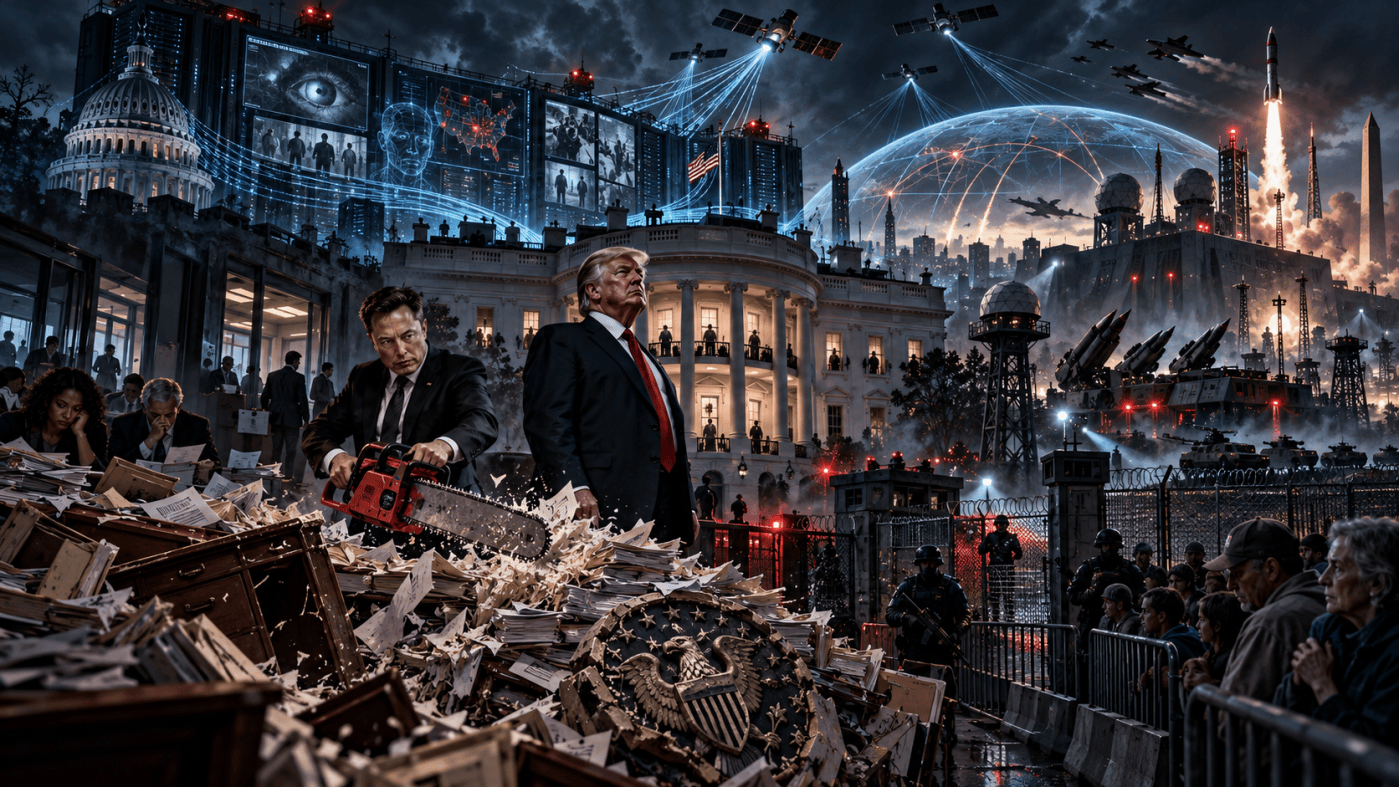
The chainsaw was sold as a weapon against government waste, but behind the spectacle, DOGE became an instrument for reorganizing executive authority, public employment, and the machinery of the capitalist state. While federal workers and social programs faced the axe, the Pentagon acknowledged redirecting DOGE-associated savings toward military technologies and weapons programs that awarded billions in contracts to corporations linked through investment, ownership, and political relationships to the ruling class surrounding Trump. From SpaceX and Golden Dome to politically connected venture capital, sensitive government data, and the circulation of DOGE personnel into private enterprise, the evidence reveals a developing convergence of state power, monopoly finance, and technological capital under the banner of America First. What Washington advertised as draining the swamp may instead have helped reconstruct it for technofascist consolidation, the militarization of Fortress America, and the New Cold War against China, while the administration fights to conceal the records that could expose the full machinery of command.
Prince Kapone | Weaponized Information | October 14, 2026
I. The Government Claims the Power, Then Pleads Confidentiality
Elon Musk could swagger through the White House with DOGE stamped across his chest, playing the billionaire wrecking ball sent to demolish the federal bureaucracy. He could parade an actual chainsaw before the cameras while Donald Trump celebrated the fulfillment of his promise to drain the swamp. The administration could boast about eliminating jobs and rescuing taxpayers from government waste. But the moment somebody demands to see what these people actually did, the wrecking crew develops a sudden and touching respect for confidentiality. In his October 13, 2026, POLITICO report, “Supreme Court to decide whether DOGE records can remain secret,” Josh Gerstein describes the administration’s fight to prevent Citizens for Responsibility and Ethics in Washington from examining DOGE’s records. The Supreme Court agreed to hear the dispute. According to the government’s lawyers, DOGE merely advised properly appointed agency officials; its challengers argue that DOGE personnel sometimes directed the decisions themselves. What a remarkable transformation. Yesterday, these were fearless revolutionaries of government efficiency, swinging their axes through Washington’s institutions. Today, they’re humble advisers, innocent of everything except making friendly suggestions. Apparently, dismantling the machinery of government is a magnificent achievement until somebody asks whose hands were on the controls.
Gerstein delivers the controversy in the respectable language of Washington’s legal establishment. Discovery requests, appellate decisions, executive confidentiality, constitutional deference: the vocabulary through which a struggle over public power becomes a dispute over the proper etiquette of investigating it. Solicitor General D. John Sauer denounces the inquiry as “wide-ranging and intrusive,” while the Supreme Court’s earlier intervention instructed lower courts to exercise “deference and restraint.” An administration claims sweeping power to reorganize federal institutions, but asking how it exercised that power supposedly threatens the constitutional order. The public must approach the government’s filing cabinets with the reverence of a peasant entering the king’s chambers. Missing from this procedural spectacle is the historical inheritance of executive authority itself. Particularly since September 11, successive presidents have accumulated powers under the banners of emergency and national security, with Congress helping authorize, finance, and normalize the expansion. DOGE wasn’t established under the War on Terror’s military statutes. But Trump inherited an executive apparatus accustomed to extraordinary discretion and secrecy. He didn’t have to invent the machinery of concentrated presidential power; he could put it to new purposes. Workers can lose their livelihoods and communities their services. But demanding to know who gave the orders? Now that would be intrusive.
The cleverest deception lies in the distinction between possessing authority on paper and exercising it in practice. The difference matters legally, but power has never required the person directing a process to sign every document. Capitalists don’t stand at every factory machine to command production, and bankers needn’t personally evict tenants to exercise power over their homes. Yet DOGE wasn’t a private corporation that slipped through an unlocked White House window and hijacked an innocent government. The executive established the operation, installed personnel across agencies, furnished their authority, and made their work part of its own administrative program. The state was actively organizing the relationship through which private managerial expertise, technological capital, and executive command participated in reshaping public institutions. Who set the priorities? Who selected the targets? What happened when agency officials objected? How did a DOGE recommendation become an administrative order? The government wants the signature to settle the question. Historical materialism examines the relations that made the signature possible. Otherwise, we might as well conclude that the secretary typing the dismissal letter is the real power behind the factory closing.
Gerstein gives us judges, lawyers, and constitutional arguments, while the class content of the operation remains largely outside the frame. Federal workers become positions to be eliminated; public programs become expenditures to be cut; the people dependent upon those institutions largely disappear. So does the distinction between destroying a public obligation and reorganizing its resources for another purpose. Musk appears as the billionaire face of an anti-government crusade, but the deeper issue isn’t simply his personal fortune or the customary privileges of wealthy men. It is the developing relationship between the executive state, monopoly finance, industrial and military capital, and a technological oligarchy increasingly involved in the machinery of public administration. The spectacle of waste-cutting supplied political legitimacy; the records could illuminate what institutional relationships were actually transformed. What if the chainsaw was not merely an instrument of subtraction but part of a selective reconstruction of the state? What if the real question is not how much government disappeared, but what kind of government was being assembled? Gerstein leaves us watching lawyers quarrel over the filing cabinet while the machinery is being reorganized behind it. For the working class, the question has never been merely who holds the key. It is who commands the machinery, whose interests it serves, and who pays when the operators finish their work.
II. Follow the Orders, Follow the Money, Find the Billionaire
Trump announced DOGE on November 12, 2024, promising to dismantle bureaucracy, slash regulations, eliminate spending, and restructure agencies. Musk and Vivek Ramaswamy were its advertised entrepreneurial saviors. On January 20, 2025, Executive Order 14158 renamed the United States Digital Service as the United States DOGE Service, placed it within the Executive Office of the President, and established a temporary organization. Agencies were ordered to create DOGE teams and facilitate access to unclassified records and information systems. A February workforce order made agency hiring decisions subject to consultation with DOGE team leaders and demanded large-scale reduction plans. Another executive order inserted DOGE into reviews of contracts, grants, loans, and property. The agency official could sign the document, but DOGE helped shape which document reached the desk. This was not a roving band of private consultants independently conquering Washington. It was an executive-organized network working through existing state authority while the government argued that its advisory status shielded it from public inspection.
The administration’s austerity was selective from the beginning. Its workforce directive generally permitted only one new hire for every four departures, but exempted immigration enforcement, law enforcement, and public-safety functions from that restriction; military personnel were excluded, and national-security exemptions remained available. This didn’t prove that every protected institution would expand, but it showed that the chainsaw wasn’t intended to fall equally upon every state function. The distinction became more revealing as auditors investigated detention expansion. A September 2026 GAO review found ICE had bought 11 warehouses for approximately $1.07 billion and subsequently planned to sell seven after incurring more than $20 million in unrecoverable expenses. Another GAO investigation exposed serious planning and cost-control failures in a detention facility operating under a contract valued at up to $1.3 billion. These were not DOGE contracts, nor proof that DOGE personally approved their waste. They demonstrated the political selectivity of a government publicly preaching fiscal discipline while expanding enforcement through expensive, poorly controlled procurement. Apparently, government becomes unbearably bloated when it employs civilian workers, but the detention apparatus can acquire an entirely different appetite.
Musk’s own place inside this apparatus was almost as difficult to reconstruct as its savings. Trump publicly identified him as DOGE’s leader, while the White House classified him as a senior presidential adviser and special government employee, not the Service’s formal administrator. An August 2026 GAO inquiry couldn’t fully reconcile his role from the records supplied. Meanwhile, Musk’s corporations remained deeply entangled with public contracting. Congressional investigators cited at least $9.5 billion in Defense Department payments to his companies since 2003. In April 2025, SpaceX received a national-security launch agreement carrying an anticipated value of roughly $5.9 billion, depending on missions ordered. Contracts are not themselves evidence of corruption. But the man preaching austerity presided over companies for which government expenditure was a major source of business. The problem reaches beyond hypocrisy: public money is condemned as waste when supporting certain public obligations and celebrated as innovation when purchasing the products of concentrated private capital.
The Pentagon didn’t merely happen to spend more while DOGE demanded reductions elsewhere. In February 2025, its leadership announced a plan to identify approximately $50 billion in spending offsets to redirect toward Trump’s military priorities; Defense Secretary Pete Hegseth described the effort as reinvestment, not an overall reduction. In April, Executive Order 14265 directed accelerated military procurement and greater adoption of commercial technology. Then came the decisive admission. In a June 26, 2025 Pentagon budget briefing, officials stated that lower-priority reductions and contract and grant savings found in collaboration with DOGE were being realigned toward higher-priority military programs. They named the F-47 fighter, space-based sensing, Golden Dome, and munitions, connecting these investments to competition with China. This does not prove that a canceled civilian grant financed a particular weapons contract, or that the entire $50 billion target was realized. It establishes something the administration’s own officials openly acknowledged: inside the Pentagon, DOGE-associated savings were part of a redistribution of resources toward military-industrial priorities. The chainsaw wasn’t simply removing expenditure from the state. It was helping clear fiscal room within one of its most powerful institutions.
Follow the procurement and the beneficiaries acquire names. In May 2026, the Space Force awarded SpaceX a $2.29 billion agreement for the Space Data Network Backbone and another $4.16 billion for space-based airborne target tracking: approximately $6.45 billion in announced values. The Space Development Agency issued approximately $3.5 billion in missile-tracking satellite agreements to Lockheed Martin, Rocket Lab, Northrop Grumman, and L3Harris, followed by approximately $1.75 billion in Golden Dome-related awards to L3Harris and Sierra Space. Boeing held the F-47 development award. These announced contract values are not necessarily amounts already disbursed, nor do they establish that DOGE financed each award. They do identify the corporations receiving substantial orders within the strategic programs the Pentagon was prioritizing. And public intervention extended beyond buying their products: in April 2026, L3Harris reported closing a $1 billion Pentagon investment in its Missile Solutions business. The state was helping capitalize weapons production itself. Apparently, Washington’s treasury is empty when a worker asks for job security and wonderfully resourceful when monopoly capital needs an industrial expansion.
Then follow the owners and investors. A July 2026 Washington Post investigation identified investments by firms associated with Donald Trump Jr. and Eric Trump in at least 15 defense, robotics, and AI companies doing federal business. The networks included 1789 Capital, where Trump Jr. was a partner, and investments in companies including SpaceX and Anduril. The investigation reported at least $3.2 billion in direct government business for the examined portfolio, plus $3.1 billion in future options following the relevant investments; these are portfolio figures, not proven personal profits. Some companies already had government contracts, and the firms disputed favoritism. Separately, major defense producers are substantially held through institutional funds managed by firms such as BlackRock, Vanguard, and State Street, although investment-management holdings are not the same thing as unilateral corporate control. The more serious finding isn’t that one family secretly owns every weapons contractor. It is that politically connected private investment networks have financial interests in companies operating inside procurement markets the same executive is expanding. The promised crusade against insiders coincided with opportunities for politically connected investors to profit from state-organized military technology. That relationship warrants investigation whether or not any particular procurement award eventually proves unlawful.
Meanwhile, civilian employment and public obligations were contracting. A GAO workforce review documented nearly 256,000 fewer civilian positions across 22 major agencies by January 2026, reflecting deferred resignations, hiring restrictions, layoffs, and other administration policies—not DOGE alone. Declines varied enormously among agencies. At the IRS, GAO counted 17,047 departures through retirement and resignation programs in 2025, even as another government estimate placed annual tax-fraud losses at $116 billion to $304 billion using earlier-year data. Those losses cannot be attributed to the new workforce reductions. The contradiction concerns the state’s priorities: an institution responsible for protecting revenue was losing experienced employees amid a campaign supposedly devoted to safeguarding public money. A quarter-million fewer positions do not mean a quarter-million fewer social needs. Work must be abandoned, shifted onto remaining workers, contracted out, or absorbed by households. The accountant records the eliminated salary; the working class inherits the unfinished job.
At the National Endowment for the Humanities, the political character of restructuring escaped the administration’s legal embroidery. In May 2026, Judge Colleen McMahon found that DOGE officials Nate Cavanaugh and Justin Fox had directed cancellation of more than 1,400 grants exceeding $100 million. They selected targets, rejected agency recommendations, and arranged notices beneath the agency chairman’s signature, using ChatGPT-assisted classifications to identify disfavored subjects. The court found statutory violations and unconstitutional viewpoint discrimination; the ruling was appealed. This was not merely a financial calculation that happened to reduce spending. It was an attempt to determine which scholarship and cultural activity would continue receiving public support. The authorized official held the pen; DOGE personnel had helped determine the words. The decision-making relationship was more consequential than its formal appearance.
Even the supposed savings refused to behave like savings. DOGE’s Wall of Receipts advertised approximately $110 billion in terminated contracts, grants, and leases by July 2026. The August GAO audit found the stated methodology wasn’t followed for roughly 61 percent of reported contract savings and couldn’t verify the methodology behind approximately 96 percent of reported grant savings. Thousands of contracts labeled terminated lacked recorded terminations in federal procurement records; one military healthcare contract was credited with $1.7 billion in savings despite not being terminated, reduced, or defunded. GAO also found cases where work and costs moved into other contracts and identified deobligated funds potentially available for other lawful agency purposes. None of this proves that every advertised dollar was secretly transferred to a favored corporation. It demonstrates that cancellation, genuine savings, and the relocation of expenditure are distinct things. Meanwhile, an October 2026 CBO estimate put the federal deficit near $2 trillion, with total outlays continuing to grow. Overall spending increases do not negate every particular reduction. They do demolish the claim that the chainsaw had rescued the nation’s finances. The champions of accountability had difficulty accounting for their own triumphs.
DOGE’s access to administrative information raised questions no less serious than its financial books. A September GAO report identified access to more than 23 systems in four agencies and incomplete documentation concerning permissions and safeguards. Another audit found gaps in personnel, ethics, and financial-disclosure records for DOGE-associated officials. At Treasury, GAO documented a DOGE employee’s access to three federal payment systems, a temporary erroneous ability to modify data without evidence of actual modification, and an unauthorized unencrypted transfer of USAID payment information to another agency’s DOGE team. These findings do not establish theft or a secret diversion of funds. They establish access to sensitive machinery of public expenditure without consistently documented controls. Government information systems were opened to restructuring personnel while auditors struggled to reconstruct exactly who had which authority. The public was expected to account for itself to government; the new operators of government were considerably less forthcoming.
The circulation of personnel completed another part of the picture. Cavanaugh and Fox later announced Special, an AI-driven service-business venture financed through networks including Andreessen Horowitz and other former DOGE associates. An October 12 investigation traced roughly two dozen former DOGE personnel into private executive, investment, and technology ventures, some seeking federal business. And despite the July 2026 expiration of DOGE’s temporary organization, an October 7 WIRED investigation identified former DOGE figures inside the White House National Design Studio, with some personnel employed through a nonprofit whose managing director had helped design DOGE’s legal structure and later served as counsel to Musk’s SpaceXAI. These relationships don’t establish that the ventures were prearranged criminal rewards or that the new office possessed DOGE’s former powers. They demonstrate that the personnel, expertise, and private-sector networks involved in government restructuring did not simply disappear when its temporary banner came down. The public spectacle ended; the movement between executive administration and technological capital continued.
Now return to the records the administration is fighting to keep from scrutiny. A March 2025 ruling found DOGE likely subject to the Freedom of Information Act because its apparent authority exceeded ordinary presidential advice. On October 13, 2026, the Supreme Court agreed to hear the administration’s challenge, without settling DOGE’s final legal status. By then, the material questions extended well beyond Musk’s title: how priorities were established, which officials exercised authority, what happened to canceled work, who received new contracts, and how personnel and financial interests intersected. The available record establishes real restructuring, acknowledged military realignments, politically connected investment interests, and significant failures of accounting and transparency. It does not yet disclose every motive or every financial path. But it supplies more than enough material to investigate whether an advertised campaign against waste functioned as political cover for an organized redistribution of state capacities and opportunities for accumulation. Trump promised to drain the swamp. The evidence asks whether his administration was reorganizing which interests would prosper inside it.
III. The Chainsaw Was Theater: The State Was Being Rebuilt
A capitalist swindle is not always exposed by demonstrating that every promise failed. Sometimes its real significance emerges when we discover what succeeded beneath the advertised failure. DOGE’s public claim was fiscal salvation, yet its documented operations entered the organization of state authority, the selection of social obligations, the distribution of administrative capacities, and the strategic markets in which private capital accumulates. The important contradiction is therefore not between a government that became smaller and one that remained expensive. It is between the promise to withdraw the state from wasteful activity and the actual struggle to determine which activities the state would continue, reorganize, or expand. Capital has never wanted an absent government. It wants a government capable of protecting property, financing infrastructure, disciplining labor, producing strategic technologies, and projecting military power, while avoiding obligations that constrain accumulation or strengthen working-class claims. The treasury becomes a bottomless reservoir for some purposes and an empty cupboard for others. Once we abandon the fantasy that efficiency has a class-neutral meaning, DOGE appears as a possible instrument of selective reconstruction rather than simply a failed subtraction exercise. Demolition was real. The more consequential question is what the demolition made possible.
The genealogy passes through neoliberal austerity, but it does not end there. Neoliberalism treated public services as liabilities, stable workers as excessive costs, and profitable collective functions as markets waiting to be opened. Yet the supposedly retreating state expanded its military and surveillance institutions and continued providing enormous support to private accumulation. The present tendency adds a different organizational possibility: the state integrates proprietary software, technical personnel, financial interests, and commercially developed systems into the exercise of authority itself. This doesn’t mean technology replaces politics. It means political decisions can be translated into classifications, access permissions, procurement requirements, and technical procedures that act upon entire institutions. The executive no longer needs merely to demand that agencies reduce spending; it can introduce personnel and systems into the process by which agencies decide which expenditures and social functions deserve to survive. And the post-9/11 concentration of presidential power helped prepare the institutional conditions for such intervention, even though DOGE’s immediate legal basis was different. The emergency presidency constructed in the name of national security became part of the inheritance available to an administration invoking an emergency of bureaucratic waste. Extraordinary command could be sold as administrative common sense.
Nor should the process be reduced to Musk personally capturing Washington. The state is an active organizer of capitalist relations, not an innocent bystander overpowered by technological wealth. Within the WI framework, the Yankees of finance, Cowboys of extractive and military industry, and Digerati of technological monopoly represent overlapping, competing fractions of the ruling bloc. Finance requires profitable investments; industrial capital requires production and public demand; technology firms seek markets and proprietary command over software and data; the imperial state seeks strategic capabilities. Their interests aren’t identical, and they needn’t share one secret instruction sheet. Yet the state can organize common priorities through contracts, financing, executive directives, institutional access, and personnel circulation. Here politically connected family wealth acquires a meaning beyond the familiar scandal of relatives trading on a powerful surname. A family investor needn’t dictate every procurement decision to benefit from state-created markets in which the family holds investments. Conversely, the existence of those investments doesn’t by itself establish a rigged award. The historical issue is how public political authority, strategic industrial policy, and private ownership claims can reproduce one another. The public hears a crusade against insiders while insiders may stand to benefit from the accumulation circuit organized around the crusade’s governing priorities. Cronyism isn’t a substitute for class analysis; it can be one of the forms through which class power is reproduced.
This also changes the meaning of fiscal austerity. The removal of a public employee does not eliminate the labor society needs. It may intensify work for those who remain, transfer responsibilities onto families, dissolve services, or create openings for contractors and automated systems. A contract may be canceled while its functions are preserved elsewhere; expenditure may be reduced in one account while strategic investment expands in another. The Pentagon’s acknowledgment of DOGE-associated realignment gives this relation a concrete institutional form without proving that every civilian reduction financed a missile. The larger transformation cannot be measured by subtracting one budget line from another. We must follow the movement of functions, ownership, labor, and command. Government can borrow more and spend more while the working class receives less social security. It can become more interventionist in strategic production and more punitive in the administration of social need. What looks like an inconsistent mixture of austerity and expansion becomes intelligible as the selective reorganization of state capacity for different class purposes. The accountant asks whether a position disappeared. Political economy asks who now performs the work, under whose authority, with what resources, and for whose benefit.
This is where the New Cold War and Fortress America cease to be decorative geopolitical context. The United States confronts rising competition from China and growing obstacles to exercising the relatively cheap global command it enjoyed after the Soviet collapse. Its response is not simply to retreat. The American Pole describes an attempt to consolidate a U.S.-commanded imperial bloc; Fortress America names the interlocking military, technological, logistical, financial, and security architecture intended to sustain it. Such an international project requires domestic industrial capacity, strategic supply chains, advanced sensing and command systems, and institutions capable of organizing large-scale investment. The Pentagon’s own references to China when describing its reprioritized programs establish the strategic connection in its official language. Yet capitalist interests remain contradictory: American corporations depend upon global production and Chinese markets even as Washington seeks to constrain China’s technological development. Military contractors compete; investors disagree; institutions resist. Technofascist consolidation isn’t one completed machine driven by a single will. It is an emergent state form developing through these struggles as monopoly capital and executive government attempt to align their capacities under imperial pressure. The point isn’t that DOGE secretly planned every element of Fortress America. It is that its selective reconstruction of administration can be investigated as one domestic mediation of the wider imperial recalibration.
The struggle over records now acquires a qualitatively different meaning. When authority is distributed among presidential offices, embedded teams, agency officials, contractors, and technological systems, the documentary trail is how society reconstructs who commanded whom. Without it, responsibility evaporates into the organizational arrangement: the adviser points to the official signature, the official invokes executive policy, and the executive shields the deliberations behind confidentiality. The government can scrutinize wages, eligibility, payments, immigration status, and households in extraordinary detail while resisting scrutiny of the people restructuring those very systems. Information flows upward as an instrument of administration; it struggles to flow downward as an instrument of accountability. Such opacity can protect a governing relationship without proving that every unreleased document conceals a criminal agreement. That is why DOGE’s significance isn’t exhausted by the question of whether individual officials broke the law. It concerns the class organization of command itself. The institutions and technologies being rearranged are produced and sustained by collective labor, yet the authority to reorganize them can be concentrated among an executive apparatus and private economic interests. The chainsaw was the public performance. The struggle concerns the machinery being assembled after the applause, and whether the people whose labor sustains society will ever exercise control over it.
IV. Open the Books, Organize the Workers, Confront the Power
Trump occupies the White House and Musk commands an extraordinary fortune, but neither manufactures the social labor that keeps public institutions functioning. Workers process the payments, maintain the networks, administer the benefits, enforce the rules, and deliver the services upon which millions depend. The billionaire sees a cost on a spreadsheet; the worker knows what happens when that cost is eliminated and the need remains. The struggle therefore cannot end with demanding a more accurate DOGE savings figure. It must connect the defense of public services and employment to the investigation of where authority, public money, and technological capacity have been concentrated. The American Federation of Government Employees has challenged attacks on federal workers and civil-service protections. That struggle matters because organized workers possess both the knowledge of how institutions operate and the collective capacity to resist their dismantling. Public administration depends upon labor the executive cannot replace with a press conference or a chainsaw.
The legal fight matters too. CREW’s lawsuit seeks the records necessary to reconstruct DOGE’s authority; the Electronic Privacy Information Center has challenged access to sensitive information. The NEH litigation demonstrates that particular executive interventions can meet organized resistance and judicial defeat. But neither a favorable judgment nor the release of a document automatically transfers power to the people. Evidence must become a tool in the hands of workers, public-service users, technical employees, and communities confronting the consequences of the restructuring. An uncovered decision can reveal who was responsible. Collective organization can demand restitution, resist further destruction, and challenge the institutions that made the decision possible.
Nor should defending necessary public capacities be confused with worshiping the existing capitalist state. The same government that distributes benefits operates prisons, detention systems, intelligence agencies, and the imperial war machine. The demand is not to preserve every institution exactly as it stands, but to defend the social labor and collective resources that working people need while contesting the private and executive command exercised over them. What would technological modernization look like under democratic control by those who operate the systems and depend upon their services? What would public investment accomplish if it were organized around housing, food, healthcare, education, and human development rather than the priorities of monopoly capital and imperial militarization? The question DOGE opens is larger than whether the billionaires behaved honorably. It is why the producers of social wealth remain excluded from deciding how that wealth, the technologies it creates, and the institutions it sustains are used. Open the books, certainly. Trace the orders, the contracts, the investors, and the chains of command. But the objective isn’t simply to discover which capitalist profited from the machinery. It is to organize the people who build and operate that machinery to contest the power directing it. The chainsaw was their spectacle. The future of the state is our struggle.


Leave a Reply