The Market Was Born with a Gun: Colonial Plunder, Neoliberal Rule, and the Worker-Peasant Road Beyond Capital

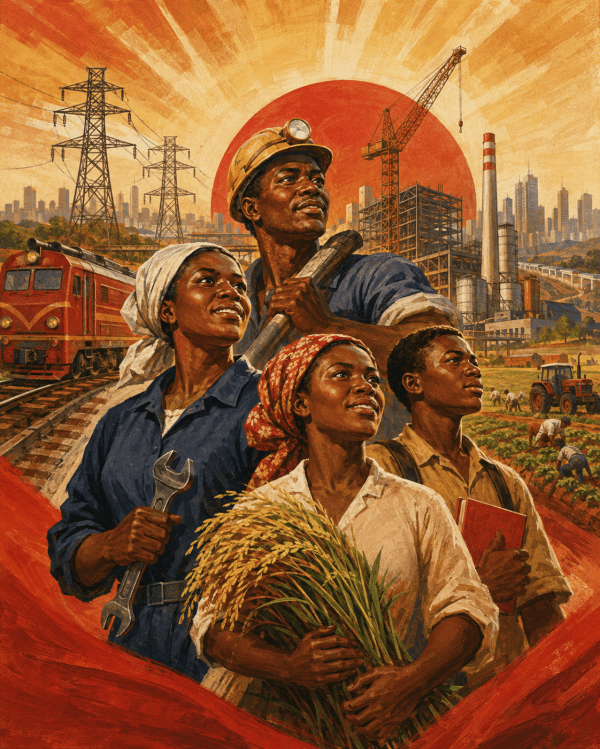
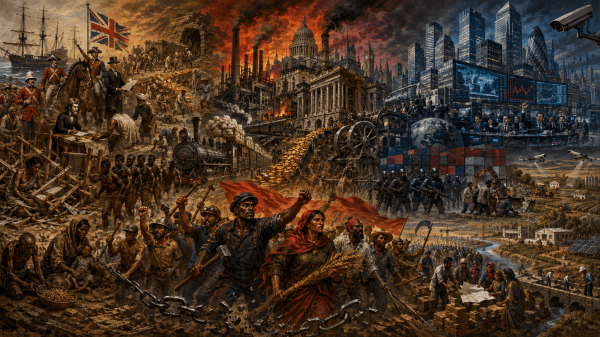
Utsa and Prabhat Patnaik’s groundbreaking analysis dismantles the myth that capitalism flourished independently within Europe, revealing a system intricately linked to colonial exploitation. They illustrate how colonialism not only financed European industrial growth but also perpetuated poverty and dependency in colonized nations. The authors articulate that capitalism's survival hinged on subjugating external economies. With the unraveling of colonial structures leading to depression and famine, they propose a radical rethinking of revolutionary potential through a worker-peasant alliance, emphasizing organized power as essential to dismantling capital's dominance. Ultimately, their work challenges the notion of capitalism's self-sufficiency, exposing its reliance on imperial mechanisms for survival.

Beyond Hegemony, Beyond Illusion: Samir Amin, Multipolarity, and the Unfinished Road to Socialism

What happens when one of the twentieth century's greatest Marxist theorists is tested against the world that emerged after unipolarity began to fracture? This Weaponized Intellects review excavates Samir Amin's Beyond US Hegemony? as both a product of its historical moment and a living revolutionary framework, measuring its arguments against China's socialist transition, Russia's anti-hegemonic resurgence, the rise of BRICS, and Amin's own later theoretical development. The result is neither celebration nor dismissal, but a critical reconstruction that distinguishes multipolarity from socialism and argues that only organized popular power can transform the decline of empire into genuine human emancipation.

The Throne Was Always Cracked: Radhika Desai and the Myth of American Hegemony

Radhika Desai’s Geopolitical Economy obliterates the illusion of a stable, American-led world, revealing that capitalism thrives on conflict, not unity. The book exposes capitalism’s instability, punctuated by crises that merely reshift the burdens onto workers and debtor nations. Desai argues for a multipolar world not as a peaceful transition to a new hegemon, but as a rupture from monopolistic control, fostering opportunities for sovereign development and socialist planning. However, liberation demands that working people reclaim the means of production and governance. The narrative warns against complacency; the emerging multipolarity is ripe for struggle, shaping the future based on who wields power over resources and development.

The War Over Totality: Engels, Science, and the Limits of Western Marxism

An uncompromising review of Sven-Eric Liedman’s The Game of Contradictions, tracing his reconstruction of Engels’s engagement with Hegel, science, and ideology while testing whether his critique clarifies the contradictions of dialectical materialism or disarms the communist struggle for totality. By Prince Kapone | Weaponized Information | Weaponized Intellects Book Review | April 12, 2026 Against... Continue Reading →

Cedric J. Robinson, Black Marxism and the Colonial Blindspot Inside Western Marxism

Black Marxism and the Colonial Blindspot Inside Western Marxism Cedric J. Robinson did not write Black Marxism to abandon Marxism, but to indict the version of it that emerged safely inside empire. By tracing capitalism’s formation through slavery, racial domination, and colonial war, Robinson forces historical materialism to confront what Western Marxism systematically erased. The... Continue Reading →

Growth Without Development: How Capitalism Produces Abundance, Manufactures Poverty, and Calls It Progress

In The Political Economy of Growth, Paul A. Baran dismantles the myth that growth is neutral or benevolent, exposing it as a class project rooted in surplus extraction and imperial power. He shows how monopoly capitalism turns productivity into waste and development into stagnation, both at home and across the colonized world. Against liberal economics... Continue Reading →

Author, Authority, and Empire: How “Authoritarian” Became Political Science’s Favorite Weapon Against Mass Power

This essay is part of Weaponized Information’s larger project to forge a new discipline of political science—one that treats politics as the scientific study of power: how it is accumulated, organized, enforced, and resisted. In “Towards a New Political Science: Politics as the Science of Power”, we broke with procedural political science and its canon... Continue Reading →

Walter Rodney’s Guyanese Working People: How Colonial Capital Made the Class It Had to Control

Walter Rodney begins with a colonial society physically reproduced by working people yet organized to deny those same people control over the labor, land, and material conditions that kept it alive. Emancipation shattered slavery’s legal form without resolving capital’s labor problem, forcing the struggle onto new terrain as workers used land, villages, mobility, and subsistence... Continue Reading →

Capital Never Rests: Karl Marx’s Capital, Volume II and the Circulation of Exploitation

This review of Capital, Volume II is the second installment in our Weaponized Intellects reconstruction of Marx’s trilogy. If you haven’t read the first review—where we follow Marx from the commodity to surplus-value, machinery, accumulation, and the so-called primitive accumulation—start there: Capital as Crime Scene: How Marx Dissects the Social Machinery of Exploitation . Time... Continue Reading →

Website Powered by WordPress.com.

Up ↑