What begins as a story about counterfeit toys reveals a deeper moral architecture designed to police who is allowed to innovate and who must remain a follower. A closer look at the empirical record exposes intellectual property not as a neutral legal system, but as a historically weaponized regime built to preserve hierarchy once monopoly... Continue Reading →
Growth Without Development: How Capitalism Produces Abundance, Manufactures Poverty, and Calls It Progress
In The Political Economy of Growth, Paul A. Baran dismantles the myth that growth is neutral or benevolent, exposing it as a class project rooted in surplus extraction and imperial power. He shows how monopoly capitalism turns productivity into waste and development into stagnation, both at home and across the colonized world. Against liberal economics... Continue Reading →
Callie House and the First Mass Reparations Movement in U.S. History
A formerly enslaved woman who helped turn memory of bondage into a national economic claim. Her movement proved reparations was a working-class demand for stolen labor, not a plea for charity. The federal government criminalized her because compensation threatened the racial economic order. Her legacy links Black liberation to the broader struggle over wealth, power,... Continue Reading →
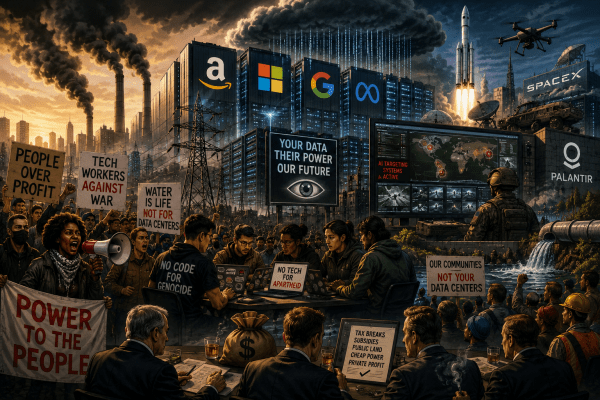
The Pole and the Cage: Fortress America, Technofascism, and the Labor Regime of Imperial Decline
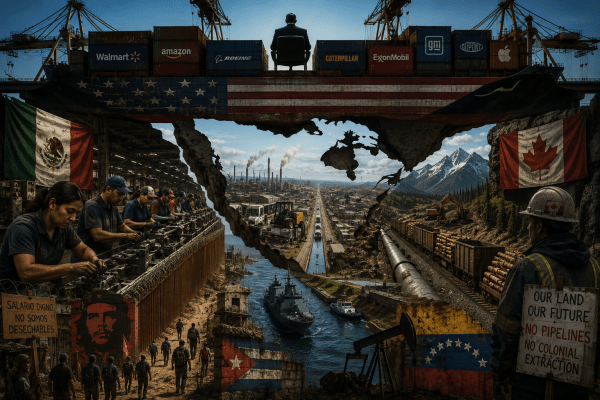
The U.S. economy is generating profits without integrating people into stable life. Domestic labor is being recalibrated through precarity, surveillance, and managed migration. Fortress America turns the hemisphere into a disciplined rear-base of corridors, minerals, and compliant labor. The American Pole and technofascism are one system—an empire tightening the enclosure at home and abroad.By: Prince... Continue Reading →
Wall Street vs. the Soviets: Sutton’s Banker Puppet-Show and the Class War He Tries to Hide
Sutton replaces workers, soldiers, and soviets with bankers and boardrooms, turning revolution into elite theater. Trotsky’s travel becomes “proof” of sponsorship, as bureaucracy and wartime chaos are rebranded as capitalist command. Forged documents linger as atmosphere while the real record—bank nationalization, debt repudiation, and trade monopoly—buries the thesis. The book ends where history begins: capital... Continue Reading →
Capital’s Emergency Exit: Michael Parenti, Fascism, and the War on Class Memory
Fascism is not an aberration but a rational instrument deployed when capital loses democratic control. Socialist revolutions expanded freedom for the many and were met with siege, sabotage, and counterrevolution. The restoration of capitalism in the East revealed the market as a system of plunder, repression, and social decay. Anti-communism and class denial function as... Continue Reading →
The Great Lecture Hall and the Small Seminar Room: Michael Parenti Vs. Western Marxism
A tribute to Michael Parenti that situates his life’s work as a living challenge to the academic drift and political retreat of Western Marxism. This essay traces Parenti’s unified analysis of class power, empire, media, ideology, and anti-communism, arguing that his legacy is not a memory to be curated but a method to be used... Continue Reading →
Author, Authority, and Empire: How “Authoritarian” Became Political Science’s Favorite Weapon Against Mass Power
This essay is part of Weaponized Information’s larger project to forge a new discipline of political science—one that treats politics as the scientific study of power: how it is accumulated, organized, enforced, and resisted. In “Towards a New Political Science: Politics as the Science of Power”, we broke with procedural political science and its canon... Continue Reading →
History as Weapon: Walter Rodney and the Discipline of Revolutionary Marxism
A Weaponized Intellects reconstruction of A History of the Guyanese Working People, 1881–1905 that treats Rodney’s most mature historical materialist work not as scholarship for contemplation, but as theory forged for organization, struggle, and socialist revolution. By Prince Kapone | Weaponized Information | Weaponized Intellects Book Review | January 23, 2026A Book Written to Be... Continue Reading →
Influence Without Empire: How China’s Infrastructure Exposes the Crisis of Imperial Narratives in Central Asia
A wire story turns development into suspicion by replacing politics with the language of “influence.”The facts reveal a region actively recalibrating after decades of imposed dependency and underdevelopment.Beneath the headlines lies a global shift where infrastructure collides with imperial decline and class struggle.The task ahead is to organize solidarity so this opening leads to sovereignty,... Continue Reading →