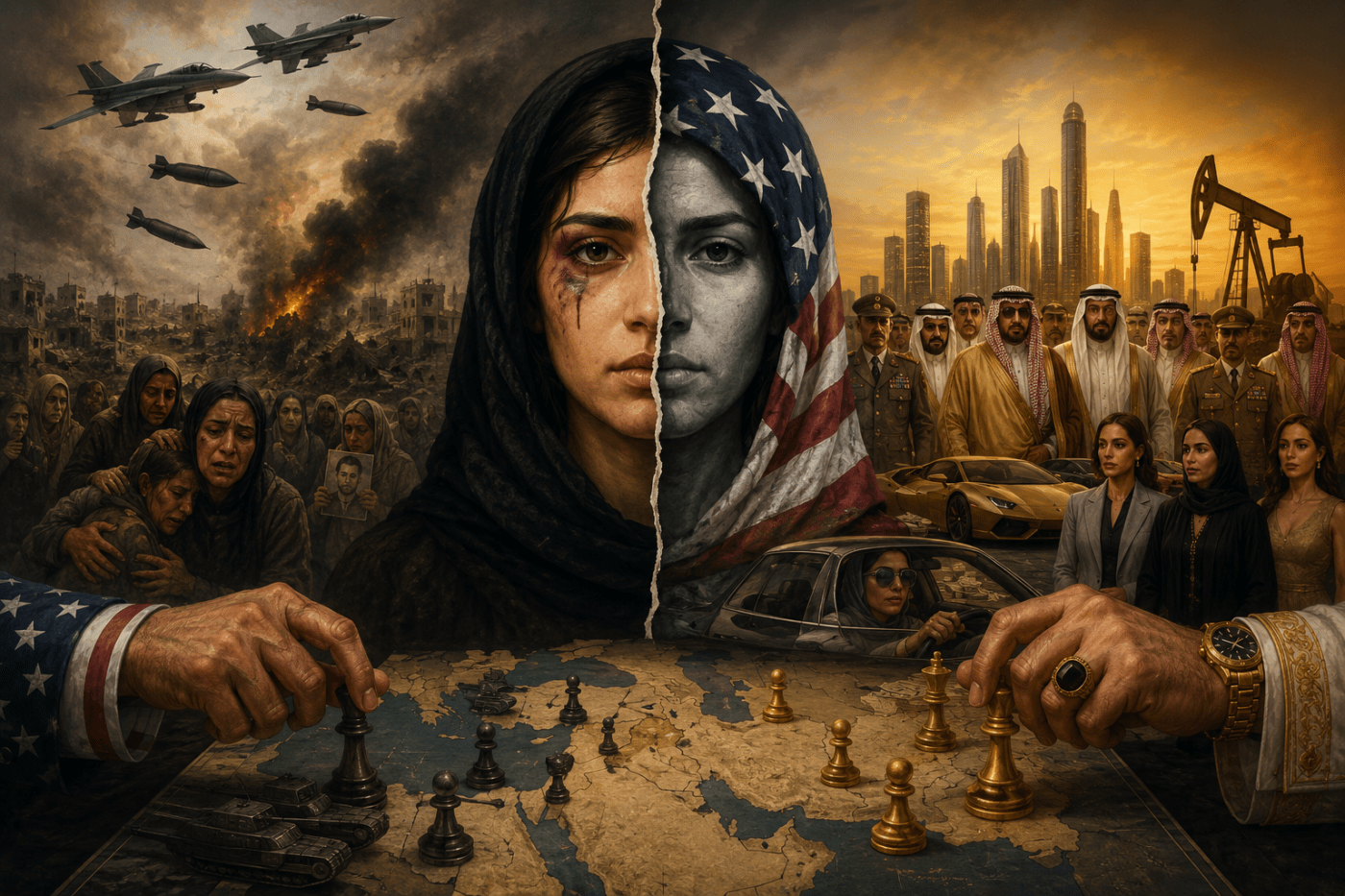
The West does not give a damn about women in West Asia. It cries for Iranian women because Iran is an enemy, then sells bombs to kings, bankrolls apartheid, protects dictators, sanctions civilians, and calls the whole rotten business human rights. Iran has contradictions, but those contradictions belong to Iranian women and Iranian society to struggle over — not to Washington, NATO, or the white ruling class. Real internationalism starts at home, against the empire that turns women’s suffering into ammunition.
By Prince Kapone | Weaponized Information| June 27, 2026
The Woman They Need Iran to Be
The Western story does not begin with Iran. It begins with an image. Before there is a country, there is a woman. Before there is history, there is a veil. Before there is society, class, religion, revolution, sanctions, war, education, medicine, family, poverty, dignity, or contradiction, there is the figure the empire requires: the Iranian woman as victim-object, lowered eyes, covered hair, silent mouth, waiting for the benevolent hand of the West to lift her out of history. This woman is not allowed to be a student, a doctor, a mother, a worker, a believer, a conservative, a dissident, a poet, a scientist, a jurist, a revolutionary, or an anti-imperialist. She is allowed to be only one thing: evidence. Her body is entered into the imperial courtroom, and the verdict has already been written.
That is why the death of Mahsa Amini could be transformed so quickly from a real tragedy inside Iranian society into an imperial instrument outside it. A young Kurdish Iranian woman died after being detained over alleged violation of Iran’s hijab rules, and the pain of that death became the raw material for an entire geopolitical machine. The U.S. Treasury Department sanctioned Iran’s Morality Police in September 2022, presenting the measure as a defense of Iranian women and protesters. One year later, the United States imposed another round of sanctions tied to the anniversary of Amini’s death and the protests that followed. Notice the alchemy. The woman becomes an image. The image becomes a moral accusation. The moral accusation becomes a sanctions package. The grief of a family becomes paperwork at the Treasury Department. The wound is not healed; it is processed.
None of this requires us to deny the existence of real contradictions in Iran. Compulsory hijab exists. Enforcement exists. Protest exists. Repression exists. Iranian women themselves know this terrain far better than the State Department interns and cable-news missionaries who discover Muslim women whenever a target state needs softening. The issue is not whether Iranian women face contradictions. The issue is how those contradictions are selected, enlarged, stripped of context, and converted into imperial common sense. The veil is not explained. It is magnified until it covers the entire country. Iran becomes a garment. Islam becomes a prison. The Islamic Republic becomes a dungeon. And the West, that old grave robber of nations, arrives once again dressed as a humanitarian.
This is not accidental. For decades, scholars of media and empire have shown how Iranian women are made to carry the whole symbolic burden of Iran in the Western imagination. One study of U.S. print media found that American representations of Iran repeatedly used iconic images of Iranian women to construct a commodified vision of Iran itself. Another version of the same critique observes that the veiled Iranian woman becomes a kind of political shorthand, a figure through which the West can see everything except the actual society in front of it. This is the old Orientalist trick with a modern camera: find the woman, freeze the image, erase the world around her, then pretend the photograph is analysis.
The same method has been used across the Muslim world. Lila Abu-Lughod’s famous question, “Do Muslim Women Need Saving?”, cuts directly into this imperial habit. The rescue story reduces Muslim women’s lives to religion, veil, and male cruelty, while pushing aside war, poverty, sanctions, authoritarianism, class, colonial inheritance, foreign intervention, and the ordinary social complexity of real human beings. The West does not ask what Muslim women are doing, thinking, building, debating, defending, or transforming. It asks whether they can be made useful to Western power. The answer, whenever Washington needs it, is always yes.
So the Iranian woman required by empire must remain abstract. If she becomes too real, the story begins to fall apart. A real Iranian woman might be religious and still politically conscious. She might wear hijab and still resent state coercion. She might oppose compulsory veiling and still oppose sanctions. She might criticize her government and still hate the empire. She might defend the Islamic Republic against foreign attack while arguing fiercely inside Iranian society over law, family, public morality, and women’s rights. She might be secular, pious, nationalist, socialist, reformist, conservative, Kurdish, Persian, Azeri, Baluch, Arab, urban, rural, rich, poor, working class, professional, unemployed, sanctioned, educated, angry, loyal, rebellious, or all of these in different moments of one complicated life. Empire has no use for that woman. She is too historical. She talks back.
What imperial feminism needs is a woman without contradiction. She must be oppressed enough to justify punishment, but not political enough to define liberation for herself. She must be visible enough to indict Iran, but invisible enough to disappear when sanctions make medicine harder to obtain, when inflation eats household survival, when war threats stalk the region, or when U.S.-armed monarchies crush women, workers, migrants, and dissidents with royal efficiency. She must be rescued, but never consulted. She must be mourned, but never allowed to ask why her mourning is routed through the same imperial machinery that has wrecked Afghanistan, Iraq, Libya, Syria, Yemen, and Palestine in the holy language of civilization.
This is the first fraud we have to tear open. The West did not invent every contradiction inside Iran. It did not invent every struggle over women’s status, public morality, or Islamic law. But it did invent the Iranian woman it needs: veiled enough to symbolize oppression, silent enough to be spoken for, wounded enough to justify punishment, and abstract enough to vanish the moment the empire’s target list changes. Behind that image there is a country. Behind that country there is a society. Behind that society there are women who do not need to be converted into imperial evidence in order to become historical agents. They already are.
The Country That Refuses to Disappear
Step past the poster that empire hangs on the wall and the room changes. Iran is not a black cloth stretched across a map. It is a society of classrooms, hospitals, clinics, bazaars, factories, universities, mosques, apartment blocks, villages, offices, laboratories, film sets, libraries, sports halls, family tables, crowded buses, and streets where millions of women move through the ordinary and extraordinary work of social life. They study, teach, pray, argue, raise children, treat patients, publish books, make films, bury relatives, organize households, endure inflation, sit for exams, enter professions, confront restrictions, defend traditions, challenge authorities, and carry the weight of a country that has lived for decades under siege. No honest account of women in Iran can begin and end with a dress code, as if a whole people can be reduced to the police regulation most useful to foreign propaganda.
The first crack in the caricature is education. The World Bank’s gender data records female tertiary enrollment in Iran at 59.1 percent in 2022, a figure that does not describe a society where women have been locked away from knowledge. The classroom does not abolish patriarchy, and no serious revolutionary should pretend it does. A woman can graduate from a university and still face the pressure of family law, employment discrimination, moral policing, patriarchal custom, economic crisis, and political exclusion. But mass female higher education changes the terrain of a society. It produces women with skills, expectations, languages, scientific training, social networks, political consciousness, and demands that cannot be stuffed back into the old household box without contradiction. The Islamic Republic did not simply inherit these women as a problem. Its own social-development model helped produce them.
That is where the real contradiction begins. Iran has produced a large body of educated women, but its labor market and political institutions have not fully absorbed the social force that education created. The same World Bank profile that shows strong female tertiary enrollment also puts women’s labor-force participation around 14 percent in 2025. This is not a small matter. It means millions of women whose capacities have been developed by schools, universities, and professional training encounter an economy narrowed by sanctions, state policy, private discrimination, family expectations, underemployment, and class inequality. The contradiction is not that Iranian women are absent from social development. The contradiction is that Iranian society has generated women whose capacities exceed the channels presently available to them.
Health and social reproduction sharpen the point further. The same imperial commentators who can see a headscarf from across the ocean suddenly go blind when the question becomes whether women survive childbirth, receive medical care, gain literacy, or live longer lives. World Bank data puts Iran’s maternal mortality ratio at 16 deaths per 100,000 live births in 2023, a measure that belongs to the material life of women, not the theatrical life of Western outrage. The United Nations Population Fund has likewise described Iran as having made major progress in maternal health and reproductive health service delivery. These facts do not erase coercion in public morality law or inequality in family law. They do something more dangerous to imperial propaganda: they force women’s lives to be measured in more than symbols.
A society that educates women, trains women, treats women, and brings women into public institutions is not automatically a liberated society. But it is also not the dungeon that Western discourse requires. Iranian women have been deeply present in medicine, education, cinema, publishing, science, public debate, athletics, and professional life. The World Health Organization has noted Iran’s expansion of primary health care and its networked health system, rooted especially in post-revolutionary rural health infrastructure, as part of the country’s public-health development story. That health system reaches into the ordinary spaces where women live, give birth, care for families, seek treatment, and reproduce society day after day. This is precisely the terrain imperial feminism prefers to ignore, because it makes Iranian women appear not as static victims but as participants in a social project shaped by both gains and limits.
Sanctions belong inside this discussion because sanctions enter the household before they ever enter the newspaper. They raise prices, restrict imports, distort medicine access, undermine employment, deepen uncertainty, and increase the burden of unpaid care. The United Nations special rapporteur on unilateral coercive measures has warned that sanctions and overcompliance can impede humanitarian goods and affect access to medicine and medical equipment in Iran. This is not an abstraction for women. When medicine is harder to get, women carry the sick. When food prices rise, women stretch the household. When jobs disappear, women absorb the crisis through unpaid labor, informal work, emotional care, and postponed futures. A sanction is not only a foreign-policy tool. In the hands of empire, it becomes a gender policy with a banker’s face.
This is why the liberal measurement of women’s freedom is so thin. It asks whether a society looks like the West imagines freedom should look, but rarely asks who controls the economy, who is under blockade, who has medicine, who has schools, who has water, who has security, who is bombed, who is sanctioned, who is made unemployed, and who must hold the family together when the currency is strangled. A feminist analysis that can identify coercion in a morality-police encounter but cannot identify coercion in a sanctions regime has not discovered women’s freedom. It has discovered a camera angle. The Iranian woman who is stopped in public is visible. The Iranian woman who cannot find imported medicine for her child because banks and suppliers fear U.S. penalties is treated as background noise.
None of this requires turning Iran into a paradise. Women’s formal political representation remains weak. The Inter-Parliamentary Union’s data show Iran near the bottom globally for women in national parliament. That gap matters because public presence is not the same as state power, and education is not the same as authority. But even here the conclusion is not the one empire wants. Low representation is a political contradiction inside Iranian society. It is a terrain of struggle for Iranian women and the Iranian people. It is not a blank check for Washington to starve the country, threaten it, isolate it, or pretend that the Pentagon has suddenly developed a tender concern for women’s parliamentary seats.
The real Iran, then, is neither the fantasy of Western rescue nor the fantasy of flawless social harmony. It is a revolutionary Islamic society under pressure from its own contradictions and from the imperial siege around it. It has expanded women’s education while limiting women’s formal economic incorporation. It has built health and social infrastructure while preserving gendered legal hierarchies. It has produced women with immense social capacity while constraining their full political authority. It has cultivated public participation while policing public morality. These are contradictions, not cartoons. And contradictions are not resolved by sanctions, lectures, bombs, or the smug sermonizing of governments that arm the monarchs next door.
Behind the veil, then, there is not silence. There is a society in motion. There are women whose lives contain piety and pressure, achievement and frustration, dignity and discipline, education and exclusion, family and ambition, faith and argument, national pride and internal struggle. That living complexity is exactly what the imperial image cannot survive. A symbol can be used. A society must be understood. Iranian women are not waiting outside history for the West to hand them permission to exist. They are already inside history, making it under conditions they did not choose, against pressures from within and from without, and with a social force no propaganda image can finally contain.
The Law the Empire Refuses to Read
There is another trick buried underneath the Western indictment of Iran. The accusation is never only that this law is unjust, that this policy is contested, that this enforcement practice is harsh, or that this social contradiction should be struggled over by the people who live inside it. The deeper accusation is that Iran has committed the great civilizational offense of refusing to organize public life according to the secular-liberal grammar of the West. Iran is judged not as Iran, not as a Shia Islamic republic born out of revolution against monarchy and imperial tutelage, but as a failed imitation of Paris, London, or Washington. Every society is apparently free to choose its destiny so long as it chooses the one already approved by the people who built Guantanamo, armed Riyadh, flattened Fallujah, and discovered women’s rights somewhere between the sanctions office and the arms bazaar.
Iran’s legal order does not hide its foundation. The Constitution of the Islamic Republic states that all civil, penal, financial, economic, administrative, cultural, military, political, and other laws must be based on Islamic criteria, and its provisions on women likewise place women’s rights and protections within that Islamic constitutional framework. That phrase, “Islamic criteria,” is not decoration. It is the architecture of the state. It means that law is not imagined as a neutral machine floating above religion, family, morality, community, and divine command. It means the society claims the right to govern itself through a religious-legal civilization rather than through the cold little idol of Western liberal individualism, which pretends to be universal precisely because it has forgotten the colonial ships that carried it.
This is where imperial feminism becomes especially dishonest. It treats Islamic jurisprudence itself as the crime. Marriage, divorce, inheritance, custody, modesty, public morality, family obligation, and gendered responsibility are presented as obvious evidence of backwardness before the argument even begins. But Islamic law is not a pile of primitive customs waiting to be corrected by a European consultant. It is a historical legal tradition with schools, jurists, debates, categories, obligations, protections, hierarchies, interpretations, and conflicts. It contains patriarchal structures, yes, as do the liberal states that suddenly become moral philosophers when the target is Muslim. But it also contains a theory of society, family, duty, sexuality, lineage, inheritance, care, and communal order. A serious analysis has to enter that world before judging it. Empire prefers not to enter. It prefers to bomb the building from outside and then call the dust enlightenment.
The family is where every civilization hides its theory of society. Liberalism says the family is a private arrangement between abstract individuals, though in practice it leaves women to absorb unpaid care, poverty, domestic violence, wage inequality, reproductive crisis, and the wreckage of market society while congratulating itself for having excellent vocabulary. Islamic jurisprudence begins from a different premise: that family life is a moral and social institution bound to obligations before God, duties between spouses, rights of children, responsibilities of kinship, rules of inheritance, and the preservation of communal life. One may agree or disagree with particular rulings, and Iranian women themselves do both. But to treat the entire framework as illegitimate because it is religious is not feminism. It is secular colonial arrogance with a university degree.
Nor is Iran some accidental theocracy imposed on a people with no relationship to the tradition that structures the state. The Central Intelligence Agency’s own public factbook identifies Iran as overwhelmingly Muslim, with Shia Muslims comprising the great majority of the population. That does not make every legal ruling correct, and it does not make dissent disappear. But it does make nonsense of the idea that a Muslim-majority society has no right to organize law through Islam. The Prophet Muhammad did not teach Muslims that revelation should remain safely locked in private sentiment while public life kneels before whatever empire happens to dominate the age. For Muslims, governance is not supposed to be morally empty. Law is accountable to a higher order than the market, the police, the parliament, or the ambassador.
This is also why the Iranian debate over women cannot be reduced to a simple battle between freedom and religion. Iranian women argue from many positions. Some argue from secular frameworks. Some argue from within Islam. Some defend the republic against foreign attack while criticizing particular laws. Some defend religious modesty while opposing arbitrary enforcement. Some want reform, some want preservation, some want transformation, and many live in the unsettled space between obedience, belief, frustration, family, national loyalty, and political dissent. That is what agency looks like in real societies. It is not always clean. It does not always flatter the Western observer. It does not always speak in NGO slogans. But it is agency all the same.
The West has trouble recognizing this because it only recognizes Muslim women as free when they become useful symbols against Muslim sovereignty. A woman who rejects compulsory hijab and supports sanctions is legible. A woman who rejects compulsory hijab and rejects sanctions becomes inconvenient. A woman who wears hijab proudly and defends the Islamic Republic becomes almost impossible for imperial discourse to process, because she breaks the little machine. She cannot be placed neatly in the box marked “victim,” and so she must be ignored, mocked, or treated as brainwashed. This is the colonial division of consciousness: the West grants agency only to those who confirm its authority.
Iran’s own constitutional order also complicates the crude Western claim that Islamic governance means no social pluralism. The constitution recognizes Zoroastrian, Jewish, and Christian Iranians as religious minorities with the right to perform religious rites and ceremonies and act according to their own canon in personal affairs and religious education. This is not liberal pluralism. It does not pretend to be. It is a different civilizational grammar of coexistence, organized through recognized communities, religious law, and Islamic state authority. Its limits should be studied honestly, and its contradictions should not be hidden. But liberalism is not the only language in which human beings have ever organized communal life. The West may find this shocking, having mistaken its own provincial history for the diary of God.
The decisive question is not whether outsiders must agree with every Iranian law. They do not. The decisive question is whether disagreement gives imperial states the right to convert Iran’s internal contradictions into coercion. Here international law matters more than liberal sermonizing. The United Nations Charter affirms the sovereign equality of all member states and requires members to refrain from the threat or use of force against the territorial integrity or political independence of any state. In plain language, a country does not lose its sovereignty because Washington dislikes its legal philosophy. The right to criticize is not the right to dominate. The right to solidarity is not the right to supervise. The existence of contradiction inside a society does not transfer ownership of that society to the empire.
This is the line that must be held without apology. Iranian women will struggle over Iranian law. They will interpret Islam, contest the state, defend the state, challenge family rules, preserve family rules, argue over modesty, demand dignity, organize from inside mosques, universities, households, courts, workplaces, streets, and political institutions. Some of those struggles will be religious. Some will be secular. Some will be reformist. Some will be conservative. Some will be revolutionary. But they belong to the people who live the contradiction, not to the governments that sanction them, encircle them, threaten them, and then send flowers to their funerals.
A Muslim society does not become oppressive merely because it refuses to exile Islam from law. A woman does not become voiceless because her political life is not translated into Western categories. A legal order does not become illegitimate because it emerges from a civilization that liberalism failed to conquer completely. Iran has contradictions, as every society does. But those contradictions must be understood on their own terrain: Shia jurisprudence, anti-imperialist revolution, Islamic constitutionalism, class formation, family life, public morality, sanctions, sovereignty, and internal struggle. The empire refuses to read that law because reading requires humility. And humility has never been one of the West’s major exports.
Iranian women do not need empire to make them historical agents. They already are. They are not waiting for a NATO communiqué to become human, nor for a Treasury designation to become political. Their struggle over law, society, dignity, piety, freedom, and obligation is real because they are real. The task of those outside Iran is not to steal that struggle, rename it, weaponize it, and fire it back at their country. The task is to respect the people who must resolve their own contradictions, and to prevent our own rulers from turning those contradictions into another instrument of domination.
The Palace Door Opens
Now open the palace door. The Western eye that can spot an Iranian headscarf from ten thousand miles away suddenly develops cataracts when it turns toward the crowned allies of empire. There, beneath the chandelier and the oil contract, women’s rights become a matter of patience, reform, modernization, cultural sensitivity, and “strategic partnership.” The same governments and newspapers that speak about Iran as if women’s oppression were invented in Tehran become tender sociologists when the subject is a monarchy that buys American weapons, hosts American forces, prices oil in obedience to imperial need, imprisons dissidents with polished efficiency, and smiles for investment summits in English. The issue is not that these regimes have made no changes. The issue is that their changes are dressed up as progress while their deeper order remains protected by the same powers that call Iran barbaric.
Saudi Arabia is the central exhibit because it has perfected the theater. Women can drive now, the brochures tell us. Women can appear in public life more visibly, the consultants explain. Women can be placed in the glossy photographs that accompany the kingdom’s new national brand. But underneath the spectacle, the structure remains royal, patriarchal, and coercive. Human Rights Watch reports that Saudi Arabia’s codified Personal Status Law formally enshrines male guardianship over women and contains provisions that facilitate discrimination in marriage, divorce, and decisions concerning children. Amnesty International likewise states that the law perpetuates male guardianship and codifies discrimination against women across family life. So here is the marvel of modern monarchy: the king grants reforms from above while the legal order preserves the authority of men over women below. A very progressive cage, perhaps, but a cage with public relations.
The case of Manahel al-Otaibi tears the mask even further. She was not sentenced by Iran. She was not punished by some enemy of the “rules-based order.” She was a Saudi fitness instructor and women’s-rights advocate sentenced to 11 years in prison, with Amnesty and ALQST saying the case involved her clothing choices and social-media advocacy against male guardianship. Reuters reported that al-Otaibi was sentenced to 11 years in prison over rights-related social-media activity and public clothing choices, according to Amnesty International. This is the contradiction the palace cannot perfume away. The monarchy sells women’s liberation abroad while punishing women who try to make liberation more than a royal decree. The woman who fits the brand is celebrated. The woman who acts as an independent political subject is disappeared into the machinery.
Qatar offers the next lesson in imperial eyesight. Here is a state that hosts one of the most important U.S. military platforms in West Asia while maintaining a gender order that Western discourse would treat as proof of civilizational evil if the country were Iran. Human Rights Watch’s report on Qatar found that Qatar’s male guardianship system denies women the right to make many key decisions about their lives, and its detailed investigation states that unmarried Qatari women under 25 need male guardian permission to travel abroad, while husbands can seek court orders to prevent wives from traveling. But Qatar is useful. Qatar is a mediator when needed, a gas supplier when required, a base when ordered, a partner when photographed. So the same guardianship system that would become the moral essence of Iran becomes, in Qatar, a reform challenge. When a woman’s restriction sits beside a U.S. airbase, empire suddenly remembers complexity.
The United Arab Emirates has turned this contradiction into architecture. It builds towers tall enough to hide the labor camp, stages conferences polished enough to hide the prison file, and sells cosmopolitan womanhood as part of a national luxury brand. Women in boardrooms, women in ministries, women in airline advertisements, women in diplomatic panels: the image is modern, efficient, bilingual, and investor-friendly. Yet Human Rights Watch reports that the UAE’s reforms fall short of uprooting discrimination against women, especially male guardianship over women, and its 2026 country chapter notes that the domestic violence law defines violence in relation to acts exceeding a perpetrator’s guardianship authority, leaving space for male discipline within limits accepted by authorities. The UAE has not abolished patriarchy. It has rebranded it in glass, gold, surveillance, and English-language press releases.
Bahrain makes the matter even uglier because the monarchy is small on the map but large in the machinery of empire. It is a U.S.-backed kingdom sitting in the middle of the Gulf’s military architecture, a place where dynastic rule, sectarian management, political repression, and American naval power meet. Human Rights Watch’s Bahrain country page notes that human rights defenders and political leaders remain arbitrarily detained despite recent amnesties, while a June 2026 report found that Bahrain revoked the nationality of 69 citizens, including infants, all Shia Muslims of Iranian heritage, rendering many stateless. This is not a minor footnote to Gulf stability. It is stability as empire defines it: a ruling house protected, an opposition disciplined, a population managed, and a foreign fleet nearby to remind everyone where sovereignty actually sits.
Then there are the women who rarely enter the royal picture at all: the migrant domestic workers, cleaners, care workers, service workers, and household laborers who make the palace economies possible. Liberal feminism in the Gulf counts the woman appointed to a ministry and forgets the woman cleaning the floor beneath her. Amnesty International reports that in Qatar migrant workers remained vulnerable to labor abuses and exploitation despite reforms, while women and other groups continued to face discrimination in law and practice. This is where the class question cuts through the perfume. A gender reform that elevates selected citizen women while relying on a racialized and migrant proletariat of women workers is not emancipation. It is hierarchy with a better brochure.
The most important point, however, is not merely that these regimes are hypocritical. The decisive point is that the West materially sustains them. The United States does not simply tolerate these monarchies. It arms them, trains them, guarantees them, bases itself around them, and integrates them into the imperial security order. The State Department reported that U.S. Foreign Military Sales reached $104.38 billion in fiscal year 2025. Reuters reported in 2025 that the United States and Saudi Arabia discussed a massive arms package, including a nearly $142 billion U.S.-Saudi arms agreement. This is the sound behind the sermon. While Washington lectures Iran about women’s rights, it sells weapons to kings.
The pattern is not limited to the Gulf. Egypt’s military state receives Western support while crushing political life. Jordan remains a loyal security partner while human rights are handled as polite paperwork. Israel is armed, financed, and defended while Palestinian women endure occupation, siege, displacement, prison, bereavement, and the daily machinery of settler-colonial violence. These regimes and allies do not become the global symbol of women’s oppression because their function is different. They are not obstacles to empire. They are instruments of it. Their abuses can be regretted, managed, footnoted, or reform-branded. Iran’s abuses must become civilizational proof. The difference is not the suffering of women. The difference is the alignment of states.
This is the colonial accounting system of imperial feminism. Repression by enemy states is called barbarism. Repression by client states is called stability. Women under Iran become universal victims whose pain indicts the entire political order. Women under the monarchies become patient beneficiaries of gradual reform, unfortunate subjects of cultural complexity, or inconvenient details in a much larger strategic partnership. The empire does not rank women’s suffering by severity. It ranks women’s suffering by usefulness.
So when Western liberals and their left-wing shadows denounce Iran with special fury while whispering about the Gulf monarchies, they are not practicing feminism. They are reproducing the map of empire. They have learned to see women through the targeting lens of their own ruling class. The women of Iran are turned into evidence against sovereignty, while the women of the client kingdoms are buried beneath contracts, bases, oil, weapons, migrant labor systems, and crowns. That is not solidarity. That is not human rights. That is not liberation. It is the old imperial bargain in a new costume: the enemy’s woman must be saved, the client’s woman must be managed, and the king must be armed before lunch.
The Feminism of the Aircraft Carrier
The double standard is not a mistake. It is a machine. Empire does not merely notice women’s suffering in some places and overlook it in others because its officials are careless, confused, or poorly educated. The pattern is too consistent for that innocent little fairy tale. Women’s pain is selected, translated, packaged, circulated, funded, televised, sanctioned, and militarized according to the needs of power. A woman under an enemy state can become the face of civilization’s emergency. A woman under a client regime becomes an unfortunate complexity. A woman under occupation becomes collateral silence. A woman under sanctions becomes invisible. The empire does not discover women’s suffering. It processes it.
This is why Lila Abu-Lughod’s question, “Do Muslim Women Need Saving?”, remains such a sharp knife against imperial common sense. The rescue story turns Muslim women into objects of Western virtue while stripping away the political economy of war, colonialism, sanctions, poverty, class, foreign intervention, and state violence. It says the problem is culture, religion, veil, backward men, backward law, backward civilization. It does not say oil, bases, debt, occupation, arms contracts, sanctions, intelligence services, proxy armies, or the long bloody hand of empire. The rescue story is useful because it makes domination look like compassion. It lets the master enter the house as a social worker.
Afghanistan was the laboratory where this method was painted in the brightest humanitarian colors. In November 2001, as U.S. bombs were already falling, Laura Bush used the presidential radio address to declare that the fight against terrorism was also a fight for the rights and dignity of women. There it was, clean and polished: women’s freedom riding in the cockpit of imperial war. The Taliban’s brutality toward women was real. But reality was not the point. The point was conversion. The suffering of Afghan women became moral fuel for invasion, occupation, military bases, counterinsurgency, aid contracts, NGO expansion, and the long fantasy that liberation could be delivered by the same power structure that had helped turn Afghanistan into a battlefield for decades.
Twenty years later, the slogan lay in ruins with the occupation itself. Afghan women had made real gains in education, public presence, media, professional life, and political participation, but those gains had been tied to a war-state architecture that could not survive the withdrawal of the armies that built it. After 2021, Afghan women faced the renewed violence of Taliban rule alongside the devastation of economic collapse, frozen reserves, sanctions pressure, humanitarian crisis, and the wreckage left by the occupiers who had spoken so tenderly in their name. The empire promised to save Afghan women, then left them inside the ruins of the war that had used them as its moral alibi.
Iraq repeated the lesson with different scenery. The United States did not invade Iraq because it loved Iraqi women. It invaded Iraq because empire wanted command over a strategic state at the center of West Asia. But women’s liberation language was useful decoration for the project, one more ribbon tied around the missile. The invasion and occupation shattered the social body, fed sectarian fragmentation, destroyed security, produced mass death and displacement, and deepened the conditions under which women bore the violence of household collapse, widowhood, unemployment, militias, checkpoints, and fear. A study on women and the Iraq war notes that Iraqi women suffered severe consequences from the invasion and occupation, including insecurity, economic hardship, and political marginalization. Liberation arrived in a tank and left behind a country where ordinary life itself had to be negotiated like a battlefield.
Libya shows the same apparatus without needing the exact same script. NATO called its 2011 war a civilian-protection operation, and NATO’s own account states that its Libya operation involved more than 26,000 sorties and strikes against roughly 6,000 military targets. Humanitarian language opened the door; regime destruction walked through it. The state was broken, armed factions multiplied, public authority fragmented, and the country became a corridor of detention, trafficking, and abuse. Reuters reported in 2026 that the UN human rights office found migrants in Libya subjected to systemic violence and abuses including rape, torture, forced labor, and trafficking. The humanitarian war did not abolish violence. It scattered violence across the ruins and then sent diplomats to manage the vocabulary.
The ideological pipeline that makes this possible is not mysterious. Corporate media discovers a woman, an NGO frames a crisis, a think tank supplies the policy grammar, exile networks provide testimony, congressional hearings manufacture urgency, foundations fund the acceptable voices, sanctions offices prepare the punishment, and the foreign-policy class calls the whole thing moral clarity. Chandra Mohanty named one of the deeper operations of this discourse in “Under Western Eyes,” where she criticized Western feminist writing for producing a singular “Third World woman” stripped of historical and political specificity. That singular woman is necessary to the imperial imagination. A real woman belongs to a class, a nation, a household, a religion, a history, a set of institutions, a colonial inheritance, and a political struggle. The imperial woman belongs to a press release.
This is the manufacture of consent in a humanitarian register. First, the women of the target state are detached from their own society. Then they are detached from imperial violence. Then they are detached from any politics that might contradict Western policy. What remains is a victim with no anti-imperial memory, no sovereignty claim, no class location, no opinion about sanctions, no grief for Palestine, no anger about Iraq, no memory of Afghanistan, no suspicion of the CIA, no understanding of how empire works. She becomes available. The Third World woman becomes legible only when she can be made available to Western power.
With Iran, the apparatus does not always require invasion. Sometimes it works through sanctions, blacklists, visa restrictions, cyber programs, diplomatic isolation, information campaigns, and the permanent threat of force. After Mahsa Amini’s death, the United States did not simply express concern. It translated concern into coercive measures. The U.S. Treasury announced that it had sanctioned Iran’s Morality Police and senior security officials in September 2022, and later described additional measures as part of repeated sanctions actions connected to Iran’s repression of protests after Amini’s death. Again, the mechanism is visible. The woman’s suffering is real. But the imperial response is not healing, solidarity, dialogue, or non-coercive cooperation. It is punishment routed through the financial architecture of empire.
This is why sanctions must be understood as part of imperial feminism’s toolkit. A sanctions regime can be announced with the language of women’s rights while deepening the pressures that women absorb in daily life. It can claim to target officials while frightening banks, suppliers, insurers, and firms away from ordinary civilian transactions. It can speak of dignity while tightening the conditions of medicine, employment, household survival, and social development. The United Nations special rapporteur on unilateral coercive measures has warned that sanctions and overcompliance can harm access to medicine and medical equipment in Iran. A policy that worsens the material life of women does not become feminist because it was announced after the death of a woman.
Here the colonial division of women’s humanity becomes plain. Women under enemy states are made universal. Their pain is urgent, civilizational, symbolic, broadcastable, sanctionable. Women under client states are localized, delayed, explained, softened, or hidden. Palestinian women under occupation are asked to wait behind Israel’s security narrative. Yemeni women under bombardment and blockade are buried under the phrase “regional conflict.” Afghan women after the U.S. withdrawal are mourned without indicting the occupation that failed them. Iraqi women after the invasion are treated as background damage. Libyan women after NATO are left among the ruins of humanitarian success. Migrant women in the Gulf disappear behind the smiling faces of royal reform. Empire does not value women equally. It values the uses to which their suffering can be put.
This is not feminism with errors. It is not solidarity that lost its way. It is an ideological formation of empire. It divides women according to geopolitical utility, converts selected suffering into legitimacy for coercion, and teaches people in the imperial core to mistake their own ruling class for a rescue mission. It allows the same state to arm monarchies, defend apartheid, bomb countries, impose sanctions, fund police and militaries, and then lecture the world about women’s dignity with the solemn face of a priest standing over a cash register.
The opposite of this fraud is not silence about women. Silence would be another betrayal. The opposite is solidarity without conquest, human rights without war, feminism without aircraft carriers, and internationalism that begins by disarming the empire at home. Iranian women do not need to be turned into ammunition in order to matter. Afghan women did not need occupation to prove their humanity. Iraqi women did not need invasion to be free. Libyan women did not need NATO to enter history. Palestinian women do not need the permission of their occupier to grieve. The task is not to improve the empire’s rescue story. The task is to break the machinery that turns women’s suffering into an argument for domination.
The First Duty Is at Home
The choice offered by empire is false from the first word. We are told that either we accept its rescue story or we do not care about women. Either we repeat its accusations on command or we are apologists for oppression. Either we hand our political judgment to the same states that armed the monarchies, destroyed Iraq, occupied Afghanistan, shattered Libya, defended Israel, starved Yemen, sanctioned Iran, and ringed West Asia with bases, or we have betrayed the cause of human dignity. This is moral blackmail dressed as concern. The opposite of imperial feminism is not silence. It is internationalism without conquest.
Sovereignty is not a certificate of perfection. It is the condition under which a people can resolve their own contradictions without being ruled, punished, encircled, or “saved” by foreign power. Iran does not need to be flawless in order to possess the right to self-determination. Iranian women do not need to be spoken for by Washington in order to struggle over law, family, public life, morality, religion, work, dignity, and political authority. The contradictions of Iranian society belong first to the people who live them. That is not indifference. It is respect for history. It is the recognition that no people become free by having their internal struggles confiscated by the very empire that wants their country disciplined.
International law, when stripped of the hypocrisy of powerful states, says this plainly. The United Nations Charter affirms the sovereign equality of all member states and requires states to refrain from the threat or use of force against the territorial integrity or political independence of any state. The 1970 Declaration on Friendly Relations states that no state may use military, political, economic, or any other form of coercion against another state in order to subordinate the exercise of its sovereign rights. These principles are not decorative phrases for diplomats to frame on the wall while bombers warm up outside. They are the minimum legal expression of a world in which the strong do not get to turn every contradiction of the weak into a pretext for domination.
That is why sanctions cannot be smuggled into the conversation as if they were harmless expressions of disapproval. Sanctions are not solidarity. They are coercion. They operate through banks, insurers, shipping lines, suppliers, corporations, hospitals, households, currencies, wages, prices, medicines, and fear. They tell the world that doing ordinary business with a targeted country may bring punishment from the imperial center. The United Nations special rapporteur on unilateral coercive measures has warned that sanctions and overcompliance can harm access to medicine and medical equipment in Iran. No one who supports policies that deepen civilian suffering gets to claim a clean conscience because the press release mentioned women.
A sanction announced in the name of women still enters the kitchen, the clinic, the pharmacy, the workplace, and the family budget. It still increases the burden on those who care for the sick, stretch the food, manage the household, look after children, search for medicine, and absorb the anxiety of social life under siege. In every society, that burden falls heavily on women. This is what the imperial moralist refuses to see. The same policy that claims to punish a state for mistreating women can make the material lives of women harder. There is no feminism in that. There is only economic warfare with a ribbon pinned to its coat.
For those of us in the imperial core, the political assignment is therefore not mysterious. Our first duty is to confront our own ruling class. Not Iran’s clerics before our own arms dealers. Not Iran’s courts before our own sanctions offices. Not Iran’s family law before our own military bases. Not Iran’s police before our own government’s support for monarchies, apartheid, occupation, siege, and dictatorship. The old socialist principle still stands: the main enemy is at home. The class that rules us is not a neutral observer of women’s rights abroad. It is an active organizer of the world system that crushes women, workers, migrants, peasants, and colonized peoples wherever profit and power require it.
This means opposing sanctions on Iran without apology. It means opposing war threats, covert destabilization, cyber warfare, assassinations, and military encirclement. It means opposing the arms sales and security guarantees that sustain Saudi Arabia, the UAE, Qatar, Bahrain, Egypt, Jordan, and Israel as pillars of U.S. power. It means exposing the think tanks, media institutions, exile circuits, foundations, and NGO pipelines that convert selective suffering into regime-change common sense. It means refusing to let the white ruling class use Muslim women as wallpaper for imperial violence while it funds the very regimes that grind women and workers into the floor.
The scale of that machinery is not symbolic. The U.S. State Department reported that Foreign Military Sales reached $104.38 billion in fiscal year 2025. Reuters reported that the United States and Saudi Arabia discussed a nearly $142 billion arms agreement. The question for people in the West is not whether we can produce another sermon about women in Iran. We have sermons stacked to the ceiling. The question is whether we can stop our governments from arming the kings, funding the occupiers, protecting the generals, licensing the bombs, and calling the resulting order “stability.”
Real solidarity begins where imperial supervision ends. It can mean exchange, study, translation, dialogue, cultural contact, anti-sanctions work, defense of peace, and respect for the internal agency of women’s movements and social struggles in Iran. It does not mean selecting the “good” Iranian women who confirm Western policy and erasing the women who are religious, anti-imperialist, nationalist, pro-republic, reformist, conservative, socialist, or simply unwilling to let their lives be turned into ammunition. Solidarity does not require Iranian women to become symbols for us. It requires us to stop letting our governments use them.
Nor does this principle apply only to Iran. Saudi women will determine the future of Saudi society. Palestinian women will determine the future of Palestine. Yemeni women will determine the future of Yemen. Afghan women will determine the future of Afghanistan. Cuban, Venezuelan, Chinese, Syrian, Lebanese, Russian, and African women will determine their futures inside their own histories, their own struggles, their own contradictions, and their own social forces. The role of internationalists is not to appoint ourselves trustees over humanity. It is to stand against domination, defend the conditions of self-determination, and fight the imperial structures that prevent peoples from resolving their own questions freely.
This is not relativism. It is discipline. It is the refusal to confuse criticism with coercion, solidarity with tutelage, concern with sanctions, feminism with occupation, and human rights with the foreign policy of the empire. A serious anti-imperialism does not deny women’s struggles. It defends the right of women to wage those struggles without having their pain seized by the same states that bomb, sanction, arm, occupy, and destabilize the world. It says that the liberation of women cannot be handed down by monarchs, marketed by consultants, or delivered by aircraft carriers. It must be made by the women and peoples themselves.
The women of Iran do not need empire to become historical subjects. They already are. What they need from us is not rescue, tutelage, sanctions, or war, but the defeat of the imperial machinery that turns their lives into ammunition. The first duty of internationalism is not to supervise the revolutions of other peoples. It is to dismantle the system of domination operating in our own names. Anything less is not solidarity. It is empire in women’s clothing.


Leave a comment