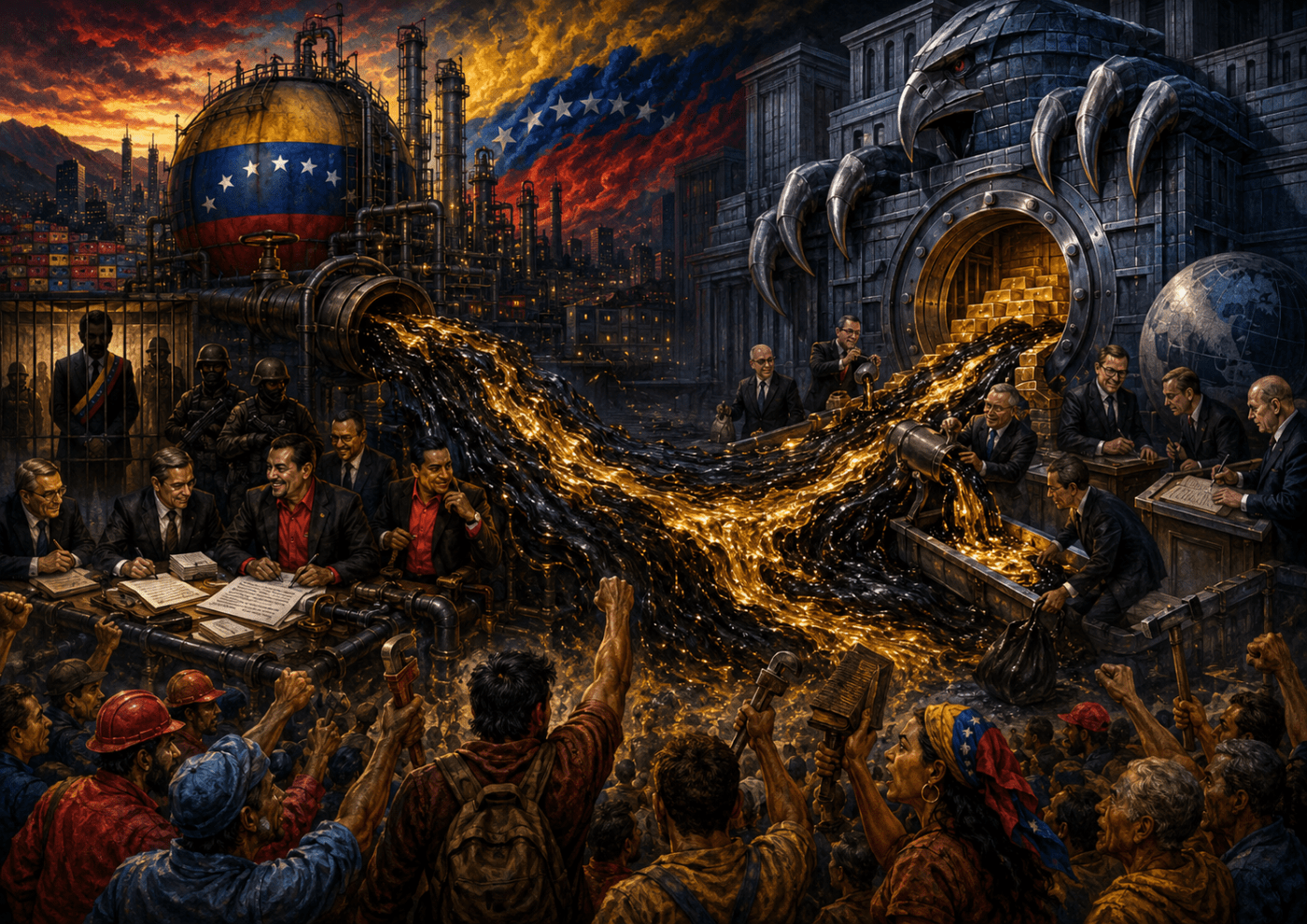
The Miami Herald turns a transnational robbery of Venezuelan social wealth into the personal tragedy of an informant discarded by Washington, leaving U.S. jurisdiction standing above the wreckage as though empire were merely an unreliable employer. Operation Money Flight exposes corrupt officials who used Bolivarian credentials to deliver PDVSA wealth into the hands of bankers, brokers and offshore capital, even as the Maduro government pursued comparable networks inside the petroleum state. After Maduro’s kidnapping, Washington generalized the same logic from criminal forfeiture to national receivership, placing lawful petroleum income under U.S. custody while the acting government maneuvers beneath military, legal and financial coercion. The revolutionary answer is indivisible: free Maduro and Cilia Flores, return Venezuela’s wealth, prosecute the compradors and place every barrel, contract and public account beneath the organized vigilance of the workers and communes.
Prince Kapone | Weaponized Information | July 27, 2026
The Informant in the Imperial Courtroom
On July 25, 2026, the Miami Herald published “Venezuelan informant says U.S. broke promises after he exposed $1.2B oil fraud”, an AI-assisted condensation of reporting originally produced by Jay Weaver. Its protagonist is Pedro Binaggia, a former Venezuelan banking lawyer who says he spent eight years working as a confidential informant for U.S. federal agents. He recorded suspected financial criminals, surrendered millions of dollars in allegedly tainted funds and helped construct Operation Money Flight. When the agents had finished collecting the recordings, the money and the names, Binaggia says the compensation and permanent residency promised to his family never arrived.
The article is sold as a story of betrayal, and at one level it is. A man entered the machinery of federal prosecution believing that usefulness would purchase protection. Instead, his visa expired, his family left the United States and the government whose case he helped build demanded that he accept narrower legal guarantees. The empire, it appears, is quite capable of recognizing loyalty while it is being performed and forgetting it once the evidence has been catalogued.
But the article’s frame sharply narrows the crime. A transnational operation involving PDVSA officials, bankers, financial managers, offshore accounts and luxury property becomes the personal tragedy of one discarded informant. The reader is invited to ask whether Washington treated Binaggia fairly, not why Washington appears as the natural investigator, judge and custodian of wealth removed from a Venezuelan public company.
The article’s compressed “key takeaways” strengthen this personalization. Years of cooperation, secret recordings, threats, surrendered funds, an expired visa and a displaced family are stacked into a clean sequence of service followed by abandonment. The messier institutional questions—how much property was actually recovered, who received it, which victims were recognized and where the money finally went—remain outside the frame.
The source hierarchy is equally revealing. Federal agents investigate. Prosecutors define the legal terrain. Defense attorneys contest the terms. A whistleblower lawyer proposes the remedy. Venezuela enters mainly as the country from which corrupt money originated, while U.S. jurisdiction arrives already dressed as common sense.
That authority is reinforced through legal language: “Kastigar letter,” “limited immunity,” “forfeiture” and “confidential informant.” These terms give the story the polished gravity of the courtroom while concealing the political assumptions beneath it. By the final paragraph, the betrayal has been reduced to an incentive problem. Unless informants are rewarded properly, future insiders may refuse to cooperate. The lesson is not that the machinery possesses too much power, but that it should maintain its human instruments more carefully.
From the Laundering Network to the Treasury Account
Operation Money Flight began in December 2014 with a sham-loan and currency-exchange arrangement designed to remove approximately $600 million from Petróleos de Venezuela S.A. By May 2015, U.S. prosecutors alleged that the operation had expanded to $1.2 billion, with the proceeds moving through money managers, brokerage firms, banks, real-estate investment companies and false investment structures in the United States and abroad. The original complaint charged former PDVSA officials, private financial operators and members of Venezuela’s wealthy elite; allegations against defendants who have not pleaded guilty or been convicted remain unproven.
Former PDVSA executive Abraham Ortega later pleaded guilty to conspiracy to commit money laundering after admitting that he accepted millions of dollars in bribes for granting priority treatment to financial arrangements connected to the scheme. Former Swiss banker Matthias Krull also pleaded guilty, admitting that the network used Miami real estate, false investment products and an international chain of professional financial intermediaries to conceal the origin and ownership of the money. Krull received a ten-year prison sentence and a $600,000 forfeiture judgment.
The documents reviewed for this Weaponized Propaganda Excavation contain individual pleas, sentencing orders, forfeiture judgments and case announcements, but not one reconciled Operation Money Flight ledger. The public record does not bring together the amount transferred by informants, property actually recovered, assets sold, administrative deductions, victim petitions and final distribution. The case produced punishment and forfeiture orders; it did not produce a transparent public account of where every recovered dollar ultimately went.
Pedro Binaggia entered the U.S. investigation in 2016. He says he recorded approximately one hundred meetings, transferred $45.6 million in tainted funds and cooperated for eight years. His prospective adjustment to permanent residence depended upon the federal agency sponsoring him because the law-enforcement agency must initiate the relevant S-classification or permanent-residence process. The institutions receiving his evidence, money and labor therefore retained control over the immigration relief affecting his family.
Venezuela was not waiting for Miami prosecutors to discover that petroleum wealth was being stolen. By April 2023, the Public Ministry stated that it had uncovered thirty-one corruption networks inside the petroleum industry and requested extraditions from Italy, Spain and the United States. Those proceedings were separate from Operation Money Flight and do not establish that Caracas investigated every defendant named in the Miami case. They establish a sustained Venezuelan campaign against comparable networks linking public officials, private capital and foreign jurisdictions.
The temporal setting changed decisively on January 3, 2026, when U.S. forces attacked Venezuela and seized President Nicolás Maduro and Cilia Flores. Venezuela’s Supreme Tribunal ordered Executive Vice President Delcy Rodríguez to assume the acting presidency to preserve continuity in the executive branch, while Venezuelan institutions continued to identify Maduro as the constitutional president.
On January 9, the White House placed Venezuelan oil and diluent revenue held in designated Treasury accounts beyond ordinary judicial attachment. The order identifies the funds as Venezuelan sovereign property held in U.S. custody, prohibits transfers or dealings without U.S. authorization and states that their administration serves U.S. foreign-policy objectives. The arrangement reaches beyond assets forfeited from particular criminal defendants. It governs lawful income generated by the country’s petroleum exports.
OFAC subsequently required specified royalties and other payments owed to blocked Venezuelan entities to enter Foreign Government Deposit Funds or other Treasury-designated accounts. The same licensing framework subjects contracts to U.S. foreign-policy and national-security priorities, requires U.S. jurisdiction for certain disputes and restricts transactions involving firms connected to China, Russia, Iran, Cuba and other states targeted by Washington. Portions of Venezuela’s routine petroleum income are collected through channels whose conditions and destination are determined outside the country.
A July 2026 Financial Times calculation estimated that more than $13 billion had entered the U.S.-administered oil-revenue system since January, while approximately $300 million had been publicly documented as returned to Venezuela. That figure is an external estimate rather than an audited government total. No complete public ledger presently reconciles revenue collected, balances retained, transfers authorized or expenditures made. The unresolved accounting question surrounding the earlier criminal forfeitures has therefore been joined by a much larger accounting question concerning the lawful petroleum income of the Venezuelan state.
The acting government also advanced a partial reform of the Organic Hydrocarbons Law after Maduro’s seizure. The National Assembly incorporated Contracts for Productive Participation developed under the Anti-Blockade Law, expanding mechanisms through which domestic and foreign investors could provide capital and operate petroleum projects while the state formally retained ownership and royalty claims. The Assembly presented the reform as a means of increasing production, attracting investment into new fields and converting petroleum extraction into infrastructure, social services and wages.
These developments followed an expanding structure of economic coercion. U.S. restrictions beginning in 2017 limited transactions involving new Venezuelan government and PDVSA debt. In March 2025, Washington added the threat of tariffs against countries purchasing Venezuelan oil. By January 2026, the United States had moved from restricting Venezuela’s access to finance and markets to holding petroleum revenue in U.S. accounts and determining the conditions under which it could be transferred.
Operation Money Flight and the post-January petroleum arrangement remain legally distinct. The first concerned the illicit diversion and laundering of PDVSA funds by identifiable officials and financial operators. The second regulates the custody and movement of lawful state petroleum income. Together they establish the factual terrain upon which the present dispute now rests: stolen money, recovered assets, sovereign revenue and final control over Venezuela’s principal source of national income.
From Comprador Theft to Imperial Receivership
The Miami Herald tells the story as though the central contradiction were between a useful informant and an ungrateful American government. Pedro Binaggia delivered recordings, money and access; Washington failed to deliver the reward. That betrayal is real enough. But it is the smallest circle inside a much larger one. The same machinery that treated the informant as disposable also claimed the authority to investigate Venezuelan officials, seize Venezuelan-linked assets, administer the recovered wealth and decide which Venezuelan institutions possessed the right to receive anything back.
Operation Money Flight began inside the Bolivarian state, but it did not end there. Corrupt officials and businessmen converted access to PDVSA into private enrichment. Their government positions gave them control over contracts, payments and petroleum revenue. Foreign banks, investment vehicles, property markets and professional money managers gave that stolen wealth somewhere to go. One group opened the public vault; another transformed the contents into respectable capitalist property.
These officials were Bolivarians by appointment, appearance or public language. They were not Bolivarian in class function. A red shirt does not abolish a private balance sheet. A revolutionary title does not change the direction in which wealth moves. When an official uses authority granted by a public project to carry social property into foreign financial circuits, that official acts as a comprador regardless of the slogans hanging behind his desk.
The comprador is not simply a greedy individual with poor morals. He occupies a material position between national resources and foreign capital. His power depends upon access to the state; his accumulation depends upon converting that access into wealth protected outside the nation. He serves international capital because international capital supplies the banks, shell structures, legal jurisdictions and property markets through which the theft becomes secure.
This is why the phrase “Venezuelan corruption” performs such useful ideological labor. It names the country where the money was stolen and erases the system that received it. The PDVSA official becomes the whole crime. The foreign banker becomes a technician. The public company is treated as diseased, while the capitalist infrastructure that washed the money clean disappears behind contracts, compliance departments and courtroom vocabulary. Venezuela supplies the scandal. International capital supplies the plumbing.
The corruption also cannot be separated from the siege imposed upon the country. Restrictions on finance, debt, markets and petroleum trade narrowed Venezuela’s ordinary channels of exchange. The state became more dependent upon exceptional arrangements, brokers and intermediaries capable of moving money through blocked terrain. Those pressures did not create the original theft, but they widened the shadows in which later networks could operate. Imperial coercion weakened the public system and then pointed to the resulting disorder as proof that the public system deserved further coercion.
The Maduro government stood on the opposite side of this contradiction. The presence of thieves inside the petroleum apparatus did not mean theft was the state’s governing program. Venezuelan institutions repeatedly investigated corruption networks, pursued suspects across borders and moved against people occupying privileged positions inside the oil industry. The state was penetrated, but it also fought the penetration. That is what class struggle looks like when it enters ministries, public companies and the administrative machinery of a revolution.
The imperial account needs the reader to collapse these opposing forces into one. It takes corrupt officials acting against Venezuela’s social property and presents them as the authentic face of the government attempting to defend that property. The burglar is discovered inside the house, and the newspaper indicts the homeowner. The arrests become proof of universal rot. The investigation becomes evidence that the investigators presided over the crime.
Washington then converted crimes committed against the Venezuelan state into authority over the Venezuelan state. First came jurisdiction over particular defendants, accounts and forfeited property. Then came restrictions on PDVSA, blocked assets and control over the financial channels through which Venezuela could sell its petroleum. After the seizure of Maduro, that authority reached lawful petroleum revenue itself. The empire moved from claiming the right to dispose of money stolen from Venezuela to claiming custody over money legally earned by Venezuela.
Operation Money Flight and the present oil arrangement are not the same legal process. The first involved the criminal diversion of public funds by identifiable actors. The second governs the movement of lawful state revenue. Their unity lies in the political relation beneath them. In both cases, Venezuelan wealth leaves effective national control, enters institutions centered in the United States and becomes subject to decisions made by authorities beyond the Venezuelan people.
The distinction between ownership and control becomes decisive here. Washington can declare that the petroleum money remains Venezuelan property while determining where it is deposited, when it can move and under what conditions it may return. A prisoner may still legally own his coat while the jailer holds the keys to the room where it hangs. Formal title survives. Sovereign command does not.
Delcy Rodríguez therefore governs through a contradiction produced by force. Venezuelan institutions continue to function, the state retains formal authority and the acting government still administers territory, ministries and petroleum production. Yet its principal source of income passes through channels controlled by the power that seized the constitutional president. Every negotiation over investment, production and reform unfolds inside that pressure.
This is neither complete sovereignty nor the total disappearance of the Venezuelan state. It is constrained sovereignty: a Bolivarian institutional structure compelled to maneuver beneath military threat, financial custody and legal coercion. To describe every concession as freely chosen would erase the gun. To pretend that coercion abolishes all internal contradiction would erase the continuing struggle over who controls the state, the petroleum industry and the direction of the revolution.
The hydrocarbons reform therefore belongs inside the same contradiction. Venezuela requires investment, production and functioning commercial routes after years of restriction. Foreign and private capital enters that need seeking greater operational power, profit and long-term access. The acting government attempts to preserve state ownership and revenue while negotiating from a position violently weakened by the capture of its president and the external administration of its oil income. The outcome cannot be understood through legal language alone. The question is which class gains practical command over production, contracts, revenue and the future of PDVSA.
Binaggia’s broken promise now appears as a minor reflection of the whole structure. He believed that service to the imperial legal system would secure protection. Venezuela was told that surrendering control to the same imperial system would protect its assets, stabilize its petroleum trade and preserve its revenue. In each case, the stronger institution received the evidence, money or cooperation and reserved for itself the power to decide what would be returned.
The real story is therefore not that a corrupt socialist state was rescued by honest American law. It is the story of a revolutionary state penetrated by comprador actors, robbed through international capitalist circuits, weakened by sanctions, and then placed under deeper imperial supervision in the name of correcting the damage. The thieves helped carry the wealth out. The empire arrived afterward to guard the exit—and eventually claimed the keys to the building.
The Bolivarian project must be judged by the direction of its struggle. On one side stand those who converted public office into private accumulation and those foreign institutions that received, protected or administered the resulting wealth. On the other stand the forces attempting to preserve petroleum as social property, prosecute the compradors and keep national resources under Venezuelan command. The courtroom story blurs that line. Historical materialism restores it.
Free the President, Return the Wealth, Arm the People With the Books
The immediate line begins where imperial propaganda refuses to begin: Nicolás Maduro and Cilia Flores must be released, U.S. military and financial coercion must end, and Venezuela’s petroleum income and external property must return to Venezuelan control. But sovereignty cannot mean silence about the officials who converted revolutionary office into private enrichment. The same struggle must prosecute the compradors who robbed PDVSA and defend the country from the empire that used their crimes as a warrant for trusteeship.
Inside the United States, that work already has an organizational vehicle. Unión del Barrio’s “No War for Oil in Venezuela” campaign demands Maduro and Flores’s unconditional release and opposes sanctions, asset piracy, military aggression and regime change. Its line should be carried into barrio organizations, union halls, classrooms and community political-education spaces, connecting the seizure of Venezuelan petroleum to the same imperial system attacking migrant and working-class communities inside the United States.
The information front requires its own infrastructure. Venezuelanalysis depends entirely upon reader support and receives no government funding. Supporting, translating and circulating its reporting on petroleum policy, sanctions, labor and the communes denies corporate newspapers and U.S. prosecutors a monopoly over the interpretation of Venezuelan reality. Organization without independent information enters battle using the enemy’s map.
Inside Venezuela, the answer to corruption cannot remain confined to ministries, prosecutors and executive appointments. The country’s communal social-comptrollership program trains organized residents to monitor public resources, demand accounting and supervise community projects. These mechanisms must be deepened through open assemblies, published contracts, accessible revenue accounts and direct scrutiny by petroleum workers, communes and organized communities. The books belong before the people, not behind another office door.
The immediate investigative campaign should join the old criminal forfeitures to the new imperial custody system. Researchers can construct a public ledger showing what was alleged stolen, what defendants admitted, what courts ordered forfeited, what the government actually collected, what entered Treasury-controlled accounts, what returned to Venezuela and what remains unexplained. Narrow Freedom of Information Act requests must identify specific existing records: forfeiture receipts, asset-sale documents, victim petitions, informant-award recommendations, account balances, transfers and disbursement authorizations.
No immunity for thieves wearing revolutionary colors. No U.S. custody over Venezuelan social property. Free Maduro and Flores. Publish the accounts. Return the wealth. Place every barrel, contract and dollar under the organized vigilance of the people who produced it.


Leave a Reply