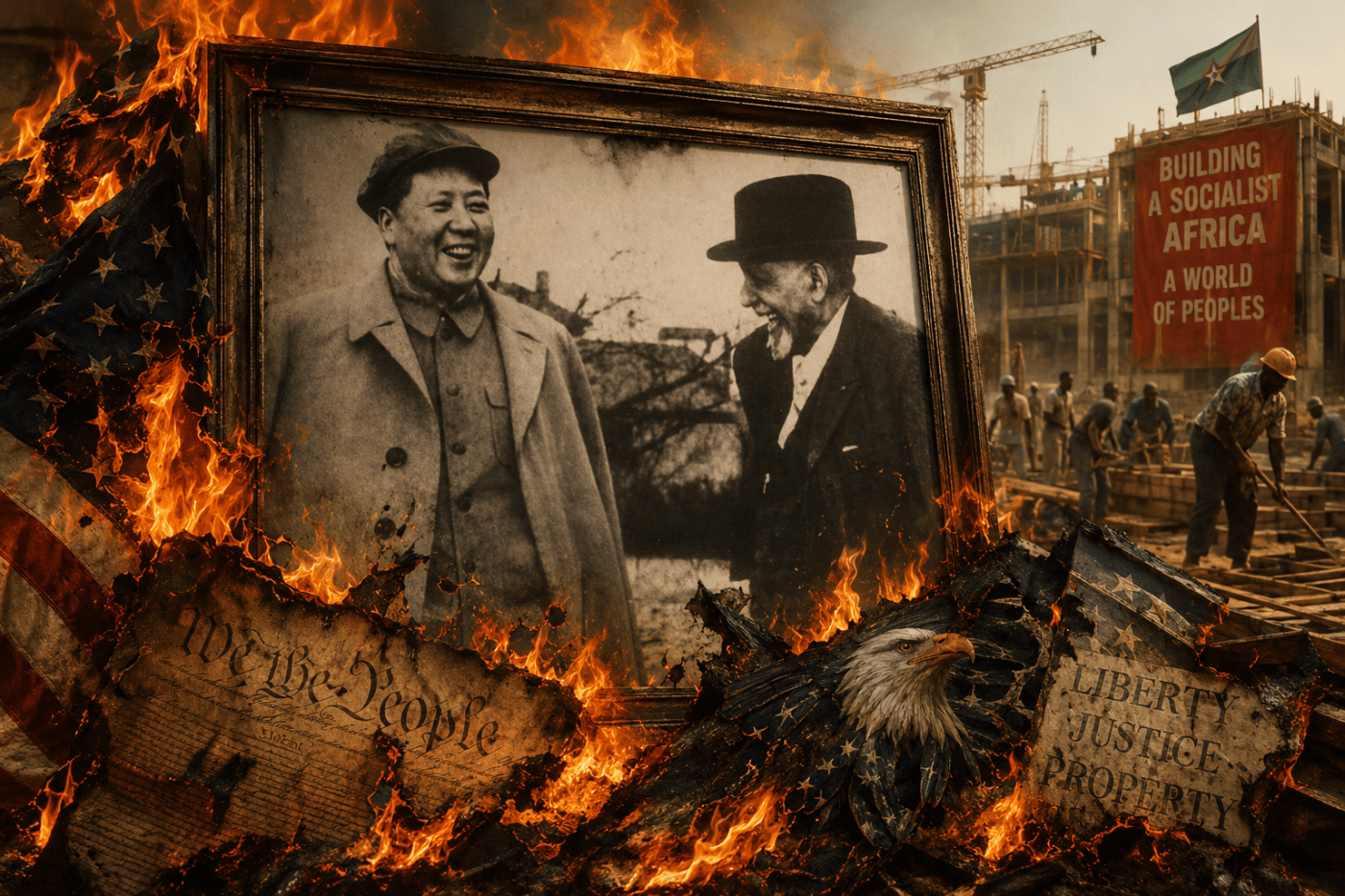
Bill V. Mullen tears W.E.B. Du Bois away from the respectable American mythology that embalmed a communist revolutionary as a harmless prophet of racial reconciliation. His recovery reveals the color line as a world system binding slavery, colonial plunder, imperial war and capitalist exploitation—and restores the diasporic international that organized resistance across those fronts. Yet the book retreats when revolution passes from rebellion into socialist state power, treating the Soviet and Chinese experiences through an anti-Stalinist framework that too often separates emancipation from the institutions required to defend and construct it. What remains is an indispensable revolutionary recovery whose strongest evidence points beyond its weakest conclusions, toward an internationalism capable of defending socialist construction without surrendering criticism or popular power.
By Prince Kapone | Weaponized Information | Weaponized Intellects Book Review | July 19, 2026
The American Du Bois and the Crime of Revolutionary Memory
Every empire manufactures a usable past. It keeps the rebels whose names can decorate a courthouse, removes the ideas that might empty the courthouse, and returns the resulting corpse to the people as national heritage. W.E.B. Du Bois has endured precisely this operation. The United States that surveilled him, prosecuted him, confiscated his passport and treated his international commitments as evidence of disloyalty now celebrates him as one of its great democratic intellectuals.
The communist becomes a civil-rights pioneer. The anti-imperialist becomes a critic who merely wanted America to honor its promises. A man who placed Black freedom inside the revolutionary struggles of Africa, Asia and the socialist world is marched back across the border after death and stationed beneath the flag he had learned to indict.
Bill V. Mullen’s Un-American: W.E.B. Du Bois and the Century of World Revolution tears open this posthumous settlement. His target is larger than the omission of several embarrassing episodes from an otherwise respectable biography. It is the ideological production of what he calls the “American Du Bois”: a nationally contained thinker whose radicalism may be acknowledged so long as its political destination remains liberal democracy. Against this construction, Mullen offers a “counter-narrative to the American Du Bois,” recovering a life increasingly organized through communism, anticolonial struggle, Pan-Africanism, peace politics and the movements that broke Europe’s claim to govern humanity.
The domesticated Du Bois is not simply incomplete. He is politically inverted. A thinker who came to locate Black emancipation beyond the institutions and loyalties of the American state is made to testify on behalf of that state’s capacity for redemption. His criticism survives as moral pressure upon the republic; his judgment upon the republic disappears. Slavery becomes an inconsistency within American freedom rather than a foundation of capitalist development. Segregation becomes failed inclusion rather than a system for organizing labor, citizenship and political power. Empire becomes one regrettable branch of foreign policy instead of the world structure through which the color line acquired its full material force.
This is counterinsurgency conducted through memory. The ruling order does not need to erase every revolutionary. Total erasure can preserve antagonism and provoke the dangerous question of what had to be suppressed. It is often more useful to separate the figure from the program, retain the moral vocabulary and destroy the strategic conclusions. Du Bois may be praised as a scholar of race while his analysis of capital is softened; honored as a Pan-Africanist while his alliance with socialist states becomes an unfortunate excess; celebrated for opposing war while the imperial relations producing war disappear from the frame. The museum receives the portrait. The movement is denied the weapon.
Mullen begins from the opposite proposition: “The twenty-first century and its dissidents are haunted by the specter of one of the twentieth century’s most ambitious and unrealized projects: world revolution.” The force of the sentence lies in the word unrealized. World revolution is neither embalmed as a failed dream nor preserved as nostalgia for a heroic age. It remains an unfinished historical problem. Capital still organizes production across borders; imperial power still protects ownership through military, financial and political coercion; the colonial division of humanity survives beneath updated legal forms. Du Bois belongs to the present because the contradictions that carried him beyond American liberalism were never resolved.
Mullen’s decisive achievement is to restore communism to the center of Du Bois’s political development. It does not appear as an eccentric attachment acquired in old age, after judgment supposedly surrendered to bitterness. Mullen reconstructs its formation through accumulated defeats and revolutionary discoveries: the destruction of Reconstruction, the racial treachery of organized white labor, the colonial partition of the world, the concentration of capitalist power, imperial war, the Bolshevik Revolution, African and Asian liberation and the persecution of peace organizers inside the United States. Communism became intelligible because the alternatives Du Bois had tested repeatedly collided with the material structure of racial capitalism and empire.
His declaration—“I believe in communism”—condensed that historical judgment. Its power lies partly in its refusal of academic shelter. Du Bois did not say communism raised several worthwhile questions, contained humane aspirations or deserved sympathetic study beside competing philosophies. “I believe in communism” names allegiance. It joins an analysis of the existing order to confidence that another social order can be built. Private command over production, colonial possession and imperial war were no longer defects awaiting correction through racial inclusion. They belonged to a structure that had to be displaced.
Liberal scholarship has treated this allegiance as a biographical complication requiring delicate contextualization, as though Du Bois had spilled ideological ink across an otherwise distinguished résumé. Mullen instead places it inside the architecture of a thinker who had concluded that Black freedom could not be secured while capital retained command over labor, land and the state. Communism did not lead Du Bois away from the color line into an abstract universal class question. It gave him a fuller account of how the color line had been constructed and reproduced through slavery, colonial extraction, segmented labor and unequal political power.
Race and class were not separate injuries waiting to be ranked. The color line organized wages, land, citizenship, colonial rule and access to the wealth produced by the darker world. White supremacy supplied capital with a disciplined hierarchy and offered sections of white workers a degrading bargain: limited material and psychological privilege in exchange for political service to the ruling class. The ruling class did not need to elevate white workers into power. It needed to persuade enough of them that their position above Black and colonized labor was a possession worth defending. Racial membership became the counterfeit handed to workers in place of control over society.
Du Bois’s movement toward communism therefore sharpened the struggle against white supremacy. Black workers, colonized peasants and metropolitan proletarians did not occupy identical positions, but their conditions had been shaped within one expanding system. Capital crossed borders; armies protected its movement; racial categories determined whose labor and land could be seized with the least political consequence. Internationalism was not a charitable enlargement of Du Bois’s sympathies. It was the scale demanded by the enemy.
Mullen names the field through which this understanding developed the “diasporic international.” It joined Black radicals, communists, anticolonial nationalists, writers, political exiles, peace organizers and revolutionary states. Du Bois did not merely gather foreign influences from a scholarly distance. His categories were remade through movements whose victories and defeats forced inherited ideas into crisis. The Russian Revolution reopened the meaning of Reconstruction. African and Asian liberation shattered Europe’s monopoly over political modernity. International communism placed colonial emancipation inside a program for reorganizing the world economy, even when its own strategic decisions failed to honor that commitment consistently.
Mullen’s treatment of the Soviet turn toward anticolonial struggle is especially important. He writes that Socialism in One Country “tipped the balance of world revolution forces in the direction of anticolonial struggle.” The formulation disrupts the familiar Western account in which the consolidation of Soviet state power simply closes the revolutionary horizon. Whatever contradictions accompanied that turn, the colonial question moved closer to the center of international communist politics. For peoples subjected to occupation, racial hierarchy and foreign ownership, the revolutionary century could not be measured solely by the fortunes of industrial Europe.
Here the contradiction governing this review enters the book. Mullen recovers Du Bois through world revolution while describing the Soviet trajectory as a “dark hijacking of world revolution.” The metaphor presumes an authentic revolutionary vehicle seized and redirected by an alien force. It protects the purity of revolution by separating emancipation from the parties, institutions and states through which workers and peasants attempted to defend their victories. Revolution remains luminous while insurgent, but grows suspect once it must govern territory, coordinate production, survive encirclement and prevent restoration.
This is not a minor disagreement over terminology. Mullen’s framework risks making the historical existence of communism less intelligible than Du Bois’s commitment to it. A communist Du Bois can be admired as the bearer of an emancipatory horizon while the socialist states that gave that horizon material depth are interpreted primarily through usurpation and betrayal. Yet the evidence Mullen recovers repeatedly presses against that separation. Anticolonial movements did not confront an abstract world system. They confronted armed colonial states, international capital and racial orders sustained by force. Their revolutions required institutions capable of doing what declarations alone could not.
That tension should not obscure the magnitude of Mullen’s breakthrough. Before the book’s conclusions can be tested, the historical ground it restores must be secured. “Un-American” was never a neutral description of insufficient patriotism. It was a weapon of a settler and imperial state against people whose solidarities exceeded the boundaries of ruling-class citizenship. The communist, Black internationalist, anticolonial militant and peace organizer became suspect because each connected domestic injustice to a world system—and because each threatened to convert that recognition into organization.
The accusation did not prove that Du Bois stood outside American history. It proved that he had entered too deeply into the history America required concealed. Mullen retrieves him from the national mausoleum and returns him to the movements whose defeat made that mausoleum possible. He restores the thinker who understood that Black liberation could not be completed beneath the command of capital, that peace required opposition to empire and that fidelity to the oppressed might demand disloyalty to the state oppressing them.
This recovery is the book’s first indispensable act. The harder question—and the one that must govern everything that follows—is whether Mullen will extend the same historical generosity to the revolutions whose victories made Du Bois’s communist internationalism materially possible.
The Color Line Becomes a World System
Du Bois did not arrive at internationalism by adding foreign affairs to an American theory of race. He discovered that the domestic was already international. The plantation, colonial port, segregated factory, mine and imperial battlefield belonged to one material history. Black labor in the United States had been formed inside the Atlantic slave trade; European industry had swollen upon colonial extraction; metropolitan citizenship had been financed partly through the exclusion of peoples denied sovereignty. The color line was never confined to the Southern courthouse or the American street. It had become a world system for distributing labor, land, political rights and premature death.
Mullen reconstructs this discovery through the “diasporic international,” the changing network of Black radicals, communists, anticolonial militants, writers and organizers through which Du Bois learned to read the twentieth century beyond the nation. This was no diplomatic salon of distinguished intellectuals exchanging sympathetic declarations. It operated through newspapers, congresses, parties, correspondence, travel, translation, exile and common struggle. Capital had internationalized exploitation. The oppressed faced the harder task of internationalizing resistance.
The value of Mullen’s account lies in refusing to make this formation a stage in one great man’s private awakening. The diasporic international was a collective process through which Black struggle, Marxism and anticolonial nationalism altered one another. Du Bois brought slavery, Reconstruction and the color line into contact with a communist movement still burdened by European assumptions. Revolutionaries from Africa, Asia, the Caribbean and the United States forced the colonial question into a Marxism that too often mistook Europe’s industrial worker for humanity’s finished political form.
Mullen locates the central problem in the relation between “proletarian internationalism and national self-determination struggle.” The formulation names two necessities that become distorted when mechanically separated. Internationalism without national liberation leaves colonial property and foreign command intact. National liberation without proletarian power may transfer the flag while preserving the classes, institutions and economic relations beneath it. Colonized peoples were not being asked to choose between the nation and the class struggle. Their historical burden was to discover political forms through which national emancipation could open the road toward social transformation.
Du Bois cut through the search for a universal sequence when he wrote: “I believe in Communism wherever and whenever men are wise and good enough to achieve it; but I do not believe all nations will achieve it in the same way or at the same time.” Communism remains the destination, but no single national experience becomes its customs office. An enslaved working population, a colonized peasantry and a metropolitan proletariat do not enter struggle through identical institutions or stages. Uneven development is not an inconvenience theory may ignore. It is the ground upon which theory proves whether it understands the world it intends to change.
For colonized peoples, sovereignty therefore formed part of the class struggle. Foreign rule organized exploitation through stolen land, comprador intermediaries, taxation, racial hierarchy and military occupation. A people denied political existence could not leap over the national question into a socialism administered through the machinery of its occupier. Independence did not complete emancipation, but without the destruction of colonial command the social question remained locked inside institutions designed to prevent the people from answering it.
Western socialism repeatedly mishandled this problem because sections of the metropolitan working class had been incorporated into the imperial order. Exploitation did not disappear, but colonial citizenship, segmented labor markets and access to imperial wealth shaped political loyalties. The ruling class needed neither to enrich every white worker nor invite them into actual command. A limited advantage over colonized labor could be presented as property worth defending. The worker received a slightly larger ration from the plunder and was encouraged to mistake it for a partnership in power.
Mullen’s “capitalist-colonialist complex” captures the structure beneath that arrangement. Colonialism was not capitalism’s regrettable overseas habit, and racism was not an irrational prejudice attached to a neutral market. Colonial extraction supplied territories, profits and raw materials; racial hierarchy determined which populations could be dispossessed with the least political cost; imperial force defended the resulting division of labor. A socialism that spoke universally of class while postponing colonial self-determination merely promoted the provincial interests of the imperial center under a red banner.
The Communist International became historically decisive because it attempted, however unevenly, to break that hierarchy. The Bolshevik Revolution shattered the political monopoly of the capitalist powers and placed colonial emancipation inside the declared strategy of an organized socialist state. For peoples whose countries had been partitioned, occupied or administered for foreign accumulation, this was no minor correction to European doctrine. It announced that colonial rule belonged among the structures world revolution was obliged to destroy.
Declaration, however, could not substitute for organization. Kwame Nkrumah’s insistence that “Today there is only one road to effective action—the organization of the masses” supplies the material principle beneath the diasporic international. Shared injury does not organize itself, and a common enemy does not manufacture common strategy. Newspapers had to circulate, cadres had to be trained, congresses convened, funds raised and political relationships maintained across surveillance, prison and exile. Internationalism acquired force only when sympathy became infrastructure.
This is why Mullen calls Dark Princess Du Bois’s “ode to the diasporic international.” Its organizers, political exiles and revolutionary travelers inhabit the networks through which distant struggles become mutually intelligible. Agnes Smedley, Virendranath Chattopadhyaya, the Ghadr movement, the Berlin Committee, Lajpat Rai and the circulation of material on lynching were not decorative background surrounding the important ideas. They were channels through which ideas became usable. The network did not merely support revolution. It was one of the forms through which revolution learned to recognize itself.
Du Bois’s line—“Only working thinkers can unite thinking workers”—places intellectual labor inside that process. The phrase refuses both the professional scholar who observes workers from a safe altitude and the worship of spontaneity that imagines suffering automatically producing strategy. Workers think; intellectuals must work. Theory becomes revolutionary when it enters collective struggle, submits its abstractions to lived conditions and helps transform scattered experience into organized knowledge. Du Bois does not abolish the intellectual. He abolishes the intellectual’s presumed exemption from the discipline of the movement.
Dark Princess also carries the world struggle inside the United States: “You can work in Africa and Asia right here in America if you work in the Black Belt.” The sentence does not flatten the American South, Africa and Asia into identical formations. It identifies the Black Belt as an internal front within a system whose colonial relations crossed the nation’s formal borders. The empire had reproduced dispossession, racial government and national subordination inside the republic. World revolution did not begin only after crossing an ocean.
George Padmore’s political journey reveals the strain within this convergence. His break from communist internationalism toward independent Pan-African organization cannot be explained as personal disillusionment or converted into proof that Marxism and national liberation were natural enemies. The dispute concerned political command: whether colonial movements would remain subordinate to the diplomatic requirements of a socialist state, and whether communist organizations would recognize colonized peoples as makers of revolution rather than reserves for a European contest.
The contradiction was genuine. The Soviet Union had emerged from world revolution while becoming a state compelled to survive inside a hostile system. Its strategic retreats did not erase October’s anticolonial meaning, but neither did every diplomatic adjustment advance colonial struggle. Mullen is most useful when he leaves the problem in this historical form. Internationalism required coordination, yet coordination could become subordination. Defense of the socialist center could preserve the material basis of anticolonial struggle, yet movements elsewhere still needed sufficient autonomy to interpret their own terrain and act upon it.
India placed the relation between nation and class under still greater pressure. Mullen calls its independence movement a “template for measuring the tensions between nationalism and proletarian internationalism embedded in India’s freedom struggle.” British rule had reordered taxation, agriculture, industry and famine around imperial accumulation. Independence was indispensable, but it could not decide who would control land, production and the new state. Political freedom opened the social question. It did not answer it.
Mullen’s discussion of the “Indian ideology” shows how national myth may conceal those unresolved struggles. The formula of “antiquity-continuity; diversity-unity; massivity-democracy; [and] multiconfessionality-secularity” imagines India as a coherent civilizational whole whose unity precedes political conflict. Such a narrative can mobilize a colonized people against foreign rule, but it can also bury caste, class and religious domination beneath the national symbol. Every liberation movement requires unity; every ruling class struggles to determine whose interests that unity will contain.
The treatment of the Untouchables makes the danger concrete. Mullen records the argument that they were “bundled back in to the Hindu electorate” because independent representation threatened the numerical and ideological unity of the Hindu bloc. The phrase exposes the coercion concealed inside formal inclusion. A population may be admitted into the nation precisely so that its separate political power can be denied. Unity becomes an instrument of domination when the oppressed receive membership only after surrendering the means to act as an organized force.
This is the sharp edge of Mullen’s criticism of nationalism. A colonized nation may require a broad front against foreign domination while containing landlords, capitalists and professional elites determined to stop at formal independence. National liberation becomes revolutionary where it dismantles the institutions joining imperial control to domestic class rule. It becomes an empty shell when the colonial administrator departs but inherited property relations and state machinery continue governing beneath a new flag.
Yet political vocabulary cannot replace class analysis. The nationalism of an oppressed people fighting to recover sovereignty is not equivalent to the nationalism of an imperial state organizing conquest. Japan’s challenge to white supremacy did not make Japanese empire a liberating force. Its ruling class entered the colonial division of Asia and imposed upon neighboring peoples the domination Japan claimed to resist. A nonwhite flag altered the administrators, not the political economy of occupation.
China posed a different historical problem because national liberation there became inseparable from social revolution. Foreign domination operated through landlordism, comprador capital and a fractured state. The communist movement did not suspend class struggle until national reunification had been achieved. It attacked the property relations through which imperialism governed China. The peasantry, dismissed by mechanical Marxism as an inert residue, became revolutionary through land struggle, political education and communist organization.
Mullen’s own architecture prepares this conclusion even where his later judgments resist it. Du Bois’s insistence that nations would not reach communism “in the same way or at the same time” denies Europe the right to issue a single institutional passport to revolution. The colonial question did not surround the real struggle occurring elsewhere. Across much of the world, it was the terrain upon which workers and peasants joined national emancipation to the destruction of landlord, comprador and imperial power.
The diasporic international was the organizational expression of that discovery. Its strength appeared whenever oppressed peoples connected their different conditions without pretending those conditions were identical. Its weakness appeared whenever metropolitan class politics postponed colonial freedom, nationalist elites suppressed workers and peasants, or racial solidarity excused an aspiring imperial power. Du Bois emerged from these conflicts neither as a nationalist who eventually discovered class nor as a Marxist who outgrew race. He learned that capitalism reproduced the color line and that any socialism built upon colonial property or racial privilege would reproduce the order it claimed to abolish.
Mullen therefore returns Marxism to a world in motion, where Black struggle and anticolonial revolution remade theory rather than receiving it complete from Europe. His achievement carries a demanding implication: the liberation of colonized nations was not a secondary theatre surrounding the true revolution. It was one of the principal terrains upon which world revolution acquired a mass base, shattered the geography of European command and discovered forms adequate to the actual composition of the oppressed. The color line had become a world system. Breaking it required a world movement capable of joining national emancipation to the organized power of workers and peasants.
History from the Barricades
History is never only a record of what happened. It is a struggle over who possesses the authority to explain what happened, whose actions become causes, whose suffering becomes scenery and whose victories are renamed accidents. The ruling class commands more than factories, banks, armies and courts. It builds archives, disciplines universities and teaches the oppressed to encounter their own past as spectators. Whole peoples enter the record as labor supplies, criminal populations or victims awaiting rescue. Their rulers act. They merely endure.
Mullen recovers in Du Bois a method built against this arrangement. The book opens with Du Bois’s declaration that “only through the present can we see the past,” because the future lies partly within the past and the past remains active inside the future. This is not a license to dress earlier events in contemporary slogans. It means that new struggles reveal capacities, relations and defeated possibilities concealed by the order that followed. The archive records what the victors permitted to remain visible. A revolutionary present can expose what their victory taught history to forget.
Mullen gives the method its sharpest formulation: “Revolution thus becomes the hermeneutic engine of both history writing and history making.” Revolution is not merely another subject in Du Bois’s work. It is the machinery through which historical relations become intelligible. Ordinary domination presents the existing order as nature: masters govern, workers obey, colonies remain dependent and the state stands above society. Revolution breaks that appearance. Classes declared passive become organized forces; populations treated as property become political subjects; imperial margins become positions from which the structure of the whole can be seen.
The word engine matters because it shifts causation. Writing history “from below” can remain a professional courtesy granted to people whose agency still occupies the margins of a familiar narrative. Du Bois alters the narrative itself. Once enslaved labor, colonial revolt and workers’ organization become forces that make history, Europe can no longer appear as the self-generating source of modern politics. The people previously admitted as evidence of suffering become authors of historical change.
Du Bois’s “Africa and the French Revolution” places the official history of modernity under this pressure. Academic common sense separated Europe’s enlightened ideas and revolutionary institutions from the slave trade and colonial extraction that financed European development. African labor could enrich Europe while Africa remained external to Europe’s political transformation. The archive had already classified Africans as people upon whom history acted, never as forces capable of altering its direction.
Du Bois overturns the sequence. The enslaved and colonized no longer arrive after the important events have occurred. Their labor, resistance and place within Atlantic accumulation enter the structure of the revolution itself. European political transformation becomes inseparable from the plantation world that produced modern wealth and from the struggles that destabilized colonial rule. Sympathy would preserve the old map and ask that its victims be remembered. Du Bois redraws the map.
Walter Benjamin’s declaration that “the subject of historical cognition is the battling, oppressed class itself” clarifies what kind of subject produces this knowledge. The decisive word is battling. Suffering does not automatically confer political truth. Oppression produces intimate knowledge of exploitation, surveillance, hunger and humiliation, but experience alone does not organize itself into strategy. A worker may understand the foreman and still misunderstand capital. A colonized people may recognize foreign domination while following a domestic ruling class into a renovated system of exploitation.
The oppressed become a historical subject through collective struggle: comparing experiences, testing explanations, building organizations and confronting power. Du Bois’s knowledge deepened through movements because movements made relations visible that scholarly distance kept apart. Black struggle, Pan-African congresses, communist debate, peace campaigns and anticolonial revolution did not contaminate an otherwise neutral intellect. They supplied the social relationships through which slavery could be connected to capitalism, race to class, America to empire and scholarship to political allegiance.
“Only working thinkers can unite thinking workers” gives this epistemology an organizational form. Workers are not mute material awaiting interpretation by professional intellectuals, and thinkers do not become revolutionary by applauding workers from outside their struggle. Intellectual labor must enter the collective process through which the exploited investigate their conditions and develop strategy. Theory becomes useful when those who produce it accept the possibility that organized struggle will correct them.
Black Reconstruction in America remains the commanding demonstration. The reigning history had described Reconstruction as an age of Black incapacity, Northern corruption and tragic federal excess. That story served a class settlement. It justified the restoration of planter power, reconciled Northern capital with white supremacy and transformed the defeat of Black democracy into evidence that Black people had never possessed the capacity to govern. The archive was not simply mistaken. It spoke in the language of the counterrevolution.
Du Bois restored the enslaved workers’ general strike, the political activity of freedpeople and the revolutionary meaning of emancipation. Reconstruction became a struggle over labor, land, state power and democracy rather than a morality play about incompetent legislators. Those portrayed as passive beneficiaries of liberation emerged as its makers. Their withdrawal of labor weakened the Confederacy; their military participation changed the war; their institutions enlarged public education and democratic government. Their defeat cleared the road for an alliance between capital and white supremacy.
This reversal changes more than Reconstruction’s reputation. It alters the meaning of the Civil War and emancipation. Black workers no longer wait for freedom to arrive in the uniform of the Union Army. Their movement changes what the state can do, makes emancipation necessary and creates institutions through which the meaning of freedom can be contested. State action remains decisive, but the state does not act upon inert human material. Popular struggle changes the available choices and forces political power onto ground it did not select.
Du Bois later wrote, “I can interpret the Soviet Union today through my experience with two million American Negroes in the last half of the nineteenth century.” Mullen correctly treats this as a reciprocal method. The Soviet Revolution helped Du Bois reread Reconstruction as a revolutionary crisis, while Reconstruction supplied a language through which he could approach the Soviet experiment. The claim is not that Russia and the American South possessed identical classes or institutions. Du Bois recognized a common historical problem: laboring people excluded from power attempting to construct a new order while displaced ruling classes gathered the forces of restoration.
The sentence also overturns the colonial hierarchy of knowledge. Europe no longer explains the world while Black history remains a regional specialty. Du Bois interprets Russia through the struggle of formerly enslaved Black workers. The plantation South becomes a position from which world revolution can be understood. Black experience is not admitted into Marxism as an illustration of theories completed elsewhere. It becomes a source of theory.
Mullen’s reconstruction cuts against two evasions. Liberal historiography isolates racial oppression from political economy and celebrates reform after removing the struggle that forced it. Mechanical Marxism recognizes class but may reduce Black people to one segment of the proletariat whose distinct history will supposedly dissolve within a universal worker identity. Du Bois rejects both. The formerly enslaved were workers, but their entrance into class struggle occurred through a collective assault upon slavery, racial caste and political exclusion. The particular form of oppression became ground for a transformation with universal consequences.
Such a method does not declare every rebellion revolutionary. Historical agency is not political innocence. The oppressed can be divided, incorporated, defeated or mobilized behind reactionary projects. Revolutionary history must investigate organization, leadership, class alliance, property and state power. It asks whether a movement expands the people’s capacity to govern or changes only the personnel administering their exploitation. The purpose is not to romanticize revolt. It is to recover the knowledge produced in struggle without suspending judgment about its direction.
Mullen is therefore right to resist biographies that treat every earlier phase of Du Bois’s life as a predetermined march toward communism. Du Bois hesitated, revised himself, carried old assumptions into new conditions and sometimes understood events only after they had passed. Yet rejecting predestination does not require pretending that every political destination remained equally plausible. A life can possess direction without following a script. Historical crises exposed the limits of positions he abandoned: the destruction of Reconstruction weakened faith in liberal progress, imperial war revealed the international organization of capital, and anticolonial revolution demonstrated that oppressed peoples could seize history rather than petition its custodians.
The present remakes the past because living struggle recovers possibilities buried beneath defeat. The Russian Revolution allowed Du Bois to perceive Reconstruction more fully as a battle over laboring power. African decolonization illuminated slave resistance, Haiti and Pan-Africanism as moments within a longer revolutionary movement rather than isolated eruptions. The facts of the past do not change, but their relationships become newly visible when the living reopen questions the victors declared settled. A revolution teaches its ancestors how to speak.
This reciprocal movement separates revolutionary history from antiquarian remembrance. The dead are not collected for admiration. Their defeats are interrogated for strategy. Which alliances broke? Which classes retreated? Where did the enemy reorganize? Which institutions preserved popular initiative, and which transferred authority away from it? Historical materialism becomes useful when memory prepares struggle. Otherwise radical scholarship becomes another mausoleum where the oppressed receive honorable burial after being denied political descendants.
The method also clarifies how domination administers memory in the present without requiring this section to leave its historical terrain. Archives are ranked by platforms, research is disciplined by funding, and political categories forged by the security state migrate into journalism and scholarship. Communists become foreign agents, Black insurgency becomes criminal disorder, anticolonial resistance becomes terrorism and state violence appears as a reluctant answer to extremism. Counterrevolution works backward as well as forward: it breaks the conceptual links through which separate acts of repression might be recognized as one system.
Du Bois moves in the opposite direction. He joins plantation and factory, colony and metropolis, archive and state, historical interpretation and organized struggle. Neutrality within domination generally means accepting the categories prepared by the dominant. The scholar who refuses to choose between the slave and the master has not escaped politics. He has chosen the archive prepared by the master.
Mullen’s reconstruction of this method supplies the standard by which his own argument must be judged. If the battling oppressed class makes and interprets history, its agency cannot disappear when it creates parties, armies, planning institutions and new property relations. The insurgent class does not become an alien object the moment it begins governing. Workers and peasants remain historical subjects while confronting invasion, scarcity, administrative weakness, restoration and the problem of preserving revolutionary power without allowing its institutions to rise above them.
This contradiction becomes unavoidable when Mullen turns to the Soviet Union, Stalin and China. His strongest formulation has already armed the critique. Revolution can serve as the hermeneutic engine only if the historian follows the oppressed through the passage liberal memory prefers to avoid: from destroying the old order to constructing and defending a new one.
When Revolution Becomes a State
Mullen restores world revolution as the horizon of Du Bois’s political life, then begins withdrawing recognition when revolution acquires territory, institutions and the means to defend itself. Insurrection appears as the self-emancipation of the oppressed; socialist construction arrives beneath the “long shadow of Stalinism.” The masses remain visible while breaking the old state, then recede behind bureaucracy once they attempt to build a new one. Here the book’s historical method reaches its ideological limit. Having established the battling oppressed class as the maker and interpreter of history, Mullen too often treats revolutionary government as something imposed upon that class from outside its own struggle.
The contradiction is concentrated in his phrase “the dark hijacking of world revolution.” A hijacking presumes an authentic revolutionary vehicle seized by an alien force and redirected against its passengers. The metaphor preserves the purity of revolution by separating it from the parties, armies and states through which workers and peasants tried to govern, industrialize and survive. October remains emancipatory at the moment of rupture; the Soviet state becomes the machinery of betrayal once revolution confronts civil war, economic collapse, invasion, administrative scarcity and the failure of expected revolutions elsewhere. History is divided into the beautiful uprising and the contaminated aftermath.
That division replaces material analysis with moral sequence. The Soviet Union did not inherit a peaceful, developed society whose leaders freely chose centralization over effortless democracy. Revolution inherited imperial war, landlord power, mass illiteracy, shattered production and an apparatus built for the old classes. It then faced foreign intervention, civil war, famine, diplomatic isolation, technological backwardness and another imperial assault gathering on the horizon. The immediate problem was not whether socialism would conform to an immaculate constitutional diagram. It was whether the first workers’ state would survive long enough to develop at all.
Mullen’s category of Stalinism compresses these conditions into a political pathology. Planning, industrialization, collectivization, party discipline, Comintern strategy, bureaucratic deformation and repression gather beneath one ideological roof. The term appears to explain everything because it no longer distinguishes among the forces it names. Imperial siege enters later as context; internal coercion supplies the verdict. The historian examines the scar and leaves the knife outside the frame.
Siege must enter the chain of causation. Revolutionary governments have been invaded, blockaded, denied credit and technology, subjected to capital flight and surrounded by states committed to their destruction. None of this abolishes internal responsibility. It defines the battlefield upon which responsibility must be judged. Centralization necessary for survival can harden into bureaucratic command. Security institutions created against real subversion can expand beyond necessity. Emergency discipline can become permanent political habit. These are contradictions within revolutionary construction, not evidence that revolution has disappeared.
Siege socialism names this unity of achievement and deformation. The state concentrates power because imperialism concentrates force against it. That concentration may preserve public ownership, sovereignty and the population’s physical survival; it may also narrow participation and elevate administrators above those whose power they claim to defend. Revolutionary criticism must protect the social foundations of socialism while fighting every institutional form that substitutes command for mass initiative. Mullen’s framework often preserves the warning while weakening the defense.
His strongest criticism should nevertheless be retained. Communist parties have subordinated movements to diplomatic priorities. State ownership does not automatically equal popular rule. The Comintern’s policy toward the Kuomintang exposed Chinese communists to catastrophic repression. Administrative power can displace workers’ organization while continuing to speak in its name. Solidarity that forbids criticism becomes incapable of distinguishing measures required for survival from policies that weaken the people’s capacity to rule. These are not liberal objections to revolution. They are problems generated by the effort to keep revolutionary power revolutionary.
Mullen, however, frequently settles the question before examining the history. He calls China a “‘compensatory’ revolution” that, in the eyes of the Comintern, merited “support at any cost, even when that support contradicted proletarian ascent and workers’ interests.” The formulation identifies a genuine danger: national liberation may be made to stand in for socialism, while loyalty to a revolutionary state substitutes for analysis of its class relations. But compensation cannot explain the Chinese Revolution itself. It may describe the hopes projected onto China from elsewhere. It cannot explain how Chinese workers and peasants destroyed landlord power, defeated foreign-backed rule and constructed a new state.
The same problem appears when Mullen argues that “metonymic nationalism emerged as a substitute” for proletarian ascent. National symbolism can certainly conceal class domination. Japanese empire and Kuomintang rule demonstrate that opposition to white supremacy or foreign interference does not by itself produce liberation. Yet a category capable of placing Japanese colonialism, bourgeois nationalism and communist revolution beneath the same suspicion has grown too broad to distinguish their class content.
Japan supplies the necessary negative case. Du Bois once regarded it as a “champion of the darker world,” mistaking a nonwhite power’s challenge to Western supremacy for emancipation from imperialism. Mullen is right to expose this “romantic Japanese exceptionalism.” Japanese industrial development armed a ruling class that imposed colonial domination upon Korea, Manchuria and China. The lesson is not that national liberation is fraudulent. It is that the social character of a state cannot be read from the color of its rulers or the enemies it confronts.
That lesson sharpens the distinction between Japan and revolutionary China. Japanese power entered the imperial division of Asia. The Chinese Revolution attacked the domestic property relations through which imperialism governed China: landlordism, comprador capital and a fractured state subordinated to foreign power. National liberation and class struggle converged because foreign domination rested upon internal class allies. Sovereignty did not replace socialist transformation. It created the political ground upon which transformation could begin.
Mullen nevertheless describes the Chinese Communist Party that took power in 1949 as “a small cadre of military leaders and intellectuals largely divorced from the Chinese peasantry and working class.” The claim cannot carry the history assigned to it. A party divorced from the peasantry does not conduct a decades-long rural revolution, establish base areas, redistribute land, survive extermination campaigns and return from military retreat with sufficient organized support to defeat a larger state. Intellectuals without a mass base generally discover exile before victory.
The error follows from a conception of workers’ power too closely modeled upon industrial Europe. China was an overwhelmingly peasant society subjected to landlord domination, comprador rule and foreign occupation. Revolution could not wait until an industrial proletariat reached proportions prescribed by mechanical theory. Maoism developed the worker-peasant alliance as the form through which communist leadership could organize the existing majority. Peasant participation did not empty the revolution of class content. Landlord property was destroyed, land relations transformed, foreign command broken and national planning made possible.
Mullen’s phrase “a communism stripped of workers’ power” therefore demands a concrete account of power. Workers’ rule cannot be reduced to party command or legal public ownership. Laboring people require institutions through which they can shape production, correct leadership and prevent administration from becoming a power over society. But class power also appears in the property abolished, the forces politically elevated and the direction given to social accumulation. Land redistribution, mass literacy, public health, planned industrialization and sovereign control over development cannot be treated as incidental because they fail to resolve every contradiction of governance.
The same material standard must govern the Soviet Union. Mullen sometimes presents Du Bois’s continuing allegiance as “delusional hope,” an attachment maintained after evidence should have dissolved it. The phrase turns a political judgment into a psychological defect. Du Bois compared Soviet socialism not with an imaginary society untouched by violence, but with imperial states enriched through slavery, colonial plunder and war. Those states segregated Black workers, crushed colonial rebellions and prosecuted Du Bois while lecturing humanity on freedom. Their indictment of the Soviet Union arrived on stationery embossed with empire.
The Soviet rupture was material. The commanding heights were removed from private ownership; production was reorganized through planning; an agrarian society developed the industrial capacity required to survive Nazi invasion; and the existence of a major socialist power widened the possibilities available to anticolonial movements. None of this sanctifies coercive collectivization, political purges, bureaucratic privilege or the restriction of popular initiative. It explains why Du Bois’s alignment cannot be dismissed as blindness. Socialist achievement and socialist deformation developed within the same historical process under siege.
Mullen approaches a more dialectical account when he describes Du Bois’s position as “both an affirmation and a negation of Russia, 1917.” October affirmed that workers and peasants could destroy an old ruling order, reorganize property and construct a state beyond capitalist command. Its negations appeared through bureaucracy, repression and the narrowing of mass participation. This formulation keeps the revolution itself under examination. It asks how emancipatory power produces new contradictions rather than declaring emancipation finished whenever its institutions fail an ideal test.
That standard should also govern Stalin. Stalin was neither the solitary author of Soviet development nor a demonic interruption of an otherwise harmonious revolution. He led within a party, state and society shaped by class conflict, inherited backwardness and international danger. Accelerated industrialization was not simply an appetite for gigantism. Without a transformed productive base, the Soviet Union would have confronted fascist invasion with the resources of an exhausted peasant economy. The factories, transport systems and technical capacity built before the war cannot be detached from the defeat of Nazi Germany.
Necessity does not excuse every policy carried out in its name. Coercive collectivization, administrative command, purges and the enlargement of security institutions inflicted immense damage upon revolutionary life. Concrete criticism must distinguish real threats from manufactured ones, necessary concentration from bureaucratic interest, and measures of survival from avoidable violence. “Stalinism” too often relieves the historian of this work. The label appears, the revolution is pronounced deformed, and the imperial powers that organized encirclement quietly leave the courtroom.
Mullen’s own evidence repeatedly exceeds that verdict. China, he writes, became “a bridge between the age of the Communist International and that of the Colonial International.” A bridge is more than compensation for a failed European hope. It carries revolutionary possibility into a new historical field. The Chinese victory demonstrated that Marxism could become a material force among the colonized majority, while the existence of socialist states altered the diplomatic, economic and military terrain upon which Bandung and African independence emerged.
This makes Mullen’s treatment of diasporic internationalists especially revealing. Their support for China expressed “undying fidelity to the world revolution conception,” yet, in his account, insufficient criticism of “ossification and devolution.” Fidelity and criticism cannot be separated into rival camps. Revolutionary solidarity must defend socialist sovereignty against imperial destruction while investigating bureaucratic interests, strategic retreats and class compromises that weaken popular power. The imperial academy offers criticism without defense. Official apologetics offers defense without criticism. Neither can guide a movement through the burden of victory.
Mullen’s framework falters where it treats state power itself as the decisive rupture between emancipation and substitution. Defeated revolutions retain their innocence because they never had to feed cities, defend borders, administer production or suppress restoration. Surviving revolutions bear the marks of those battles and are then condemned for having scars. The real standard is whether institutions created through struggle preserve, enlarge or displace the power of workers and peasants under concrete conditions.
Du Bois’s support for the Soviet Union and China belongs on that terrain. He underestimated contradictions and sometimes withheld criticism where criticism was required. Yet his fundamental alignment was neither irrational nor merely compensatory. He understood that the central division of his century did not run between immaculate liberal democracy and totalitarian excess. It ran between an imperial order defending private accumulation and revolutionary societies attempting, through uneven and sometimes brutal struggle, to subordinate accumulation to human need.
Mullen recovers the communist Du Bois but hesitates before the world that made his communism concrete. The Soviet Union and China force the question revolutionary history cannot evade: what happens after the oppressed acquire the state power necessary to redirect history and must preserve it under conditions chosen largely by their enemies? The answer begins by following revolution into government, scarcity, contradiction and siege—defending what it has conquered, criticizing what deforms it and refusing the imperial privilege of judging socialism as though imperialism were absent.
Peace Was Another Front of the Revolution
Du Bois understood peace as a question of power. War did not descend upon humanity because diplomats misunderstood one another or nations lacked sufficient tolerance. It arose from a world divided between those who commanded colonies, markets and armies and those whose labor and land were being seized. To struggle for peace therefore required opposition to the social order producing war. A peace movement that refused anti-imperialism could mourn the bodies while preserving the machine that manufactured them.
Mullen’s final chapter, “Making Peace: Gendering the World Revolution/Reckoning the Third World,” recovers this unity at a decisive stage in Du Bois’s life. Its strategic premise comes from Claudia Jones: “Communist women, by their leadership among the masses of women, and learning from them to fight for their demands, will fuse the women’s peace movement under the leadership of the working class.” Peace appears here not as a respectable cause floating above class struggle, but as a field of mass organization through which women confronting war, racism, poverty and repression might enter a broader movement against imperialism.
The phrase “learning from them” carries the weight of Jones’s argument. Communist women do not descend upon an unformed mass carrying a completed program. They lead by entering struggles already present in daily life and connecting food prices, housing, conscription, racist violence and threatened children to the class power beneath them. Revolutionary leadership is neither administrative command nor passive celebration of spontaneity. It is the organized exchange through which immediate demands become political education and political education becomes collective force.
Mullen extends this recovery by returning Shirley Graham Du Bois and a wider network of Black women radicals to the political transformation of Du Bois’s later years. Shirley did not merely provide companionship or encouragement to an aging intellectual. She helped move Du Bois toward communist membership, peace organization and deeper identification with the anticolonial world. Around them stood women who wrote, researched, raised funds, sustained correspondence, organized delegations and preserved movements under surveillance and repression. Their labor did not occur behind history’s real actors. It produced the relationships through which internationalism became durable.
This is the chapter’s necessary correction to heroic biography. World revolution did not travel only through famous speeches, party congresses and the decisions of celebrated men. It moved through households converted into political workshops, letters carried across borders, publications assembled under pressure, comrades housed during exile and organizations kept alive while their public leaders were prosecuted. A movement that devalues the labor reproducing it eventually discovers that its declarations possess no social body.
Gendering world revolution therefore means more than adding women to a familiar procession. It changes what counts as political work, where strategy is produced and how movements sustain themselves. Peace organizing drew women into struggle through the conditions imperialism imposed upon everyday life, but it did not confine them to a supposedly feminine moral opposition to violence. Jones envisioned their movement contributing to “a new anti-fascist, anti-imperialist people’s coalition” advancing “to Socialism.” The peace front became revolutionary where the defense of life was joined to the defeat of the property system consuming it.
Du Bois’s late language introduces the chapter’s central contradiction. “I do not believe,” he wrote, “that, in the economic revolution through which the present world is bound to go, force or violence is necessary.” He believed “great and revolutionary change” might be achieved through “reason and peace.” The confidence is understandable after two world wars and beneath the threat of nuclear annihilation. It also sits uneasily beside the history he had spent a lifetime reconstructing. Ruling classes had not surrendered slavery, colonies, land or factories because reason finally defeated misunderstanding. They yielded when organized peoples made the old order impossible to preserve.
Mullen is right to leave that tension visible. Du Bois had not abandoned revolution; he was reconsidering the means through which it might proceed. The decisive issue is whether peaceful transformation names a possibility created by organized power or a moral demand imposed upon the oppressed regardless of what their rulers do. Peace can become revolutionary strategy when mass organization, socialist strength and anticolonial unity narrow the ruling class’s capacity to wage war. It becomes submission when the victims are ordered to renounce force while empire retains armies, blockades and covert action.
Du Bois’s praise for Lenin prevents his peace politics from collapsing into pacifism. Lenin, he wrote, “consistently and firmly spoke out for peace” while calling upon free peoples to support “by any means the national emancipation movements of the colonized peoples.” The apparent contradiction dissolves once colonial rule is recognized as organized violence. Land theft, forced labor, famine, racial law and occupation do not become peaceful because the conqueror has stabilized them. National liberation appears to disturb the peace only because empire defines submission as order.
Du Bois therefore opposed nuclear war without accepting the political relations that made war inevitable. He defended coexistence between social systems while refusing to confuse coexistence with colonial obedience. Peace was not the freezing of an unjust balance between armed masters and disarmed subjects. It required dismantling the imperial relations through which a handful of states claimed the power to decide whether others would live, develop or govern themselves.
Speaking in Tashkent, Du Bois translated this position into political economy. African states, he argued, should refuse capital from the “exploiting world, led by America” and “buy of the Soviet Union and China as they grow able to sell at low prices.” His conclusion was sharper still: “Save thus your own capital and drive the imperialists into bankruptcy or into Socialism.” Independence remained insecure while Western banks, corporations and commodity markets controlled development. A national flag above an economy organized for foreign accumulation could leave the colonial relation intact beneath new management.
The language of boycott matters because Du Bois did not treat economic exchange as a neutral encounter among formally equal states. Capital from the exploiting world arrived carrying power accumulated through colonialism. Credit determined what would be built, trade rules what could be sold and foreign ownership where the surplus would flow. Relations with socialist states offered newly independent countries a means of loosening that command, preserving domestic resources and enlarging the space for planned development.
This was not diplomacy substituted for class struggle. Du Bois joined sovereign state action to a social objective. The imperialists were to be driven toward bankruptcy or socialism, not invited to administer decolonization more generously. Socialist trade could widen the field of national development, but geopolitical room was not identical with popular power. Its revolutionary content depended upon which classes controlled the postcolonial state, whether workers and peasants were organized and whether sovereignty reached land, finance and production.
Ghana gave this problem a political home. Du Bois’s final migration was not a picturesque retirement beneath African independence. Ghana stood within a struggle to convert formal sovereignty into continental power. Nkrumah understood that fragmented postcolonial states remained exposed to foreign capital, military pressure and political subversion. Du Bois placed his remaining labor within that front because decolonization had shifted the center of world politics. The former colonies were no longer only territories acted upon by great powers. They were attempting to become makers of a new international order.
Mullen also preserves the danger inside that transition. National unity could conceal class rule; developmentalism could elevate administrators while workers and peasants remained spectators; nonalignment could become diplomatic maneuver without social transformation. The weakness was not that independence mattered too much. It was that independence could be emptied when the people lacked organized power over the economy and state. Peace, sovereignty and development remained revolutionary only where they enlarged the capacity of laboring people to govern.
This is where Mullen’s description of Du Bois’s late outlook as “revolutionary nostalgia” proves too narrow. Nostalgia suggests that allegiance to the Soviet Union, China and world revolution compensated emotionally for political defeat. Memory certainly shaped Du Bois’s judgment, as it shapes every revolutionary tradition. But his turn toward socialist trade, African sovereignty and communist organization responded to existing forces that had broken the Western monopoly over development and materially widened the possibilities of anticolonial emancipation.
The chapter does not need a long detour into the present to establish its continuing force. Its own history supplies the lesson. Peace movements become dangerous when they connect military violence to property, racial rule and imperial command. States can tolerate sorrow more easily than explanation, and explanation more easily than organization. Once grief acquires institutions, correspondence, political education and international allies, it begins to interfere with the machinery producing the grief.
That is why the organizational labor recovered by Mullen matters so much. The household, newspaper, delegation, women’s committee and solidarity network formed the infrastructure through which apparently separate struggles could discover a common enemy. Peace became revolutionary not when it purified itself of politics, but when it joined nuclear danger to imperial rivalry, African sovereignty to economic independence, Black liberation to anticolonial struggle and socialist power to the material survival of the oppressed world.
Mullen’s final chapter is strongest when it reveals peace as another front of world revolution rather than an escape from it. Women’s organization, socialist trade, anticolonial sovereignty and mass political education belong to one strategic field. Du Bois hoped reason and peace might accomplish a transformation whose enemies had repeatedly answered reason with force. Yet his practice supplied the correction to his optimism. Peace required organized masses, socialist allies and colonized peoples capable of withdrawing their labor, resources and obedience from empire.
Du Bois did not ask the oppressed to reconcile themselves with the conditions killing them. He asked them to build enough power that war would cease to be the private instrument of imperial states. His road ran through women organizing the everyday life of resistance, African governments breaking economic dependence, communist movements joining peace to class power and socialist countries widening the field of decolonization. Peace was not the silence left after struggle had been abandoned. It was the world that struggle was meant to make possible.
The Unfinished Road Must Be Traveled
Un-American succeeds where much of the Du Bois industry has failed. It restores a revolutionary life whose parts had been separated for public consumption. The scholar of the color line returns to communism; the Pan-Africanist to socialist internationalism; the peace advocate to struggle against imperial war; the exile to the anticolonial world that had become his political homeland. After Mullen’s reconstruction, the domesticated Du Bois can no longer be defended through innocent omission. His communism was not an embarrassing appendix to a respectable career. It was the political conclusion drawn from the central conflicts of his century.
That recovery is indispensable, but the book’s method becomes less secure when revolution passes from opposition into government. Mullen follows Du Bois toward socialist power, then increasingly interprets that power through the language of substitution, ossification and betrayal. The contradiction is not that he criticizes the Soviet Union, China or communist parties. They require criticism. It is that the historical generosity extended to insurgent workers and colonized peoples contracts once those forces acquire borders, institutions and responsibility for social reproduction.
A revolutionary history adequate to victory must investigate two dangers at once. The first is counterrevolution: invasion, blockade, sabotage, capital flight, technological denial and the restoration of defeated property classes. The second grows within the revolutionary order itself: bureaucracy, administrative privilege, coercive excess and the displacement of mass initiative. To erase the first turns socialist deformation into a self-generated disease. To deny the second turns revolutionary defense into an alibi for every action of the state. Materialism begins where both pressures enter the same analysis.
The standard cannot be institutional purity. It must ask which property relations were destroyed, which classes were politically elevated and whether the new order enlarged the people’s capacity to live and govern. Who controlled land, industry, finance and the social surplus? Did literacy, health, housing, productive capacity and national sovereignty expand? Did workers and peasants possess institutions through which they could influence production, correct leadership and defend the revolution from those administering it? These questions refuse both anticommunist dismissal and ceremonial loyalty.
Du Bois supplied his own compass when he defined true revolution through “the uplift of the human race.” The phrase becomes harmless only when detached from the material content of his communism. Human uplift required liberation from private command over labor, colonial seizure of land, racial degradation and imperial war. It demanded institutions capable of feeding, educating and protecting populations capitalism had classified as disposable. A revolution that fails to enlarge human life betrays its purpose. A criticism that ignores the human capacities created through revolutionary transformation because the process violated an immaculate constitutional design betrays history in another direction.
Mullen’s call for the “decolonization and de-Stalinization of the archive” contains the book’s unresolved ideological struggle. Decolonization is essential because the archive was assembled through imperial power. It treated Europe as the author of universal history, reduced colonized peoples to objects and concealed the violence through which capitalist modernity was built. “De-Stalinization,” however, cannot function as an equivalent solvent applied to socialist states, communist parties and revolutionary compromises. Without historical precision, the term imports a Cold War verdict into the archive it claims to liberate from imperial command.
The pairing therefore requires interrogation. Decolonization asks whose conquest established the archive’s categories and whose resistance those categories suppress. De-Stalinization, as Mullen often employs it, risks beginning from the assumption that centralized socialist power is already evidence of revolutionary dispossession. The first operation restores the colonized as historical subjects. The second may remove those same subjects from view once they act through parties, states and institutions capable of defending what they have won.
A revolutionary archive requires a harder discipline. It must recover mass initiative without pretending organization stands outside popular power. It must examine leadership without reducing history to the intentions of leaders. It must expose repression without allowing imperial violence to disappear from the causal field. It must distinguish coordination required for survival from bureaucratic interests that grow inside that coordination. Above all, it must reject the Western habit of admiring colonized peoples while they resist empire and distrusting them once they seize a state, plan an economy or defend their revolution by force.
Mullen’s own evidence frequently points beyond his framework. The diasporic international did not consist solely of persecuted intellectuals exchanging radical ideas across borders. It joined movements to organizations, organizations to revolutionary governments and revolutionary governments to the material defense of anticolonial struggle. Socialist states were not external patrons hovering above this network. Whatever their contradictions, they altered the balance of forces within which liberation movements could survive, negotiate and win.
This is why Du Bois remains useful beyond the accuracy of every judgment he made. He sometimes mistook racial defiance for anti-imperialism, underestimated contradictions within socialist societies and extended confidence where criticism was necessary. Yet the direction of his development was unmistakable. He placed Black liberation within the defeat of colonialism, capitalism and war. He refused the proposition that oppressed peoples must first satisfy the moral standards of their rulers before acquiring power. He chose the turbulent construction of a new world over the polished barbarism of the old.
Mullen writes of the “untraveled routes” of the diasporic international. The phrase names more than forgotten intellectual connections. Those routes were broken by prosecution, exile, organizational destruction, anticommunist discipline and the domestication of revolutionary memory. They ran among Black workers, colonized nations, communist parties, women’s peace movements, revolutionary governments and intellectuals who treated scholarship as preparation for struggle. Recovering the map is not the same as rebuilding the road. A route exists politically only when living forces can travel it.
The strategic lesson is that no single formation can substitute for the whole. Anti-racism severed from class becomes the administration of inequality. Class politics severed from colonial history reproduces the privileges of the dominant nation. Peace politics detached from anti-imperialism requests quieter methods of conquest. National sovereignty without popular power can enlarge the room in which domestic elites bargain. Socialist states without organized mass initiative may defend public property while weakening the people’s ability to govern it. Each force reaches its limit where its necessary allies have been excluded.
The bloc Du Bois pursued remains unfinished: Black and colonized workers whose conditions expose the internal structure of empire; sections of the metropolitan working class prepared to break with racial and national privilege; liberation movements capable of converting sovereignty into social transformation; socialist states whose existence limits imperial command; and revolutionary intellectuals willing to place knowledge under the discipline of organization. None can replace the others. States without movements may bargain above the people. Movements without organization can be scattered by repression. Internationalism without material institutions becomes a noble sentiment awaiting another defeat.
The intellectual also occupies a precise place within this bloc. Du Bois did not abandon scholarship when he entered communist and anticolonial struggle. He changed its allegiance. Research ceased to be the accumulation of expertise above the people and became part of the collective investigation through which movements understand their enemies, recover their ancestors and identify the forces available for action. The revolutionary intellectual does not flatter every movement or state claiming the red flag. Neither does he preserve personal innocence by standing outside the compromises imposed by struggle.
A Weaponized Intellects review must therefore do more than measure a book’s virtues and defects. It must determine which ideas sharpen revolutionary understanding, which reproduce inherited defeat and which contradictions must be fought through rather than avoided. Mullen gives us a communist Du Bois who can no longer be contained by the American nation. That achievement must be defended. His interpretation becomes weakest where it recognizes revolution most generously when defeated, exiled or not yet burdened with power.
The necessary correction is neither apologetics nor liberal anti-authoritarianism. It is a material defense of socialist construction joined to ruthless criticism of every bureaucracy, privilege and strategic retreat that narrows the people’s capacity to rule. Defense without criticism transforms solidarity into obedience. Criticism without defense leaves imperialism as the only power permitted to act historically. Revolutionary judgment must hold the line against both.
The final verdict is therefore dialectical rather than diplomatic. Un-American is a revolutionary recovery marked by a Western Marxist retreat. It restores Du Bois to world revolution while narrowing the legitimacy of the states and institutions through which world revolution acquired duration. The contradiction does not make the book useless. It makes ideological struggle within the book necessary. Its strongest evidence repeatedly exceeds its weakest conclusions.
Du Bois became un-American when he transferred his loyalty from the imperial nation to humanity’s revolutionary majority. Recovering him confronts the reader with the same demand. The task is not to admire his courage from within the boundaries he crossed, but to rebuild the solidarities those boundaries were designed to prevent: workers and colonized peoples organized across nations, revolutionary states defended without surrendering criticism and intellectual labor returned to the hands of struggle. Revolutionary memory earns its name only when it shortens the distance to revolutionary power. The unfinished road must be traveled.
Un-American in the Era of American Decline
The road recovered by Un-American runs directly into an American present where international solidarity is again being translated into subversion. Du Bois’s passage from reformer to communist internationalist was not merely a change of opinion. It was a transfer of allegiance—from the nation that claimed him while degrading his people to the workers, colonized nations and revolutionary movements struggling against the world that nation commanded. To become un-American in his sense was to escape the prison of imperial common sense. Under the second Trump administration, that prison is being renovated for a new generation.
Mullen writes that capitalist hegemony sought “to incarcerate his mind, if not his body” within the “discursive limits of the possible.” Du Bois eventually turned that exclusion into political freedom. “Un-Americanness and exile,” Mullen argues, became both “a political necessity” and “a passport to global solidarity.” The metaphor is exact. The nation revoked his certificate of belonging, and the world of the oppressed issued another document. What American ideology declared exile became entrance into a larger political home.
Every ruling order patrols the frontier of reasonable thought. Capitalism may be criticized for greed but not displaced as a social system. Colonialism may be mourned as history but not recognized in sanctions, occupation or unequal exchange. Black suffering may be commemorated so long as it remains disconnected from the political economy reproducing it. Peace may be praised until somebody organizes against the empire’s wars. Du Bois became dangerous because he crossed each boundary and refused to return for rehabilitation.
The United States has therefore manufactured an “American Du Bois”: the distinguished sociologist, founder of the NAACP and safely deceased prophet of multicultural democracy. The communist who joined the party, defended the Soviet Union and revolutionary China, organized against nuclear war, moved to Ghana and placed Black liberation within world revolution is left outside the museum. Mullen describes Du Bois’s development as an “evolutionary political embrace of the Un-American” before the term became an instrument of his “marginalization and dishonor.” American memory operates through a practiced division of labor. Liberal institutions embalm the revolutionary after removing the politics that made him dangerous; the security state deals with anyone attempting to continue the work.
The Trump administration’s restoration of official anticommunist ritual makes this operation unusually visible. Its proclamation of an “Anti-Communism Week” and invocation of Loyalty Day do more than recite the standard cemetery arithmetic through which every socialist failure becomes evidence against socialism while slavery, colonial famine and imperial war remain regrettable exceptions to capitalism. Such ceremonies define national innocence and identify those who may be placed outside it. They prepare the language through which the “radical left,” international solidarity and opposition to private power can be represented as threats to the nation rather than conflicts within it.
Martin Luther King Jr., speaking at a Freedomways tribute to Du Bois in 1968, exposed the method: “It is time to cease muting the fact that Dr. Du Bois was a genius and chose to be a Communist. Our irrational obsessive anticommunism has led us into too many quagmires to be retained as if it were a mode of scientific thinking.” Anticommunism begins with a verdict and dresses the verdict as investigation. It studies socialist societies without siege, revolution without counterrevolution and scarcity without blockade. The empire enters the laboratory wearing a white coat and asks why its victim is bleeding.
The ritual has returned because imperial decline has reopened questions the ruling class had declared closed. Public ownership reappears wherever privatization has produced ruin. Planning becomes thinkable when markets can manufacture abundance while rationing housing, medicine and food. China’s development has broken the Western monopoly over the image of modernity. Cuba’s survival keeps alive the scandal of a small socialist country refusing political extinction. Across Africa, Asia and Latin America, states and movements seek room beyond the dollar system, the sanctions list and the military base. None of these developments abolishes internal class struggle, but together they weaken Washington’s authority to present capitalism as nature and American command as world order.
Trumpism is not an alien force invading an otherwise innocent republic. Mullen shows Du Bois arriving at a view of United States history organized around “American counterrevolution.” The overthrow of Reconstruction, preservation of racial terror, consolidation of plutocratic government and expansion of empire belonged to one historical process. Trump inherited that machinery, removed portions of its liberal upholstery and accelerated it under conditions of narrowing global command.
The contemporary production of the un-American is clearest in the repression of Palestine solidarity. The administration has joined civil-rights enforcement, immigration authority, university funding and national-security language into one field of discipline. Campus protest can be classified as antisemitism, political criticism as sympathy for terrorism and foreign students as removable political subjects. The state does not need to prohibit every idea. It can attach an idea to visa cancellation, lost employment, revoked funding, accreditation pressure and professional destruction.
Antisemitism is real, reactionary and poisonous to emancipatory politics. Opposition to hatred of Jewish people, however, cannot require obedience to a state carrying out occupation, dispossession and war. Collapsing antisemitism into anti-Zionism converts Palestine into a loyalty examination. The congressional committee has not disappeared. It has been dispersed through the border database, campus disciplinary office, grant contract and social-media feed.
Du Bois was prosecuted because the Peace Information Center circulated an international appeal against nuclear war. The institutional machinery has changed, but the governing question has not: may people living inside the United States organize politically with populations against whom the United States and its allies exercise violence? Sympathy can often be tolerated because sympathy is private, episodic and easily consumed. Organization builds memory, discipline and relationships. It creates the possibility of interference.
This is why Mullen’s discussion of Freedomways retains such urgency. Its inaugural editorial announced the purpose of “examining experiences and strengthening the relationship among peoples of African descent in this country, in Latin America, and wherever there are communities of such people anywhere in the world.” The journal functioned as infrastructure connecting Black struggle, African liberation, Bandung, Latin America, communism and the peace movement. Power does not tremble because the oppressed possess opinions. It trembles when they discover one another.
The second Trump administration has accordingly treated the university as a counterinsurgency problem. Foreign-funding investigations, federal grant pressure, immigration enforcement and accreditation threats converge upon institutions accused of permitting political activity the state considers hostile. The corporate university deserves no romance: it is financed by donors, military contracts, pharmaceutical capital, real-estate expansion and student debt. Administrators often discover their devotion to free expression just after the police have cleared the encampment. Yet the university remains contradictory terrain because it concentrates international students, precarious workers, political resources and young people encountering realities that national ideology was built to conceal.
“Foreign influence” now performs much of the labor once assigned to “un-American activity.” The American ruling class maintains military alliances across continents, coordinates intelligence services, subsidizes foreign governments, commands financial institutions and integrates corporations through planetary supply chains. This is called leadership. When Black radicals communicate with African movements, students organize for Palestine, socialists study China or workers coordinate across borders, international relationship becomes penetration. Empire universalizes its own alliances while criminalizing the internationalism of those it governs.
Du Bois escaped this enclosure by placing Black America inside a diasporic and revolutionary world. Africa, India, China, the Soviet Union and the movements of colonized peoples were not supporting scenery for an American struggle. They were active fronts of a single historical conflict. Mullen writes that the “century of world revolution was lived elsewhere than America.” Du Bois’s departure for Ghana therefore represented entry into history rather than flight from it. He did not abandon Black America. He rejected the proposition that its liberation could be completed within an imperial nation whose power depended upon subordinating darker peoples abroad.
That standpoint becomes more necessary as American supremacy weakens. Decline does not mean disappearance, and it guarantees no progressive succession. A wounded empire still possesses aircraft carriers, sanctions architecture, intelligence networks, financial chokepoints and a ruling class accustomed to commanding the planet. The loss of cheap authority may produce greater violence as coercion replaces consent. Abroad, pressure appears through tariffs, blockade, technological denial, military encirclement and intensified efforts to discipline the Western Hemisphere. At home, the same crisis demands ideological enclosure: China must be feared, Palestine silenced, Cuba strangled and every alternative to private accumulation represented as tyranny.
China’s rise and the wider multipolar field nevertheless open contradictions that proclamation cannot close. China’s socialist construction, state-directed development and international economic reach demonstrate that modernization need not occur under Western tutelage. South–South cooperation and alternative institutions enlarge the bargaining space available to postcolonial states. Yet multipolarity is not socialism by diplomatic association. A government may resist Washington while exploiting its own workers, and sovereignty may empower a people or merely improve the negotiating position of its bourgeoisie. Du Bois’s method demands support for the erosion of imperial monopoly alongside the persistent questions: who owns, who plans, who labors and who rules?
Here Mullen’s central contradiction acquires immediate political force. He restores the Du Bois who escaped American captivity, built the diasporic international and chose communism. Yet his anti-Stalinist framework often separates that emancipatory movement from the socialist states that gave anticolonial struggle material depth. Empire makes no such courteous distinction. It sanctions Cuba, surrounds China, attacks revolutionary governments and criminalizes international solidarity because movements, states, intellectual networks and material alliances can become parts of one historical bloc. What Western Marxism separates into the pure revolution and the compromised state, imperial strategists study as a possible chain of resistance.
Un-American passes the test of the present where it restores political treason against empire as a revolutionary virtue. It exposes the fraud by which the United States persecutes radicals in life and recruits them into national mythology after death. It confirms that Du Bois’s communism was not the tragic excess of an otherwise useful thinker, but the destination toward which his investigations of race, class, colonialism and war carried him. The book falters where it approaches the institutional consequences of that journey and retreats from the power required to make internationalism more than an ethical appeal.
To become un-American in an era of American decline is not to cultivate rebellion as an identity or exchange one national loyalty for another. It is to withdraw allegiance from the state that divides humanity into allies and enemies according to the requirements of its supremacy. Du Bois crossed that line when he chose communism, Africa, China, peace and the colonized world over the respectability America offered only after making the choice costly. The line is being drawn again through visa files, campus budgets, foreign-influence investigations and the old accusation of disloyalty dressed in digital clothes.
Mullen recovers the man who crossed it. The political task is to rebuild the journals, parties, unions, schools and solidarity networks through which such a crossing becomes collective power rather than individual conscience. Revolutionary memory earns its name only when it arms the living. In an empire losing command but not appetite, obedience will continue to present itself as the most American virtue. The future belongs to those prepared to become un-American together.


Leave a Reply